


ETSI TR 103 439 V2.1.1 (2021-10)
Intelligent Transport Systems (ITS); Multi-Channel Operation study; Release 2
Intelligent Transport Systems (ITS); Multi-Channel Operation study; Release 2
DTR/ITS-00279
General Information
Standards Content (Sample)
TECHNICAL REPORT
Intelligent Transport Systems (ITS);
Multi-Channel Operation study;
Release 2
2 ETSI TR 103 439 V2.1.1 (2021-10)
Reference
DTR/ITS-00279
Keywords
application, ITS, location, multichannel, switching
ETSI
650 Route des Lucioles
F-06921 Sophia Antipolis Cedex - FRANCE
Tel.: +33 4 92 94 42 00 Fax: +33 4 93 65 47 16
Siret N° 348 623 562 00017 - APE 7112B
Association à but non lucratif enregistrée à la
Sous-Préfecture de Grasse (06) N° w061004871
Important notice
The present document can be downloaded from:
http://www.etsi.org/standards-search
The present document may be made available in electronic versions and/or in print. The content of any electronic and/or
print versions of the present document shall not be modified without the prior written authorization of ETSI. In case of any
existing or perceived difference in contents between such versions and/or in print, the prevailing version of an ETSI
deliverable is the one made publicly available in PDF format at www.etsi.org/deliver.
Users of the present document should be aware that the document may be subject to revision or change of status.
Information on the current status of this and other ETSI documents is available at
https://portal.etsi.org/TB/ETSIDeliverableStatus.aspx
If you find errors in the present document, please send your comment to one of the following services:
https://portal.etsi.org/People/CommiteeSupportStaff.aspx
Notice of disclaimer & limitation of liability
The information provided in the present deliverable is directed solely to professionals who have the appropriate degree of
experience to understand and interpret its content in accordance with generally accepted engineering or
other professional standard and applicable regulations.
No recommendation as to products and services or vendors is made or should be implied.
No representation or warranty is made that this deliverable is technically accurate or sufficient or conforms to any law
and/or governmental rule and/or regulation and further, no representation or warranty is made of merchantability or fitness
for any particular purpose or against infringement of intellectual property rights.
In no event shall ETSI be held liable for loss of profits or any other incidental or consequential damages.
Any software contained in this deliverable is provided "AS IS" with no warranties, express or implied, including but not
limited to, the warranties of merchantability, fitness for a particular purpose and non-infringement of intellectual property
rights and ETSI shall not be held liable in any event for any damages whatsoever (including, without limitation, damages
for loss of profits, business interruption, loss of information, or any other pecuniary loss) arising out of or related to the use
of or inability to use the software.
Copyright Notification
No part may be reproduced or utilized in any form or by any means, electronic or mechanical, including photocopying and
microfilm except as authorized by written permission of ETSI.
The content of the PDF version shall not be modified without the written authorization of ETSI.
The copyright and the foregoing restriction extend to reproduction in all media.
© ETSI 2021.
All rights reserved.
ETSI
3 ETSI TR 103 439 V2.1.1 (2021-10)
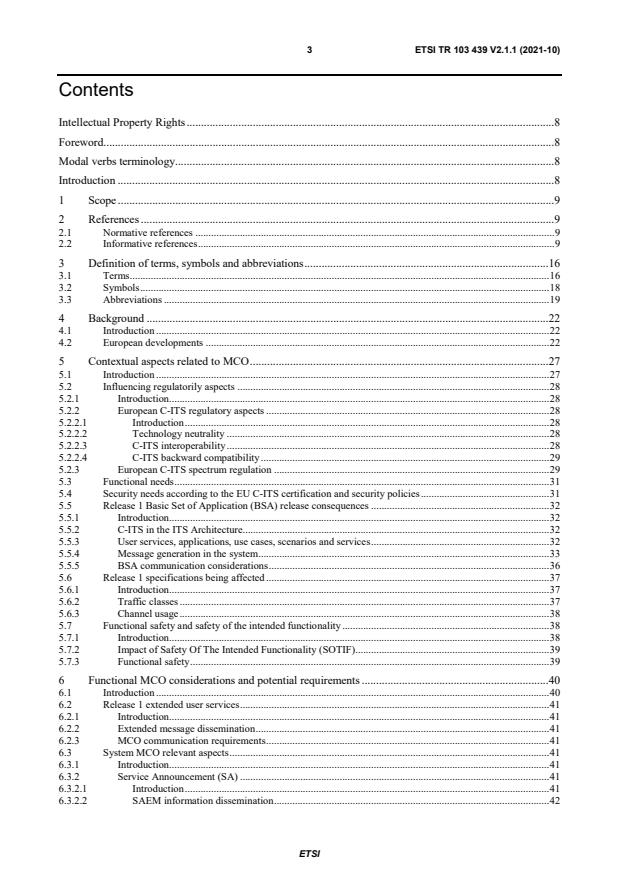
Contents
Intellectual Property Rights . 8
Foreword . 8
Modal verbs terminology . 8
Introduction . 8
1 Scope . 9
2 References . 9
2.1 Normative references . 9
2.2 Informative references . 9
3 Definition of terms, symbols and abbreviations . 16
3.1 Terms . 16
3.2 Symbols . 18
3.3 Abbreviations . 19
4 Background . 22
4.1 Introduction . 22
4.2 European developments . 22
5 Contextual aspects related to MCO . 27
5.1 Introduction . 27
5.2 Influencing regulatorily aspects . 28
5.2.1 Introduction. 28
5.2.2 European C-ITS regulatory aspects . 28
5.2.2.1 Introduction . 28
5.2.2.2 Technology neutrality . 28
5.2.2.3 C-ITS interoperability . 28
5.2.2.4 C-ITS backward compatibility . 29
5.2.3 European C-ITS spectrum regulation . 29
5.3 Functional needs . 31
5.4 Security needs according to the EU C-ITS certification and security policies . 31
5.5 Release 1 Basic Set of Application (BSA) release consequences . 32
5.5.1 Introduction. 32
5.5.2 C-ITS in the ITS Architecture. 32
5.5.3 User services, applications, use cases, scenarios and services . 32
5.5.4 Message generation in the system . 33
5.5.5 BSA communication considerations . 36
5.6 Release 1 specifications being affected . 37
5.6.1 Introduction. 37
5.6.2 Traffic classes . 37
5.6.3 Channel usage . 38
5.7 Functional safety and safety of the intended functionality . 38
5.7.1 Introduction. 38
5.7.2 Impact of Safety Of The Intended Functionality (SOTIF) . 39
5.7.3 Functional safety . 39
6 Functional MCO considerations and potential requirements . 40
6.1 Introduction . 40
6.2 Release 1 extended user services . 41
6.2.1 Introduction. 41
6.2.2 Extended message dissemination . 41
6.2.3 MCO communication requirements . 41
6.3 System MCO relevant aspects . 41
6.3.1 Introduction. 41
6.3.2 Service Announcement (SA) . 41
6.3.2.1 Introduction . 41
6.3.2.2 SAEM information dissemination . 42
ETSI
4 ETSI TR 103 439 V2.1.1 (2021-10)
6.3.2.3 SAEM MCO communication requirements . 42
6.3.3 Position Accuracy Improvement (PAI) . 43
6.3.3.1 Introduction . 43
6.3.3.2 PAI information Dissemination . 44
6.3.3.3 PAI MCO communication requirements . 44
6.3.4 Privacy . 45
6.3.5 Security . 46
6.3.5.1 Introduction . 46
6.3.5.2 Security information dissemination . 47
6.3.5.3 Security MCO communication requirements . 47
6.4 Collective Perception (CP) . 48
6.4.1 Introduction. 48
6.4.2 CP information dissemination. 48
6.4.3 CP MCO communication requirements . 49
6.5 Vulnerable Road User (VRU) . 50
6.5.1 Introduction. 50
6.5.2 VRU information dissemination . 51
6.5.3 VRU communication requirements . 51
6.6 Manoeuvre Coordination (MC) . 53
6.6.1 Introduction. 53
6.6.2 MC information dissemination . 54
6.6.3 MC MCO communication requirements. 55
6.7 Basic CACC and platooning . 55
6.7.1 Introduction. 55
6.7.2 CACC information dissemination . 55
6.7.3 Platooning information dissemination . 56
6.7.4 CACC and platooning MCO communication requirements . 58
6.8 Intersection safety. 59
6.8.1 Introduction. 59
6.8.2 IS information dissemination . 59
6.8.3 AS information dissemination . 60
6.8.4 Urban Rail Safety (URS) information dissemination . 61
6.8.5 Intersection safety MCO communication requirements. 63
6.9 High-definition sensor sharing . 65
6.9.1 Introduction. 65
6.9.2 High-definition sensor sharing information dissemination . 65
6.9.3 High-definition sensor sharing MCO communication requirements . 65
6.10 Non-safety ITS applications . 65
6.10.1 Introduction. 65
6.10.2 Non-safety ITS applications information dissemination . 65
6.10.3 Non-safety ITS applications MCO communication requirements . 65
6.11 Testing and validation user services . 65
6.11.1 Introduction. 65
6.11.2 Testing and validation information dissemination . 66
6.11.3 Testing and validation user service MCO communication requirements . 66
6.12 General MCO communication considerations. 66
7 Technical capabilities and limitations . 67
7.1 Introduction . 67
7.2 Transceiver configurations . 67
7.3 Channels with wider bandwidth . 68
7.4 Channel load measurement. 69
7.5 Multi-channel interference effects . 69
7.5.1 Overview . 69
7.5.2 Unwanted emissions . 70
7.5.2.1 Overview . 70
7.5.2.2 Adjacent and second adjacent channel leakage . 70
7.5.2.3 Spurious emissions . 70
7.5.3 Blocking and selectivity . 70
7.5.4 Combined unwanted emission and selectivity effects. 70
7.5.5 Other effect . 71
7.5.5.1 Overloading . 71
ETSI
5 ETSI TR 103 439 V2.1.1 (2021-10)
7.5.5.2 Intermodulation . 72
7.5.5.3 CSMA/CA energy detection threshold. 72
7.5.6 Summary MCO interference effects . 73
8 Simulations and Verifications . 73
8.1 Introduction . 73
8.2 Key performance indicators . 73
8.2.1 Introduction. 73
8.2.2 Packet Reception Ratio . 73
8.2.3 Range (maximum distance with PRR = 0,9). 73
8.2.4 Inter-Packet Gap . 74
8.2.5 Channel Busy Ratio . 74
8.3 Road layout and vehicle distribution . 74
8.4 Simulation settings . 75
8.4.1 Introduction. 75
8.4.2 Traffic generation . 75
8.4.3 Access layers settings . 75
8.4.3.1 Introduction . 75
8.4.3.2 Physical layer settings . 75
8.4.3.3 Decentralized congestion control . 76
8.4.4 Physical layer modelling . 76
8.4.4.1 Introduction . 76
8.4.4.2 Propagation . 76
8.4.4.3 MCO interference modelling . 77
8.4.4.4 Error evaluation . 77
8.5 Simulation results . 78
8.5.1 Introduction. 78
8.5.2 Balanced data traffic in adjacent channels . 79
8.5.2.1 Introduction . 79
8.5.2.2 Scenarios for the investigation in balanced traffic . 79
8.5.2.3 Preliminary considerations . 79
8.5.2.4 PRR versus distance . 80
8.5.2.5 Range and IPG . 82
8.5.2.6 Deriving conclusions in the balanced traffic case . 84
8.5.3 Imbalanced data traffic in adjacent channels . 84
8.5.3.1 Introduction . 84
8.5.3.2 Scenarios for the investigation in imbalanced traffic . 84
8.5.3.3 Preliminary considerations . 85
8.5.3.4 PRR versus distance . 86
8.5.3.5 Range and IPG . 88
8.5.3.6 Deriving conclusions in the imbalanced traffic case . 89
8.5.4 Effectiveness of power and channel occupation control for MCO . 89
8.6 Summary . 90
9 Multi-Channel Operation . 91
9.1 Introduction . 91
9.2 Physical channels . 91
9.3 Taxonomy of MCO possibilities . 91
9.3.1 Introduction. 91
9.3.2 Channel usage mechanisms for MCO . 91
9.3.3 Channel association policies for MCO . 92
9.3.4 Supplementary functional elements for MCO . 93
9.4 MCO approaches . 95
9.4.1 Introduction. 95
9.4.2 C-ITS Channel use and relation . 95
9.4.3 C-ITS Message classification . 96
9.4.4 Basic broadcast . 96
9.4.5 Advanced broadcast . 96
9.4.5.1 Introduction . 96
9.4.5.2 Advanced broadcast using sequential filling with predefined association . 96
9.4.5.3 Advanced broadcast using an elastic mechanism with predefined association . 97
9.4.6 Advanced groupcast . 99
ETSI
6 ETSI TR 103 439 V2.1.1 (2021-10)
9.4.6.1 Introduction . 99
9.4.6.2 Advanced groupcast using elastic with flexible association . 99
9.4.7 Evaluation of the pros and cons of sequential filling and elastic assignment for Advanced Broadcast . 100
9.4.7.1 Introduction . 100
9.4.7.2 Criteria . 100
9.4.7.3 Comparison . 100
9.4.8 Advanced Considerations . 102
9.4.8.1 Introduction . 102
9.4.8.2 Transmit power . 102
9.4.8.3 Use of Non-Safety related channels SCH3 and SCH4 . 102
9.4.8.4 Use of the announcement service for MCO . 102
9.4.9 MCO Architecture and its entities . 102
10 Recommendations . 104
10.1 Introduction . 104
10.2 Message exchange predictability . 104
10.3 Multi-channel congestion control . 104
10.4 Message priorities. 104
10.5 MCO interference management . 105
10.6 Use of non-safety related channels for safety related message transmissions . 105
10.7 Channel assignment for SAS . 105
Annex A: Multi-channel interference effects for ITS-G5 . 106
A.1 Overview . 106
A.2 Sensitivity . 106
A.3 Adjacent channel rejection . 106
A.4 TX spectrum mask . 109
A.5 Combined unwanted emission and selectivity effects . 110
A.6 Conclusion ITS-G5 . 111
Annex B: Multi-channel interference effects for LTE-V2X . 115
B.1 Overview . 115
B.2 Sensitivity . 115
B.3 Adjacent channel rejection . 116
B.4 TX spectrum mask . 119
B.5 Combined unwanted emission and selectivity effects . 119
B.6 Conclusions LTE-V2X . 120
Annex C: MCO solutions and algorithms . 122
C.1 ETSI TS 102 724 . 122
C.2 CARHet . 122
C.2.1 Introduction . 122
C.2.2 Channel access strategy . 122
C.2.3 Channel usage strategy . 122
C.3 LTE-V2X RB allocation . 123
C.3.1 Introduction . 123
C.3.2 Channel access . 123
C.3.3 ProSe Per Packet Priority (PPPP) for V2X communication . 124
C.4 SAMCO (Service-Actuated Multi-Channel Operation) . 124
C.4.1 Introduction . 124
C.4.2 Channel access strategy . 124
C.4.3 Channel usage possibilities. 124
ETSI
7 ETSI TR 103 439 V2.1.1 (2021-10)
C.5 IEEE 1609.4-2016 . 125
C.5.1 Introduction . 125
C.5.2 Channel access strategy . 125
C.5.3 Channel usage strategy . 126
Annex D: Insight in the channel models . 128
D.1 Introduction . 128
D.2 WINNER+ B1, C1, C2 path-loss models in LOS conditions . 128
D.3 Modified versions of the path-loss models in ECC REPORT 68. 128
D.4 LOS path-loss model in ETSI TR 103 257-1 . 129
D.5 Comparison of the LOS path-loss models . 129
Annex E: Impact of the interference from adjacent channels: additional results . 131
E.1 Introduction . 131
E.2 Inter-packet gap detailed statistics . 131
E.3 Results assuming a different channel model . 132
E.4 Results assuming messages with a larger size . 134
E.5 Results in urban scenarios . 135
Annex F: Interference from SRD to ITS-G5 in non-safety channels . 138
F.1 Introduction . 138
F.2 Scenario and assumptions . 138
F.3 Impact of interference . 138
Annex G: Interference from SRD to LTE-V2X in non-safety channels . 140
G.1 Introduction . 140
G.2 Scenario and assumptions . 140
G.3 Impact of interference . 140
Annex H: Bibliography . 142
History . 143
ETSI
8 ETSI TR 103 439 V2.1.1 (2021-10)
Intellectual Property Rights
Essential patents
IPRs essential or potentially essential to normative deliverables may have been declared to ETSI. The declarations
pertaining to these essential IPRs, if any, are publicly available for ETSI members and non-members, and can be
found in ETSI SR 000 314: "Intellectual Property Rights (IPRs); Essential, or potentially Essential, IPRs notified to
ETSI in respect of ETSI standards", which is available from the ETSI Secretariat. Latest updates are available on the
ETSI Web server (https://ipr.etsi.org/).
Pursuant to the ETSI Directives including the ETSI IPR Policy, no investigation regarding the essentiality of IPRs,
including IPR searches, has been carried out by ETSI. No guarantee can be given as to the existence of other IPRs not
referenced in ETSI SR 000 314 (or the updates on the ETSI Web server) which are, or may be, or may become,
essential to the present document.
Trademarks
The present document may include trademarks and/or tradenames which are asserted and/or registered by their owners.
ETSI claims no ownership of these except for any which are indicated as being the property of ETSI, and conveys no
right to use or reproduce any trademark and/or tradename. Mention of those trademarks in the present document does
not constitute an endorsement by ETSI of products, services or organizations associated with those trademarks.
DECT™, PLUGTESTS™, UMTS™ and the ETSI logo are trademarks of ETSI registered for the benefit of its
Members. 3GPP™ and LTE™ are trademarks of ETSI registered for the benefit of its Members and of the 3GPP
Organizational Partners. oneM2M™ logo is a trademark of ETSI registered for the benefit of its Members and of the ®
oneM2M Partners. GSM and the GSM logo are trademarks registered and owned by the GSM Association.
Foreword
This Technical Report (TR) has been produced by ETSI Technical Committee Intelligent Transport Systems (ITS).
The present document is based on input provided by various European projects, AutoNet 2030, CODIS, Truck
Platooning Challenge, ENSEMBLE, TIMON, HIGHTS, Intercor, C-ROADS, VRUITS (improving the safety and
mobility of Vulnerable Road Users through ITS applications), PROSPECTS (Proactive Safety for Pedestrians and
Cyclists), XCYCLE (Advanced measures to reduce cyclists' fatalities and increase comfort in the interaction with
motorised vehicles), SafetyCube (Safety CaUsation, Benefits and Efficiency) and SENIORS (Safety Enhanced
Innovations for Older Road userS). The present docum
...
Questions, Comments and Discussion
Ask us and Technical Secretary will try to provide an answer. You can facilitate discussion about the standard in here.
Loading comments...