


ETSI TS 103 324 V2.1.1 (2023-06)
Intelligent Transport Systems (ITS); Vehicular Communications; Basic Set of Applications; Collective Perception Service; Release 2
Intelligent Transport Systems (ITS); Vehicular Communications; Basic Set of Applications; Collective Perception Service; Release 2
DTS/ITS-00167
General Information
Standards Content (Sample)
TECHNICAL SPECIFICATION
Intelligent Transport System (ITS);
Vehicular Communications;
Basic Set of Applications;
Collective Perception Service;
Release 2
2 ETSI TS 103 324 V2.1.1 (2023-06)
Reference
DTS/ITS-00167
Keywords
ITS, protocol
ETSI
650 Route des Lucioles
F-06921 Sophia Antipolis Cedex - FRANCE
Tel.: +33 4 92 94 42 00 Fax: +33 4 93 65 47 16
Siret N° 348 623 562 00017 - APE 7112B
Association à but non lucratif enregistrée à la
Sous-Préfecture de Grasse (06) N° w061004871
Important notice
The present document can be downloaded from:
https://www.etsi.org/standards-search
The present document may be made available in electronic versions and/or in print. The content of any electronic and/or
print versions of the present document shall not be modified without the prior written authorization of ETSI. In case of any
existing or perceived difference in contents between such versions and/or in print, the prevailing version of an ETSI
deliverable is the one made publicly available in PDF format at www.etsi.org/deliver.
Users of the present document should be aware that the document may be subject to revision or change of status.
Information on the current status of this and other ETSI documents is available at
https://portal.etsi.org/TB/ETSIDeliverableStatus.aspx
If you find errors in the present document, please send your comment to one of the following services:
https://portal.etsi.org/People/CommiteeSupportStaff.aspx
If you find a security vulnerability in the present document, please report it through our
Coordinated Vulnerability Disclosure Program:
https://www.etsi.org/standards/coordinated-vulnerability-disclosure
Notice of disclaimer & limitation of liability
The information provided in the present deliverable is directed solely to professionals who have the appropriate degree of
experience to understand and interpret its content in accordance with generally accepted engineering or
other professional standard and applicable regulations.
No recommendation as to products and services or vendors is made or should be implied.
No representation or warranty is made that this deliverable is technically accurate or sufficient or conforms to any law
rule and/or regulation and further, no representation or warranty is made of merchantability or fitness
and/or governmental
for any particular purpose or against infringement of intellectual property rights.
In no event shall ETSI be held liable for loss of profits or any other incidental or consequential damages.
Any software contained in this deliverable is provided "AS IS" with no warranties, express or implied, including but not
limited to, the warranties of merchantability, fitness for a particular purpose and non-infringement of intellectual property
rights and ETSI shall not be held liable in any event for any damages whatsoever (including, without limitation, damages
for loss of profits, business interruption, loss of information, or any other pecuniary loss) arising out of or related to the use
of or inability to use the software.
Copyright Notification
No part may be reproduced or utilized in any form or by any means, electronic or mechanical, including photocopying and
microfilm except as authorized by written permission of ETSI.
The content of the PDF version shall not be modified without the written authorization of ETSI.
The copyright and the foregoing restriction extend to reproduction in all media.
© ETSI 2023.
All rights reserved.
ETSI
3 ETSI TS 103 324 V2.1.1 (2023-06)
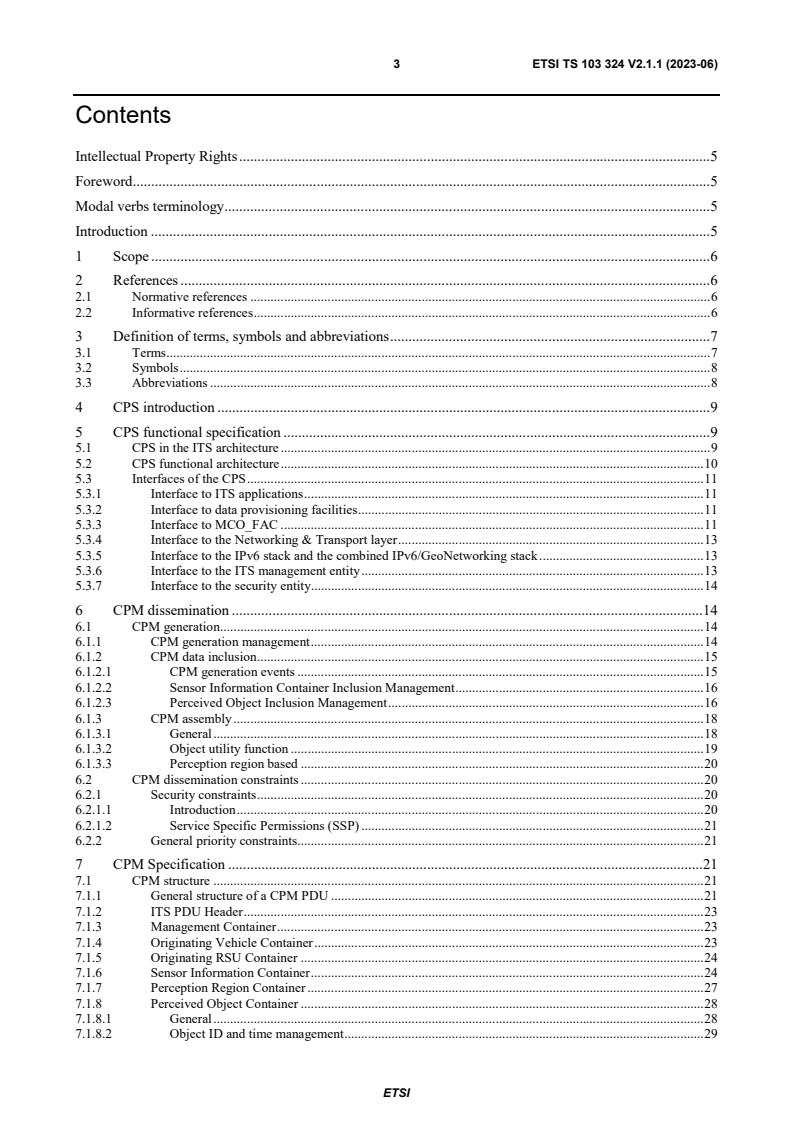
Contents
Intellectual Property Rights . 5
Foreword . 5
Modal verbs terminology . 5
Introduction . 5
1 Scope . 6
2 References . 6
2.1 Normative references . 6
2.2 Informative references . 6
3 Definition of terms, symbols and abbreviations . 7
3.1 Terms . 7
3.2 Symbols . 8
3.3 Abbreviations . 8
4 CPS introduction . 9
5 CPS functional specification . 9
5.1 CPS in the ITS architecture . 9
5.2 CPS functional architecture . 10
5.3 Interfaces of the CPS . 11
5.3.1 Interface to ITS applications . 11
5.3.2 Interface to data provisioning facilities . 11
5.3.3 Interface to MCO_FAC . 11
5.3.4 Interface to the Networking & Transport layer . 13
5.3.5 Interface to the IPv6 stack and the combined IPv6/GeoNetworking stack . 13
5.3.6 Interface to the ITS management entity . 13
5.3.7 Interface to the security entity. 14
6 CPM dissemination . 14
6.1 CPM generation . 14
6.1.1 CPM generation management . 14
6.1.2 CPM data inclusion . 15
6.1.2.1 CPM generation events . 15
6.1.2.2 Sensor Information Container Inclusion Management . 16
6.1.2.3 Perceived Object Inclusion Management . 16
6.1.3 CPM assembly . 18
6.1.3.1 General . 18
6.1.3.2 Object utility function . 19
6.1.3.3 Perception region based . 20
6.2 CPM dissemination constraints . 20
6.2.1 Security constraints . 20
6.2.1.1 Introduction . 20
6.2.1.2 Service Specific Permissions (SSP) . 21
6.2.2 General priority constraints. 21
7 CPM Specification . 21
7.1 CPM structure . 21
7.1.1 General structure of a CPM PDU . 21
7.1.2 ITS PDU Header . 23
7.1.3 Management Container . 23
7.1.4 Originating Vehicle Container . 23
7.1.5 Originating RSU Container . 24
7.1.6 Sensor Information Container . 24
7.1.7 Perception Region Container . 27
7.1.8 Perceived Object Container . 28
7.1.8.1 General . 28
7.1.8.2 Object ID and time management . 29
ETSI
4 ETSI TS 103 324 V2.1.1 (2023-06)
7.1.8.3 Kinematic and attitude state description . 30
7.1.8.4 Object dimensions and age . 30
7.1.8.5 Link to Sensor Information Container. 30
7.1.8.6 Object perception quality . 30
7.1.8.7 Object classification . 31
7.1.8.8 Link to MAPEM . 32
7.2 CPM format specification . 32
Annex A (normative): ASN.1 modules . 33
Annex B (informative): Specification of CPM in readable format . 35
Annex C (informative): Interpretation of the kinematic and attitude state description . 36
Annex D (normative): Frequency and Content Management . 37
Annex E (informative): Object Inclusion Rate Control . 38
Annex F (normative): Configuration parameter values . 39
History . 42
ETSI
5 ETSI TS 103 324 V2.1.1 (2023-06)
Intellectual Property Rights
Essential patents
IPRs essential or potentially essential to normative deliverables may have been declared to ETSI. The declarations
pertaining to these essential IPRs, if any, are publicly available for ETSI members and non-members, and can be
found in ETSI SR 000 314: "Intellectual Property Rights (IPRs); Essential, or potentially Essential, IPRs notified to
ETSI in respect of ETSI standards", which is available from the ETSI Secretariat. Latest updates are available on the
ETSI Web server (https://ipr.etsi.org/).
Pursuant to the ETSI Directives including the ETSI IPR Policy, no investigation regarding the essentiality of IPRs,
including IPR searches, has been carried out by ETSI. No guarantee can be given as to the existence of other IPRs not
referenced in ETSI SR 000 314 (or the updates on the ETSI Web server) which are, or may be, or may become,
essential to the present document.
Trademarks
The present document may include trademarks and/or tradenames which are asserted and/or registered by their owners.
ETSI claims no ownership of these except for any which are indicated as being the property of ETSI, and conveys no
right to use or reproduce any trademark and/or tradename. Mention of those trademarks in the present document does
not constitute an endorsement by ETSI of products, services or organizations associated with those trademarks.
DECT™, PLUGTESTS™, UMTS™ and the ETSI logo are trademarks of ETSI registered for the benefit of its
Members. 3GPP™ and LTE™ are trademarks of ETSI registered for the benefit of its Members and of the 3GPP
Organizational Partners. oneM2M™ logo is a trademark of ETSI registered for the benefit of its Members and of the ®
oneM2M Partners. GSM and the GSM logo are trademarks registered and owned by the GSM Association.
Foreword
This Technical Specification (TS) has been produced by ETSI Technical Committee Intelligent Transport Systems
(ITS).
Modal verbs terminology
In the present document "shall", "shall not", "should", "should not", "may", "need not", "will", "will not", "can" and
"cannot" are to be interpreted as described in clause 3.2 of the ETSI Drafting Rules (Verbal forms for the expression of
provisions).
"must" and "must not" are NOT allowed in ETSI deliverables except when used in direct citation.
Introduction
The present document specifies the Collective Perception Service (CPS) and how a transmitting ITS station (ITS-S) can
inform other ITS-Ss about the kinematic and attitude dynamics and other attributes of objects (e.g. vehicles, pedestrians,
animals and others) detected by sensors such as radars, lidars and cameras to which the transmitting ITS-S has access.
The CPS increases awareness among ITS-Ss by sharing information about perceived objects in the local environment.
The Collective Perception Message (CPM) enables the interoperable sharing of basic information about the
disseminating ITS-S (required for the interpretation of the transmitted data), its sensory capabilities, perceived objects
and road-related perception regions. CPMs are generated quasi-periodically as determined by CPM generation events.
ETSI
6 ETSI TS 103 324 V2.1.1 (2023-06)
1 Scope
The present document specifies the CPS. Conceptually, Collective Perception involves sharing safety-relevant
information about the current context of the ITS-S's environment. This includes the definition of the syntax and
semantics of the CPM and the specification of the data and message handling of the CPM to increase the awareness of
the environment in a cooperative manner.
2 References
2.1 Normative references
References are either specific (identified by date of publication and/or edition number or version number) or
non-specific. For specific references, only the cited version applies. For non-specific references, the latest version of the
referenced document (including any amendments) applies.
Referenced documents which are not found to be publicly available in the expected location might be found at
https://docbox.etsi.org/Reference/.
NOTE: While any hyperlinks included in this clause were valid at the time of publication, ETSI cannot guarantee
their long-term validity.
The following referenced documents are necessary for the application of the present document.
[1] ETSI TS 103 097: "Intelligent Transport Systems (ITS); Security; Security header and certificate
formats; Release 2".
[2] Recommendation ITU-T X.691 (2021-02): "Information technology - ASN.1 encoding rules:
Specification of Packed Encoding Rules (PER)".
[3] ETSI TS 102 894-2 (V2.1.1): "Intelligent Transport Systems (ITS); Users and applications
requirements; Part 2: Applications and facilities layer common data dictionary; Release 2".
[4] ETSI EN 302 890-2: "Intelligent Transport Systems (ITS); Facilities Layer function;
Part 2: Position and Time management (PoTi); Release 2".
[5] ETSI TS 103 836-4-1: "Intelligent Transport Systems (ITS); Vehicular Communications;
GeoNetworking; Part 4: Geographical addressing and forwarding for point-to-point and
point-to-multipoint communications; Sub-part 1: Media-Independent Functionality; Release 2".
[6] ETSI TS 103 836-5-1: "Intelligent Transport Systems (ITS); Vehicular Communications;
GeoNetworking; Part 5: Transport Protocols; Sub-part 1: Basic Transport Protocol; Release 2".
[7] ETSI TS 103 141: "Intelligent Transport Systems (ITS); Facilities layer function; Multi-Channel
Operation (MCO) for Cooperative ITS (C-ITS); Release 2".
2.2 Informative references
References are either specific (identified by date of publication and/or edition number or version number) or
non-specific. For specific references, only the cited version applies. For non-specific references, the latest version of the
referenced document (including any amendments) applies.
NOTE: While any hyperlinks included in this clause were valid at the time of publication, ETSI cannot guarantee
their long-term validity.
The following referenced documents are not necessary for the application of the present document, but they assist the
user with regard to a particular subject area.
[i.1] ETSI TR 103 562: "Intelligent Transport Systems (ITS); Vehicular Communications; Basic Set of
Applications; Analysis of the Collective Perception Service (CPS); Release 2".
ETSI
7 ETSI TS 103 324 V2.1.1 (2023-06)
[i.2] ETSI TS 103 898: "Intelligent Transport Systems (ITS); Communications Architecture;
Release 2".
[i.3] ETSI EN 302 895: "Intelligent Transport Systems (ITS); Vehicular Communications; Basic Set of
Applications; Local Dynamic Map (LDM)".
[i.4] Car 2 Car Communication Consortium: "Technical Report on CPM Object Quality".
[i.5] ISO EN 17419: "Intelligent Transport Systems -- Cooperative Systems -- Classification and
management of ITS applications in a global context" Definition of terms, symbols and
abbreviations".
[i.6] ETSI TS 103 836-3: "Intelligent Transport Systems (ITS); Vehicular Communications;
GeoNetworking; Part 3: Network Architecture; Release 2".
[i.7] ETSI TS 102 723-5: "Intelligent Transport Systems (ITS); OSI cross-layer topics; Part 5: Interface
between management entity and facilities layer; Release 2".
[i.8] ETSI TR 102 965: "Intelligent Transport Systems (ITS); Application Object Identifier (ITS-AID);
Registration list".
[i.9] ETSI TS 102 940: "Intelligent Transport Systems (ITS); Security; ITS communications security
architecture and security management; Release 2".
[i.10] ETSI TR 103 460: "Intelligent Transport Systems (ITS); Security; Pre-standardization study on
Misbehavior Detection; Release 2".
[i.11] ETSI TS 102 890-1: "Intelligent Transport Systems (ITS); Facilities layer function;
Part 1: Services Announcement (SA) specification".
[i.12] ETSI TS 103 300-3: "Intelligent Transport Systems (ITS); Vulnerable Road Users (VRU)
awareness; Part 3: Specification of VRU awareness basic service; Release 2".
[i.13] ETSI TS 103 301: "Intelligent Transport Systems (ITS); Vehicular Communications; Basic Set of
Applications; Facilities layer protocols and communication requirements for infrastructure
services; Release 2".
3 Definition of terms, symbols and abbreviations
3.1 Terms
For the purposes of the present document, the following terms apply:
central ITS-S: ITS-S in a backend, e.g. traffic control centre, traffic management centre, or cloud system from road
authorities, ITS application suppliers or automotive OEMs
classification confidence level: measure related to the certainty, generally a probability, with which a perceived object
can be linked to a specific object class or type (e.g. with X % probability the object is of type A)
NOTE: The sum of the object classification confidence levels for each perceived object may not exceed 100 %
(e.g. in the example above, the classification confidence for an object to be of type B will not exceed
(100-X) %).
Collective Perception (CP): concept involving sharing of information (generated by sensor systems) about the
perceived environment of an ITS-S
Collective Perception Message (CPM): message generated by the CPS
Collective Perception Message (CPM) data: some or all data included in a CPM
Collective Perception Service (CPS): functionality in the ITS-S facilities layer to support ITS-S applications, CPM
management and CPM dissemination
ETSI
8 ETSI TS 103 324 V2.1.1 (2023-06)
Collective Perception Service (CPS) protocol: ITS facilities layer protocol for CPM dissemination and reception
confidence level: probability with which the estimate of a statistical parameter (e.g. an arithmetic mean) in a sample
survey is also true for the entire population from which the samples were taken
confidence value: estimated absolute accuracy (i.e. closeness of a measured value to a standard or known value) of a
measured value of a parameter with a specified confidence level (generally 95 % in the present document)
ITS station (ITS-S): functional entity specified by the ITS station (ITS-S) reference architecture
object: material thing that can be seen and touched and therefore detected and with which parameters can be associated
that can be measured and/or estimated
object list: collection of objects
object perception quality: quantification of the estimated likelihood that a detected object exists, i.e. has been detected
previously and has continuously been detected by a sensor
perception region confidence: quantification of the estimated likelihood that objects or unoccupied regions may be
detected within a perception region
roadside ITS-S: ITS-S operating in the context of roadside ITS equipment
state space representation: mathematical description of a detected object consisting of state variables such as position,
velocity, attitude, angular rate, etc.
Vehicle-to-Everything (V2X): type of communication that includes Vehicle-to-Vehicle (V2V), Vehicle-to-
Infrastructure (V2I), Infrastructure-to-Vehicle (I2V), or Vehicle-to-Network (V2N), and Network-to-Vehicle (N2V)
communications
Vehicle ITS-S: ITS-S operating in the context of vehicular ITS equipment
3.2 Symbols
For the purposes of the present document, the following symbols apply:
IF.CPS Interface between CPS and LDM or ITS applications
IF.APP Interface between CPS and ITS applications
IF.FAC Interface between CPS and other facilities layer entities
IF.MCO Interface between CPS and the MCO facility layer entity
IF.Mng Interface between CPS and ITS management entity
IF.N&T Interface between CPS and ITS network & transport layer
IF.SEC Interface between CPS and ITS security entity
3.3 Abbreviations
For the purposes of the present document, the following abbreviations apply:
API Application Programming Interface
ASN.1 Abstract Syntax Notation One
CAM Cooperative Awareness Message
CP Collective Perception
CPM Collective Perception Message
CPS Collective Perception Service
DCC Decentralized Congestion Control
DDP Device Data Provider
DE Data Element
DF Data Frame
FoV Field of View
I2V Infrastructure to Vehicle
ITS Intelligent Transport Systems
ITS-S Intelligent Transport Systems Station
LDM Local Dynamic Map
ETSI
9 ETSI TS 103 324 V2.1.1 (2023-06)
MCI MCO Control Information
MCO Multi Channel Operations
MIB Management Information Base
MTU Maximum Transmission Unit
PCI Protocol Control Information
R-ITS-S Roadside ITS Station
SA Service Announcement
SCH Service Channel
SCO Single Channel Operations
UPER Unaligned Packed Encoding Rule
V2I Vehicle-to-Infrastructure
V2V Vehicle-to-Vehicle
VAM VRU Awareness Message
VoI Value of Information
VRU Vulnerable Road User
4 CPS introduction
Collective Perception Messages (CPMs) are transmitted by ITS-Ss in order to share information about perceived objects
(such as vehicles, pedestrians, animals and other collision relevant objects) and perception regions (road regions that
allow receiving ITS-Ss to determine unoccupied regions) in the local environment. This enhances the environmental
perception of CPS-enabled ITS-Ss by providing information about non-V2X-equipped road users, other collision
relevant objects, unoccupied regions and also increases the number of information sources for V2X-equipped road
users. The availability of multiple sources of information associated with an object or an unoccupied region allows
ITS-Ss to perform data fusion which generally leads to lower uncertainty in both the classification of objects and in
their properties such as their sizes and their kinematic and attitude states. Even if data manipulated or corrupted at the
source are received, a sufficient number of independent sources that maintain integrity may allow identification of such
data.
A CPM contains a set of perceived objects and regions, along with their observed status and attributes. The content may
vary depending on the type of the road user or object and the detection capabilities of the originating ITS-S. For
perceived objects, the status information is expected to include at least the detection time, position, and optionally other
elements of the kinematic and attitude state. To support the CPM interpretation at any receiving ITS-S, a sender can
also include information about its sensors, such as sensor types and fields of view.
On reception of a CPM, receiving ITS-Ss become aware of the presence, type, and status of a recognized road user,
object or region that was detected by the transmitting ITS-S. The received information can then be used by the receiving
ITS-S to support ITS applications that increase safety and improve traffic efficiency thereby generally decreasing travel
time. For example, by monitoring the status of a detected road user or object, a receiving ITS-S can estimate the
collision risk with that road user or object and can inform the user via the HMI of the receiving ITS-S or take corrective
actions automatically. Data distributed by the CPS is clearly useful for a large number of ITS safety and efficiency-
related applications making the CPS an essential component of any ITS deployment, especially where any form of
autonomous activity is anticipated.
ETSI TR 103 562 [i.1] provides an analysis of the Collective Perception Service with further information and
simulation results.
5 CPS functional specification
5.1 CPS in the ITS architecture
The CPS is a facilities layer entity in the ITS-S architecture as defined in ETSI TS 103 898 [i.2]. It may interface with
other entities of the Facilities layer and with ITS applications to collect relevant information for CPM generation and
for forwarding received CPM content for further processing. Figure 1 depicts the CPS within the ITS-S architecture
along with the logical interfaces to other layers and entities within the Facilities layer.
ETSI
10 ETSI TS 103 324 V2.1.1 (2023-06)
The entities for the collection of data to generate a CPM may be the Device Data Provider (DDP), the Position and
Time management (POTI) and the Local Dynamic Map (LDM). For vehicle ITS-Ss, the DDP may be connected to the
in-vehicle network to provide the vehicle state information. For roadside ITS-Ss and central ITS-S, the DDP may be
connected to sensors mounted on the roadside infrastructure such as poles or gantries. The POTI entity provides
estimates of the kinematic state of the ITS-S and time information as specified in ETSI EN 302 890-2 [4]. An LDM as
outlined in ETSI EN 302 895 [i.3] is a database in an ITS-S, which in addition to on-board sensor data may be updated
with received CAM and CPM data. ITS applications may retrieve information from the LDM for further processing.
The CPS may also interface with the Service Announcement (SA) Service [i.11] to indicate an ITS-S's ability to
generate CPMs and to provide details about the communication technology used.
Figure 1 presents the CPS in the ITS-S architecture as well as its logical interfaces with other entities and layers.
NOTE: The CPS may exchange information with additional facilities layer entities for the purpose of generation,
transmission, forwarding and reception of CPM. For simplicity reason, these interfaces are not illustrated
in Figure 1.
The functionalities of the CPS are defined in clause 5.2 and the interfaces are defined in clause 5.3.
Figure 1: CPS within the ITS-S architecture
NOTE: IF.App in Figure 1 can be implemented as IF.CPS as shown in Figure 2.
5.2 CPS functional architecture
For sending and receiving CPMs, the CPS shall provide the following sub-functions:
• Encode CPM: This sub-function shall construct the CPM according to the format specified in Annex A. The
most recent abstract CP object information, sensor information and perception region information data shall be
included in the CPM.
• Decode CPM: This sub-function shall decode the received CPM.
• CPM transmission management: This sub-function implements the protocol of the originating ITS-S
including:
- Activation and termination of CPM transmission operation.
- Determination of the CPM generation event frequency.
- Triggering the generation of the CPM.
• CPM reception management: This sub-function implements the protocol in the receiving ITS-S including:
- Triggering the decoding of the CPM upon receiving an incoming CPM.
ETSI
11 ETSI TS 103 324 V2.1.1 (2023-06)
- Provisioning of the decoded CPM to the LDM and/or ITS applications of the receiving ITS-S.
- Optionally, checking the validity of the information of received CPMs.
NOTE: Details for checking the validity of received CPM information is provided in ETSI TR 103 460 [i.10].
Figure 2 shows the functional block diagram of the CPS and interfaces to other facilities and layers (clause 5.3).
Figure 2: Functional block diagram of the CPS
5.3 Interfaces of the CPS
5.3.1 Interface to ITS applications
An ITS application is an application layer functionality that implements the logic for fulfilling one or more ITS use
cases.
For the provision of received data, the CPS provides the interface IF.CPS to LDM or ITS application as illustrated in
Figure 2.
5.3.2 Interface to data provisioning facilities
For the generation of CPMs, the CPS interacts with other Facilities layer entities to obtain the required data. This set of
other facilities is referred to as data provisioning facilities, e.g. the ITS-S's POTI, DDP or LDM. Data is exchanged
between the data provisioning facilities and the CP basic service via the interface IF.FAC.
NOTE: Specifications of the interface to the data provisioning facilities and the corresponding protocols are out
of scope of the present document.
5.3.3 Interface to MCO_FAC
If the ITS-S supports MCO, the CPS shall exchange information with the MCO_FAC via the interface IF.MCO
specified in ETSI TS 103 141 [7] and depicted in Figure 2. This interface can be used to configure the default MCO
settings for the generated CPMs and can also be used to configure the MCO parameters on a per message basis.
If the ITS-S supports MCO, the CPS shall provide the CPM embedded in a Facility-layer Service Data Unit (FL-SDU)
together with protocol control information (PCI) to the MCO_FAC. In addition, it can also provide MCO Control
Information (MCI) following ETSI TS 103 141 [7] to configure the MCO parameters of the CPM being provided. At
the receiving ITS-S, the MCO_FAC shall pass the received CPM to the CPS.
The data set that is passed between CPS and the MCO_FAC for the originating and receiving ITS-S is specified in
Table 1.
ETSI
12 ETSI TS 103 324 V2.1.1 (2023-06)
Table 1: Data exchanged between the CPS and the MCO_FAC
Category Data Data requirement Mandatory/Conditional
/Optional
Data passed from the CPM {cpm} as specified in Annex A Mandatory
CPS to the MCO_FAC
PCI Depending on the protocol stack applied in Optional
the networking and transport layer as
specified in Table 2
MCI MCO parameters configuration. Needed if Conditional
the default MCO parameters have not been
configured or want to be overwritten for a
specific CPM
Data passed from the Received {cpm} as specified in Annex A Mandatory
MCO_FAC to the CPS CPM
If the GeoNetworking/BTP stack is used and GeoNetworking is used as the network layer protocol, the PCI being
passed from CPS to the GeoNetworking/BTP stack shall comply with Table 2.
Table 2: PCI from CPS to GeoNetworking/BTP at the originating ITS-S
Category Data Data requirement Mandatory/Conditional
/Optional
Data passed from the BTP type BTP header type B Conditional
CPS to ETSI TS 103 836-5-1 [6], The data shall be passed if the value
GeoNetworking/BTP (clause 7.2.2) is not provided by the ITS-S
configuration, e.g. defined in a
Management Information Base (MIB)
or if the value is different from the
default value as set in the MIB.
Destination port As specified in ETSI Conditional
TS 103 836-5-1 [6] (see note) The data shall be passed if the value
is not provided by the ITS-S
configuration, e.g. defined in a
Management Information Base (MIB)
or if the value is different from the
default value as set in the MIB.
Destination port As specified in ETSI Conditional
info TS 103 836-5-1 [6] The data shall be passed if the value
is not provided by the ITS-S
configuration, e.g. defined in a
Management Information Base (MIB)
or if the value is different from the
default value as set in the MIB.
GN Packet GeoNetworking SHB Conditional
transport type The data shall be passed if the value
is not provided by the ITS-S
configuration, e.g. defined in a
Management Information Base (MIB)
or if the value is different from the
default value as set in the MIB.
GN Unspecified, ITS-G5 or Conditional
Communication LTE-V2X The data shall be passed if the value
profile is not provided by the ITS-S
configuration, e.g. defined in a
Management Information Base (MIB)
or if the value is different from the
default value as set in the MIB.
GN Security profile SECURED or UNSECURED Conditional
The data shall be passed if the value
is not provided by the ITS-S
configuration, e.g. defined in a
Management Information Base (MIB)
or if the value is different from the
default value as set in the MIB.
GN Traffic Class As defined in ETSI Mandatory
TS 103 836-4-1 [5]
ETSI
13 ETSI TS 103 324 V2.1.1 (2023-06)
Category Data Data requirement Mandatory/Conditional
/Optional
GN Maximum Shall not exceed 1 000 ms Mandatory
packet lifetime
Length Length of the CPM Mandatory
NOTE: When a global registration authority for ITS application as specified in ISO EN 17419 [i.5] is operational,
the BTP destination port registered with this authority shall be used.
5.3.4 Interface to the Networking & Transport layer
If the ITS-S does not support MCO, the CPS exchanges information with the ITS Networking & Transport Layer via
the interface IF.N&T, as depicted in Figure 2.
At the originating ITS-S, the CPS shall provide the CPM embedded in a Facility-layer Service Data Unit (FL-SDU)
together with protocol control information (PCI) to the ITS Networking & Transport Layer. At the receiving ITS-S, the
ITS Networking & Transport Layer passes the received CPM to the CPS, if available.
The data set that shall be passed between CPS and the ITS Networking & Transport Layer for the
originating and receiving ITS-S is specified in Table 3.
Table 3: Data passed between the CPS and the ITS Networking & Transport Layer
Category Data Data requirement Mandatory/Conditional
/Optional
Data passed from the CPM {cpm} as specified in Annex A Mandatory
CPS to the ITS
PCI Depending on the protocol stack applied in Optional
Networking & Transport the networking and transport layer as
Layer
specified in Table 2
Data passed from the ITS Received {cpm} as specified in Annex A Mandatory
Networking & Transport CPM
Layer to the CPS
If the GeoNetworking/BTP stack is used and GeoNetworking is used as the network layer protocol, the PCI being
passed from CPS to the GeoNetworking/BTP stack shall comply with Table 2.
5.3.5 Interface to the IPv6 stack and the combined IPv6/GeoNetworking
stack
The CPS may use the IPv6 stack or the combined IPv6/GeoNetworking stack for CPM dissemination as specified in
ETSI TS 103 836-3 [i.6].
NOTE 1: The specifications of the interface between the CPS and the IPv6 stack is out of scope of the present
document.
NOTE 2: If IP-based transport is used to transfer the facility layer CPM between interconnected actors, security
constraints as outlined in clause 6.2.1 may not be applicable. In this case trust enforcement among the
participating actors, e.g. using mutual authentication, and authenticity of information can be based on
other standard IT security methods, such as IPSec, DTLS, TLS or other VPN solutions that provide an
end-to-end secure communication path between known actors.
NOTE 3: Security methods, sharing methods and other transport related information, such as messaging queuing
protocols, transport layer protocol, ports to use, etc. can be agreed among interconnected actors.
When the CPM dissemination makes use of the combined IPv6/GeoNetworking stack, the interface between the CPS
and the combined IPv6/GeoNetworking stack may be identical to the interface between the CPS and IPv6 stack.q
5.3.6 Interface to the ITS management entity
The CPS of an originating ITS-S obtains configuration parameters and other control information from the Management
Information Base (MIB) located in the management entity via the IF.Mng interface, as depicted in Figure 2.
ETSI
14 ETSI TS 103 324 V2.1.1 (2023-06)
NOTE 1: A list of primitives exchanged with the management layer are provided in ETSI TS 102 723-5 [i.7].
NOTE 2: Specifications of IF.Mng and the corresponding protocol are out of scope of the present document.
5.3.7 Interface to the security entity
The CPS may exchange primitives with the Security entity of the ITS-S (see Figure 1) using the IF.SEC interface
provided by the Security entity, as depicted in Figure 2.
In case the facility layer security is used, for ITS stations that use the trust model according to ETSI TS 102 940 [i.9]
and ITS certificates according to ETSI TS 103 097 [1] and that are of type [Itss_WithPrivacy] as defined in ETSI
TS 102 940 [i.9], the CPS shall interact with the ID management functionality of the Security entity to set the actual
value of the ITS-S ID in the ITS PDU Header of the CPM. When the Security entity is triggering an Authorization
Ticket change, the CPS shall change the value of the ITS-ID in the component ItsPduHeader.stationId accordingly and
shall not send CPM messages with the previous ID anymore.
NOTE 1: Due to priority mechanisms implemented at MCO_FAC or at lower layers, the sending ITS-S may apply
reordering of the messages contained in its buffer. Queued messages which are identified with the old
ITS-ID are discarded as soon as a message with the new ITS-ID is sent. Implementers should be aware
that whether or not messages previously queued prior to an ID change event get transmitted or not is
implementation dependent.
NOTE 2: ITS stations of type [Itss_NoPrivacy] as defined in ETSI TS 102 940 [i.9] and ITS stations that do not use
the trust model according to ETSI TS 102 940 [i.9] and ITS certificates according to ETSI TS 103 097 [1]
do not need to implement functionality that changes ITS-S IDs (pseudonyms).
In order to avoid similarities between successive CPMs, all detected objects shall be reported as newly detected objects
in the CPM following a pseudonym change. Additionally, the SensorInformationContainer may be omitted for a certain
time as described in clause 6.1.2.2.
6 CPM dissemination
6.1 CPM generation
6.1.1 CPM generation management
The functional scheme of the CPM generation management is illustrated in Figure 3. for single channel operation and in
Figure 4. for multi-channel operation. Its different entities related to the CPM data inclusion management and the CPM
assembly are specified in clause 6.1.2 and clause 6.1.3, respectively. The CPM Generation Frequency and Content
Management is specified in Annex D.
ETSI
15 ETSI TS 103 324 V2.1.1 (2023-06)
Figure 3: CPM generation management scheme: single channel operation
Figure 4: CPM generation management scheme: multi-channel operation
6.1.2 CPM data inclusion
6.1.2.1 CPM generation events
CPMs are generated during periodic CPM generation events. The time elapsed between the triggering of consecutive
CPM generation events shall be equal to T_GenCpm. T_GenCpm is limited to T_GenCpmMin ≤ T_GenCpm
≤ T_GenCpmMax. During each generation event, the inclusion of the SensorInformationContainer, PerceivedObject,
and PerceptionRegion shall be determined as defined in clause 6.1.2.2, clause 6.1.2.3 and clause 6.1.2.3, respectively.
Based on these inclusion rules, each generation may result in the generation of none, one or a set of CPMs.
ETSI
16 ETSI TS 103 324 V2.1.1 (2023-06)
If the ITS-S supports MCO, T_GenCpm and the number of perceived objects and regions selected for inclusion during a
generation event shall be managed
...
Questions, Comments and Discussion
Ask us and Technical Secretary will try to provide an answer. You can facilitate discussion about the standard in here.
Loading comments...