


ETSI GR RIS 002 V1.1.1 (2023-08)
Reconfigurable Intelligent Surfaces (RIS); Technological challenges, architecture and impact on standardization
Reconfigurable Intelligent Surfaces (RIS); Technological challenges, architecture and impact on standardization
DGR/RIS-002
General Information
Standards Content (Sample)
GROUP REPORT
Reconfigurable Intelligent Surfaces (RIS);
Technological challenges, architecture and
impact on standardization
Disclaimer
The present document has been produced and approved by the Reconfigurable Intelligent Surfaces (RIS) ETSI Industry
Specification Group (ISG) and represents the views of those members who participated in this ISG.
It does not necessarily represent the views of the entire ETSI membership.
2 ETSI GR RIS 002 V1.1.1 (2023-08)
Reference
DGR/RIS-002
Keywords
architecture, RIS, standardization impacts,
technological challenge
ETSI
650 Route des Lucioles
F-06921 Sophia Antipolis Cedex - FRANCE
Tel.: +33 4 92 94 42 00 Fax: +33 4 93 65 47 16
Siret N° 348 623 562 00017 - APE 7112B
Association à but non lucratif enregistrée à la
Sous-Préfecture de Grasse (06) N° w061004871
Important notice
The present document can be downloaded from:
https://www.etsi.org/standards-search
The present document may be made available in electronic versions and/or in print. The content of any electronic and/or
print versions of the present document shall not be modified without the prior written authorization of ETSI. In case of any
existing or perceived difference in contents between such versions and/or in print, the prevailing version of an ETSI
deliverable is the one made publicly available in PDF format at www.etsi.org/deliver.
Users of the present document should be aware that the document may be subject to revision or change of status.
Information on the current status of this and other ETSI documents is available at
https://portal.etsi.org/TB/ETSIDeliverableStatus.aspx
If you find errors in the present document, please send your comment to one of the following services:
https://portal.etsi.org/People/CommiteeSupportStaff.aspx
If you find a security vulnerability in the present document, please report it through our
Coordinated Vulnerability Disclosure Program:
https://www.etsi.org/standards/coordinated-vulnerability-disclosure
Notice of disclaimer & limitation of liability
The information provided in the present deliverable is directed solely to professionals who have the appropriate degree of
experience to understand and interpret its content in accordance with generally accepted engineering or
other professional standard and applicable regulations.
No recommendation as to products and services or vendors is made or should be implied.
No representation or warranty is made that this deliverable is technically accurate or sufficient or conforms to any law
rule and/or regulation and further, no representation or warranty is made of merchantability or fitness
and/or governmental
for any particular purpose or against infringement of intellectual property rights.
In no event shall ETSI be held liable for loss of profits or any other incidental or consequential damages.
Any software contained in this deliverable is provided "AS IS" with no warranties, express or implied, including but not
limited to, the warranties of merchantability, fitness for a particular purpose and non-infringement of intellectual property
rights and ETSI shall not be held liable in any event for any damages whatsoever (including, without limitation, damages
for loss of profits, business interruption, loss of information, or any other pecuniary loss) arising out of or related to the use
of or inability to use the software.
Copyright Notification
No part may be reproduced or utilized in any form or by any means, electronic or mechanical, including photocopying and
microfilm except as authorized by written permission of ETSI.
The content of the PDF version shall not be modified without the written authorization of ETSI.
The copyright and the foregoing restriction extend to reproduction in all media.
© ETSI 2023.
All rights reserved.
ETSI
3 ETSI GR RIS 002 V1.1.1 (2023-08)
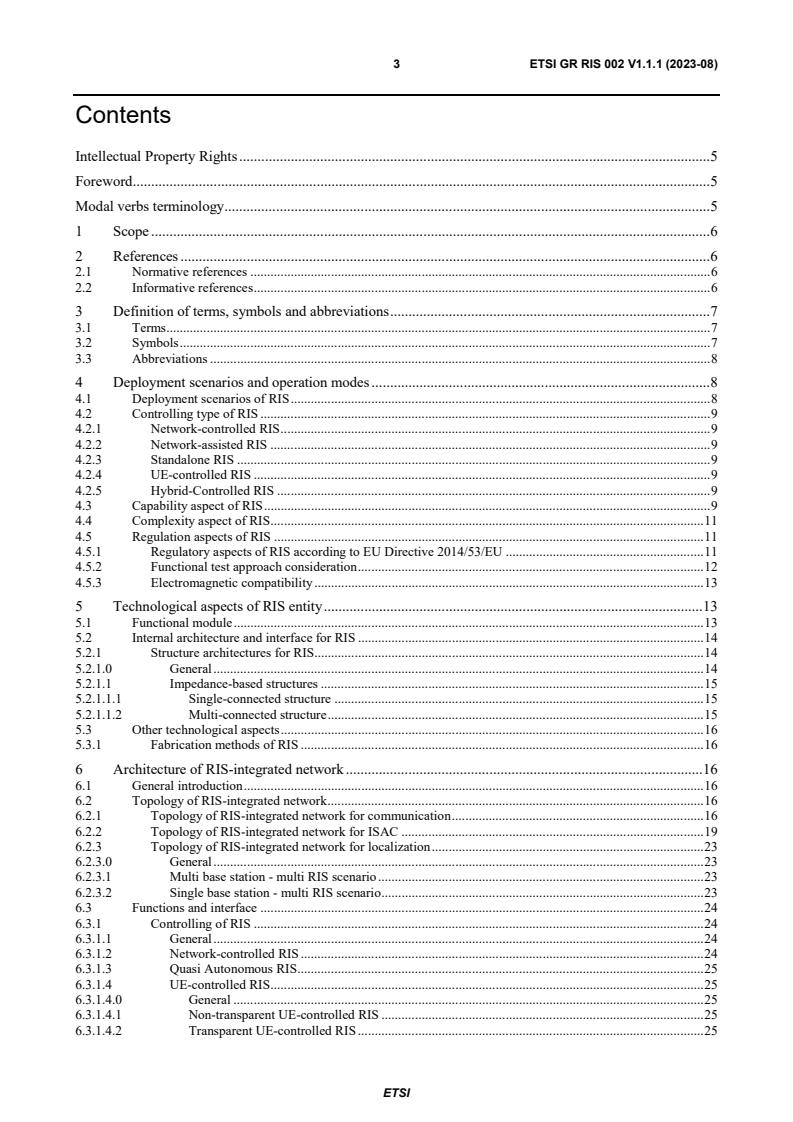
Contents
Intellectual Property Rights . 5
Foreword . 5
Modal verbs terminology . 5
1 Scope . 6
2 References . 6
2.1 Normative references . 6
2.2 Informative references . 6
3 Definition of terms, symbols and abbreviations . 7
3.1 Terms . 7
3.2 Symbols . 7
3.3 Abbreviations . 8
4 Deployment scenarios and operation modes . 8
4.1 Deployment scenarios of RIS . 8
4.2 Controlling type of RIS . 9
4.2.1 Network-controlled RIS . 9
4.2.2 Network-assisted RIS . 9
4.2.3 Standalone RIS . 9
4.2.4 UE-controlled RIS . 9
4.2.5 Hybrid-Controlled RIS . 9
4.3 Capability aspect of RIS . 9
4.4 Complexity aspect of RIS . 11
4.5 Regulation aspects of RIS . 11
4.5.1 Regulatory aspects of RIS according to EU Directive 2014/53/EU . 11
4.5.2 Functional test approach consideration . 12
4.5.3 Electromagnetic compatibility . 13
5 Technological aspects of RIS entity . 13
5.1 Functional module . 13
5.2 Internal architecture and interface for RIS . 14
5.2.1 Structure architectures for RIS. 14
5.2.1.0 General . 14
5.2.1.1 Impedance-based structures . 15
5.2.1.1.1 Single-connected structure . 15
5.2.1.1.2 Multi-connected structure . 15
5.3 Other technological aspects . 16
5.3.1 Fabrication methods of RIS . 16
6 Architecture of RIS-integrated network . 16
6.1 General introduction . 16
6.2 Topology of RIS-integrated network . 16
6.2.1 Topology of RIS-integrated network for communication . 16
6.2.2 Topology of RIS-integrated network for ISAC . 19
6.2.3 Topology of RIS-integrated network for localization . 23
6.2.3.0 General . 23
6.2.3.1 Multi base station - multi RIS scenario . 23
6.2.3.2 Single base station - multi RIS scenario . 23
6.3 Functions and interface . 24
6.3.1 Controlling of RIS . 24
6.3.1.1 General . 24
6.3.1.2 Network-controlled RIS . 24
6.3.1.3 Quasi Autonomous RIS . 25
6.3.1.4 UE-controlled RIS . 25
6.3.1.4.0 General . 25
6.3.1.4.1 Non-transparent UE-controlled RIS . 25
6.3.1.4.2 Transparent UE-controlled RIS . 25
ETSI
4 ETSI GR RIS 002 V1.1.1 (2023-08)
6.3.2 RIS selection . 25
6.3.2.0 General . 25
6.3.2.1 Selecting same RIS for DL and UL . 26
6.3.2.2 Separate RIS selection for DL and UL . 26
6.4 Potential specification impact. 27
7 Radio and physical layer aspect of RIS-integrated network. 27
7.1 General introduction . 27
7.2 RIS control mechanism in RIS-integrated network . 28
7.2.0 General . 28
7.2.1 Required control information for RIS . 28
7.2.2 Design of control signalling . 30
7.2.2.1 Protocol structure of control signal . 30
7.2.2.2 Channel structure of control signal . 30
7.3 Additional impacts on other aspects in RIS-integrated network . 31
7.3.1 Channel measurement and feedback . 31
7.4 Potential specification impact. 32
8 Conclusion and recommendation . 32
History . 33
ETSI
5 ETSI GR RIS 002 V1.1.1 (2023-08)
Intellectual Property Rights
Essential patents
IPRs essential or potentially essential to normative deliverables may have been declared to ETSI. The declarations
pertaining to these essential IPRs, if any, are publicly available for ETSI members and non-members, and can be
found in ETSI SR 000 314: "Intellectual Property Rights (IPRs); Essential, or potentially Essential, IPRs notified to
ETSI in respect of ETSI standards", which is available from the ETSI Secretariat. Latest updates are available on the
ETSI Web server (https://ipr.etsi.org/).
Pursuant to the ETSI Directives including the ETSI IPR Policy, no investigation regarding the essentiality of IPRs,
including IPR searches, has been carried out by ETSI. No guarantee can be given as to the existence of other IPRs not
referenced in ETSI SR 000 314 (or the updates on the ETSI Web server) which are, or may be, or may become,
essential to the present document.
Trademarks
The present document may include trademarks and/or tradenames which are asserted and/or registered by their owners.
ETSI claims no ownership of these except for any which are indicated as being the property of ETSI, and conveys no
right to use or reproduce any trademark and/or tradename. Mention of those trademarks in the present document does
not constitute an endorsement by ETSI of products, services or organizations associated with those trademarks.
DECT™, PLUGTESTS™, UMTS™ and the ETSI logo are trademarks of ETSI registered for the benefit of its
Members. 3GPP™ and LTE™ are trademarks of ETSI registered for the benefit of its Members and of the 3GPP
Organizational Partners. oneM2M™ logo is a trademark of ETSI registered for the benefit of its Members and of the ®
oneM2M Partners. GSM and the GSM logo are trademarks registered and owned by the GSM Association.
Foreword
This Group Report (GR) has been produced by ETSI Industry Specification Group (ISG) Reconfigurable Intelligent
Surfaces (RIS).
Modal verbs terminology
In the present document "should", "should not", "may", "need not", "will", "will not", "can" and "cannot" are to be
interpreted as described in clause 3.2 of the ETSI Drafting Rules (Verbal forms for the expression of provisions).
"must" and "must not" are NOT allowed in ETSI deliverables except when used in direct citation.
ETSI
6 ETSI GR RIS 002 V1.1.1 (2023-08)
1 Scope
The present document identifies and includes the information on:
• The technological challenges to deploy RIS as a new network entity.
• The potential impacts on internal architecture, framework and the required interfaces of RIS.
• The potential impacts on architecture, framework and the required interfaces of RIS-integrated network.
• The potential recommendations and specification impacts to standardization to support RIS as a network
entity.
2 References
2.1 Normative references
Normative references are not applicable in the present document.
2.2 Informative references
References are either specific (identified by date of publication and/or edition number or version number) or
non-specific. For specific references, only the cited version applies. For non-specific references, the latest version of the
referenced document (including any amendments) applies.
NOTE: While any hyperlinks included in this clause were valid at the time of publication, ETSI cannot guarantee
their long term validity.
The following referenced documents are not necessary for the application of the present document but they assist the
user with regard to a particular subject area.
[i.1] ETSI EG 203 336 (V1.2.1) (2020-05): "Guide for the selection of technical parameters for the
production of Harmonised Standards covering article 3.1(b) and article 3.2 of Directive
2014/53/EU".
[i.2] 3GPP TR 22.858: "Study of enhancements for residential 5G".
[i.3] 3GPP TR 22.859: "Study on Personal Internet of Things (PIoT) networks".
[i.4] ETSI TS 122 261: "5G; Service requirements for the 5G system (3GPP TS 22.261)".
[i.5] ETSI GR RIS 001: "Reconfigurable Intelligent Surfaces (RIS); Use Cases, Deployment Scenarios
and Requirements".
[i.6] ETSI GR RIS 003: "Reconfigurable Intelligent Surfaces (RIS); Communication Models, Channel
Models, Channel Estimation and Evaluation Methodology".
[i.7] ETSI TS 138 401: "5G; NG-RAN; Architecture description (3GPP TS 38.401)".
[i.8] ETSI TS 138 300: "5G; NR; NR and NG-RAN Overall description; Stage-2 (3GPP TS 38.300)".
[i.9] Directive 2014/53/EU of the European Parliament and of the Council of 16 April 2014 on the
harmonisation of the laws of the Member States relating to the making available on the market of
radio equipment and repealing Directive 1999/5/EC Text with EEA relevance.
[i.10] IEC 61000-4-2: "Electromagnetic compatibility (EMC) - Part 4-2: Testing and measurement
techniques - Electrostatic discharge immunity test".
[i.11] IEC 61000-4-3: "Electromagnetic compatibility (EMC) - Part 4-3: Testing and measurement
techniques - Radiated, radio-frequency, electromagnetic field immunity test".
ETSI
7 ETSI GR RIS 002 V1.1.1 (2023-08)
[i.12] IEC 61000-4-4: "Electromagnetic compatibility (EMC) - Part 4-4: Testing and measurement
techniques - Electrical fast transient/burst immunity test".
[i.13] IEC 61000-4-5: "Electromagnetic compatibility (EMC) - Part 4-5: Testing and measurement
techniques - Surge immunity test".
[i.14] IEC 61000-4-6: "Electromagnetic compatibility (EMC) - Part 4-4: Testing and measurement
techniques - Electrical fast transient/burst immunity test".
[i.15] IEC 61000-4-11: "Electromagnetic compatibility (EMC) - Part 4-11: Testing and measurement
techniques - Voltage dips, short interruptions and voltage variations immunity tests for equipment
with input current up to 16 A per phase".
[i.16] CISPR 32: "Electromagnetic compatibility of multimedia equipment - Emission requirements".
[i.17] Recommendation ITU-R SM.329: "Unwanted emissions in the spurious domain".
[i.18] IEC 61000-3-2: "Electromagnetic compatibility (EMC) - Part 3-2: Limits - Limits for harmonic
current emissions (equipment input current ≤16 A per phase)".
[i.19] IEC 61000-3-12: "Electromagnetic compatibility (EMC) - Part 3-12: Limits - Limits for harmonic
currents produced by equipment connected to public low-voltage systems with input current >16 A
and ≤ 75 A per phase".
[i.20] IEC 61000-3-3: "Electromagnetic compatibility (EMC) - Part 3-3: Limits - Limitation of voltage
changes, voltage fluctuations and flicker in public low-voltage supply systems, for equipment with
rated current ≤16 A per phase and not subject to conditional connection".
[i.21] IEC 61000-3-11: "Electromagnetic compatibility (EMC) - Part 3-11: Limits - Limitation of voltage
changes, voltage fluctuations and flicker in public low-voltage supply systems - Equipment with
rated current ≤ 75 A and subject to conditional connection".
3 Definition of terms, symbols and abbreviations
3.1 Terms
For the purposes of the present document, the following terms apply:
micro-controller: entity that determine the response of RIS in the electromagnetic domain according to control
information from RIS controller
RIS: entity that consists of a large number of RIS Elements and micro-controller
NOTE: The incoming signal on RIS from any direction can be shaped to any direction (including absorption) in a
programmable/controllable manner.
RIS controller: entity that generates/deliver the control information to RIS (see the illustration in clause 4.1).
NOTE: Depending on the considered deployment scenario and controlling type (see subsections in clause 4.2),
RIS Controller can be co-located with a network node or co-located with RIS.
RIS element: entity that facilitates shaping/tuning incoming signals/reflection coefficients
3.2 Symbols
Void.
ETSI
8 ETSI GR RIS 002 V1.1.1 (2023-08)
3.3 Abbreviations
For the purposes of the present document, the following abbreviations apply:
AoD Angle of Departure
BS Base Station
CPN Customer Premises Networks
CSI Channel State Information
CU Central Unit
DU Distributed Unit
EIRP Effective Isotropic Radiated Power
LMF Location Management Function
LOS Line Of Sight
MIMO Massive Input Massive Output
MU-MIMO Multiple-Users Massive Input Massive Output
PIN Personal Internet of things networks
PRAS Premises Radio Access Station
PRS Positioning Reference Signal
RIS Reconfigurable Intelligent Surfaces
RSRP Reference Signal Received Power
RSTD Reference Signal Time Difference
SRS Sounding Reference Signal
TCI Transmission Configuration Indication
TDM Time Division Multiplexing
UE User Equipment
UL Up Link
4 Deployment scenarios and operation modes
4.1 Deployment scenarios of RIS
The deployment of RIS refers to the integration of a new type of system node with reconfigurable surface technology,
where its response can be adapted to the status of the propagation environment through control signalling.
Figure 4.1-1: Illustration of deployment scenario of RIS
Deployment scenarios are determined by the user application trends and business models, as well as the maturity of RIS
technologies. In ETSI GR RIS 001 [i.5], several key deployment scenarios are summarized, including indoors,
outdoors, and hybrid scenarios. RISs can be deployed in a static manner, as well as a nomadic manner, serving different
use cases such as vehicular communications.
ETSI
9 ETSI GR RIS 002 V1.1.1 (2023-08)
4.2 Controlling type of RIS
4.2.1 Network-controlled RIS
In the network-controlled mode, the network determines the control information, which is used to control and configure
RIS, based on the collected information from UE and/or RIS. The "RIS controller" may also collect data from UE
and/or RIS itself and provide the collected data to the network. The "RIS controller" is deployed and owned by the
network.
4.2.2 Network-assisted RIS
In the network-assisted mode, the network provides certain feedback or assistance information to the "RIS controller".
rd
The "RIS controller" can be either deployed and owned by the network or separately deployed as an authorized 3 party
component. The "RIS controller" collects information from UE and/or RIS itself. The "RIS controller" then utilizes the
assistance information provided by the network and configures the RIS based on the collected information from UE
and/or RIS itself.
4.2.3 Standalone RIS
In the standalone RIS controller, the "RIS controller" determine the control information, which is used to control and
configure RIS, based on the collected information from UE and/or RIS itself. The "RIS controller" can be either
deployed and owned by the network and can be pre-configured by the network or separately deployed as an authorized
rd
3 party component.
4.2.4 UE-controlled RIS
In the UE-controlled RIS, the UE determine the control information, which is used to control and configure RIS via the
"RIS controller". The "RIS controller" can be either deployed and owned by the network operator or separately
rd
deployed as an authorized 3 party component. The network authorizes the UE to configure the RIS for a specific
operating frequency range including licensed and unlicensed spectrum. The UE either pre-configures the RIS or
(re)configures via the "RIS controller.
4.2.5 Hybrid-Controlled RIS
In the hybrid-controlled RIS, the "RIS controller" could be split into "remote RIS controller" and "local RIS controller".
rd
The "remote RIS controller" is deployed at a part of network or the controlling UE(s) or at an authorized 3 party entity,
while the "local RIS controller" is supposed to be deployed at the RIS microcontroller (as defined in clause 5.1). The
owner of the RIS control functionality can decide to split it between the remote and local entities in order to reduce the
latency and communication overheads of the dynamic RIS control. The owner of the RIS control function can decide
which information from the UE (s) and RIS side will be collected by the "local RIS controller" or by the "remote RIS
controller". Optionally, the "remote RIS controller" can instruct the served UEs to provide assisting information to the
"local RIS controller".
4.3 Capability aspect of RIS
In this clause, the general capability aspect of RIS and RIS controller according to the different controlling types in
clause 4.2 is shown as following:
• Network-controlled RIS:
- In the network-controlled mode, the control information is fully determined by the network, the RIS only
needs to be capable of tuning the coefficients and properties of RIS elements according to the control
information. As for the RIS controller, it needs to receive the control information from the network and
may need to feedback to the network. The RIS controller should be capable of:
receiving control signals from the network;
(optionally) transmitting signals to the network;
ETSI
10 ETSI GR RIS 002 V1.1.1 (2023-08)
reconfiguring the coefficients of RIS elements.
• Network-assisted RIS:
- In the network-assisted mode, the capability of RIS panel is same as the above. While for the RIS
controller, in addition to receiving the control information from the network, the RIS controller can
collect data and perform calculations to configure the RIS. In this case, the capability of RIS controller
includes the following:
receiving control signals from the network;
reconfiguring the coefficients of RIS elements;
limited processing and calculating capability;
collecting data from UEs/RISs.
• The standalone RIS:
- In the standalone mode, higher capabilities are needed since the control information is determined by the
RIS controller. In this case, the capabilities of RIS may include the following aspects:
tuning the coefficients and properties of RIS elements;
(optionally) sensing capability (e.g. power sensing, location sensing);
- As for the RIS controller in this mode, the RIS controller may be capable of:
reconfiguring the coefficients of RIS elements;
collecting data from UEs/RISs;
basic data processing and calculation.
• UE-controlled RIS:
- In the UE-controlled mode, the control information is determined by UE. In this case, the capability of
RIS can consider the following aspects:
tuning the coefficients and properties of each RIS elements.
- As for the RIS controller, following capabilities aspects should be considered:
receiving signals from the network (e.g. initial configuration information or information of
authorized UEs);
reconfiguring the coefficients of RIS elements;
receiving control signals from authorized UEs.
In addition to the RIS capability aspects for specific RIS types, as described above, additional capability aspect of RIS
related to mode of operation can be considered. Depending on the RIS elements and its hardware capabilities, RIS can
further report to the controlling node on whether it supports multi-functional mode of operation or not. If RIS supports
multi-functional mode of operation, then it can further report specific modes, for example:
• Reflection mode.
• Refraction mode.
• Absorption mode.
Based on the reported capability for operating modes, the related control information described in clause 7.2.1 can be
impacted. In case if multi-functional mode is not supported by RIS, then no additional control information signalling
would be needed for operating mode indication.
ETSI
11 ETSI GR RIS 002 V1.1.1 (2023-08)
4.4 Complexity aspect of RIS
The complexity aspect of RIS is related to the capability of RIS, the structure architecture, etc. As analysed in the above
clause, the capability of RIS panel for the network-controlled type, network-assisted type and UE-controlled type is
mainly to tune the coefficients and properties of RIS elements according to the configuration from the RIS controller,
thus the complexity of these three type of RIS mainly depends on the structure architecture, hardware implementation
and other aspects. While for the standalone RIS, the control information is determined by the RIS controller itself,
which may require the RIS element to be configured with the sensing capability, thus to increase the complexity of RIS
itself.
As for the complexity aspect of RIS controller, for network-controlled RIS and UE-controlled RIS, the RIS controller
only needs to receive the control information from the network or UE and configure the RIS element according to the
control information, while the RIS controller of network-assisted and standalone RIS may need additional processing
and calculating capability, which causes higher complexity.
Table 4.4-1 below illustrates the complexity aspect of the four different controlled type of RIS.
Table 4.4-1: Complexity aspect of different controlled type of RIS
Complexity aspects of
RIS Controlling Type Complexity aspects of RIS
RIS Controller
Network-controlled RIS Depends on the structure and implementation of RIS panel Low
Network-assisted RIS Depends on the structure and implementation of RIS panel Medium
High, and also depends on the structure and implementation
Standalone RIS High
of RIS panel
UE-controlled RIS Depends on the structure and implementation of RIS panel Low
4.5 Regulation aspects of RIS
4.5.1 Regulatory aspects of RIS according to EU Directive 2014/53/EU
As RIS are specified as radio components of radio communication networks, they will be regarded as radio equipment
to which the European Directive 2014/53/EU [i.9] (known as Radio Equipment Directive, RED) applies.
Reminder:
NOTE 1: Article 3.1(b) of Directive 2014/53/EU [i.9] states:
"Radio equipment shall be constructed so as to ensure….an adequate level of electromagnetic
compatibility as set out in Directive 2014/30/EU."
NOTE 2: Article 3.2 of Directive 2014/53/EU [i.9] states:
"Radio equipment shall be so constructed that it both effectively uses and supports the efficient use of
radio spectrum in order to avoid harmful interference."
As the basic RIS promise is to manipulate electromagnetic attributes in a wanted way, there is a need to consider RED
essential requirements in particular. Thus, the following radio parameters are of interest according to ETSI
EG 203 336 [i.1].
ETSI
12 ETSI GR RIS 002 V1.1.1 (2023-08)
Table 4.5.1-1: RIS related essential requirements
[i.1] Essential RF parameter of interest RIS correspondence
5.2.2 Transmitter power limits Reflected/penetrated (see note 2) signal power limits
5.2.3 Transmitter power accuracy To Be Defined if RIS offers power control capabilities
5.2.4 Transmitter spectrum mask Reflected/penetrated signal spectrum mask
To Be Defined if RIS offers carrier frequency manipulation
5.2.5 Transmitter frequency stability
capabilities
5.2.6 Transmitter intermodulation attenuation Reflected/penetrated signal quality
Reflected/penetrated unwanted emissions
5.2.7 Transmitter unwanted emissions
(incl. out of band and spurious domain emissions)
5.2.8 Transmitter time domain characteristics NA
5.2.9 Transmitter transients NA
5.3 Receiver parameters NA (see note 1)
NOTE 1: Receiver parameters are not to be considered, as RIS does not offer dedicated reception performance,
however, if so, its performance is sufficiently determined by above listed reflected (or repeated) signal
performance, as the sole goal of it is the reconfigurable reflection (or repetition) of the impinging radio
signal.
NOTE 2: Depending on the deployment scenario the RIS is either configured to reflect the wanted impinging signal
or to penetrate to its back when applied as transparent surface.
4.5.2 Functional test approach consideration
In table 4.5.1-1 listed essential requirements can be assessed (i.e. tested) in default RIS operation mode, i.e. while
illuminated by a wanted signal of interest and optional co-channel, adjacent channel or out of band interference.
By default, measurements are done over the air, i.e. in an appropriate anechoic environment using dedicated feeds and
measurement probes in terms of frequency range, bandwidth and measurement sensitivity and quality.
Figure 4.5.2-1 depicts the principle RIS performance assessment setup. The impinging wave, provided by a wanted
signal feed over the air, will be reflected by the RIS under test in a wanted way. The essential requirement parameters
are evaluated at the maximum of the reflected wave in terms of EIRP. This is called maximum reflected EIPR (Max R-
EIRP). The maximum reflected EIRP is composed of all N components (e.g. RIS unit cells) involved, determined by the
��
�
impinging wave path � , the reflection coefficient � � and the reflecting wave path ℎ .
� �
�
The feed of wanted and interfering signal is for further study and depends on the RIS use cases to be considered for
regulatory performance assessment. Furthermore, unwanted emission assessment can not be limited to the wanted
reflecting angle only.
Figure 4.5.2-1: Principle RIS OTA assessment setup
ETSI
13 ETSI GR RIS 002 V1.1.1 (2023-08)
4.5.3 Electromagnetic compatibility
According to Directive 2014/53/EU [i.9] mentioned in clause 4.5.1, electromagnetic compatibility is one of an
important issue of RED. Therefore all of the radio equipment should pass the EMC test before being used. EMC test
can be separated into Electro-Magnetic Interference (EMI) and Electro-Magnetic Susceptibility (EMS), in which EMI
will test the disturbance generated by the equipment and EMS will test the behaviour of equipment under disturbance.
As the RIS will work under complicated electromagnetic environment, the EMC test is necessary to be considered and
implemented. Table 4.5.3-1 illustrates the EMC test and its corresponding standard.
Table 4.5.3-1: RIS related EMC test
EMC Test Related standard
Electro-Magnetic susceptibility EMS
Electrostatic discharge immunity test (ESD) IEC 61000-4-2 [i.10]
Radiated, radio-frequency, electromagnetic field immunity test (RS) IEC 61000-4-3 [i.11]
Electrical Fast Transient/burst immunity test (EFT) IEC 61000-4-4 [i.12]
Surge immunity test (Surge) IEC 61000-4-5 [i.13]
Immunity to conducted disturbances, induced by radio frequency IEC 61000-4-6 [i.14]
fields (CS)
Voltage dips, short interruptions and voltage variation immunity IEC 61000-4-11 [i.15]
tests
Electro-Magnetic Interference EMI
Radiated emission (RE) CISPR 32 [i.16]
Radiated Spurious Emission (RSE) Recommendation ITU-R SM.329 [i.17]
Conducted Emission (CE) CISPR 32 [i.16]
Harmonic current emission IEC 61000-3-2 [i.18] or IEC 61000-3-12 [i.19]
Voltage fluctuations and flicker IEC 61000-3-3 [i.20] or IEC 61000-3-11 [i.21]
NOTE 1: The standards above are all basic standard (Testing and measurement techniques), which does not include
the test limits. All of the test limits can be found from generic standard or corresponding product standard.
NOTE 2: The Radiated test for RISs working under high frequency (FR2) are tested under Over The Air (OTA)
environment.
NOTE 3: Some EMC test method for RISs would be a bit different compared with traditional method especially for
passive and hybrid RIS.
5 Technological aspects of RIS entity
5.1 Functional module
The RIS as a whole can be modelled as the combination of at least a RIS controller and a RIS panel.
The RIS panel comprises of a group of elements, which have the capability to change the at least one of the properties
of the incident radio waves including frequency, amplitude, phase and polarization. The radio wave can be at least
reflected or transmitted to another direction after hitting the RIS panel, depending on the design of RIS.
The RIS micro-controller refers to a component of RIS, responsible for configuring the RIS elements to achieve a
wanted way of manipulation of the incident radio wave, potentially processing any signalling received from another
network node. The configuration of RIS element by the micro-controller is conveyed through control signalling from
RIS controller shown in Figure 5.1-1.
ETSI
14 ETSI GR RIS 002 V1.1.1 (2023-08)
Figure 5.1-1: Illustration of a RIS comprising a micro-controller and a panel
5.2 Internal architecture and interface for RIS
5.2.1 Structure architectures for RIS
5.2.1.0 General
The major two components of the RIS are the micro-controller and RIS panel.
Figure 5.2.1.0-1: Illustration of RIS inner structures
The RIS panel can be modelled as a multi-layered surface where each layer is designed to achieve different functions.
An example of a simple design of a three-layered reflective RIS panel is given in Figure 5.2.1.0-1. The outer layer
comprises of a large number of elements, typically arranged in a form of two-dimensional arrays. The elements are
usually made of small squared thin metal plates. The middle layer is intended to stop the incident radio wave from
penetrating the panel, and is usually made of copper. The inner layer is connected to the RIS micro-controller and
usually comprises of control circuits, which can take the power level from RIS micro-controller as input, and upon that
specific power level equivalently change the response of the circuit so that the corresponding elements on the outer
layer will pose a specific change on the incident radio wave.
Inside RIS, one interface is the interface between the RIS micro-controller and RIS panel to transmit the control signals.
ETSI
15 ETSI GR RIS 002 V1.1.1 (2023-08)
5.2.1.1 Impedance-based structures
5.2.1.1.1 Single-connected structure
In a single-connected RIS, each element is connected to a single impedance unit, where each impedance unit is not
connected to other impedance units in the RIS. An example of a single-connected RIS structure with � =4 elements
and � =4 RIS elements is shown in Figure 5.2.1.1.1-1. Here, RIS elements 1, 2, 3 and 4 are separately connected to
impedance units � , � , � and � , respectively.
� � � �
4-element Single-Connected
RIS Structure
Z
2 Z
RIS Element 1
RIS Element 2
RIS Element 3
RIS Element 4
Z
Z
Figure 5.2.1.1.1-1: Single-connected impedance-based RIS structure
A signal impinging on RIS element 1 is reflected (from the same element) with a reflection coefficient � based on
�
impedance � . Similarly, signals impinging on elements 2, 3 and 4 are reflected with reflection coefficients � , � and
� � �
� based on impedances � , � and � , where the reflection matrix is given by the diagonal matrix �:
� � � �
��
�
� 000
��
�
0 � 00
� = � �.
��
�
00 � 0
��
�
00 0 �
5.2.1.1.2 Multi-connected structure
In a multi-connected RIS structure, a RIS element is connected to other RIS elements, for example through a switch
array or with fixed connections. The connections between the RIS elements may be equipped with additional impedance
units. A signal impinging on a RIS element may be reflected from another RIS element or from multiple RIS elements
by relying on the directional impedance network. The switch grid or fixed connections would introduce additional
complexity in terms of design and configuration compared to a single-connected RIS but would provide additional
degrees of freedom for tuning of the impinging signals. Some example applications of multi-connected RIS may include
simultaneously transmitting and reflecting RIS and coverage extension, e.g. signal impinging on one side refracted from
the back side.
Multi-connected RIS architecture can be operated with non-diagonal phase matrices to direct signals impinging on a
given element from another of the connected elements. For example, consider a multi-connected RIS structure with
� =4 elements with a phase matrix:
��
�,�
0 0 � 0
��
�,�
000 �
� = � �
��
�,�
� 000
��
�,�
0 � 00
�� rd st
�,�
where the coefficient � is at the 3 row and the 1 column, meaning that the signal impinging on element 3 is
directed to (and reflected from) element 1 with phase shift � .
�,�
ETSI
16 ETSI GR RIS 002 V1.1.1 (2023-08)
5.3 Other technological aspects
5.3.1 Fabrication methods of RIS
There can be different ways to fabricate RIS panels, as shown in Table 5.3.1-1. Different fabrication methods
essentially bring different characteristics of RISs, such as the working frequency, power consumption, costs, insertion
loss, etc. The desired fabrication methods may depend on the deployment scenario, including the intended working
frequency, as well as use cases.
Table 5.3.1-1 illustrates the behaviour of different hardware implementations of RISs.
Table 5.3.1-1: Different hardware implementations of RISs and their comparison over multiple KPIs
RF- PN Varactor Photo- Ferro- Liquid
MOSFET
MEMS diodes diodes conductive electric crystal
Working frequency
< 40 < 110 < 20 < 200 / / > 20
(GHz)
Working Voltage High Medium High High Low Very High High
Power consumption Low Medium High Low Medium Low Low
Time to change
μs ns ns ns μs ms ms
codebook
Inser
...
Questions, Comments and Discussion
Ask us and Technical Secretary will try to provide an answer. You can facilitate discussion about the standard in here.
Loading comments...