


ETSI GS MEC-DEC 032-2 V3.2.1 (2024-11)
Multi-access Edge Computing (MEC); API Conformance Test Specification; Part 2: Test Purposes (TP)
Multi-access Edge Computing (MEC); API Conformance Test Specification; Part 2: Test Purposes (TP)
RGS/MEC-DEC32-2v321ApiTest
General Information
Standards Content (Sample)
GROUP SPECIFICATION
Multi-access Edge Computing (MEC);
API Conformance Test Specification;
Part 2: Test Purposes (TP)
Disclaimer
The present document has been produced and approved by the Multi-access Edge Computing (MEC) ETSI Industry
Specification Group (ISG) and represents the views of those members who participated in this ISG.
It does not necessarily represent the views of the entire ETSI membership.
2 ETSI GS MEC-DEC 032-2 V3.2.1 (2024-11)
Reference
RGS/MEC-DEC32-2v321ApiTest
Keywords
API, conformance, MEC, testing
ETSI
650 Route des Lucioles
F-06921 Sophia Antipolis Cedex - FRANCE
Tel.: +33 4 92 94 42 00 Fax: +33 4 93 65 47 16
Siret N° 348 623 562 00017 - APE 7112B
Association à but non lucratif enregistrée à la
Sous-Préfecture de Grasse (06) N° w061004871
Important notice
The present document can be downloaded from the
ETSI Search & Browse Standards application.
The present document may be made available in electronic versions and/or in print. The content of any electronic and/or
print versions of the present document shall not be modified without the prior written authorization of ETSI. In case of any
existing or perceived difference in contents between such versions and/or in print, the prevailing version of an ETSI
deliverable is the one made publicly available in PDF format on ETSI deliver repository.
Users should be aware that the present document may be revised or have its status changed,
this information is available in the Milestones listing.
If you find errors in the present document, please send your comments to
the relevant service listed under Committee Support Staff.
If you find a security vulnerability in the present document, please report it through our
Coordinated Vulnerability Disclosure (CVD) program.
Notice of disclaimer & limitation of liability
The information provided in the present deliverable is directed solely to professionals who have the appropriate degree of
experience to understand and interpret its content in accordance with generally accepted engineering or
other professional standard and applicable regulations.
No recommendation as to products and services or vendors is made or should be implied.
No representation or warranty is made that this deliverable is technically accurate or sufficient or conforms to any law
and/or governmental rule and/or regulation and further, no representation or warranty is made of merchantability or fitness
for any particular purpose or against infringement of intellectual property rights.
In no event shall ETSI be held liable for loss of profits or any other incidental or consequential damages.
Any software contained in this deliverable is provided "AS IS" with no warranties, express or implied, including but not
limited to, the warranties of merchantability, fitness for a particular purpose and non-infringement of intellectual property
rights and ETSI shall not be held liable in any event for any damages whatsoever (including, without limitation, damages
for loss of profits, business interruption, loss of information, or any other pecuniary loss) arising out of or related to the use
of or inability to use the software.
Copyright Notification
No part may be reproduced or utilized in any form or by any means, electronic or mechanical, including photocopying and
microfilm except as authorized by written permission of ETSI.
The content of the PDF version shall not be modified without the written authorization of ETSI.
The copyright and the foregoing restriction extend to reproduction in all media.
© ETSI 2024.
All rights reserved.
ETSI
3 ETSI GS MEC-DEC 032-2 V3.2.1 (2024-11)
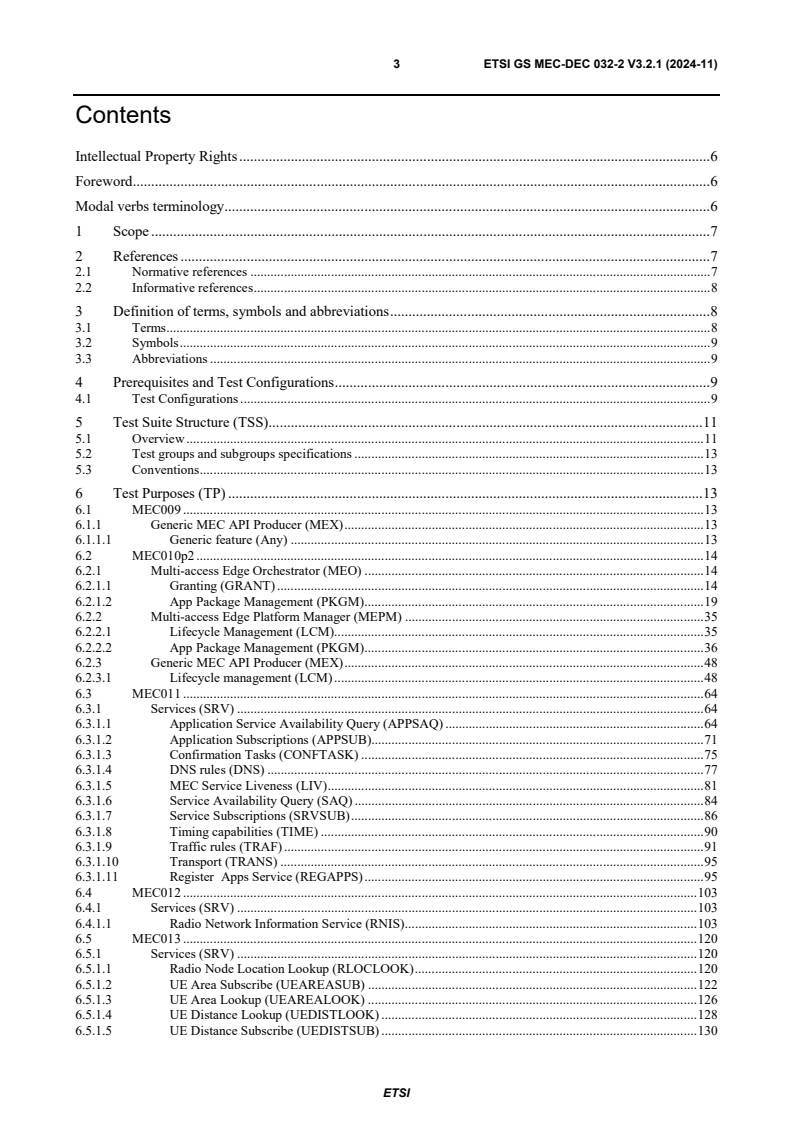
Contents
Intellectual Property Rights . 6
Foreword . 6
Modal verbs terminology . 6
1 Scope . 7
2 References . 7
2.1 Normative references . 7
2.2 Informative references . 8
3 Definition of terms, symbols and abbreviations . 8
3.1 Terms . 8
3.2 Symbols . 9
3.3 Abbreviations . 9
4 Prerequisites and Test Configurations . 9
4.1 Test Configurations . 9
5 Test Suite Structure (TSS) . 11
5.1 Overview . 11
5.2 Test groups and subgroups specifications . 13
5.3 Conventions . 13
6 Test Purposes (TP) . 13
6.1 MEC009 . 13
6.1.1 Generic MEC API Producer (MEX) . 13
6.1.1.1 Generic feature (Any) . 13
6.2 MEC010p2 . 14
6.2.1 Multi-access Edge Orchestrator (MEO) . 14
6.2.1.1 Granting (GRANT) . 14
6.2.1.2 App Package Management (PKGM) . 19
6.2.2 Multi-access Edge Platform Manager (MEPM) . 35
6.2.2.1 Lifecycle Management (LCM). 35
6.2.2.2 App Package Management (PKGM) . 36
6.2.3 Generic MEC API Producer (MEX) . 48
6.2.3.1 Lifecycle management (LCM) . 48
6.3 MEC011 . 64
6.3.1 Services (SRV) . 64
6.3.1.1 Application Service Availability Query (APPSAQ) . 64
6.3.1.2 Application Subscriptions (APPSUB). 71
6.3.1.3 Confirmation Tasks (CONFTASK) . 75
6.3.1.4 DNS rules (DNS) . 77
6.3.1.5 MEC Service Liveness (LIV) . 81
6.3.1.6 Service Availability Query (SAQ) . 84
6.3.1.7 Service Subscriptions (SRVSUB) . 86
6.3.1.8 Timing capabilities (TIME) . 90
6.3.1.9 Traffic rules (TRAF) . 91
6.3.1.10 Transport (TRANS) . 95
6.3.1.11 Register Apps Service (REGAPPS) . 95
6.4 MEC012 . 103
6.4.1 Services (SRV) . 103
6.4.1.1 Radio Network Information Service (RNIS) . 103
6.5 MEC013 . 120
6.5.1 Services (SRV) . 120
6.5.1.1 Radio Node Location Lookup (RLOCLOOK) . 120
6.5.1.2 UE Area Subscribe (UEAREASUB) . 122
6.5.1.3 UE Area Lookup (UEAREALOOK) . 126
6.5.1.4 UE Distance Lookup (UEDISTLOOK) . 128
6.5.1.5 UE Distance Subscribe (UEDISTSUB) . 130
ETSI
4 ETSI GS MEC-DEC 032-2 V3.2.1 (2024-11)
6.5.1.6 UE Information Lookup (UEINFOLOOK) . 132
6.5.1.7 UE Location Lookup (UELOCLOOK) . 135
6.5.1.8 UE Location Subscription (UELOCSUB) . 140
6.5.1.9 UE Zone Lookup (UEZONELOOK) . 146
6.5.1.10 UE Zone Subscription (UEZONESUB) . 151
6.5.1.11 UE Test Notification (UETESTNOT) . 157
6.6 MEC014 . 159
6.6.1 Services (SRV) . 159
6.6.1.1 UE Identity tag (UETAG) . 159
6.7 MEC015 . 163
6.7.1 Services (SRV) . 163
6.7.1.1 Multi-access Traffic Steering (MTS) . 163
6.7.1.2 Traffic Management (TM) . 164
6.8 MEC016 . 176
6.8.1 Multi-access Edge Orchestrator (MEO) . 176
6.8.1.1 UE Application Contexts (UEAPPCTX) . 176
6.8.1.2 UE Applications Location (UEAPPLOC) . 180
6.8.1.3 UE Applications (UEAPPS). 182
6.9 MEC021 . 185
6.9.1 Services (SRV) . 185
6.9.1.1 Application Mobility Service (AMS) . 185
6.10 MEC028 . 204
6.10.1 Services (SRV) . 204
6.10.1.1 WLAN Access Information (WAI) . 204
6.11 MEC029 . 221
6.11.1 Services (SRV) . 221
6.11.1.1 Fixed Access Information Service (FAIS) . 221
6.12 MEC030 . 235
6.12.1 Services (SRV) . 235
6.12.1.1 V2X Information Service (V2X) . 235
6.13 MEC033 . 267
6.13.1 Services (SRV) . 267
6.13.1.1 Device provisioning (IOTDEV) . 267
6.13.1.2 IoT platform discovery (IOTPLAT) . 275
6.14 MEC040 . 280
6.14.1 Services (SRV) . 280
6.14.1.1 MEC Federation (MEF) . 280
Annex A (informative): Information on the tools to generate the present document . 298
Annex B (informative): Change history . 299
History . 300
ETSI
5 ETSI GS MEC-DEC 032-2 V3.2.1 (2024-11)
List of tables
Table 5.1-1: Test Suite Structure for MEC API Conformance.11
Table 6.1.1.1-1: TP_MEC_MEC009_MEX_ANY_001_NT .13
ETSI
6 ETSI GS MEC-DEC 032-2 V3.2.1 (2024-11)
Intellectual Property Rights
Essential patents
IPRs essential or potentially essential to normative deliverables may have been declared to ETSI. The declarations
pertaining to these essential IPRs, if any, are publicly available for ETSI members and non-members, and can be
found in ETSI SR 000 314: "Intellectual Property Rights (IPRs); Essential, or potentially Essential, IPRs notified to
ETSI in respect of ETSI standards", which is available from the ETSI Secretariat. Latest updates are available on the
ETSI IPR online database.
Pursuant to the ETSI Directives including the ETSI IPR Policy, no investigation regarding the essentiality of IPRs,
including IPR searches, has been carried out by ETSI. No guarantee can be given as to the existence of other IPRs not
referenced in ETSI SR 000 314 (or the updates on the ETSI Web server) which are, or may be, or may become,
essential to the present document.
Trademarks
The present document may include trademarks and/or tradenames which are asserted and/or registered by their owners.
ETSI claims no ownership of these except for any which are indicated as being the property of ETSI, and conveys no
right to use or reproduce any trademark and/or tradename. Mention of those trademarks in the present document does
not constitute an endorsement by ETSI of products, services or organizations associated with those trademarks.
DECT™, PLUGTESTS™, UMTS™ and the ETSI logo are trademarks of ETSI registered for the benefit of its
Members. 3GPP™, LTE™ and 5G logo are trademarks of ETSI registered for the benefit of its Members and of the
3GPP Organizational Partners. oneM2M™ logo is a trademark of ETSI registered for the benefit of its Members and of ®
the oneM2M Partners. GSM and the GSM logo are trademarks registered and owned by the GSM Association.
Foreword
This Group Specification (GS) has been produced by ETSI Industry Specification Group (ISG) Multi-access Edge
Computing (MEC).
The present document is part 2 of a multi-part deliverable. Full details of the entire series can be found in part 1 [i.9].
Modal verbs terminology
In the present document "shall", "shall not", "should", "should not", "may", "need not", "will", "will not", "can" and
"cannot" are to be interpreted as described in clause 3.2 of the ETSI Drafting Rules (Verbal forms for the expression of
provisions).
"must" and "must not" are NOT allowed in ETSI deliverables except when used in direct citation.
ETSI
7 ETSI GS MEC-DEC 032-2 V3.2.1 (2024-11)
1 Scope
Based on the testing methodology guidelines and framework specified in ETSI GR MEC-DEC 025 [i.8], the present
document specifies part 2 of a multi-part deliverable test specification for the MEC service APIs (currently ETSI
GS MEC 012 [5], ETSI GS MEC 013 [6], ETSI GS MEC 014 [7], ETSI GS MEC 015 [8], ETSI GS MEC 016 [9],
ETSI GS MEC 021 [10], ETSI GS MEC 028 [11], ETSI GS MEC 029 [12], ETSI GS MEC 030 [13]), ETSI
GS MEC 033 [14], ETSI GS MEC 040 [15]), and the MEC APIs specified in ETSI GS MEC 010-2 [3] and ETSI
GS MEC 011 [4].
The present document includes the Test Suite Structure (TSS) and Test Purposes (TPs) using the standardized notation
Test Description Language - Test Objectives extension (TDL_TO).
2 References
2.1 Normative references
References are either specific (identified by date of publication and/or edition number or version number) or
non-specific. For specific references, only the cited version applies. For non-specific references, the latest version of the
referenced document (including any amendments) applies.
Referenced documents which are not found to be publicly available in the expected location might be found at
https://docbox.etsi.org/Reference/.
NOTE: While any hyperlinks included in this clause were valid at the time of publication, ETSI cannot guarantee
their long term validity.
The following referenced documents are necessary for the application of the present document.
[1] Void.
[2] ETSI GS MEC 009 (V2.2.1): "Multi-access Edge Computing (MEC); General principles, patterns
and common aspects of MEC Service APIs".
[3] ETSI GS MEC 010-2 (V3.1.1): "Multi-access Edge Computing (MEC); MEC Management;
Part 2: Application lifecycle, rules and requirements management".
[4] ETSI GS MEC 011 (V3.2.1): "Multi-access Edge Computing (MEC); Edge Platform Application
Enablement".
[5] ETSI GS MEC 012 (V2.2.1): "Multi-access Edge Computing (MEC); Radio Network Information
API".
[6] ETSI GS MEC 013 (V3.1.1): "Multi-access Edge Computing (MEC); Location API".
[7] ETSI GS MEC 014 (V3.1.1): "Multi-access Edge Computing (MEC); UE Identity API".
[8] ETSI GS MEC 015 (V2.2.1): "Multi-Access Edge Computing (MEC); Traffic Management APIs".
[9] ETSI GS MEC 016 (V2.2.1): "Multi-access Edge Computing (MEC); Device application
interface".
[10] ETSI GS MEC 021 (V3.1.1): "Multi-access Edge Computing (MEC); Application Mobility
Service API".
[11] ETSI GS MEC 028 (V2.3.1): "Multi-access Edge Computing (MEC); WLAN Access Information
API".
[12] ETSI GS MEC 029 (V2.2.1): "Multi-access Edge Computing (MEC); Fixed Access Information
API".
ETSI
8 ETSI GS MEC-DEC 032-2 V3.2.1 (2024-11)
[13] ETSI GS MEC 030 (V3.1.1): "Multi-access Edge Computing (MEC); V2X Information Services
API".
[14] ETSI GS MEC 033 (V3.1.1): "Multi-access Edge Computing (MEC); IoT API".
[15] ETSI GS MEC 040 (V3.1.1): "Multi-access Edge Computing (MEC); Federation enablement
APIs".
[16] ETSI TS 102 894-2: "Intelligent Transport Systems (ITS); Users and applications requirements;
Part 2: Applications and facilities layer common data dictionary".
2.2 Informative references
References are either specific (identified by date of publication and/or edition number or version number) or
non-specific. For specific references, only the cited version applies. For non-specific references, the latest version of the
referenced document (including any amendments) applies.
NOTE: While any hyperlinks included in this clause were valid at the time of publication, ETSI cannot guarantee
their long term validity.
The following referenced documents are not necessary for the application of the present document but they assist the
user with regard to a particular subject area.
[i.1] Void.
[i.2] Void.
[i.3] Void.
[i.4] Void.
[i.5] Void.
[i.6] Void.
[i.7] TTCN-3 abstract test language.
[i.8] ETSI GR MEC-DEC 025: "Multi-access Edge Computing (MEC); MEC Testing Framework".
[i.9] ETSI GS MEC-DEC 032-1: "Multi-access Edge Computing (MEC); API Conformance Test
Specification; Part 1: Test Requirements and Implementation Conformance Statement (ICS)".
[i.10] ETSI GR MEC 001 (V3.1.1): "Multi-access Edge Computing (MEC); Terminology".
3 Definition of terms, symbols and abbreviations
3.1 Terms
For the purposes of the present document, the following terms apply:
certification/compliance assessment: major goal of a compliance assessment is to ensure the interoperability of
implementations, and the conformance of implementations to the standard
conformance testing: purpose of conformance testing is to determine to what extent a single implementation of a
particular standard conforms to the individual requirements of that standard
interoperability testing: purpose of interoperability testing is to prove that end-to-end functionality between (at least)
two communicating systems is as required by the standard(s) on which those systems are based
Test Case (TC): complete and independent specification of the actions required to achieve a specific Test Purpose
NOTE: TCs are written in testing languages, e.g. TTCN-3 [i.7].
ETSI
9 ETSI GS MEC-DEC 032-2 V3.2.1 (2024-11)
Test Descriptions (TD): specification of the sequence of actions required to realize the verdict identified in the TP
NOTE: TDs are primarily intended for use in interoperability test specifications. However, in some instances,
particularly where there is a considerable difference in complexity between the TPs and the TCs, it is
worthwhile adding TDs as an extra design stage in a conformance test specification.
Test Purpose (TP): definition in broad terms of the goal of a particular test
NOTE: A TP should be written for each potential test of each identified requirement. A TP is defined in prose, or
in high level languages such as TDL-TO.
test suite: collection of Test Cases
testing framework: guidance for development of conformance and interoperability test strategies, test systems and the
resulting test specifications
3.2 Symbols
Void.
3.3 Abbreviations
For the purposes of the present document, the abbreviations given in ETSI GR MEC 001 [i.10] apply.
4 Prerequisites and Test Configurations
4.1 Test Configurations
Test configurations capture and describe the components identified in the tests and the connections between them. In
particular and as reported in ETSI GR MEC-DEC 025 [i.8], in the context of conformance testing the test configuration
"defines how the test system connects to the SUT".
For the present test suite, six (6) configurations are identified and listed in the present clause.
For each test configuration two (2) main components are identified: the IUT implementing the API provider and the
Tester implementing the API consumer. The IUT is part of a SUT (System Under Test), thus the component may be run
together with other components of the MEC System that are required to enable the behaviour to be tested. The
definition of the other components is out of scope.
Figure 4.1-1 depicts configuration Config_MEC_1 which includes a MEC Platform as the IUT and a MEC App as the
Tester. This configuration is applicable for all test purposes in all subgroups of the SRV Group.
Test system
SUT
MEC
MEC App
Platform
Figure 4.1-1: Config_MEC_1
Figure 4.1-2 depicts configuration Config_MEC_2 which includes a MEO as the IUT and OSS/BSS as the Tester. This
configuration is applicable for group MEO, subgroup PKGM.
ETSI
10 ETSI GS MEC-DEC 032-2 V3.2.1 (2024-11)
Test system
SUT
MEO
OSS/BSS
Figure 4.1-2: Config_MEC_2
Figure 4.1-3 depicts configuration Config_MEC_3 which includes a MEO as the IUT and a MEPM as the Tester. This
configuration is applicable for subgroup MEO/GRANT and in subgroup MEPM/PKGM.
Test system
SUT
MEO
MEPM
Figure 4.1-3: Config_MEC_3
Figure 4.1-4 depicts configuration Config_MEC_4 which includes a UALCM Proxy as the IUT and a DEV App as the
Tester. This configuration is applicable for group MEO subgroups UEAPPCTX and UEAPPS.
Test system
SUT
MEC System
UE App
Figure 4.1-4: Config_MEC_4
Figure 4.1-5 depicts configuration Config_MEC_5 which includes a MEPM as the IUT and a MEO as the Tester. This
configuration is applicable for group MEPM, subgroup PKGM.
Test system
SUT
MEPM
MEO
Figure 4.1-5: Config_MEC_5
Figure 4.1-6 depicts configuration Config_MEC_6 which includes a generic MEC API Provider as the IUT and a
generic MEC API consumer as the Tester. This configuration is applicable for test targeting generic API behaviours,
thus group MEX, subgroup ANY and LCM.
ETSI
11 ETSI GS MEC-DEC 032-2 V3.2.1 (2024-11)
Test system
SUT
MEC API Provider
MEC API
Consumer
Figure 4.1-6: Config_MEC_6
Figure 4.1-7 depicts configuration Config_MEC_7 which includes a MEF as the IUT and a MEO as the Tester. This
configuration is applicable for test targeting MEC Federation API behaviours [15].
Test system
SUT
MEF
MEO
Figure 4.1-7: Config_MEC_7
5 Test Suite Structure (TSS)
5.1 Overview
The test suite structure identifies grouping of test purposes and serves as a base for grouping of Test Case in the ATS
(Abstract Test Suite).
The Test Suite structure is used for the creation of identifiers of Test Purposes.
Table 5.1-1 identifies the Test Suite Structure for the MEC API Conformance test suites. Documentation on the groups
and subgroups is provided in clause 5.2.
Table 5.1-1: Test Suite Structure for MEC API Conformance
TP______
= root MEC MEC
= base document MEC009 Addressing base requirements in ETSI GS MEC 009 [2]
MEC010p2 Addressing base requirements in ETSI GS MEC 010-2 [3]
MEC011 Addressing base requirements in ETSI GS MEC 011 [4]
MEC012 Addressing base requirements in ETSI GS MEC 012 [5]
MEC013 Addressing base requirements in ETSI GS MEC 013 [6]
MEC014 Addressing base requirements in ETSI GS MEC 014 [7]
MEC015 Addressing base requirements in ETSI GS MEC 015 [8]
MEC016 Addressing base requirements in ETSI GS MEC 016 [9]
MEC021 Addressing base requirements in ETSI GS MEC 021 [10]
MEC028 Addressing base requirements in ETSI GS MEC 028 [11]
MEC029 Addressing base requirements in ETSI GS MEC 029 [12]
MEC030 Addressing base requirements in ETSI GS MEC 030 [13]
MEC033 Addressing base requirements in ETSI GS MEC 033 [14]
MEC040 Addressing base requirements in ETSI GS MEC 040 [15]
ETSI
12 ETSI GS MEC-DEC 032-2 V3.2.1 (2024-11)
TP______
= group SRV MEC Services
MEO MEC Orchestrator
MEPM MEC Platform Manager
PLAT MEC platform
MEX Generic MEC API Producer
= subgroup AMS Application Mobility Service
ANY Un-specified feature, used for generic test purposes
APPASQ Application Service Availability Query
APPSUB Application Subscriptions
CONFTASK Confirmation Tasks
DNS DNS rules
FAIS Fixed Access Information Service
GRANT Granting
IOTDEV IoT Device Provisioning
IOTPLAT IoT Platform Discovery
LCM Lifecycle Management
LIV Liveness
MEF MEC Federation
MTS Multi-access Traffic Steering
PKGM App Package Management
REGAPPS Register Apps
RLOCLOOK Radio Node Location Lookup
RNIS Radio Network Information Service
SAQ Service Availability Query
SRVSUB Service Subscriptions
TIME Timing capabilities
TM Traffic Management
TRAF Traffic rules
TRANS Transport
UEAPPCTX Device Application Contexts
UEAPPS Device Applications
UEAPPLOC UE App Location
UEAREASUB UE Area Subscribe
UEDISTLOOK UE Distance Lookup
UEDISTSUB UE Distance Subscribe
UEINFOLOOK UE Information Lookup
UELOCLOOK UE Location lookup
UELOCSUB UE Location Subscription
UETAG UE Identity Tag
UETRACKSUB UE Tracking Subscribe
UETESTNOT UE Test Notification
UEZONELOOK UE Zone Lookup
UEZONESUB UE Zone Subscription
V2X V2X Information Service
WAI WLAN Access Information
= sequential
001 to 999
number
= type of testing OK Valid/Successful behaviour (200, 201, 202, 204)
BR Bad request
NT No token
WT Wrong Token
NF Missing (404)
CO Conflict (409)
PF Precondition Failed (412)
E1 Generic error condition 1
E2 Generic error condition 2
E3 Generic error condition 3
…
ETSI
13 ETSI GS MEC-DEC 032-2 V3.2.1 (2024-11)
5.2 Test groups and subgroups specifications
The test grouping is organized on three (3) levels. The first level is the reference to the base Document that contains the
requirements for the tests. The second level is the Group and identifies the MEC component that is providing the
Service or Interface to be tested. The third level is called Subgroup and identifies a set of functionalities within an API.
In general this is related to the entities and resources manipulated or served by the API.
Moreover, test purposes are identified and categorized by a sequential three-digits number (uniquely assigned upon
definition of each test purpose) and by the type of test performed. The type of test helps quickly identify the type of
behaviour that is expected by the IUT in the test purpose.
5.3 Conventions
Conventions reported in ETSI GR MEC-DEC 025 [i.8], clauses 4.3.3.2.3 and 4.3.3.2.4 shall apply.
The test purposes are primarily developed in textual syntax of TDL-TO. The sources for the Test Purposes are available
in https://forge.etsi.org/rep/mec/gs032p2-test-purposes/-/tree/3.1.1.
The definitions of PICS, Entities, Events and data types are available in Domain section in the mec-common.tplan2 file.
6 Test Purposes (TP)
6.1 MEC009
6.1.1 Generic MEC API Producer (MEX)
6.1.1.1 Generic feature (Any)
Table 6.1.1.1-1: TP_MEC_MEC009_MEX_ANY_001_NT
TP Id
"TP_MEC_MEC009_MEX_ANY_001_NT"
Test Objective Check that a MEC API provider responds with an error when it receives
a request without token
Reference
ETSI GS MEC 009 V2.1.1 [2], clause 6.16.1
Configuration Config_MEC_6
Initial Conditions
with {
the IUT being_in idle_state
}
Expected Behaviour
ensure that {
when {
the IUT receives a HTTP_REQUEST containing
uri indicating value ACCEPTABLE_URI,
not authorization
from the MEC_CONSUMER entity
}
then {
the IUT sends a HTTP_RESPONSE containing
status set to "401 Unauthorized"
to the MEC_CONSUMER entity
}
}
ETSI
14 ETSI GS MEC-DEC 032-2 V3.2.1 (2024-11)
TP Id "TP_MEC_MEC009_MEX_ANY_001_WT"
Test Objective Check that a MEC API provider responds with an error when it receives
a request with a wrong token
Reference ETSI GS MEC 009 V2.1.1 [2], clause 6.16.1
Configuration Config_MEC_6
Initial Conditions
with {
the IUT being_in idle_state
}
Expected Behaviour
ensure that {
when {
the IUT receives a HTTP_REQUEST containing
uri indicating value ACCEPTABLE_URI,
headers containing
authorization set to NOT_VALID_TOKEN
from the MEC_CONSUMER entity
}
then {
the IUT sends a HTTP_RESPONSE containing
status set to "401 Unauthorized"
to the MEC_CONSUMER entity
}
}
6.2 MEC010p2
6.2.1 Multi-access Edge Orchestrator (MEO)
6.2.1.1 Granting (GRANT)
TP Id "TP_MEC_MEC010p2_MEO_GRANT_001_OK"
Test Objective Check that MEO sends a synchronous grant response when a grant request is requested -
INSTANTIATE
Reference ETSI GS MEC 010-2 V3.1.1 [3], clause 7.5.1.3.1
ETSI GS MEC 010-2 V3.1.1 [3], clause 6.2.4.2.2
ETSI GS MEC 010-2 V3.1.1 [3], clause 6.2.4.4.2
Configuration
Config_MEC_3
PICS Selection
PIC_GRANTS_MANAGEMENT
Initial Conditions
with {
the IUT having a app_instance containing
appInstanceID indicating value APP_INSTANCE_ID,
link indicating value H_LINK
}
Expected Behaviour
ensure that {
when {
the IUT receives a vPOST containing
uri indicating value "/granting/v1/grants",
body containing
GrantRequest containing
appInstanceId set to APP_INSTANCE_ID,
appLcmOpOccId set to any_value,
appDId set to any_value,
operation set to INSTANTIATE,
addResources set to INST_RESOURCES_LIST,
_links containing
appLcmOpOcc set to APP_LCM_OP_OCC_LINK,
appInstance set to APP_INSTANCE_LINK
from the MEPM entity
}
then {
the IUT sends a HTTP_RESPONSE containing
status set to "201 Created",
ETSI
15 ETSI GS MEC-DEC 032-2 V3.2.1 (2024-11)
headers containing
Location set to "/granting/v1/grants/{GRANTING_ID}"
body containing
Grant containing
id set to any_value,
appInstanceId set to APP_INSTANCE_ID,
appLcmOpOccId set to any_value,
addResources set to INST_RESOURCES_LIST,
_links containing
appLcmOpOcc set to APP_LCM_OP_OCC_LINK,
appInstance set to APP_INSTANCE_LINK
to the MEPM entity
}
}
TP Id "TP_MEC_MEC010p2_MEO_GRANT_001_BR"
Test Objective Check that MEO responds with an error when it receives a malformed request when a new grant
request is performed - INSTANTIATE
Reference ETSI GS MEC 010-2 V3.1.1 [3], clause 7.5.1.3.1
ETSI GS MEC 010-2 V3.1.1 [3], clause 6.2.4.2.2
ETSI GS MEC 010-2 V3.1.1 [3], clause 6.2.4.4.2
Configuration Config_MEC_3
PICS Selection PIC_GRANTS_MANAGEMENT
Initial Conditions
with {
the IUT having a app_instance containing
appInstanceID indicating value APP_INSTANCE_ID,
link indicating value H_LINK
}
Expected Behaviour
ensure that {
when {
the IUT receives a vPOST containing
uri indicating value "/granting/v1/grants",
body containing
GrantRequest containing
appInstanceId set to APP_INSTANCE_ID,
appLcmOpOccId set to any_value,
appDId set to any_value,
operationERROR set to INSTANTIATE,
not addResources,
_links containing
appLcmOpOcc set to APP_LCM_OP_OCC_LINK,
appInstance set to APP_INSTANCE_LINK
from the MEPM entity
}
then {
the IUT sends a HTTP_RESPONSE containing
status set to "400 Bad Request"
to the MEPM entity
}
}
ETSI
16 ETSI GS MEC-DEC 032-2 V3.2.1 (2024-11)
TP Id "TP_MEC_MEC010p2_MEO_GRANT_002_OK"
Test Objective Check that MEO sends a synchronous grant response when a grant request is requested
Reference ETSI GS MEC 010-2 V3.1.1 [3], clause 7.5.1.3.1
ETSI GS MEC 010-2 V3.1.1 [3], clause 6.2.4.2.2
ETSI GS MEC 010-2 V3.1.1 [3], clause 6.2.4.4.2
Configuration Config_MEC_3
PICS Selection PIC_GRANTS_MANAGEMENT
Initial Conditions
with {
the IUT having a app_instance containing
appInstanceID indicating value APP_INSTANCE_ID,
link indicating value H_LINK
}
Expected Behaviour
ensure that {
when {
the IUT receives a vPOST containing
uri indicating value "/granting/v1/grants",
body containing
GrantRequest containing
appInstanceId set to APP_INSTANCE_ID,
appLcmOpOccId set to any_value,
appDId set to any_value,
operation set to OPERATION_TYPE, //Shall be one from - OPERATE - TERMINATE
_links containing
appLcmOpOcc set to APP_LCM_OP_OCC_LINK,
appInstance set to APP_INSTANCE_LINK
from the MEPM entity
}
then {
the IUT sends a HTTP_RESPONSE containing
status set to "201 Created",
headers containing
Location set to "/granting/v1/grants/{GRANTING_ID}"
body containing
Grant containing
id set to any_value,
appInstanceId set to APP_INSTANCE_ID,
appLcmOpOccId set to any_value,
_links containing
appLcmOpOcc set to APP_LCM_OP_OCC_LINK,
appInstance set to APP_INSTANCE_LINK
to the MEPM entity
}
}
TP Id
"TP_MEC_MEC010p2_MEO_GRANT_003_OK"
Test Objective Check that MEO sends a asynchronous grant response when a grant request is requested -
INSTANTIATE
Reference
ETSI GS MEC 010-2 V3.1.1 [3], clause 7.5.1.3.1
ETSI GS MEC 010-2 V3.1.1 [3], clause 6.2.4.2.2
ETSI GS MEC 010-2 V3.1.1 [3], clause 6.2.4.4.2
Configuration Config_MEC_3
PICS Selection PIC_GRANTS_MANAGEMENT
Initial Conditions
with {
the IUT having a app_instance containing
appInstanceID indicating value APP_INSTANCE_ID,
link indicating value H_LINK
}
ETSI
17 ETSI GS MEC-DEC 032-2 V3.2.1 (2024-11)
Expected Behaviour
ensure that {
when {
the IUT receives a vPOST containing
uri indicating value "/granting/v1/grants",
body containing
GrantRequest containing
appInstanceId set to APP_INSTANCE_ID,
appLcmOpOccId set to any_value,
appDId set to any_value,
operation set to INSTANTIATE,
addResources set to INST_RESOURCES_LIST,
_links containing
appLcmOpOcc set to APP_LCM_OP_OCC_LINK,
appInstance set to APP_INSTANCE_LINK
from the MEPM entity
}
then {
the IUT sends a HTTP_RESPONSE containing
status set to "202 Accepted",
headers containing
Location set to "/granting/v1/grants/{GRANTING_ID}"
to the MEPM entity
}
}
TP Id "TP_MEC_MEC010p2_MEO_GRANT_004_OK"
Test Objective Check that MEO sends a asynchronous grant response when a grant request is requested
Reference ETSI GS MEC 010-2 V3.1.1 [3], clause 7.5.1.3.1
ETSI GS MEC 010-2 V3.1.1 [3], clause 6.2.4.2.2
ETSI GS MEC 010-2 V3.1.1 [3], clause 6.2.4.4.2
Configuration
Config_MEC_3
PICS Selection PIC_GRANTS_MANAGEMENT
Initial Conditions
with {
the IUT having a app_instance containing
appInstanceID indicating value APP_INSTANCE_ID,
link indicating value H_LINK
}
Expected Behaviour
ensure that {
when {
the IUT receives a vPOST containing
uri indicating value "/granting/v1/grants",
body containing
GrantRequest containing
appInstanceId set to APP_INSTANCE_ID,
appLcmOpOccId set to any_value,
appDId set to any_value,
operation set to OPERATION_TYPE, //Shall be one from - OPERATE - TERMINATE
_links containing
appLcmOpOcc set to APP_LCM_OP_OCC_LINK,
...
Questions, Comments and Discussion
Ask us and Technical Secretary will try to provide an answer. You can facilitate discussion about the standard in here.
Loading comments...