


ETSI GS F5G 014 V1.1.1 (2023-05)
Fifth Generation Fixed Network (F5G); F5G Network Architecture Release 2
Fifth Generation Fixed Network (F5G); F5G Network Architecture Release 2
DGS/F5G-0014
General Information
Standards Content (Sample)
GROUP SPECIFICATION
Fifth Generation Fixed Network (F5G);
F5G Network Architecture
Release 2
Disclaimer
The present document has been produced and approved by the Fifth Generation Fixed Network (F5G) ETSI Industry
Specification Group (ISG) and represents the views of those members who participated in this ISG.
It does not necessarily represent the views of the entire ETSI membership.
2 ETSI GS F5G 014 V1.1.1 (2023-05)
Reference
DGS/F5G-0014
Keywords
architecture, F5G
ETSI
650 Route des Lucioles
F-06921 Sophia Antipolis Cedex - FRANCE
Tel.: +33 4 92 94 42 00 Fax: +33 4 93 65 47 16
Siret N° 348 623 562 00017 - APE 7112B
Association à but non lucratif enregistrée à la
Sous-Préfecture de Grasse (06) N° w061004871
Important notice
The present document can be downloaded from:
https://www.etsi.org/standards-search
The present document may be made available in electronic versions and/or in print. The content of any electronic and/or
print versions of the present document shall not be modified without the prior written authorization of ETSI. In case of any
existing or perceived difference in contents between such versions and/or in print, the prevailing version of an ETSI
deliverable is the one made publicly available in PDF format at www.etsi.org/deliver.
Users of the present document should be aware that the document may be subject to revision or change of status.
Information on the current status of this and other ETSI documents is available at
https://portal.etsi.org/TB/ETSIDeliverableStatus.aspx
If you find errors in the present document, please send your comment to one of the following services:
https://portal.etsi.org/People/CommiteeSupportStaff.aspx
If you find a security vulnerability in the present document, please report it through our
Coordinated Vulnerability Disclosure Program:
https://www.etsi.org/standards/coordinated-vulnerability-disclosure
Notice of disclaimer & limitation of liability
The information provided in the present deliverable is directed solely to professionals who have the appropriate degree of
experience to understand and interpret its content in accordance with generally accepted engineering or
other professional standard and applicable regulations.
No recommendation as to products and services or vendors is made or should be implied.
No representation or warranty is made that this deliverable is technically accurate or sufficient or conforms to any law
rule and/or regulation and further, no representation or warranty is made of merchantability or fitness
and/or governmental
for any particular purpose or against infringement of intellectual property rights.
In no event shall ETSI be held liable for loss of profits or any other incidental or consequential damages.
Any software contained in this deliverable is provided "AS IS" with no warranties, express or implied, including but not
limited to, the warranties of merchantability, fitness for a particular purpose and non-infringement of intellectual property
rights and ETSI shall not be held liable in any event for any damages whatsoever (including, without limitation, damages
for loss of profits, business interruption, loss of information, or any other pecuniary loss) arising out of or related to the use
of or inability to use the software.
Copyright Notification
No part may be reproduced or utilized in any form or by any means, electronic or mechanical, including photocopying and
microfilm except as authorized by written permission of ETSI.
The content of the PDF version shall not be modified without the written authorization of ETSI.
The copyright and the foregoing restriction extend to reproduction in all media.
© ETSI 2023.
All rights reserved.
ETSI
3 ETSI GS F5G 014 V1.1.1 (2023-05)
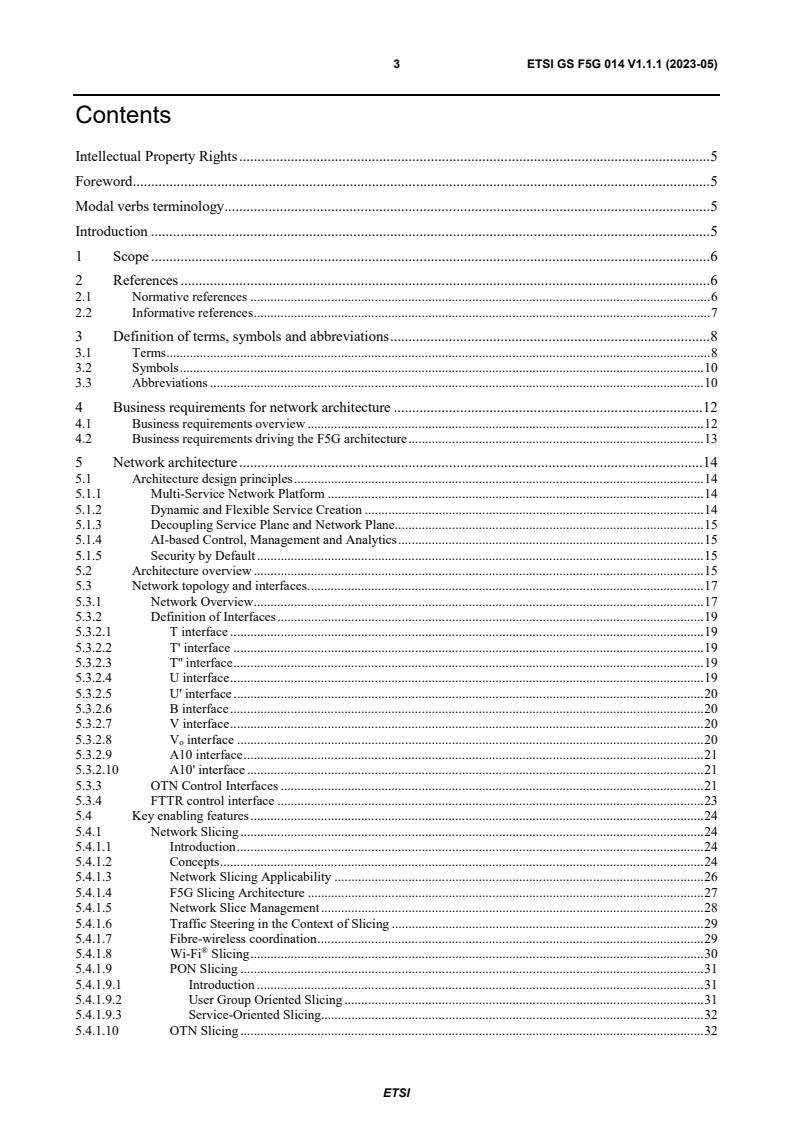
Contents
Intellectual Property Rights . 5
Foreword . 5
Modal verbs terminology . 5
Introduction . 5
1 Scope . 6
2 References . 6
2.1 Normative references . 6
2.2 Informative references . 7
3 Definition of terms, symbols and abbreviations . 8
3.1 Terms . 8
3.2 Symbols . 10
3.3 Abbreviations . 10
4 Business requirements for network architecture . 12
4.1 Business requirements overview . 12
4.2 Business requirements driving the F5G architecture . 13
5 Network architecture . 14
5.1 Architecture design principles . 14
5.1.1 Multi-Service Network Platform . 14
5.1.2 Dynamic and Flexible Service Creation . 14
5.1.3 Decoupling Service Plane and Network Plane. 15
5.1.4 AI-based Control, Management and Analytics . 15
5.1.5 Security by Default . 15
5.2 Architecture overview . 15
5.3 Network topology and interfaces . 17
5.3.1 Network Overview . 17
5.3.2 Definition of Interfaces . 19
5.3.2.1 T interface . 19
5.3.2.2 T' interface . 19
5.3.2.3 T'' interface . 19
5.3.2.4 U interface . 19
5.3.2.5 U' interface . 20
5.3.2.6 B interface . 20
5.3.2.7 V interface . 20
5.3.2.8 Vo interface . 20
5.3.2.9 A10 interface . 21
5.3.2.10 A10' interface . 21
5.3.3 OTN Control Interfaces . 21
5.3.4 FTTR control interface . 23
5.4 Key enabling features . 24
5.4.1 Network Slicing . 24
5.4.1.1 Introduction . 24
5.4.1.2 Concepts . 24
5.4.1.3 Network Slicing Applicability . 26
5.4.1.4 F5G Slicing Architecture . 27
5.4.1.5 Network Slice Management . 28
5.4.1.6 Traffic Steering in the Context of Slicing . 29
5.4.1.7 Fibre-wireless coordination . 29 ®
5.4.1.8 Wi-Fi Slicing . 30
5.4.1.9 PON Slicing . 31
5.4.1.9.1 Introduction . 31
5.4.1.9.2 User Group Oriented Slicing . 31
5.4.1.9.3 Service-Oriented Slicing. 32
5.4.1.10 OTN Slicing . 32
ETSI
4 ETSI GS F5G 014 V1.1.1 (2023-05)
5.4.1.11 IP AggN Slicing . 34
5.4.2 Traffic Steering . 35
5.4.2.1 Overview . 35
5.4.2.2 Traffic Steering Architecture . 35
5.4.2.2.1 High-level Framework . 35
5.4.2.2.2 Management Control and Analytics (MCA) functions . 36
5.4.2.2.3 Access Network Element Based Functions . 37
5.4.2.2.4 Aggregation Network Element Based Functions . 38
5.4.2.3 Example for Traffic Steering. 38
5.4.3 Separation of Services Plane and Underlay Plane . 39
5.4.3.1 Introduction . 39
5.4.3.1.1 Purpose of service and network separation. 39
5.4.3.1.2 Implementation of separation between service and network . 40
5.4.3.2 The Underlay Plane . 41
5.4.3.2.1 Introduction . 41
5.4.3.2.2 Bearer Technologies . 42
5.4.3.2.3 Summary and Analyses . 44
5.4.3.3 The Service Plane . 44
5.4.3.3.1 Introduction . 44
5.4.3.3.2 Traffic encapsulation for the Service Plane . 45
5.4.3.3.3 Signalling for the Service Plane . 45
5.4.4 The Aggregation Network Fabric . 46
5.4.4.1 IP/Ethernet Fabric . 46
5.4.4.2 OTN Fabric . 47
5.5 Management, Control and Analytics (MCA) . 49
5.5.1 Overview . 49
5.5.2 Autonomous Management and Control . 49
5.5.3 Digital Twin and Telemetry . 50
5.5.4 Network Abstraction and Model-driven Design . 50
5.6 Security . 51
6 Network devices/equipment requirements . 51
6.1 Customer Premises Network requirements . 51
6.2 Optical Access Network requirements . 52
6.2.1 Access Network System Requirements . 52
6.2.2 ONU Requirements. 52
6.2.2.1 Functional Requirements . 52
6.2.3 OLT Requirements . 53
6.2.3.1 Functional Requirements . 53
6.2.3.2 Interface Requirements . 54
6.3 Optical Transport Network requirements . 54
6.4 IP Network requirements . 55
6.5 F5G Security requirements . 55
7 Network migration . 55
Annex A (informative): How the F5G Architecture addresses the Gaps . 58
History . 61
ETSI
5 ETSI GS F5G 014 V1.1.1 (2023-05)
Intellectual Property Rights
Essential patents
IPRs essential or potentially essential to normative deliverables may have been declared to ETSI. The declarations
pertaining to these essential IPRs, if any, are publicly available for ETSI members and non-members, and can be
found in ETSI SR 000 314: "Intellectual Property Rights (IPRs); Essential, or potentially Essential, IPRs notified to
ETSI in respect of ETSI standards", which is available from the ETSI Secretariat. Latest updates are available on the
ETSI Web server (https://ipr.etsi.org/).
Pursuant to the ETSI Directives including the ETSI IPR Policy, no investigation regarding the essentiality of IPRs,
including IPR searches, has been carried out by ETSI. No guarantee can be given as to the existence of other IPRs not
referenced in ETSI SR 000 314 (or the updates on the ETSI Web server) which are, or may be, or may become,
essential to the present document.
Trademarks
The present document may include trademarks and/or tradenames which are asserted and/or registered by their owners.
ETSI claims no ownership of these except for any which are indicated as being the property of ETSI, and conveys no
right to use or reproduce any trademark and/or tradename. Mention of those trademarks in the present document does
not constitute an endorsement by ETSI of products, services or organizations associated with those trademarks.
DECT™, PLUGTESTS™, UMTS™ and the ETSI logo are trademarks of ETSI registered for the benefit of its
Members. 3GPP™ and LTE™ are trademarks of ETSI registered for the benefit of its Members and of the 3GPP
Organizational Partners. oneM2M™ logo is a trademark of ETSI registered for the benefit of its Members and of the ®
oneM2M Partners. GSM and the GSM logo are trademarks registered and owned by the GSM Association. ®
BLUETOOTH is a trademark registered and owned by Bluetooth SIG, Inc.
Foreword
This Group Specification (GS) has been produced by ETSI Industry Specification Group (ISG) Fifth Generation Fixed
Network (F5G).
Modal verbs terminology
In the present document "shall", "shall not", "should", "should not", "may", "need not", "will", "will not", "can" and
"cannot" are to be interpreted as described in clause 3.2 of the ETSI Drafting Rules (Verbal forms for the expression of
provisions).
"must" and "must not" are NOT allowed in ETSI deliverables except when used in direct citation.
Introduction
The F5G network, as described in ETSI GR F5G 002 [i.2], has committed to three characteristics for extending and
enhancing fixed networks, eFBB, FFC and GRE. These characteristics are derived from the F5G use cases (ETSI
GR F5G 008 [i.1]) that require these enhancements. To implement these characteristics, the F5G architecture has
introduced new design principles and new features. Such features include separation of data plane into Underlay Plane
and Service Plane, dual network fabrics for the Aggregation Network, comprised of an IP/Ethernet and an OTN fabric,
and the seamless and combined usage of PON and OTN, E2E slicing, etc. Based on these design principles and new
features, F5G networks can provide a variety of services for residential and enterprise customers over one physical
network with guaranteed SLAs. The new F5G architecture balances performance and operational efficiency through a
higher degree of flexibility and choice. Network services can be carried by an IP/Ethernet or an OTN fabric depending
on the network characteristics and the performance requirements and allowing for independent changes of the Underlay
or Service Planes to match the needs of applications, services or users. Using EVPN as the unified Service Plane
technology simplifies the Service Plane protocols and management. This Service Plane is easily programmable to adapt
ETSI
6 ETSI GS F5G 014 V1.1.1 (2023-05)
to market needs and it supports different cloud-oriented Information and Communication Technology (ICT)
architectures.
1 Scope
The present document specifies the End-to-End network architecture, features and related network devices/elements'
requirements for F5G, including on-premises, Access, IP and Transport Networks. The present document defines new
features and enhance existing ones.
2 References
2.1 Normative references
References are either specific (identified by date of publication and/or edition number or version number) or
non-specific. For specific references, only the cited version applies. For non-specific references, the latest version of the
referenced document (including any amendments) applies.
Referenced documents which are not found to be publicly available in the expected location might be found at
https://docbox.etsi.org/Reference/.
NOTE: While any hyperlinks included in this clause were valid at the time of publication, ETSI cannot guarantee
their long term validity.
The following referenced documents are necessary for the application of the present document.
[1] IETF RFC 8453: "Framework for Abstraction and Control of TE Networks (ACTN)".
[2] Recommendation ITU-T G.709/Y.1331: "Interfaces for the optical transport network".
[3] Recommendation ITU-T G.709.1/Y.1331.1: "Flexible OTN short-reach interfaces".
[4] Recommendation ITU-T G.709.3/Y.1331.3: "Flexible OTN long-reach interfaces".
[5] IETF RFC 8402: "Segment Routing Architecture".
[6] IETF RFC 8986: "Segment Routing over IPv6 (SRv6) Network Programming".
[7] IETF RFC 7209: "Requirements for Ethernet VPN (EVPN)".
[8] IETF RFC 8584: "Framework for Ethernet VPN Designated Forwarder Election Extensibility".
[9] IETF RFC 4760: "Multiprotocol Extensions for BGP-4".
[10] IEEE 802.11ax™: "IEEE Standard for Information Technology -- Telecommunications and
Information Exchange between Systems Local and Metropolitan Area Networks -- Specific
Requirements Part 11: Wireless LAN Medium Access Control (MAC) and Physical Layer (PHY)
Specifications Amendment 1: Enhancements for High-Efficiency WLAN".
[11] Recommendation ITU-T G.9807.1: "10-Gigabit-capable symmetric passive optical network
(XGS-PON)".
[12] Recommendation ITU-T G.798: "Characteristics of optical transport network hierarchy equipment
functional blocks".
[13] Recommendation ITU-T G.873.1: "Optical transport network: Linear protection".
[14] Recommendation ITU-T G.873.2: "ODUk shared ring protection".
[15] Recommendation ITU-T G.873.3: "Optical transport network - Shared mesh protection".
ETSI
7 ETSI GS F5G 014 V1.1.1 (2023-05)
[16] Recommendation ITU-T G.8251: "The control of jitter and wander within the optical transport
network (OTN)".
[17] Recommendation ITU-T G.8201: "Error performance parameters and objectives for multi-operator
international paths within optical transport networks".
[18] IEEE 802.3.1™: "IEEE Standard for Management Information Base (MIB) Definitions for
Ethernet".
[19] IEEE 802.1Q™: "IEEE Standard for Local and Metropolitan Area Networks–Bridges and Bridged
Networks".
[20] ETSI GS F5G 006 (V1.1.1): "Fifth Generation Fixed Network (F5G); End-to-End Management
and Control; Release #1".
[21] ETSI GS F5G 011: "Fifth Generation Fixed Network (F5G); Telemetry Framework and
Requirements for Access Networks".
[22] ETSI GS F5G 012 (V1.1.1): "Fifth Generation Fixed Network (F5G); Security; F5G Security
Countermeasure Framework Specification".
[23] ETSI TS 103 924: "Optical Network and Device Security Catalogue of requirements".
[24] IETF RFC 7950: "The YANG 1.1 Data Modeling Language".
[25] IETF RFC 6241: "Network Configuration Protocol (NETCONF)".
[26] IETF RFC 8040: "RESTCONF Protocol".
[27] ETSI GS F5G 013 (V1.1.1): "Fifth Generation Fixed Network (F5G); F5G Technology Landscape
Release #2".
[28] ETSI GS F5G 015 (V1.1.1): "Fifth Generation Fixed Network (F5G); F5G Residential Services
Quality Evaluation and Classification".
2.2 Informative references
References are either specific (identified by date of publication and/or edition number or version number) or
non-specific. For specific references, only the cited version applies. For non-specific references, the latest version of the
referenced document (including any amendments) applies.
NOTE: While any hyperlinks included in this clause were valid at the time of publication, ETSI cannot guarantee
their long term validity.
The following referenced documents are not necessary for the application of the present document but they assist the
user with regard to a particular subject area.
[i.1] ETSI GR F5G 008 (V1.1.1): "Fifth Generation Fixed Network (F5G); F5G Use Cases Release #2".
[i.2] ETSI GR F5G 001 (V1.1.1): "Fifth Generation Fixed Network (F5G); F5G Generation Definition
Release #1".
[i.3] ITU-T Study Group 15/Q18, G.fin-SA: "High speed fibre-based in-premises transceivers - system
architecture".
[i.4] IETF draft-ietf-ccamp-transport-nbi-app-statement: "Transport Northbound Interface Applicability
Statement".
[i.5] IETF draft-ietf-teas-ietf-network-slices: "Framework for IETF Network Slices".
[i.6] IETF draft-ietf-teas-applicability-actn-slicing: "Applicability of Abstraction and Control of Traffic
Engineered Networks (ACTN) to Network Slicing".
[i.7] IETF draft-ietf-ccamp-yang-otn-slicing: "Framework and Data Model for OTN Network Slicing".
ETSI
8 ETSI GS F5G 014 V1.1.1 (2023-05)
[i.8] ITU-T Study Group 15/Q11 G.osu: "Optical Service Unit (OSU) path layer network".
[i.9] IETF draft-ietf-teas-enhanced-vpn: "A Framework for Enhanced Virtual Private Network (VPN+)
Services".
[i.10] IETF draft-ietf-teas-ns-ip-mpls: "Realizing Network Slices in IP/MPLS Networks".
[i.11] ETSI GR IPE 005: "IPv6 Enhanced Innovation (IPE); 5G Transport over IPv6 and SRv6".
[i.12] IETF RFC 8655: "Deterministic Networking Architecture".
[i.13] IETF RFC 2702: "Requirements for Traffic Engineering Over MPLS".
[i.14] IETF RFC 3209: "RSVP-TE: Extensions to RSVP for LSP Tunnels".
[i.15] IETF draft-ietf-spring-resource-aware-segments: "Introducing Resource Awareness to SR
Segments".
[i.16] IEC 61158: "Industrial communication networks -- Fieldbus specifications".
3 Definition of terms, symbols and abbreviations
3.1 Terms
For the purposes of the present document, the following terms apply:
access node: network node which has connectivity by access network technology to the customers and is connected to
the aggregation network
NOTE: The access node is the delineation between the access network and aggregation network. The access node
might consist of several physical network elements.
AggN Edge Node: network node which has connectivity to several access nodes and is connected to the core network
NOTE: The AggN Edge Node is the delineation between the aggregation network and the core network. The
AggN Edge Node might consist of several physical network elements.
aggregation fabric: network connecting the access node and the AggN Edge Node
application list: list of applications and the associated attributes to identify the application in a network element
bearer connection: network connection instance in the Underlay Plane with particular QoS characteristics, transporting
the traffic according to the service or network requirements
Dedicated Network (D-Net): set of preconfigured paths or bearer connections established on a shared networking
infrastructure
NOTE: D-Nets operate independently from each other, are fully isolated from other paths and bearer connections,
and meet the SLA requirements of the tenants. A D-Net can be managed by an independent management
plane or several D-Nets can be managed by a single management plane.
digital twin: model of the network, including available resources and configurations and containing a real-time,
equivalent model of the running network
EtherCAT (Ethernet for Control Automation Technology): Ethernet-based fieldbus system
NOTE: The protocol is standardized in IEC 61158 [i.16] and is suitable for both hard and soft real-time
computing requirements in automation technology.
ETSI
9 ETSI GS F5G 014 V1.1.1 (2023-05)
isolation: several levels of isolation including on data level, resource level and several mechanisms for soft and hard
isolation
NOTE 1: On the data level, each instance has its own isolated data instance. On the resource level, it means
isolation which includes tenants having their own basic resources like databases, logs, alarms, and
networking resources. There is also soft isolation of resources like buffers, queues, control-plane
processes, forwarding processes and hardware isolation like boards and ports, CPU cores, forwarding
chips and sub-racks.
NOTE 2: Different isolation levels and mechanisms have different characteristics and complexities.
Management, Control and Analytics (MCA) plane: sub-system, which is responsible for the management, control
and analytics of the complete end-to-end F5G network
network slice: logical network that achieves specific service requirements
Network Service Providers (NSPs): business entity which provides a logical or physical network or connectivity
service
NOTE: The NSP defines network services including the network functions and the required E2E network
resources including topology, transmission links, and ODN resources that can be exclusively used, and
resources such as boards and ports of each Network Element (NE).
Network Slice Instance (NSI): instantiation of a network slice with particular defined network capabilities (e.g. QoS,
OAM, reliability) and a set of resources
NOTE: The network slice instance is characterized by multiple parameters and covers management, control, and
forwarding requirements of the services. The network slice instance is an end-to-end concept.
Network Slice Template: data structure with different parameters of the network slice instance's characteristics
Service Access Point (SAP): function that provides and controls the customer access to the service
NOTE: The SAP is a component in the Service Plane.
Service Mapping Point (SMP): function that maps the service traffic to a specific Underlay Plane infrastructure
NOTE: The SMP is a component in the Service Plane.
service plane: plane for the connectivity services to customers
NOTE: Connectivity services can be dynamically created, deleted and adapted, and provides the service with a
customer agreed quality.
Service Processing Point (SPP): function that performs service specific processing
NOTE: The SPP is a component in the Service Plane.
Service Slice Type (SST): data structure that defines an expected network behaviour in terms of features and services
(e.g. specialized broadband for a particular application) of a slice
tenant: business entity using and controlling a network slice
NOTE: The tenant can be different entities depending on the context and business relationship.
EXAMPLE: A tenant can be a Virtual Network Operator (VNO) or a Network as a Service (NaaS) user.
traffic steering: function deciding what traffic is steered to what destination or next node
NOTE 1: The traffic needs to be identified such that it can be steered.
NOTE 2: A bearer connection can be a tunnel or a native network connection depending on the technologies used.
ETSI
10 ETSI GS F5G 014 V1.1.1 (2023-05)
trust domain: collection of entities between which there is either direct, delegated or transitive trust
NOTE: The trust is in the authenticity of identifiers and respecting the privacy requirements that share a set of
security policies that mitigate any risk of exploit to the grouping and/or collection within the trust domain
boundary (see ETSI GS F5G 012 [22])
underlay plane: physical network of the physical network elements and the interconnecting links
3.2 Symbols
Void.
3.3 Abbreviations
For the present document, the following abbreviations apply:
ACTN Abstraction and Control of Traffic-Engineering Network
AEL Aggregation Edge Leaf
AgF Aggregation Fabric
AggN Aggregation Network
AI Artificial Intelligence
AL Access Leaf
AN Access Network
AP Access Point
API Application Programming Interface
ARPU Average Revenue Per User
ASG Access Service Gateway
BGP Border Gateway Protocol
BNG Broadband Network Gateway
BSS Business Support System
BYOD Bring You Own Device
CE Customer Equipment
CNC Customer Network Controller
CPE Customer Premises Equipment
CPN Customer Premises Network
CPU Central Processing Unit
CR Core Router
CSMA/CD Carrier Sense Multiple Access/Collision Detection
DC Data Centre
DC-GW Data Center Gateway
DetNet Deterministic Networking
DSCP Differentiated Services Code Point
E2E End-to-End
E-CPE Enterprise CPE
EDCA Enhanced Distributed Channel Access
eFBB enhanced Fixed BroadBand
E-LAN Ethernet Virtual Private LAN
E-Line Ethernet Virtual Private Line
E-O-CPE Enterprise-OTN-Customer Premise Equipment
ETH Ethernet
E-Tree Ethernet Virtual Private Tree
EVPN Ethernet VPN
FEC Forward Error Correction
FFC Full Fibre Connection
FlexO Flexible Optical transport network
FTTH Fibre-To-The-Home
FTTR Fibre-To-The-Room
GEM GPON Encapsulation Mode
GMPLS Generalized Multi-Protocol Label Switching
GPON Gigabit Passive Optical Network
ETSI
11 ETSI GS F5G 014 V1.1.1 (2023-05)
GRE Guaranteed Reliable Experience
HGW Home Gateway
ICT Information and Communication Technology
IE Industrial Equipment
IoT Internet of Things
IP RAN IP Radio Access Network
IP Internet Protocol
IPTV Internet Protocol Television
IT Information Technology
L2VPN Layer 2 VPN
LAN Local Area Network
LDP Label Distribution Protocol
LSP Link State Protocol
MAC Media Access Control
MAN Metropolitan Area Network
MCA Management, Control, and Analytics
MDSC Multi-Domain Service Coordinator
MEF Metro Ethernet Forum
MP2MP Multi-Point to Multi-Point
MP-BGP Multiprotocol Extensions for BGP
MPLS Multiprotocol Label Switching
MPLS-TE MPLS Traffic Engineering
MS-OTN Multi-Service OTN
NaaS Network as a Service
NAT Network Address Translation
NE Network Element
NFV Network Function Virtualisation
NMS Network Management System
NSI Network Slice Instance
NSP Network Service Provider
O&M Operation and Maintenance
OAM Operation, Administration and Maintenance
OAM&P Operation, Administration, Maintenance and Provision
ODN Optical Distribution Network
ODU Optical Data Unit
OLT Optical Line Terminal
OMCI ONU Management and Control Interface
ONU Optical Network Unit
OSS Operations Support System
OSU Optical Service Unit
OTN Optical Transport Network
OTUCn Optical Transport Unit-Cn
OTUk Optical Transport Unit (k = 0 to 4)
OXC Optical Cross-Connect
P2MP Point to Multi-Point
pBNG physical Broadband Network Gateway
PBX Private Branch Exchange
PC Personal Computer
PCP Priority Code Point
PCS Physical Coding Sublayer
PDH Plesiochronous Digital Hierarchy
PE Provider Edge
PHY Physical layer
PLC Power Line Communication
PNC Provisioning Network Controller
POL Passive Optical LAN
PON Passive Optical Network
PPPoE Point-to-Point Protocol over Ethernet
QoE Quality of Experience
QoS Quality of Service
RFC Requests for Comments
RG Residential Gateway
ETSI
12 ETSI GS F5G 014 V1.1.1 (2023-05)
RoT Root of Trust
RSVP-TE Resource Reservation Protocol-Traffic Engineering
RU Radio Unit
SAP Service Access Point
SDH Synchronous Digital Hierarchy
SDN Software Defined Networking
SID Segment Identifier
SLA Service Level Agreement
SME Small and Medium Enterprises
SMP Service Mapping Point
SPP Service Processing Point
SR Segment Routing
SRH Segment Routing Header
SRv6 Segment Routing over IPv6
T-CONT Traffic Container
TDM Time Division Multiplexing
TDMA Time Division Multiple Access
TID Traffic IDentifier
TOS Type Of Service
TSN Time-Sensitive Network
VCPE Virtual Customer Premises Equipment
VLAN Virtual LAN
VNF Virtual Network Function
VNO Virtual Network Operator
VoIP Voice over IP
VPN Virtual Private Network
VR Virtual Reality
VTP Virtual Transport Path
VxLAN Virtual extensible Local Area Network
WAN Wide Area Network
WDM Wavelength-Division Multiplexing
WG Wireless Gateway ®
multimedia
WMM Wi-Fi
XC Cross-Connect
XGS-PON 10-Gigabit-capable Symmetric PON
NOTE: Also known as symmetric 10G-PON.
YANG Yet Another Next Generation data modelling language
4 Business requirements for network architecture
4.1 Business requirements overview
When implementing a use case, the business requirements may be separated into a Physical Layer, a Network Layer and
an Application and Management Layer. The focus of the present document is the F5G network architecture. This clause
will summarize the business requirements of the network layer. However, this clause may also illustrate system-level
requirements essential to network nodes and equipment for the F5G use cases. Other requirements not deduced from the
F5G use cases may also be considered, such as network evolution trends.
ETSI
13 ETSI GS F5G 014 V1.1.1 (2023-05)
4.2 Business requirements driving the F5G architecture
• Dual-Gigabit Networks:
- The dual-Gigabit networks are represented by 5G mobile and fixed multi-gigabit optical networks (F5G),
which provide fixed and mobile gigabit single user access capabilities. The dual-Gigabit network
features ultra-high bandwidth, ultra-low latency and enhanced reliability. That means dual 5G and F5G
networks need to be built for new application scenarios beyond the traditional applications. It is a key
element for developing the digital economy, the digital society and the digital government.
• Rich set of Applications and Services for Different Market Segments:
- The F5G architecture needs to support a rich and diverse set of application and service scenarios for a
wide range of customer profiles including home users, large, medium, and small enterprises and specific
vertical industries. Those applications and services for the different markets are ideally supported on the
same infrastructure for improved operational efficiency of communication and networking services. This
multi-service network shall allow flexible and dynamic service creation, development and deployment.
• F5G Infrastructure Convergence and Consolidation:
- In the current fixed network business, the networking services are provided with dedicated networks and
shared best-effort network infrastructure using copper- and fibre-based access networks. Consolidating
and converging the fixed network infrastructure requires the overall infrastructure to enable a seamless
connection between network segments (access, aggregation and core) and differentiate the services
required by the different market segments and applications. The differentiation is expected over several
dimensions, including bandwidth, latency, reliability, end-to-end delay assurance, and convergence
through dynamic service awareness on a single, converged and agile management plane.
- Also, studies show that enterprises from medium to small scale have a very diverse set of networking
service requirements and are often co-located with other SMEs and residential housing. Sharing
infrastructure on various levels is a suitable way of increasing operational efficiency.
• Converged Application Needs:
- The line between home and enterprise networks is blurring since many more of those that work from
home offices require enterprise-grade infrastructure. Also, industries and education institutions have
moved more online and have massively digitized their processes, requiring the proper networking
technology. On the other hand, some enterprises encourage Bring Your Own Device (BYOD), and some
applications that the workforce are using are based on what they use at home. Also, enterprise networks
are required to support residential oriented methods of working and processes, including on-demand
ordering of communication services.
• Shift of Broadband Service Requirements:
- So far, specifically for the residential markets, the services focus on the Internet Access Bandwidth.
Also, in the enterprise markets, an important focus is on network bandwidth and reliability. For F5G, the
assumption is that bandwidth is no longer the only dimension and that there is a shift from bandwidth to
user experience to improve ARPU. This implies that the network needs to be more service-aware.
Separation and isolation of user traffic from each other are a necessary mechanism to deal with
guaranteed SLAs (e.g. through E2E slicing). More experience-based network policies are required to
support more scenario-based broadband products for home, enterprise and verticals.
• Growing beyond Traditional Telecommunication:
- The F5G architecture shall enable a wide range of services and functionalities, namely addressing
specific vertical industries and other needs that support new business areas. For example, the
functionality of E2E slicing and time-critical communication enables a larger set of industrial
applications. In additio
...
Questions, Comments and Discussion
Ask us and Technical Secretary will try to provide an answer. You can facilitate discussion about the standard in here.
Loading comments...