


ETSI GS F5G 023 V1.1.1 (2024-09)
Fifth Generation Fixed Network (F5G); F5G Advanced Technology Requirements and Gap Analyses; Release 3
Fifth Generation Fixed Network (F5G); F5G Advanced Technology Requirements and Gap Analyses; Release 3
DGS/F5G-0023
General Information
Standards Content (Sample)
GROUP SPECIFICATION
Fifth Generation Fixed Network (F5G);
F5G Advanced Technology Requirements and Gap Analyses;
Release 3
Disclaimer
The present document has been produced and approved by the Fifth Generation Fixed Network (F5G) ETSI Industry
Specification Group (ISG) and represents the views of those members who participated in this ISG.
It does not necessarily represent the views of the entire ETSI membership.
2 ETSI GS F5G 023 V1.1.1 (2024-09)
Reference
DGS/F5G-0023
Keywords
F5G, fibre, optical, PON, requirements
ETSI
650 Route des Lucioles
F-06921 Sophia Antipolis Cedex - FRANCE
Tel.: +33 4 92 94 42 00 Fax: +33 4 93 65 47 16
Siret N° 348 623 562 00017 - APE 7112B
Association à but non lucratif enregistrée à la
Sous-Préfecture de Grasse (06) N° w061004871
Important notice
The present document can be downloaded from the
ETSI Search & Browse Standards application.
The present document may be made available in electronic versions and/or in print. The content of any electronic and/or
print versions of the present document shall not be modified without the prior written authorization of ETSI. In case of any
existing or perceived difference in contents between such versions and/or in print, the prevailing version of an ETSI
deliverable is the one made publicly available in PDF format on ETSI deliver.
Users should be aware that the present document may be revised or have its status changed,
this information is available in the Milestones listing.
If you find errors in the present document, please send your comments to
the relevant service listed under Committee Support Staff.
If you find a security vulnerability in the present document, please report it through our
Coordinated Vulnerability Disclosure (CVD) program.
Notice of disclaimer & limitation of liability
The information provided in the present deliverable is directed solely to professionals who have the appropriate degree of
experience to understand and interpret its content in accordance with generally accepted engineering or
other professional standard and applicable regulations.
No recommendation as to products and services or vendors is made or should be implied.
No representation or warranty is made that this deliverable is technically accurate or sufficient or conforms to any law
and/or governmental rule and/or regulation and further, no representation or warranty is made of merchantability or fitness
for any particular purpose or against infringement of intellectual property rights.
In no event shall ETSI be held liable for loss of profits or any other incidental or consequential damages.
Any software contained in this deliverable is provided "AS IS" with no warranties, express or implied, including but not
limited to, the warranties of merchantability, fitness for a particular purpose and non-infringement of intellectual property
rights and ETSI shall not be held liable in any event for any damages whatsoever (including, without limitation, damages
for loss of profits, business interruption, loss of information, or any other pecuniary loss) arising out of or related to the use
of or inability to use the software.
Copyright Notification
No part may be reproduced or utilized in any form or by any means, electronic or mechanical, including photocopying and
microfilm except as authorized by written permission of ETSI.
The content of the PDF version shall not be modified without the written authorization of ETSI.
The copyright and the foregoing restriction extend to reproduction in all media.
© ETSI 2024.
All rights reserved.
ETSI
3 ETSI GS F5G 023 V1.1.1 (2024-09)
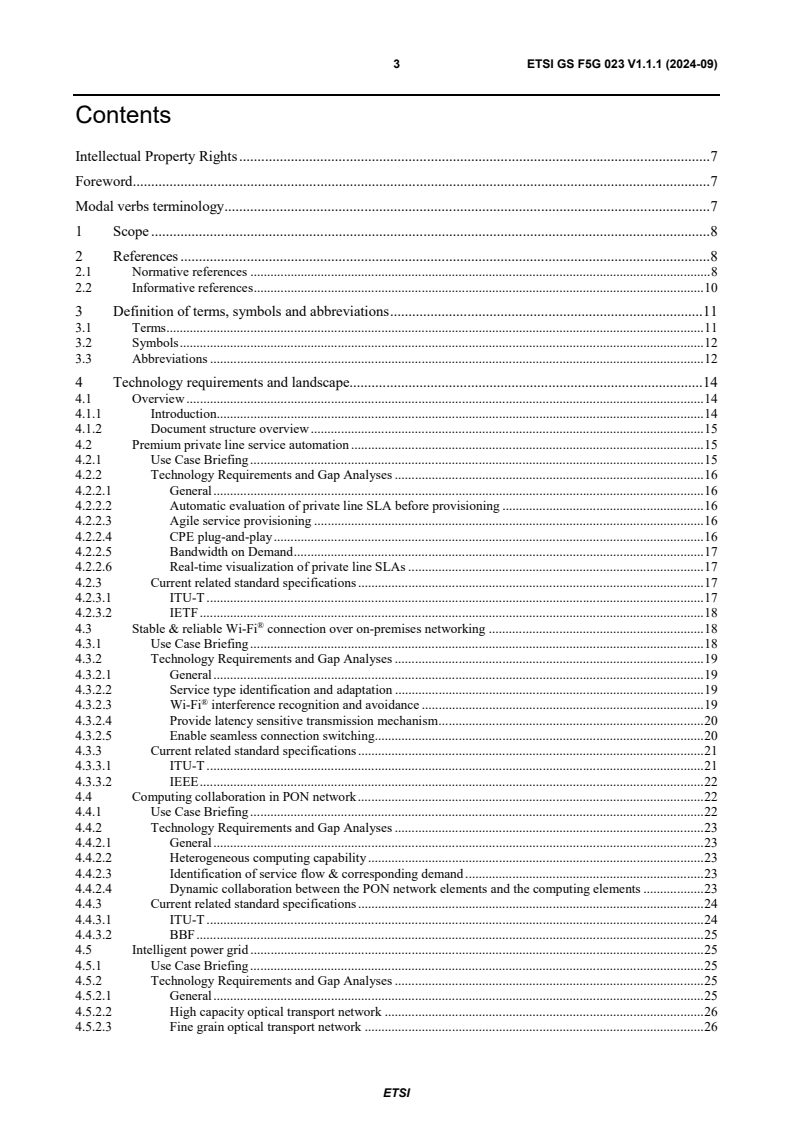
Contents
Intellectual Property Rights . 7
Foreword . 7
Modal verbs terminology . 7
1 Scope . 8
2 References . 8
2.1 Normative references . 8
2.2 Informative references . 10
3 Definition of terms, symbols and abbreviations . 11
3.1 Terms . 11
3.2 Symbols . 12
3.3 Abbreviations . 12
4 Technology requirements and landscape. 14
4.1 Overview . 14
4.1.1 Introduction. 14
4.1.2 Document structure overview . 15
4.2 Premium private line service automation . 15
4.2.1 Use Case Briefing . 15
4.2.2 Technology Requirements and Gap Analyses . 16
4.2.2.1 General . 16
4.2.2.2 Automatic evaluation of private line SLA before provisioning . 16
4.2.2.3 Agile service provisioning . 16
4.2.2.4 CPE plug-and-play . 16
4.2.2.5 Bandwidth on Demand . 17
4.2.2.6 Real-time visualization of private line SLAs . 17
4.2.3 Current related standard specifications . 17
4.2.3.1 ITU-T . 17
4.2.3.2 IETF . 18 ®
4.3 Stable & reliable Wi-Fi connection over on-premises networking . 18
4.3.1 Use Case Briefing . 18
4.3.2 Technology Requirements and Gap Analyses . 19
4.3.2.1 General . 19
4.3.2.2 Service type identification and adaptation . 19 ®
4.3.2.3 Wi-Fi interference recognition and avoidance . 19
4.3.2.4 Provide latency sensitive transmission mechanism . 20
4.3.2.5 Enable seamless connection switching. 20
4.3.3 Current related standard specifications . 21
4.3.3.1 ITU-T . 21
4.3.3.2 IEEE . 22
4.4 Computing collaboration in PON network . 22
4.4.1 Use Case Briefing . 22
4.4.2 Technology Requirements and Gap Analyses . 23
4.4.2.1 General . 23
4.4.2.2 Heterogeneous computing capability . 23
4.4.2.3 Identification of service flow & corresponding demand . 23
4.4.2.4 Dynamic collaboration between the PON network elements and the computing elements . 23
4.4.3 Current related standard specifications . 24
4.4.3.1 ITU-T . 24
4.4.3.2 BBF . 25
4.5 Intelligent power grid . 25
4.5.1 Use Case Briefing . 25
4.5.2 Technology Requirements and Gap Analyses . 25
4.5.2.1 General . 25
4.5.2.2 High capacity optical transport network . 26
4.5.2.3 Fine grain optical transport network . 26
ETSI
4 ETSI GS F5G 023 V1.1.1 (2024-09)
4.5.2.4 End-to-end high quality connection . 27
4.5.3 Current related standard specifications . 28
4.5.3.1 ITU-T . 28
4.5.3.2 IEEE . 30
4.6 Railway perimeter inspection . 30
4.6.1 Use Case Briefing . 30
4.6.2 Technology Requirements and Gap Analyses . 30
4.6.2.1 General . 30
4.6.2.2 Fibre sensing performance . 30
4.6.3 Current related standard specifications . 31
4.6.3.1 ITU-T . 31
4.7 Naked-eye 3D display . 31
4.7.1 Use Case Briefing . 31
4.7.2 Technology Requirements and Gap Analyses . 31
4.7.2.1 General . 31
4.7.2.2 Extremely high throughput . 32
4.7.2.3 Latency restricted transmission . 32
4.8 Unified access and on-premises network . 32
4.8.1 Use Case Briefing . 32
4.8.2 Technology Requirements and Gap Analyses . 33
4.8.2.1 General . 33
4.8.2.2 Provide unified control of data transmission . 33
4.8.2.3 Provide unified management of the whole system . 33
4.8.3 Current related standard specifications . 34
4.8.3.1 ITU-T SG15 . 34
4.8.3.2 ETSI ISG F5G . 34
4.9 OTN intelligent fault management . 35
4.9.1 Use Case Briefing . 35
4.9.2 Technology Requirements and Gap Analyses . 35
4.9.2.1 General . 35
4.9.2.2 OTN alarm aggregation . 35
4.9.2.3 Troubleshooting . 36
4.9.2.4 Fault impact analysis . 36
4.9.2.5 Report of incident information . 36
4.9.3 Current related standard specifications . 37
4.9.3.1 ITU . 37
4.9.3.2 IETF . 37
4.10 Evaluation and assurance of user service experience . 37
4.10.1 Use Case Briefing . 37
4.10.2 Technology Requirements and Gap Analyses . 37
4.10.2.1 General . 37
4.10.2.2 Evaluation of user's service experience . 38
4.10.2.3 User experience demarcation and root cause analysis . 38
4.10.2.4 User experience rectification and audit . 39
4.10.3 Current related standard specifications . 40
4.10.3.1 BBF . 40
4.10.3.2 ETSI . 40
4.11 Cloud Desktop . 40
4.11.1 Use Case Briefing . 40
4.11.2 Technology Requirements and Gap Analyses . 40
4.11.2.1 General . 40
4.11.2.2 Edge cloud infrastructure . 40
4.11.2.3 Enable intelligence in the network . 41
4.11.2.4 Shallow compression techniques . 41
4.12 Dynamically digitalized ODN . 42
4.12.1 Use Case Briefing . 42
4.12.2 Technology Requirements and Gap Analyses . 42
4.12.2.1 General . 42
4.12.2.2 Dynamically visualization of ODN . 42
4.12.2.3 Proactively diagnostic and remote fault location . 43
4.12.2.4 ODN resource management . 43
4.12.3 Current related standard specifications . 43
ETSI
5 ETSI GS F5G 023 V1.1.1 (2024-09)
4.12.3.1 Current ODN related standards . 43
4.13 On-premises Millimetre-Wave (mmWave) WLAN . 43
4.13.1 Use Case Briefing . 43
4.13.2 Technology Requirements and Gap Analyses . 44
4.13.2.1 General . 44
4.13.2.2 Provide necessary throughput to support F5G-A applications . 44 ®
4.13.2.3 Well controlled Wi-Fi signals to support interference free connection . 44 ®
4.13.2.4 Coordination with sub-6 G Wi-Fi . 45
4.13.3 Current related standard specifications . 45
4.13.3.1 ITU-T SG15 . 45
4.13.3.2 IEEE 802.11 . 46
4.14 Wavelength-shared WDM Aggregation Network (AGGN) . 46
4.14.1 Use Case Briefing . 46
4.14.2 Technology Requirements and Gap Analyses . 46
4.14.2.1 Network bandwidth . 46
4.14.2.2 Multiple-ring network and long-haul transmission distance . 47
4.14.2.3 Flexible grooming capability . 47
4.14.2.4 Automatic network O&M . 48
4.14.3 Current related standard specifications . 49
4.14.3.1 ITU-T . 49
4.14.3.2 ETSI . 49
4.14.3.3 IEEE . 49
4.14.3.4 OIF . 49
4.15 Robotics as a Service . 49
4.15.1 Use Case Briefing . 49
4.15.2 Technology Requirements and Gap Analyses . 49
4.15.2.1 General . 49
4.15.2.2 Latency . 49
4.15.2.3 Cable Requirements . 50
4.15.2.4 Ease of Installation . 51
5.15.2.5 Integration of F5G-A networks with ROS and DDS . 51
4.15.3 Current related standard specifications . 51
4.15.3.1 Cable Specifications . 51
4.15.3.2 Data Distribution Service (DDS) . 51
4.16 All-optical base for urban rail transit communication network . 52
4.16.1 Use Case Briefing . 52
4.16.2 Technology Requirements and Gap Analyses . 53
4.16.2.1 General . 53
4.16.2.2 All-optical network base communication network for urban rail transit network . 54
4.16.3 Current related standard specifications . 55
4.16.3.1 ITU-T . 55
4.16.3.2 IEEE . 55
4.17 Optical Fibre sensing for telecom operators . 56
4.17.1 Use Case Briefing . 56
4.17.2 Technology Requirements and Gap Analyses . 56
4.17.2.1 General . 56
4.17.3 Current related standard specifications . 57
4.17.3.1 ITU-T . 57
4.18 QoD App-Flow service provisioning . 58
4.18.1 Use Case Briefing . 58
4.18.2 Technology Requirements and Gap Analyses . 58
4.18.2.1 General . 58
4.18.3 Current related standard specifications . 60
4.18.3.1 CAMARA . 60
4.18.3.2 ITU-T QoS in PON and G.fin . 60
4.18.3.3 F5G Telemetry . 60
5 Technology Landscape Summary . 60
History . 70
ETSI
6 ETSI GS F5G 023 V1.1.1 (2024-09)
Table of Figures
Figure 1: Centralized fibre and wireless coordination architecture (Source: Recommendation ITU-T G.9940 [7]) .21
Figure 2: Protocol stack of G.fin DLL (Source: Recommendation ITU-T G.9942 [9]) .22
Figure 3: An example of management scheme of FTTR (Source: Recommendation ITU-T G.9940 [7]) .25
Figure 4: Overview of the OTN structure .28
Figure 5: Overview of the fgOTN layer network inside OTN .29
Figure 6: The information structure of the fgOTN layer network .29
Figure 7: Incident-based fault management (Source: ETSI GR F5G 020 [i.1]) .35
Figure 8: Overview of the F5G-A Residential broadband QoE evaluation and assurance (Source: ETSI GR F5G 020
[i.1]) .38
Figure 9: An example of mmWave WLAN network .44
Figure 10: Wavelength-shared AGGN configuration.47
Figure 11: Overview of urban rail transit communication system (Source: ETSI GR F5G 020 [i.1]) .53
Figure 12: ITU-T G.dfos scope .57
Table of Tables
Table 1: Summary of Requirements and Gaps .60
Table 2: Suggested actions for identified gaps .66
ETSI
7 ETSI GS F5G 023 V1.1.1 (2024-09)
Intellectual Property Rights
Essential patents
IPRs essential or potentially essential to normative deliverables may have been declared to ETSI. The declarations
pertaining to these essential IPRs, if any, are publicly available for ETSI members and non-members, and can be
found in ETSI SR 000 314: "Intellectual Property Rights (IPRs); Essential, or potentially Essential, IPRs notified to
ETSI in respect of ETSI standards", which is available from the ETSI Secretariat. Latest updates are available on the
ETSI Web server (https://ipr.etsi.org/).
Pursuant to the ETSI Directives including the ETSI IPR Policy, no investigation regarding the essentiality of IPRs,
including IPR searches, has been carried out by ETSI. No guarantee can be given as to the existence of other IPRs not
referenced in ETSI SR 000 314 (or the updates on the ETSI Web server) which are, or may be, or may become,
essential to the present document.
Trademarks
The present document may include trademarks and/or tradenames which are asserted and/or registered by their owners.
ETSI claims no ownership of these except for any which are indicated as being the property of ETSI, and conveys no
right to use or reproduce any trademark and/or tradename. Mention of those trademarks in the present document does
not constitute an endorsement by ETSI of products, services or organizations associated with those trademarks.
DECT™, PLUGTESTS™, UMTS™ and the ETSI logo are trademarks of ETSI registered for the benefit of its
Members. 3GPP™ and LTE™ are trademarks of ETSI registered for the benefit of its Members and of the 3GPP
Organizational Partners. oneM2M™ logo is a trademark of ETSI registered for the benefit of its Members and of the ®
oneM2M Partners. GSM and the GSM logo are trademarks registered and owned by the GSM Association.
Foreword
This Group Specification (GS) has been produced by ETSI Industry Specification Group (ISG) Fifth Generation Fixed
Network (F5G).
Modal verbs terminology
In the present document "shall", "shall not", "should", "should not", "may", "need not", "will", "will not", "can" and
"cannot" are to be interpreted as described in clause 3.2 of the ETSI Drafting Rules (Verbal forms for the expression of
provisions).
"must" and "must not" are NOT allowed in ETSI deliverables except when used in direct citation.
ETSI
8 ETSI GS F5G 023 V1.1.1 (2024-09)
1 Scope
The present document specifies the technology requirements for F5G-A use cases release 3 and explores existing
technologies from related SDOs. The present document performs gap analyses between the technologies required by the
use cases and those that are available. The identification of the relevant SDOs is based on their existing projects.
2 References
2.1 Normative references
References are either specific (identified by date of publication and/or edition number or version number) or
non-specific. For specific references, only the cited version applies. For non-specific references, the latest version of the
referenced document (including any amendments) applies.
Referenced documents which are not found to be publicly available in the expected location might be found at
https://docbox.etsi.org/Reference.
NOTE: While any hyperlinks included in this clause were valid at the time of publication, ETSI cannot guarantee
their long term validity.
The following referenced documents are necessary for the application of the present document.
[1] Recommendation ITU-T G.709/Y.1331: "Interfaces for the optical transport network".
[2] Recommendation ITU-T G.709.20: "Overview of fine grain OTN".
[3] ETSI GS F5G 014: "Fifth Generation Fixed Network (F5G); F5G Network Architecture
Release 2".
[4] IEEE 802.11k™: "IEEE Standard for Information technology -- Local and metropolitan area
networks-- Specific requirements-- Part 11: Wireless LAN Medium Access Control (MAC) and
Physical Layer (PHY) Specifications Amendment 1: Radio Resource Measurement of Wireless
LANs".
[5] IEEE 802.11v™: "IEEE Standard for Information technology -- Local and metropolitan area
networks-- Specific requirements-- Part 11: Wireless LAN Medium Access Control (MAC) and
Physical Layer (PHY) specifications Amendment 8: IEEE 802.11 Wireless Network
Management".
[6] IEEE 802.11r™: "IEEE Standard for Information technology -- Local and metropolitan area
networks-- Specific requirements-- Part 11: Wireless LAN Medium Access Control (MAC) and
Physical Layer (PHY) Specifications Amendment 2: Fast Basic Service Set (BSS) Transition".
[7] Recommendation ITU-T G.9940 (2023): "High speed fibre-based in-premises transceivers -
system architecture".
[8] Recommendation ITU-T G.9941 (2024): "High speed fibre-based in-premises transceivers -
physical layer specification".
[9] Recommendation ITU-T G.9942 (2024): "High speed fibre-based in-premises transceivers - Data
link layer".
[10] Recommendation ITU-T G.988 (2022): "ONU management and control interface (OMCI)
specification".
[11] ETSI GS F5G 013: "Fifth Generation Fixed Network (F5G); F5G Technology Landscape
Release 2".
[12] Recommendation ITU-T G.709.1: "Flexible OTN common elements", consented in the ITU-T
SG15 Plenary Meeting, 20 November - 1 December, 2023.
ETSI
9 ETSI GS F5G 023 V1.1.1 (2024-09)
[13] Recommendation ITU-T G.709.3: "Flexible OTN B100G long-reach interfaces".
[14] Recommendation ITU-T G.709.5: "Flexible OTN short-reach interfaces".
[15] Recommendation ITU-T G.709.6: "Flexible OTN B400G long-reach interfaces".
[16] Recommendation ITU-T G.872: "Architecture of the optical transport network".
[17] IEEE P2893™-2023: "IEEE Approved Draft Standard for Flexible Optical Service Unit
(OSUFlex) of Optical Transport Network (OTN) in Power Systems", published, 14 July, 2023.
[18] Recommendation ITU-T G.823: "The control of jitter and wander within digital networks which
are based on the 2048 kbit/s hierarchy.
[19] Recommendation ITU-T G.825: "The control of jitter and wander within digital networks which
are based on the synchronous digital hierarchy (SDH).
[20] Recommendation ITU-T G.874 (2020.10): "Management aspects of optical transport network
elements".
[21] ETSI GS F5G 015 (V1.2.1): "Fifth Generation Fixed Network (F5G); F5G Residential Services
Quality Evaluation and Classification Release 2".
[22] ETSI GS F5G 017 (V1.1.1): "Fifth Generation Fixed Network (F5G); F5G Measurement
Specification for Residential Services Quality Evaluation".
[23] ETSI GS F5G 026 (V1.1.1): "Fifth Generation Fixed Network (F5G); Architecture and data
models for residential service quality monitoring".
[24] ISO/IEC 14496-10:2022: "Information technology -- Coding of audio-visual objects -- Part 10:
Advanced video coding".
[25] Recommendation ITU-T G.698.2: "Amplified multichannel dense wavelength division
multiplexing applications with single channel optical interfaces".
[26] IEEE 802.3™-2022: "IEEE standards for Ethernet".
th
[27] OIF-400ZR-01.0 March 10 2020: "Implementation Agreement 400ZR".
[28] IEEE 802.3ct™-2021: "IEEE Standard for Ethernet Amendment 13: Physical Layers and
Management Parameters for 100 Gb/s Operation over DWDM Systems".
[29] Recommendation ITU-T G.672: "Characteristics of multi-degree reconfigurable optical add/drop
multiplexers".
[30] Recommendation ITU-T G.7044/Y.1347: "Hitless adjustment of ODUflex (GFP)".
[31] Recommendation ITU-T G.698.4 (2023): "Multichannel bi-directional DWDM applications with port
agnostic single-channel optical interfaces".
[32] ETSI GS F5G 006: "Fifth Generation Fixed Network (F5G); End-to-End Management and
Control; Release #1".
[33] IEEE 802.3df™-2024: "IEEE Standard for Ethernet Amendment 9: Media Access Control
Parameters for 800 Gb/s and Physical Layers and Management Parameters for 400 Gb/s and
800 Gb/s Operation".
[34] Recommendation ITU-T G.9804.3: "50-Gigabit-capable passive optical networks (50G-PON):
Physical media dependent (PMD) layer specification".
[35] Recommendation ITU-T G.987 series: "10-Gigabit-capable passive optical networks (XG-PON)".
ETSI
10 ETSI GS F5G 023 V1.1.1 (2024-09)
2.2 Informative references
References are either specific (identified by date of publication and/or edition number or version number) or
non-specific. For specific references, only the cited version applies. For non-specific references, the latest version of the
referenced document (including any amendments) applies.
NOTE: While any hyperlinks included in this clause were valid at the time of publication, ETSI cannot guarantee
their long term validity.
The following referenced documents are not necessary for the application of the present document but they assist the
user with regard to a particular subject area.
[i.1] ETSI GR F5G 020 (V1.1.1): "Fifth Generation Fixed Network (F5G); F5G Advanced Use Cases;
Release 3".
[i.2] IETF RFC 3945: "Generalized Multi-Protocol Label Switching (GMPLS) Architecture".
[i.3] IETF RFC 7138: "Traffic Engineering Extensions to OSPF for GMPLS Control of Evolving G.709
Optical Transport Networks".
[i.4] IETF RFC 7139: "GMPLS Signalling Extensions for Control of Evolving G.709 Optical Transport
Networks".
[i.5] IETF RFC 9376: "Applicability of GMPLS for beyond 100 Gbit/s Optical Transport Network".
[i.6] draft-ietf-ccamp-otn-topo-yang: "A YANG Data Model for Optical Transport Network Topology".
[i.7] draft-ietf-ccamp-otn-tunnel-model: "OTN Tunnel YANG Model".
[i.8] draft-ietf-ccamp-otn-path-computation-yang: "A YANG Data Model for requesting Path
Computation in an Optical Transport Network (OTN)".
[i.9] draft-ietf-ccamp-l1csm-yang: "A YANG Data Model for L1 Connectivity Service Model
(L1CSM)".
[i.10] draft-ietf-ccamp-client-signal-yang: "A YANG Data Model for Transport Network Client Signals.
[i.11] ITU-T draft G.9943: "High speed fibre-based in-premises transceivers - management".
[i.12] ITU-T draft G.wmci: "WLAN management control interface (WMCI) for in-premises network".
[i.13] IEEE 802.11bn™: "IEEE Standard for Information Technology--Telecommunications and
Information Exchange between Systems - Local and Metropolitan Area Networks--Specific
Requirements - Part 11: Wireless LAN Medium Access Control (MAC) and Physical Layer (PHY)
Specifications Amendment: Enhancements for Ultra High Reliability".
[i.14] BBF oneM2M TR-069: "CPE WAN Management Protocol (CWMP)".
[i.15] BBF oneM2M TR-369: "User Services Platform (USP)".
[i.16] ITU-T draft G.dfos: "Distributed fibre optic sensing".
[i.17] ITU-T draft G.Sup.CMAFP: "Coordinated management of access and fibre on premises
networks".
[i.18] ETSI DGS/F5G-0025: "Fifth Generation Fixed Network (F5G); Architecture of computing
collaboration in PON network".
[i.19] IETF draft-gstk-ccamp-actn-optical-transport-mgmt: "Integrating YANG Configuration and
Management into an Abstraction and Control of TE Networks (ACTN) System for Optical
Networks".
[i.20] BBF oneM2M TR-383: "Common YANG Modules for Access Networks".
[i.21] BBF oneM2M TR-385: "ITU-T PON YANG Modules".
ETSI
---
...
Questions, Comments and Discussion
Ask us and Technical Secretary will try to provide an answer. You can facilitate discussion about the standard in here.
Loading comments...