


ETSI GS PDL 024 V1.1.1 (2024-11)
Permissioned Distributed Ledgers (PDL); Architecture enhancements for PDL service provisioning in telecom networks
Permissioned Distributed Ledgers (PDL); Architecture enhancements for PDL service provisioning in telecom networks
DGS/PDL-0024_Arch_Serv_prov
General Information
Standards Content (Sample)
GROUP SPECIFICATION
Permissioned Distributed Ledgers (PDL);
Architecture enhancements for PDL service provisioning
in telecom networks
Disclaimer
The present document has been produced and approved by the Permissioned Distributed Ledger (PDL) ETSI Industry
Specification Group (ISG) and represents the views of those members who participated in this ISG.
It does not necessarily represent the views of the entire ETSI membership.
2 ETSI GS PDL 024 V1.1.1 (2024-11)
Reference
DGS/PDL-0024_Arch_Serv_prov
Keywords
architecture, distributed ledger
ETSI
650 Route des Lucioles
F-06921 Sophia Antipolis Cedex - FRANCE
Tel.: +33 4 92 94 42 00 Fax: +33 4 93 65 47 16
Siret N° 348 623 562 00017 - APE 7112B
Association à but non lucratif enregistrée à la
Sous-Préfecture de Grasse (06) N° w061004871
Important notice
The present document can be downloaded from the
ETSI Search & Browse Standards application.
The present document may be made available in electronic versions and/or in print. The content of any electronic and/or
print versions of the present document shall not be modified without the prior written authorization of ETSI. In case of any
existing or perceived difference in contents between such versions and/or in print, the prevailing version of an ETSI
deliverable is the one made publicly available in PDF format on ETSI deliver repository.
Users should be aware that the present document may be revised or have its status changed,
this information is available in the Milestones listing.
If you find errors in the present document, please send your comments to
the relevant service listed under Committee Support Staff.
If you find a security vulnerability in the present document, please report it through our
Coordinated Vulnerability Disclosure (CVD) program.
Notice of disclaimer & limitation of liability
The information provided in the present deliverable is directed solely to professionals who have the appropriate degree of
experience to understand and interpret its content in accordance with generally accepted engineering or
other professional standard and applicable regulations.
No recommendation as to products and services or vendors is made or should be implied.
No representation or warranty is made that this deliverable is technically accurate or sufficient or conforms to any law
and/or governmental rule and/or regulation and further, no representation or warranty is made of merchantability or fitness
for any particular purpose or against infringement of intellectual property rights.
In no event shall ETSI be held liable for loss of profits or any other incidental or consequential damages.
Any software contained in this deliverable is provided "AS IS" with no warranties, express or implied, including but not
limited to, the warranties of merchantability, fitness for a particular purpose and non-infringement of intellectual property
rights and ETSI shall not be held liable in any event for any damages whatsoever (including, without limitation, damages
for loss of profits, business interruption, loss of information, or any other pecuniary loss) arising out of or related to the use
of or inability to use the software.
Copyright Notification
No part may be reproduced or utilized in any form or by any means, electronic or mechanical, including photocopying and
microfilm except as authorized by written permission of ETSI.
The content of the PDF version shall not be modified without the written authorization of ETSI.
The copyright and the foregoing restriction extend to reproduction in all media.
© ETSI 2024.
All rights reserved.
ETSI
3 ETSI GS PDL 024 V1.1.1 (2024-11)
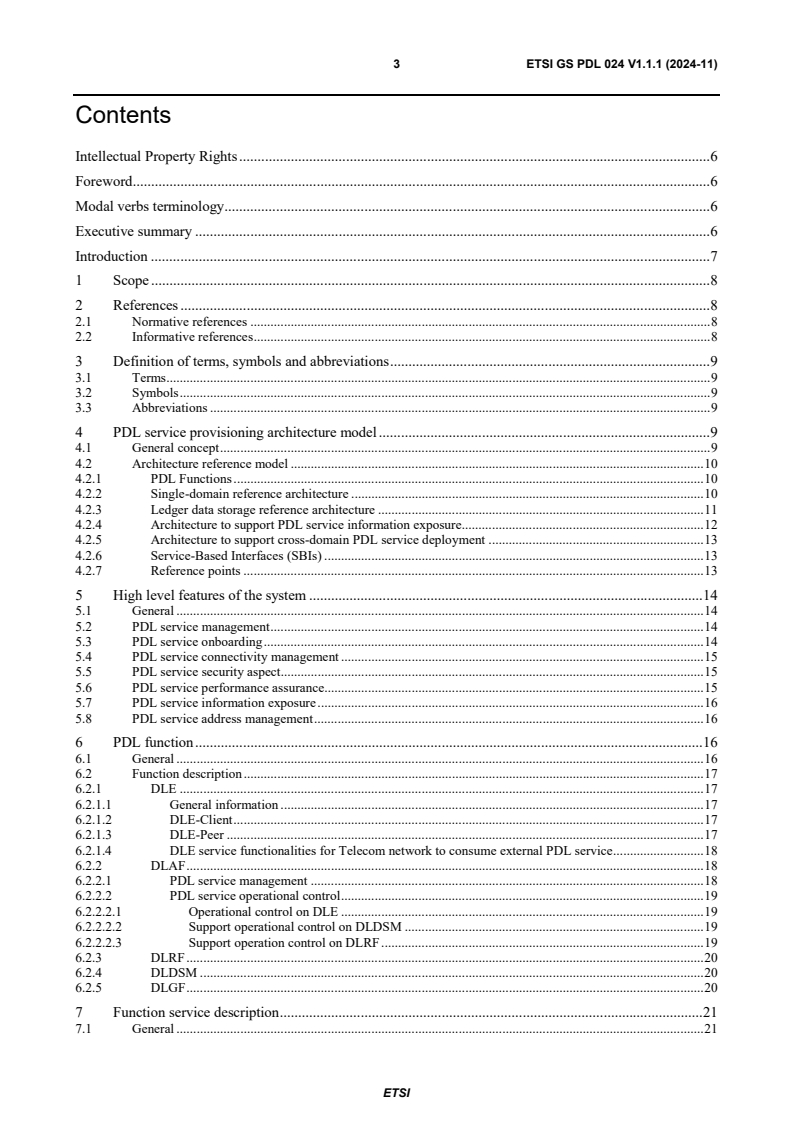
Contents
Intellectual Property Rights . 6
Foreword . 6
Modal verbs terminology . 6
Executive summary . 6
Introduction . 7
1 Scope . 8
2 References . 8
2.1 Normative references . 8
2.2 Informative references . 8
3 Definition of terms, symbols and abbreviations . 9
3.1 Terms . 9
3.2 Symbols . 9
3.3 Abbreviations . 9
4 PDL service provisioning architecture model . 9
4.1 General concept . 9
4.2 Architecture reference model . 10
4.2.1 PDL Functions . 10
4.2.2 Single-domain reference architecture . 10
4.2.3 Ledger data storage reference architecture . 11
4.2.4 Architecture to support PDL service information exposure. 12
4.2.5 Architecture to support cross-domain PDL service deployment . 13
4.2.6 Service-Based Interfaces (SBIs) . 13
4.2.7 Reference points . 13
5 High level features of the system . 14
5.1 General . 14
5.2 PDL service management . 14
5.3 PDL service onboarding . 14
5.4 PDL service connectivity management . 15
5.5 PDL service security aspect. 15
5.6 PDL service performance assurance. 15
5.7 PDL service information exposure . 16
5.8 PDL service address management . 16
6 PDL function . 16
6.1 General . 16
6.2 Function description . 17
6.2.1 DLE . 17
6.2.1.1 General information . 17
6.2.1.2 DLE-Client . 17
6.2.1.3 DLE-Peer . 17
6.2.1.4 DLE service functionalities for Telecom network to consume external PDL service . 18
6.2.2 DLAF . 18
6.2.2.1 PDL service management . 18
6.2.2.2 PDL service operational control . 19
6.2.2.2.1 Operational control on DLE . 19
6.2.2.2.2 Support operational control on DLDSM . 19
6.2.2.2.3 Support operation control on DLRF . 19
6.2.3 DLRF . 20
6.2.4 DLDSM . 20
6.2.5 DLGF . 20
7 Function service description . 21
7.1 General . 21
ETSI
4 ETSI GS PDL 024 V1.1.1 (2024-11)
7.2 DLAF services . 21
7.3 DLE services . 23
7.4 DLRF Services . 24
7.5 DLDSM services . 25
7.6 DLGF services . 26
7.7 Summary . 27
8 Procedures for PDL service provisioning system . 27
8.1 PDL service provisioning procedures . 27
8.1.1 PDL service description . 27
8.1.2 DLE instantiation . 28
8.1.3 PDL service deployment . 29
8.1.4 PDL service onboarding . 30
8.1.5 PDL service update . 31
8.1.6 PDL service termination . 32
8.1.7 DLE redaction capability provisioning . 33
8.2 Information exposure procedures . 35
8.2.1 DLE information exposure . 35
8.2.1.1 General information . 35
8.2.1.2 DLE direct exposure . 35
8.2.1.3 DLE indirect exposure . 36
8.2.2 DLRF information exposure . 36
8.2.3 PDL service information exposure . 37
8.2.3.1 General information . 37
8.2.3.2 PDL service internal exposure . 38
8.2.3.3 PDL service external exposure via NEF . 39
8.2.4 DLDSM information exposure . 39
8.3 Mobility management procedures . 40
8.3.1 General Information . 40
8.3.2 PDL service network scale-up . 41
8.3.2.1 A new DLE joining in via DLAF . 41
8.3.2.2 A new DLE joining in via a peer DLE . 41
8.3.3 PDL Service Network Scale-Down . 42
8.3.3.1 Direct DLE leaving a PDL service network . 42
8.3.3.2 Indirect DLE Leaving a PDL Service network . 43
8.4 PDL service address management procedure . 44
9 Integration recommendation of PDL capability with telecom networks . 45
9.1 General information . 45
9.2 Telecom-native PDL capability . 45
9.3 Telecom-connected PDL capability . 46
9.4 Deployment Considerations of PDL Functions . 46
9.4.1 DLAF Deployment Options . 46
9.4.2 DLRF Deployment Options . 47
9.4.3 DLDSM Deployment Options . 47
9.4.4 DLE Deployment Options . 47
9.4.5 DLGF Deployment Options . 47
9.5 Mapping and Classification of PDL Functions in Telecom Networks . 48
9.5.1 Introduction. 48
9.5.2 PDL function Classification . 48
9.5.3 Possible Mapping to Existing Operation Planes in Telecom Networks . 48
9.6 PDL service deployment considerations . 49
9.6.1 Single-operator provisioning . 49
9.6.2 Multi-operator/party provisioning . 49
9.7 Summary . 50
10 Conclusion . 50
10.1 General information . 50
10.2 Recommendation for the next steps . 50
History . 51
ETSI
5 ETSI GS PDL 024 V1.1.1 (2024-11)
Table of figures
Figure 1: Single-domain PDL service architecture model with SBI in control plane .10
Figure 2: Single-domain PDL service architecture model with reference point representation .11
Figure 3: Architecture for external ledger data storage .12
Figure 4: Architecture for PDL service information exposure .12
Figure 5: Architecture for cross-domain PDL service provisioning .13
Figure 6: Telecom network consuming PDL service(s) via DLE-SF .18
Figure 7: Procedure to instantiate a DLE instance by sending a request to domain resource managers .28
Figure 8: Procedure for provisioning a PDL service by a DLAF to a set of DLE instances .29
Figure 9: Procedure for PDL service onboarding .30
Figure 10: Procedure for update an existing PDL service in the network .31
Figure 11: Procedure for terminating an existing PDL service in the network .32
Figure 12: Ledger Redaction Capability Provisioning .33
Figure 13: Procedure for DLE information direct exposure .35
Figure 14: Procedure for DLE information indirect exposure .36
Figure 15: Procedure for DLRF information exposure .37
Figure 16: Procedure for PDL service internal exposure to other NFs in the network .38
Figure 17: Procedure for PDL service exposure to an external party .39
Figure 18: Procedure for DLDSM information exposure .40
Figure 19: Procedure for a DLE joining a PDL service network via DLAF .41
Figure 20: Procedure for a DLE joining a PDL service network via a peer DLE .41
Figure 21: Procedure for a DLE leaving a PDL service network via DLAF .42
Figure 22: Procedure for a DLE leaving a PDL service network via a peer DLE .43
Figure 23: Create Mapping Record between Blockchain Address and 3GPP Identifier .44
Figure 24: A Telecom-native PDL capability integration .46
Figure 25: Telecom network-connected PDL capability integration .46
Figure 26: Multi-Operator PDL service provisioning organization .49
Figure 27: Multi-Party PDL Service Provisioning Organization .49
ETSI
6 ETSI GS PDL 024 V1.1.1 (2024-11)
Intellectual Property Rights
Essential patents
IPRs essential or potentially essential to normative deliverables may have been declared to ETSI. The declarations
pertaining to these essential IPRs, if any, are publicly available for ETSI members and non-members, and can be
found in ETSI SR 000 314: "Intellectual Property Rights (IPRs); Essential, or potentially Essential, IPRs notified to
ETSI in respect of ETSI standards", which is available from the ETSI Secretariat. Latest updates are available on the
ETSI IPR online database.
Pursuant to the ETSI Directives including the ETSI IPR Policy, no investigation regarding the essentiality of IPRs,
including IPR searches, has been carried out by ETSI. No guarantee can be given as to the existence of other IPRs not
referenced in ETSI SR 000 314 (or the updates on the ETSI Web server) which are, or may be, or may become,
essential to the present document.
Trademarks
The present document may include trademarks and/or tradenames which are asserted and/or registered by their owners.
ETSI claims no ownership of these except for any which are indicated as being the property of ETSI, and conveys no
right to use or reproduce any trademark and/or tradename. Mention of those trademarks in the present document does
not constitute an endorsement by ETSI of products, services or organizations associated with those trademarks.
DECT™, PLUGTESTS™, UMTS™ and the ETSI logo are trademarks of ETSI registered for the benefit of its
Members. 3GPP™, LTE™ and 5G™ logo are trademarks of ETSI registered for the benefit of its Members and of the
3GPP Organizational Partners. oneM2M™ logo is a trademark of ETSI registered for the benefit of its Members and of ®
the oneM2M Partners. GSM and the GSM logo are trademarks registered and owned by the GSM Association.
Foreword
This Group Specification (GS) has been produced by ETSI Industry Specification Group (ISG) Permissioned
Distributed Ledger (PDL).
Modal verbs terminology
In the present document "shall", "shall not", "should", "should not", "may", "need not", "will", "will not", "can" and
"cannot" are to be interpreted as described in clause 3.2 of the ETSI Drafting Rules (Verbal forms for the expression of
provisions).
"must" and "must not" are NOT allowed in ETSI deliverables except when used in direct citation.
Executive summary
The present document outlines the architecture enhancements for Permissioned Distributed Ledger (PDL) service
provisioning in telecom networks. The present document, produced by the ETSI Industry Specification Group (ISG) for
Permissioned Distributed Ledger (PDL), aims to specify the technical solutions necessary for enabling telecom
networks to provision various PDL services over their infrastructure. Key aspects of the present document include:
• PDL Service Provisioning Architecture Model: The architecture model is designed to accommodate and
operate PDL services in next-generation telecom networks, taking into account the constraints of Public Land
Mobile Networks (PLMNs) such as geographically segmented network domains and heterogeneous resource
capacities.
• PDL Functions: The architecture consists of several PDL functions, including the Distributed Ledger Anchor
Function (DLAF), Distributed Ledger Repository Function (DLRF), Distributed Ledger Enabler (DLE),
Distributed Ledger Data Storage Management (DLDSM), and Distributed Ledger Governance
Function (DLGF).
ETSI
7 ETSI GS PDL 024 V1.1.1 (2024-11)
• High-Level Features: The present document specifies high-level functionalities and features of the PDL
provisioning architecture, including PDL service management, onboarding, connectivity management, security
aspects, performance assurance, and information exposure.
• Procedures for PDL Service Provisioning: Detailed procedures are provided for PDL service provisioning,
including service description, DLE instantiation, service deployment, onboarding, update, termination, and
redaction capability provisioning.
• Integration with Telecom Networks: The present document discusses various integration options for PDL
capabilities with telecom networks, including telecom-native and telecom-connected PDL capabilities, and
deployment considerations for PDL functions.
• Recommendations: The present document concludes with recommendations for further study on integrating
the proposed PDL service provisioning architecture with telecom network architecture to provide
PDL-enhanced telecom network services, focusing on signalling protocol design, integration of PDL service
procedures with telecom network service procedures, and integration of PDL service signalling with telecom
network service protocols.
Introduction
The present document outlines the architecture enhancements for Permissioned Distributed Ledger (PDL) service
provisioning in telecom networks. Produced by the ETSI Industry Specification Group (ISG) for Permissioned
Distributed Ledger (PDL), the present document aims to specify the technical solutions necessary for enabling telecom
networks to provision various PDL services over their infrastructure. The integration of PDL capabilities into telecom
networks is driven by the need for secure, reliable, and scalable distributed ledger services that can support a wide range
of applications, from basic mobile internet connectivity to compute-oriented tasks for both mobile users and
Over-The-Top (OTT) service providers. The proposed enhancements focus on extending the architectural and signalling
aspects of telecom networks to integrate distributed ledger capabilities as part of their native features. The present
document covers the architecture model for PDL service provisioning, high-level features of the system, detailed
descriptions of PDL functions, and procedures for PDL service provisioning. It also discusses various integration
options for PDL capabilities with telecom networks, including telecom-native and telecom-connected PDL capabilities,
and provides recommendations for further study on integrating the proposed PDL service provisioning architecture with
telecom network architecture to provide PDL-enhanced telecom network services.
ETSI
8 ETSI GS PDL 024 V1.1.1 (2024-11)
1 Scope
The present document will specify technical solutions for enabling a telecom network to be capable of provisioning
various PDL services over the infrastructure itself. The scope of the present document aims to specify required
end-to-end enhancements/modifications on:
1) The telecom network architecture across user entities, (radio) access network, core network and service
providers (e.g. by adding new functions or enhancing functions);
2) Functionalities of the new functions and/or enhanced functions; and
3) Interfaces and procedures among the new functions and/or existing functions.
2 References
2.1 Normative references
References are either specific (identified by date of publication and/or edition number or version number) or
non-specific. For specific references, only the cited version applies. For non-specific references, the latest version of the
referenced document (including any amendments) applies.
Referenced documents which are not found to be publicly available in the expected location might be found in the
ETSI docbox.
NOTE: While any hyperlinks included in this clause were valid at the time of publication, ETSI cannot guarantee
their long term validity.
The following referenced documents are necessary for the application of the present document.
[1] ETSI GS PDL 012 (V1.1.1): "Permissioned Distributed Ledger (PDL); Reference Architecture".
[2] ETSI GS PDL 023 (V1.1.1): "PDL service enablers for Decentralized Identification and Trust
Management".
2.2 Informative references
References are either specific (identified by date of publication and/or edition number or version number) or
non-specific. For specific references, only the cited version applies. For non-specific references, the latest version of the
referenced document (including any amendments) applies.
NOTE: While any hyperlinks included in this clause were valid at the time of publication, ETSI cannot guarantee
their long term validity.
The following referenced documents are not necessary for the application of the present document but they assist the
user with regard to a particular subject area. ®
[i.1] "Merkle-tree" from Wikipedia in English, 10 September 2024. Page Version ID: 1245066542. ®
[i.2] "Trie" from Wikipedia in English, 02 September 2024. Page Version ID: 1243621934.
rd
[i.3] 3GPP TS 23.501 (V19.0.0): "3 Generation Partnership Project; Technical Specification Group
Services and System Aspects; System architecture for the 5G System (5GS); Stage 2
(Release 19)".
ETSI
9 ETSI GS PDL 024 V1.1.1 (2024-11)
3 Definition of terms, symbols and abbreviations
3.1 Terms
Void.
3.2 Symbols
Void.
3.3 Abbreviations
For the purposes of the present document, the following abbreviations apply:
rd
3GPP 3 Generation Partnership Project
AF Application Function
AMF Access and Mobility Function
AUSF Authentication Server Function
CMP Certificate Management Protocol
DAPP Decentralized APPlication
DLAF Distributed Ledger Anchor Function
DLDSM Distributed Ledger Data Storage Management
DLE Distributed Ledger Enabler
DLGF Distributed Ledger Governance Function
DLRF Distributed Ledger Repository Function
DN Data Network
KPI Key Performance Indicator
LBO Local Break Out
NEF Network Exposure Function
NF Network Function
OTT Over The Top
PDU Packet Data Unit
PLMN Public Land Mobile Network
SBI Service Based Interface
SEPP Security Edge Protection Proxy
SF Service Function
SMF Service Management Function
TEE Trust Execution Environment
UE User Equipment
UPF User Plane Function
4 PDL service provisioning architecture model
4.1 General concept
The architecture model for PDL service provisioning is to design the minimum set of PDL functions that are required to
accommodate and operate a PDL service from a user in the next generation of telecom networks. A user can be either
an end user like a UE or an Over-The-Top (OTT) tenant, or even the operator itself. The general concept to design the
architecture model is to take into account the constraints of a PLMN such as geographically segmented network
domains, distributed infrastructure elements and heterogeneous resource capacities across the entire network
infrastructure. Some key concepts are to:
• Modularize the PDL function design.
ETSI
10 ETSI GS PDL 024 V1.1.1 (2024-11)
• Enable each PDL function and its services to interact with other PDL functions and their services directly or
indirectly via a Service Communication Proxy if required. The architecture will reuse all available
intermediate functions from the underlying PLMN to route Certificate Management Protocol (CMP) messages.
• Wherever applicable, define procedures (i.e. the set of interactions between PDL functions) as services, so that
their re-use is possible.
• Support capability exposure.
4.2 Architecture reference model
4.2.1 PDL Functions
The PDL service provisioning architecture consists of the following PDL functions:
• Distributed Ledger Anchor Function (DLAF).
• Distributed Ledger Repository Function (DLRF).
• Distributed Ledger Enabler (DLE).
• Distributed Ledger Enabler Service Function (DLE-SF).
• Distributed Ledger Data Storage Management (DLDSM).
• Distributed Ledger Governance Function (DLGF).
4.2.2 Single-domain reference architecture
Figure 1 depicts a single-domain PDL service system architecture, where Service-Based Interfaces (SBI) are used in the
PDL service control and management plane:
Figure 1: Single-domain PDL service architecture model with SBI in control plane
ETSI
11 ETSI GS PDL 024 V1.1.1 (2024-11)
Figure 2 depicts the single-domain PDL service system architecture with reference points:
Figure 2: Single-domain PDL service architecture model with reference point representation
The architecture model represents a scenario where a DLE-Client accesses a PDL service realized by multiple
DLE-Peers organized as a distributed ledger (or Blockchain) network deployed in a telecom network. The PDL service
connects to a Data Network (DN). This PDL service is managed and controlled by a set of PDL functions at the upper
part. In addition, the PDL functions can further interact with other telecom network control functions that are typically
for existing 3GPP network services.
NOTE 1: A DLE can be a standalone function that is deployed as an individual physical or virtual function; or a
DLE can be a non-standalone function that is co-located with other network functions in the telecom
network infrastructure (as shown with the dash box outside). For example, a DLE can co-exist with a
User Plane Function (UPF).
NOTE 2: DLDSM provides external ledger storage capacity if a DLE has limits in capacity or availability time.
NOTE 3: Another PDL service network can be provisioned in DN. The existing PDL service running on DLEs can
access to the other PDL service network via Nxuf interface. This interface can link to a UPF or a direct
connection to DN. A PDL service network in DN can run the same PDL service of one consortium or a
different PDL service for inter-ledger/blockchain operations. In addition, the other way to inter-work with
another PDL service network is via Security Edge Protection Proxy (SEPP), instead of UPF.
NOTE 4: The PDL service architecture part may need to interact with network functions (NFs) / entities in the same
telecom network for a PDL service provisioning.
NOTE 5: Nxcf interface represents the interactions between DLAF and network functions for operational purposes
in the same telecom network. The interactions are done by using the services provided by both DLAF and
other NFs over 3GPP SBIs.
4.2.3 Ledger data storage reference architecture
Figure 3 depicts the architecture model for external storage of the ledger data from DLE. This provides alternatives to a
PDL service to offload the ledger data if there are limits on the local DLE such as short of storage or service time
termination and so on.
ETSI
12 ETSI GS PDL 024 V1.1.1 (2024-11)
NOTE: DLDSM only handles PDL service data instead of the operational data. When the PDL service data is
offloaded from a DLE to DLDSM (and to a storage), privacy-preserving and data security policies have to
be considered.
Figure 3: Architecture for external ledger data storage
4.2.4 Architecture to support PDL service information exposure
A vertical user shall be able to know the status of a PDL service that is provisioned in a telecom network. The
architecture shall be able to expose the information and data of a PDL service to the end user, the tenant or both. This is
related to Service Level Agreement (SLA), QoS control or relevant service intervention from an external party. Figure 4
depicts the architecture for PDL service information exposure:
Figure 4: Architecture for PDL service information exposure
The information of a PDL service can be shared internally and externally via an SBI manner. For internal cases,
operators may need the service information of the provisioned PDL service for operational purposes such as charging,
QoS adaption and so on. For external cases, service providers may also need the service information to determine how
to influence and/or interact with the operator for service adaptation and so on.
ETSI
13 ETSI GS PDL 024 V1.1.1 (2024-11)
4.2.5 Architecture to support cross-domain PDL service deployment
Figure 5 depicts the architecture for cross-domain PDL service deployment:
Figure 5: Architecture for cross-domain PDL service provisioning
A PDL service can be deployed across multiple PLMN domains. Different domains can refer different operational
domains of one PLMN operator, or different network domains of different PLMN operators where their ownerships can
be completely different.
NOTE: A PDL service provisioning is assumed that it is not done in a Local-Break-Out (LBO) mode when a
DLE-Client roams in a visiting PLMN. Unlike a PDU session, a PDL service semantically involves
ledger data that are stored in the PLMN(s) where it is initially provisioned. If a visiting PLMN does not
participate the provisioning of that PDL service, a more efficient way is to connect the roaming
DLE-Client back to its home PLMN and access the PDL service back there. Temporally extending a PDL
service to a visiting PLMN requires much more efforts to build the PDL service network in the visiting
PLMN part, which could trigger a lot of overheads in both PLMNs (for signalling and synchronization).
4.2.6 Service-Based Interfaces (SBIs)
The PDL service provisioning system architecture contains the following SBIs:
Sdlaf: SBI of DLAF
Sdlrf: SBI of DLRF
Sdldsm: SBI of DLDSM
Sdlgf: SBI of DLGF
4.2.7 Reference points
The PDL service provisioning system architecture contains the following reference points:
Intf1: Reference point between the PDL-Client and DLAF
Intf2: Reference point between the PDL-Client and DLE
Intf3: Reference point between the DLAF and DLE
Intf4: Reference point between the DLAF and DLDSM
Intf5: Reference point between two DLEs
Intf6: Reference point between the DLE and DLDSM
ETSI
14 ETSI GS PDL 024 V1.1.1 (2024-11)
Nxuf: Reference point between the DLE and user plane connecting to DN
Intf8: Reference point between the DLAF and DLRF
Intf9: Reference point between the DLGF and DLAF
Intf10: Reference point between the DLGF and DLRF
Nxcf: A group of interfaces between the DLAF and other Telecom Network Functions
NOTE: The reference point between the DLAF and other telecom network (control) functions reuse the reference
points defined in 3GPP TS 23.501 [i.3] for interacting with typical Network Functions (NFs) in a PLMN.
5 High level features of the system
5.1 General
This clause specifies the high-level functionalities and features of the PDL provisioning architecture.
5.2 PDL service management
The PDL service architecture shall support the whole lifecycle management and control of a PDL service from the time
the PDL service is requested, its provisioning, deployment and operations, until its termination. In addition, the PDL
service architecture shall also support the management of smart contracts intended to be deployed as an application
logic of the PDL service. Specifically, PDL service management shall realize the following features:
• Handle and parse the PDL service deployment request.
• Identify network resources feasible for PDL service deployment request.
• Configure network resources with DLE capabilities (e.g. with software libraries, service policies and so on).
• Manage PDL service network topology (e.g. topological structure, links among DLEs and so on).
• Configure DLE's profile for a PDL service (e.g. consensus protocol, redaction policy and participating roles).
• Review and publish smart contracts of a PDL service (e.g. compatibility, validness and threat analysis of a
smart contract), which is the responsibility of DLAF and/or DLGF.
5.3 PDL service onboarding
To leverage PDL technology for enabling future trustworthy wireless sys
...
Questions, Comments and Discussion
Ask us and Technical Secretary will try to provide an answer. You can facilitate discussion about the standard in here.
Loading comments...