


ETSI TS 103 789 V1.1.1 (2023-05)
Short Range Devices (SRD) and Ultra Wide Band (UWB); Radar related parameters and physical test setup for object detection, identification and RCS measurement
Short Range Devices (SRD) and Ultra Wide Band (UWB); Radar related parameters and physical test setup for object detection, identification and RCS measurement
DTS/ERM-TGUWB-608
General Information
Standards Content (Sample)
TECHNICAL SPECIFICATION
Short Range Devices (SRD) and Ultra Wide Band (UWB);
Radar related parameters and physical test setup for
object detection, identification and RCS measurement
2 ETSI TS 103 789 V1.1.1 (2023-05)
Reference
DTS/ERM-TGUWB-608
Keywords
measurement, radar, radiodetermination, SRD,
UWB
ETSI
650 Route des Lucioles
F-06921 Sophia Antipolis Cedex - FRANCE
Tel.: +33 4 92 94 42 00 Fax: +33 4 93 65 47 16
Siret N° 348 623 562 00017 - APE 7112B
Association à but non lucratif enregistrée à la
Sous-Préfecture de Grasse (06) N° w061004871
Important notice
The present document can be downloaded from:
https://www.etsi.org/standards-search
The present document may be made available in electronic versions and/or in print. The content of any electronic and/or
print versions of the present document shall not be modified without the prior written authorization of ETSI. In case of any
existing or perceived difference in contents between such versions and/or in print, the prevailing version of an ETSI
deliverable is the one made publicly available in PDF format at www.etsi.org/deliver.
Users of the present document should be aware that the document may be subject to revision or change of status.
Information on the current status of this and other ETSI documents is available at
https://portal.etsi.org/TB/ETSIDeliverableStatus.aspx
If you find errors in the present document, please send your comment to one of the following services:
https://portal.etsi.org/People/CommiteeSupportStaff.aspx
If you find a security vulnerability in the present document, please report it through our
Coordinated Vulnerability Disclosure Program:
https://www.etsi.org/standards/coordinated-vulnerability-disclosure
Notice of disclaimer & limitation of liability
The information provided in the present deliverable is directed solely to professionals who have the appropriate degree of
experience to understand and interpret its content in accordance with generally accepted engineering or
other professional standard and applicable regulations.
No recommendation as to products and services or vendors is made or should be implied.
No representation or warranty is made that this deliverable is technically accurate or sufficient or conforms to any law
rule and/or regulation and further, no representation or warranty is made of merchantability or fitness
and/or governmental
for any particular purpose or against infringement of intellectual property rights.
In no event shall ETSI be held liable for loss of profits or any other incidental or consequential damages.
Any software contained in this deliverable is provided "AS IS" with no warranties, express or implied, including but not
limited to, the warranties of merchantability, fitness for a particular purpose and non-infringement of intellectual property
rights and ETSI shall not be held liable in any event for any damages whatsoever (including, without limitation, damages
for loss of profits, business interruption, loss of information, or any other pecuniary loss) arising out of or related to the use
of or inability to use the software.
Copyright Notification
No part may be reproduced or utilized in any form or by any means, electronic or mechanical, including photocopying and
microfilm except as authorized by written permission of ETSI.
The content of the PDF version shall not be modified without the written authorization of ETSI.
The copyright and the foregoing restriction extend to reproduction in all media.
© ETSI 2023.
All rights reserved.
ETSI
3 ETSI TS 103 789 V1.1.1 (2023-05)
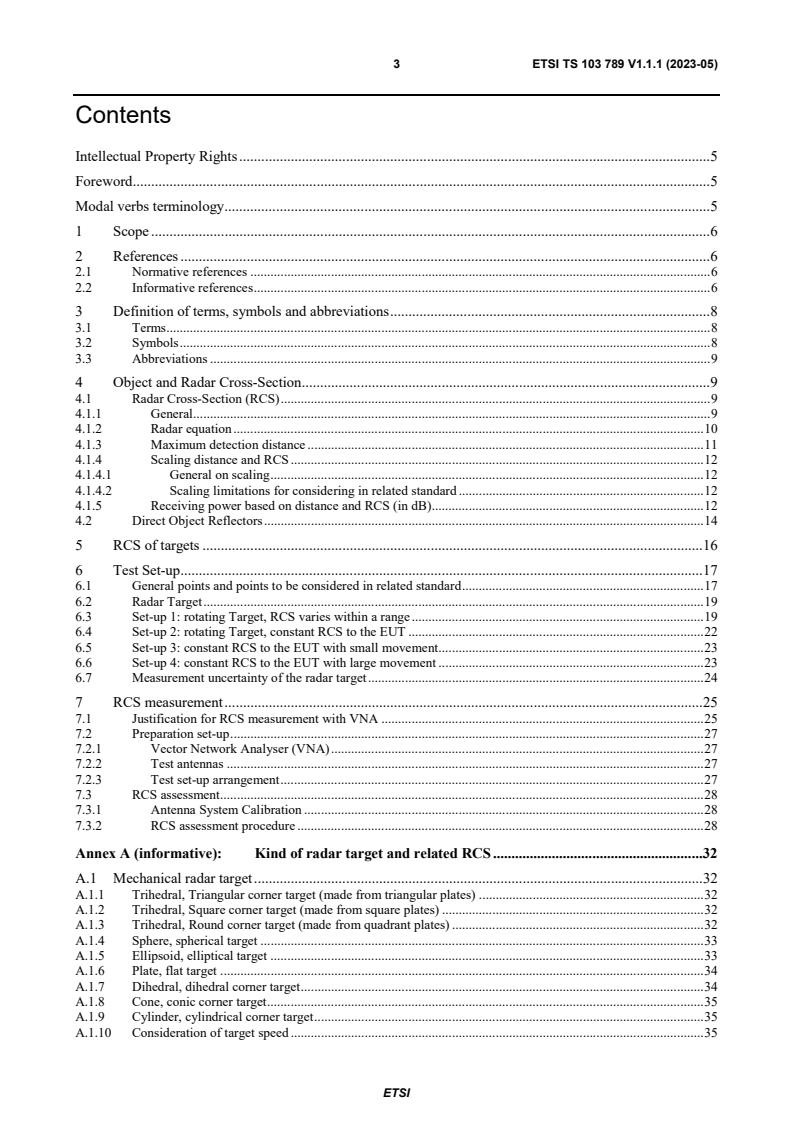
Contents
Intellectual Property Rights . 5
Foreword . 5
Modal verbs terminology . 5
1 Scope . 6
2 References . 6
2.1 Normative references . 6
2.2 Informative references . 6
3 Definition of terms, symbols and abbreviations . 8
3.1 Terms . 8
3.2 Symbols . 8
3.3 Abbreviations . 9
4 Object and Radar Cross-Section . 9
4.1 Radar Cross-Section (RCS) . 9
4.1.1 General . 9
4.1.2 Radar equation . 10
4.1.3 Maximum detection distance . 11
4.1.4 Scaling distance and RCS . 12
4.1.4.1 General on scaling . 12
4.1.4.2 Scaling limitations for considering in related standard . 12
4.1.5 Receiving power based on distance and RCS (in dB) . 12
4.2 Direct Object Reflectors . 14
5 RCS of targets . 16
6 Test Set-up . 17
6.1 General points and points to be considered in related standard . 17
6.2 Radar Target . 19
6.3 Set-up 1: rotating Target, RCS varies within a range . 19
6.4 Set-up 2: rotating Target, constant RCS to the EUT . 22
6.5 Set-up 3: constant RCS to the EUT with small movement . 23
6.6 Set-up 4: constant RCS to the EUT with large movement . 23
6.7 Measurement uncertainty of the radar target . 24
7 RCS measurement . 25
7.1 Justification for RCS measurement with VNA . 25
7.2 Preparation set-up . 27
7.2.1 Vector Network Analyser (VNA) . 27
7.2.2 Test antennas . 27
7.2.3 Test set-up arrangement . 27
7.3 RCS assessment . 28
7.3.1 Antenna System Calibration . 28
7.3.2 RCS assessment procedure . 28
Annex A (informative): Kind of radar target and related RCS . 32
A.1 Mechanical radar target . 32
A.1.1 Trihedral, Triangular corner target (made from triangular plates) . 32
A.1.2 Trihedral, Square corner target (made from square plates) . 32
A.1.3 Trihedral, Round corner target (made from quadrant plates) . 32
A.1.4 Sphere, spherical target . 33
A.1.5 Ellipsoid, elliptical target . 33
A.1.6 Plate, flat target . 34
A.1.7 Dihedral, dihedral corner target . 34
A.1.8 Cone, conic corner target . 35
A.1.9 Cylinder, cylindrical corner target . 35
A.1.10 Consideration of target speed . 35
ETSI
4 ETSI TS 103 789 V1.1.1 (2023-05)
A.1.11 Boundary conditions of the RCS equations . 35
A.2 RCS based on material parameter/material surfaces . 42
A.2.1 General . 42
A.2.2 Theory reflections on dielectric surfaces . 42
A.2.3 Special cases . 45
A.2.3.1 Normal incidence . 45
A.2.3.2 Brewster's angle . 45
A.2.3.3 Total internal reflection . 45
A.2.3.4 Power coefficient diagrams. 45
A.2.4 From use-case with material to equivalent test scenario with target and specified RCS . 46
Annex B (normative): Boundary conditions for radiated measurement scenarios using
artificial radar targets . 48
B.1 General . 48
B.2 Far-field condition . 48
B.3 Point target condition . 50
Annex C (normative): Friis transmission equation . 52
Annex D (informative): RCS of Living Objects . 53
Annex E (normative): RCS measurement with 2-port VNA solution . 55
E.1 General . 55
E.2 Preparation set-up . 56
E.2.1 Vector Network Analyser (VNA) . 56
E.2.2 Test antennas . 56
E.2.3 Test set-up arrangement . 56
E.3 RCS assessment . 56
E.3.1 Antenna System Calibration . 56
E.3.2 Measurement cases . 57
E.3.2.1 General . 57
E.3.2.2 Case: linear polarized incident transmitting signal/target with depolarization effect . 57
E.3.2.3 Case: incident transmitting signal with two polarization/target with no depolarization effect . 57
E.3.2.4 Case: incident transmitting signal with two polarization/target with depolarization effect . 57
E.3.3 RCS assessment procedure . 57
Annex F (informative): possible technical solutions for target in Set-up 2 with fixed RCS . 60
Annex G (informative): Example for clause 6 set-ups . 61
G.1 Example for clause 6.5 set-up; RX conformance test for Child Presence Detection applications in
vehicles . 61
G.2 Example for clause 6.6 set-up; RX conformance test for Intrusion detection applications. 62
Annex H (informative): Bibliography . 65
Annex I (informative): Change History . 66
History . 67
ETSI
5 ETSI TS 103 789 V1.1.1 (2023-05)
Intellectual Property Rights
Essential patents
IPRs essential or potentially essential to normative deliverables may have been declared to ETSI. The declarations
pertaining to these essential IPRs, if any, are publicly available for ETSI members and non-members, and can be
found in ETSI SR 000 314: "Intellectual Property Rights (IPRs); Essential, or potentially Essential, IPRs notified to
ETSI in respect of ETSI standards", which is available from the ETSI Secretariat. Latest updates are available on the
ETSI Web server (https://ipr.etsi.org/).
Pursuant to the ETSI Directives including the ETSI IPR Policy, no investigation regarding the essentiality of IPRs,
including IPR searches, has been carried out by ETSI. No guarantee can be given as to the existence of other IPRs not
referenced in ETSI SR 000 314 (or the updates on the ETSI Web server) which are, or may be, or may become,
essential to the present document.
Trademarks
The present document may include trademarks and/or tradenames which are asserted and/or registered by their owners.
ETSI claims no ownership of these except for any which are indicated as being the property of ETSI, and conveys no
right to use or reproduce any trademark and/or tradename. Mention of those trademarks in the present document does
not constitute an endorsement by ETSI of products, services or organizations associated with those trademarks.
DECT™, PLUGTESTS™, UMTS™ and the ETSI logo are trademarks of ETSI registered for the benefit of its
Members. 3GPP™ and LTE™ are trademarks of ETSI registered for the benefit of its Members and of the 3GPP
Organizational Partners. oneM2M™ logo is a trademark of ETSI registered for the benefit of its Members and of the ®
oneM2M Partners. GSM and the GSM logo are trademarks registered and owned by the GSM Association.
Foreword
This Technical Specification (TS) has been produced by ETSI Technical Committee Electromagnetic compatibility and
Radio spectrum Matters (ERM).
Modal verbs terminology
In the present document "shall", "shall not", "should", "should not", "may", "need not", "will", "will not", "can" and
"cannot" are to be interpreted as described in clause 3.2 of the ETSI Drafting Rules (Verbal forms for the expression of
provisions).
"must" and "must not" are NOT allowed in ETSI deliverables except when used in direct citation.
ETSI
6 ETSI TS 103 789 V1.1.1 (2023-05)
1 Scope
The purpose of the present document is to summarize Radar related parameters for object detection, identification and
RCS measurement and to develop a physical test setup (e.g. based on fixed and moving targets with specified RCS) to
provide a simplified test for the assessment of RBS and RBR requirements. Therefore, a clear specification is necessary
to provide all necessary information to test houses to run "reproducible" and "comparable" tests.
2 References
2.1 Normative references
References are either specific (identified by date of publication and/or edition number or version number) or
non-specific. For specific references, only the cited version applies. For non-specific references, the latest version of the
referenced document (including any amendments) applies.
Referenced documents which are not found to be publicly available in the expected location might be found at
https://docbox.etsi.org/Reference/.
NOTE: While any hyperlinks included in this clause were valid at the time of publication, ETSI cannot guarantee
their long term validity.
The following referenced documents are necessary for the application of the present document.
Not applicable.
2.2 Informative references
References are either specific (identified by date of publication and/or edition number or version number) or
non-specific. For specific references, only the cited version applies. For non-specific references, the latest version of the
referenced document (including any amendments) applies.
NOTE: While any hyperlinks included in this clause were valid at the time of publication, ETSI cannot guarantee
their long term validity.
The following referenced documents are not necessary for the application of the present document but they assist the
user with regard to a particular subject area.
[i.1] J. Fortuny-Guasch, J.M. Chareau: "Radar Cross-Section Measurements of Pedestrian Dummies
and Humans in the 24/77 GHz Frequency Bands. Establishment of a Reference Library of RCS
Signatures of Pedestrian Dummies in the Automotive Radar Bands", JRC Scientific and Policy
Report EUR 25762 EN, 2013.
[i.2] Ø. Aardal, et al.: "Radar Cross-Section of Human Heartbeat and Respiration", IEEE Biomedical
Circuits and Systems, 2010.
[i.3] "RCS Measurements of a Human Hand for Radar-Based Gesture Recognition at E-band",
Philipp Hügler, Martin Geiger, and Christian Waldschmidt; Ulm University, Institute of
Microwave Engineering, 89081 Ulm, Germany.
[i.4] "RCS of human being physiological movements in the 1-10 GHz bandwidth: theory, simulation
and measurements", G. De Pasquale, A. Sarri, C. Bonopera. L. Fiori; IDS Ingegneria dei Sistemi
SpA; Via Livornese 1019, 56122, Pisa, Italy.
[i.5] "Measurement of the Radar Cross-Section of a man", F. V. Schultz, R. C. Burgener,
February 1958.
ETSI
7 ETSI TS 103 789 V1.1.1 (2023-05)
[i.6] "Radar Cross-Sections of pedestrians at automotive radar frequencies using ray tracing and point
scatterer modelling", Yoshana Deep, Patrick Held, Shobha Sundar Ram, Dagmar Steinhauser,
Anshu Gupta, Frank Gruson, Andreas Koch, Anirban Roy, IET Radar, Sonar & Navigation,
ISSN 1751-8784.
[i.7] Application Note; ROHDE&SCHWARZ: "Antenna Measurements, RCS Measurements and
Measurements on Pulsed Signals with Vector Network Analyzers R&S ZVM, R&S ZVK".
[i.8] Application Note; ANRITSU: "Measurement of Radar Cross-Section Using the "VNA Master"
Handheld VNA".
[i.9] White Paper, Keysight: "New Network Analyzer Methodologies in Antenna/RCS Measurements".
[i.10] IEEE Std 1502™-2020: "IEEE Recommended Practice for Radar Cross-Section Test Procedures".
[i.11] Efficient Simulation Tool to Characterize the Radar Cross-Section of a Pedestrian in Near Field,
Progress In Electromagnetics Research C, Vol. 100, 145-159, 2020.
nd
[i.12] Bassem Mahafza. Radar systems analysis and design using matlab. 2 ed. IEEE Aerospace and
Electronic Systems Magazine, 21, 01 2000.
[i.13] Time Domain Complex Radar Cross-Section of Human Body for Breath-Activity Monitoring,
th
2017 11 European Conference on Antennas and Propagation (EUCAP).
[i.14] Bufler, T.D.; Narayanan, R.M.: "Radar classification of indoor targets using support vector
machines". IET Radar Sonar Navig. 2016, 10, 1468-1476.
[i.15] Radar based human vital sign detection in car, R.Kooji, S.Neji, June 20, 2020.
[i.16] Characteristics of Radar Cross-Section with Different Objects, P. Rajyalakshmi1 and G.S.N. Raju,
International Journal of Electronics and Communication Engineering. ISSN 0974-2166 Volume 4,
Number 2 (2011), pp. 205-216.
[i.17] Comparison of bistatic signatures of octahedral and icosahedral reflectors in high-frequency
domain, Gildas Kubick´e 1, Christophe Bourlier, Joseph Saillard, IREENA, Universite de Nantes,
Polytech'Nantes, Rue Christian Pauc, La Chantrerie, BP 50609, 44306 Nantes Cedex 3, France,
th
Proceedings of the 4 European Radar Conference.
[i.18] "Performance investigation of marine radar reflectors on the market", Steve Luke, QinetiQ Ltd,
March 2007.
[i.19] Investigations of Electrical Size Effects on Radar Cross-Section for Orthogonally Distorted Corner
Reflectors, 2015 IEEE Radar Conference (RadarCon).
[i.20] ETSI EN 303 883-2: "Short Range Devices (SRD) and Ultra Wide Band (UWB);
Part 2: Measurement techniques for receiver requirements".
[i.21] "Analysis of Quantum Radar Cross-Section of Dihedral Corner Reflector"; IEEE photonics
technology letters, Vol. 33, No. 22, November 15, 2021.
[i.22] "Simulation of Radar Cross-Section (RCS) of Spherical Objects"; International Journal of Trend in
Research and Development, Volume 2(5), ISSN 2394-9333.
[i.23] Radar Cross-Section measurements Eugene F. Knott - 2006 - Technology & Engineering -
pages 17-21.
[i.24] ETSI EN 303 883-1: "Short Range Devices (SRD) and Ultra Wide Band (UWB); Part 1:
Measurement techniques for transmitter requirements".
[i.25] EN 50131-1:2006 + A1:2009 + A2:2017 + A3:2020: "Alarm systems - Intrusion and hold-up
systems - Part 1: System requirements" (produced by CENELEC).
[i.26] EN 50131-2-3:2008: "Alarm systems - Intrusion and hold-up systems - Part 2-3: Requirements for
microwave detectors" (produced by CENELEC).
NOTE: A newer version is available as per EN 50131-2-3:2021.
ETSI
8 ETSI TS 103 789 V1.1.1 (2023-05)
[i.27] EN 50131-2-4:2020: "Alarm systems - Intrusion and hold-up systems - Part 2-4: Requirements for
combined passive infrared and microwave detectors" (produced by CENELEC).
3 Definition of terms, symbols and abbreviations
3.1 Terms
For the purposes of the present document, the following terms apply:
assessment area/volume: area/volume the target could move based on the test set-up and specified based on the
intended use
supporting structure: to realize larger distances for simulating the intended use and positioning the object/target in the
assessment spot (area of the intended use)
target: object that scatters energy back to the EUT
target retainer: mechanical structure to position the target/object and simulate small movements within the assessment
spot (area of the intended use)
NOTE: Target retainer is also within the "beam" of the EUT.
3.2 Symbols
For the purposes of the present document, the following symbols apply:
A effective area of the receiving antenna [m²]
eff
c speed of light: 299 792 458 [m/s]
D distance between EUT and target [m]
D maximal distance between EUT and target for the use-case
T
D maximum distance to the target based on the wanted technical performance, use-case; in [m]
wp
D distance for the conformance test [m]
conf
maximum detection distance (between EUT and target)
Dmax
dB decibel
f frequency in [Hz]
G gain of the transmit antenna [dimensionless]
G gain of the receiving antenna [dimensionless]
RX
g gain of the receiving antenna in [dBi]
RX
gain of the transmit antenna [dimensionless]
GTX
g gain of the transmit antenna in [dBi]
TX
L edge length of corner reflector
P received power at the EUT in [dBm]
@EUT
P power received back from the object by the EUT, either in [W], [dBW] or [dBm]
RX
P transmitter power of the EUT, either in [W], [dBW] or [dBm]
TX
radiated transmitted power of the EUT, either in [W], [dBW] or [dBm]
PRTX
P received power at the EUT if the receiver is at his sensitivity in [dBm]
sen
r radius of the conducting sphere
sphere
r radius of a specified target around a rotating axis, in [m]
T
RCS Radar CrossSection [m²]
rcs radar cross-section [dBm²]
RCS of the object for the conformance test [m²]
RCSconf
RCS Radar Cross-Section (RCS) of the conducting sphere [m²]
sphere
RCS Radar Cross-Sections of trihedral square shaped corner reflector in boresight direction, in [m²]
square
RCS minimal RCS of the related target for the use-case; specified in related standard, in [m²]
T
rcs minimal RCS of the related target for the use-case specified in related standard, in [dBm²]
T
RCS Radar Cross-Sections of trihedral triangular shaped corner reflector in boresight direction, in [m²]
triangular
RCS of the object based on the wanted technical performance, use-case; in [m ]
RCSwp
rcs RCS of the object based on the wanted technical performance, use-case; in [dBm ]
wp
�
λ wavelength of the radio signal [m] and λ=
�
ETSI
9 ETSI TS 103 789 V1.1.1 (2023-05)
Δ delta difference of a distance, in [m]
ω rotation speed of a specified target, in [cps]
T
3.3 Abbreviations
For the purposes of the present document, the following abbreviations apply:
AFR Alias Free Range
CAN Controller Area Network
CPD Child Presence Detection
e.i.r.p. equivalent isotropically radiated power
EURAD European Radar Conference
EUT Equipment Under Test
FAR False Alarm Rate
HPBW Half Power Beamwidth
IRS International Radar Symposium
LPR Level Probing Radar
NARCAP National Aviation Reporting Center on Anomalous Phenomena
OFR Operating Frequency Range
OSM Open-Short-Match
OTA Over-The-Air
RBR Receiver Baseline Resilience
RBS Receiver Baseline Sensitivity
RCS Radar Cross-Section [m²]
RX Receiver
SPEAG Schmid & Partner Engineering AG
TGUWB Task Group Ultra Wide Band
TX Transmitter
UWB Ultra Wide Band
VNA Vector Network Analyser
4 Object and Radar Cross-Section
4.1 Radar Cross-Section (RCS)
4.1.1 General
Informally, the RCS of a target is the cross-sectional area of a perfectly reflecting sphere that would produce the same
strength reflection as would the target in question. (Bigger sizes of this imaginary sphere would produce stronger
reflections.) Thus, RCS is an abstraction: the Radar Cross-Sectional area of an object does not necessarily bear a direct
relationship with the physical cross-sectional area of that object but depends upon other factors.
Somewhat less informally, the RCS of a radar target is an effective area that intercepts the transmitted radar power and
then scatters that power isotopically back to the radar receiver.
Radar Cross-Section (RCS) is a measure of how detectable a target is by radar sensor. Therefore, it is often referred to
as the electromagnetic signature of the target. A larger RCS indicates that a target is more easily detected.
While important in detecting targets, strength of transmitter and distance are not factors that affect the calculation of an
RCS because RCS is a property of the target's reflectivity.
In radar sensor measurements power is transmitted towards a target which reflects a portion of the power back to a
receiver. The received power depends - among other factors - on the Radar Cross-Section (RCS) of the object:
P_Rx ∝ RCS (1a)
The Radar Cross-Section (RCS) of a target depends on several parameters:
• Frequency of radar signal.
ETSI
10 ETSI TS 103 789 V1.1.1 (2023-05)
• Target material.
• Target shape.
• Target size.
• Direction of the incident and reflected waves relative to the target.
• Target movement:
- If a target moves it may change its orientation (direction of the incident and reflected waves relative to
the target), or its shape (e.g. a human moves inside the same range gate) or the distance to the TX and
RX. Movement on its own (translation or rotation), without change of shape or size, does not change the
angle dependent RCS of a target if viewed from the coordinate system of the target.
• Target illumination:
- RCS of a target is different for different directions/illumination angles (incident and reflected may be
different directions in case of multi-static radar). Inhomogeneity in the material of a target may cause
angle-dependent RCS.
4.1.2 Radar equation
The RCS of a radar target is the hypothetical area required to intercept the transmitted power density at the target as if
the total intercepted power were re-radiated isotopically. This is a complex statement that can be understood by
examining the monostatic radar (radar transmitter and receiver co-located, see figure 1).
Figure 1: Scenario to show connection between RCS, Distance (D) and Power
The related radar equation (see equation (1b)) could be written as:
� � �
�� ��
P = ×RCS× ×A (1b)
�� ���
� �
��� ���
with:
• P : transmitter power [W]
TX
• G : gain of the transmit antenna [dimensionless]
TX
• D: distance between EUT and target [m]
• RCS: Radar Cross-Section [m²]
• P : power received back from the object by the EUT [W]
RX
: effective area of the receiving antenna [m²], see equation (2):
• Aeff
�
� �
��
A = (2)
���
��
ETSI
11 ETSI TS 103 789 V1.1.1 (2023-05)
with:
• G : gain of the receiving antenna [dimensionless]
RX
�
• λ: wavelength of the radio signal [m] and λ=
�
- c: speed of light: 299 792 458 [m/s]
- f: frequency in [Hz]
and provided that the transmitter and the receiver are co-located, and the same antenna is used for transmitting and
receiving (G = G = G), see equation (3):
TX RX
� �
� � �
��
P = ×RCS (3)
��
� �
(��) �
with:
• P : transmitter power [W]
TX
• G: gain of the transmit antenna [dimensionless]
• D: distance between EUT and target [m]
• RCS: Radar Cross-Section [m²]
• PRX: power received back from the object by the EUT [W]
A radio determination device (EUT) is only able to detect a signal reflected from an object (target) if the signal is above
the sensitivity level of the EUT receiver. The level "above" the sensitivity is necessary to guarantee an object detection
(detection probability), see equation (4):
P ≥ Sensitivity of RX = � (4)
�� ���
For the RBS requirement (sensitivity) for radiodetermination in a harmonised standard it is therefore sufficient to
specify:
• the target (kind of) or a representative RCS (which could be realized by e.g. triple mirror, see trihedral in
clause A.1);
• a minimum distance of the object to the EUT; and
• a wanted technical performance criteria: e.g. detection probability.
The antenna gain and transmit power is given by the TX-requirements in the harmonised standard (part of the radio
regulation).
With these specified requirements/parameters in the related standard each EUT has to fulfil a clear minimum level of
sensitivity to guarantee a level of detection.
4.1.3 Maximum detection distance
The maximum detection distance for a EUT is if the received signal is equal to the sensitivity level of the receiver P ,
sen
(see clause 4.1.2, equation (4)). Together with equation (4) and equation (3) (see clause 4.1.2) the maximum detection
distance D for a EUT with the same antenna gain for the transmitting and receiving path is shown in equation (5). If
max
the antenna gains for the transmitting and receiving path are not equal, see equation (6).
� �
� � � � ���
��
� = � (5)
���
�
(��) �
���
�
�
� � � � ���
�� �� ��
� = (6)
�
���
�
(��) �
���
ETSI
12 ETSI TS 103 789 V1.1.1 (2023-05)
4.1.4 Scaling distance and RCS
4.1.4.1 General on scaling
In equation (6) the EUT related parameter and the frequency are constant, the maximal distance the EUT is able to
detect an object is only relating to the RCS of the object, see equation (7).
� �
�
� � � �
��
� = � × ×��� = ��������×��� (7)
√
��� �
� (��)
���
If the maximum detection distance D according to the wanted technical performance of the EUT can not be realized in
wp
a test scenario (e.g. due to limited size of test site), then the distance for the conformance test D can be scaled down
conf
by choosing another RCS (see equation (8)).
conf
���
�
����
� = � (8)
�
���� ��
���
��
with:
• D : distance for the conformance test [m]
conf
• RCS : RCS of the object for the conformance test [m²]
conf
• RCS : RCS of the object based on the wanted technical performance, use-case; in [m ]
wp
• Dwp: maximum detection distance to the object based on the wanted technical performance, use-case; in [m]
If the distance for the conformance test D can be fixed, then the necessary RCS for the conformance test can be
conf conf
calculated based on formula (9).
�
����
�
��� = � � ��� (9)
���� ��
�
��
4.1.4.2 Scaling limitations for considering in related standard
There are limitations to the RCS vs. distance scaling approach. The related standard shall consider the following points
in context with the use-case, wanted technical performance and restrict the scaling as necessary, if one of the conditions
below would apply:
• the detection algorithm of the EUT is configured for a certain absolute distance or for a min/max range (e.g.
reflections from objects below a minimum distance and/or above a maximum distance are omitted):
- therefore, scaling can only be applied within the operating range of the detection algorithm. This
operating range can be specified in the related standard by e.g. different wanted technical performance
criteria or different EUT categories;
• the EUT is implementing full-duplex operation and the detection "sensitivity" is dominated by cross-coupling
of the TX signal into the RX path ("spill-over"):
- therefore, scaling can only be applied as long as thermal noise in the RX is the limiting factor for the
detection distance.
4.1.5 Receiving power based on distance and RCS (in dB)
Based on clause 4.1.2, equation (3) and the case that the antenna gain for the transmitting and receiving path will be
considered separately. This would lead to:
�
� � � �
�� �� ��
P = ×RCS (10)
��
� �
(��) �
With the mathematical consideration:
P[dBW]= 10log (P[W]) (11)
ETSI
13 ETSI TS 103 789 V1.1.1 (2023-05)
The received power P in [dBW] can be calculated (equation (11) within equation (10)).
RX
P [dBW] = 10log�P � +10log�� � +10log(� )+20log�λ� −30log�4π� −40log�D� +10log(���)(12)
�� �� �� ��
with the considerations of:
• 10 log (G) = antenna gain in [dBi] = g
• 30 log (4π) = 32,98
• 10 log (RCS) = rcs [dBm ]
A simplified equation for the received power P in [dBW] can be written as:
RX
� � � � � � � �
P dBW = � ��� +� +� +20log λ −32,98 −40log D +rcs (13)
�� �� �� ��
The equation for received power P in [dBW] could be further simplified as:
RX
� � � �
P dBW = � ��� +� +� +20log�c� −20log(�) − 32,98 − 40 log�D� +rcs (14)
�� �� �� ��
With the consideration of:
� �
• 20 log c = 169,54
• and equation (14)
� � � � � �
P dBW = � ��� +� +� + 169,54 − 20 log(�) − 32,98 − 40 log D +rcs (15)
�� �� �� ��
with a final consideration of:
• �[���] = P[dBW] + 30
a final simplification would lead to equation (16); received power P in [dBm]:
RX
� � � � � � � �
P dBm = � ��� +� +� −20log � −40log D +rcs +166,56 (16)
�� �� �� ��
For most of the EUTs the radiated power (e.i.r.p.) is regulated and the EUTs are highly integrated (no antenna
connector, etc.) so that only the received power at the EUT (see figure 2) can be assessed, therefore based on (16) and
figure 2.
Figure 2: Scenario to show connection between RCS, Distance (D) and Power@EUT
and considering that:
• � [dBm] = � [dBm] +� ; radiated power in [dBm]
��� �� ��
• � �dBm� = � �dBm� −� ; received power @ the EUT in [dBm]
@��� �� ��
ETSI
14 ETSI TS 103 789 V1.1.1 (2023-05)
The received power @ the EUT (P ) in [dBm] can be given with:
@���
� � � �
P dBm = � ��� −20log��[��]� −40log�D[m]� +rcs + 166,56 (17)
@��� ���
For the sensitivity case:
P �dBm� = � ����� −20log��[��]� −40log�� [m]� +��� + 166,56 (18)
��� ��� �� ��
Based on equation (18) a related standard has to specify the:
• D : minimum distance to the object based on the wanted technical performance, use-case; in [m]
wp
• rcs : rcs of the object based on the wanted technical performance, use-case; in [dBm ]
wp
Summary: based on clause 4.1.4 and the case that the RCS of an object is fixed a related standard could cover several
use-cases only by adjusting the distance between EUT and target. Based on this case the usage of available "radar
targets" from the market with specified RCS would simplify and make testing more reproduceable.
The purpose of this case is to justify and simplify an argument for adjusting the power at the EUT. For situations when
the movement of the target is relevant to determining the function of the EUT, see some possible setups in clause 6. If
only the distance needs to be adjusted to adjust the power, this would make a test setup easier, and there are some
parameters, e.g. rotation speed, that can change and not present a complication for the tests in the end.
4.2 Direct Object Reflectors
Summary mechanical objects, details inside a specific Annex A.
The shape and size of radar targets depend on the desired Radar Cross-Section (RCS). Conducting spheres as well as
square or triangular shaped corner reflectors of different sizes are most suitable for this purpose. The equations for the
Radar Cross-Sections of these different reflectors in the boresight direction are simple and can be found throughout the
radar literature.
The Radar Cross-Section of a conducting sphere is independent of the wavelength and angle of incidence of the
reflected radar signal. It is defined as:
�
��� =�∙� (19)
������ ������
• ��� : Radar Cross-Section (RCS) of the conducting sphere.
������
• � : radius of the conducting sphere.
������
The Radar Cross-Sections in boresight direction of the two different trihedral corner reflectors (��� and
������
��� ) illustrated in figure 3 can be calculated as follows:
����� �!��
�
� × �
��� =12 (20)
������
�
�
�
�� × �
��� = (21)
����������
�
�
• ��� : Radar Cross-Sections of trihedral square shaped corner reflector in boresight direction (in m²), see
������
figure 3 left.
• ��� : Radar Cross-Sections of trihedral triangular shaped corner reflector in boresight direction (in
����� �!��
m²), see figure 3 right.
• �: edge length of corner reflector (compare figure 3).
• �: wavelength of incident wave.
However, the validity of these simple RCS equations is subject to some constraints which are treated in detail in
Annex A.
ETSI
15 ETSI TS 103 789 V1.1.1 (2023-05)
Figure 3: Different corner reflectors
(left-hand side: trihedral square shaped, right-hand side: trihedral triangular shaped)
For such corner reflectors the RCS is very limited to a small angular range, see as an example for a trihedral triangular
shaped corner reflector in figure 4.
Figure 4: General Radiation pattern for a trihedral triangular shaped corner reflector
There is also the possibility to combine the corner reflectors to a 3-dimensional structure (see figure 5).
This would allow a relatively more constant RCS of the angle around the target, see figure 6.
Such possibilities and impact shall be considered in the related standard if specifying the target based on the intended
use. More details are provided in [i.17], [i.18] and [i.21].
ETSI
16 ETSI TS 103 789 V1.1.1 (2023-05)
Trihedral quarter-circle trihedral, [i.19]
Trihedral triangular, [i.18]
Figure 5: Octahedral reflector
Figure 6: RCS of a 3-D trihedral triangular shaped target (left-hand in figure 5)
5 RCS of targets
The present document provides the following information on Radar Cross-Section (RCS) and targets:
• In clauses 4.2 and A.1 are information on typical simplified mechanical test targets. More information on
mechanical targets are also available in [i.16].
...
Questions, Comments and Discussion
Ask us and Technical Secretary will try to provide an answer. You can facilitate discussion about the standard in here.
Loading comments...