


ETSI TS 101 220 V15.1.0 (2019-05)
Smart Cards; ETSI numbering system for telecommunication application providers (Release 15)
Smart Cards; ETSI numbering system for telecommunication application providers (Release 15)
RTS/SCP-T070653vf10
General Information
Standards Content (Sample)
TECHNICAL SPECIFICATION
Smart Cards;
ETSI numbering system
for telecommunication application providers
(Release 15)
Release 15 2 ETSI TS 101 220 V15.1.0 (2019-05)
Reference
RTS/SCP-T070653vf10
Keywords
GSM, ID, smart card, UMTS
ETSI
650 Route des Lucioles
F-06921 Sophia Antipolis Cedex - FRANCE
Tel.: +33 4 92 94 42 00 Fax: +33 4 93 65 47 16
Siret N° 348 623 562 00017 - NAF 742 C
Association à but non lucratif enregistrée à la
Sous-Préfecture de Grasse (06) N° 7803/88
Important notice
The present document can be downloaded from:
http://www.etsi.org/standards-search
The present document may be made available in electronic versions and/or in print. The content of any electronic and/or
print versions of the present document shall not be modified without the prior written authorization of ETSI. In case of any
existing or perceived difference in contents between such versions and/or in print, the prevailing version of an ETSI
deliverable is the one made publicly available in PDF format at www.etsi.org/deliver.
Users of the present document should be aware that the document may be subject to revision or change of status.
Information on the current status of this and other ETSI documents is available at
https://portal.etsi.org/TB/ETSIDeliverableStatus.aspx
If you find errors in the present document, please send your comment to one of the following services:
https://portal.etsi.org/People/CommiteeSupportStaff.aspx
Copyright Notification
No part may be reproduced or utilized in any form or by any means, electronic or mechanical, including photocopying
and microfilm except as authorized by written permission of ETSI.
The content of the PDF version shall not be modified without the written authorization of ETSI.
The copyright and the foregoing restriction extend to reproduction in all media.
© ETSI 2019.
All rights reserved.
TM TM TM
DECT , PLUGTESTS , UMTS and the ETSI logo are trademarks of ETSI registered for the benefit of its Members.
TM TM
3GPP and LTE are trademarks of ETSI registered for the benefit of its Members and
of the 3GPP Organizational Partners.
oneM2M™ logo is a trademark of ETSI registered for the benefit of its Members and
of the oneM2M Partners. ®
GSM and the GSM logo are trademarks registered and owned by the GSM Association.
ETSI
Release 15 3 ETSI TS 101 220 V15.1.0 (2019-05)
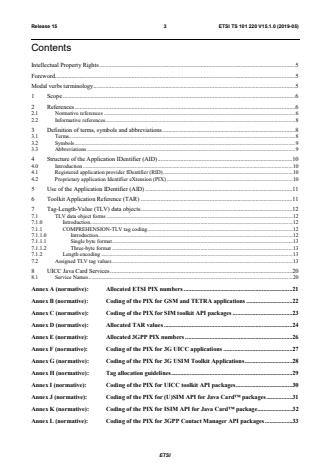
Contents
Intellectual Property Rights . 5
Foreword . 5
Modal verbs terminology . 5
1 Scope . 6
2 References . 6
2.1 Normative references . 6
2.2 Informative references . 8
3 Definition of terms, symbols and abbreviations . 8
3.1 Terms . 8
3.2 Symbols . 9
3.3 Abbreviations . 9
4 Structure of the Application IDentifier (AID) . 10
4.0 Introduction . 10
4.1 Registered application provider IDentifier (RID) . 10
4.2 Proprietary application Identifier eXtension (PIX) . 10
5 Use of the Application IDentifier (AID) . 11
6 Toolkit Application Reference (TAR) . 11
7 Tag-Length-Value (TLV) data objects . 12
7.1 TLV data object forms . 12
7.1.0 Introduction. 12
7.1.1 COMPREHENSION-TLV tag coding . 12
7.1.1.0 Introduction . 12
7.1.1.1 Single byte format . 13
7.1.1.2 Three-byte format . 13
7.1.2 Length encoding . 13
7.2 Assigned TLV tag values . 13
8 UICC Java Card Services . 20
8.1 Service Names . 20
Annex A (normative): Allocated ETSI PIX numbers . 21
Annex B (normative): Coding of the PIX for GSM and TETRA applications . 22
Annex C (normative): Coding of the PIX for SIM toolkit API packages . 23
Annex D (normative): Allocated TAR values . 24
Annex E (normative): Allocated 3GPP PIX numbers . 26
Annex F (normative): Coding of the PIX for 3G UICC applications . 27
Annex G (normative): Coding of the PIX for 3G USIM Toolkit Applications . 28
Annex H (normative): Tag allocation guidelines . 29
Annex I (normative): Coding of the PIX for UICC toolkit API packages . 30
Annex J (normative): Coding of the PIX for (U)SIM API for Java Card™ packages . 31
Annex K (normative): Coding of the PIX for ISIM API for Java Card™ package. 32
Annex L (normative): Coding of the PIX for 3GPP Contact Manager API packages . 33
ETSI
Release 15 4 ETSI TS 101 220 V15.1.0 (2019-05)
Annex M (normative): Allocated 3GPP2 PIX numbers . 34
Annex N (normative): Allocated oneM2M PIX numbers . 35
Annex O (informative): Bibliography . 36
Annex P (informative): Change history . 37
History . 41
ETSI
Release 15 5 ETSI TS 101 220 V15.1.0 (2019-05)
Intellectual Property Rights
Essential patents
IPRs essential or potentially essential to normative deliverables may have been declared to ETSI. The information
pertaining to these essential IPRs, if any, is publicly available for ETSI members and non-members, and can be found
in ETSI SR 000 314: "Intellectual Property Rights (IPRs); Essential, or potentially Essential, IPRs notified to ETSI in
respect of ETSI standards", which is available from the ETSI Secretariat. Latest updates are available on the ETSI Web
server (https://ipr.etsi.org/).
Pursuant to the ETSI IPR Policy, no investigation, including IPR searches, has been carried out by ETSI. No guarantee
can be given as to the existence of other IPRs not referenced in ETSI SR 000 314 (or the updates on the ETSI Web
server) which are, or may be, or may become, essential to the present document.
Trademarks
The present document may include trademarks and/or tradenames which are asserted and/or registered by their owners.
ETSI claims no ownership of these except for any which are indicated as being the property of ETSI, and conveys no
right to use or reproduce any trademark and/or tradename. Mention of those trademarks in the present document does
not constitute an endorsement by ETSI of products, services or organizations associated with those trademarks.
Foreword
This Technical Specification (TS) has been produced by ETSI Technical Committee Smart Card Platform (SCP).
The contents of the present document are subject to continuing work within TC SCP and may change following formal
TC SCP approval. If TC SCP modifies the contents of the present document, it will then be republished by ETSI with
an identifying change of release date and an increase in version number as follows:
Version x.y.z
where:
x the first digit:
0 early working draft;
1 presented to TC SCP for information;
2 presented to TC SCP for approval;
3 or greater indicates TC SCP approved document under change control.
y the second digit is incremented for all changes of substance, i.e. technical enhancements, corrections,
updates, etc.
z the third digit is incremented when editorial only changes have been incorporated in the document.
Modal verbs terminology
In the present document "shall", "shall not", "should", "should not", "may", "need not", "will", "will not", "can" and
"cannot" are to be interpreted as described in clause 3.2 of the ETSI Drafting Rules (Verbal forms for the expression of
provisions).
"must" and "must not" are NOT allowed in ETSI deliverables except when used in direct citation.
ETSI
Release 15 6 ETSI TS 101 220 V15.1.0 (2019-05)
1 Scope
The present document provides for the administration of shared name spaces in use by applications on the UICC
including the managed allocation of identifiers from these name spaces.
2 References
2.1 Normative references
References are either specific (identified by date of publication and/or edition number or version number) or
non-specific. For specific references, only the cited version applies. For non-specific references, the latest version of the
referenced document (including any amendments) applies.
• In the case of a reference to a TC SCP document, a non specific reference implicitly refers to the latest version
of that document in the same Release as the present document.
Referenced documents which are not found to be publicly available in the expected location might be found at
https://docbox.etsi.org/Reference/.
NOTE: While any hyperlinks included in this clause were valid at the time of publication ETSI cannot guarantee
their long term validity.
The following referenced documents are necessary for the application of the present document.
[1] Void.
[2] Recommendation ITU-T E.164: "The international public telecommunication numbering plan".
[3] ISO/IEC 7816-4: "Identification cards - Integrated circuit cards - Part 4: Organization, security and
commands for interchange".
[4] Recommendation ITU-T E.118: "The international telecommunication charge card".
[5] Void.
[6] ETSI TS 151 011: "Digital cellular telecommunications system (Phase 2+); Specification of the
Subscriber Identity Module - Mobile Equipment (SIM-ME) interface (3GPP TS 51.011)".
[7] ETSI TS 101 267: "Digital cellular telecommunications system (Phase 2+); Specification of the
SIM Application Toolkit (SAT) for the Subscriber Identity Module - Mobile Equipment (SIM-
ME) interface (3GPP TS 11.14)".
[8] ETSI TS 143 019: "Digital cellular telecommunications system (Phase 2+); Subscriber Identity
Module Application Programming Interface (SIM API) for Java Card; Stage 2
(3GPP TS 43.019 )".
[9] ETSI EN 300 812-3: "Terrestrial Trunked Radio (TETRA); Subscriber Identity Module to Mobile
Equipment (SIM-ME) interface; Part 3: Integrated Circuit (IC); Physical, logical and TSIM
application characteristics".
[10] ETSI TS 131 101: "Universal Mobile Telecommunications System (UMTS); LTE; UICC-terminal
interface; Physical and logical characteristics (3GPP TS 31.101)".
[11] ETSI TS 131 102: "Universal Mobile Telecommunications System (UMTS); LTE; Characteristics
of the Universal Subscriber Identity Module (USIM) application (3GPP TS 31.102)".
[12] ETSI TS 131 111: "Digital cellular telecommunications system (Phase 2+) (GSM); Universal
Mobile Telecommunications System (UMTS); LTE; Universal Subscriber Identity Module
(USIM) Application Toolkit (USAT) (3GPP TS 31.111)".
ETSI
Release 15 7 ETSI TS 101 220 V15.1.0 (2019-05)
[13] ETSI TS 131 114: "Universal Mobile Telecommunications System (UMTS); LTE; Universal
Subscriber Identity Module Application Toolkit (USAT) interpreter protocol and administration
(3GPP TS 31.114)".
[14] ETSI TS 131 103: "Digital cellular telecommunications system (Phase 2+) (GSM); Universal
Mobile Telecommunications System (UMTS); LTE; Characteristics of the IP Multimedia Services
Identity Module (ISIM) application (3GPP TS 31.103)".
[15] ISO/IEC 8825-1: "Information technology - ASN.1 encoding rules: Specification of Basic
Encoding Rules (BER), Canonical Encoding Rules (CER) and Distinguished Encoding Rules
(DER)".
[16] ISO/IEC 7816-6: "Identification cards - Integrated circuit cards - Part 6: Interindustry data
elements for interchange".
[17] ETSI TS 102 241: "Smart Cards; UICC Application Programming Interface (UICC API) for Java
TM
Card ".
[18] ETSI TS 131 130: "Digital cellular telecommunications system (Phase 2+) (GSM); Universal
Mobile Telecommunications System (UMTS); LTE; (U)SIM Application Programming Interface
(API); (U)SIM API for Java™ Card (3GPP TS 31.130)".
[19] ETSI TS 102 226: "Smart Cards; Remote APDU structure for UICC based applications".
[20] ETSI TS 131 116: "Digital cellular telecommunications system (Phase 2+) (GSM); Universal
Mobile Telecommunications System (UMTS); LTE; Remote APDU Structure for (U)SIM Toolkit
applications (3GPP TS 31.116)".
[21] Void.
[22] ETSI TS 102 474: "Digital Video Broadcasting (DVB); IP Datacast over DVB-H: Service
Purchase and Protection".
[23] Void.
[24] ETSI TS 131 133: "Digital cellular telecommunications system (Phase 2+) (GSM); Universal
Mobile Telecommunications System (UMTS); LTE; IP Multimedia Services Identity Module
(ISIM) Application Programming Interface (API); ISIM API for Java Card™ (3GPP TS 31.133)".
[25] OMA-TS-Smartcard-Web-Server-V1-0: "Smartcard-Web-Server".
NOTE: See http://www.openmobilealliance.org.
[26] ETSI TS 102 225: "Smart Cards; Secured packet structure for UICC based applications".
[27] ETSI TS 131 221: "Universal Mobile Telecommunications System (UMTS); LTE; Contact
Manager Application Programming Interface (API); Contact Manager API for Java Card
(3GPP TS 31.221)".
[28] 3GPP2 C.S0065-0: "cdma2000 Application on UICC for Spread Spectrum Systems".
NOTE: Available at https://www.3gpp2.org/Public_html/Specs/C.S0065-0%20v1.0_060630.pdf.
[29] Void.
[30] GlobalPlatform: "Card Remote Application Management over HTTP Card Specification v2.2 -
Amendment B" v1.1.3.
NOTE: See http://www.globalplatform.org/.
[31] OMA-TS-BCAST-Services-V1-1: "Mobile Broadcast Services".
NOTE: See http://www.openmobilealliance.org.
[32] ETSI TS 102 921: "Machine-to-Machine communications (M2M); mIa, dIa and mId interfaces".
ETSI
Release 15 8 ETSI TS 101 220 V15.1.0 (2019-05)
[33] ISO/IEC 7816-5:2004: "Identification cards - Integrated circuit cards - Part 5: Registration of
application providers".
[34] ETSI TS 118 103: "oneM2M; Security solutions (oneM2M TS-0003)".
[35] OMA-TS-LightweightM2M-V1-0: "Lightweight Machine to Machine".
[36] ETSI TS 131 104: "Universal Mobile Telecommunications System (UMTS); LTE; Characteristics
of the Hosting Party Subscription Identity Module (HPSIM) application (3GPP TS 31.104)".
[37] GlobalPlatform: "Global Platform Card, Confidential Card Content Management, Card
Specification v2.3 - Amendment A", Version 1.1.
NOTE: See http://www.globalplatform.org/.
2.2 Informative references
References are either specific (identified by date of publication and/or edition number or version number) or
non-specific. For specific references, only the cited version applies. For non-specific references, the latest version of the
referenced document (including any amendments) applies.
• In the case of a reference to a TC SCP document, a non specific reference implicitly refers to the latest version
of that document in the same Release as the present document.
NOTE: While any hyperlinks included in this clause were valid at the time of publication ETSI cannot guarantee
their long term validity.
The following referenced documents are not necessary for the application of the present document but they assist the
user with regard to a particular subject area.
Not applicable.
3 Definition of terms, symbols and abbreviations
3.1 Terms
For the purposes of the present document, the following terms apply:
Application IDentifier (AID): data element, which identifies an application in a card
NOTE: An AID may contain a Registered application provider IDentifier (RID). If it contains either a RID or an
issuer identification number, then this identification is unambiguous (see ISO/IEC 7816-4 [3]).
Application Provider (AP): entity, which provides those components of an application on a card, required to perform
the respective application
NOTE: See ISO/IEC 7816-4 [3].
data object: structured data seen on an interface consisting of the concatenation of a mandatory tag field, a mandatory
length field and an optional value field
tag: nominal datum that encodes the name of a data object
telecommunication IC card application: application described by an ETSI document
template: definition of a set of TLV data objects forming the value field of a constructed BER-TLV data object and a
data object that realizes this definition
Toolkit Application Reference (TAR): data element, which identifies an application in the toolkit mechanisms
(e.g. SMS Data Download)
ETSI
Release 15 9 ETSI TS 101 220 V15.1.0 (2019-05)
3.2 Symbols
Void.
3.3 Abbreviations
For the purposes of the present document, the following abbreviations apply:
AID Application IDentifier
AP Application Provider
APDU Application Protocol Data Unit
API Application Program Interface
AT ATtention
BCD Binary Coded Decimal
BER Basic Encoding Rules
BSSID Basic SSID
CBMS Convergence of Broadcast and Mobile Services
CR Comprehension Required
DECT Digital Enhanced Cordless Telecommunications
DM Device Management
DNS Domain Name System
DTMF Dual Tone Multi Frequency
GAD Geographical Area Description
GSM Global System for Mobile communication
GSMA GSM Association
HESSID Homogeneous Extended SSID
HPSIM Hosting Party Subscription Identity Module
IC Integrated Circuit(s)
ICC Integrated Circuit Card
ID IDentifier
IP Internet Protocol
ISIM IP Multimedia Services Identity Module
ISO International Organization for Standardization
MAC Medium Access Control
MMS Multimedia Message Service
NMEA National Maritime Electronic Association
PIX Proprietary application Identifier eXtension
RFU Reserved for Future Use
RID Registered application provider IDentifier
RSP Remote SIM Provisioning
SA Security Association
SCP Smart Card Platform
SIM Subscriber Identity Module
SM Session Management
SSID Service Set Identifier
TAR Toolkit Application Reference
TC Technical Committee
TETRA TErrestrial Trunked RAdio
TLV Tag-Length-Value
TP Transport Protocol
UPT Universal Personal Telecommunications
URL Uniform Resource Locator
USAT USIM Application Toolkit
USIM Universal Subscriber Identity Module
USSD Unstructured Supplementary Services Data
UTRAN Universal Terrestrial Radio Access Network
ETSI
Release 15 10 ETSI TS 101 220 V15.1.0 (2019-05)
4 Structure of the Application IDentifier (AID)
4.0 Introduction
In accordance with ISO/IEC 7816-4 [3], the AID has the following structure.
<--------------------------- Application IDentifier (AID) ----------------------------->
Registered application provider IDentifier Proprietary application Identifier eXtension
(RID) (PIX)
<--------------- 5 bytes ----------------> <--------------- ≤ 11 bytes -------------->
Figure 4.1: AID structure
The AID consists of a Registered application provider IDentifier (RID) of 5 bytes and a Proprietary application
Identifier eXtension (PIX) of up to 11 bytes.
4.1 Registered application provider IDentifier (RID)
The RIDs dealt with in the present document, as registered by ISO/IEC according to ISO/IEC 7816-5 [33], are:
• 'A000000009' for ETSI;
• 'A000000087' for the 3GPP;
• 'A000000343' for the 3GPP2;
• 'A000000645' for the oneM2M.
The following RIDs are for informational purposes only. These RIDs and associated PIXs are maintained by the
respective bodies:
• 'A000000412' for the OMA;
• 'A000000424' for the WiMAX Forum.
4.2 Proprietary application Identifier eXtension (PIX)
The PIX is used at the discretion of ETSI and can contain between 7 bytes and 11 bytes of information. The PIX is
coded in hexadecimal. Hexadecimal digit 1 is the most significant digit.
Digits 1 to 4 Application code
Purpose: To be used for identification of the standardized ETSI or 3G card application
(e.g. GSM, DECT, UPT, pre-paid application). Different versions of an
application may have individual codings.
Management: Assigned by ETSI on request from the ETSI or 3G technical body
responsible for the document in question.
Coding: Hexadecimal. The coding indicates the ETSI or 3G document that specifies
the standardized ETSI or 3G card application and the PIX number.
The correspondence between digits 1 to 4 and the ETSI or 3G document in
question can be seen in a list maintained by the ETSI Secretariat (see
annex A). Escape value '0000' is reserved for use by the ETSI Secretariat for
proprietary ETSI or 3G applications.
ETSI
Release 15 11 ETSI TS 101 220 V15.1.0 (2019-05)
Digits 5 to 8 Country code
Purpose: To indicate the country of the application provider of the ETSI or
3G standardized application.
Coding: According to Recommendation ITU-T E.164 [2]. The coding is right justified
and padded with 'F' on the left.
NOTE 1: List of actual country codes is published by ITU.
Digits 9 to 14 Application provider code
Purpose: Individual code for the application provider of the ETSI or 3G standardized
application.
Coding: According to Recommendation ITU-T E.118 [4]. Hexadecimal. The coding is
right justified and padded with 'F' on the left.
Digits 15 up to 22 Application provider field Optional. Up to 8 digits
Purpose: The use of this field is entirely up to the application provider. It may, for
instance, be used to indicate "local" versions, revisions, etc. of the ETSI or
3G standardized application. According to ISO/IEC 7816-4 [3], if the AID is
16 bytes long, then the value 'FF' for the least significant byte (digits 21 and
22) is reserved for future use.
Management: Application provider.
Coding: Hexadecimal.
NOTE 2: Digits 1 to 14 are assigned and registered by the ETSI Secretariat upon request by the responsible ETSI
technical body.
5 Use of the Application IDentifier (AID)
The use of the AID is specified in ISO/IEC 7816-4 [3].
6 Toolkit Application Reference (TAR)
The Toolkit Application Reference (TAR) is used to uniquely identify a second level application
(e.g. Toolkit Application).
To be addressed, the Toolkit Application needs a first level application (e.g. GSM, USIM application) running.
A second level application may have several TAR values assigned.
The TAR values in the range '00 00 01' to 'AF FF FF' and 'C0 00 00' to 'FF FF FF' are under the responsibility of the
first level application issuer.
The TAR values '00 00 00' and in the range 'B0 00 00' to 'BF FF FF' are reserved for allocation (by the ETSI
Technical Body responsible for the present document) to generic second level application independent of the first level
application issuer.
It is not mandatory for a second level application to have a TAR value assigned. If a TAR value is assigned to a second
level application it is not mandatory for this value to be included in the AID. As a consequence, the AID coding of the
second level application might not always comply with the present document (see annex B).
Annex D lists the TAR values or range and their associated applications and application categories.
Table 6.1: Void
ETSI
Release 15 12 ETSI TS 101 220 V15.1.0 (2019-05)
7 Tag-Length-Value (TLV) data objects
7.1 TLV data object forms
7.1.0 Introduction
The encoding of data objects shall consist of three components that appear in the following order:
1) Tag (T).
2) Length (L).
3) Value (V).
The encoding of these components for each of the recognized forms of TLV is given in table 7.1.
Table 7.1
Name of TLV Encoding of tag field Encoding of length field Encoding of value field
BER-TLV See ISO/IEC 8825-1 [15] See clause 7.1.2 See ISO/IEC 8825-1 [15]
COMPACT-TLV See ISO/IEC 7816-4 [3] See ISO/IEC 7816-4 [3] See ISO/IEC 7816-4 [3]
COMPREHENSION-TLV See clause 7.1.1 See clause 7.1.2 See ISO/IEC 7816-4 [3]
7.1.1 COMPREHENSION-TLV tag coding
7.1.1.0 Introduction
COMPREHENSION-TLV tags can be in one of two formats: single byte and three-byte format.
The value of the first byte identifies the format used.
Table 7.2
First byte value Format
'00' Not used
'01' to '7E' Single byte
'7F' Three-byte
'80' Reserved for future use
'81' to 'FE' Single byte
'FF' Not used
The same value in the different formats represents the same data object.
Unless otherwise stated, for COMPREHENSION-TLV it is the responsibility of the UICC application and the terminal
to decide the value of the Comprehension Required (CR) flag for each data object in a given command.
Handling of the CR flag is the responsibility of the receiving entity.
Table 7.3
CR Value
Comprehension required 1
Comprehension not required 0
ETSI
Release 15 13 ETSI TS 101 220 V15.1.0 (2019-05)
7.1.1.1 Single byte format
The tag is coded over one byte.
Table 7.4
8 7 6 5 4 3 2 1
CR Tag value
CR: Comprehension required for this object.
7.1.1.2 Three-byte format
The tag is coded over three bytes.
Table 7.5
Byte 1 Byte 2 Byte 3
8 7 6 5 4 3 2 1
Tag value format = '7F' CR Tag value
Tag value format: Byte 1 equal to '7F' indicates that the tag is in the three-byte format:
• CR: Comprehension required for this object. Use and coding is the same as in single byte format.
• Tag value: Coded over 15 bits, with bit 7 of byte 2 as the most significant bit. Range is from '00 01' to '7F FF'.
7.1.2 Length encoding
The length is coded onto 1, 2, 3 or 4 bytes according to table 7.6.
Table 7.6
Length Byte 1 Byte 2 Byte 3 Byte 4
0 to 127 Length ('00' to '7F') Not present Not present Not present
128 to 255 '81' Length ('80' to 'FF') Not present Not present
256 to 65 535 '82' Length ('01 00' to 'FF FF') Not present
65 536 to 16 777 215 '83' Length ('01 00 00' to 'FF FF FF')
7.2 Assigned TLV tag values
The assigned tag values given in the following tables are the tag values used by specifications referencing the present
document. All unassigned tag values are reserved for future use.
Table 7.7
COMPACT-TLV tag ATR data objects
'31' Card Service Data
'73' Card Capabilities
Table 7.8
BER-TLV tag Templates
'61' Application Template
'62' FCP Template
'7B' Security Environment Template
ETSI
Release 15 14 ETSI TS 101 220 V15.1.0 (2019-05)
Table 7.9
BER-TLV tag FCP template ('62')
'80' File Size - Data
'81' File Size - Total
'82' File Descriptor
'83' File Identifier
'84' DF Name (AID)
'85' Proprietary - Primitive
'88' SFI Support
'8A' Life Cycle Status
Security attribute data object
'8B' Security Attribute - Reference Format
'8C' Security Attribute - Compact Format
'AB' Security Attribute Template - Expanded Format
Proprietary template
'A5' Proprietary Template
PIN Status data objects
'C6' PIN Status data objects
Table 7.10
BER-TLV tag Security attribute template ('AB')
Access Mode data objects
'80' Access Mode - Generic Command
'81' - '8F' Access Mode - Command Description
'9C' Proprietary State Machine
Security Condition data objects
'90' Security Condition - ALWAYS
'97' Security Condition - NEVER
'9E' Security Condition - Security Condition Byte
'A4' Control reference Template
'A0' Security Condition - OR Template
'AF' Security Condition - AND Template
Table 7.11
BER-TLV tag Control reference template ('A4')
'83' Key Reference
'95' Usage Qualifier
Table 7.12
BER-TLV tag PIN Status data objects ('C6')
'83' Key Reference
'90' PIN Enabled/Disabled status byte(s)
'95' Usage Qualifier
ETSI
Release 15 15 ETSI TS 101 220 V15.1.0 (2019-05)
Table 7.13
BER-TLV Tag Proprietary template ('A5')
'80' UICC Characteristics
'81' Application Power Consumption
'82' Minimum Application Clock Freq.
'83' Amount of Available Memory
'84' File details
'85' Reserved file size
'86' Maximum file size
'87' Supported system commands
'88' Specific UICC environmental conditions
'89' Platform to Platform CAT Secured APDU
'C0' Special File Information
'C1' Filling Pattern
'C2' Repeat Pattern
Table 7.14
BER-TLV tag Application template ('61')
'4F' Application Identifier (AID)
'50' Application Label
'51' Path
'52' Command to Perform
'53' Discretionary Data
'73' Discretionary Template
'5F50' Uniform Resource Locator (URL)
Table 7.15
BER-TLV tag Discretionary template ('73') in EF DIR
'A0' EAP Application service specific data content tag
'A1' M2M service specific data content tag
'A2' oneM2M service specific data content tag
Table 7.16
BER-TLV Tag Terminal capabilities template ('A9')
'80' Terminal power supply
'81' Extended logical channels terminal support
'82' Additional interfaces support
'83' eUICC-related capabilities
ETSI
Release 15 16 ETSI TS 101 220 V15.1.0 (2019-05)
Table 7.17
BER-TLV tag Card application toolkit templates
'CF' Reserved for proprietary use (direction terminal to UICC)
'D0' Proactive Command
'D1' GSM/3GPP/3GPP2 - SMS-PP Download
'D2' GSM/3GPP/3GPP2 - Cell Broadcast Download
'D3' Menu Selection
'D4' Call Control
'D5' GSM/3GPP/3GPP2 - MO Short Message control
'D6' Event Download
'D7' Timer Expiration
'D8' Reserved for intra-UICC communication and not visible on the card interface
'D9' 3GPP/3GPP2 - USSD Download
'DA' MMS Transfer status
'DB' MMS notification download
'DC' Terminal application tag
'DD' 3GPP - Geographical Location Reporting tag
'DE' Envelope Container
'DF' 3GPP - ProSe Report tag
'E0' Reserved for 3GPP (for future usage)
'E1' Reserved for 3GPP (for future usage)
'E2' Reserved for 3GPP (for future usage)
'E3' Reserved for 3GPP (for future usage)
'E4' Reserved for GSMA (direction terminal to UICC)
Table 7.18
BER-TLV tag Remote Management Application Data templates
'01' reserved for OMA SCWS [25]
'81' reserved for OMA SCWS [25] and GlobalPlatform Card Specification Amd. B [30]
'A2' Reserved for GSMA RSP
'AA' Command Scripting Template for definite length coding
'AB' Response Scripting Template for definite length coding
'AE' Command Scripting Template for indefinite length coding
'AF' Response Scripting Template for indefinite length coding
NOTE: Tag values with b2 and b1 set to 0 shall not be assigned to avoid conflicts with automatic
application data format detection defined in ETSI TS 102 226 [19].
Table 7.19
BER-TLV tag Command Scripting template ('AA' or 'AE')
'22' C-APDU tag (see note)
'81' Immediate Action tag
'82' Error Action tag
'83' Script Chaining tag
NOTE: When used in this template, the CR flag for this tag shall be set to 0.
Table 7.20
BER-TLV tag Response Scripting template ('AB' or 'AF')
'23' R-APDU tag (see note)
'80' Number of executed C-APDUs tag (for Release 6)
'80' Number of executed command TLV objects tag (for Release 7 onwards)
'81' Immediate Action Response tag
'83' Script Chaining Response tag
'90' Bad format tag
NOTE: When used in this template, the CR flag for this tag shall be set to 0.
ETSI
Release 15 17 ETSI TS 101 220 V15.1.0 (2019-05)
Table 7.21
BER-TLV tag Manage Secure Channel command
'81' UICC_ID TLV
'82' Endpoint information TLV
'83' Term label - Terminal_ID TLV
'84' Term label - Terminal_appli_ID TLV
'85' Term label - UICC_Identifier TLV
'86' Term label - UICC_appli_ID TLV
'87' Key Agreement Mechanism TLV
'88' MSA_ID TLV
'89' Algorithm and Integrity TLV
'8A' Tnonce TLV
'8B' CSA_ID TLV
'8C' Unonce TLV
'8D' SSCMAC TLV
'8E' Endpoint data container size TLV
'8F' CSAMAC TLV
Table 7.22
BER-TLV tag Transact Data command
'80' Secure Channel TLV
'81' Encrypted Data BER TLV
'82' Command APDU BER TLV
'83' Response APDU BER TLV
Table 7.23
COMPREHENSION Card application toolkit data objects Length Tag value, Reassign
-TLV tag of tag bits 1 - 7 (see note)
(CR and Tag value) (Range: '01' - '7E')
'01' or '81' Command details tag 1 '01' No
'02' or '82' Device identity tag 1 '02' No
'03' or '83' Result tag 1 '03' No
'04' or '84' Duration tag 1 '04' No
'05' or '85' Alpha identifier tag 1 '05' No
'06' or '86' Address tag 1 '06' Yes
'07' or '87' Capability configuration parameters tag 1 '07' Yes
'08' or '88' Subaddress tag 1 '08' Yes
'09' or '89' Reserved for GSM/3G (SS string tag) 1 '09' Yes
Reserved for GSM/3G (BSSID tag)
Reserved for GSM/3G (PLMN ID tag)
Reserved for GSM/3G (E-UTRAN Timing Advance tag)
'0A' or '8A' Reserved for GSM/3GPP2 (USSD string tag) 1 '0A' Yes
Reserved for GSM/3G (IP Address List)
Reserved for 3GPP (HESSID tag)
'0B' or '8B' Reserved for GSM/3G (SMS TPDU tag) 1 '0B' Yes
Reserved for GSM/3G (Surrounding macrocells)
'0C' or '8C' Reserved for GSM/3G (Cell Broadcast page tag) 1 '0C' Yes
'0D' or '8D' Text string tag 1 '0D' NR
'0E' or '8E' Tone tag 1 '0E' Yes
eCAT client profile
'0F' or '8F' Item tag 1 '0F' Yes
eCAT client identity
'10' or '90' Item identifier tag 1 '10' Yes
Encapsulated envelope type
'11' or '91' Response length tag 1 '11' Yes
Call control result tag
'12' or '92' File List tag 1 '12' Yes
CAT service list tag
'13' or '93' Location Information tag 1 '13' Yes
'14' or '94' IMEI tag 1 '14' Yes
ETSI
Release 15 18 ETSI TS 101 220 V15.1.0 (2019-05)
COMPREHENSION Card application toolkit data objects Length Tag value, Reassign
-TLV tag of tag bits 1 - 7 (see note)
(CR and Tag value) (Range: '01' - '7E')
'15' or '95' Help request tag 1 '15' Yes
'16' or '96' Network Measurement Results tag 1 '16' Yes
'17' or '97' Default Text tag 1 '17' Yes
'18' only Items Next Action Indicator tag 1 '18' Yes
'19' or '99' Event list tag 1 '19' Yes
'1A' or '9A' Reserved for GSM/3G (Cause tag) 1 '1A' Yes
'1B' or '9B' Location status tag 1 '1B' Yes
'1C' or '9C' Transaction identifier tag 1 '1C' Yes
'1D' or '9D' Reserved for GSM/3G (BCCH channel list tag) 1 '1D' Yes
Reserved for GSM/3G (Data connection status tag)
'1E' or '9E' Icon identifier tag 1 '1E' No
'1F' or '9F' Item Icon identifier list tag 1 '1F' Yes
'20' or 'A0' Card reader status tag 1 '20' Yes
'21' or 'A1' Card ATR tag 1 '21' Yes
eCAT sequence number
'22' or 'A2' C-APDU tag 1 '22' Yes
Encrypted TLV list
'23' or 'A3' R-APDU tag 1 '23' Yes
SA template
'24' or 'A4' Timer identifier tag 1 '24' Yes
'25' or 'A5' Timer value tag 1 '25' Yes
'26' or 'A6' Date-Time and Time zone tag 1 '26' Yes
'27' or 'A7' Call control requested action tag 1 '27' Yes
'28' or 'A8' AT Command tag 1 '28' Yes
'29' or 'A9' AT Response tag 1 '29' Yes
'2A' or 'AA' Reserved for GSM/3G (BC Repeat Indicator tag) 1 '2A' Yes
Reserved for GSM/3G (Data connection type tag)
'2B' or 'AB' Immediate response tag 1 '2B' Yes
'2C' or 'AC' DTMF string tag 1 '2C' Yes
'2D' or 'AD' Language tag 1 '2D' Yes
'2E' or 'AE' Reserved for GSM/3G (Timing Advance tag) 1 '2E' Yes
Reserved for GSM/3G ((E)SM cause tag)
'2F' or 'AF' AID tag 1 '2F' Yes
'30' or 'B0' Browser Identity tag 1 '30' Yes
'31' or 'B1' URL tag 1 '31' Yes
Reserved for GSM/3G (IMS URI tag)
'32' or 'B2' Bearer tag 1 '32' Yes
'33' or 'B3' Provisioning Reference File tag 1 '33' Yes
'34' or 'B4' Browser Termination Cause tag 1 '34' Yes
Supported Radio Access Technologies
'35' or 'B5' Bearer description tag 1 '35' Yes
'36' or 'B6' Channel data tag 1 '36' Yes
'37' or 'B7' Channel data length tag 1 '37' Yes
'38' or 'B8' Channel status tag 1 '38' Yes
'39' or 'B9' Buffer size tag 1 '39' Yes
'3A' or 'BA' Card reader identifier tag 1 '3A' Yes
REFRESH Enforcement Policy tag
'3B' or 'BB' File Update Information tag 1 '3B' Yes
Application specific refresh data tag
'3C' or 'BC' UICC/terminal interface transport level tag 1 '3C' Yes
'3D' or 'BD' Not used 1 '3D'
'3E' or 'BE' Other address (data destination address) tag 1 '3E' Yes
'3F' or 'BF' Access Technology tag 1 '3F' Yes
'40' or 'C0' Display parameters tag 1 '40' Yes
DNS server address
'41' or 'C1' Service Record tag 1 '41' Yes
'42' or 'C2' Device Filter tag 1 '42' Yes
'43' or 'C3' Service Search tag 1 '43' Yes
'44' or 'C4' Attribute information tag 1 '44' Yes
'45' or 'C5' Service Availability tag 1 '45' Yes
'46' or 'C6' Reserved for 3GPP2 (3GPP2 tag 1) 1 '46'
ETSI
Release 15 19 ETSI TS 101 220 V15.1.0 (2019-05)
COMPREHENSION Card application toolkit data objects Length Tag value, Reassign
-TLV tag of tag bits 1 - 7 (see note)
(CR and Tag value) (Range: '01' - '7E')
'47' or 'C7' Network Access Name tag 1 '47' Yes
'48' or 'C8' Reserved for 3GPP2 (3GPP2 tag 2) 1 '48'
'49' or 'C9' Remote Entity Address tag 1 '49' Yes
'4A' or 'CA' Reserved for 3GPP (I-WLAN Identifier tag) 1 '4A' Yes
Reserved for 3GPP (SSID tag)
'4B' or 'CB' Reserved for 3GPP ((I-)WLAN Access Status tag) 1 '4B' Yes
RFU (only to be assigned if context specific re-use of '4C' to '4F'
other values is not possible)
'50' or 'D0' Text attribute tag 1 '50' No
'51' or 'D1' Item text attribute list tag 1 '51' Yes
'52' or 'D2' Reserved for 3GPP (PDP context Activation parameter 1 '52' Yes
tag)
'53' or 'D3' Contactless state request tag 1 '53' Yes
'54' or 'D4' Contactless functionality state tag 1 '54' Yes
'55' or 'D5' Reserved for 3GPP (CSG cell selection status tag) 1 '55' Yes
Reserved for 3GPP (IMS call disconnection cause tag)
'56' or 'D6' Reserved for 3GPP (CSG ID) 1 '56' Yes
'57' or 'D7' Reserved for 3GPP (HNB name) 1 '57' Yes
Reserved for 3GPP (Extended rejection cause code
tag)
RFU (only to be assigned if context specific re-use of '58' to '5F'
other values is not possible)
'60' or 'E0' MAC 1 '60' No
'61' or 'E1' Reserved for 3GPP2 (3GPP2 Tag 3) 1 '61'
'62' or 'E2' IMEISV tag 1 '62' Yes
'63' or 'E3' Battery state tag 1 '63' Yes
'64' or 'E4' Browsing status tag 1 '64' Yes
'65' or 'E5' Network Search Mode tag 1 '65' Yes
'66' or 'E6' Frame Layout tag 1 '66' Yes
'67' or 'E7' Frames Information tag 1 '67' Yes
Profile ID tag 1
'68' or 'E8' Frame identifier tag 1 '68' No
'69' or 'E9' Reserved for 3GPP (UTRAN/E-UTRAN Measurement 1 '69' Yes
Qualifier tag)
'6A' or 'EA' Multimedia Message Reference tag 1 '6A' Yes
'6B' or 'EB' Multimedia Message Identifier tag 1 '6B' Yes
'6C' or 'EC' Multimedia Message Transfer Status tag 1 '6C' Yes
'6D' or 'ED' Reserved for 3GPP2 (3GPP2 tag 4) 1 '6D'
'6E' or 'EE' Multimedia Message Content Identifier tag 1 '6E' Yes
'6F' or 'EF' Multimedia Message Notification tag 1 '6F' Yes
'70' or 'F0' Last Envelope tag 1 '70' NR
'71' or 'F1' Registry application data tag 1 '71' Yes
'72' or 'F2' Reserved for 3GPP (PLMNwAcT List tag) 1 '72' Yes
'73' or 'F3' Reserved for 3GPP (Routing Area Information tag) 1 '73' Yes
Reserved for 3GPP (URI truncated)
'74' or 'F4' Reserved for 3GPP (Update/Attach Type tag) 1 '74' Yes
Reserved for 3GPP (ProSe Report Data Tag) 1
'75' or 'F5' Reserved for 3GPP (Rejection Cause Code tag) 1 '75' Yes
'76' or 'F6' Reserved for 3GPP (Geographical Location 1 '76' Yes
Parameters tag)
Reserved for 3GPP (IARI tag)
'77' or 'F7' Reserved for 3GPP (GAD Shapes tag) 1 '77' Yes
Reserved for 3GPP (IMPU list tag)
'78' or 'F8' Reserved for 3GPP (NMEA sentence tag) 1 '78' Yes
Reserved for 3GPP (IMS Status Code tag)
'79' or 'F9' Reserved for 3GPP (PLMN List tag) 1 '79' Yes
Reserved for 3GPP (E-UTRAN Inter-frequency
Network Measurement Results tag)
'7A' or 'FA' Broadcast Network Information tag 1 '7A' Yes
Extended registry application data tag
'7B' or 'FB' ACTIVATE descriptor tag 1 '7B' Yes
ETSI
Release 15 20 ETSI TS 101 220 V15.1.0 (2019-05)
COMPREHENSION Card application toolkit data objects Length Tag value, Reassign
-TLV tag of tag bits 1 - 7 (see note)
(CR and Tag value) (Range: '01' - '7E')
'7C' or 'FC' Reserved for 3GPP (EPS PDN connection activation 1 '7C' Yes
parameters tag)
'7D' or 'FD' Reserved for 3GPP (Tracking Area Identification tag) 1 '7D' Yes
'7E' or 'FE' Reserved for 3GPP (CSG ID list tag) 1 '7E' Yes
Reserved for 3GPP (Media type tag)
NOTE: Starting from Release 10, tag values are assigned in a context specific manner, i.e. the same tag value can be
used for different data objects, provided that the object can be uniquely identified from the context of the
proactive command or ENVELOPE command in which it is used.
The column "reassign" indicates whether it is expected that a tag can be reassigned in a context specific
manner (yes), whether that is not recommended (NR) because of potential future conflicts or if this shall not be
done (no).
8 UICC Java Card Services
8.1 Service Names
UICC Java Card Services are described in ETSI TS 102 241 [17].
Global services dedicated to UICC belong to the family "UICC Services (service ids assigned by ETSI)" and shall have
the service family identifier 'A1'.
Service labels are defined in uicc.system.servicesConstants interface.
Table 8.1
Servi
...
Questions, Comments and Discussion
Ask us and Technical Secretary will try to provide an answer. You can facilitate discussion about the standard in here.
Loading comments...