


ETSI GS ZSM 018 V1.1.1 (2024-12)
Zero-touch network and Service Management (ZSM); Network Digital Twin for enhanced zero-touch network and service management
Zero-touch network and Service Management (ZSM); Network Digital Twin for enhanced zero-touch network and service management
DGS/ZSM-018_NDT_norm
General Information
Standards Content (Sample)
GROUP SPECIFICATION
Zero-touch network and Service Management (ZSM);
Network Digital Twin for enhanced zero-touch network and
service management
Disclaimer
The present document has been produced and approved by the Zero-touch network and Service Management (ZSM) ETSI
Industry Specification Group (ISG) and represents the views of those members who participated in this ISG.
It does not necessarily represent the views of the entire ETSI membership.
2 ETSI GS ZSM 018 V1.1.1 (2024-12)
Reference
DGS/ZSM-018_NDT_norm
Keywords
automation, digital twins
ETSI
650 Route des Lucioles
F-06921 Sophia Antipolis Cedex - FRANCE
Tel.: +33 4 92 94 42 00 Fax: +33 4 93 65 47 16
Siret N° 348 623 562 00017 - APE 7112B
Association à but non lucratif enregistrée à la
Sous-Préfecture de Grasse (06) N° w061004871
Important notice
The present document can be downloaded from the
ETSI Search & Browse Standards application.
The present document may be made available in electronic versions and/or in print. The content of any electronic and/or
print versions of the present document shall not be modified without the prior written authorization of ETSI. In case of any
existing or perceived difference in contents between such versions and/or in print, the prevailing version of an ETSI
deliverable is the one made publicly available in PDF format on ETSI deliver repository.
Users should be aware that the present document may be revised or have its status changed,
this information is available in the Milestones listing.
If you find errors in the present document, please send your comments to
the relevant service listed under Committee Support Staff.
If you find a security vulnerability in the present document, please report it through our
Coordinated Vulnerability Disclosure (CVD) program.
Notice of disclaimer & limitation of liability
The information provided in the present deliverable is directed solely to professionals who have the appropriate degree of
experience to understand and interpret its content in accordance with generally accepted engineering or
other professional standard and applicable regulations.
No recommendation as to products and services or vendors is made or should be implied.
No representation or warranty is made that this deliverable is technically accurate or sufficient or conforms to any law
and/or governmental rule and/or regulation and further, no representation or warranty is made of merchantability or fitness
for any particular purpose or against infringement of intellectual property rights.
In no event shall ETSI be held liable for loss of profits or any other incidental or consequential damages.
Any software contained in this deliverable is provided "AS IS" with no warranties, express or implied, including but not
limited to, the warranties of merchantability, fitness for a particular purpose and non-infringement of intellectual property
rights and ETSI shall not be held liable in any event for any damages whatsoever (including, without limitation, damages
for loss of profits, business interruption, loss of information, or any other pecuniary loss) arising out of or related to the use
of or inability to use the software.
Copyright Notification
No part may be reproduced or utilized in any form or by any means, electronic or mechanical, including photocopying and
microfilm except as authorized by written permission of ETSI.
The content of the PDF version shall not be modified without the written authorization of ETSI.
The copyright and the foregoing restriction extend to reproduction in all media.
© ETSI 2024.
All rights reserved.
ETSI
3 ETSI GS ZSM 018 V1.1.1 (2024-12)
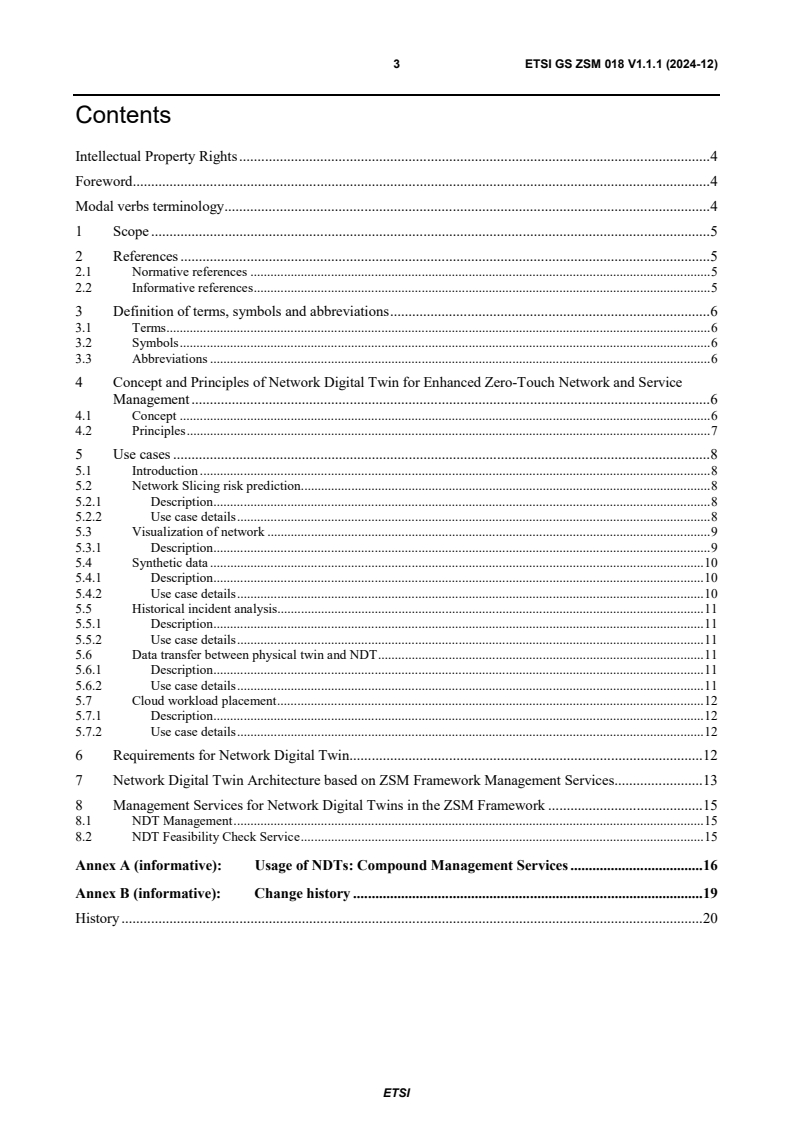
Contents
Intellectual Property Rights . 4
Foreword . 4
Modal verbs terminology . 4
1 Scope . 5
2 References . 5
2.1 Normative references . 5
2.2 Informative references . 5
3 Definition of terms, symbols and abbreviations . 6
3.1 Terms . 6
3.2 Symbols . 6
3.3 Abbreviations . 6
4 Concept and Principles of Network Digital Twin for Enhanced Zero-Touch Network and Service
Management . 6
4.1 Concept . 6
4.2 Principles . 7
5 Use cases . 8
5.1 Introduction . 8
5.2 Network Slicing risk prediction . 8
5.2.1 Description . 8
5.2.2 Use case details . 8
5.3 Visualization of network . 9
5.3.1 Description . 9
5.4 Synthetic data . 10
5.4.1 Description . 10
5.4.2 Use case details . 10
5.5 Historical incident analysis. 11
5.5.1 Description . 11
5.5.2 Use case details . 11
5.6 Data transfer between physical twin and NDT . 11
5.6.1 Description . 11
5.6.2 Use case details . 11
5.7 Cloud workload placement . 12
5.7.1 Description . 12
5.7.2 Use case details . 12
6 Requirements for Network Digital Twin . 12
7 Network Digital Twin Architecture based on ZSM Framework Management Services . 13
8 Management Services for Network Digital Twins in the ZSM Framework . 15
8.1 NDT Management . 15
8.2 NDT Feasibility Check Service . 15
Annex A (informative): Usage of NDTs: Compound Management Services . 16
Annex B (informative): Change history . 19
History . 20
ETSI
4 ETSI GS ZSM 018 V1.1.1 (2024-12)
Intellectual Property Rights
Essential patents
IPRs essential or potentially essential to normative deliverables may have been declared to ETSI. The declarations
pertaining to these essential IPRs, if any, are publicly available for ETSI members and non-members, and can be
found in ETSI SR 000 314: "Intellectual Property Rights (IPRs); Essential, or potentially Essential, IPRs notified to
ETSI in respect of ETSI standards", which is available from the ETSI Secretariat. Latest updates are available on the
ETSI IPR online database.
Pursuant to the ETSI Directives including the ETSI IPR Policy, no investigation regarding the essentiality of IPRs,
including IPR searches, has been carried out by ETSI. No guarantee can be given as to the existence of other IPRs not
referenced in ETSI SR 000 314 (or the updates on the ETSI Web server) which are, or may be, or may become,
essential to the present document.
Trademarks
The present document may include trademarks and/or tradenames which are asserted and/or registered by their owners.
ETSI claims no ownership of these except for any which are indicated as being the property of ETSI, and conveys no
right to use or reproduce any trademark and/or tradename. Mention of those trademarks in the present document does
not constitute an endorsement by ETSI of products, services or organizations associated with those trademarks.
DECT™, PLUGTESTS™, UMTS™ and the ETSI logo are trademarks of ETSI registered for the benefit of its
Members. 3GPP™, LTE™ and 5G™ logo are trademarks of ETSI registered for the benefit of its Members and of the
3GPP Organizational Partners. oneM2M™ logo is a trademark of ETSI registered for the benefit of its Members and of ®
the oneM2M Partners. GSM and the GSM logo are trademarks registered and owned by the GSM Association.
Foreword
This Group Specification (GS) has been produced by ETSI Industry Specification Group (ISG) Zero-touch network and
Service Management (ZSM).
Modal verbs terminology
In the present document "shall", "shall not", "should", "should not", "may", "need not", "will", "will not", "can" and
"cannot" are to be interpreted as described in clause 3.2 of the ETSI Drafting Rules (Verbal forms for the expression of
provisions).
"must" and "must not" are NOT allowed in ETSI deliverables except when used in direct citation.
ETSI
5 ETSI GS ZSM 018 V1.1.1 (2024-12)
1 Scope
The present document specifies extensions and new capabilities to support and integrate digital twin technologies with
the ZSM framework reference architecture in order to enhance end to end zero-touch network and service management
and automation.
The present document defines use cases related to Network Digital Twins (NDTs) to derive specific requirements. It
also documents important NDT principles.
The present normative document is based on the ZSM reference architecture and refers to available standards and open
source works where appropriate. ETSI GR ZSM 015 [i.1] provides background relevant to the present document and
should be read as a companion document.
2 References
2.1 Normative references
References are either specific (identified by date of publication and/or edition number or version number) or
non-specific. For specific references, only the cited version applies. For non-specific references, the latest version of the
referenced document (including any amendments) applies.
Referenced documents which are not found to be publicly available in the expected location might be found in the
ETSI docbox.
NOTE: While any hyperlinks included in this clause were valid at the time of publication, ETSI cannot guarantee
their long term validity.
The following referenced documents are necessary for the application of the present document.
[1] ETSI GS ZSM 002: "Zero-touch network and Service Management (ZSM); Reference
Architecture".
[2] ETSI GS ZSM 003: "Zero-touch network and Service Management (ZSM); End-to-end
management and orchestration of network slicing".
[3] ETSI GS ZSM 016: "Zero-touch network and Service Management (ZSM); Intent-driven Closed
Loops".
2.2 Informative references
References are either specific (identified by date of publication and/or edition number or version number) or
non-specific. For specific references, only the cited version applies. For non-specific references, the latest version of the
referenced document (including any amendments) applies.
NOTE: While any hyperlinks included in this clause were valid at the time of publication, ETSI cannot guarantee
their long term validity.
The following referenced documents are not necessary for the application of the present document but they assist the
user with regard to a particular subject area.
[i.1] ETSI GR ZSM 015: "Zero-touch network and Service Management (ZSM); Network Digital
Twin".
[i.2] ETSI GS ZSM 007: "Zero-touch network and Service Management (ZSM); Terminology for
concepts in ZSM".
ETSI
6 ETSI GS ZSM 018 V1.1.1 (2024-12)
3 Definition of terms, symbols and abbreviations
3.1 Terms
For the purposes of the present document, the terms given in ETSI GS ZSM 007 [i.2] and the following apply:
Digital Twin (DT): digital counterpart of the physical twin that captures its attributes, behaviour and interactions
Network Digital Twin (NDT): virtual replica of a communications network or part of one
NOTE: Communications network can for example include equipment, systems, processes, software or
environments of physical network elements and components, virtualised network functions, services and
traffic.
physical twin: equipment, system, process, software or environment that the digital twin is designed to replicate and
represent virtually
3.2 Symbols
Void.
3.3 Abbreviations
For the purposes of the present document, the abbreviations given in ETSI GS ZSM 007 [i.2] and the following apply:
NRT Non-Real Time
RT Real Time
4 Concept and Principles of Network Digital Twin for
Enhanced Zero-Touch Network and Service
Management
4.1 Concept
As discussed in clause 4.1 of ETSI GR ZSM 015 [i.1] a Digital Twin (DT) is a virtual replica of a real-world system.
That replica may model the composition, state, attributes, behaviours and other aspects of the physical twin. A Network
Digital Twin (NDT) is a DT whose physical counterpart is a real-world communications network, or some part of one.
There have been different views expressed in the industry over time concerning the extent and nature of functions
encompassed by an NDT. But all NDT use cases that have been considered are based fundamentally upon modelling to
determine the expected outcomes, impacts and effects of prospective operations, processes or changes. Such modelling
is thus the essential function of NDTs. An NDT management service reflecting this is defined in clause 8.
Information about the outcomes and effects of prospective operations, actions or changes - determined by NDT-based
modelling - may be used to guide operational decision-making, including within automation-supporting closed loops.
The precise nature and context of such decision-making, and in general the precise role of an NDT, vary among NDT
use cases. Use case-dependent detailed functional architectures may be represented by "composing" NDT management
services with other management services, per the ZSM architectural principles of flexible modularity and composability
ETSI GS ZSM 002 [1], clauses 4.2.1 and 4.2.9. This is illustrated in Annex A.
The use - or at least, the potential use - of NDT-generated information within automated operations systems, is what
distinguishes NDTs from other simulations and modelling. Such use depends on data and information flow between the
NDT and other elements of the operations environment. This includes:
a) data and information flow to the NDT, to support accurate modelling of the physical network and its use; and
ETSI
7 ETSI GS ZSM 018 V1.1.1 (2024-12)
b) information flow from the NDT to other components of operations systems.
NOTE: In this context, the term "operations" encompasses any or all of the meanings traditionally encompassed
by the terms control & orchestration, management and planning.
4.2 Principles
1) NDT should be use case specific
The NDT, including the input and output as well as the data on which the NDT depends should be use case-
specific. NDT may use data from various sources and this data should be at right level of granularity and
abstraction. Additionally, data should meet the requirements for quality, quantity and other characteristics
suggested by the use case.
2) Different actions in NDT may be executed concurrently
NDT can be executed concurrently and independently, instead of sequentially, to greatly boost the processing
efficiency.
Depending on the scenario requirements (e.g. risk prediction, fault analysis, configuration verification), it may
be necessary to trigger multiple NDT modelling sessions in order to perform multiple evaluations of the
scenario. The execution of multiple NDT modelling sessions could require coordination among them.
Examples include:
- The NDT management service for signalling storm analysis will perform several NDT modelling
sessions, predicting the amount of signalling traffic based on the current number of users and then
evaluating the impact of the predicted signalling traffic has on the current network.
- During the intent negotiation phase, when an intent handler is required to respond to a Best operation
query (Best operation is defined in ETSI GS ZSM 016 [3], clause 6.2.4.3) from an intent owner. In this
case, the NDT management service can be requested to explore several possible solutions for the
evaluation for the best possible outcomes that could be achieved by the intent handler. It is also possible
to use the NDT management service to find out the optimal combination of values for intent parameters,
which are best aligned with the intent handler's capabilities.
In order to efficiently fulfil these requirements, it should be possible to start multiple NDT modelling sessions
concurrently, and then report the best possible proposal after evaluation. Therefore, a management function
may be used to initiate multiple concurrent modelling sessions. In addition, this management function may
coordinate among the multiple modelling sessions, including identifying and addressing the different types of
relationships such as cooperation, conflict or dependency.
3) Separation of Concerns in NDTs
In order to support the separation of concerns in management, described in principle 8 from ETSI
GS ZSM 002 [1], clause 4.2.8, the ZSM framework supports the same separation of concerns in NDTs as
follows:
- E2ES MD NDT: Provide Management Services (MnS) and capabilities which support the management
of end-to-end managed services that span multiple management domains.
- MD NDT: Provide Management Services (MnS) and capabilities which support the management of
management domain entities.
4) NDT enables improved decision-making through its dynamic behaviour modelling capability
NDT's dynamic behaviour modelling capabilities like simulation, emulation and prediction enable network and
service management to have improved decision-making capabilities compared to traditional methods without
any adverse impact on the physical twin.
5) NDT is aware of the dynamic changes of the physical twin environment
The NDT is environment-aware based on information received from telemetry data, sensors, anomaly
detection, failure prediction etc. The dynamic behaviour models of the NDT should consider the dynamic
changes in the physical twin and its environment.
ETSI
8 ETSI GS ZSM 018 V1.1.1 (2024-12)
6) NDTs should accommodate variations in physical twin composition
Real networks vary and evolve in a number of ways, for example network size, equipment types involved,
supported processes, diverse data sources and types. These variations of the physical twin affect the
performance of the NDT. An NDT shall accommodate such variations in order to generate the best quality
outputs from the NDT models.
NOTE: The variations an NDT can accommodate is implementation dependent.
5 Use cases
5.1 Introduction
The present clause describes the use cases related to Network Digital Twins (NDTs) that have been used to derive
specific requirements listed in clause 6. For a more extensive set of use cases refer to ETSI GR ZSM 015 [i.1].
5.2 Network Slicing risk prediction
5.2.1 Description
As described in clause 7.1 of ETSI GS ZSM 003 [2], the required attribute values for the network slice SLA/SLS are
translated and used as input for the attributes of Service profile or intent expectations of the E2E Service MD, which in
turn are further translated into attributes or intent expectations for the network slice profiles of each MD (normally CN
domain, AN domain and TN domain). In the ZSM framework the NDT MnS may be utilized to identify the risks of
SLA/SLS not being met due to changing traffic and network conditions (e.g. a MD not being able to provide the
network slice latency it committed for) and the NDT supports the ZSM framework to take actions before these risks
materialize and therefore before the committed SLA/SLS are broken.
5.2.2 Use case details
A precondition of this use case is that the network slice is established and running in the network and the target of the
use case is to ensure the network slice SLA/SLS is not broken.
The present clause describes the sequence how the NDT MnS may be used for the prediction of risks in network slicing
with the following steps from Figure 5.2.2-1:
1) Data collected from the physical twin is used by the NDT at the required frequency.
2) A MD MnS consumer requests the NDT MnS to perform predictions on slice parameters values.
3) The NDT MnS returns the predicted values.
4) MD MnSs use the predicted slice parameter values to identify the risks of SLS being outside of the expected
range for these parameters. Once a risk is identified the MD tries to find domain level solutions to avoid or
mitigate the risk.
5) If the MD can find a solution to avoid the risk within the MD, and no other dependencies are affected or
broken by the new solution, it implements it by executing domain level actions.
6) If it cannot find a solution it reports the risk to the subscribed MnS(s) in the E2ES MD using a domain
analytics service as described in clause 6.5.3.2.1 of ETSI GS ZSM 002 [1].
7) Using the risks information reported by the prediction service, as well as other performance measurements
collected from the different MDs, the E2ES MD identifies possible solutions.
8) The E2ES MD requests one or multiple predictions from the E2E NDT MnS in order to identify a valid
solution that would avoid or mitigate the reported risk.
9) The E2E NDT MnS returns the predicted values.
ETSI
9 ETSI GS ZSM 018 V1.1.1 (2024-12)
10) Once the E2ES MD identifies a valid solution it communicates it to the appropriate MD using a domain
orchestration service as described in clause 6.5.5.2.1 of ETSI GS ZSM 002 [1].
11) The MDs implement domain level actions.
Figure 5.2.2-1: Example of simplified sequence diagram of network slice risk prediction and healing
NOTE: E2ES MD could also be doing the risk prediction. However, in this use case the focus is the MD doing
the risk prediction.
5.3 Visualization of network
5.3.1 Description
The visualization of the network is helpful for the network operators. As an NDT can be time basis modelling
(e.g. current time, historical time, future time), the visualization of the network can show not only the current
information (e.g. running status, health status), but also the historical information or future predictions of the network.
ETSI
10 ETSI GS ZSM 018 V1.1.1 (2024-12)
For example, based on the definition in clauses 6.5.5.2.7 and 6.6.5.2.7 of ETSI GS ZSM 002 [1], by querying the
topology information from topology information service producer, the visualization of network topology can be
available and help in understanding the current status of the network. On the other hand, the traffic data can be collected
from the physical twin, and used for network performance analysis, fault prediction, etc. based on its variation. With the
help of NDT which can model the correlation of different models and data (e.g. topology model and traffic data), it is
possible to get a complete view relevant to the specified time (e.g. a specified point of time or a specified time frame).
This view represents the physical twin by combining topology visualization with traffic information, and it can show
how traffic flows across n
...
Questions, Comments and Discussion
Ask us and Technical Secretary will try to provide an answer. You can facilitate discussion about the standard in here.
Loading comments...