


ETSI GR NFV-SEC 016 V1.2.1 (2024-12)
Network Functions Virtualisation (NFV); Security; Location, locstamp and timestamp; Report on location, timestamping of VNFs
Network Functions Virtualisation (NFV); Security; Location, locstamp and timestamp; Report on location, timestamping of VNFs
RGR/NFV-SEC016ed121
General Information
Standards Content (Sample)
GROUP REPORT
Network Functions Virtualisation (NFV);
Security;
Location, locstamp and timestamp;
Report on location, timestamping of VNFs
Disclaimer
The present document has been produced and approved by the Network Functions Virtualisation (NFV) ETSI Industry
Specification Group (ISG) and represents the views of those members who participated in this ISG.
It does not necessarily represent the views of the entire ETSI membership.
2 ETSI GR NFV-SEC 016 V1.2.1 (2024-12)
Reference
RGR/NFV-SEC016ed121
Keywords
critical infrastructure, GNSS, ICT, location, NFV,
security, time-stamping
ETSI
650 Route des Lucioles
F-06921 Sophia Antipolis Cedex - FRANCE
Tel.: +33 4 92 94 42 00 Fax: +33 4 93 65 47 16
Siret N° 348 623 562 00017 - APE 7112B
Association à but non lucratif enregistrée à la
Sous-Préfecture de Grasse (06) N° w061004871
Important notice
The present document can be downloaded from the
ETSI Search & Browse Standards application.
The present document may be made available in electronic versions and/or in print. The content of any electronic and/or
print versions of the present document shall not be modified without the prior written authorization of ETSI. In case of any
existing or perceived difference in contents between such versions and/or in print, the prevailing version of an ETSI
deliverable is the one made publicly available in PDF format on ETSI deliver repository.
Users should be aware that the present document may be revised or have its status changed,
this information is available in the Milestones listing.
If you find errors in the present document, please send your comments to
the relevant service listed under Committee Support Staff.
If you find a security vulnerability in the present document, please report it through our
Coordinated Vulnerability Disclosure (CVD) program.
Notice of disclaimer & limitation of liability
The information provided in the present deliverable is directed solely to professionals who have the appropriate degree of
experience to understand and interpret its content in accordance with generally accepted engineering or
other professional standard and applicable regulations.
No recommendation as to products and services or vendors is made or should be implied.
No representation or warranty is made that this deliverable is technically accurate or sufficient or conforms to any law
and/or governmental rule and/or regulation and further, no representation or warranty is made of merchantability or fitness
for any particular purpose or against infringement of intellectual property rights.
In no event shall ETSI be held liable for loss of profits or any other incidental or consequential damages.
Any software contained in this deliverable is provided "AS IS" with no warranties, express or implied, including but not
limited to, the warranties of merchantability, fitness for a particular purpose and non-infringement of intellectual property
rights and ETSI shall not be held liable in any event for any damages whatsoever (including, without limitation, damages
for loss of profits, business interruption, loss of information, or any other pecuniary loss) arising out of or related to the use
of or inability to use the software.
Copyright Notification
No part may be reproduced or utilized in any form or by any means, electronic or mechanical, including photocopying and
microfilm except as authorized by written permission of ETSI.
The content of the PDF version shall not be modified without the written authorization of ETSI.
The copyright and the foregoing restriction extend to reproduction in all media.
© ETSI 2024.
All rights reserved.
ETSI
3 ETSI GR NFV-SEC 016 V1.2.1 (2024-12)
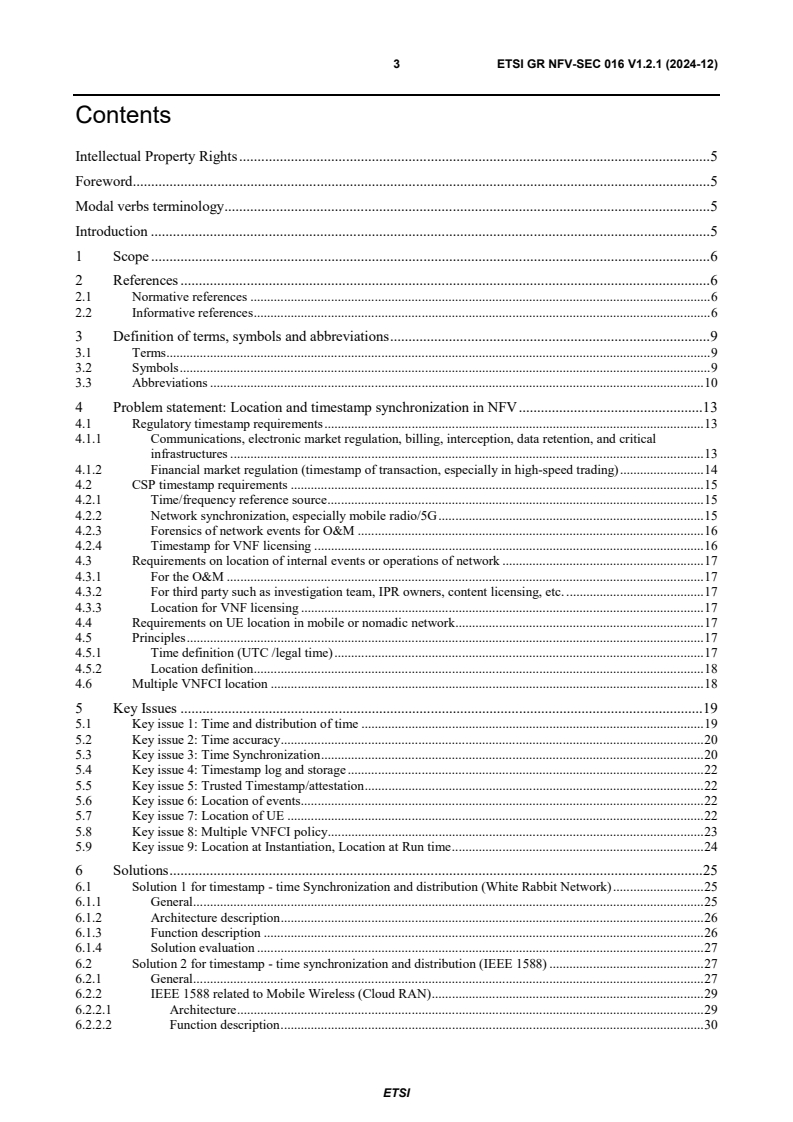
Contents
Intellectual Property Rights . 5
Foreword . 5
Modal verbs terminology . 5
Introduction . 5
1 Scope . 6
2 References . 6
2.1 Normative references . 6
2.2 Informative references . 6
3 Definition of terms, symbols and abbreviations . 9
3.1 Terms . 9
3.2 Symbols . 9
3.3 Abbreviations . 10
4 Problem statement: Location and timestamp synchronization in NFV . 13
4.1 Regulatory timestamp requirements . 13
4.1.1 Communications, electronic market regulation, billing, interception, data retention, and critical
infrastructures . 13
4.1.2 Financial market regulation (timestamp of transaction, especially in high-speed trading) . 14
4.2 CSP timestamp requirements . 15
4.2.1 Time/frequency reference source . 15
4.2.2 Network synchronization, especially mobile radio/5G . 15
4.2.3 Forensics of network events for O&M . 16
4.2.4 Timestamp for VNF licensing . 16
4.3 Requirements on location of internal events or operations of network . 17
4.3.1 For the O&M . 17
4.3.2 For third party such as investigation team, IPR owners, content licensing, etc. . 17
4.3.3 Location for VNF licensing . 17
4.4 Requirements on UE location in mobile or nomadic network . 17
4.5 Principles . 17
4.5.1 Time definition (UTC /legal time) . 17
4.5.2 Location definition . 18
4.6 Multiple VNFCI location . 18
5 Key Issues . 19
5.1 Key issue 1: Time and distribution of time . 19
5.2 Key issue 2: Time accuracy . 20
5.3 Key issue 3: Time Synchronization . 20
5.4 Key issue 4: Timestamp log and storage . 22
5.5 Key issue 5: Trusted Timestamp/attestation . 22
5.6 Key issue 6: Location of events . 22
5.7 Key issue 7: Location of UE . 22
5.8 Key issue 8: Multiple VNFCI policy . 23
5.9 Key issue 9: Location at Instantiation, Location at Run time . 24
6 Solutions . 25
6.1 Solution 1 for timestamp - time Synchronization and distribution (White Rabbit Network) . 25
6.1.1 General . 25
6.1.2 Architecture description . 26
6.1.3 Function description . 26
6.1.4 Solution evaluation . 27
6.2 Solution 2 for timestamp - time synchronization and distribution (IEEE 1588) . 27
6.2.1 General . 27
6.2.2 IEEE 1588 related to Mobile Wireless (Cloud RAN) . 29
6.2.2.1 Architecture . 29
6.2.2.2 Function description . 30
ETSI
4 ETSI GR NFV-SEC 016 V1.2.1 (2024-12)
6.2.2.3 Solution evaluation. 32
6.2.3 IEEE 1588 related to Cable TV . 33
6.2.3.1 Architecture . 33
6.2.3.2 Function description . 35
6.2.3.3 Solution evaluation. 36
6.3 Solution 3 for timestamp - time synchronization and distribution (based on trusted GNSS/ LEOs) . 36
6.3.1 Architecture description . 36
6.3.2 Function description . 37
6.3.3 Solution evaluation . 38
6.4 Solution 4 for timestamp Data centre Time Protocol (DTP) . 39
6.4.0 introduction . 39
6.4.1 Architecture description . 39
6.4.2 Function description . 40
6.4.3 Solution evaluation . 40
6.5 Solution 5 for locstamp - based on binding of trusted hardware's ID with vertical hierarchy location . 41
6.5.1 Architecture description . 41
6.5.2 Function description . 42
6.5.3 Solution evaluation . 42
6.6 Solution 6 for locstamp - based on indoor positioning such as RFID Tagging . 43
6.6.0 introduction . 43
6.6.1 Architecture description . 43
6.6.2 Function description . 43
6.6.3 Solution evaluation . 44
6.7 Solution 7 for locstamp - based on GNSS raw data . 44
6.7.1 Architecture description . 44
6.7.2 Function description . 44
6.7.3 Solution evaluation . 45
6.8 Solution 8 for locstamp - based on Trusted GNSS Positioning . 46
6.8.0 Introduction. 46
6.8.1 Architecture description . 46
6.8.1.1 Signal authentication . 46
6.8.1.2 Encryption . 46
6.8.2 Function description . 47
6.8.3 Solution evaluation . 47
7 Conclusion . 48
Annex A: European Securities and Markets Authority: regulatory technical and
implementing standards RTS 25 on clock synchronization . 54
A.1 Guidelines on clock synchronization . 54
A.1.0 General . 54
A.1.1 Reportable Events. 54
A.1.2 Time stamp granularity . 54
A.1.3 Compliance with the maximum divergence requirements . 54
A.1.4 Application, host and wire timestamps . 55
A.1.5 Gateway-to-gateway latency . 55
Annex B: DHS requirements for critical infrastructure and GNSS . 56
B.1 Introduction . 56
B.2 Recommendations . 56
B.2.0 General . 56
B.2.1 Installation and operation recommendations for owners, operators, and installers . 56
B.2.2 Development recommendations for manufacturers . 57
Annex C: Change history . 58
History . 59
ETSI
5 ETSI GR NFV-SEC 016 V1.2.1 (2024-12)
Intellectual Property Rights
Essential patents
IPRs essential or potentially essential to normative deliverables may have been declared to ETSI. The declarations
pertaining to these essential IPRs, if any, are publicly available for ETSI members and non-members, and can be
found in ETSI SR 000 314: "Intellectual Property Rights (IPRs); Essential, or potentially Essential, IPRs notified to
ETSI in respect of ETSI standards", which is available from the ETSI Secretariat. Latest updates are available on the
ETSI IPR online database.
Pursuant to the ETSI Directives including the ETSI IPR Policy, no investigation regarding the essentiality of IPRs,
including IPR searches, has been carried out by ETSI. No guarantee can be given as to the existence of other IPRs not
referenced in ETSI SR 000 314 (or the updates on the ETSI Web server) which are, or may be, or may become,
essential to the present document.
Trademarks
The present document may include trademarks and/or tradenames which are asserted and/or registered by their owners.
ETSI claims no ownership of these except for any which are indicated as being the property of ETSI, and conveys no
right to use or reproduce any trademark and/or tradename. Mention of those trademarks in the present document does
not constitute an endorsement by ETSI of products, services or organizations associated with those trademarks.
DECT™, PLUGTESTS™, UMTS™ and the ETSI logo are trademarks of ETSI registered for the benefit of its
Members. 3GPP™, LTE™ and 5G™ logo are trademarks of ETSI registered for the benefit of its Members and of the
3GPP Organizational Partners. oneM2M™ logo is a trademark of ETSI registered for the benefit of its Members and of ®
the oneM2M Partners. GSM and the GSM logo are trademarks registered and owned by the GSM Association. ®
BLUETOOTH is a trademark registered and owned by Bluetooth SIG, Inc.
Foreword
This Group Report (GR) has been produced by ETSI Industry Specification Group (ISG) Network Functions
Virtualisation (NFV).
Modal verbs terminology
In the present document "should", "should not", "may", "need not", "will", "will not", "can" and "cannot" are to be
interpreted as described in clause 3.2 of the ETSI Drafting Rules (Verbal forms for the expression of provisions).
"must" and "must not" are NOT allowed in ETSI deliverables except when used in direct citation.
Introduction
The reliability and the ability to securely measure time and location are important for security. It is a challenge in
virtualisation, especially in NFV environment. The present document studies these issues from a security perspective.
ETSI
6 ETSI GR NFV-SEC 016 V1.2.1 (2024-12)
1 Scope
The present document is a study on how the location of sensitive VNFs (e.g. VNFs handling data with Data Protection
location handling restrictions, network security functions and LI functions) can be attested. The present document
considers the use of trusted locstamp and timestamp information derived from Global Navigation Satellite Systems
(GNSS), such as Galileo. The present document also considers other physical location binding solutions. The
capabilities described also have benefits for other less sensitive virtualised services which may need to verify location
of VNFs or data.
2 References
2.1 Normative references
Normative references are not applicable in the present document.
2.2 Informative references
References are either specific (identified by date of publication and/or edition number or version number) or
non-specific. For specific references, only the cited version applies. For non-specific references, the latest version of the
referenced document (including any amendments) applies.
NOTE: While any hyperlinks included in this clause were valid at the time of publication, ETSI cannot guarantee
their long term validity.
The following referenced documents are not necessary for the application of the present document but they assist the
user with regard to a particular subject area.
™
[i.1] IEEE ICC 2015 - Workshop on Cloud-Processing in Heterogeneous Mobile Communication
Networks (IWCPM)-(2015): "Synchronization challenges in packet-based Cloud-RAN fronthaul
for mobile networks".
[i.2] Heavy Reading - White Paper (December 2014): "New Synchronization Requirements for 4G
Backhaul & Fronthaul".
[i.3] 3GPP TR 38.803: "Study on new radio access technology: Radio Frequency (RF) and co-existence
aspects".
[i.4] Recommendation ITU-T G.8260: "Definitions and terminology for synchronization in packet
networks".
[i.5] Recommendation ITU-T G.8261: "Timing and synchronization aspects in packet networks".
[i.6] Recommendation ITU-T G.8271: "Time and phase synchronization aspects of packet networks".
[i.7] Recommendation ITU-T G.8262: "Timing characteristics of a synchronous Ethernet equipment
slave clock".
[i.8] Recommendation ITU-T G.8263: "Timing characteristics of packet-based equipment clocks".
[i.9] Recommendation ITU-T G.8272: "Timing characteristics of primary reference time clocks".
[i.10] Recommendation ITU-T G.8273: "Framework of phase and time clocks".
[i.11] Recommendation ITU-T G.8265: "Architecture and requirements for packet-based frequency
delivery".
[i.12] Recommendation ITU-T G.8275: "Architecture and requirements for packet-based time and phase
distribution".
[i.13] Recommendation ITU-T G.8264: "Distribution of timing information through packet networks".
ETSI
7 ETSI GR NFV-SEC 016 V1.2.1 (2024-12)
[i.14] Recommendation ITU-T G.8265.1: "Precision time protocol telecom profile for frequency
synchronization".
[i.15] Recommendation ITU-T G.8275.1: "Precision time protocol telecom profile for phase/time
synchronization".
[i.16] ETSI TS 136 133: "LTE; Evolved Universal Terrestrial Radio Access (E-UTRA); Requirements
for support of radio resource management (3GPP TS 36.133)".
[i.17] ETSI TR 136 922: "LTE; Evolved Universal Terrestrial Radio Access (E-UTRA); TDD Home
eNode B (HeNB) Radio Frequency (RF) requirements analysis (3GPP TR 36.922)".
™
Communications Standards Magazine (volume 1, issue 1, March 2017): "Analysis of the
[i.18] IEEE
Synchronization Requirements of 5G and Corresponding Solutions".
™
NOTE: Available at Analysis of the Synchronization Requirements of 5g and Corresponding Solutions | IEEE
™
Journals & Magazine | IEEE Xplore.
™
[i.19] IEEE 1588: "Precision Clock Synchronization Protocol for Networked Measurement and Control
Systems".
[i.20] Recommendation ITU-R TF.460-6: "Standard-frequency and time-signal emissions".
[i.21] German law on time.
[i.22] ITU: "Final Acts WRC-12", World Radiocommunication Conference (Geneva, 2012).
[i.23] Downstream Radio Frequency Interface Specification, CM-SP-DRFII14-131120, November 20,
2013, Cable Television Laboratories, Inc.
[i.24] DOCSIS 3.1, Physical Layer Specification, CM-SP-PHYv3.1-I08- 151210, December 10, 2015,
Cable Television Laboratories, Inc.
[i.25] DOCSIS 3.0, Physical Layer Specification, CM-SP-PHYv3.0-I12- 150305, March 5, 2015, Cable
Television Laboratories, Inc.
[i.26] Data-Over-Cable Service Interface Specifications DCA - MHAv2 Remote DOCSIS Timing
Interface CM-SP-R-DTI-I05-170524.
[i.27] ETSI TS 136 104: "LTE; Evolved Universal Terrestrial Radio Access (E-UTRA); Base Station
(BS) radio transmission and reception (3GPP TS 36.104)".
[i.28] ISO/IEC 19762:2016: "Information technology — Automatic identification and data capture
(AIDC) techniques — Harmonized vocabulary".
[i.29] ETSI GS NFV 003: "Network Functions Virtualisation (NFV); Terminology for Main Concepts in
NFV".
[i.30] ETSI GS NFV-SEC 013: "Network Functions Virtualisation (NFV) Release 3; Security; Security
Management and Monitoring specification".
[i.31] ETSI GR NFV-SEC 011: "Network Functions Virtualisation (NFV); Security; Report on NFV LI
Architecture".
[i.32] NISTIR 8006: "NIST Cloud Computing Forensic Science Challenges".
[i.33] ESMA Guidelines: "Transaction reporting, order record keeping and clock synchronization under
MiFID II".
[i.34] Ofcom (UK): "Metering and Billing directive".
[i.35] Bundesnetzagentur (Germany): "Billing accuracy".
™
[i.36] IEC/IEEE 61850-9-3:2016: "Communication networks and systems for power utility
automation - Part 9-3: Precision time protocol profile for power utility automation".
ETSI
8 ETSI GR NFV-SEC 016 V1.2.1 (2024-12)
™ ™ ™
[i.37] IEEE C37.238 -2017: "IEEE Standard Profile for Use of IEEE 1588 Precision Time Protocol
in Power System Applications".
[i.38] Meinberg: "Time synchronization in Virtual Machines". ®
[i.39] Ericsson : "An overview of remote interference management".
[i.40] Marc Weiss, Ph.D. of the Time and Frequency Division, NIST: "Telecom Requirements for Time
and Frequency Synchronization".
[i.41] Reeve: "Telecommunications Synchronization Overview".
[i.42] Recommendation ITU-R TF.1876-0: "Trusted time source for Time Stamp Authority".
™
[i.43] IEEE 802.11 : "Wireless LAN Medium Access Control (MAC) and Physical Layer (PHY)
Specifications".
[i.44] ISO/IEC 24730: "Information technology, Real time locating systems (RTLS)".
[i.45] International Bureau of Weights and Measures (BIPM): "UTC definition".
[i.46] IETF RFC 5905: "Network Time Protocol Version 4: Protocol and Algorithms Specification".
[i.47] EECIS: "How NTP works".
[i.48] ITU-R Sector: "ITU-R FAQ on Universal Time Scale (UTC) - Leap Second".
[i.49] Void.
[i.50] CERN: "The White Rabbit Project".
NOTE: Repository of the White Rabbit Project.
[i.51] ATIS: "Workshop on Synchronization and Timing Systems". ®
[i.52] "Shannon-Hartley-theorem" from Wikipedia .
[i.53] Recommendation ITU G.8275/Y.1369: "Architecture and requirements for packet-based time and
phase distribution".
[i.54] M. Rizzi, M. Lipinski, P. Ferrari, S. Rinaldi, and A. Flammini: "White rabbit clock
synchronization: Ultimate limits on close-in phase noise and short-term stability due to FPGA
™
implementation," IEEE Transactions on Ultrasonics, Ferroelectrics, and Frequency Control,
September 2018.
[i.55] Lee, S. K., Wang, H., & Weatherspoon, H. (2019): "Globally Synchronized Time via Datacenter
™
Networks", IEEE /ACM Transactions on Networking.
[i.56] ITU GSTR-GNSS (2020): "Considerations on the use of GNSS as a primary time reference in
telecommunications".
[i.57] CSA Cloud Security Alliance: "Privacy level agreement outline for the sale of cloud services in
the European Union".
[i.58] GSMA NG.126: "Cloud Infrastructure Reference Model Version 1.0".
[i.59] U.S. Department of Homeland Security: "Improving the Operation and Development of Global
Positioning System (GPS) Equipment Used by Critical Infrastructure".
[i.60] ETSI GR NFV-SEC 018: "Network Functions Virtualisation (NFV); Security; Report on NFV
Remote Attestation Architecture".
[i.61] ETSI GR NFV-SEC 009: "Network Functions Virtualisation (NFV); NFV Security; Report on use
cases and technical approaches for multi-layer host administration".
[i.62] ETSI TS 123 501: "5G; System architecture for the 5G System (5GS) (3GPP TS 23.501)".
ETSI
9 ETSI GR NFV-SEC 016 V1.2.1 (2024-12)
™
[i.63] IEEE 802.1AS : "Standard for Local and Metropolitan Area Networks - Timing and
Synchronization for Time-Sensitive Applications".
™
: "Standard for Local and Metropolitan Area Networks - Bridges and Bridged
[i.64] IEEE 802.1Q
Networks".
™
[i.65] IEEE 802.3ae : "Standard for Information technology - Local and metropolitan area
networks - Part 3: CSMA/CD Access Method and Physical Layer Specifications - Media Access
Control (MAC) Parameters, Physical Layer, and Management Parameters for 10 Gb/s Operation".
™ ™
[i.66] IEEE 802.3 : "IEEE Standard for Ethernet".
[i.67] Ericsson Technology Review, January 13, 2021: "5G synchronization requirements and solutions".
[i.68] "Telco Cloud Infra Timing Application - ptp4l, phc2sys and pmc".
[i.69] Directive 2014/65/EU of the European Parliament and of the Council of 15 May 2014 on markets
in financial instruments and amending Directive 2002/92/EC and Directive 2011/61/EU.
[i.70] International Civil Aviation Organization, Doc 9674 AN/946: "World Geodetic System - 1984
(WGS-84)".
[i.71] ETSI TS 138 104: "5G; NR; Base Station (BS) radio transmission and reception (3GPP
TS 38.104)".
[i.72] ETSI TS 136 101: "LTE; Evolved Universal Terrestrial Radio Access (E-UTRA); User Equipment
(UE) radio transmission and reception (3GPP TS 36.101)".
[i.73] NISTIR 7904: "Trusted Geolocation in the Cloud: Proof of Concept Implementation".
[i.74] ESMA: "ESMA/2015/1464 Regulatory technical and implementing standards - Annex I,
MiFID II / MiFIR".
[i.75] Commission delegated regulation (EU) 2017/574 of 7 June 2016 supplementing Directive
2014/65/EU of the European Parliament and of the Council with regard to regulatory technical
standards for the level of accuracy of business clocks.
[i.76] SEC Rule 613: "Securities and Exchange Commission".
[i.77] Federal Energy Regulatory Commission: "Federal Power Act".
3 Definition of terms, symbols and abbreviations
3.1 Terms
Void.
3.2 Symbols
For the purposes of the present document, the following symbols apply:
dB Decibel
GHz Gigahertz
km Kilometer
MHz Megahertz
ppb parts per billion
ETSI
10 ETSI GR NFV-SEC 016 V1.2.1 (2024-12)
3.3 Abbreviations
For the purposes of the present document, the following abbreviations apply:
2G Second generation technology standard for cellular networks
3G Third generation technology standard for broadband cellular networks
3GPP 3G Project Partnership
4G Fourth-generation technology standard for broadband cellular network technology
5G Fifth-generation technology standard for broadband cellular networks
ADMF ADMinistration Function
API Application Programming Interface
ATIS Alliance for Telecommunications Industry Solutions
BBU BaseBand Unit
BIPM Bureau International des Poids et Mesures - International Bureau of Weights and Measures
BTS Base Transceiver Station
C/A C/A (GNSS legacy civil signal)
CA Carrier Aggregation
CCAP Cable Converged Access Platform
CERN Centre Européen pour la Recherche Nucléaire (European Organization for Nuclear Research)
CET Central European Time
CLK CLocK
CMTS Cable Modem Termination System
CO Central Offices
CoMP Coordinated Multi-Point transmission/reception (3GPP)
COTS Commercial-Off-The-Shelf
CPRI Common Public Radio Interface
CPU Central Processing Unit
CRAN/C-RAN Centralized/Cloud Radio Access Network
CS Commercial Service (Galileo)
CSP Communications Services Provider
DHCP Dynamic Host Configuration Protocol
DHS Department of Homeland Security
DOCSIS Data Over Cable Service Interface Specification
DPDK Data Plane Development Kit
DTI DOCSIS Timing Interface
DTP Data centre Time Protocol
ECDSA Elliptic Curve Digital Signature Algorithm
eICIC enhanced Inter Cell Interference Coordination
EPC Evolved Packet Core
ePTRC enhanced Primary Time Reference Clock
EQAM Enhanced Quadrature Amplitude Modulation
ESMA European Securities Markets Authority
FCC Federal Communications Commission
FDD Frequency Division Multiplex
FIFO First In First Out
GEO GEostationary Orbit
GNSS Global Navigation Satellite System
GPS Global Positioning System
GS Group Specification
GSM Global System for Mobile
GSMA GSM Association
HAS High Accuracy Service (Galileo)
HFC Hybrid Fiber-Coaxial
HLR Home Location Register
HMEE Hardware Mediated Execution Enclave
HSM Hardware Security Module
HW HardWare
ID IDentity
IEC International Electrotechnical Commission
™
IEEE Institute of Electrical and Electronic Engineers
IERS International Earth Rotation and Reference Systems Service
ETSI
11 ETSI GR NFV-SEC 016 V1.2.1 (2024-12)
IP Internet Protocol
IPR Intellectual Property Rights
IPSEC Internet Protocol SECurity
ISO International Organization for Standardization
IT Information Technology
LEA Law Enforcement Agency
LEMF Law Enforcement Mediation Function
LEO Low Earth Orbit
LI Lawful Interception
LTE Long Term Evolution
LTE-A Long Term Evolution - Advanced
MAC Media Access Control
MACSEC Media Access Control SECurity
MANO MANagement and Orchestration
MBMS Multimedia Broadcast Multicast Service
MBSFN Multimedia Broadcast multicast service Single Frequency Network
M-CMTS Modular CMTS
MDF MeDiation Function
MEO Medium Earth Orbit
MiFID Markets in Financial Instruments Directive
MIMO Multiple Input Multiple Output (3GPP)
MPEG Moving Picture Experts Group
MS Multiple System (DOCSIS)
N/A Not Applicable
NB Node B
NFVI Network Function Virtualisation Infrastructure
NIC Network Interface Controller
NIST National Institute of Standards and Technology
NISTR NIST Internal Report
NMA Navigation Message Authentication
NTP Network Time Protocol
NTS Network Time Security
O&M Operations & Maintenance
OFCOM Office for Communications services of UK
O-RAN Open Radio Access Network
OS-NMA Open Service - Navigation Message Authentication
OSS Operations Support System
OTDOA Observed Time Difference Of Arrival
OTN Optical Transport Network
PCS Physical Coding Sublayer
PHC PTP Hardware Clock
PHY PHYsical
PLA Privacy Level Agreement
PM Physical Machine
PMA Physical Medium Attachment
PMD Physical Medium Dependent
PNT Positioning, Navigation and Timing
PoP Point of Presence
PPS Pulse-Per-Second
PRC Primary Reference Clock
PRS Public Regulated Service
PRTC Primary Reference Time Clock
PSAP Public Safety Answering Point
PTP Precision Time Protocol
QAM Quadrature Amplitude Modulation
QoS Quality of Services
Radio Access Network
RAN
R-DTI Remote DOCSIS Timing Interface
RE Radio Equipment
REC Radio Equipment Controller
RF Radio Frequency
RFID Radio Frequency IDentification
ETSI
12 ETSI GR NFV-SEC 016 V1.2.1 (2024-12)
RoT Root of Trust
R-PHY Remote PHY (DOCSIS)
RRH Remote Radio Heads
RTS Regulatory Technical Standard
RX Receiver
SDH Synchronous Digital Hierarchy
SDN Software Defined Network
SLA Service Level Agreement
SMS Short Message Service
SNMP Simple Network Management Protocol
SONET Synchronous Optical NETwork
SR-IOV Single-Root Input/Output Virtualisation
SSL Secure Socket Layer
STL Satellite Time and Location
SV Space Vehicle time
SyncE Synchronous Ethernet
TAE Time Alignment Error
TAI International Atomic Time
TCG Trusted Computing Group
TDD Time Division Duplex
TESLA Timed Efficient Stream Loss-Tolerant Authentication
TF Time and Frequency (ITU specifications)
TKG TelekommuniKationsGesetz, German Telecommunications Act
TLV Time Length Value
TPM Trusted Platform Module
TS Technical Specification
TSN Time Sensitive Network
TTD True Time Delay
TX Transmission
UE User Equipment
UMTS Universal Mobile Telecommunications System
URLLC Ultra-Reliable and Low Latency Communications
USNO U.S. Naval Observatory
UT1 Earth rotation time
UTC Universal Time Coordinated
vCCAP Virtual CCAP
VLAN Virtual Local Aera Network
VM Virtual Machine
VNF Virtual Network Function
VNFC Virtual Network Component
VNFCI Virtual Network Function Component Instance
VNFD Virtual Network Function Descriptor
VNFI Virtual Network Function Infrastructure
VoIP Voice over IP
WLAN Wireless Local Area Network
WR White Rabbit
WRC World Radiocommunication Conference
WSTS Workshop on Synchronization and Timing Systems (ATIS)
WTSC Wireless Technology and Systems Committee (ATIS)
ETSI
13 ETSI GR NFV-SEC 016 V1.2.1 (2024-12)
4 Problem statement: Location and timestamp
synchronization in NFV
4.1 Regulatory timestamp requirements
4.1.1 Communications, electronic market regulation, billing, interception,
data retention, and critical infrastructures
The NIST Cloud Computing Forensic Science Working Group has stated that accurate time synchronization has always
been an issue in network forensics, and is made all the more challenging in a cloud environment as timestamps need to
be synchronized across multiple physical machines that are spread across multiple geographical regions, between the
cloud infrastructure and remote web clients including numerous end points. Time synchronization has been categorized
under the Analysis challenge of cloud forensics (see NISTIR 8006 [i.32]) which consists of:
• correlation of forensic artefacts across and within cloud providers;
• reconstruction of events from virtual images or storage;
• integrity of metadata; and
• timeline analysis of log data including synchronization of timestamps.
th
Time synchronization has been ranked as 5 among the 65 challenges of cloud forensics identified by NIST.
Locating data is another challenging and time-consuming task in a cloud environment. Legal ramifications need to be
taken into consideration due to several countries passing laws regarding the geo-location of data. In a cloud
environment, data may be dispersed on physical storages across a number of foreign countries and/or moved around
according to the VMs topology. In the context of network forensics, it is important to be able to locate the physical or
virtual nodes which handle the data even if these resources can be dynamically (re)assigned on demand.
NIST has categorized the location of data under the Data Collection challenge of cloud forensics. The multiple venues
and geo-locations challenge, ranked challenge #17 by NIST is due to the impact on chain of custody, finding evidence,
and identifying access resources which arise from distributed data collection across a range of sources or geo-location
unknowns. The decreased access and data control challenge (#25) results from the cloud customers, lack of control and
knowledge of the physical locations of the data. The locating evidence challenge (#27) is related to eDiscovery, which
is a critical component in cloud computing and essential for locating data that may be requested in a subpoena.
The time frame and the thoroughness of results are issues due to the lack of knowledge of all locations of data storage.
The physical location challenge (#48) is related to (#27), since physical locations of data are unknown (due in part to
lack of local storage and access to the hardware), there are difficulties in specifying and responding to subpoenas.
The virtualisation infrastructure provides a flexible environment to host several enterprise applications and
telecommunication services. Precise and secure timing services and time-stamping of events are also critical to many of
those services (e.g. mobile wireless) and applications (e.g. High Frequency Trading, financial transactions, banking
systems, billing, etc.). The virtualisation infrastructure itself requires timing and synchronization for fault management
(through logging of events) and Security management (through Identity and Access Management).
National regulations from the EU and the USA have also been issued on clock synchronization, location and
timestamps:
• The annex on RTS 25 (Regulatory technical standards [i.33]) from the European Securities Market
Authority (ESMA) is mainly on clock synchronization and the level of accuracy of business clocks
supplementing Directive 2014/65/EU (see [i.69]). This annex does require that any financial transaction needs
to be timestamped with a granularity of 100 µs relative to Coordinated Universal Time (UTC).
• The US Financial Industry Regulatory Authority which is providing guidance on quotation, order and
transaction reporting facilities requires clock synchronization for audit trail purposes. Financial transactions
need to be timestamped with a granularity of 50 ms by traders. Such system has also to be aligned to the UTC
of NIST atomic clock source with up to a 50 ms tolerance.
ETSI
14 ETSI GR NFV-SEC 016 V1.2.1 (2024-12)
• The SEC Rule 613 [i.76] requires "Each national securities exchange, national securities association, and
member of such exchange or association to synchronize its business clocks that are used for the purposes of
recording the date and time of any reportable event". The approved plan requires a granularity of 1 ms and
50 ms synchronization.
• The OFCOM's (UK) Metering and Billing directive was reviewed in 2021 on retail and wholesale for CSP.
The Appendix A2 clause 3.3, on measurement
...
Questions, Comments and Discussion
Ask us and Technical Secretary will try to provide an answer. You can facilitate discussion about the standard in here.
Loading comments...