


ETSI GS E4P 008 V1.1.1 (2021-05)
Europe for Privacy-Preserving Pandemic Protection (E4P); Back-End mechanisms for pandemic contact tracing systems
Europe for Privacy-Preserving Pandemic Protection (E4P); Back-End mechanisms for pandemic contact tracing systems
DGS/E4P-008
General Information

Standards Content (Sample)
GROUP SPECIFICATION
Europe for Privacy-Preserving Pandemic Protection (E4P);
Back-End mechanisms for pandemic contact tracing systems
Disclaimer
The present document has been produced and approved by the Europe for Privacy-Preserving Pandemic Protection ETSI
Industry Specification Group (ISG) and represents the views of those members who participated in this ISG.
It does not necessarily represent the views of the entire ETSI membership.
2 ETSI GS E4P 008 V1.1.1 (2021-05)
Reference
DGS/E4P-008
Keywords
covid, eHealth, emergency services, identity,
mobility, pandemic, privacy, security, smartphone
ETSI
650 Route des Lucioles
F-06921 Sophia Antipolis Cedex - FRANCE
Tel.: +33 4 92 94 42 00 Fax: +33 4 93 65 47 16
Siret N° 348 623 562 00017 - APE 7112B
Association à but non lucratif enregistrée à la
Sous-Préfecture de Grasse (06) N° w061004871
Important notice
The present document can be downloaded from:
http://www.etsi.org/standards-search
The present document may be made available in electronic versions and/or in print. The content of any electronic and/or
print versions of the present document shall not be modified without the prior written authorization of ETSI. In case of any
existing or perceived difference in contents between such versions and/or in print, the prevailing version of an ETSI
deliverable is the one made publicly available in PDF format at www.etsi.org/deliver.
Users of the present document should be aware that the document may be subject to revision or change of status.
Information on the current status of this and other ETSI documents is available at
https://portal.etsi.org/TB/ETSIDeliverableStatus.aspx
If you find errors in the present document, please send your comment to one of the following services:
https://portal.etsi.org/People/CommiteeSupportStaff.aspx
Notice of disclaimer & limitation of liability
The information provided in the present deliverable is directed solely to professionals who have the appropriate degree of
experience to understand and interpret its content in accordance with generally accepted engineering or
other professional standard and applicable regulations.
No recommendation as to products and services or vendors is made or should be implied.
No representation or warranty is made that this deliverable is technically accurate or sufficient or conforms to any law
and/or governmental rule and/or regulation and further, no representation or warranty is made of merchantability or fitness
for any particular purpose or against infringement of intellectual property rights.
In no event shall ETSI be held liable for loss of profits or any other incidental or consequential damages.
Any software contained in this deliverable is provided "AS IS" with no warranties, express or implied, including but not
limited to, the warranties of merchantability, fitness for a particular purpose and non-infringement of intellectual property
rights and ETSI shall not be held liable in any event for any damages whatsoever (including, without limitation, damages
for loss of profits, business interruption, loss of information, or any other pecuniary loss) arising out of or related to the use
of or inability to use the software.
Copyright Notification
No part may be reproduced or utilized in any form or by any means, electronic or mechanical, including photocopying and
microfilm except as authorized by written permission of ETSI.
The content of the PDF version shall not be modified without the written authorization of ETSI.
The copyright and the foregoing restriction extend to reproduction in all media.
© ETSI 2021.
All rights reserved.
ETSI
3 ETSI GS E4P 008 V1.1.1 (2021-05)
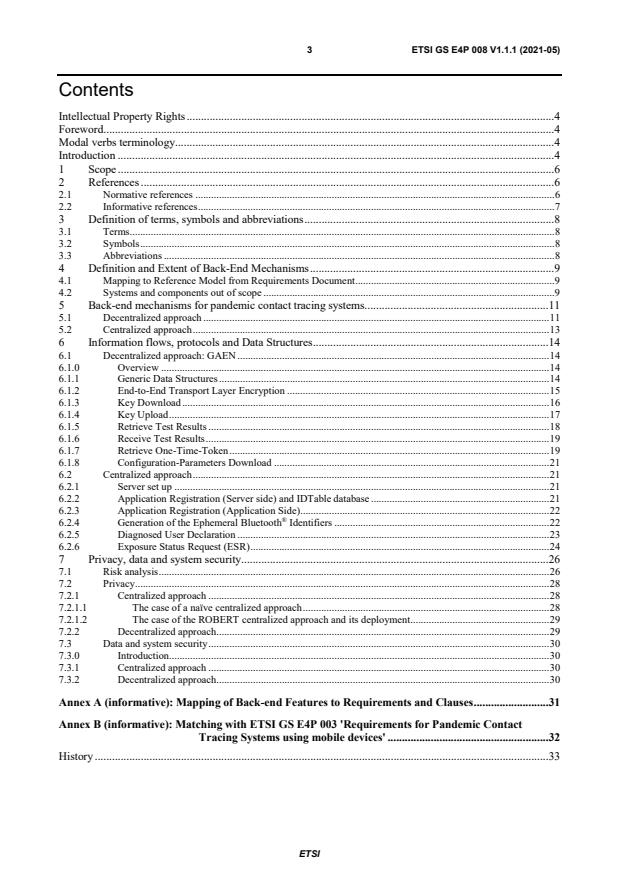
Contents
Intellectual Property Rights . 4
Foreword . 4
Modal verbs terminology . 4
Introduction . 4
1 Scope . 6
2 References . 6
2.1 Normative references . 6
2.2 Informative references . 7
3 Definition of terms, symbols and abbreviations . 8
3.1 Terms . 8
3.2 Symbols . 8
3.3 Abbreviations . 8
4 Definition and Extent of Back-End Mechanisms . 9
4.1 Mapping to Reference Model from Requirements Document . 9
4.2 Systems and components out of scope . 9
5 Back-end mechanisms for pandemic contact tracing systems. 11
5.1 Decentralized approach . 11
5.2 Centralized approach . 13
6 Information flows, protocols and Data Structures . 14
6.1 Decentralized approach: GAEN . 14
6.1.0 Overview . 14
6.1.1 Generic Data Structures . 14
6.1.2 End-to-End Transport Layer Encryption . 15
6.1.3 Key Download . 16
6.1.4 Key Upload . 17
6.1.5 Retrieve Test Results . 18
6.1.6 Receive Test Results . 19
6.1.7 Retrieve One-Time-Token . 19
6.1.8 Configuration-Parameters Download . 21
6.2 Centralized approach . 21
6.2.1 Server set up . 21
6.2.2 Application Registration (Server side) and IDTable database . 21
6.2.3 Application Registration (Application Side) . 22 ®
6.2.4 Generation of the Ephemeral Bluetooth Identifiers . 22
6.2.5 Diagnosed User Declaration . 23
6.2.6 Exposure Status Request (ESR) . 24
7 Privacy, data and system security . 26
7.1 Risk analysis . 26
7.2 Privacy . 28
7.2.1 Centralized approach . 28
7.2.1.1 The case of a naïve centralized approach . 28
7.2.1.2 The case of the ROBERT centralized approach and its deployment . 29
7.2.2 Decentralized approach . 29
7.3 Data and system security . 30
7.3.0 Introduction. 30
7.3.1 Centralized approach . 30
7.3.2 Decentralized approach . 30
Annex A (informative): Mapping of Back-end Features to Requirements and Clauses . 31
Annex B (informative): Matching with ETSI GS E4P 003 'Requirements for Pandemic Contact
Tracing Systems using mobile devices' . 32
History . 33
ETSI
4 ETSI GS E4P 008 V1.1.1 (2021-05)
Intellectual Property Rights
Essential patents
IPRs essential or potentially essential to normative deliverables may have been declared to ETSI. The declarations
pertaining to these essential IPRs, if any, are publicly available for ETSI members and non-members, and can be
found in ETSI SR 000 314: "Intellectual Property Rights (IPRs); Essential, or potentially Essential, IPRs notified to
ETSI in respect of ETSI standards", which is available from the ETSI Secretariat. Latest updates are available on the
ETSI Web server (https://ipr.etsi.org/).
Pursuant to the ETSI Directives including the ETSI IPR Policy, no investigation regarding the essentiality of IPRs,
including IPR searches, has been carried out by ETSI. No guarantee can be given as to the existence of other IPRs not
referenced in ETSI SR 000 314 (or the updates on the ETSI Web server) which are, or may be, or may become,
essential to the present document.
Trademarks
The present document may include trademarks and/or tradenames which are asserted and/or registered by their owners.
ETSI claims no ownership of these except for any which are indicated as being the property of ETSI, and conveys no
right to use or reproduce any trademark and/or tradename. Mention of those trademarks in the present document does
not constitute an endorsement by ETSI of products, services or organizations associated with those trademarks.
DECT™, PLUGTESTS™, UMTS™ and the ETSI logo are trademarks of ETSI registered for the benefit of its
Members. 3GPP™ and LTE™ are trademarks of ETSI registered for the benefit of its Members and of the 3GPP
Organizational Partners. oneM2M™ logo is a trademark of ETSI registered for the benefit of its Members and of the ®
oneM2M Partners. GSM and the GSM logo are trademarks registered and owned by the GSM Association. ®
BLUETOOTH is a trademark registered and owned by Bluetooth SIG, Inc.
Foreword
This Group Specification (GS) has been produced by ETSI Industry Specification Group (ISG) Europe for Privacy-
Preserving Pandemic Protection (E4P).
Modal verbs terminology
In the present document "shall", "shall not", "should", "should not", "may", "need not", "will", "will not", "can" and
"cannot" are to be interpreted as described in clause 3.2 of the ETSI Drafting Rules (Verbal forms for the expression of
provisions).
"must" and "must not" are NOT allowed in ETSI deliverables except when used in direct citation.
Introduction
The COVID-19 pandemic has generated significant challenge for many countries and their citizens and showed that
digital technologies could play an important role in addressing this pandemic and future pandemics. Various
applications, services and systems for contact tracing (identification and notification of those who come in contact with
a carrier) have been developed in different regions.
Despite the similar goal of automated detection of COVID-19 exposure as a complementary solution to manual tracing
(interviews with people diagnosed with COVID-19 to track down their recent contacts), their functionality, technology,
scale, required data and limitations are different and may not interoperate.
ETSI
5 ETSI GS E4P 008 V1.1.1 (2021-05)
These systems are currently being deployed in different countries and many more are expected in the near future. In
particular, mobile devices with their contact tracing applications can support public health authorities in controlling and
containing the pandemic. In that purpose, E4P has been created to provide a technical answer to pandemic crisis not
limited to COVID-19 by specifying interoperable contact tracing systems.
ETSI
6 ETSI GS E4P 008 V1.1.1 (2021-05)
1 Scope
The present document specifies back-end mechanisms for Pandemic contact Tracing Systems, including:
• architecture;
• information flow;
• protocols for sharing proximity data of contacts;
• the requisite APIs (Application Programming Interfaces); and
• privacy, data and system security.
Sufficient technical detail will be included to also facilitate means of interoperability in a later Work Item (ETSI
GS E4P 007 [3]. Each Digital Contact Tracing System is characterized by its degree of compatibility with the E4P
requirements work item (ETSI GS E4P 003 [1]).
2 References
2.1 Normative references
References are either specific (identified by date of publication and/or edition number or version number) or
non-specific. For specific references, only the cited version applies. For non-specific references, the latest version of the
referenced document (including any amendments) applies.
Referenced documents which are not found to be publicly available in the expected location might be found at
https://docbox.etsi.org/Reference/.
NOTE: While any hyperlinks included in this clause were valid at the time of publication, ETSI cannot guarantee
their long term validity.
The following referenced documents are necessary for the application of the present document.
[1] ETSI GS E4P 003 (V1.1.1): "Europe for Privacy-Preserving Pandemic Protection (E4P); High
level requirements for pandemic contact tracing systems using mobile devices".
[2] ETSI GS E4P 006 (V1.1.1): "Europe for Privacy-Preserving Pandemic Protection (E4P); Device-
Based Mechanisms for pandemic contact tracing systems".
[3] ETSI GS E4P 007 (V1.1.1): "Europe for Privacy-Preserving Pandemic Protection (E4P);
Pandemic proximity tracing systems: Interoperability framework".
[4] IETF RFC 5246: "The Transport Layer Security (TLS) Protocol Version 1.2".
[5] IETF RFC 2616: "Hypertext Transfer Protocol -- HTTP/1.1".
[6] IETF RFC 3629: "UTF-8, a transformation format of ISO 10646".
[7] IETF RFC 5905: "Network Time Protocol Version 4: Protocol and Algorithms Specification".
[8] ZIP File Format Specification, Version: 6.3.9.
NOTE: Available at https://pkware.cachefly.net/webdocs/casestudies/APPNOTE.TXT.
[9] Annex D.1 of NIST FIPS186-4.
[10] FIPS PUB 180-4: "Secure Hash Standard (SHS)".
NOTE: Available at https://nvlpubs.nist.gov/nistpubs/FIPS/NIST.FIPS.180-4.pdf.
ETSI
7 ETSI GS E4P 008 V1.1.1 (2021-05) ®
[11] "Exposure Notification Bluetooth Specification", v1.2 April 2020, Google Apple.
NOTE: Available at https://developers.google.com/android/exposure-notifications/exposure-key-file-format.
[12] PRIVATICS team, Inria, France, Fraunhofer AISEC, Germany: "ROBERT: ROBust and privacy-
presERving proximity Tracing, version 1.1", May 31st, 2020.
NOTE: Available at https://github.com/ROBERT-proximity-tracing/documents and https://hal.inria.fr/hal-
02611265/en/.
2.2 Informative references
References are either specific (identified by date of publication and/or edition number or version number) or
non-specific. For specific references, only the cited version applies. For non-specific references, the latest version of the
referenced document (including any amendments) applies.
NOTE: While any hyperlinks included in this clause were valid at the time of publication, ETSI cannot guarantee
their long term validity.
The following referenced documents are not necessary for the application of the present document but they assist the
user with regard to a particular subject area.
[i.1] Frequently Asked Questions about the Corona-Warn-App.
NOTE: Available at https://www.coronawarn.app/en/faq/#anonymous.
[i.2] Criteria for the Evaluation of Contact Tracing Apps.
NOTE: Available at https://github.com/corona-warn-app/cwa-
documentation/blob/master/pruefsteine.md#unlinkability.
[i.3] PRIVATICS team, Inria, France, Fraunhofer AISEC, Germany: "ROBERT: ROBust and privacy-
presERving proximity Tracing, version 1.1", May 31st, 2020. .
NOTE: Available at https://github.com/ROBERT-proximity-tracing/documents, https://hal.inria.fr/hal-
02611265/en/.
[i.4] G. Kessibi, M. Cunche, A. Boutet, C. Castelluccia, C. Lauradoux, D. Le Metayer, V. Roca:
"Analysis of Diagnosis Key distribution mechanism in contact tracing applications based on
Google-Apple Exposure Notification (GAEN) framework (version 1.2)", September 2020. .
NOTE: Available at https://github.com/3rd-ways-for-EU-exposure-notification/project-DESIRE,
https://hal.inria.fr/hal-02899412/en/.
[i.5] Swiss Confederation: "Replay Attacks", June 14th, 2020, section "Unmasking users by
eavesdropping EphIDs".
[i.6] Tijmen Schep: "Corona Detective".
NOTE: Available at https://www.coronadetective.eu/.
[i.7] O. Seiskari: "BLE contact tracing sniffer PoC".
NOTE: Available at https://github.com/oseiskar/corona-sniffer.
[i.8] S. Vaudenay: "Centralized or Decentralized? The Contact Tracing Dilemma".
NOTE: Available at https://infoscience.epfl.ch/record/277809.
[i.9] Ghazaleh Beigi, Huan Liu: "A Survey on Privacy in Social Media: Identification, Mitigation, and
Applications". ACM/IMS Transactions on Data Science, March 2020, Article No. 7.
NOTE: Available at https://doi.org/10.1145/3343038.
[i.10] IETF RFC 8446: "The Transport Layer Security (TLS) Protocol Version 1.3".
ETSI
8 ETSI GS E4P 008 V1.1.1 (2021-05)
3 Definition of terms, symbols and abbreviations
3.1 Terms
For the purposes of the present document, the following terms apply:
diagnosis key: secret code from which ephemeral identifiers for a given period of time can be derived with the help of a
cryptographic function
ephemeral identifier: unique device identifier exchanged with another device during a proximity event
proximity event: event recorded by the software on a mobile device corresponding to proximity to other device with an
active interoperable applications, and which meets the predefined criteria for an event to be recorded (e.g. duration)
3.2 Symbols
Void.
3.3 Abbreviations
For the purposes of the present document, the following abbreviations apply:
ACK Acknowledgement
BCD Requirement "Back-end Centralized Diagnosed"
BCE Requirement "Back-end Centralized EBID"
BCP Requirement "Back-end Centralized Privacy"
BCR Requirement "Back-end Centralized Registration"
BCS Requirement "Back-end Centralized Setup"
BCX Requirement "Back-end Centralized Exposure"
BDB Requirement "Back-end Decentralized BaseURL"
BDD Requirement "Back-end Decentralized Data-Structures"
BDK Requirement "Back-end Decentralized Key Download"
BDO Requirement "Back-end Decentralized One-Time-Token"
BDP Requirement "Back-end Decentralized Parameters"
BDR Requirement "Back-end Decentralized Retrieve Test Results"
BDT Requirement "Back-end Decentralized TLS"
BDU Requirement "Back-end Decentralized Key Uplead"
BE Reference Point "Back-end - External System"
BF Reference Point "Back-end - Federation" ®
Bluetooth LE Bluetooth Low Energy
CDN Content Distribution Network
DB Reference Point "Device - Back-end"
DCTS Digital Contact Tracing System
DP3T Decentralized Privacy-Preserving Proximity Tracing ®
EBID Ephemeral Bluetooth IDentifier
ESR Exposure Status Request
GAEN Google Apple Exposure Notification
GDPR General Data Protection Regulation
GUID Globally Unique Identifier
HSM Hardware Security Module
HTTP Hypertext Transfer Protocol
IP Internet Protocol
JSON JavaScript Object Notation
MB Mbits/s
NTP Network Time Protocol
PKI Public Key Infrastructure
QR Quick Response
TAN Transaction Authentication Number
ETSI
9 ETSI GS E4P 008 V1.1.1 (2021-05)
TEE Trusted Execution Environment
TLS Transport Layer Security
URL Uniform Resource Locator
UTF Unicode Transformation Format
4 Definition and Extent of Back-End Mechanisms
4.1 Mapping to Reference Model from Requirements Document
Figure 1: E4P Reference Architecture
The present document covers all back-end mechanisms necessary to make a digital contact tracing system functional.
Depending on the nature of the system, certain functions reside in the central infrastructure or in the device.
Functions west-bound from the reference point "DB" are covered in ETSI GS E4P 006 [2].
Mechanisms that facilitate interoperability between digital contact tracing systems, east-bound from the reference point
"BF", like a federation function between systems using the same design approach, or between systems with different
design approaches, are addressed in ETSI GS E4P 007 [3].
Digital contact tracing systems need to be integrated into a regional or national regime of handling a pandemic.
Functions in this context can be e.g. testing or setting of parameters to calibrate or adapt the system. These functions are
eastbound of the reference point "BE" and out of scope of the ISG E4P.
4.2 Systems and components out of scope
Deployment of a Digital Context Tracing System (DCTS) requires a suitable technical and organizational integration
with regional or national authorities and health entities, part of or working under authorization of the public health
authorities (in the scope of overall contact tracing initiated by public health entity/ies).
ETSI
10 ETSI GS E4P 008 V1.1.1 (2021-05)
DCTS provides the technical means to securely measure, collect, calculate, and communicate data according to and in
the context of an overall scheme defined by epidemiological and legal experts that have the respective scientific and
formal authorizations. The definition of the parameters to tune a DCTS, e.g. distance and time of proximity to be
measured, risk calculation algorithms, legal requirements on data handling, etc. are defined and decided on outside of
the DCTS. The E4P Reference Architecture refers to this complex as "External Systems" and defines the Reference
Point BE (Back-End - External Systems) for the respective information flows.
Figure 2 shows some examples of information flow types initiated by External Systems that might or might not be
handled by the Infrastructure as defined in the present document. If the information flow handled by the Infrastructure
would be
the information has to make use of the Reference Point BE. An example from the present document
clause 6.1.6.
Figure 2: E4P High-level Reference Architecture indicating
different types of information flows with External Systems
"Receive Test-Result" is informally represented in Figure 2 by the arrows II indicating the steps:
a) test result received by the Back-end;
b) test result retrieved by the Device;
c) test result displayed and acted on by the user.
In case of a positive test result, the release of 'diagnosis keys' is initiated in one of two ways: by an action by the user or
by an action by the App software on the device; in the latter case the DCTS App informs the user.
The arrow I represent an information flow of the type "Configuration-Parameter Download", where the parameters
affect the functions performed by the device, but are not necessarily displayed to the user.
The arrow III represents an "out-of-band" flow, where information to the user is bypassing the DCTS infrastructure.
The arrow IV represents all interactions between the users and their smartphones in relation with DCTS; this includes
interactions with the DCTS App, but may include interactions with other Apps, e.g. a browser or e-mail client used to
obtain useful information related to the use of DCTS.
In case of the decentralized approach the downloaded Diagnosis Keys come together with a digital signature to allow
the Mobile Device to verify, that the Diagnosis Keys are genuine and were not manipulated during transport. The
concrete way how the Mobile App gets the signature test key is out of scope of the present document (see clause 6.1.3).
ETSI
11 ETSI GS E4P 008 V1.1.1 (2021-05)
In clause 6.1.6, the reception of test results from the responsible authority shall be authenticated. How this
authentication is done is out of scope of the present document.
In clause 6.1.7, it is out of scope of the present document how the health authority decides to issue a teleTAN in the
case a laboratory does not support the procedure described in this clause.
In clause 6.1.8, the details regarding the configuration parameters to alter/tune the risk calculation algorithm are out of
scope of the present document.
5 Back-end mechanisms for pandemic contact tracing
systems
5.1 Decentralized approach
Figure 3: Back-end mechanisms overview (decentralized)
External System Communication
The External System Communication component interacts with external systems (e.g. Health Authorities, Test
Laboratories) in order to acquire or provide necessary information (e.g. test results, parameters to tune the overall
system or the exposure calculation formula, etc.) to make the overall Contact Tracing System functional.
NOTE 1: The E4P Reference Architecture also shows a Reference Point BF towards functions or modules realizing
federation between two or more Digital Contact Tracing Systems. However, no federation specific
functions inside a Back-end are described in the present document. For details regarding federation see
ETSI GS E4P 007 [3].
ETSI
12 ETSI GS E4P 008 V1.1.1 (2021-05)
Contact App Communication
The Contact App Communication component interacts with the Mobile Device to Upload Diagnosis Keys (e.g. if User
is diagnosed) and to download periodically the Diagnosis Keys (needed to calculate the Users exposure to other
diagnosed Users) and parameters to tune the risk calculation. In the latter case a Load Balancing Function may be used
to cope with the number of mobile devices. The Contact App Communication component is also used to perform some
"dummy" communication between Mobile Devices and the Back-end to make the Upload unobservable.
Authorization/Verification
The Authorization/Verification component authorizes specific Users for specific actions (e.g. Uploads) by appropriate
means (e.g. one-time PINs) and verifies the correct authorizations in the respective steps.
Contact Data Storage
The Contact Data Storage component stores the sets of Diagnosis Keys the DCTS has to handle and provides access to
them according to the specified protocols and rules.
Test Result Data Storage
The Test Result Data Storage component stores the test results necessary to forward to Users and provides access only
to verified authorizations.
Load Balancing (e.g. CDN)
The Load Balancing component is an optional function that replicates needed resources in order to guaranty maximum
availability of the DCTS. Below are some illustrative calculations regarding the expected amount of data which needs
to be transmitted to each Mobile Device in case of a decentralised DCTS.
NOTE 2: The following calculation is based on GAEN [i.1].
In the decentralised system design each Mobile Device locally checks if the device was in close proximity to other
mobile devices of diagnosed users. Therefore, each Mobile Device needs to know all the relevant diagnosis keys from
diagnosed users. In the current system design "relevant keys" usually refers to the diagnosis keys used by an diagnosed
user during 14 days (depending on the epidemiological necessities, e.g. at least 14 days for COVID-19) prior to the
point in time at which the user uploads his/her diagnosis keys to the back-end.
Moreover, the diagnosis keys change on a daily base, i.e. there is one diagnosis key per mobile device per day. Taking
this as input for the calculations and assuming that each user uses only one mobile device, each newly diagnosed user
will upload 14 diagnosis keys to the back-end, which need to be distributed to all other mobile devices.
A single diagnosis key consists of 16 random bytes. Therefore, each newly diagnosed user contributes at least
14 × 16 = 224 random bytes to the amount of data which need to be distributed to each other mobile device per day.
Note that because of the random nature of these bytes they cannot be compressed. Assuming 10 000, 100 000 or
1 000 000 newly diagnosed users this will lead to an amount of data of 2,24 MB, 22,4 MB or 224 MB respectively.
Encoding the diagnosis keys using appropriated data structures will require some extra bytes. Given that the protocol
buffer data structure TemporaryExposureKey as describe in clause 6.1.1 is used for encoding diagnosis keys, the
additional overhead will be roughly 11 bytes per diagnosis key.
These bytes can be compressed making an exact calculation of the amount of data traffic necessary to transmit the
diagnosis keys difficult. In a worst case scenario it would need 14 × (16 + 11) =378 bytes per newly diagnosed user. So,
for 10 000, 100 000 or 1 000 000 newly diagnosed users this will lead to an amount of data of 3,78 MB, 37,8 MB or
378 MB respectively.
ETSI
13 ETSI GS E4P 008 V1.1.1 (2021-05)
5.2 Centralized approach
Figure 4: Back-end mechanisms overview (centralized)
Application registration
The Application registration component is responsible for performing all the operations that are needed when a Mobile
Application registers to the Back-end (the first time a newly activated Mobile Application contacts the Back-end).
Ephemeral Ids generation
The Ephemeral Ids generation component provides the generation of the ephemeral identifiers that will be used by each
Mobile Device. These ephemeral identifiers are regularly sent by the Back-end to the Mobile Application.
Diagnosed user handling
The Diagnosed user handling component handles the necessary operations when a User is diagnosed. In this case, the
Mobile Application downloads what is essentially the relevant ephemeral identifiers that the Mobile Application has
seen during the period within which the User may have be contagious.
Exposure status
The Exposure status component is responsible for determining whether the User of a given Mobile Device is considered
as at risk for having been in close proximity (according to a risk calculation method) with another diagnosed User (this
is done by comparing the ephemeral identifiers that were downloaded to the Back-end via the Diagnosed user handling
function to the ephemeral identifiers that were generated for the User via the Ephemeral Ids generation function). The
Mobile Application regularly polls the Back-end to check whether its User should be considered at risk.
ETSI
14 ETSI GS E4P 008 V1.1.1 (2021-05)
6 Information flows, protocols and Data Structures
6.1 Decentralized approach: GAEN
6.1.0 Overview
The back-end of a decentralized DCTS is mainly an information hub collecting and providing information to other
systems without having to understand or being able to make use of the data handled in any way that would compromise
the privacy of the Users.
The main tasks of the Back-end are:
• Handling of Diagnosis Keys, both from and to the Mobile Devices.
• Handling of test results received from e.g. Test Laboratories and making them available to the respective
Users.
• Handling of parameters to tune the DCTS, as issued by the Health Authority.
Figure 5: DCTS Back-end information flows (decentralized)
6.1.1 Generic Data Structures
[BDD-01] The following data structures describe protocol buffer data structures initially defined by GAEN [11] used
during the transfer of Diagnosis Keys. They shall be used as building blocks used to construct the actual data structures
used during Key Download and Key Upload.
ETSI
15 ETSI GS E4P 008 V1.1.1 (2021-05)
message TemporaryExposureKey {
// The actual Diagnosis Key of an diagnosed user
optional bytes key_data = 1;
// The interval number since epoch for which a key starts
optional int32 rolling_start_interval_number = 2;
// Increments of 10 minutes describing how long a key is valid
optional int32 rolling_period = 3
[default = 144]; // defaults to 24 hours
// Data type representing why this key was published.
enum ReportType {
UNKNOWN = 0;
CONFIRMED_TEST = 1;
CONFIRMED_CLINICAL_DIAGNOSIS = 2;
SELF_REPORT = 3;
RECURSIVE = 4; // Reserved for future use.
REVOKED = 5; // Used to revoke a key.
}
// Type of diagnosis associated with a key.
optional ReportType report_type = 5;
// Number of days elapsed between symptom onset and the Diagnosis Key
// being used.
// E.g. 2 means Diagnosis Key is used 2 days after onset of symptoms.
optional sint32 days_since_onset_of_symptoms = 6;
}
Protocol Buffer Data Structure describing a single Diagnosis Key.
message SignatureInfo {
// Signature test key version for rollovers
// Must be in character class [a-zA-Z0-9_]. For example, 'v1'
optional string verification_key_version = 3;
// Alias with which to identify the Signature test key used for verification
// Must be in character class [a-zA-Z0-9_.]
optional string verification_key_id = 4;
// ASN.1 OID for Algorithm Identifier.
optional string signature_algorithm = 5;
}
Protocol Buffer Data Structure containing information for referencing to a key which can be used to verify a given
digital signature.
message Signature {
// Information about the signing key, version, algorithm, and so on.
optional SignatureInfo signature_info = 1;
// Describes for which part this signature is
// Number of the part
optional int32 batch_num = 2;
// Total number of parts
optional int32 batch_size = 3;
// The actual bytes of the digital signature
// The specific format depends on the signature algorithm
optional bytes signature = 4;
}
Protocol Buffer Data Structure describing a single digital signature.
6.1.2 End-to-End Transport Layer Encryption
All communication between the Mobile Device and the Back-end shall be secured by an End-to-End Transport Layer
Encryption.
[BDT-01] The backend shall at least support TLS version 1.2 as specified in IETF RFC 5246 [4]. The backend shall not
support any version of TLS below TLS version 1.2. It is recommended to use TLS version 1.3 as specified in IETF
RFC 8446 [i.10].
[BDT-02] The backend shall only support cipher suites which offer a security level equivalent to 112 bit symmetric key
encryption. The backend shall support cipher suites which offer Perfect Forward Secrecy. The Mobile Device should
use a cipher suite which implements Perfect Forward Secrecy for connecting with the backend.
ETSI
16 ETSI GS E4P 008 V1.1.1 (2021-05)
6.1.3 Key Download
This clause describes the information flows and protocols for providing the Diagnosis Keys Download function. There
is no access control for downloading the Diagnosis Keys, since it is a fundamental design principle to broadcast the
Diagnosis Keys to any user of the decentralised DCTS.
[BDK-01] The Diagnosis Keys Download function shall provide the Diagnosis Keys in the Exposure Key export file
format as described by GAEN [11]. Each provided file is a zip [8] archive containing exactly two entries:
export.bin and export.sig.
NOTE 1: A zip archive is used here because it allows to store the two entries within a single file. The usually
provided compression functionality is of no use here since the main part of the content of the zip archive
are random bytes (Diagnosis Keys).
The entry export.bin stores the Diagnosis Keys received by the Backend during a certain time frame (typically a
whole day) utilizing a protocol buffer data structure. Grouping Diagnosis Keys according to the receive time would
make incremental updates for a Mobile Device easier. The ordering of the Diagnosis Keys shall not allow to draw any
conclusion with respect to the original order of reception of Diagnosis Keys by the back-end with respect to the related
time interval.
message TemporaryExposureKeyExport {
// The two timestamps below describe the times during which the contained
// keys arrived at the backend (UTC seconds).
optional fixed64 start_timestamp = 1;
optional fixed64 end_timestamp = 2;
// Describes the region from which these Diagnosis Keys came from.
optional string region = 3;
// The following two entries can be used to split the whole Diagnosis Key
// export over multiple files.
// Number of the part of the keys contained in this file
optional int32 batch_num = 4;
// Total number of parts
optional int32 batch_size = 5;
// Information about the signatures used to sign this data structure
repeated SignatureInfo signature_infos = 6;
// The actual (initially uploaded) Diagnosis Keys
repeated TemporaryExposureKey keys = 7;
// Diagnosis Keys which changed their status since the last upload
repeated TemporaryExposureKey revised_keys = 8;
}
Protocol Buffer Data Structure within the export.bin entry of the Key Download HTTP GET request.
The export.bin binary file consist of a header followed by the binary representation of the protocol buffer data
structure described above. The header has the following content, which is padded by spaces encoded in UTF-8 (IETF
RFC 3629 [6]) 16 bytes in total:
EK Export v1
Header of export.bin
Therefore, the bytes of the header are:
0x45 0x4B 0x20 0x45 0x78 0x70 0x6F 0x72 0x74 0x20 0x76 0x31 0x20 0x20 0x20 0x20
Binary representation of the header of export.bin
The entry export.sig stores a digital signature over the export.bin entry. This allows the Mobile Device to
verify, that the Diagnosis Keys are genuine and were not manipulated during transport (e.g. in case a Content
Distribution Network (CDN) is used). The Mobile Device shall verify this digital signature with the help of the
corresponding public key. A Mobile Device shall only process an export.bin entry, if and only if the signature
could be successfully verified. The public signature test key can be either part of the Mobile App or could be
downloaded from the backend or some other trustworthy place e.g. belonging to a Public Key Infrastructure (PKI). The
concrete way how the Mobile App gets the signature test key is out of scope of the present document.
ETSI
17 ETSI GS E4P 008 V1.1.1 (2021-05)
The entry export.sig is a serialized form of the following protocol buffer data structure:
message SignatureList {
//The actual digital signatures for the corresponding export.bin entry
repeated Signature signatures = 1;
}
Protocol Buffer Data Structure within the export.sig entry of the Key Download HTTP GET request.
NOTE 2: This application layer signature would allow the Mobile Device to verify the validity of the provided
Diagnosis Keys independent of any authentication mechanism the transport layer may provide.
The zip archives for the different time periods containing the corresponding Diagnosis Keys shall be provided to the
Mobile Device by means of the Hypertext Transfer Protocol (see IETF RFC 2616 [5]). In order to download a single zip
archive a Mobile Device shall issue a HTTP GET request. The URL of that request shall encode in which zip archive
the Mobile Device is interested in.
The URL pointing to a given zip file should be constructed as described in the following paragraphs.
[BDB-01] There shall be a base URL (baseURL) which serves as a starting point for creating the final download URL.
This baseURL shall be known to the Mobile Device.
The Key Download procedure should support different versions, e.g. for allowing future updates of the present
document. Therefore, a path encoding the version of the Key Download procedure should follow the baseURL. The
resulting versioned_baseURL will be as follows: baseURL/version/VERSIONTAG. The only valid value for
the VERSIONTAG is v1, i.e. the versioned_baseURL will be: baseURL/version/v1.
The URL for downloading the keys encodes the country of origin of the corresponding keys. In order to get a list of
countries for which the backend provides diagnosis keys an HTTP GET request with the accepted content type set to
application/json and the following URL should be used: versioned_baseURL/diagnosis-
keys/country. The returned JSON data structure shall contain an array of the country codes for which diagnosis
keys are stored.
In order to download diagnosis keys regarding a specific country of origin the following
versioned_country_baseURL is defined: versioned_baseURL/diagnosis-
keys/country/COUNTRYCODE. Moreover, to learn for which dates diagnosis keys are stored in the backend an
HTTP GET request with the accepted content type set to application/json and the following URL should be
used: versioned_country_baseURL
...
Questions, Comments and Discussion
Ask us and Technical Secretary will try to provide an answer. You can facilitate discussion about the standard in here.
Loading comments...