


ETSI GS PDL 022 V1.1.1 (2024-03)
Permissioned Distributed Ledgers (PDL); PDL in Wholesale Supply Chain Management
Permissioned Distributed Ledgers (PDL); PDL in Wholesale Supply Chain Management
DGS/PDL-0022_supply_chain
General Information
Standards Content (Sample)
GROUP SPECIFICATION
Permissioned Distributed Ledgers (PDL);
PDL in Wholesale Supply Chain Management
Disclaimer
The present document has been produced and approved by the Permissioned Distributed Ledger (PDL) ETSI Industry
Specification Group (ISG) and represents the views of those members who participated in this ISG.
It does not necessarily represent the views of the entire ETSI membership.
2 ETSI GS PDL 022 V1.1.1 (2024-03)
Reference
DGS/PDL-0022_supply_chain
Keywords
architecture, distributed ledger, ICT
ETSI
650 Route des Lucioles
F-06921 Sophia Antipolis Cedex - FRANCE
Tel.: +33 4 92 94 42 00 Fax: +33 4 93 65 47 16
Siret N° 348 623 562 00017 - APE 7112B
Association à but non lucratif enregistrée à la
Sous-Préfecture de Grasse (06) N° w061004871
Important notice
The present document can be downloaded from:
https://www.etsi.org/standards-search
The present document may be made available in electronic versions and/or in print. The content of any electronic and/or
print versions of the present document shall not be modified without the prior written authorization of ETSI. In case of any
existing or perceived difference in contents between such versions and/or in print, the prevailing version of an ETSI
deliverable is the one made publicly available in PDF format at www.etsi.org/deliver.
Users of the present document should be aware that the document may be subject to revision or change of status.
Information on the current status of this and other ETSI documents is available at
https://portal.etsi.org/TB/ETSIDeliverableStatus.aspx
If you find errors in the present document, please send your comment to one of the following services:
https://portal.etsi.org/People/CommiteeSupportStaff.aspx
If you find a security vulnerability in the present document, please report it through our
Coordinated Vulnerability Disclosure Program:
https://www.etsi.org/standards/coordinated-vulnerability-disclosure
Notice of disclaimer & limitation of liability
The information provided in the present deliverable is directed solely to professionals who have the appropriate degree of
experience to understand and interpret its content in accordance with generally accepted engineering or
other professional standard and applicable regulations.
No recommendation as to products and services or vendors is made or should be implied.
No representation or warranty is made that this deliverable is technically accurate or sufficient or conforms to any law
rule and/or regulation and further, no representation or warranty is made of merchantability or fitness
and/or governmental
for any particular purpose or against infringement of intellectual property rights.
In no event shall ETSI be held liable for loss of profits or any other incidental or consequential damages.
Any software contained in this deliverable is provided "AS IS" with no warranties, express or implied, including but not
limited to, the warranties of merchantability, fitness for a particular purpose and non-infringement of intellectual property
rights and ETSI shall not be held liable in any event for any damages whatsoever (including, without limitation, damages
for loss of profits, business interruption, loss of information, or any other pecuniary loss) arising out of or related to the use
of or inability to use the software.
Copyright Notification
No part may be reproduced or utilized in any form or by any means, electronic or mechanical, including photocopying and
microfilm except as authorized by written permission of ETSI.
The content of the PDF version shall not be modified without the written authorization of ETSI.
The copyright and the foregoing restriction extend to reproduction in all media.
© ETSI 2024.
All rights reserved.
ETSI
3 ETSI GS PDL 022 V1.1.1 (2024-03)
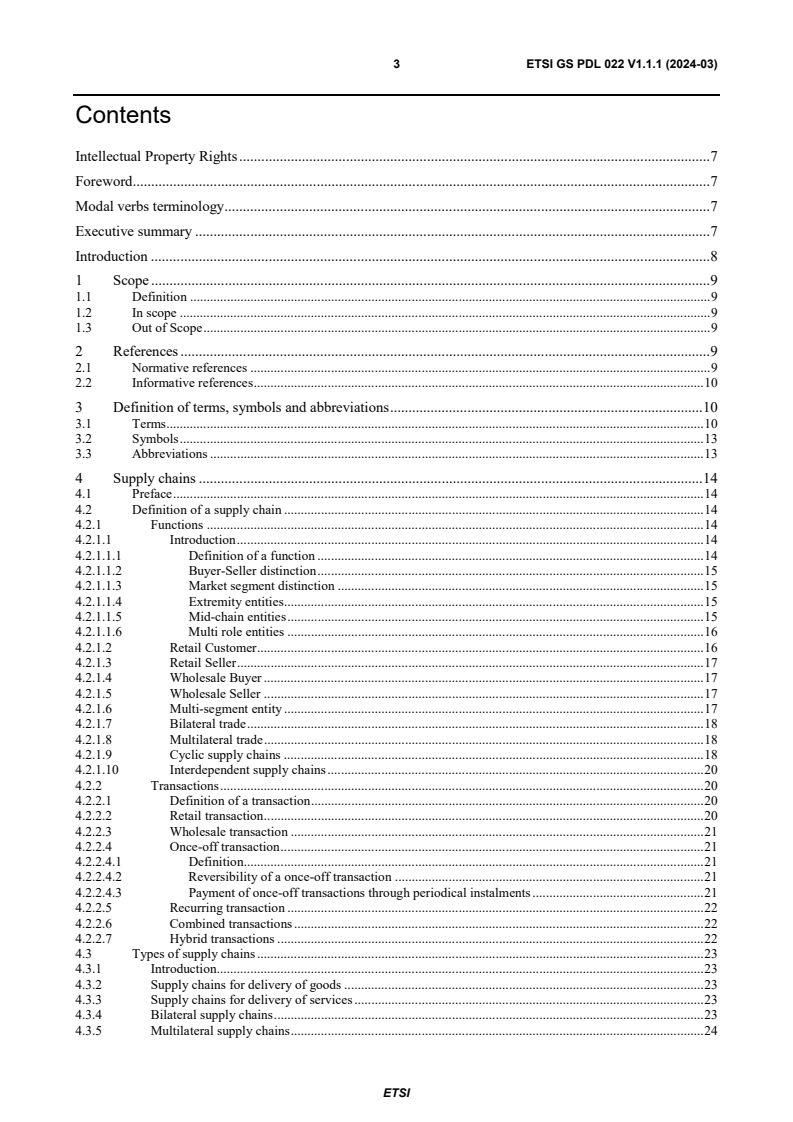
Contents
Intellectual Property Rights . 7
Foreword . 7
Modal verbs terminology . 7
Executive summary . 7
Introduction . 8
1 Scope . 9
1.1 Definition . 9
1.2 In scope . 9
1.3 Out of Scope . 9
2 References . 9
2.1 Normative references . 9
2.2 Informative references . 10
3 Definition of terms, symbols and abbreviations . 10
3.1 Terms . 10
3.2 Symbols . 13
3.3 Abbreviations . 13
4 Supply chains . 14
4.1 Preface . 14
4.2 Definition of a supply chain . 14
4.2.1 Functions . 14
4.2.1.1 Introduction . 14
4.2.1.1.1 Definition of a function . 14
4.2.1.1.2 Buyer-Seller distinction . 15
4.2.1.1.3 Market segment distinction . 15
4.2.1.1.4 Extremity entities. 15
4.2.1.1.5 Mid-chain entities . 15
4.2.1.1.6 Multi role entities . 16
4.2.1.2 Retail Customer . 16
4.2.1.3 Retail Seller . 17
4.2.1.4 Wholesale Buyer . 17
4.2.1.5 Wholesale Seller . 17
4.2.1.6 Multi-segment entity . 17
4.2.1.7 Bilateral trade . 18
4.2.1.8 Multilateral trade . 18
4.2.1.9 Cyclic supply chains . 18
4.2.1.10 Interdependent supply chains . 20
4.2.2 Transactions . 20
4.2.2.1 Definition of a transaction . 20
4.2.2.2 Retail transaction . 20
4.2.2.3 Wholesale transaction . 21
4.2.2.4 Once-off transaction . 21
4.2.2.4.1 Definition. 21
4.2.2.4.2 Reversibility of a once-off transaction . 21
4.2.2.4.3 Payment of once-off transactions through periodical instalments . 21
4.2.2.5 Recurring transaction . 22
4.2.2.6 Combined transactions . 22
4.2.2.7 Hybrid transactions . 22
4.3 Types of supply chains . 23
4.3.1 Introduction. 23
4.3.2 Supply chains for delivery of goods . 23
4.3.3 Supply chains for delivery of services . 23
4.3.4 Bilateral supply chains . 23
4.3.5 Multilateral supply chains . 24
ETSI
4 ETSI GS PDL 022 V1.1.1 (2024-03)
4.4 PDL in supply chains . 24
4.4.1 Types of PDL related entities and nodes in a supply chain . 24
4.4.1.1 Introduction . 24
4.4.1.2 Trading entities . 24
4.4.1.3 Non-trading entities . 24
4.4.1.4 Trading PDL nodes . 25
4.4.1.5 Non-trading PDL nodes . 25
4.4.2 Buyer-Seller PDL . 25
4.4.2.1 Definition . 25
4.4.2.2 Unilateral . 25
4.4.2.3 Bilateral . 25
4.4.2.4 Buyer-Seller PDL architecture . 26
4.4.3 Multilateral PDL . 27
4.4.4 Ecosystem-wide PDL . 27
4.4.4.1 Definition of an ecosystem-wide PDL . 27
4.4.4.2 Ecosystem-wide PDL architecture . 28
4.4.4.3 Ecosystem-wide PDL plurality . 29
5 Lifecycle Management . 29
5.1 Definition of a lifecycle . 29
5.2 Lifecycle of goods and/or services in a supply chain . 30
5.3 Lifecycle stages . 31
5.3.1 Inception of an idea or a proposed solution . 31
5.3.1.1 Proposing a solution based on market research or prediction of future needs . 31
5.3.1.2 Proposing a solution based on a specific request . 31
5.3.1.3 Data management and PDL aspects . 31
5.3.2 Design, pricing and presentation . 32
5.3.2.1 General discussion . 32
5.3.2.2 Internal cost and external cost . 32
5.3.2.3 Selling price and mark-up . 32
5.3.2.4 Recursive processes . 33
5.3.2.5 Validity of quotes . 33
5.3.2.6 Supply chain depth . 34
5.3.2.7 Presentation of a solution and a quote . 34
5.3.2.8 Transaction management and PDL management . 35
5.3.3 Ordering . 35
5.3.3.1 General discussion . 35
5.3.3.2 Recursiveness . 35
5.3.3.3 Acceptance of order . 36
5.3.3.4 Transaction management and PDL management . 36
5.3.4 Delivery . 36
5.3.4.1 Preface . 36
5.3.4.2 Goods and services sold from Stock/Inventory . 36
5.3.4.3 Goods that require pre-shipment staging/assembly . 37
5.3.4.4 Goods and/or services delivered using supply-chain partners . 37
5.3.4.5 Successful delivery. 37
5.3.4.6 Integration and chaining . 37
5.3.4.7 Failed delivery . 37
5.3.4.8 Transaction management and PDL management . 38
5.3.4.9 Process diagrams for various delivery scenarios - Parallel delivery . 38
5.3.5 Operations and management . 39
5.3.5.1 Operations and management considerations . 39
5.3.5.2 Monitoring and reporting quality and performance of goods and service . 40
5.3.5.2.1 Introduction to monitoring and reporting . 40
5.3.5.2.2 Report triggers/generation . 40
5.3.5.2.3 Scheduled report request propagation . 40
5.3.5.2.4 Non-Scheduled Report Request Propagation . 41
5.3.5.2.5 Performance reporting process . 41
5.3.5.3 Measuring usage of service (where applicable) . 41
5.3.5.4 Fault identification and repair . 42
5.3.5.4.1 Decision tree . 42
5.3.5.4.2 Fault management scenarios when abandoning a faulty service that is in operation . 44
ETSI
5 ETSI GS PDL 022 V1.1.1 (2024-03)
5.3.5.4.3 Fault management scenarios when repairing a faulty service that is in operation . 45
5.3.5.4.4 Fault management scenarios when repairing a faulty service that is not in operation . 46
5.3.5.4.5 Fault management when ignoring the fault . 47
5.3.5.4.6 Proactive fault management . 47
5.3.5.4.7 Reactive fault management . 47
5.3.5.5 Other operations and management activities . 47
5.3.6 Settlement . 48
5.3.6.1 Once-off settlement . 48
5.3.6.2 Periodical settlement . 48
5.3.6.3 Usage-based settlement . 48
5.3.6.4 Payment process . 49
Annex A (informative): Use case 1: Distributed network slicing bilateral marketplace
(network slicing and resource allocation) . 50
A.1 Use case background . 50
A.2 Distributed slice brokering for bilateral trading and PDL . 50
A.3 Double auction mechanism as a smart contract . 50
History . 52
ETSI
6 ETSI GS PDL 022 V1.1.1 (2024-03)
List of Figures
Figure 1: Architecture of an entity in a supply chain .14
Figure 2: Entity types .16
Figure 3: Multi-role entity .16
Figure 4: Multi segment entity .18
Figure 5: Bilateral wholesale trade .18
Figure 6: Cyclic supply chain .19
Figure 7: Interdependent supply chains .20
Figure 8: Buy-Sell PDL implementation in a supply chain .26
Figure 9: Buyer-Seller PDL architecture .26
Figure 10: Ecosystem-wide PDL .28
Figure 11: Ecosystem-wide PDL architecture .28
Figure 12: Ecosystem-wide PDL plurality .29
Figure 13: Lifecycle stages between a Buyer and a Seller .30
Figure 14: Lifecycle stages in a supply chain .30
Figure 15: Design, pricing and presentation of menu based goods and services.33
Figure 16: Order Acceptance and Rejection process .36
Figure 17: Delivery options .38
Figure 18: Internal Delivery .38
Figure 19: Staged/Sequential Delivery of External and Internal elements .39
Figure 20: Service delivery - Parallel delivery .39
Figure 21: Scheduled Monitoring and reporting quality and performance of service .41
Figure 22: Non-Scheduled service monitoring and reporting process.41
Figure 23: Measuring usage of service .42
Figure 24: Fault identification and repair decision tree .44
Figure 25: Fault management scenarios A & B .45
Figure 26: Fault management scenario C .45
Figure 27: Fault management scenarios D & E .46
Figure 28: Fault management scenarios F and G .46
Figure 29: Fault management scenarios J and K .47
Figure A.1: Mobile network slicing supply chain .51
Figure A.2: Bilateral trade using smart contracts (sequence diagram) .51
ETSI
7 ETSI GS PDL 022 V1.1.1 (2024-03)
Intellectual Property Rights
Essential patents
IPRs essential or potentially essential to normative deliverables may have been declared to ETSI. The declarations
pertaining to these essential IPRs, if any, are publicly available for ETSI members and non-members, and can be
found in ETSI SR 000 314: "Intellectual Property Rights (IPRs); Essential, or potentially Essential, IPRs notified to
ETSI in respect of ETSI standards", which is available from the ETSI Secretariat. Latest updates are available on the
ETSI Web server (https://ipr.etsi.org/).
Pursuant to the ETSI Directives including the ETSI IPR Policy, no investigation regarding the essentiality of IPRs,
including IPR searches, has been carried out by ETSI. No guarantee can be given as to the existence of other IPRs not
referenced in ETSI SR 000 314 (or the updates on the ETSI Web server) which are, or may be, or may become,
essential to the present document.
Trademarks
The present document may include trademarks and/or tradenames which are asserted and/or registered by their owners.
ETSI claims no ownership of these except for any which are indicated as being the property of ETSI, and conveys no
right to use or reproduce any trademark and/or tradename. Mention of those trademarks in the present document does
not constitute an endorsement by ETSI of products, services or organizations associated with those trademarks.
DECT™, PLUGTESTS™, UMTS™ and the ETSI logo are trademarks of ETSI registered for the benefit of its
Members. 3GPP™ and LTE™ are trademarks of ETSI registered for the benefit of its Members and of the 3GPP
Organizational Partners. oneM2M™ logo is a trademark of ETSI registered for the benefit of its Members and of the ®
oneM2M Partners. GSM and the GSM logo are trademarks registered and owned by the GSM Association.
Foreword
This Group Specification (GS) has been produced by ETSI Industry Specification Group (ISG) Permissioned
Distributed Ledger (PDL).
Modal verbs terminology
In the present document "shall", "shall not", "should", "should not", "may", "need not", "will", "will not", "can" and
"cannot" are to be interpreted as described in clause 3.2 of the ETSI Drafting Rules (Verbal forms for the expression of
provisions).
"must" and "must not" are NOT allowed in ETSI deliverables except when used in direct citation.
Executive summary
The present document defines and describes the use of PDL in the lifecycle of goods and/or services delivered through a
supply chain. It defines the types of supply chains, the types and roles of entities in a supply chain, and the lifecycle
phases and processes executed by the different entities along the supply chain. The present document also describes the
architectural concepts of the PDLs used in supply chains as well as the data stored on the chain during the lifecycle
processes.
ETSI
8 ETSI GS PDL 022 V1.1.1 (2024-03)
Introduction
The delivery of goods and/or services through a supply chain involves operational and commercial activities across a
chain of entities. Such goods and/or services traverse a series of phases that are bound into a lifecycle that may include
initial inquiry/research, quoting, ordering, delivery, quality assurance, usage measurement, fault repair, financial
settlement and change management.
A supply chain is built from pairs of Buyers and Sellers where on one side there is an ultimate Buyer procuring the
goods and/or services, and down the chain there are entities that serve as both Sellers and Buyers. They sell to the
upstream Buyer and buy from downstream Sellers. Some of those downstream entities simply pass the goods and/or
services from the downstream Seller to the upstream Buyer (commonly referred to as "wholesaler") and some also
contribute certain elements to the final product sold to the ultimate Customer. An example of a wholesaler would be a
vegetable grocer that buys from the farmers by the tons and sells to the consumers by the kilo, while another example
could be of a data centre operator that rents office space from one entity, buys 19" racks from another entity, computers
from another entity, software licenses from yet another entity, integrates and assembles them all and sells computation
capacity or storage space to ICT consumers.
The processes that occur at each participant in such supply chain differ depending on the lifecycle stage and the role
that the participant plays in such chain.
Many entities participating in supply chains have developed their own processes, nomenclature and data models to
define their internal operations. Integrating, coordinating and synchronizing such processes across operational
boundaries creates misalignment in process steps, data models and inter-entity communications, often resulting in
failure to automate the inter-entity operations thus reverting to slow and inefficient manual processes.
The present document defines the stages, processes, and high-level requirements each player has to abide by for the
proper operation of a supply chain. The main intention is to allow automation of such supply chains, minimizing
manual activities that are expensive, slow and prone to errors.
Clause 4 of the present document defines the types of supply chains, the entities taking part in a supply chain, the types
of transaction occurring in a supply chain and the types of, and requirements from, the PDLs in use in a supply chain.
Clause 5 of the present document lists the lifecycle stages and defines the required process flow for each of those stages
in a supply chain environment.
Annex A describes a potential use case of PDL in management of lifecycle of a network slice in a supply chain of
mobile operators. This annex is descriptive and does not include specifications or requirements.
ETSI
9 ETSI GS PDL 022 V1.1.1 (2024-03)
1 Scope
1.1 Definition
The present document defines and describes the use of PDL in the lifecycle of goods and/or services delivered through a
supply chain.
1.2 In scope
a) Definition of types of supply chains.
b) Definition of the types and roles of entities in a supply chain.
c) Definition of the lifecycle phases and processes executed by the different entities along the supply chain.
d) Definition of the types of transaction occurring in a supply chain.
e) Definition of the types of, and requirements from, PDLs in use in a supply chain.
f) Definition of the lifecycle stages.
g) Definition of the required process flow for each of lifecycle stage in a supply chain environment.
1.3 Out of Scope
a) Detailed data models for specific goods and/or services.
b) Settlement of usage-based services.
2 References
2.1 Normative references
References are either specific (identified by date of publication and/or edition number or version number) or
non-specific. For specific references, only the cited version applies. For non-specific references, the latest version of the
referenced document (including any amendments) applies.
Referenced documents which are not found to be publicly available in the expected location might be found at
https://docbox.etsi.org/Reference/.
NOTE: While any hyperlinks included in this clause were valid at the time of publication, ETSI cannot guarantee
their long term validity.
The following referenced documents are necessary for the application of the present document.
Not applicable.
ETSI
10 ETSI GS PDL 022 V1.1.1 (2024-03)
2.2 Informative references
References are either specific (identified by date of publication and/or edition number or version number) or
non-specific. For specific references, only the cited version applies. For non-specific references, the latest version of the
referenced document (including any amendments) applies.
NOTE: While any hyperlinks included in this clause were valid at the time of publication, ETSI cannot guarantee
their long term validity.
The following referenced documents are not necessary for the application of the present document but they assist the
user with regard to a particular subject area.
[i.1] MEF 74 (December 2018): "Commercial Affecting Attributes".
[i.2] Journal of Object Technology: "Cloud Computing; Today and Tomorrow", Vol. 8, No. 1, January-
February 2009.
[i.3] University of Cambridge (August 2018): "Cambridge Judge Business School - Defining DLT".
[i.4] Recommendation ITU-T M.3400 (02/2000): "TMN management functions".
[i.5] MEF 55.1 (February 2021): "LSO Reference Architecture and Framework".
[i.6] IETF RFC 7665 (October 2015): "Service Function Chaining (SFC) Architecture".
[i.7] MEF 10.4 (December 2018): "Subscriber Ethernet Service Attributes".
[i.8] ETSI GS PDL 015 (V1.1.1): "Permissioned Distributed Ledger (PDL); Reputation management".
[i.9] MEF 17 (April 2007): "Service OAM Requirements & Framework - Phase 1".
[i.10] Smith J. E. & Nair R.: "The Architecture Of Virtual Machines". Computer, 38(5), 32-38.
May 2005.
[i.11] MEF 52 (November 2015): "Carrier Ethernet Performance Reporting Framework".
[i.12] N. Afraz and M. Ruffini: "5G Network Slice Brokering: A Distributed Blockchain-based Market",
2020 European Conference on Networks and Communications (EuCNC), Dubrovnik, Croatia,
2020, pp. 23-27, doi: 10.1109/EuCNC48522.2020.9200915.
[i.13] Diego Ongaro and John Ousterhout: "Stanford University, In Search of an Understandable
Consensus Algorithm", June 2014.
3 Definition of terms, symbols and abbreviations
3.1 Terms
For the purposes of the present document, the following terms apply:
bilateral agreement: business relationship between two Participants
NOTE: The business relationship between these Participants is always direct, private and bilateral.
bilateral business process: various business processes that are part of the Bilateral Agreement
NOTE: The bilateral business process includes Pre-Order, Order, Service Delivery, SOAM, Billing and Change
Management.
bilateral PDL: ledger shared between exactly two parties
ETSI
11 ETSI GS PDL 022 V1.1.1 (2024-03)
billing: commercial process of invoicing, reconciliation and settlement of amounts due by Buyer, Seller or bidirectional
trading partners
NOTE: See MEF 74 [i.1].
Buyer: entity that buys a service from a Seller of which it is an immediate upstream neighbour in the Supply Chain
change management: changes made to in-operation service instances
cloud: non-geographically specific environment offering data services such as compute, storage and connectivity
NOTE: Journal of Object Technology [i.2].
commercial agreement: agreement between two parties allowing for buying services, selling services between them or
both
commercial framework: framework that facilitates the generation of commercial value through wholesale trading of
data services
compute: act of manipulating data or acting based on data using a computing resource
connectivity: act of transporting data through space
data service: service that combines one or more of the following:
• Connectivity service
• Compute service
• Storage service
data-on-demand service: data-on-demand services are expected to be activated, operated, billed, and settled with
immediate effect
NOTE: This expectation is based on pre-existing and pre-on-boarded facilities and interconnects.
Distributed Ledger Technology (DLT): digital system for recording information so it is recorded in multiple places at
the same time
NOTE: Defining DLT, University of Cambridge [i.3].
DLT Abstraction Layer: architectural abstraction between applications using the DLT and the DLT itself
ecosystem: federated and collaborative platform that enables establishment of data services through a Supply Chain
ecosystem-wide PDL: PDL that includes exactly one node from each participant in an Ecosystem
NOTE: It may also include a validation node.
fault management: process of identifying and rectifying faults in services
NOTE: Recommendation ITU-T M.3400 [i.4].
inquiry: first part of the process 'Inquiry and Quote'
NOTE: It includes request by Buyer from Seller confirmation of ability to Quote followed by a Quote for service
as described in the Inquiry. Service details may include: Locations, Bandwidth, QoS, VNF details (CPU,
OS, RAM, Storage, etc.).
Interface Reference Point (IRP): See MEF 55.1 [i.5].
internal PDL: repository that contains information that is used internally by an entity and that does not need to be
shared with any external entity
invoicing: process in which the Seller generates and sends an invoice to the Buyer for the amount stipulated by the
Bilateral Agreement and based on utilization information and SLA or other credits as applicable based on agreement
ETSI
12 ETSI GS PDL 022 V1.1.1 (2024-03)
Lifecycle Service Orchestration (LSO): open and interoperable automation of management operations over the entire
lifecycle of Layer 1, Layer 2 and Layer 3 Data Services
NOTE: This includes fulfilment, control, performance, assurance, usage, security, analytics and policy
capabilities, over all the network domains that require coordinated management and control in order to
deliver the service (see MEF 55.1 [i.5]).
LSO Reference Architecture: layered abstraction architecture that characterizes the management and control domains
and entities, and the interfaces among them, to enable cooperative orchestration of Data Services
NOTE: See MEF 55.1 [i.5].
LSO Sonata IRP: IRP through which a Buyer and Seller exchange commercial and operational information pertaining
to services
NOTE: See MEF 55.1 [i.5].
order: request from Buyer to Seller for service based on Quote provided by Seller
ordering: service lifecycle phase in which a Buyer places an order for a service with a Seller based on a quote received
from the Seller either through an inquiry/quote phase or based on a valid rate sheet
provisioning: phase in the lifecycle of a data-on-demand service during which an order is fulfilled and implemented on
the respective network components
quote: price for a service offered by a Seller to a Buyer
raft: consensus algorithm
NOTE: See Stanford [i.13].
reconciliation: process of reaching agreement in case of a dispute
NOTE: See MEF 74 [i.1].
Seller: entity that sells goods or a service to a Buyer of which it is an immediate downstream neighbour in the Supply
Chain
service chaining: process of configuring and integrating multiple Service Elements to become a single composite
service referred to as a Service Chain
NOTE: See IETF RFC 7665 [i.6].
service delivery: process of integrating different Service Elements and delivering them as complete service to the
Buyer
service element: component of a service
EXAMPLE: Include VM, Access E-Line, combination of the two, etc.
settlement: transfer of monetary funds between parties based on billing and reconciliation
NOTE 1: The process of analysing the amount a Buyer is invoice
...
Questions, Comments and Discussion
Ask us and Technical Secretary will try to provide an answer. You can facilitate discussion about the standard in here.
Loading comments...