


ETSI GS CIM 006 V1.3.1 (2024-03)
Context Information Management (CIM); NGSI-LD Information Model
Context Information Management (CIM); NGSI-LD Information Model
RGS/CIM-006v131
General Information
Standards Content (Sample)
GROUP SPECIFICATION
Context Information Management (CIM);
NGSI-LD Information Model
Disclaimer
The present document has been produced and approved by the cross-cutting Context Information Management (CIM) ETSI
Industry Specification Group (ISG) and represents the views of those members who participated in this ISG.
It does not necessarily represent the views of the entire ETSI membership.
2 ETSI GS CIM 006 V1.3.1 (2024-03)
Reference
RGS/CIM-006v131
Keywords
information model, interoperability, smart city
ETSI
650 Route des Lucioles
F-06921 Sophia Antipolis Cedex - FRANCE
Tel.: +33 4 92 94 42 00 Fax: +33 4 93 65 47 16
Siret N° 348 623 562 00017 - APE 7112B
Association à but non lucratif enregistrée à la
Sous-Préfecture de Grasse (06) N° w061004871
Important notice
The present document can be downloaded from:
https://www.etsi.org/standards-search
The present document may be made available in electronic versions and/or in print. The content of any electronic and/or
print versions of the present document shall not be modified without the prior written authorization of ETSI. In case of any
existing or perceived difference in contents between such versions and/or in print, the prevailing version of an ETSI
deliverable is the one made publicly available in PDF format at www.etsi.org/deliver.
Users of the present document should be aware that the document may be subject to revision or change of status.
Information on the current status of this and other ETSI documents is available at
https://portal.etsi.org/TB/ETSIDeliverableStatus.aspx
If you find errors in the present document, please send your comment to one of the following services:
https://portal.etsi.org/People/CommiteeSupportStaff.aspx
If you find a security vulnerability in the present document, please report it through our
Coordinated Vulnerability Disclosure Program:
https://www.etsi.org/standards/coordinated-vulnerability-disclosure
Notice of disclaimer & limitation of liability
The information provided in the present deliverable is directed solely to professionals who have the appropriate degree of
experience to understand and interpret its content in accordance with generally accepted engineering or
other professional standard and applicable regulations.
No recommendation as to products and services or vendors is made or should be implied.
No representation or warranty is made that this deliverable is technically accurate or sufficient or conforms to any law
rule and/or regulation and further, no representation or warranty is made of merchantability or fitness
and/or governmental
for any particular purpose or against infringement of intellectual property rights.
In no event shall ETSI be held liable for loss of profits or any other incidental or consequential damages.
Any software contained in this deliverable is provided "AS IS" with no warranties, express or implied, including but not
limited to, the warranties of merchantability, fitness for a particular purpose and non-infringement of intellectual property
rights and ETSI shall not be held liable in any event for any damages whatsoever (including, without limitation, damages
for loss of profits, business interruption, loss of information, or any other pecuniary loss) arising out of or related to the use
of or inability to use the software.
Copyright Notification
No part may be reproduced or utilized in any form or by any means, electronic or mechanical, including photocopying and
microfilm except as authorized by written permission of ETSI.
The content of the PDF version shall not be modified without the written authorization of ETSI.
The copyright and the foregoing restriction extend to reproduction in all media.
© ETSI 2024.
All rights reserved.
ETSI
3 ETSI GS CIM 006 V1.3.1 (2024-03)
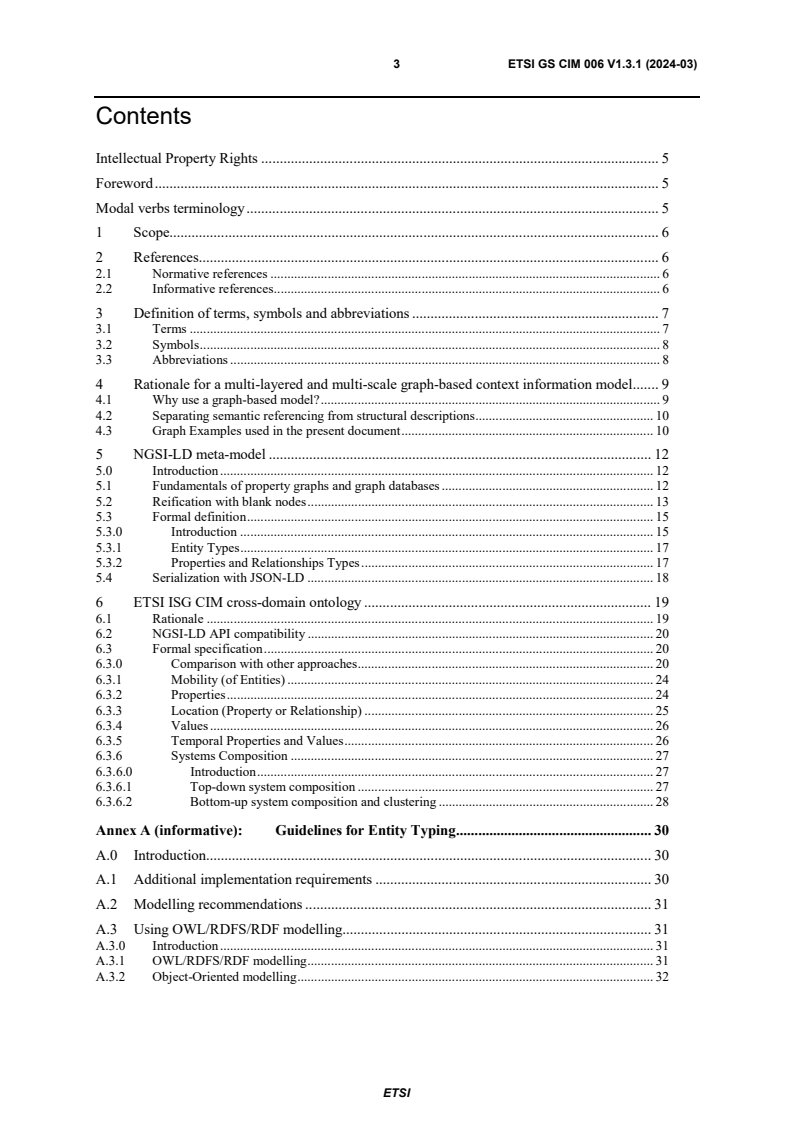
Contents
Intellectual Property Rights . 5
Foreword . 5
Modal verbs terminology . 5
1 Scope. 6
2 References . 6
2.1 Normative references . 6
2.2 Informative references . 6
3 Definition of terms, symbols and abbreviations . 7
3.1 Terms . 7
3.2 Symbols . 8
3.3 Abbreviations . 8
4 Rationale for a multi-layered and multi-scale graph-based context information model . 9
4.1 Why use a graph-based model? . 9
4.2 Separating semantic referencing from structural descriptions . 10
4.3 Graph Examples used in the present document . 10
5 NGSI-LD meta-model . 12
5.0 Introduction . 12
5.1 Fundamentals of property graphs and graph databases . 12
5.2 Reification with blank nodes . 13
5.3 Formal definition . 15
5.3.0 Introduction . 15
5.3.1 Entity Types . 17
5.3.2 Properties and Relationships Types . 17
5.4 Serialization with JSON-LD . 18
6 ETSI ISG CIM cross-domain ontology . 19
6.1 Rationale . 19
6.2 NGSI-LD API compatibility . 20
6.3 Formal specification . 20
6.3.0 Comparison with other approaches . 20
6.3.1 Mobility (of Entities) . 24
6.3.2 Properties . 24
6.3.3 Location (Property or Relationship) . 25
6.3.4 Values . 26
6.3.5 Temporal Properties and Values . 26
6.3.6 Systems Composition . 27
6.3.6.0 Introduction . 27
6.3.6.1 Top-down system composition . 27
6.3.6.2 Bottom-up system composition and clustering . 28
Annex A (informative): Guidelines for Entity Typing . 30
A.0 Introduction . 30
A.1 Additional implementation requirements . 30
A.2 Modelling recommendations . 31
A.3 Using OWL/RDFS/RDF modelling . 31
A.3.0 Introduction . 31
A.3.1 OWL/RDFS/RDF modelling . 31
A.3.2 Object-Oriented modelling . 32
ETSI
4 ETSI GS CIM 006 V1.3.1 (2024-03)
Annex B (informative): Relationship to other cross-domain ontologies and upper
ontologies . 33
B.0 Introduction . 33
B.1 Mapping to oneM2M . 33
B.2 Mapping to W3C WoT Thing Description . 34
B.3 Mapping to W3C Time Ontology . 34
B.4 GSMA NGSI-LD-Entities . 35
B.5 Mapping to SAREF . 35
Annex C (informative): Distinguishing real-word entities from NGSI-LD Entities . 37
C.0 Introduction . 37
C.1 W3C View . 37
C.2 NGSI-LD View . 37
Annex D (informative): OWL-DL representation of the Information Model . 39
Annex E (informative): Change History . 46
History . 47
ETSI
5 ETSI GS CIM 006 V1.3.1 (2024-03)
Intellectual Property Rights
Essential patents
IPRs essential or potentially essential to normative deliverables may have been declared to ETSI. The
declarations pertaining to these essential IPRs, if any, are publicly available for ETSI members and non-
members, and can be found in ETSI SR 000 314: "Intellectual Property Rights (IPRs); Essential, or potentially
Essential, IPRs notified to ETSI in respect of ETSI standards", which is available from the ETSI Secretariat.
Latest updates are available on the ETSI Web server (https://ipr.etsi.org/).
Pursuant to the ETSI Directives including the ETSI IPR Policy, no investigation regarding the essentiality of
IPRs, including IPR searches, has been carried out by ETSI. No guarantee can be given as to the existence of
other IPRs not referenced in ETSI SR 000 314 (or the updates on the ETSI Web server) which are, or may be, or
may become, essential to the present document.
Trademarks
The present document may include trademarks and/or tradenames which are asserted and/or registered by their
owners. ETSI claims no ownership of these except for any which are indicated as being the property of ETSI,
and conveys no right to use or reproduce any trademark and/or tradename. Mention of those trademarks in the
present document does not constitute an endorsement by ETSI of products, services or organizations associated
with those trademarks.
DECT™, PLUGTESTS™, UMTS™ and the ETSI logo are trademarks of ETSI registered for the benefit of its
Members. 3GPP™ and LTE™ are trademarks of ETSI registered for the benefit of its Members and of the
3GPP Organizational Partners. oneM2M™ logo is a trademark of ETSI registered for the benefit of its ®
Members and of the oneM2M Partners. GSM and the GSM logo are trademarks registered and owned by the
GSM Association.
Foreword
This Group Specification (GS) has been produced by ETSI Industry Specification Group (ISG) cross-cutting
Context Information Management (CIM).
Modal verbs terminology
In the present document "shall", "shall not", "should", "should not", "may", "need not", "will", "will not",
"can" and "cannot" are to be interpreted as described in clause 3.2 of the ETSI Drafting Rules (Verbal forms for
the expression of provisions).
"must" and "must not" are NOT allowed in ETSI deliverables except when used in direct citation.
ETSI
6 ETSI GS CIM 006 V1.3.1 (2024-03)
1 Scope
The purpose of the present document is to give property graphs a formal semantic grounding based on
RDF/RDFS/OWL, with blank nodes reification, geared to JSON-LD serialization. On top of it, a set of core
cross-domain ontology classes have been defined, based on this meta-model. This whole information model is
meant to be used by many applications as a basis for data representations. It is compatible with the NGSI-LD
API defined in ETSI GS CIM 009 [2].
2 References
2.1 Normative references
References are either specific (identified by date of publication and/or edition number or version number) or
non-specific. For specific references, only the cited version applies. For non-specific references, the latest
version of the referenced document (including any amendments) applies.
Referenced documents which are not found to be publicly available in the expected location might be found at
https://docbox.etsi.org/Reference.
NOTE: While any hyperlinks included in this clause were valid at the time of publication, ETSI cannot
guarantee their long term validity.
The following referenced documents are necessary for the application of the present document. ®
[1] W3C Recommendation 16 July 2020: "JSON-LD 1.1: A JSON-based Serialization for
Linked Data".
[2] ETSI GS CIM 009 (V1.7.1): "Context Information Management (CIM); NGSI-LD API". ®
[3] W3C Candidate Recommendation Draft 15 November 2022: "Time Ontology in OWL".
2.2 Informative references
References are either specific (identified by date of publication and/or edition number or version number) or
non-specific. For specific references, only the cited version applies. For non-specific references, the latest
version of the referenced document (including any amendments) applies.
NOTE: While any hyperlinks included in this clause were valid at the time of publication, ETSI cannot
guarantee their long term validity.
The following referenced documents are not necessary for the application of the present document but they
assist the user with regard to a particular subject area.
[i.1] Guinard, D., & Trifa, V. (2016): "Building the web of things", Shelter Island: Manning.
[i.2] Tim Berners-Lee (2006-07-27): "Linked Data", Design Issues W3C.
[i.3] J. Frey, K. Müller, S. Hellmann, E. Rahm and M.-E. Vidal (2017): Semantic Web -
Interoperability, Usability, Applicability an IOS Press Journal: "Evaluation of Metadata
Representations in RDF stores".
[i.4] Cassandras, C. G., & Lafortune, S. (2009) Springer Science & Business Media:
"Introduction to discrete event systems". ®
[i.5] W3C Editor's Draft 11 August 2005: "Simple part-whole relations in OWL Ontologies". ®
[i.6] W3C Working Group Note 9 March 2006: "A Semantic Web Primer for Object-Oriented
Software Developers".
ETSI
7 ETSI GS CIM 006 V1.3.1 (2024-03) ®
[i.7] W3C : "HttpRange14Webography". ®
[i.8] W3C Interest Group Note 3 December 2008: "Cool URIs for the Semantic Web", Leo
Sauermann and Richard Cyganiak.
3 Definition of terms, symbols and abbreviations
3.1 Terms
For the purposes of the present document, the following terms apply:
cross-domain ontology: part of the information model that defines generic classes (formal concepts and
constructs, with associated constraints) that serve as common denominators between domain specific models,
addressing the temporal and structural description of physical systems
domain-specific ontologies: information models that define base classes and their constraints, within specific
technical domains (e.g. buildings, transportation, agriculture) and define their structure and vocabulary
meta-model: part of the information model that formally defines the NGSI-LD foundational classes (Entities,
Relationships, Properties and reification constructs) on the basis of RDF/RDFS/OWL
NGSI-LD Entity: informational representative of something that is supposed to exist in the real world,
physically or conceptually
NOTE: In the NGSI-LD API, any instance of such an entity is uniquely identified by a URI, and
characterized by reference to one or more NGSI-LD Entity Type(s).
NGSI-LD Entity Type: categorization of an NGSI-LD Entity as belonging to a class of similar entities, or
sharing a set of characteristic properties
NOTE: In the NGSI-LD API, an NGSI-LD Entity Type is uniquely identified by a URI.
EXAMPLE 1: "Vehicle" is an NGSI-LD Entity Type and is identified with a proper URI.
EXAMPLE 2: Bob's private car whose plate number is "ABCD1234" is an NGSI-LD Entity whose
NGSI-LD Entity Type name is "Vehicle".
EXAMPLE 3: Alice's motorhome has a unique URI as id, but can be assigned multiple NGSI-LD Entity
types, e.g. "Vehicle" and "Home".
NGSI-LD GeoProperty: subclass of NGSI-LD Property which is a description instance which associates a
main characteristic, i.e. an NGSI-LD Value, to either an NGSI-LD Entity, an NGSI-LD Relationship or another
NGSI-LD Property, that uses the special hasValue property to define its target value and holds a geographic
location in GeoJSON format
NGSI-LD JsonProperty: subclass of NGSI-LD Property which is a description instance which associates a raw
JSON literal value as a defined main characteristic to an NGSI-LD Entity, an NGSI-LD Relationship or another
NGSI-LD Property and that uses the special hasJson (a subproperty of hasValue) property to define its target
value. The target value contains data which is not available for interpretation
NGSI-LD LanguageProperty: subclass of NGSI-LD Property which is a description instance which associates
a set of strings in different natural languages as a defined main characteristic, i.e. an NGSI-LD Map, to an
NGSI-LD Entity, an NGSI-LD Relationship or another NGSI-LD Property and that uses the special
hasLanguageMap (a subproperty of hasValue) property to define its target value
NGSI-LD ListProperty: description instance which associates an ordered array of main characteristics, i.e.
NGSI-LD Values, to either an NGSI-LD Entity, an NGSI-LD Relationship or another NGSI-LD Property and
that uses the special hasValueList property to define its target value
ETSI
8 ETSI GS CIM 006 V1.3.1 (2024-03)
NGSI-LD ListRelationship: description of an ordered array of directed links between a subject which is either
an NGSI-LD Entity, an NGSI-LD Property or another NGSI-LD Relationship on one hand, and a series of
objects, which are NGSI-LD Entities, on the other hand, and which uses the special hasObjectList property to
define its target objects
EXAMPLE: "A bus route services the following bus stops" can be represented by an NGSI-LD
ListRelationship whose name is "route" which holds an array of directed links towards a
series of NGSI-LD Entities of type (Type name) "BusStop".
NGSI-LD Property: description instance which associates a main characteristic, i.e. an NGSI-LD Value, to
either an NGSI-LD Entity, an NGSI-LD Relationship or another NGSI-LD Property and that uses the special
hasValue property to define its target value
EXAMPLE: "Bob's vehicle's speed is 40 km/h" can be represented by an NGSI-LD Property, whose
name is "speed", and which characterizes an NGSI-LD Entity, whose NGSI-LD Type is
"Vehicle". Such a name can be expanded to a fully qualified name in the form of a
URI, for instance "http://example.org/Vehicle" or
"http://example.org/speed".
NGSI-LD Relationship: description of a directed link between a subject which is either an NGSI-LD Entity, an
NGSI-LD Property or another NGSI-LD Relationship on one hand, and an object, or unordered array of objects,
each of which is an NGSI-LD Entity, on the other hand, and which uses the special hasObject property to define
its target object
EXAMPLE 1: An NGSI-LD Entity of type "Vehicle" can be the subject of an NGSI-LD Relationship
whose object is an NGSI-LD Entity of type "Parking".
EXAMPLE 2: An NGSI-LD Entity of type "Vehicle" can be the subject of an NGSI-LD Relationship
whose object is an array of NGSI-LD Entities of type "Passenger".
NGSI-LD Value: JSON value (i.e. a string, a number, true or false, an object, an array), or JSON-LD typed
value (i.e. a string as the lexical form of the value together with a type, defined by an XSD base type or more
generally an IRI), or JSON-LD structured value (i.e. a set, a list, a language-tagged string)
EXAMPLE: Bob's private car 'speed' NGSI-LD Value is the number 100 (kilometres per hour).
NGSI-LD VocabProperty: subclass of NGSI-LD Property which is a description instance which associates a
string value which can be coerced to a URI as a defined main characteristic to an NGSI-LD Entity, an NGSI-LD
Relationship or another NGSI-LD Property and that uses the special hasVocab (a subproperty of hasValue)
property to define its target value
EXAMPLE: "Bob's car is a non-commercial vehicle" can be represented by an NGSI-LD
VocabProperty whose name is "category" which holds the string value
"non-commercial". If the associated JSON-LD context defines the term
"non-commercial" as "http://example.com/non-commercial", then the
returned value shall be expanded using type coercion into the IRI the
http://example.com/non-commercial.
3.2 Symbols
Void.
3.3 Abbreviations
For the purposes of the present document, the following abbreviations apply:
API Application Programming Interface
CIM Context Information Management
CNIT Consorzio Nazionale Interuniversitario per le Telecomunicazioni
DBMS DataBase Management System
ETSI
9 ETSI GS CIM 006 V1.3.1 (2024-03)
™
GSMA GSM Association
HTTP HyperText Transfer Protocol
IoT Internet of Things
IRI Internationalized Resource Identifier
ISG Industry Specification Group
JSON JavaScript Object Notation
JSON-LD JavaScript Object Notation for Linked Data
LD Linked Data
LOD Linked Open Data
NGSI Next Generation Service Interfaces
NIR Non-Informational Resource
OGC Open Geospatial Consortium
OWL Web Ontology Language
OWL-DL Web Ontology Language - Description Logic
PG Property Graph
RDF Resource Description Framework
RDFS Resource Description Framework Schema
SAREF Smart Applications REFerence ontology
SAS Société par Actions Simplifiée
SPARQL SPARQL Protocol and RDF Query Language
URI Uniform Resource Identifier
WoT Web of Things
XML eXtended Markup language
XSD XML Schema Definition
4 Rationale for a multi-layered and multi-scale
graph-based context information model
4.1 Why use a graph-based model?
Systems and environments about which context information is stored and managed encompass many physical
and non-physical entities. Context comprises all characteristics of these entities, as well as their states and other
dynamic properties, together with relationships that stand for real-world connections, i.e. physical, virtual, or
even abstract connections between them. This context information may be consolidated on the basis of data
obtained from many different primary sources and infrastructures. Typical examples of such systems would be
smart homes, buildings, or cities. Such systems, due to the wide range of requirements and granularities, are
complex from the semantic, structural and behavioural viewpoints.
The expressivity and versatility of graph-based models allows to bring the whole corpus of graph theory to bear
and to capture key information about such complex environments, in a directly usable way, as the graph matches
all kinds of real-world connections between different physical and non-physical entities.
Graph models bring a fresh view on the definition of context information. In the first wave of context-awareness
research dating back to the early 2000s, context used to be mostly, and implicitly, user-centric, typically
capturing e.g. the activity or location of mobile users to adapt services offered to them. A widely publicized
definition of context, dating from this stage of research, was "any information that can be used to characterize
the situation of an entity". In a broader view of context where the very notion of context is de-centred and
relative, this definition may in fact remain valid if entities are represented as the nodes of a graph. Rather than
through a vague notion of situation, context is defined in the present document as the set of properties
characterizing these nodes, together with the set of relationships that enmesh them together, and the properties
of these relationships. In this perspective, the primary data of one application may be the context of another, and
vice versa. Context is, though decentered and broadly defined, the graph itself. NGSI-LD thus maintains and
exposes context information as a graph of matching links between the informational units corresponding to
real-world entities of these environments.
ETSI
10 ETSI GS CIM 006 V1.3.1 (2024-03)
Traditional (mono-centred) context fitted rather well a classical object-oriented or key-value description, with a
set of more or less detailed context features attached to a single entity. The multi-centred notion of context
address in the present document requires breaking this rigid hierarchical model by using a more expressive,
flexible and adaptable information model. Graphs are the only model adapted to capture the complex structure
of inter-entity relationships that make up context information in the sense in which it is defined it here. This
information need not be semantically defined from the outset: it may be natively structural information,
capturing e.g. containment or adjacency relationships. The semantics of this context may be added in a later
stage of graph enrichment. This model fits the natively distributed nature of context data sources.
The Web of Things (WoT) [i.1] does also involve a graph of sorts, but it dispenses with maintaining it explicitly
inside a database. The WoT graph is, like the graph of the original web, an implicit 100 % distributed graph of
hyperlinks, not between web pages but between resources corresponding to connected devices that expose an
interface on the web (e.g. using HTTP, WebSockets, etc.).
This view also aligns well with the grand evolution of the Web towards Linked Data, an evolution proposed by
W3C from the Semantic Web project [i.2] that is currently supported by RDF-derived graph models. Linked
Data provides a method of publishing structured data so that it can be interlinked and support semantic queries.
4.2 Separating semantic referencing from structural
descriptions
The NGSI-LD information model separates semantic referencing, used in the classical sense of the Semantic
Web, from the structural description proper. The structural description may itself be decomposed into a basis
structural graph whose nodes are physically-matched entities, and an overlay layer used to capture the way in
which these entities are clustered into subgraphs.
Semantic referencing used by NGSI-LD is based on standard RDF/RDS/OWL typing and public ontologies, as
shared by all other semantic information models. All nodes and edges of the structural graph are thus matched to
several relevant classes/categories of these ontologies that jointly characterize the features shared by all
instances of these classes.
A structural graph is a model of the structural description of an environment, capturing the relationships
between the different subsystems that make up this environment. This description is, to some extent,
independent of the overlaying semantic referencing, and it could be considered to "stand on its own", even
without this referencing. A structural graph does in fact have a different kind of semantics of its own, such as
e.g. when a graph captures and matches the structure of a physical network like a power grid or a water
distribution network. These semantics apply to the graphs as a whole and are not reducible to the kind of
"per-resource" semantics, which RDF is meant to describe.
4.3 Graph Examples used in the present document
Two examples of structural representations of city environments will be used as lead examples throughout the
present document and are presented in Figure 1 Property graph example (1) and Figure 2 Property graph
example (2).
The following graphical conventions are used throughout the present document:
• Regular (physically-matched) entities are represented as black rectangles.
• Relationships between these entities are represented as diamonds (rhombuses) overlaid
on the corresponding arc of the graph, a convention borrowed from "entity-relationship" diagrams.
• Properties are represented by ovals that are on an arc between their entity or
relationship and the property value, but often the arc is shortened to zero length for compactness.
ETSI
11 ETSI GS CIM 006 V1.3.1 (2024-03)
• Values are represented as hexagons that may about the oval of the property of which
they are the target, omitting an arc between the two.
Figure 1 describes a parking scenario, adjacent to two different streets. Information about the streets, parking
places, and the sensors that monitor are attached to entities as shown in the figure. This example is intended to
illustrate the full expressivity of a property graph as used to capture not only pure semantics, as an RDF graph
would, but also structural and behavioural (in this case, the real-time state) information.
Figure 1: Property graph example (1)
Figure 2 example (2) is a more complex example used to illustrate intersecting domains and intertwined
technical systems. The example consists of a building and its parts (using "hasPart" relationships) forming the
structure of the building, in addition to other technical systems that are included in the building. The building is
comprised of a garage and apartments (only one instance is represented below). A parking place within the
garage belongs to the apartment, thus forming one system together. The building is equipped with a security
system containing security devices. Additionally, there is a separate public parking that also appears in the
example.
Figure 2: Property graph example (2)
ETSI
12 ETSI GS CIM 006 V1.3.1 (2024-03)
5 NGSI-LD meta-model
5.0 Introduction
The NGSI-LD meta-model provides a formal basis for representing "property graphs" using RDF/RDFS/OWL.
It makes it possible to perform back and forth conversion between datasets based on the property graph model
on the one hand and linked data datasets which rely on the RDF framework, on the other hand. This may be seen
as raising the semantic expressivity of RDF triples to the level of property graphs. Property graphs may,
contrary to RDF, use predicates as subjects of other predicates (properties of properties and properties of
relationships).
5.1 Fundamentals of property graphs and graph databases
Property graphs are the implicit semi-formal data models underlying most present-day graph databases. They
have gained widespread following, more in industry than in academia. They make it possible to attach properties
(defined as key-value pairs) to relationships, a feature which RDF does not directly support, but they lack the
standardization and formal underpinnings of RDF and do not interoperate directly with linked data and other
RDF datasets. Also they do not lend themselves to reasoning with RDF-based reasoning tools or querying with
standard query languages such as SPARQL.
Property graphs are usually defined (informally) as follows:
• A property graph is made up of nodes (vertices), relationships, and properties.
• Nodes may have properties in the form of arbitrary key-value pairs. Keys are strings and values are
arbitrary data types.
• A relationship is an arc (uni-directional, i.e. directed edge) of the graph proper, which always has an
identifier, a start node and an end node. Like nodes, relationships can have properties attached to them.
There are several key differences between property graphs (PG in the following) and RDF graphs:
• RDF properties are expressed as regular triples, i.e. arcs of the graph with start node and end node, and
their target can be either a literal, an IRI or a blank node [1], whereas the target of a PG property
always corresponds to an RDF literal.
• PG relationships (i.e. primary graph links between PG vertices) are first-class citizens of the PG model
and have an internal structure similar to that of a vertex, inherited from object-oriented modelling
object, with an optional set of properties defined by key-value pairs.
• The distinction between relationships and properties in the PG model is similar to the distinction
between object properties and datatype properties in OWL, but stronger.
• PG properties are, for simplicity and avoiding clutter in diagrams, usually not represented as additional
arcs of an underlying graph, but are represented as attached to vertices or relationships.
• Identifiers in a Property Graph need only be unique within the scope of a given graph (typically as
internal identifiers assigned by the Graph DBMS), and need not be universally unique like URIs/IRIs.
• Property graphs can be queried with graph-specific query languages that may use graph patterns
(complete subgraphs) as query terms, i.e. are not limited to only nodes identified with specific
key/values.
• PG properties and relationships are individually identified when instantiated, whereas RDF properties
are not instantiated nor identified as individual resources, being only defined by their property type.
• Properties cannot be directly attached to the arc (predicate) of an RDF triple, but RDF reification
makes it possible, in several different ways, to circumvent this limitation by turning a triple into a
resource.
ETSI
13 ETSI GS CIM 006 V1.3.1 (2024-03)
5.2 Reification with blank nodes
In the RDF formalism, the reification of a statement turns it into a resource, so that it can be the subject of
another statement. Making statements about statements is useful e.g. for providing information about the
provenance (lineage) of data. It is indispensable for transforming a property graph into an RDF dataset. Many
different reification solutions have been proposed. Reification by way of blank nodes is the simplest for the
current purposes and is the solution chosen by ETSI ISG CIM. Consider the following simple example.
Figure 3: Property graph example to be represented in RDF using reification
To express that the camera monitors only 70 % of the street area, which obviously is not a property of the street,
nor of the camera, but of their relationship, it is needed to reify this statement about the relationship:
[CameraA monitors StreetA]
in order to make it the subject of another statement:
[[statement_1] hasCoverage 70 %],
This can be done by adding a blank node to obtain an RDF-reified equivalent of the example property graph
with three triples as follows and as visualized in Figure 4:
[CameraA monitors _blankNode_n]
[_blankNode_n hasObject StreetA]
[_blank_node_n hasCoverage "70 %"]
Figure 4: RDF reified example
This solution is especially convenient when the graph is serialized using JSON-LD [1] (see clause 5.4) because
blank nodes do not explicitly appear in the textual serialized description, and actually show up only when it is
represented as a RDF graph. It is thus possible for a developer to generate the JSON-LD payload required by the
NGSI-LD API in a form that is very similar to what he would have generated in plain JSON. The simplicity of
JSON-LD representation of property graphs reified with blank nodes is a key argument behind the choice of this
solution.
With alternative reification methods, users and developers shall include supplementary terms and shall deal with
complex redundant terms that may distract and confuse them. Several such reification methods have been
proposed in the literature (e.g. see [i.3]). For comparison, here is a brief description of three of the more widely
used reification methods:
• Classical RDF reification defines a new RDF resource that is linked back to the original statement.
This uses RDF built-in reification capabilities, as RDF natively provides a vocabulary intended for
describing RDF statements, namely the type rdf:Statement, and the properties rdf:subject,
rdf:predicate, and rdf:object. A total of 4 additional statements (corresponding to the so-called
"reification quad") are required to fully define a statement as a resource, and this is just in order to be
able to make this resource the subject or object of other statements.
ETSI
14 ETSI GS CIM 006 V1.3.1 (2024-03)
• Singleton properties: this other simple solution to reification amounts to identifying each predicate
instance individually as a resource with its own per instance IRI, and using this new resource as the
subject of another statement. This actually changes the nature of the original RDF graph because what
was originally an arc of the graph becomes a vertex of the transformed graph.
• Named graphs/quads: all RDF triples are redefined as "quadruples" ("quads" for short, unrelated to the
"reification quads" mentioned above). These quads are generalizations of triples, with 4-fold arity
(whereas the above "reification quads" are sets of 4 triples!). These quads have as the extra element an
associated IRI that identifies the statement as an instance of the corresponding predicate (which is
itself, as per the RDF model, defined by a generic IRI). This fourth element, the IRI, makes it possible
for the statement to be the subject (or object) of another RDF triple. Named graphs are much more
powerful than this basic quad mechanism, in that they allow any subgraph (set of interconnected
triples) to be jointly identified. JSON-LD [1] supports these general named graphs but it is a very
cumbersome and heavyweight means to reify simple triples. The reification method used in the present
document is much more lightweight than the "Named graphs" approach.
These reification methods are compared in Figure 5 (Standard RDF reification - with quads) and in Figure 6
(Singleton property reification), with the proposed blank-node-based reification method, from two points of
views: (a) JSON-LD corresponding representation and (b) SPARQL query complexity for extracting data.
Figure 5: Standard RDF reification Figure 6: Singleton property reification
JSON-LD Format: JSON-LD Format:
[ [
{"@id": "CameraA", {"@id": "CameraA",
"monitors": {"@id": "StreetA"}} "monitors#id1":
{"@id": "StreetA}}
{"@id": "Statement_1",
"subject": {"@id": "monitors#id1",
{"@id": "CameraA"}, "singletonPropertyOf":
"predicate": {"@id": "monitors"},
{"@id": "monitors"}, "hasCoverage": "90%" }
"object": ]
{"@id": "StreetA"},
"hasCoverage": "70%" }
]
ETSI
15 ETSI GS CIM 006 V1.3.1 (2024-03)
SPARQL Query: SPARQL Query:
SELECT ?R WHERE { SELECT ?R WHERE {
?st rdf:subject :CameraA. :CameraA ?p :StreetA.
?st rdf:predicate ?p :singletonPropertyOf
:monitors. :monitors.
?st rdf:object StreetA. ?p :hasCoverage ?R
?st :hasCoverage ?R }
}
Using reification with blank nodes, the SPARQL query is as follows:
SELECT ?R WHERE {
:CameraA :monitors ?bn.
?bn :hasObject :StreetA.
?bn :hasCoverage ?R.
}
For targeting directly the query to the object of "monitors" instead of the value of the coverage of the
monitoring, the owl:propertyChainAxiom is used as follows:
: monitors owl:propertyChainAxiom (:monitors:hasObject).
This can be defined for all reifiable properties similar to "monitors" in the preceding statement. The SPARQL
query for the object of the property becomes simple and equivalent to queries without reification.
SELECT ?S where {
:CameraA : monitors ?S.}
5.3 Formal definition
5.3.0 Introduction
For the purposes of the present document, and as shown in clause 3.1, the following terms and definitions apply
(for convenience and brevity the "NGSI-LD" prefix may be omitted in the rest of the present document):
NGSI-LD Entity: informational representative of something that is supposed to exist in the real world,
physically or conceptually
NOTE: In the NGSI-LD API, any instance of such an entity is uniquely identified by a URI, and
characterized by reference to one or more NGSI-LD Entity Type(s).
NGSI-LD Entity Type: categorization of an NGSI-LD Entity as belonging to a class of similar entities, or
sharing a set of characteristic properties
NOTE: In the NGSI-LD API, an NGSI-LD Entity Type is uniquely identified by a URI.
EXAMPLE 1: "Vehicle" is an NGSI-LD Entity Type and is identified with a proper URI.
EXAMPLE 2: Bob's private car whose plate number is "ABCD1234" is an NGSI-LD Entity whose
NGSI-LD Entity Type name is "Vehicle".
EXAMPLE 3: Alice's motorhome has a unique URI as id, but can be assigned multiple NGSI-LD Entity
types, e.g. "Vehicle" and "Home".
NGSI-LD GeoProperty: subclass of NGSI-LD Property which is a description instance which associates a
main characteristic, i.e. an NGSI-LD Value, to either an NGSI-LD Entity, an NGSI-LD Relationship or another
NGSI-LD Property, that uses the special hasValue property to define its target value and holds a geographic
location in GeoJSON format
ETSI
16 ETSI GS CIM 006 V1.3.1 (2024-03)
NGSI-LD JsonProperty: subclass of NGSI-LD Property which is a description instance which associates a raw
JSON literal value as a defined main characteristic to an NGSI-LD Entity, an NGSI-LD Relationship or another
NGSI-LD Property and that uses the special hasJson (a subpr
...
Questions, Comments and Discussion
Ask us and Technical Secretary will try to provide an answer. You can facilitate discussion about the standard in here.
Loading comments...