


ETSI TS 102 361-2 V2.4.1 (2017-10)
Electromagnetic compatibility and Radio spectrum Matters (ERM); Digital Mobile Radio (DMR) Systems; Part 2: DMR voice and generic services and facilities
Electromagnetic compatibility and Radio spectrum Matters (ERM); Digital Mobile Radio (DMR) Systems; Part 2: DMR voice and generic services and facilities
RTS/ERM-TGDMR-357
General Information
Standards Content (Sample)
TECHNICAL SPECIFICATION
Electromagnetic compatibility
and Radio spectrum Matters (ERM);
Digital Mobile Radio (DMR) Systems;
Part 2: DMR voice and generic services and facilities
2 ETSI TS 102 361-2 V2.4.1 (2017-10)
Reference
RTS/ERM-TGDMR-357
Keywords
air interface, digital, PMR, protocol, radio
ETSI
650 Route des Lucioles
F-06921 Sophia Antipolis Cedex - FRANCE
Tel.: +33 4 92 94 42 00 Fax: +33 4 93 65 47 16
Siret N° 348 623 562 00017 - NAF 742 C
Association à but non lucratif enregistrée à la
Sous-Préfecture de Grasse (06) N° 7803/88
Important notice
The present document can be downloaded from:
http://www.etsi.org/standards-search
The present document may be made available in electronic versions and/or in print. The content of any electronic and/or
print versions of the present document shall not be modified without the prior written authorization of ETSI. In case of any
existing or perceived difference in contents between such versions and/or in print, the only prevailing document is the
print of the Portable Document Format (PDF) version kept on a specific network drive within ETSI Secretariat.
Users of the present document should be aware that the document may be subject to revision or change of status.
Information on the current status of this and other ETSI documents is available at
https://portal.etsi.org/TB/ETSIDeliverableStatus.aspx
If you find errors in the present document, please send your comment to one of the following services:
https://portal.etsi.org/People/CommiteeSupportStaff.aspx
Copyright Notification
No part may be reproduced or utilized in any form or by any means, electronic or mechanical, including photocopying
and microfilm except as authorized by written permission of ETSI.
The content of the PDF version shall not be modified without the written authorization of ETSI.
The copyright and the foregoing restriction extend to reproduction in all media.
© ETSI 2017.
All rights reserved.
TM TM TM
DECT , PLUGTESTS , UMTS and the ETSI logo are trademarks of ETSI registered for the benefit of its Members.
TM
3GPP and LTE™ are trademarks of ETSI registered for the benefit of its Members and
of the 3GPP Organizational Partners.
oneM2M logo is protected for the benefit of its Members.
GSM® and the GSM logo are trademarks registered and owned by the GSM Association.
ETSI
3 ETSI TS 102 361-2 V2.4.1 (2017-10)
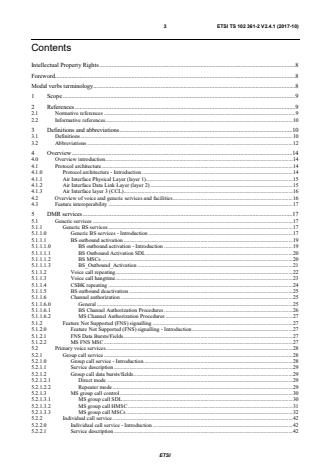
Contents
Intellectual Property Rights . 8
Foreword . 8
Modal verbs terminology . 8
1 Scope . 9
2 References . 9
2.1 Normative references . 9
2.2 Informative references . 10
3 Definitions and abbreviations . 10
3.1 Definitions . 10
3.2 Abbreviations . 12
4 Overview . 14
4.0 Overview introduction . 14
4.1 Protocol architecture. 14
4.1.0 Protocol architecture - Introduction . 14
4.1.1 Air Interface Physical Layer (layer 1). 15
4.1.2 Air Interface Data Link Layer (layer 2) . 15
4.1.3 Air Interface layer 3 (CCL). 16
4.2 Overview of voice and generic services and facilities . 16
4.3 Feature interoperability . 17
5 DMR services . 17
5.1 Generic services . 17
5.1.1 Generic BS services . 17
5.1.1.0 Generic BS services - Introduction . 17
5.1.1.1 BS outbound activation . 19
5.1.1.1.0 BS outbound activation - Introduction . 19
5.1.1.1.1 BS Outbound Activation SDL . 20
5.1.1.1.2 BS MSCs . 20
5.1.1.1.3 BS_Outbound_Activation . 21
5.1.1.2 Voice call repeating. 22
5.1.1.3 Voice call hangtime. 23
5.1.1.4 CSBK repeating . 24
5.1.1.5 BS outbound deactivation . 25
5.1.1.6 Channel authorization . 25
5.1.1.6.0 General . 25
5.1.1.6.1 BS Channel Authorization Procedures . 26
5.1.1.6.2 MS Channel Authorization Procedures . 27
5.1.2 Feature Not Supported (FNS) signalling . 27
5.1.2.0 Feature Not Supported (FNS) signalling - Introduction . 27
5.1.2.1 FNS Data Bursts/Fields . 27
5.1.2.2 MS FNS MSC . 27
5.2 Primary voice services . 28
5.2.1 Group call service . 28
5.2.1.0 Group call service - Introduction . 28
5.2.1.1 Service description . 29
5.2.1.2 Group call data bursts/fields . 29
5.2.1.2.1 Direct mode . 29
5.2.1.2.2 Repeater mode . 29
5.2.1.3 MS group call control. 30
5.2.1.3.1 MS group call SDL . 30
5.2.1.3.2 MS group call HMSC . 31
5.2.1.3.3 MS group call MSCs . 32
5.2.2 Individual call service . 42
5.2.2.0 Individual call service - Introduction . 42
5.2.2.1 Service description . 42
ETSI
4 ETSI TS 102 361-2 V2.4.1 (2017-10)
5.2.2.2 Individual call data bursts/fields . 42
5.2.2.2.1 Direct mode . 42
5.2.2.2.2 Repeater mode . 43
5.2.2.3 MS Individual call channel access . 43
5.2.2.3.0 MS individual call channel access - Introduction . 43
5.2.2.3.1 UU_V_Req channel access SDL . 43
5.2.2.3.2 UU_Ans_Rsp channel access SDL . 44
5.2.2.4 MS Individual call control . 45
5.2.2.4.0 MS individual call control - Introduction . 45
5.2.2.4.1 MS OACSU Individual call source CCL SDL . 46
5.2.2.4.2 MS OACSU Individual call setup MSCs . 47
5.3 Supplementary voice services . 49
5.3.1 Unaddressed voice call service . 49
5.3.1.0 Unaddressed voice call service - Introduction. 49
5.3.1.1 Unaddressed voice call data burst/fields . 49
5.3.1.2 MS Unaddressed voice call control . 49
5.3.2 All call voice service. 49
5.3.2.0 All call voice service - Introduction . 49
5.3.2.1 All call data bursts/fields . 49
5.3.2.2 MS All call control . 49
5.3.2.3 BS All call control . 50
5.3.2.3.1 All call voice repeating . 50
5.3.2.3.2 All call end of transmission . 50
5.3.3 Broadcast call voice service . 51
5.3.3.0 Broadcast call voice service - Introduction . 51
5.3.3.1 Broadcast call data bursts/fields . 51
5.3.3.2 MS Broadcast call control . 51
5.3.3.3 BS Broadcast call control . 51
5.3.3.3.1 Broadcast call voice repeating . 51
5.3.3.3.2 Broadcast call end of transmission . 51
5.3.4 Open voice channel mode service . 51
5.3.4.0 Open voice channel mode service - Introduction . 51
5.3.4.1 OVCM service description . 52
5.4 Voice associated inband data services . 52
5.4.1 Voice associated inband data services - Introduction . 52
5.4.2 Inband positioning data service . 53
5.4.3 Inband talker alias data service . 53
6 DMR facilities . 54
6.1 Transmit timeout . 54
6.2 TDMA direct mode wide area timing . 54
6.2.1 Facility description . 54
6.2.1.0 Facility description - Introduction . 54
6.2.1.1 Leader_and_Timing_Unknown . 54
6.2.1.2 Leader_Unknown . 54
6.2.1.3 Leader_and_Timing_Known . 55
6.2.1.4 Leader . 55
6.2.2 TDMA direct mode data bursts/fields . 55
6.2.2.1 Synchronization . 55
6.2.2.2 Colour Code . 55
6.2.2.3 Channel Timing CSBK . 55
6.2.2.3.0 Channel Timimg CSBK - Introduction . 55
6.2.2.3.1 CT_CSBK_Beacon . 56
6.2.2.3.2 CT_CSBK_Prop . 56
6.2.2.3.3 CT_CSBK_Term . 56
6.2.2.3.4 CT_CSBK_Req . 57
6.2.2.3.5 CT_CSBK_Resp. 57
6.2.3 TDMA direct mode SDL . 57
6.2.3.0 TDMA direct mode SDL - Introduction . 57
6.2.3.1 Power up and channel change SDL . 58
6.2.3.2 Leader and timing unknown SDL . 58
6.2.3.3 Leader unknown SDL . 60
ETSI
5 ETSI TS 102 361-2 V2.4.1 (2017-10)
6.2.3.4 Leader and timing known SDL . 61
6.2.3.5 Leader SDL . 62
6.2.3.6 Leader identifier conflict SDL . 63
6.2.3.7 CT_CSBK evaluation SDL . 64
6.2.3.8 Send correction SDL . 66
6.2.3.9 Accept leader SDL . 68
6.2.3.10 Appoint new leader SDL . 68
6.2.3.11 Timing push SDL . 69
6.2.3.12 Transmit procedure SDL . 70
7 PDU description . 71
7.0 PDU description - Introduction . 71
7.1 Layer 3 PDUs . 72
7.1.0 Layer 3 PDUs - Introduction. 72
7.1.1 Full Link Control PDUs . 72
7.1.1.1 Group Voice Channel User LC PDU . 72
7.1.1.2 Unit to Unit Voice Channel User LC PDU . 73
7.1.1.3 GPS Info LC PDU . 73
7.1.1.4 Talker Alias header LC PDU . 73
7.1.1.5 Talker Alias block LC PDU . 74
7.1.2 Control Signalling BlocK (CSBK) PDUs . 74
7.1.2.1 BS Outbound Activation CSBK PDU . 74
7.1.2.2 Unit to Unit Voice Service Request CSBK PDU . 75
7.1.2.3 Unit to Unit Voice Service Answer Response CSBK PDU . 75
7.1.2.4 Negative Acknowledge Response CSBK PDU . 76
7.1.2.5 Preamble CSBK PDU . 76
7.1.2.6 Channel Timing CSBK PDU . 76
7.1.3 Short Link Control PDUs . 77
7.1.3.1 Null Message. 77
7.1.3.2 Activity Update . 78
7.2 Layer 3 information element coding . 79
7.2.0 Layer 3 information element coding - Introduction . 79
7.2.1 Service Options . 79
7.2.2 Answer Response . 79
7.2.3 Reason Code . 80
7.2.4 Service Type . 80
7.2.5 Source Type . 80
7.2.6 Additional Information Field . 80
7.2.7 CSBK Blocks to Follow (CBF) . 80
7.2.8 Identifier (ID) . 81
7.2.9 Dynamic Identifier (DI) . 81
7.2.10 Wide Area Timing Identifier (WATID) . 81
7.2.11 Channel Timing Opcode (CTO) . 81
7.2.12 New Leader (NL) . 82
7.2.13 Generation (Gen) . 82
7.2.14 Sync Age (SA) . 82
7.2.15 Position Error . 83
7.2.16 Longitude . 83
7.2.17 Latitude . 83
7.2.18 Talker Alias Data Format . 83
7.2.19 Talker Alias Data Length . 83
Annex A (normative): Timers and constants in DMR . 85
A.0 Timers and constants in DMR - Introduction . 85
A.1 Layer 3 timers . 85
A.2 Layer 3 constants . 86
Annex B (normative): Opcode Reference Lists . 87
B.1 Full Link Control Opcode List . 87
ETSI
6 ETSI TS 102 361-2 V2.4.1 (2017-10)
B.2 CSBK Opcode List . 87
B.3 Short Link Control Opcode List . 87
Annex C (informative): Numbering and dialling plan . 88
C.1 Introduction to the numbering and dialling plan . 88
C.2 Subscriber mapping . 89
C.2.1 User Interface - Air Interface . 89
C.2.1.0 User Interface - Air Interface - Introduction . 89
C.2.1.1 Mapping for MS individual address space . 90
C.2.1.1.0 Mapping for MS individual address space - Introduction . 90
C.2.1.1.1 Mapping for diallable addresses (prefix 0 to 9) . 91
C.2.1.1.2 Mapping for non-diallable individual addresses (prefix 10 to 14) . 91
C.2.1.1.3 Examples of individual address mapping . 92
C.2.1.2 Mapping for MS talkgroup address space . 92
C.2.1.2.0 Mapping for MS talkgroup address space - Introduction . 92
C.2.1.2.1 The concept of the wildcard character . 92
C.2.1.2.2 The concept of stored parameters . 93
C.2.1.2.3 The concept of ad-hoc arrangement . 93
C.2.1.2.4 The rules for the sender . 93
C.2.1.2.5 The rules for the recipient . 93
C.2.1.2.6 Mapping of dialled strings to the AI talkgroup address space . 94
C.2.1.2.6.0 Mapping of dialled strings to the AI talkgroup address space - Introduction . 94
C.2.1.2.6.1 Mapping of numeric dialled strings to the AI talkgroup address space . 94
C.2.1.2.6.2 Mapping for non-diallable talkgroup addresses (prefix 10 to14) . 96
C.2.1.2.6.3 Examples of talkgroup non-diallable address mapping . 96
C.2.1.2.7 The concept of the prefix . 96
C.2.2 Addresses . 98
C.2.3 Conversion rules . 98
C.2.3.1 MS addresses . 98
C.2.3.2 Limiting the length of the destination address . 98
C.2.3.3 All talkgroup address . 98
C.2.3.4 Gateways . 99
C.3 User dialling plan . 99
C.3.1 User numbering . 99
C.3.1.0 User numbering - Introduction. 99
C.3.1.1 Dialling method . 99
C.3.1.2 Call Type determination . 99
C.3.1.3 Call modifier strings . 99
C.3.2 Dialled digits to address mapping . 100
C.3.3 Storage requirements . 100
C.3.3.1 MS individual address . 100
C.3.3.2 Talkgroups . 100
C.3.3.3 All MSs . 100
C.3.3.4 Non-diallable numbers . 100
C.3.3.5 Talkgroup recognition. 101
C.3.3.5.1 All numeric talkgroups . 101
C.3.3.5.2 Talkgroups defined by wildcards . 101
C.3.3.5.3 MS receives a talkgroup call . 101
C.3.4 Dialling procedures . 102
C.3.4.1 MS calls . 102
C.3.4.1.1 Seven digit dialling . 102
C.3.4.1.2 Abbreviated dialling . 102
C.3.4.1.3 Individual call . 103
C.3.4.1.4 Talkgroup Call . 103
C.3.4.1.5 All Call . 103
C.3.4.2 Gateway calls . 103
C.3.4.2.1 Telephone call . 103
C.3.4.2.1.0 Telephone call - introduction . 103
C.3.4.2.1.1 Telephone numeric padding format . 103
ETSI
7 ETSI TS 102 361-2 V2.4.1 (2017-10)
C.3.4.2.1.2 Telephone star modifier format . 104
C.3.4.2.2 PABX call . 104
C.3.4.2.2.0 PABX call - Introduction . 104
C.3.4.2.2.1 PABX numeric padding format . 104
C.3.4.2.2.2 PABX star modifier format . 104
C.3.4.2.3 IP call . 104
C.3.4.3 Call modifiers . 105
C.3.4.3.0 Call modifiers - Introduction . 105
C.3.4.3.1 Broadcast call . 105
C.3.4.3.2 Priority call . 105
C.3.4.3.3 Emergency call . 105
C.3.4.3.4 Status call . 105
C.3.4.3.5 Divert own call . 106
C.3.4.3.6 Open channel voice mode call . 106
C.3.4.3.7 Force talkgroup service . 106
C.3.4.3.8 Multiple call modifiers . 106
C.3.4.4 MS behaviour commands . 106
C.3.4.4.0 MS behaviour commands - Introduction . 106
C.3.4.4.1 Edit the talkgroup table . 106
C.3.4.4.2 Queue Incoming call . 107
C.3.4.4.3 Display own identity . 107
C.3.4.4.4 Display Own talkgroup table. 107
C.3.4.5 Call set-up abandon or call complete . 107
Annex D (informative): Change requests . 108
Annex E (informative): Bibliography . 109
History . 110
ETSI
8 ETSI TS 102 361-2 V2.4.1 (2017-10)
Intellectual Property Rights
Essential patents
IPRs essential or potentially essential to the present document may have been declared to ETSI. The information
pertaining to these essential IPRs, if any, is publicly available for ETSI members and non-members, and can be found
in ETSI SR 000 314: "Intellectual Property Rights (IPRs); Essential, or potentially Essential, IPRs notified to ETSI in
respect of ETSI standards", which is available from the ETSI Secretariat. Latest updates are available on the ETSI Web
server (https://ipr.etsi.org/).
Pursuant to the ETSI IPR Policy, no investigation, including IPR searches, has been carried out by ETSI. No guarantee
can be given as to the existence of other IPRs not referenced in ETSI SR 000 314 (or the updates on the ETSI Web
server) which are, or may be, or may become, essential to the present document.
Trademarks
The present document may include trademarks and/or tradenames which are asserted and/or registered by their owners.
ETSI claims no ownership of these except for any which are indicated as being the property of ETSI, and conveys no
right to use or reproduce any trademark and/or tradename. Mention of those trademarks in the present document does
not constitute an endorsement by ETSI of products, services or organizations associated with those trademarks.
Foreword
This Technical Specification (TS) has been produced by ETSI Technical Committee Electromagnetic compatibility and
Radio spectrum Matters (ERM).
The present document is part 2 of a multi-part deliverable covering the Technical Requirements for Digital Mobile
Radio (DMR), as identified below:
Part 1: "DMR Air Interface (AI) protocol";
Part 2: "DMR voice and generic services and facilities";
Part 3: "DMR data protocol";
Part 4: "DMR trunking protocol".
Modal verbs terminology
In the present document "shall", "shall not", "should", "should not", "may", "need not", "will", "will not", "can" and
"cannot" are to be interpreted as described in clause 3.2 of the ETSI Drafting Rules (Verbal forms for the expression of
provisions).
"must" and "must not" are NOT allowed in ETSI deliverables except when used
...
Questions, Comments and Discussion
Ask us and Technical Secretary will try to provide an answer. You can facilitate discussion about the standard in here.
Loading comments...