


ETSI GS MEC 028 V2.3.1 (2022-07)
Multi-access Edge Computing (MEC); WLAN Access Information API
Multi-access Edge Computing (MEC); WLAN Access Information API
RGS/MEC-0028v231WlanAPI
General Information
Standards Content (Sample)
GROUP SPECIFICATION
Multi-access Edge Computing (MEC);
WLAN Access Information API
Disclaimer
The present document has been produced and approved by the Multi-access Edge Computing (MEC) ETSI Industry
Specification Group (ISG) and represents the views of those members who participated in this ISG.
It does not necessarily represent the views of the entire ETSI membership.
2 ETSI GS MEC 028 V2.3.1 (2022-07)
Reference
RGS/MEC-0028v231WlanAPI
Keywords
API, MEC, service, WLAN
ETSI
650 Route des Lucioles
F-06921 Sophia Antipolis Cedex - FRANCE
Tel.: +33 4 92 94 42 00 Fax: +33 4 93 65 47 16
Siret N° 348 623 562 00017 - APE 7112B
Association à but non lucratif enregistrée à la
Sous-Préfecture de Grasse (06) N° w061004871
Important notice
The present document can be downloaded from:
http://www.etsi.org/standards-search
The present document may be made available in electronic versions and/or in print. The content of any electronic and/or
print versions of the present document shall not be modified without the prior written authorization of ETSI. In case of any
existing or perceived difference in contents between such versions and/or in print, the prevailing version of an ETSI
deliverable is the one made publicly available in PDF format at www.etsi.org/deliver.
Users of the present document should be aware that the document may be subject to revision or change of status.
Information on the current status of this and other ETSI documents is available at
https://portal.etsi.org/TB/ETSIDeliverableStatus.aspx
If you find errors in the present document, please send your comment to one of the following services:
https://portal.etsi.org/People/CommiteeSupportStaff.aspx
If you find a security vulnerability in the present document, please report it through our
Coordinated Vulnerability Disclosure Program:
https://www.etsi.org/standards/coordinated-vulnerability-disclosure
Notice of disclaimer & limitation of liability
The information provided in the present deliverable is directed solely to professionals who have the appropriate degree of
experience to understand and interpret its content in accordance with generally accepted engineering or
other professional standard and applicable regulations.
No recommendation as to products and services or vendors is made or should be implied.
No representation or warranty is made that this deliverable is technically accurate or sufficient or conforms to any law
rule and/or regulation and further, no representation or warranty is made of merchantability or fitness
and/or governmental
for any particular purpose or against infringement of intellectual property rights.
In no event shall ETSI be held liable for loss of profits or any other incidental or consequential damages.
Any software contained in this deliverable is provided "AS IS" with no warranties, express or implied, including but not
limited to, the warranties of merchantability, fitness for a particular purpose and non-infringement of intellectual property
rights and ETSI shall not be held liable in any event for any damages whatsoever (including, without limitation, damages
for loss of profits, business interruption, loss of information, or any other pecuniary loss) arising out of or related to the use
of or inability to use the software.
Copyright Notification
No part may be reproduced or utilized in any form or by any means, electronic or mechanical, including photocopying and
microfilm except as authorized by written permission of ETSI.
The content of the PDF version shall not be modified without the written authorization of ETSI.
The copyright and the foregoing restriction extend to reproduction in all media.
© ETSI 2022.
All rights reserved.
ETSI
3 ETSI GS MEC 028 V2.3.1 (2022-07)
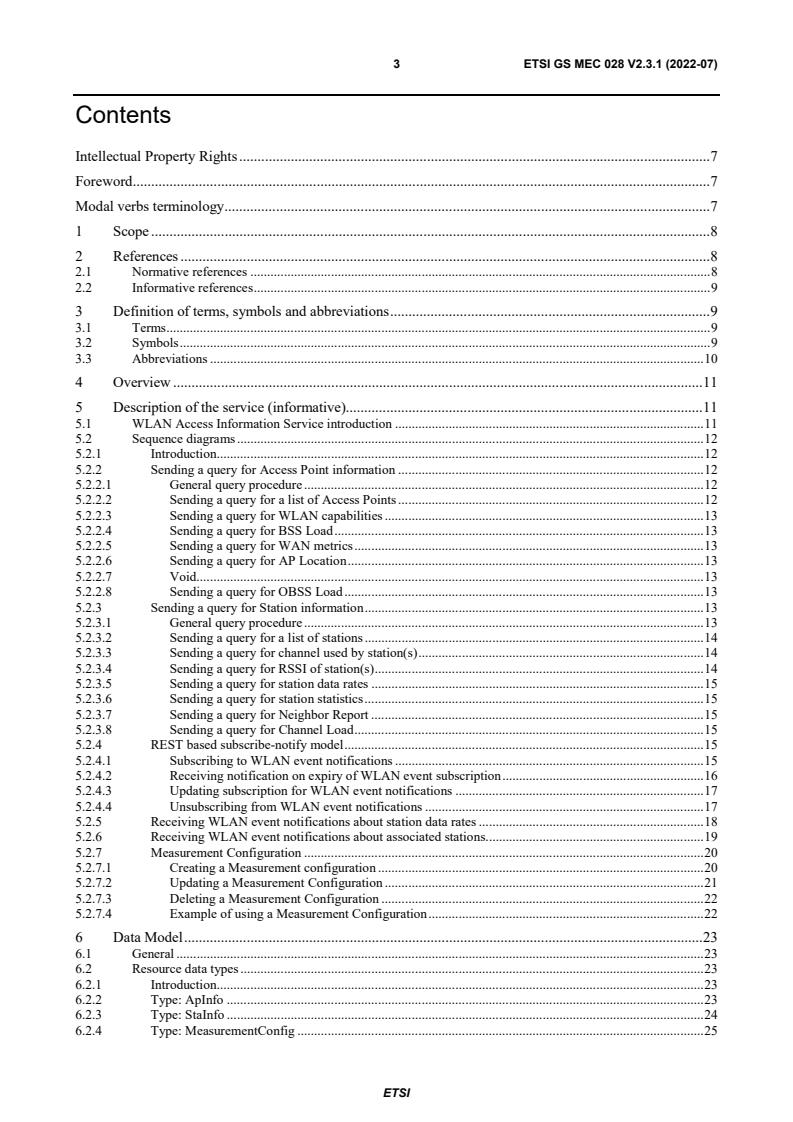
Contents
Intellectual Property Rights . 7
Foreword . 7
Modal verbs terminology . 7
1 Scope . 8
2 References . 8
2.1 Normative references . 8
2.2 Informative references . 9
3 Definition of terms, symbols and abbreviations . 9
3.1 Terms . 9
3.2 Symbols . 9
3.3 Abbreviations . 10
4 Overview . 11
5 Description of the service (informative). 11
5.1 WLAN Access Information Service introduction . 11
5.2 Sequence diagrams . 12
5.2.1 Introduction. 12
5.2.2 Sending a query for Access Point information . 12
5.2.2.1 General query procedure . 12
5.2.2.2 Sending a query for a list of Access Points . 12
5.2.2.3 Sending a query for WLAN capabilities . 13
5.2.2.4 Sending a query for BSS Load . 13
5.2.2.5 Sending a query for WAN metrics . 13
5.2.2.6 Sending a query for AP Location . 13
5.2.2.7 Void. 13
5.2.2.8 Sending a query for OBSS Load . 13
5.2.3 Sending a query for Station information . 13
5.2.3.1 General query procedure . 13
5.2.3.2 Sending a query for a list of stations . 14
5.2.3.3 Sending a query for channel used by station(s) . 14
5.2.3.4 Sending a query for RSSI of station(s) . 14
5.2.3.5 Sending a query for station data rates . 15
5.2.3.6 Sending a query for station statistics . 15
5.2.3.7 Sending a query for Neighbor Report . 15
5.2.3.8 Sending a query for Channel Load . 15
5.2.4 REST based subscribe-notify model . 15
5.2.4.1 Subscribing to WLAN event notifications . 15
5.2.4.2 Receiving notification on expiry of WLAN event subscription . 16
5.2.4.3 Updating subscription for WLAN event notifications . 17
5.2.4.4 Unsubscribing from WLAN event notifications . 17
5.2.5 Receiving WLAN event notifications about station data rates . 18
5.2.6 Receiving WLAN event notifications about associated stations. 19
5.2.7 Measurement Configuration . 20
5.2.7.1 Creating a Measurement configuration . 20
5.2.7.2 Updating a Measurement Configuration . 21
5.2.7.3 Deleting a Measurement Configuration . 22
5.2.7.4 Example of using a Measurement Configuration . 22
6 Data Model . 23
6.1 General . 23
6.2 Resource data types . 23
6.2.1 Introduction. 23
6.2.2 Type: ApInfo . 23
6.2.3 Type: StaInfo . 24
6.2.4 Type: MeasurementConfig . 25
ETSI
4 ETSI GS MEC 028 V2.3.1 (2022-07)
6.2.5 Type: MeasurementConfigLinkList . 25
6.3 Subscription data types . 25
6.3.1 Introduction. 25
6.3.2 Type: AssocStaSubscription . 25
6.3.3 Type: StaDataRateSubscription . 26
6.3.4 Type: SubscriptionLinkList . 27
6.3.5 Type: MeasurementReportSubscription . 28
6.3.6 Void . 28
6.4 Notifications data types . 28
6.4.1 Introduction. 28
6.4.2 Type: AssocStaNotification . 29
6.4.3 Type: StaDataRateNotification . 29
6.4.4 Type: ExpiryNotification . 29
6.4.5 Type: MeasurementReportNotification . 29
6.4.6 Type: TestNotification . 30
6.5 Referenced structured data types . 30
6.5.1 Introduction. 30
6.5.2 Type: TimeStamp . 30
6.5.3 Type: ApIdentity . 30
6.5.4 Type: WlanCapabilities . 31
6.5.5 Void . 31
6.5.6 Type: WanMetrics . 31
6.5.7 Type: BssLoad . 32
6.5.8 Type: ExtBssLoad . 32
6.5.9 Type: ApLocation . 33
6.5.10 Type: NeighborReport . 33
6.5.11 Type: StaIdentity . 34
6.5.12 Type: ApAssociated . 34
6.5.13 Type: StaStatistics . 34
6.5.14 Type: HtCapabilities . 35
6.5.15 Type: VhtCapabilities . 35
6.5.16 Type: HeCapabilities . 35
6.5.17 Type: DmgCapabilities . 35
6.5.18 Type: EdmgCapabilities . 36
6.5.19 Type: GeoLocation . 36
6.5.20 Type: CivicLocation . 36
6.5.21 Type: Rssi . 37
6.5.22 Type: StaDataRate . 38
6.5.23 Type: LinkType . 38
6.5.24 Type: ChannelLoadConfig . 38
6.5.25 Type: BeaconRequestConfig . 38
6.5.26 Type: StaStatisticsConfig . 39
6.5.27 Type: BeaconReport . 39
6.5.28 Type: BeaconReportingConfig . 40
6.5.29 Type: ReportedBeaconFrameInfo . 41
6.5.30 Type: BssidInfo . 41
6.5.31 Type: BssCapabilities . 42
6.5.32 Type: NeighborReportConfig . 43
6.5.33 Type: STACounterTriggerCondition . 43
6.5.34 Type: StaStatisticsGroupZeroData . 43
6.5.35 Type: StaStatisticsGroupOneData . 44
6.5.36 Type: StaStatisticsGroup2to9Data . 44
6.5.37 Type: ReportingReasonStaCounters . 44
6.5.38 Type: ReportingReasonQoSCounters . 45
6.5.39 Type: ChannelLoad. 45
6.5.40 Type: OBssLoad . 45
6.5.41 Type: MeasurementInfo . 46
6.5.42 Type: WebsockNotifConfig . 46
6.6 Referenced simple data types and enumerations . 46
7 API definition . 46
7.1 Introduction . 46
ETSI
5 ETSI GS MEC 028 V2.3.1 (2022-07)
7.2 Global definitions and resource structure . 47
7.3 Resource: ap_information . 48
7.3.1 Description . 48
7.3.2 Resource definition . 48
7.3.3 Resource Methods . 48
7.3.3.1 GET . 48
7.3.3.2 PUT . 49
7.3.3.3 PATCH . 50
7.3.3.4 POST . 50
7.3.3.5 DELETE . 50
7.4 Resource: sta_information . 50
7.4.1 Description . 50
7.4.2 Resource definition . 50
7.4.3 Resource Methods . 50
7.4.3.1 GET . 50
7.4.3.2 PUT . 51
7.4.3.3 PATCH . 52
7.4.3.4 POST . 52
7.4.3.5 DELETE . 52
7.5 Resource: subscriptions . 52
7.5.1 Description . 52
7.5.2 Resource definition . 52
7.5.3 Resource methods . 52
7.5.3.1 GET . 52
7.5.3.2 PUT . 53
7.5.3.3 PATCH . 53
7.5.3.4 POST . 53
7.5.3.5 DELETE . 55
7.6 Resource: existing subscription . 55
7.6.1 Description . 55
7.6.2 Resource definition . 55
7.6.3 Resource methods . 55
7.6.3.1 GET . 55
7.6.3.2 PUT . 56
7.6.3.3 PATCH . 58
7.6.3.4 POST . 58
7.6.3.5 DELETE . 58
7.7 Resource: measurements . 59
7.7.1 Description . 59
7.7.2 Resource definition . 59
7.7.3 Resource methods . 59
7.7.3.1 GET . 59
7.5.3.2 PUT . 60
7.5.3.3 PATCH . 60
7.7.3.4 POST . 60
7.7.3.5 DELETE . 62
7.8 Resource: existing measurements . 62
7.8.1 Description . 62
7.8.2 Resource definition . 62
7.8.3 Resource methods . 62
7.8.3.1 GET . 62
7.8.3.2 PUT . 63
7.8.3.3 PATCH . 65
7.8.3.4 POST . 65
7.8.3.5 DELETE . 65
Annex A (informative): Complementary material for API utilization . 66
Annex B (informative): Mapping of permissions for RESTful API and topic based alternative
transport . 67
B.1 Overview . 67
ETSI
6 ETSI GS MEC 028 V2.3.1 (2022-07)
B.2 Mapping of permissions - RESTful and topic based alternative transport . 67
History . 68
ETSI
7 ETSI GS MEC 028 V2.3.1 (2022-07)
Intellectual Property Rights
Essential patents
IPRs essential or potentially essential to normative deliverables may have been declared to ETSI. The declarations
pertaining to these essential IPRs, if any, are publicly available for ETSI members and non-members, and can be
found in ETSI SR 000 314: "Intellectual Property Rights (IPRs); Essential, or potentially Essential, IPRs notified to
ETSI in respect of ETSI standards", which is available from the ETSI Secretariat. Latest updates are available on the
ETSI Web server (https://ipr.etsi.org/).
Pursuant to the ETSI Directives including the ETSI IPR Policy, no investigation regarding the essentiality of IPRs,
including IPR searches, has been carried out by ETSI. No guarantee can be given as to the existence of other IPRs not
referenced in ETSI SR 000 314 (or the updates on the ETSI Web server) which are, or may be, or may become,
essential to the present document.
Trademarks
The present document may include trademarks and/or tradenames which are asserted and/or registered by their owners.
ETSI claims no ownership of these except for any which are indicated as being the property of ETSI, and conveys no
right to use or reproduce any trademark and/or tradename. Mention of those trademarks in the present document does
not constitute an endorsement by ETSI of products, services or organizations associated with those trademarks.
DECT™, PLUGTESTS™, UMTS™ and the ETSI logo are trademarks of ETSI registered for the benefit of its
Members. 3GPP™ and LTE™ are trademarks of ETSI registered for the benefit of its Members and of the 3GPP
Organizational Partners. oneM2M™ logo is a trademark of ETSI registered for the benefit of its Members and of the ®
oneM2M Partners. GSM and the GSM logo are trademarks registered and owned by the GSM Association.
Foreword
This Group Specification (GS) has been produced by ETSI Industry Specification Group (ISG) Multi-access Edge
Computing (MEC).
Modal verbs terminology
In the present document "shall", "shall not", "should", "should not", "may", "need not", "will", "will not", "can" and
"cannot" are to be interpreted as described in clause 3.2 of the ETSI Drafting Rules (Verbal forms for the expression of
provisions).
"must" and "must not" are NOT allowed in ETSI deliverables except when used in direct citation.
ETSI
8 ETSI GS MEC 028 V2.3.1 (2022-07)
1 Scope
The present document focuses on the WLAN Access Information MEC service. It describes the message flows and the
required information. The present document also specifies the RESTful API with the data model.
2 References
2.1 Normative references
References are either specific (identified by date of publication and/or edition number or version number) or
non-specific. For specific references, only the cited version applies. For non-specific references, the latest version of the
referenced document (including any amendments) applies.
Referenced documents which are not found to be publicly available in the expected location might be found at
https://docbox.etsi.org/Reference/.
NOTE: While any hyperlinks included in this clause were valid at the time of publication, ETSI cannot guarantee
their long term validity.
The following referenced documents are necessary for the application of the present document.
[1] Void.
[2] IETF RFC 2818: "HTTP Over TLS".
NOTE: Available at https://tools.ietf.org/html/rfc2818.
[3] IETF RFC 5246: "The Transport Layer Security (TLS) Protocol Version 1.2".
NOTE 1: Available at https://tools.ietf.org/html/rfc5246.
NOTE 2: Obsoleted by IETF RFC 8446.
[4] IETF RFC 6749: "The OAuth 2.0 Authorization Framework".
NOTE: Available at https://tools.ietf.org/html/rfc6749.
[5] IETF RFC 6750: "The OAuth 2.0 Authorization Framework: Bearer Token Usage".
NOTE: Available at https://tools.ietf.org/html/rfc6750.
[6] IETF RFC 6225: "Dynamic Host Configuration Protocol Options for Coordinate-Based Location
Configuration Information".
NOTE: Available at https://tools.ietf.org/html/rfc6225.
[7] IETF RFC 4776: "Dynamic Host Configuration Protocol (DHCPv4 and DHCPv6) Option for
Civic Addresses Configuration Information".
NOTE: Available at https://tools.ietf.org/html/rfc4776.
[8] IEEE 802.11™-2016: "IEEE Standard for Information technology -- Telecommunications and
information exchange between systems Local and metropolitan area networks -- Specific
requirements - Part 11: Wireless LAN Medium Access Control (MAC) and Physical Layer (PHY)
Specifications".
[9] Void.
[10] ETSI GS MEC 009: "Multi-access Edge Computing (MEC); General principles, patterns and
common aspects of MEC Service APIs".
ETSI
9 ETSI GS MEC 028 V2.3.1 (2022-07)
2.2 Informative references
References are either specific (identified by date of publication and/or edition number or version number) or
non-specific. For specific references, only the cited version applies. For non-specific references, the latest version of the
referenced document (including any amendments) applies.
NOTE: While any hyperlinks included in this clause were valid at the time of publication, ETSI cannot guarantee
their long term validity.
The following referenced documents are not necessary for the application of the present document but they assist the
user with regard to a particular subject area.
[i.1] ETSI GS MEC 011: "Multi-access Edge Computing (MEC); Edge Platform Application
Enablement".
[i.2] OpenAPI™ Specification.
NOTE: Available at https://github.com/OAI/OpenAPI-Specification. ®
[i.3] Wi-Fi Alliance 2014: "Hot Spot 2.0 (Release 2) Technical Specification V1.0.0".
[i.4] ETSI GS MEC 002: "Multi-access Edge Computing (MEC); Phase 2: Use Cases and
Requirements".
[i.5] ETSI GS MEC 003: "Multi-access Edge Computing (MEC); Framework and Reference
Architecture".
[i.6] ETSI GS MEC 012: "Multi-access Edge Computing (MEC); Radio Network Information API".
[i.7] ETSI GS MEC 029: "Multi-access Edge Computing (MEC); Fixed Access Information API". ®
[i.8] Wi-Fi Alliance 2019: "Data Elements Specification v1.0".
[i.9] ISO 3166: "Codes for the representation of names of countries and their subdivisions".
[i.10] IEEE P802.11ax™: "Wireless LAN Medium Access Control (MAC) and Physical Layer (PHY)
Specifications - Amendment 1: Enhancement for High Efficiency WLAN".
[i.11] IEEE P802.11ay™: "Wireless LAN Medium Access Control (MAC) and Physical Layer (PHY)
Specifications - Amendment 1: Enhancement for High Efficiency WLAN - Amendment 2:
Enhanced throughput for operation in license-exempt bands above 45 GHz".
[i.12] ETSI GS MEC 001: "Multi-access Edge Computing (MEC); Terminology".
3 Definition of terms, symbols and abbreviations
3.1 Terms
For the purposes of the present document, the terms given in ETSI GS MEC 001 [i.12] apply.
3.2 Symbols
Void.
ETSI
10 ETSI GS MEC 028 V2.3.1 (2022-07)
3.3 Abbreviations
For the purposes of the present document, the abbreviations given in ETSI GS MEC 001 [i.12] and the following apply:
rd
3GPP 3 Generation Partnership Project
AID Association Identifier
A-MPDU Aggregate MAC Protocol Data Unit
A-MSDU Aggregate MAC Service Data Unit
AP Access Point
API Application Programming Interface
APSD Automatic Power Save Delivery
ASEL Antenna Selection
BSS Basic Service Set
BSSID Basic Service Set Identifier
DMG Directional Multi-Gigabit
NOTE: As in Directional Multi-Gigabit WLAN.
DSSS Direct Sequence Spread Spectrum
EDMG Enhanced Directional Multi-Gigabit
NOTE: As in Enhanced Directional Multi-Gigabit WLAN.
ERP Extended Rate PHY
ESS Extended Service Set
FCS Frame Check Sequence
FTM Fine Timing Measurement
HE High Efficiency
NOTE: As in High Efficiency WLAN.
HT High Throughput
NOTE: As in High Throughput WLAN.
HTTP Hyper Text Transport Protocol
ID Identifier
IEEE Institute of Electrical and Electronics Engineers
LMD Load Measurement Duration
MAC Medium Access Control
MCS Modulation and Coding Scheme
MDE Mobility Domain Element
MPDU MAC Protocol Data Unit
NSS Number of Spatial Streams
OBSS Overlapping Basic Service Set
OFDM Orthogonal Frequency Division Multiplexing
PBSS Personal Basic Service Set
PCP PBSS Control Point
PHY Physical layer
PPDU PHY Protocol Data Unit
QoS Quality of Service
RCPI Received Channel Power Indicator
RSNI Received Signal-to-Noise Indicator
RSSI Receive Signal Strength Indicator
RTS Request To Send
SC Single Carrier
SSID Service Set Identifier
STA Station
TSF Timing Synchronization Function
TU Time Unit
URI Uniform Resource Identifier
ETSI
11 ETSI GS MEC 028 V2.3.1 (2022-07)
VHT Very High Throughput
NOTE: As in Very High Throughput WLAN.
WAI WLAN Access Information
WAIS WLAN Access Information Service
WLAN Wireless Local Area Network
4 Overview
The present document specifies the WLAN Access Information (WAI) API to support the requirements defined for
Multi-access Edge Computing in ETSI GS MEC 002 [i.4].
Clause 5 provides overview how WLAN Access Information Service (WAIS) may be used by the MEC applications
and by the MEC platform. It describes the information flows used for WLAN Access Information Service.
The information that can be exchanged over the WAI API is described in clause 6 which provides detailed description
on all information elements that are used for WLAN Access Information.
Clause 7 describes the actual WAI API providing detailed information how information elements are mapped into a
RESTful API design.
5 Description of the service (informative)
5.1 WLAN Access Information Service introduction
Multi-access Edge Computing allows running the MEC applications at the edge of the network where the environment
is characterized by low latency, proximity, high bandwidth and exposure to location and up-to-date information from
the underlying access networks. The information on current conditions from the WLAN access is shared via WLAN
Access Information Service.
WLAN Access Information Service (WAIS) is a service that provides WLAN access related information to service
consumers within MEC System. The WLAN Access Information Service is available for authorized MEC applications
and is discovered over the Mp1 reference point as specified in ETSI GS MEC 003 [i.5]. The granularity of the WLAN
Access Information may be adjusted based on parameters such as information per station (STA), per Access Point (AP)
or per Multiple Access Points (Multi-APs).
The WLAN Access Information may be used by the MEC applications and MEC platform to optimize the existing
services and to provide new type of services that are based on up to date information from WLAN access possibly
combined with the information such as Radio Network Information as specified in ETSI GS MEC 012 [i.6] or Fixed
Access Network Information as specified in ETSI GS MEC 029 [i.7] from the other access technologies.
The present document defines the protocol, data model and interface in the form of RESTful Application Programming
Interface (APIs) specifications. Information about the Access Points and client stations can be requested either by
querying or by subscribing to notifications.
The procedures defined for queries are flexible and cater wide set of use cases from simple queries to queries requesting
wide set of information on targets. This flexibility is enabled with concepts of attribute-based filtering and attribute
selectors, as specified in ETSI GS MEC 009 [10], and those are described in more detail in clauses 6.18 and 6.19 of
ETSI GS MEC 009 [10].
ETSI
12 ETSI GS MEC 028 V2.3.1 (2022-07)
5.2 Sequence diagrams
5.2.1 Introduction
The service consumers communicate with WLAN Access Information Service over WAI API to get contextual
information from the WLAN access network. Both the MEC application and MEC platform may be service consumers
and both the MEC platform and MEC application may be providers of WLAN Access Information.
The WAI API supports both queries and subscriptions (pub/sub mechanism) over the RESTful API or over alternative
transports such as message bus. Alternative transports are not specified in detail in the present document. When queries
are used, the attribute-based filter expression can be used to limit the number of objects returned by query operation and
attribute-selectors can be used to limit the number of attributes included in the response.
For RESTful architectural style, the present document defines the HTTP protocol bindings.
5.2.2 Sending a query for A
...
Questions, Comments and Discussion
Ask us and Technical Secretary will try to provide an answer. You can facilitate discussion about the standard in here.
Loading comments...