


ETSI GR PDL 020 V1.1.1 (2023-06)
Permissioned Distributed Ledger (PDL); Wireless Consensus Network
Permissioned Distributed Ledger (PDL); Wireless Consensus Network
DGR/PDL-0020_Wireless_consens
General Information
Standards Content (Sample)
GROUP REPORT
Permissioned Distributed Ledger (PDL);
Wireless Consensus Network
Disclaimer
The present document has been produced and approved by the Permissioned Distributed Ledger (PDL) ETSI Industry
Specification Group (ISG) and represents the views of those members who participated in this ISG.
It does not necessarily represent the views of the entire ETSI membership.
2 ETSI GR PDL 020 V1.1.1 (2023-06)
Reference
DGR/PDL-0020_Wireless_consens
Keywords
network management, PDL, wireless,
wireless ad-hoc network
ETSI
650 Route des Lucioles
F-06921 Sophia Antipolis Cedex - FRANCE
Tel.: +33 4 92 94 42 00 Fax: +33 4 93 65 47 16
Siret N° 348 623 562 00017 - APE 7112B
Association à but non lucratif enregistrée à la
Sous-Préfecture de Grasse (06) N° w061004871
Important notice
The present document can be downloaded from:
https://www.etsi.org/standards-search
The present document may be made available in electronic versions and/or in print. The content of any electronic and/or
print versions of the present document shall not be modified without the prior written authorization of ETSI. In case of any
existing or perceived difference in contents between such versions and/or in print, the prevailing version of an ETSI
deliverable is the one made publicly available in PDF format at www.etsi.org/deliver.
Users of the present document should be aware that the document may be subject to revision or change of status.
Information on the current status of this and other ETSI documents is available at
https://portal.etsi.org/TB/ETSIDeliverableStatus.aspx
If you find errors in the present document, please send your comment to one of the following services:
https://portal.etsi.org/People/CommiteeSupportStaff.aspx
If you find a security vulnerability in the present document, please report it through our
Coordinated Vulnerability Disclosure Program:
https://www.etsi.org/standards/coordinated-vulnerability-disclosure
Notice of disclaimer & limitation of liability
The information provided in the present deliverable is directed solely to professionals who have the appropriate degree of
experience to understand and interpret its content in accordance with generally accepted engineering or
other professional standard and applicable regulations.
No recommendation as to products and services or vendors is made or should be implied.
No representation or warranty is made that this deliverable is technically accurate or sufficient or conforms to any law
rule and/or regulation and further, no representation or warranty is made of merchantability or fitness
and/or governmental
for any particular purpose or against infringement of intellectual property rights.
In no event shall ETSI be held liable for loss of profits or any other incidental or consequential damages.
Any software contained in this deliverable is provided "AS IS" with no warranties, express or implied, including but not
limited to, the warranties of merchantability, fitness for a particular purpose and non-infringement of intellectual property
rights and ETSI shall not be held liable in any event for any damages whatsoever (including, without limitation, damages
for loss of profits, business interruption, loss of information, or any other pecuniary loss) arising out of or related to the use
of or inability to use the software.
Copyright Notification
No part may be reproduced or utilized in any form or by any means, electronic or mechanical, including photocopying and
microfilm except as authorized by written permission of ETSI.
The content of the PDF version shall not be modified without the written authorization of ETSI.
The copyright and the foregoing restriction extend to reproduction in all media.
© ETSI 2023.
All rights reserved.
ETSI
3 ETSI GR PDL 020 V1.1.1 (2023-06)
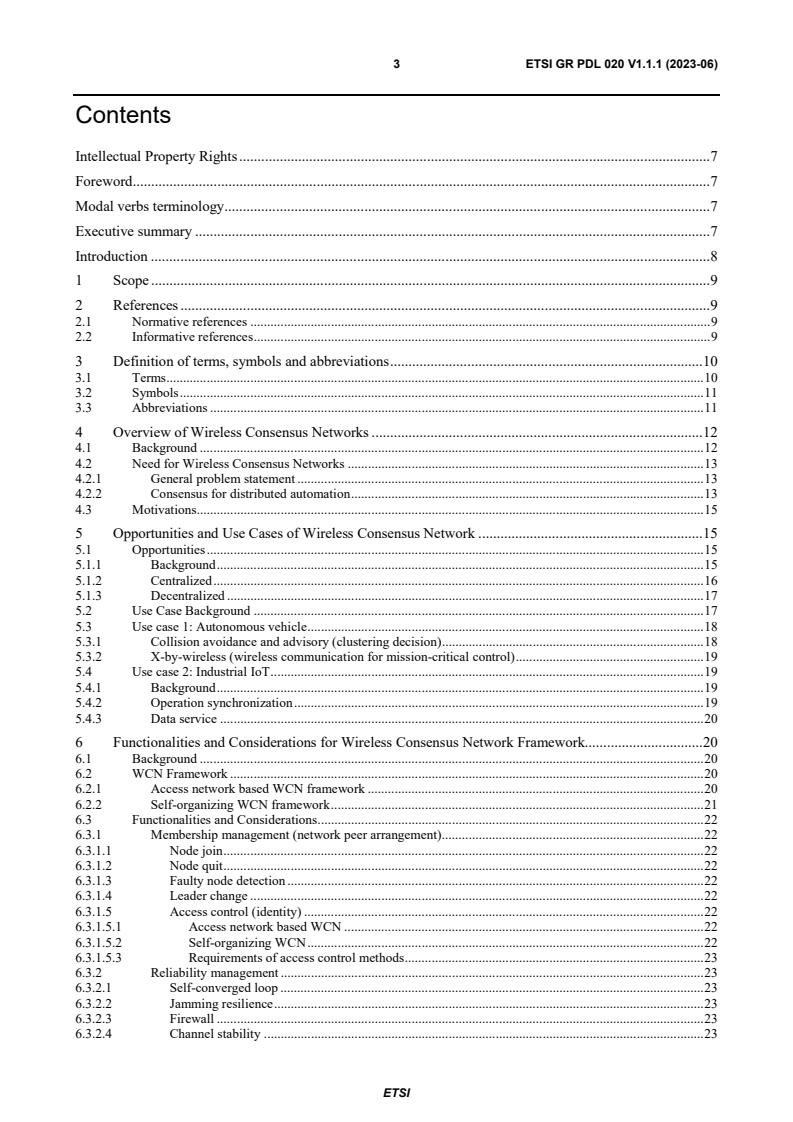
Contents
Intellectual Property Rights . 7
Foreword . 7
Modal verbs terminology . 7
Executive summary . 7
Introduction . 8
1 Scope . 9
2 References . 9
2.1 Normative references . 9
2.2 Informative references . 9
3 Definition of terms, symbols and abbreviations . 10
3.1 Terms . 10
3.2 Symbols . 11
3.3 Abbreviations . 11
4 Overview of Wireless Consensus Networks . 12
4.1 Background . 12
4.2 Need for Wireless Consensus Networks . 13
4.2.1 General problem statement . 13
4.2.2 Consensus for distributed automation . 13
4.3 Motivations. 15
5 Opportunities and Use Cases of Wireless Consensus Network . 15
5.1 Opportunities . 15
5.1.1 Background . 15
5.1.2 Centralized . 16
5.1.3 Decentralized . 17
5.2 Use Case Background . 17
5.3 Use case 1: Autonomous vehicle . 18
5.3.1 Collision avoidance and advisory (clustering decision) . 18
5.3.2 X-by-wireless (wireless communication for mission-critical control) . 19
5.4 Use case 2: Industrial IoT . 19
5.4.1 Background . 19
5.4.2 Operation synchronization . 19
5.4.3 Data service . 20
6 Functionalities and Considerations for Wireless Consensus Network Framework. 20
6.1 Background . 20
6.2 WCN Framework . 20
6.2.1 Access network based WCN framework . 20
6.2.2 Self-organizing WCN framework . 21
6.3 Functionalities and Considerations . 22
6.3.1 Membership management (network peer arrangement). 22
6.3.1.1 Node join . 22
6.3.1.2 Node quit . 22
6.3.1.3 Faulty node detection . 22
6.3.1.4 Leader change . 22
6.3.1.5 Access control (identity) . 22
6.3.1.5.1 Access network based WCN . 22
6.3.1.5.2 Self-organizing WCN . 22
6.3.1.5.3 Requirements of access control methods . 23
6.3.2 Reliability management . 23
6.3.2.1 Self-converged loop . 23
6.3.2.2 Jamming resilience . 23
6.3.2.3 Firewall . 23
6.3.2.4 Channel stability . 23
ETSI
4 ETSI GR PDL 020 V1.1.1 (2023-06)
6.3.2.5 Streaming bandwidth . 23
6.3.2.6 Storage . 23
6.3.3 Reliability gain . 24
7 Hardware Definition . 24
7.1 Hardware requirement . 24
7.1.1 Processing capability for consensus . 24
7.1.2 Communication capability . 25
7.1.2.1 Common wireless communication protocols . 25
7.1.2.2 LoRa . 25 ®
7.1.2.3 Zigbee . 25
7.1.2.4 Vehicle specific WCN technologies . 25
7.1.2.4.1 Introduction . 25
7.1.2.4.2 DSRC . 26
7.1.2.4.3 C-V2X . 26
7.1.3 Storage capability . 26
7.1.3.1 Storage requirements . 26
7.1.3.2 Storage for computing . 26
7.1.3.3 Storage for transaction persistence . 26
7.2 Hardware security and threats . 27
7.2.1 Hardware security . 27
7.2.1.1 Secure booting . 27
7.2.1.2 Trusted computing environment . 27
7.2.1.3 Invasion detection and physical protection . 27
7.2.1.4 Environmentally safe and storage encryption . 27
7.2.2 Hardware threats . 27
7.2.2.1 Trusted Platform (TPM) intrusion . 27
7.2.2.2 WCN underlay network intrusion . 27
7.2.2.3 Environmental factors and physical invasion . 28
8 Consensus Protocol for WCN . 28
8.1 Background . 28
8.2 Proof based consensus . 28
8.2.1 Proof of Work . 28
8.2.2 Proof of Stake . 30
8.2.3 Proof of Authority . 30
8.2.4 Other proof-based consensus protocols . 31
8.3 Voting based consensus . 31
8.3.1 PBFT . 31
8.3.2 Raft . 31
8.4 Performance metrics . 33
8.4.1 Background . 33
8.4.2 Security Bound . 33
8.4.3 Node Scalabilit y . 34
8.4.4 Transaction Throughput and Latency . 34
9 Raft as a Protocol for WCN . 34
9.1 Background . 34
9.2 Protocol description . 34
9.2.1 Number of nodes . 34
9.2.2 Node state of consensus . 35
9.2.3 Leader election . 35
9.2.4 Log replication . 36
9.2.5 Rules for node . 36
9.3 Routing and synchronization . 37
9.4 On-boarding and withdrawal of nodes . 38
9.5 Recommendation . 38
10 Conclusion and recommendation . 38
10.1 Conclusion . 38
10.2 Recommendations for the Next Step . 38
History . 39
ETSI
5 ETSI GR PDL 020 V1.1.1 (2023-06)
List of Tables
Table 1: Comparison of centralized vs. decentralized .12
Table 2: SAE Automation Levels .14
Table 3: Layered Architecture of IIoT .19
Table 4: Performance comparison of commonly used CMs .33
ETSI
6 ETSI GR PDL 020 V1.1.1 (2023-06)
List of Figures
Figure 1: Wireless distributed consensus for traffic decision .18
Figure 2: WCN framework based on access network .21
Figure 3: WCN framework based on self-organizing networks .21
TM
Figure 4: Process of guessing a secret value in Bitcoin .29
Figure 5: PBFT and Raft consensus protocols with synchronization stages .32
Figure 6: Communication topology of Raft .35
Figure 7: Routing protocol .37
ETSI
7 ETSI GR PDL 020 V1.1.1 (2023-06)
Intellectual Property Rights
Essential patents
IPRs essential or potentially essential to normative deliverables may have been declared to ETSI. The declarations
pertaining to these essential IPRs, if any, are publicly available for ETSI members and non-members, and can be
found in ETSI SR 000 314: "Intellectual Property Rights (IPRs); Essential, or potentially Essential, IPRs notified to
ETSI in respect of ETSI standards", which is available from the ETSI Secretariat. Latest updates are available on the
ETSI Web server (https://ipr.etsi.org/).
Pursuant to the ETSI Directives including the ETSI IPR Policy, no investigation regarding the essentiality of IPRs,
including IPR searches, has been carried out by ETSI. No guarantee can be given as to the existence of other IPRs not
referenced in ETSI SR 000 314 (or the updates on the ETSI Web server) which are, or may be, or may become,
essential to the present document.
Trademarks
The present document may include trademarks and/or tradenames which are asserted and/or registered by their owners.
ETSI claims no ownership of these except for any which are indicated as being the property of ETSI, and conveys no
right to use or reproduce any trademark and/or tradename. Mention of those trademarks in the present document does
not constitute an endorsement by ETSI of products, services or organizations associated with those trademarks.
DECT™, PLUGTESTS™, UMTS™ and the ETSI logo are trademarks of ETSI registered for the benefit of its
Members. 3GPP™ and LTE™ are trademarks of ETSI registered for the benefit of its Members and of the 3GPP
Organizational Partners. oneM2M™ logo is a trademark of ETSI registered for the benefit of its Members and of the ®
oneM2M Partners. GSM and the GSM logo are trademarks registered and owned by the GSM Association. ®
BLUETOOTH is a trademark registered and owned by Bluetooth SIG, Inc.
Foreword
This Group Report (GR) has been produced by ETSI Industry Specification Group (ISG) Permissioned Distributed
Ledger (PDL).
Modal verbs terminology
In the present document "should", "should not", "may", "need not", "will", "will not", "can" and "cannot" are to be
interpreted as described in clause 3.2 of the ETSI Drafting Rules (Verbal forms for the expression of provisions).
"must" and "must not" are NOT allowed in ETSI deliverables except when used in direct citation.
Executive summary
The present document presents the fundamentals and potential applications of decentralized identification that can
benefit various public and private services. Further present document also discusses a set of PDL services that can
together enable a PDL based Wireless Consensus Network framework.
ETSI
8 ETSI GR PDL 020 V1.1.1 (2023-06)
Introduction
Consensus is a fundamental component of PDL, critical when updating ledgers with new transactions and ensuring
ledgers are synchronized and consistent. Current studies related to PDL and consensus have not considered the network
infrastructure (i.e. wired or wireless) and assume network communications is reliable and error-free [i.3]. However, in
practical terms communication errors may occur during consensus process because of network infrastructure conditions
especially when wireless networks are in use. Wireless networks are less stable and less reliable than wired networks
due to interferences and obstacles in space. Meanwhile, compared with wired networks, wireless networks can be more
dynamic since wireless nodes (such as mobile devices) can join or leave a network without the need for physical
connections or disconnection of devices. Therefore, the use of Wireless Consensus Networks (WCNs) for consensus
between nodes (which can be a mix of mobile and static devices) could pose challenges. This study provides an
overview of wireless consensus network approaches that can offer benefits to certain services. Various factors such as
the requirements and architectures of WCNs, consensus mechanisms, hardware, protocols used to realize WCNs are
analysed. In addition, this study also demonstrates some use cases based on WCNs.
A consensus network is used to achiever two primary goals:
a) to ensure a consensus on content of data among nodes in a distributed system exists; and
b) to reach an agreement on a proposal.
It is expected to be fault tolerant, scalable, secure, democratic, and privacy-preserving to serve as an auditable tool in
scenarios where data integrity should be preserved and recorded (e.g. when investigating events related to autonomous
driving). Furthermore, a consensus network also serves as the backbone of distributed systems such as PDL. The
present document discusses the challenges of maintaining sufficient quality of the above metrics when the consensus
network is operated over fully or partially wireless infrastructure, hence becoming a WCN.
ETSI
9 ETSI GR PDL 020 V1.1.1 (2023-06)
1 Scope
The present document investigates the following aspects related to wireless consensus network:
• Use cases of wireless consensus networks.
• Wireless consensus network architecture.
• Methods to construct wireless consensus networks:
- MAC and physical layers.
- Decentralized/Centralized communication.
• Performance metrics of consensus mechanisms/protocols.
• Protocols to construct wireless consensus networks.
2 References
2.1 Normative references
Normative references are not applicable in the present document.
2.2 Informative references
References are either specific (identified by date of publication and/or edition number or version number) or
non-specific. For specific references, only the cited version applies. For non-specific references, the latest version of the
referenced document (including any amendments) applies.
NOTE: While any hyperlinks included in this clause were valid at the time of publication, ETSI cannot guarantee
their long term validity.
The following referenced documents are not necessary for the application of the present document but they assist the
user with regard to a particular subject area.
[i.1] Xu H., Fan Y., Li W. & Zhang L. (2022): "Wireless Distributed Consensus for Connected
Autonomous Systems". IEEE™ Internet of Things Journal, doi: 10.1109/JIOT.2022.3229746.
[i.2] Sae International (2018): "Taxonomy and definitions for terms related to driving automation
systems for on-road motor vehicles".
[i.3] Shi Y., Zhou Y., & Shi, Y. (2021, July): "Over-the-air decentralized federated learning". In 2021
IEEE International Symposium on Information Theory (ISIT) (pp. 455-460). IEEE™.
[i.4] Hu Z., Shen J., Guo S., Zhang X., Zhong Z., Chen Q. A. & Li K. (2022, January): "Pass: A
system-driven evaluation platform for autonomous driving safety and security". In NDSS
Workshop on Automotive and Autonomous Vehicle Security (AutoSec).
[i.5] Feng C., Xu Z., Zhu X., Klaine P. V. & Zhang L. (2023): "Wireless Distributed Consensus in
Vehicle to Vehicle Networks for Autonomous Driving", IEEE™ Transactions on Vehicular
Technology.
[i.6] Sun Y., Zhang L., Feng G., Yang B., Cao B. & Imran M. A. (2019): "Blockchain-enabled wireless
Internet of Things: Performance analysis and optimal communication node deployment", IEEE™
Internet of Things Journal, 6(3), 5791-5802.
[i.7] Zhang L., Xu H., Onireti O., Imran M. A. & Cao, B. (2021): "How much communication resource
is needed to run a wireless blockchain network?", IEEE™ network, 36(1), 128-135.
ETSI
10 ETSI GR PDL 020 V1.1.1 (2023-06)
[i.8] Li W., Feng C., Zhang L., Xu H., Cao B. & Imran M. A. (2020): "A scalable multi-layer PBFT
consensus for blockchain", IEEE™ Transactions on Parallel and Distributed Systems, 32(5),
1146-1160.
[i.9] Williamson T. & Spencer N. A. (1989): "Development and operation of the traffic alert and
collision avoidance system (TCAS)", Proceedings of the IEEE™, 77(11), 1735-1744.
[i.10] Isermann R., Schwarz R. & Stolzl S. (2002): "Fault-tolerant drive-by-wire systems", IEEE™
Control Systems Magazine, 22(5), 64-81.
[i.11] Patterson D. A., Gibson G. & Katz R. H. (1988, June): "A case for redundant arrays of inexpensive
disks (RAID)". In Proceedings of the 1988 ACM SIGMOD international conference on
Management of data (pp. 109-116).
[i.12] Vukadinovic V., Bakowski K., Marsch P., Garcia I. D., Xu H., Sybis M., . & Thibault I. (2018):
"3GPP C-V2X and IEEE™ 802.11 p for Vehicle-to-Vehicle communications in highway
platooning scenarios". Ad Hoc Networks, 74, 17-29.
[i.13] McKeen F., Alexandrovich I., Anati I., Caspi D., Johnson S., Leslie-Hurd R. & Rozas C. (2016):
® ®
software guard extensions (intel sgx) support for dynamic memory management inside an
"Intel
enclave". In Proceedings of the Hardware and Architectural Support for Security and Privacy 2016
(pp. 1-9).
[i.14] Gervais A., Karame G. O., Wüst K., Glykantzis V., Ritzdorf H. & Capkun, S. (2016, October):
"On the security and performance of proof of work blockchains". In Proceedings of the 2016 ACM
SIGSAC conference on computer and communications security (pp. 3-16).
[i.15] Menon A. A., Saranya T., Sureshbabu S. & Mahesh A. S. (2022): "A Comparatıve Analysis on
Three Consensus Algorithms: Proof of Burn, Proof of Elapsed Time, Proof of Authority". In
Computer Networks and Inventive Communication Technologies: Proceedings of Fourth ICCNCT
2021 (pp. 369-383). Springer Singapore.
[i.16] Samuel C. N., Glock S., Verdier F. & Guitton-Ouhamou P. (2021, May): "Choice of ethereum
clients for private blockchain: Assessment from proof of authority perspective". In 2021 IEEE
International Conference on Blockchain and Cryptocurrency (ICBC) (pp. 1-5). IEEE™.
[i.17] IEEE 802.11p™: "IEEE Standard for Information technology -- Local and metropolitan area
networks -- Specific requirements -- Part 11: Wireless LAN Medium Access Control (MAC) and
Physical Layer (PHY) Specifications Amendment 6: Wireless Access in Vehicular Environments".
[i.18] IEEE 802.15.4™: "IEEE Standard for Low-Rate Wireless Networks".
[i.19] DSRC vs. C-V2X for Safety Applications.
[i.20] ARINC 629: "Airlines Electronic Engineering Committee, 629 Part 2-2 Multi-Transmitter Data
Bus, Part 2-Application Guide", February 1999.
[i.21] ARINC 659: "Airlines Electronic Engineering Committee, 659 Backplane Data Bus",
December 1993.
[i.22] ARINC 664: "Airlines Electronic Engineering Committee, 664P4-2 Aircraft Data Network,
Part 4 - Internet-Based Address Structure Assigned Numbers", December 2007.
3 Definition of terms, symbols and abbreviations
3.1 Terms
Void.
ETSI
11 ETSI GR PDL 020 V1.1.1 (2023-06)
3.2 Symbols
Void.
3.3 Abbreviations
For the purposes of the present document, the following abbreviations apply:
rd
3GPP 3 Generation Partnership Project
th
4G 4 Generation of mobile communication technology standards
th
5G 5 Generation of mobile communication technology standards
AI Artificial Intelligence
API Application Programming Interface
BFT Byzantine Fault Tolerance
CA Collision Advisory
CAN Controller Area Network
CFT Crash Fault Tolerance
CM Consensus Mechanism
CP Consensus Protocol
CPU Central Processing Unit
CSMA Carrier-Sense Multiple Access
CSMA/CA Carrier-Sense Multiple Access with Collision Avoidance
CSMA/CD Carrier-Sense Multiple Access with Collision Detection
CSS Chirp Spread Spectrum
DCN Distributed Consensus Network
DDoS Distributed Deny of Service
DSRC Dedicated Short Range Communication
FIFO First In First Out
GPS Global Positioning System
ID Identity
IIoT Industrial Internet of Things
IoT Internet of Things
IP Internet Protocol
IPFS InterPlanetary File System
ITS Intelligent Transportation Systems
LoRa Long Range
LTE Long Term Evolution
MAC Medium Access Control
MCU MicroController Unit
NAND Not AND
OFDM Orthogonal Frequency Division Multiplexing
PBFT Practical Byzantine Fault Tolerance
PCDA Perception-Collection-Decision-Action
PDL Permissioned Distributed Ledger
PoA Proof of Authority
PoS Proof of Stake
PoW Proof of Work
PoX Proof-based Algorithms
PSU Power Supply Unit
QoS Quality of Service
RAID Redundant Arrays of Independent Disks
RAM Random Access Memory
RF Radio Frequency
RISC Reduced Instruction Set Computer
ROP Return Oriented Programming
RREP Routing Response message
RREQ Routing Request message
SAE Society of Automotive Engineers
SC-FDMA Single-Carrier Frequency-Division Multiple Access
SGX Software Guard eXtensions
SNR Signal to Noise Ratio
ETSI
12 ETSI GR PDL 020 V1.1.1 (2023-06)
SPOF Single Point Of Failure
TCAS Traffic Collision Avoidance Systems
TEE Trusted Execution Environment
TPM Trusted Platform
TPS Transaction Per Second
UAF Use After Free
URLLC Ultra-Reliable and Low Latency Communication
V2I Vehicle to Infrastructure
V2N Vehicle to Network
V2P Vehicle to Pedestrian
V2V Vehicle to Vehicle
V2X Vehicle to Everything
WCN Wireless Consensus Network
WLAN Wireless Local Area Network
WPAN Wireless Personal Area Network
XGS intel Software Guard eXtensions
4 Overview of Wireless Consensus Networks
4.1 Background
Permissioned Distributed Ledger (PDL) is built on a decentralized network that relies on frequently direct
communications between distributed nodes. Compared with centralized data records as presented in Table 1, PDL is
more receptive to enabling numerous participants to share data in an autonomous and uncoordinated manner. The
Consensus Mechanisms (CMs), which play a pivotal role in PDL, are resource-demanding both in terms of computation
and in terms of communication overheads. The CMs would often determine security requirements (i.e. fault tolerances,
identity) and other key performance metrics such as transaction throughput, latency thresholds and scalability to achieve
the data consistency required for proper PDL functions.
Table 1: Comparison of centralized vs. decentralized
Property Centralized Decentralized
Meaning The retention of power and authority with The dissemination of authority, responsibility,
respect to planning and decisions, with the top and accountability to the various management
management, is known as centralized or levels, is known as decentralized or
centralization. decentralization.
Geographical Located at a centralized location (with possible Geographically distributed.
Distribution mirrors/replication).
Node Ownership All nodes are owned by a single entity. Each node is owned by a different entity.
Involves Systematic and consistent preservation of Disintermediation. Systematic dispersal of
authority. authority.
Communication Vertical. Open and Free.
Decision Making Made by single entity - SPOF. Consensus by participants to prevent SPOF.
Fast. May be slow depending on consensus
mechanism.
Advantage Clear coordination and leadership. Sharing of burden and responsibility.
Power of decision Managing authority (not necessarily the operator Decentralization. Disintermediation. Multiple
making of the ledger). participants have the power of decision making.
Best suited for Small-sized networks/organizations. Large-sized networks/organizations.
Data that is owned by a single entity. Data that is shared between multiple entities.
Authority Single entity. Multiple (all) participants.
ETSI
13 ETSI GR PDL 020 V1.1.1 (2023-06)
Most PDL systems are designed and operated in a stable wired communication network connecting advanced devices
under the assumption of sufficient communication resource availability and quality. However, in reality a growing
number of PDL node peers are connected through wireless networks rendering them Wireless Consensus Networks
(WCN) [i.1]. Constrained by the unpredictable behaviour of wireless channels and frequency spectrum limitations,
communications can significantly affect the key performance metrics of WCN. Moreover, wired communications
systems can quickly detect transmission failure, while wireless systems may not be able to detect faults as quickly. In
wireless systems, transmission failures are not sensed by the transmitters and receivers. Wireless nodes can only sense if
the channel is occupied during transmissions, and back-off for a random period to avoid collisions using methods such
as CSMA/CA. The transceiver has no knowledge if the frame has been received. On the other hand, wired systems can
detect transmission failures easily through collision detections techniques, such as, CSMA/CD. Hence this study
investigates consensus mechanisms and protocols that can potentially be used in WCN in the future and discusses
characteristics, metrics, and use cases of WCN.
4.2 Need for Wireless Consensus Networks
4.2.1 General problem statement
Driven by advances in 5G, industry 4.0, cloud/edge computing and artificial intelligence, the Internet of Things (IoT) is
extending from home and work environments to critical and complex industrial systems, such as transportation,
healthcare, utilities, communications, and e-commerce sectors. Meanwhile, an increasing number of mobile devices and
applications are emerging to serve people in their daily tasks such as wearables and autonomous driving. These vital
societal and industrial functions are increasingly interconnected for information exchange through communication
networks to complete joint tasks. It is infeasible to rely on wired connectivity between such mobile devices. Thus,
achieving consensus in open wireless channels involving mobile devices becomes a necessity and needs to be further
investigated.
4.2.2 Consensus for distributed automation
Consensus for distributed automation is best demonstrated through a use case of autonomous vehicles. Considering
Table 2, autonomous vehicles are currently at SAE L2 of Autonomy heading towards SAE L3 and further based on a
framework defined by the Society of Automotive Engineers (SAE) [i.2], as shown in Table 2. Current autonomous
vehicles detect other vehicles by identifying them as obstacles, which is not optimal in terms of safety and efficiency.
One step forward is that all driver-less vehicles are connected, communicating with each other, knowing each other's
intention in advance, and jointly reach optimal decisions in a cooperative manner. However, existing solutions are
centralized, with limited availability and challenging trustworthiness, reliability, scalability, privacy, and security.
Compared with centralized solutions, PDLs could be a promising technical route for a distributed scenario such as
connected autonomous vehicles. It requires solutions that are fault-tolerant, scalable, ultra-reliable, flexible, democratic
and privacy-preserving, operated over a wireless network. Therefore, a WCN that meets the above requirements can
serve as an enabling technology to bring the autonomous driving to reality.
ETSI
14 ETSI GR PDL 020 V1.1.1 (2023-06)
Table 2: SAE Automation Levels
SAE Level Name Narrative definition Execution of Monitoring Fallback System capability
steering and of driving performance of (driving modes)
acceleration/ environment dynamic driving
deceleration task
Human driver monitors the driving environment
L0 No Automation The full-time performance by the human driver of all Human driver Human driver Human driver N/A
aspects of the dynamic driving task, even when
"enhanced by warning or intervention systems"
L1 Driver Assistance The driving mode-specific Using information Human driver Some driving
execution by a driver assistance about the driving and system modes
system of either steering or environment and with
acceleration/deceleration the expectation that
the human driver
L2 Partial Automation The driving mode-specific System
execution by one or more driver performs all
remaining aspects of
assistance systems of both
the dynamic driving
steering and
acceleration/deceleration task
Automated driving system monitors the driving environment
L3 Conditional The driving mode-specific With the expectation System System Human driver Some driving
Automation performance by an automated that the human driver modes
driving system of all aspects of will respond
the dynamic driving task appropriately to a
request to intervene
L4 High Automation Even if a human System Many driving
driver does not modes
respond appropriately
to a request to
intervene the car can
pull over safely by
guiding system
L5 Full Automation Under all roadway All driving modes
and environmental
conditions that can
be managed by a
human driver
ETSI
15 ETSI GR PDL 020 V1.1.1 (2023-06)
4.3 Motivations
Compared with wireless networks, one of the significant advantages of wired networks is their reliability and stability.
Wired networks offer faster and more reliable connectivity compared to wireless networks. Since the data is transmi
...
Questions, Comments and Discussion
Ask us and Technical Secretary will try to provide an answer. You can facilitate discussion about the standard in here.
Loading comments...