


ETSI GR NFV-EVE 019 V4.1.1 (2021-10)
Network Functions Virtualisation (NFV) Release 4; Architectural Framework; Report on VNF generic OAM functions
Network Functions Virtualisation (NFV) Release 4; Architectural Framework; Report on VNF generic OAM functions
DGR/NFV-EVE019
General Information
Standards Content (Sample)
GROUP REPORT
Network Functions Virtualisation (NFV) Release 4;
Architectural Framework;
Report on VNF generic OAM functions
Disclaimer
The present document has been produced and approved by the Network Functions Virtualisation (NFV) ETSI Industry
Specification Group (ISG) and represents the views of those members who participated in this ISG.
It does not necessarily represent the views of the entire ETSI membership.
2 ETSI GR NFV-EVE 019 V4.1.1 (2021-10)
Reference
DGR/NFV-EVE019
Keywords
API, architecture, MANO, NFV, OAM
ETSI
650 Route des Lucioles
F-06921 Sophia Antipolis Cedex - FRANCE
Tel.: +33 4 92 94 42 00 Fax: +33 4 93 65 47 16
Siret N° 348 623 562 00017 - APE 7112B
Association à but non lucratif enregistrée à la
Sous-Préfecture de Grasse (06) N° w061004871
Important notice
The present document can be downloaded from:
http://www.etsi.org/standards-search
The present document may be made available in electronic versions and/or in print. The content of any electronic and/or
print versions of the present document shall not be modified without the prior written authorization of ETSI. In case of any
existing or perceived difference in contents between such versions and/or in print, the prevailing version of an ETSI
deliverable is the one made publicly available in PDF format at www.etsi.org/deliver.
Users of the present document should be aware that the document may be subject to revision or change of status.
Information on the current status of this and other ETSI documents is available at
https://portal.etsi.org/TB/ETSIDeliverableStatus.aspx
If you find errors in the present document, please send your comment to one of the following services:
https://portal.etsi.org/People/CommiteeSupportStaff.aspx
Notice of disclaimer & limitation of liability
The information provided in the present deliverable is directed solely to professionals who have the appropriate degree of
experience to understand and interpret its content in accordance with generally accepted engineering or
other professional standard and applicable regulations.
No recommendation as to products and services or vendors is made or should be implied.
No representation or warranty is made that this deliverable is technically accurate or sufficient or conforms to any law
and/or governmental rule and/or regulation and further, no representation or warranty is made of merchantability or fitness
for any particular purpose or against infringement of intellectual property rights.
In no event shall ETSI be held liable for loss of profits or any other incidental or consequential damages.
Any software contained in this deliverable is provided "AS IS" with no warranties, express or implied, including but not
limited to, the warranties of merchantability, fitness for a particular purpose and non-infringement of intellectual property
rights and ETSI shall not be held liable in any event for any damages whatsoever (including, without limitation, damages
for loss of profits, business interruption, loss of information, or any other pecuniary loss) arising out of or related to the use
of or inability to use the software.
Copyright Notification
No part may be reproduced or utilized in any form or by any means, electronic or mechanical, including photocopying and
microfilm except as authorized by written permission of ETSI.
The content of the PDF version shall not be modified without the written authorization of ETSI.
The copyright and the foregoing restriction extend to reproduction in all media.
© ETSI 2021.
All rights reserved.
ETSI
3 ETSI GR NFV-EVE 019 V4.1.1 (2021-10)
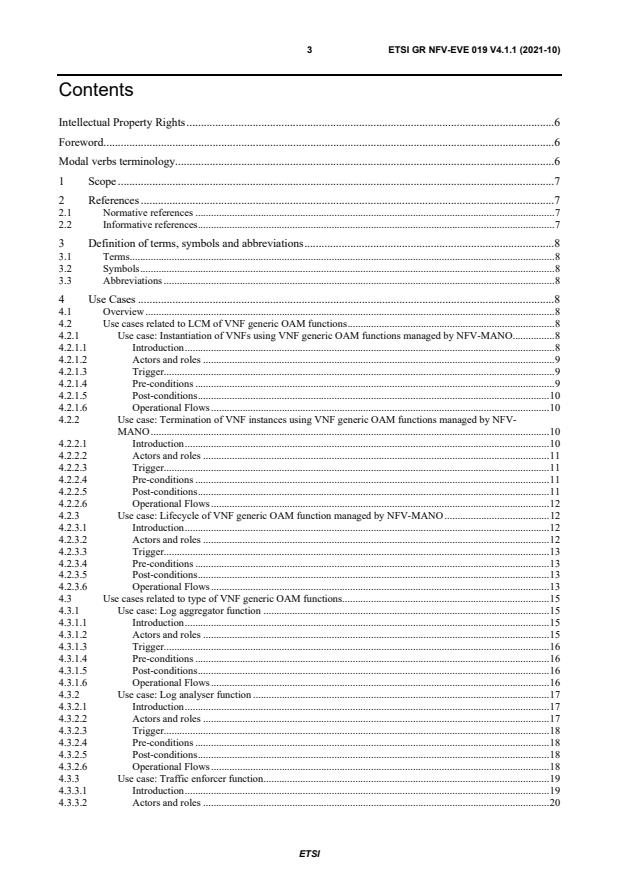
Contents
Intellectual Property Rights . 6
Foreword . 6
Modal verbs terminology . 6
1 Scope . 7
2 References . 7
2.1 Normative references . 7
2.2 Informative references . 7
3 Definition of terms, symbols and abbreviations . 8
3.1 Terms . 8
3.2 Symbols . 8
3.3 Abbreviations . 8
4 Use Cases . 8
4.1 Overview . 8
4.2 Use cases related to LCM of VNF generic OAM functions . 8
4.2.1 Use case: Instantiation of VNFs using VNF generic OAM functions managed by NFV-MANO. 8
4.2.1.1 Introduction . 8
4.2.1.2 Actors and roles . 9
4.2.1.3 Trigger . 9
4.2.1.4 Pre-conditions . 9
4.2.1.5 Post-conditions . 10
4.2.1.6 Operational Flows . 10
4.2.2 Use case: Termination of VNF instances using VNF generic OAM functions managed by NFV-
MANO . 10
4.2.2.1 Introduction . 10
4.2.2.2 Actors and roles . 11
4.2.2.3 Trigger . 11
4.2.2.4 Pre-conditions . 11
4.2.2.5 Post-conditions . 11
4.2.2.6 Operational Flows . 12
4.2.3 Use case: Lifecycle of VNF generic OAM function managed by NFV-MANO . 12
4.2.3.1 Introduction . 12
4.2.3.2 Actors and roles . 12
4.2.3.3 Trigger . 13
4.2.3.4 Pre-conditions . 13
4.2.3.5 Post-conditions . 13
4.2.3.6 Operational Flows . 13
4.3 Use cases related to type of VNF generic OAM functions . 15
4.3.1 Use case: Log aggregator function . 15
4.3.1.1 Introduction . 15
4.3.1.2 Actors and roles . 15
4.3.1.3 Trigger . 16
4.3.1.4 Pre-conditions . 16
4.3.1.5 Post-conditions . 16
4.3.1.6 Operational Flows . 16
4.3.2 Use case: Log analyser function . 17
4.3.2.1 Introduction . 17
4.3.2.2 Actors and roles . 17
4.3.2.3 Trigger . 18
4.3.2.4 Pre-conditions . 18
4.3.2.5 Post-conditions . 18
4.3.2.6 Operational Flows . 18
4.3.3 Use case: Traffic enforcer function . 19
4.3.3.1 Introduction . 19
4.3.3.2 Actors and roles . 20
ETSI
4 ETSI GR NFV-EVE 019 V4.1.1 (2021-10)
4.3.3.3 Trigger . 20
4.3.3.4 Pre-conditions . 20
4.3.3.5 Post-conditions . 20
4.3.3.6 Operational Flows . 20
4.3.4 Use case: VNF metrics aggregator function . 21
4.3.4.1 Introduction . 21
4.3.4.2 Actors and roles . 21
4.3.4.3 Trigger . 22
4.3.4.4 Pre-conditions . 22
4.3.4.5 Post-conditions . 22
4.3.4.6 Operational Flows . 22
4.3.5 Use case: VNF metrics analyser function . 22
4.3.5.1 Introduction . 22
4.3.5.2 Actors and roles . 23
4.3.5.3 Trigger . 23
4.3.5.4 Pre-conditions . 23
4.3.5.5 Post-conditions . 24
4.3.5.6 Operational Flows . 24
4.3.6 Use case: Time function . 24
4.3.6.1 Introduction . 24
4.3.6.2 Actors and roles . 25
4.3.6.3 Time synchronization (base flow #1) . 26
4.3.6.3.1 Introduction . 26
4.3.6.3.2 Trigger . 26
4.3.6.3.3 Pre-conditions . 26
4.3.6.3.4 Post-conditions . 26
4.3.6.3.5 Operational Flow #1 . 26
4.3.6.4 Time re-synchronization after drift (base flow #2) . 27
4.3.6.4.1 Introduction . 27
4.3.6.4.2 Trigger . 27
4.3.6.4.3 Pre-conditions . 27
4.3.6.4.4 Post-conditions . 27
4.3.6.4.5 Operational Flow #2 . 28
4.3.7 Use case: Notification manager function . 28
4.3.7.1 Introduction . 28
4.3.7.2 Actors and roles . 29
4.3.7.3 Trigger . 29
4.3.7.4 Pre-conditions . 29
4.3.7.5 Post-conditions . 29
4.3.7.6 Operational Flows . 30
4.3.8 Use case: Network configuration manager function . 30
4.3.8.1 Introduction . 30
4.3.8.2 Actors and roles . 31
4.3.8.3 Trigger . 31
4.3.8.4 Pre-conditions . 31
4.3.8.5 Post-conditions . 32
4.3.8.6 Operational Flows . 32
4.3.9 Use case: Upgrade VNF function . 33
4.3.9.1 Introduction . 33
4.3.9.2 Actors and roles . 33
4.3.9.3 Trigger . 34
4.3.9.4 Pre-conditions . 34
4.3.9.5 Post-conditions . 34
4.3.9.6 Operational Flows . 34
4.3.10 Use case: VNF configuration manager function . 36
4.3.10.1 Introduction . 36
4.3.10.2 Actors and roles . 36
4.3.10.3 Trigger . 37
4.3.10.4 Pre-conditions . 37
4.3.10.5 Post-conditions . 37
4.3.10.6 Operational Flows . 38
ETSI
5 ETSI GR NFV-EVE 019 V4.1.1 (2021-10)
5 Use Cases analysis . 38
5.1 Overview . 38
5.2 Use cases related to LCM of VNF generic OAM functions . 39
5.3 Use cases related to types of VNF generic OAM functions . 39
5.4 Use cases related to functionality currently provided by VNFs . 40
5.5 Use cases related to functionality currently provided by OSS/BSS and EM . 41
5.6 Characteristics of VNF generic OAM functions . 41
5.7 Comparison of VNF generic OAM functions and VNF common services . 42
6 Framework and potential solutions . 43
6.1 Introduction . 43
6.2 Framework . 43
6.2.1 Overview of interactions . 43
6.2.2 Types of functions of generic OAM . 44
6.3 Solution A: Introducing generic OAM as a new functional block . 45
6.3.1 Introduction. 45
6.3.2 Internal interactions of each function in generic OAM FB . 45
6.3.3 Interaction of Generic OAM FB and other functions/functional blocks . 45
6.4 Solution B: Extending existing functional blocks for Generic OAM functionality. 46
6.4.1 Introduction. 46
6.4.2 Solution B1: Splitting of functionalities into existing functional blocks . 46
6.4.3 Solution B2: Splitting of functionalities into existing functional block . 47
6.5 Solution C: Generic OAM functions as VNF . 48
6.6 Analysis . 48
6.6.1 Introduction. 48
6.6.2 Solution A: Introducing generic OAM as a new functional block . 49
6.6.3 Solution B: Extending existing functional blocks for Generic OAM functionality . 49
6.6.4 Solution C: Generic OAM functions as VNF . 49
7 Recommendations . 49
7.1 Overview . 49
7.2 Recommendations towards VNF generic OAM functions . 50
8 Conclusion . 52
Annex A: Change History . 53
History . 54
ETSI
6 ETSI GR NFV-EVE 019 V4.1.1 (2021-10)
Intellectual Property Rights
Essential patents
IPRs essential or potentially essential to normative deliverables may have been declared to ETSI. The declarations
pertaining to these essential IPRs, if any, are publicly available for ETSI members and non-members, and can be
found in ETSI SR 000 314: "Intellectual Property Rights (IPRs); Essential, or potentially Essential, IPRs notified to
ETSI in respect of ETSI standards", which is available from the ETSI Secretariat. Latest updates are available on the
ETSI Web server (https://ipr.etsi.org/).
Pursuant to the ETSI Directives including the ETSI IPR Policy, no investigation regarding the essentiality of IPRs,
including IPR searches, has been carried out by ETSI. No guarantee can be given as to the existence of other IPRs not
referenced in ETSI SR 000 314 (or the updates on the ETSI Web server) which are, or may be, or may become,
essential to the present document.
Trademarks
The present document may include trademarks and/or tradenames which are asserted and/or registered by their owners.
ETSI claims no ownership of these except for any which are indicated as being the property of ETSI, and conveys no
right to use or reproduce any trademark and/or tradename. Mention of those trademarks in the present document does
not constitute an endorsement by ETSI of products, services or organizations associated with those trademarks.
DECT™, PLUGTESTS™, UMTS™ and the ETSI logo are trademarks of ETSI registered for the benefit of its
Members. 3GPP™ and LTE™ are trademarks of ETSI registered for the benefit of its Members and of the 3GPP
Organizational Partners. oneM2M™ logo is a trademark of ETSI registered for the benefit of its Members and of the ®
oneM2M Partners. GSM and the GSM logo are trademarks registered and owned by the GSM Association.
Foreword
This Group Report (GR) has been produced by ETSI Industry Specification Group (ISG) Network Functions
Virtualisation (NFV).
Modal verbs terminology
In the present document "should", "should not", "may", "need not", "will", "will not", "can" and "cannot" are to be
interpreted as described in clause 3.2 of the ETSI Drafting Rules (Verbal forms for the expression of provisions).
"must" and "must not" are NOT allowed in ETSI deliverables except when used in direct citation.
ETSI
7 ETSI GR NFV-EVE 019 V4.1.1 (2021-10)
1 Scope
The present document analyses and defines the type of OAM functions for VNFs that can be generalized and be
provided as a "generic function" supporting e.g. the provisioning, connectivity, configuration and monitoring of VNFs
on a virtualised platform. The present document also describes possible solutions to realize such generic OAM
functions.
2 References
2.1 Normative references
Normative references are not applicable in the present document.
2.2 Informative references
References are either specific (identified by date of publication and/or edition number or version number) or
non-specific. For specific references, only the cited version applies. For non-specific references, the latest version of the
referenced document (including any amendments) applies.
NOTE: While any hyperlinks included in this clause were valid at the time of publication, ETSI cannot guarantee
their long term validity.
The following referenced documents are not necessary for the application of the present document but they assist the
user with regard to a particular subject area.
[i.1] ETSI GR NFV 003: "Network Functions Virtualisation (NFV); Terminology for Main Concepts in
NFV".
[i.2] ETSI GR NFV-IFA 029: "Network Functions Virtualisation (NFV) Release 3; Architecture;
Report on the Enhancements of the NFV architecture towards "Cloud-native" and "PaaS".
[i.3] ETSI GS NFV-IFA 027: "Network Functions Virtualisation (NFV) Release 4; Management and
Orchestration; Performance Measurements Specification".
[i.4] ETSI GS NFV-SOL 016: "Network Functions Virtualisation (NFV) Release 3; Protocols and Data
Models; NFV-MANO procedures specification".
[i.5] ETSI GS NFV-IFA 008: "Network Functions Virtualisation (NFV) Release 4; Management and
Orchestration; Ve-Vnfm reference point - Interface and Information Model Specification".
[i.6] ETSI GS NFV-IFA 031: "Network Functions Virtualisation (NFV) Release 4; Management and
Orchestration; Requirements and interfaces specification for management of NFV-MANO".
[i.7] ETSI GS NFV-IFA 010: "Network Functions Virtualisation (NFV) Release 4; Management and
Orchestration; Functional requirements specification".
[i.8] ETSI GS NFV-IFA 009: "Network Functions Virtualisation (NFV); Management and
Orchestration; Report on Architectural Options".
[i.9] ETSI GS NFV-IFA 013: "Network Functions Virtualisation (NFV) Release 4; Management and
Orchestration; Os-Ma-nfvo reference point - Interface and Information Model Specification".
[i.10] ETSI GS NFV-IFA 007: "Network Functions Virtualisation (NFV) Release 4; Management and
Orchestration; Or-Vnfm reference point - Interface and Information Model Specification".
ETSI
8 ETSI GR NFV-EVE 019 V4.1.1 (2021-10)
3 Definition of terms, symbols and abbreviations
3.1 Terms
For the purposes of the present document, the terms given in ETSI GR NFV 003 [i.1] and the following apply:
VNF generic OAM function: function that provides in a generic form OAM capabilities applicable to any kind of
VNFs
NOTE 1: These functions aim at easing the provisioning, connectivity, configuration and monitoring of one or
more VNFs.
NOTE 2: The kinds of VNF concern to diverse VNF implementation approaches and diverse network functionality
and services provided by the VNFs.
3.2 Symbols
Void.
3.3 Abbreviations
For the purposes of the present document, the abbreviations given in ETSI GR NFV 003 [i.1] and the following apply:
DNS Domain Name System
NTP Network Time Protocol
4 Use Cases
4.1 Overview
This clause provides a list of use cases related to functionality that would benefit from VNF generic OAM functions.
The use cases are grouped into two categories, namely use cases related to the lifecycle of VNF generic OAM functions
and use cases related to type of VNF generic OAM functions.
4.2 Use cases related to LCM of VNF generic OAM functions
4.2.1 Use case: Instantiation of VNFs using VNF generic OAM functions
managed by NFV-MANO
4.2.1.1 Introduction
This use case is about the instantiation of VNFs that their implementation uses one or more VNF generic OAM
functions. That way, the Operator is provided with a more generic way to configure, manage/operate, and monitor the
VNFs it operates. Also, the management of the VNFs will be more focused on services management, while some of the
VNF generic OAM functions will deal with the underlying resources, host, and network. In this use case it is assumed
that NFV-MANO is responsible to manage the lifecycle of the VNF generic OAM functions, e.g. instantiate a VNF
generic OAM function when required by a VNF instance or terminate a VNF generic OAM function when it is no
longer being used by any VNF instance. It is also assumed that the VNF generic OAM function can be consumed by
multiple consumer instances at the same time.
During the instantiation of the VNFs, NFV-MANO needs to check the availability of the VNF generic OAM functions.
ETSI
9 ETSI GR NFV-EVE 019 V4.1.1 (2021-10)
Different options are possible (not an exhaustive list):
a) The required VNF generic OAM function supports all required functionalities. It is already instantiated in the
system, can be shared and is operational.
b) The VNF generic OAM function supports all required functionalities, is not yet instantiated in the system or
the instantiated function cannot be shared and can be instantiated.
c) Some or all of the required functionalities are missing or the required VNF generic OAM function is not
available and the VNF instantiation will fail.
The user story related to this use case is the following:
An Operator can instantiate VNFs that are using VNF generic OAM functions and has a generic way to
configure, manage/operate, and monitor the different network functions in the Operator's environment and can
focus on "services management".
4.2.1.2 Actors and roles
Table 4.2.1.2-1 describes the use case actors and roles.
Table 4.2.1.2-1: Instantiation of VNFs using VNF generic OAM functions
managed by NFV-MANO, actors and roles
# Actor Description
1 Operator A human being or an organization that operates the system including the
NFV-MANO functional entities, the VNFs, the VNF generic OAM functions, and
the underlying infrastructure.
2 OSS/BSS The entity that receives request from the Operator to instantiate the VNF.
3 NFV-MANO The entity instantiating and managing the VNF.
4.2.1.3 Trigger
Table 4.2.1.3-1 describes the use case trigger.
Table 4.2.1.3-1: Instantiation of VNFs using VNF generic OAM functions
managed by NFV-MANO, trigger
Trigger Description
Operator is requesting the instantiation of the VNF.
4.2.1.4 Pre-conditions
Table 4.2.1.4-1 describes the pre-conditions of this use case.
Table 4.2.1.4-1: Instantiation of VNFs using VNF generic OAM functions
managed by NFV-MANO, pre-conditions
# Pre-condition Description
1 NFV-MANO environment is operational
2 VNF Package is onboarded The VNF implementation supports the use of one or more
VNF generic OAM functions.
3 VNF generic OAM functions are available All VNF generic OAM functions required by the VNF are
available. Some of them may already be instantiated and
operational.
4 NFV-MANO knows which VNF generic OAM
functions are required by the VNF and need to
be instantiated
ETSI
10 ETSI GR NFV-EVE 019 V4.1.1 (2021-10)
4.2.1.5 Post-conditions
Table 4.2.1.5-1 describes the post-conditions of this use case.
Table 4.2.1.5-1: Instantiation of VNFs using VNF generic OAM functions
managed by NFV-MANO, post-conditions
# Post-condition Description
1 VNF is instantiated VNF is instantiated and is using VNF generic OAM functions.
4.2.1.6 Operational Flows
Table 4.2.1.6-1 describes the base flow of this use case.
Table 4.2.1.6-1: Instantiation of VNFs using VNF generic OAM functions
managed by NFV-MANO, base flow
# Actor/Role Description
Begins Operator -> Operator is triggering the instantiation of the VNF to the NFVO via OSS/BSS.
When OSS/BSS ->
NFV-MANO
1 NFV-MANO NFV-MANO is checking the availability of the VNF generic OAM functions required to run
the VNF function.
2 NFV-MANO If a VNF generic OAM function is not yet instantiated, the VNF generic OAM function will be
instantiated by NFV-MANO.
3 NFV-MANO Once all required VNF generic OAM functions are instantiated and ready to be used,
NFV-MANO will instantiate the requested VNF. A detailed flow for the "Instantiate VNF
instance" is described as part of the "NS instantiate procedure" in clause 5.2 of ETSI
GS NFV-SOL 016 [i.4].
Ends NFV-MANO -> NFV-MANO returns an "operation completed" notification to the Operator via OSS/BSS.
When OSS/BSS ->
Operator
4.2.2 Use case: Termination of VNF instances using VNF generic OAM
functions managed by NFV-MANO
4.2.2.1 Introduction
This use case is about the termination of VNF instances that their implementation uses one or more VNF generic OAM
functions. In this use case it is assumed that NFV-MANO is responsible to manage the lifecycle of the VNF generic
OAM functions, e.g. terminate or scale in a VNF generic OAM function when it is no longer being used by one or more
VNF instances.
The user stories related to this use case are:
• An Operator can terminate the VNF instances that are using VNF generic OAM functions, so that the
virtualised resources associated to the VNFs and associated VNF generic OAM functions can be released.
• An Operator can terminate the VNF instances without having to handle the lifecycle of the VNF generic OAM
functions.
ETSI
11 ETSI GR NFV-EVE 019 V4.1.1 (2021-10)
4.2.2.2 Actors and roles
Table 4.2.2.2-1 describes the use case actors and roles.
Table 4.2.2.2-1: Termination of VNF instances using VNF generic OAM functions
managed by NFV-MANO, actors and roles
# Actor Description
1 Operator A human being or an organization that operates the system including the
NFV-MANO functional entities, the VNFs, the VNF generic OAM functions, and
the underlying infrastructure.
2 OSS/BSS The entity that receives request from the Operator to terminate the VNF.
3 NFV-MANO The entity managing and terminating the VNF instance.
4.2.2.3 Trigger
Table 4.2.2.3-1 describes the use case trigger.
Table 4.2.2.3-1: Termination of VNF instances using VNF generic OAM functions
managed by NFV-MANO, trigger
Trigger Description
Operator is requesting the termination of the VNF instance.
4.2.2.4 Pre-conditions
Table 4.2.2.4-1 describes the pre-conditions of this use case.
Table 4.2.2.4-1: Termination of VNF instances using VNF generic OAM functions
managed by NFV-MANO, pre-conditions
# Pre-condition Description
1 NFV-MANO environment is operational.
2 NFV-MANO knows which lifecycle operations
are required to be performed on the VNF
generic OAM functions (e.g. terminate, scale in)
after terminating the VNF instance.
4.2.2.5 Post-conditions
Table 4.2.2.5-1 describes the post-conditions of this use case.
Table 4.2.2.5-1: Termination of VNF instances using VNF generic OAM functions
managed by NFV-MANO, post-conditions
# Post-condition Description
1 VNF instance is terminated.
2 Lifecycle operations on the
VNF generic OAM functions
(e.g. terminate, scale in) are
successfully completed.
ETSI
12 ETSI GR NFV-EVE 019 V4.1.1 (2021-10)
4.2.2.6 Operational Flows
Table 4.2.2.6-1 describes the base flow of this use case.
Table 4.2.2.6-1: Termination of VNF instances using VNF generic OAM functions
managed by NFV-MANO, base flow
# Actor/Role Description
Begins Operator -> Operator is triggering the termination of the VNF instance to the NFVO via OSS/BSS.
When OSS/BSS ->
NFV-MANO
1 NFV-MANO NFV-MANO terminates the VNF instance. A detailed flow for the "Terminate VNF instance"
is described as part of the "NS termination procedure" in clause 5.3 of ETSI
GS NFV-SOL 016 [i.4].
2 NFV-MANO Once the termination of the VNF instance has been successfully executed, NFV-MANO is
performing the lifecycle operations on the VNF generic OAM functions (e.g. terminate,
scale in). See note.
Ends NFV-MANO -> NFV-MANO returns an "operation completed" notification to the Operator via OSS/BSS.
When OSS/BSS ->
Operator
NOTE: The allowed lifecycle operations depend on the type of the VNF generic OAM function. For example, the Log
aggregator function as described in clause 4.3.1 below cannot be terminated. The reason is that this function
might stay available for keeping log files accessible for consumption by users such as the Operator.
4.2.3 Use case: Lifecycle of VNF generic OAM function managed by
NFV-MANO
4.2.3.1 Introduction
The goal of this use case is to describe a generic use case "LCM of VNF generic OAM function managed by
NFV-MANO". The use case shows a complete lifecycle of a VNF generic OAM function that is instantiated, scaled,
and terminated based on the demand of two exemplary NSs.
The user story related to this use case is:
• An Operator can deploy VNFs that are using VNF generic OAM functions, and has a generic way to
configure, manage/operate, and monitor the different network functions in the Operator's environment and can
focus on "services management".
The following clauses describe the use case of "LCM of VNF generic OAM function managed by NFV-MANO" which
is related to above user story. This use case assumes that the Operator is managing the VNF generic OAM function
using existing mechanisms of NFV-MANO for the lifecycle management of these functions. In addition, for the
purpose of the present use case, the VNF generic OAM function is assumed to be scalable.
4.2.3.2 Actors and roles
Table 4.2.3.2-1 describes the use case actors and roles.
Table 4.2.3.2-1: Lifecycle of VNF generic OAM function managed by NFV-MANO, actors and roles
# Actor Description
1 Operator A human being or an organization that operates the system including the NFV-MANO
functional entities, the VNFs, the VNF generic OAM functions, and the underlying
infrastructure.
2 OSS/BSS The entity that receives request from the Operator to perform various NS LCM operations.
3 VNF A, Instances of two different VNFs A and B that both require the same VNF generic OAM
VNF B function.
4 NS A In this simplified use case, NS A consists of VNF A and VNF B.
5 VNF generic A VNF generic OAM function.
OAM function
6 NFV-MANO Management and network orchestration framework including NFVO, VNFM(s), and VIM.
ETSI
13 ETSI GR NFV-EVE 019 V4.1.1 (2021-10)
4.2.3.3 Trigger
Table 4.2.3.3-1 describes the use case trigger.
Table 4.2.3.3-1: Lifecycle of VNF generic OAM function managed by NFV-MANO, trigger
Trigger Description
Operator is deploying NS A that is requiring the VNF generic OA
...
Questions, Comments and Discussion
Ask us and Technical Secretary will try to provide an answer. You can facilitate discussion about the standard in here.
Loading comments...