


ETSI TS 103 584 V1.1.1 (2018-01)
DTS-UHD Point Source Renderer
DTS-UHD Point Source Renderer
DTS/JTC-DTS-PSR
General Information
Standards Content (Sample)
TECHNICAL SPECIFICATION
DTS-UHD Point Source Renderer
2 ETSI TS 103 584 V1.1.1 (2018-01)
Reference
DTS/JTC-DTS-PSR
Keywords
audio, broadcast, codec, digital, object audio
ETSI
650 Route des Lucioles
F-06921 Sophia Antipolis Cedex - FRANCE
Tel.: +33 4 92 94 42 00 Fax: +33 4 93 65 47 16
Siret N° 348 623 562 00017 - NAF 742 C
Association à but non lucratif enregistrée à la
Sous-Préfecture de Grasse (06) N° 7803/88
Important notice
The present document can be downloaded from:
http://www.etsi.org/standards-search
The present document may be made available in electronic versions and/or in print. The content of any electronic and/or
print versions of the present document shall not be modified without the prior written authorization of ETSI. In case of any
existing or perceived difference in contents between such versions and/or in print, the only prevailing document is the
print of the Portable Document Format (PDF) version kept on a specific network drive within ETSI Secretariat.
Users of the present document should be aware that the document may be subject to revision or change of status.
Information on the current status of this and other ETSI documents is available at
https://portal.etsi.org/TB/ETSIDeliverableStatus.aspx
If you find errors in the present document, please send your comment to one of the following services:
https://portal.etsi.org/People/CommiteeSupportStaff.aspx
Copyright Notification
No part may be reproduced or utilized in any form or by any means, electronic or mechanical, including photocopying
and microfilm except as authorized by written permission of ETSI.
The content of the PDF version shall not be modified without the written authorization of ETSI.
The copyright and the foregoing restriction extend to reproduction in all media.
© ETSI 2018.
© European Broadcasting Union 2018.
All rights reserved.
TM TM TM
DECT , PLUGTESTS , UMTS and the ETSI logo are trademarks of ETSI registered for the benefit of its Members.
TM
3GPP and LTE™ are trademarks of ETSI registered for the benefit of its Members and
of the 3GPP Organizational Partners.
oneM2M logo is protected for the benefit of its Members.
GSM® and the GSM logo are trademarks registered and owned by the GSM Association.
ETSI
3 ETSI TS 103 584 V1.1.1 (2018-01)
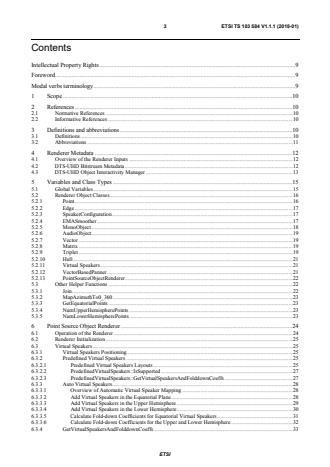
Contents
Intellectual Property Rights . 9
Foreword . 9
Modal verbs terminology . 9
1 Scope . 10
2 References . 10
2.1 Normative References . 10
2.2 Informative References . 10
3 Definitions and abbreviations . 10
3.1 Definitions . 10
3.2 Abbreviations . 11
4 Renderer Metadata . 12
4.1 Overview of the Renderer Inputs . 12
4.2 DTS-UHD Bitstream Metadata . 12
4.3 DTS-UHD Object Interactivity Manager . 13
5 Variables and Class Types . 15
5.1 Global Variables . 15
5.2 Renderer Object Classes . 16
5.2.1 Point . 16
5.2.2 Edge . 17
5.2.3 SpeakerConfiguration . 17
5.2.4 EMASmoother . 17
5.2.5 MonoObject . 18
5.2.6 AudioObject . 19
5.2.7 Vector . 19
5.2.8 Matrix . 19
5.2.9 Triplet . 19
5.2.10 Hull . 21
5.2.11 Virtual Speakers . 21
5.2.12 VectorBasedPanner . 21
5.2.13 PointSourceObjectRenderer . 22
5.3 Other Helper Functions . 22
5.3.1 Join. 22
5.3.2 MapAzimuthTo0_360 . 23
5.3.3 GetEquatorialPoints . 23
5.3.4 NumUpperHemispherePoints . 23
5.3.5 NumLowerHemispherePoints . 23
6 Point Source Object Renderer . 24
6.1 Operation of the Renderer . 24
6.2 Renderer Initialization . 25
6.3 Virtual Speakers . 25
6.3.1 Virtual Speakers Positioning. 25
6.3.2 Predefined Virtual Speakers . 25
6.3.2.1 Predefined Virtual Speakers Layouts . 25
6.3.2.2 PredefinedVirtualSpeakers::IsSupported . 27
6.3.2.3 PredefinedVirtualSpeakers::GetVirtualSpeakersAndFolddownCoeffs . 27
6.3.3 Auto Virtual Speakers . 28
6.3.3.1 Overview of Automatic Virtual Speaker Mapping . 28
6.3.3.2 Add Virtual Speakers in the Equatorial Plane . 28
6.3.3.3 Add Virtual Speakers in the Upper Hemisphere . 29
6.3.3.4 Add Virtual Speakers in the Lower Hemisphere . 30
6.3.3.5 Calculate Fold-down Coefficients for Equatorial Virtual Speakers . 31
6.3.3.6 Calculate Fold-down Coefficients for the Upper and Lower Hemisphere . 32
6.3.4 GetVirtualSpeakersAndFolddownCoeffs . 33
ETSI
4 ETSI TS 103 584 V1.1.1 (2018-01)
6.3.5 Hull Initialization . 33
6.4 Predefined Virtual Speakers Organization . 34
6.5 Rendering All Objects . 35
6.5.1 Object Rendering . 35
6.5.2 Vector Based Panner . 36
6.5.3 Panning in a Hull . 36
7 Predefined Virtual Speaker Mapping . 38
7.1 Channel Bitmask . 38
7.2 General Mapping Functions . 39
7.2.1 GetLinearGainVectorFromTable . 39
7.2.2 Physical Speaker Search Functions . 40
7.2.2.1 Search Functions Overview . 40
7.2.2.2 ClosestAzEq . 40
7.2.2.3 ClosestAzUH . 40
7.2.2.4 ClosestElv . 40
7.2.2.5 LeftLargestEqtr . 40
7.2.2.6 RightLargestEqtr . 40
7.2.2.7 PrefOrder . 41
7.2.2.8 Split . 41
7.2.2.9 ExclusiveOr . 41
7.3 Equatorial Plane and Upper Hemisphere . 41
7.3.1 Equatorial Plane and Height Functions . 41
7.3.1.1 GetChannelMaskForEqtrUpHemiGroups . 41
7.3.1.2 GroupEquatorOrUpper . 41
7.3.1.3 list_of_all_groups_equator_or_upper . 42
7.3.2 GroupEquatorOrUpper1 . 42
7.3.2.1 Channel Layouts in GroupEquatorOrUpper1 . 42
7.3.2.2 Virtual Speakers and their Fold-down Coefficients for GroupEquatorOrUpper1 . 43
7.3.3 GroupEquatorOrUpper2 . 43
7.3.3.1 Channel Layouts in GroupEquatorOrUpper2 . 43
7.3.3.2 Virtual Speakers and their Fold-down Coefficients for GroupEquatorOrUpper2 . 44
7.3.4 GroupEquatorOrUpper3 . 44
7.3.4.1 Channel Layouts in GroupEquatorOrUpper3 . 44
7.3.4.2 Virtual Speakers and their Fold-down Coefficients for GroupEquatorOrUpper3 . 44
7.3.5 GroupEquatorOrUpper4 . 45
7.3.5.1 Channel Layouts in GroupEquatorOrUpper4 . 45
7.3.5.2 Virtual Speakers and their Fold-down Coefficients for GroupEquatorOrUpper4 . 45
7.3.6 GroupEquatorOrUpper5 . 46
7.3.6.1 Channel Layouts in GroupEquatorOrUpper5 . 46
7.3.6.2 Virtual Speakers and their Fold-down Coefficients for GroupEquatorOrUpper5 . 46
7.3.7 GroupEquatorOrUpper6 . 46
7.3.7.1 Channel Layouts in GroupEquatorOrUpper6 . 46
7.3.7.2 Virtual Speakers and their Fold-down Coefficients for GroupEquatorOrUpper6 . 47
7.3.8 GroupEquatorOrUpper7 . 47
7.3.8.1 Channel Layouts in GroupEquatorOrUpper7 . 47
7.3.8.2 Virtual Speakers and their Fold-down Coefficients for GroupEquatorOrUpper7 . 48
7.3.9 GroupEquatorOrUpper8 . 48
7.3.9.1 Channel Layouts in GroupEquatorOrUpper8 . 48
7.3.9.2 Virtual Speakers and their Fold-down Coefficients for GroupEquatorOrUpper8 . 49
7.3.10 GroupEquatorOrUpper9 . 49
7.3.10.1 Channel Layouts in GroupEquatorOrUpper9 . 49
7.3.10.2 Virtual Speakers and their Fold-down Coefficients for GroupEquatorOrUpper9 . 50
7.3.11 GroupEquatorOrUpper10 . 50
7.3.11.1 Channel Layouts in GroupEquatorOrUpper10 . 50
7.3.11.2 Virtual Speakers and their Fold-down Coefficients for GroupEquatorOrUpper10 . 56
7.3.12 GroupEquatorOrUpper11 . 56
7.3.12.1 Channel Layouts in GroupEquatorOrUpper11 . 56
7.3.12.2 Virtual Speakers and their Fold-down Coefficients for GroupEquatorOrUpper11 . 57
7.3.13 GroupEquatorOrUpper12 . 57
7.3.13.1 Channel Layouts in GroupEquatorOrUpper12 . 57
7.3.13.2 Virtual Speakers and their Fold-down Coefficients for GroupEquatorOrUpper12 . 57
ETSI
5 ETSI TS 103 584 V1.1.1 (2018-01)
7.3.14 GroupEquatorOrUpper13 . 58
7.3.14.1 Channel Layouts in GroupEquatorOrUpper13 . 58
7.3.14.2 Virtual Speakers and their Fold-down Coefficients for GroupEquatorOrUpper13 . 58
7.3.15 GroupEquatorOrUpper14 . 58
7.3.15.1 Channel Layouts in GroupEquatorOrUpper14 . 58
7.3.15.2 Virtual Speakers and their Fold-down Coefficients for GroupEquatorOrUpper14 . 58
7.3.16 GroupEquatorOrUpper15 . 59
7.3.16.1 Channel Layouts in GroupEquatorOrUpper15 . 59
7.3.16.2 Virtual Speakers and their Fold-down Coefficients for GroupEquatorOrUpper15 . 59
7.3.17 GroupEquatorOrUpper16 . 59
7.3.17.1 Channel Layouts in GroupEquatorOrUpper16 . 59
7.3.17.2 Virtual Speakers and their Fold-down Coefficients for GroupEquatorOrUpper16 . 59
7.3.18 GroupEquatorOrUpper17 . 60
7.3.18.1 Channel Layouts in GroupEquatorOrUpper17 . 60
7.3.18.2 Virtual Speakers and their Fold-down Coefficients for GroupEquatorOrUpper17 . 60
7.3.19 GroupEquatorOrUpper18 . 60
7.3.19.1 Channel Layouts in GroupEquatorOrUpper18 . 60
7.3.19.2 Virtual Speakers and their Fold-down Coefficients for GroupEquatorOrUpper18 . 60
7.3.20 GroupEquatorOrUpper19 . 61
7.3.20.1 Channel Layouts in GroupEquatorOrUpper19 . 61
7.3.20.2 Virtual Speakers and their Fold-down Coefficients for GroupEquatorOrUpper19 . 61
7.3.21 GroupEquatorOrUpper20 . 61
7.3.21.1 Channel Layouts in GroupEquatorOrUpper20 . 61
7.3.21.2 Virtual Speakers and their Fold-down Coefficients for GroupEquatorOrUpper20 . 62
7.3.22 GroupEquatorOrUpper21 . 62
7.3.22.1 Channel Layouts in GroupEquatorOrUpper21 . 62
7.3.22.2 Virtual Speakers and their Fold-down Coefficients for GroupEquatorOrUpper21 . 62
7.4 Lower Hemisphere . 62
7.4.1 Conditions for Lower Hemisphere Groups . 62
7.4.2 Functions for Virtual Speakers in the Lower Hemisphere . 63
7.4.2.1 GetChannelLayoutMaskForLowerHemisphere . 63
7.4.2.2 GroupLower . 63
7.4.2.3 list_of_all_groups_lower . 64
7.4.3 GroupLower1 . 64
7.4.3.1 Channel layouts in GroupLower1 . 64
7.4.3.2 Virtual Speakers and their Fold-down Coefficients for GroupLower1 . 64
7.4.4 GroupLower2 . 64
7.4.4.1 Channel layouts in GroupLower2 . 64
7.4.4.2 Virtual Speakers and their Fold-down Coefficients for GroupLower2 . 65
7.4.5 GroupLower3 . 65
7.4.5.1 Channel layouts in GroupLower3 . 65
7.4.5.2 Virtual Speakers and their Fold-down Coefficients for GroupLower3 . 65
7.4.6 GroupLower4 . 65
7.4.6.1 Channel layouts in GroupLower4 . 65
7.4.6.2 Virtual Speakers and their Fold-down Coefficients for GroupLower4 . 66
7.4.7 GroupLower5 . 66
7.4.7.1 Channel Layouts in GroupLower5 . 66
7.4.7.2 Virtual Speakers and their Fold-down Coefficients for GroupLower5 . 66
History . 67
ETSI
6 ETSI TS 103 584 V1.1.1 (2018-01)
List of Tables
Table 1: DTS-UHD Metadata Parameters used for Rendering .13
Table 2: Object Interactive Parameters Specified in the Bitstream .14
Table 3: Channel Definitions and Bitmask .39
Table 4: GroupEquatorOrUpper1 list_of_channel_masks[] .42
Table 5: GroupEquatorOrUpper1 Fold-down Coefficients for Virtual Speakers in Equatorial Plane .43
Table 6: GroupEquatorOrUpper1 Fold-down Coefficients for Virtual Speakers in Upper Hemisphere .43
Table 7: GroupEquatorOrUpper2 list_of_channel_masks[] .43
Table 8: GroupEquatorOrUpper2 Fold-down Coefficients for Virtual Speakers in Equatorial Plane .44
Table 9: GroupEquatorOrUpper2 Fold-down Coefficients for Virtual Speakers in Upper Hemisphere .44
Table 10: GroupEquatorOrUpper3 list_of_channel_masks[] .44
Table 11: GroupEquatorOrUpper3 Fold-down Coefficients for Virtual Speakers in Equatorial Plane .44
Table 12: GroupEquatorOrUpper3 Fold-down Coefficients for Virtual Speakers in Upper Hemisphere .45
Table 13: GroupEquatorOrUpper4 list_of_channel_masks[] .45
Table 14: GroupEquatorOrUpper4 Fold-down Coefficients for Virtual Speakers in Equatorial Plane .45
Table 15: GroupEquatorOrUpper4 Fold-down Coefficients for Virtual Speakers in Upper Hemisphere .45
Table 16: GroupEquatorOrUpper5 list_of_channel_masks[] .46
Table 17: GroupEquatorOrUpper5 Fold-down Coefficients for Virtual Speakers in Equatorial Plane .46
Table 18: GroupEquatorOrUpper5 Fold-down Coefficients for Virtual Speakers in Upper Hemisphere .46
Table 19: GroupEquatorOrUpper6 list_of_channel_masks[] .46
Table 20: GroupEquatorOrUpper6 Fold-down Coefficients for Virtual Speakers in Equatorial Plane .47
Table 21: GroupEquatorOrUpper6 Fold-down Coefficients for Virtual Speakers in Upper Hemisphere .47
Table 22: GroupEquatorOrUpper7 list_of_channel_masks[] .47
Table 23: GroupEquatorOrUpper7 Fold-down Coefficients for Virtual Speakers in Equatorial Plane .48
Table 24: GroupEquatorOrUpper7 Fold-down Coefficients for Virtual Speakers in Upper Hemisphere .48
Table 25: GroupEquatorOrUpper8 list_of_channel_masks[] .48
Table 26: GroupEquatorOrUpper8 Fold-down Coefficients for Virtual Speakers in Equatorial Plane .49
Table 27: GroupEquatorOrUpper8 Fold-down Coefficients for Virtual Speakers in Upper Hemisphere .49
Table 28: GroupEquatorOrUpper9 list_of_channel_masks[] .49
Table 29: GroupEquatorOrUpper9 Fold-down Coefficients for Virtual Speakers in Equatorial Plane .50
Table 30: GroupEquatorOrUpper9 Fold-down Coefficients for Virtual Speakers in Upper Hemisphere .50
Table 31: GroupEquatorOrUpper10 list_of_channel_masks[] .50
Table 32: GroupEquatorOrUpper10 Fold-down Coefficients for Virtual Speakers in Equatorial Plane .56
Table 33: GroupEquatorOrUpper11 list_of_channel_masks[] .57
ETSI
7 ETSI TS 103 584 V1.1.1 (2018-01)
Table 34: GroupEquatorOrUpper11 Fold-down Coefficients for Virtual Speakers in Upper Hemisphere .57
Table 35: GroupEquatorOrUpper12 list_of_channel_masks[] .57
Table 36: GroupEquatorOrUpper12 Fold-down Coefficients for Virtual Speakers in Upper Hemisphere .57
Table 37: GroupEquatorOrUpper13 list_of_channel_masks[] .58
Table 38: GroupEquatorOrUpper13 Fold-down Coefficients for Virtual Speakers in Upper Hemisphere .58
Table 39: GroupEquatorOrUpper14 list_of_channel_masks[] .58
Table 40: GroupEquatorOrUpper14 Fold-down Coefficients for Virtual Speakers in Upper Hemisphere .59
Table 41: GroupEquatorOrUpper15 list_of_channel_masks[] .59
Table 42: GroupEquatorOrUpper15 Fold-down Coefficients for Virtual Speakers in Upper Hemisphere .59
Table 43: GroupEquatorOrUpper16 list_of_channel_masks[] .59
Table 44: GroupEquatorOrUpper16 Fold-down Coefficients for Virtual Speakers in Upper Hemisphere .60
Table 45: GroupEquatorOrUpper17 list_of_channel_masks[] .60
Table 46: GroupEquatorOrUpper17 Fold-down Coefficients for Virtual Speakers in Upper Hemisphere .60
Table 47: GroupEquatorOrUpper18 list_of_channel_masks[] .60
Table 48: GroupEquatorOrUpper18 Fold-down Coefficients for Virtual Speakers in Upper Hemisphere .61
Table 49: GroupEquatorOrUpper19 list_of_channel_masks[] .61
Table 50: GroupEquatorOrUpper19 Fold-down Coefficients for Virtual Speakers in Upper Hemisphere .61
Table 51: GroupEquatorOrUpper20 list_of_channel_masks[] .61
Table 52: GroupEquatorOrUpper20 Fold-down Coefficients for Virtual Speakers in Upper Hemisphere .62
Table 53: GroupEquatorOrUpper21 list_of_channel_masks[] .62
Table 54: GroupEquatorOrUpper21 Fold-down Coefficients for Virtual Speakers in Upper Hemisphere .62
Table 55: GroupLower1 list_of_channel_masks[] .64
Table 56: GroupLower1 Fold-down Coefficients for Virtual Speakers in Lower Hemisphere.64
Table 57: GroupLower2 list_of_channel_masks[] .64
Table 58: GroupLower2 Fold-down Coefficients for Virtual Speakers in Lower Hemisphere.65
Table 59: GroupLower3 list_of_channel_masks[] .65
Table 60: GroupLower3 Fold-down Coefficients for Virtual Speakers in Lower Hemisphere.65
Table 61: GroupLower4 list_of_channel_masks[] .65
Table 62: GroupLower4 Fold-down Coefficients for Virtual Speakers in Lower Hemisphere.66
Table 63: GroupLower5 list_of_channel_masks[] .66
Table 64: GroupLower5 Fold-down Coefficients for Virtual Speakers in Lower Hemisphere.66
ETSI
8 ETSI TS 103 584 V1.1.1 (2018-01)
List of Figures
Figure 1: Point Source Object Renderer System .12
Figure 2: Object Interactivity Manager .14
Figure 3: Point Source Object Renderer Coordinate System .16
Figure 4: EMASmoother Sample Application .18
Figure 5: Point Source Object Renderer Block Diagram .24
Figure 6: Stereo (LR) Configuration with Predefined Virtual Speakers .26
Figure 7: 7.x Output Configuration with Predefined Virtual Speakers .27
Figure 8: Adding Virtual Speakers in Equatorial Plane .29
Figure 9: 7.x Output Configuration with Automatic Virtual Speakers .30
Figure 10: Remapping Virtual Speakers Between Physical Speakers .31
Figure 11: 7.x Speaker Configuration Point Source Location Panning .36
Figure 12: Point Source Panner Distribution of Gains .37
ETSI
9 ETSI TS 103 584 V1.1.1 (2018-01)
Intellectual Property Rights
Essential patents
IPRs essential or potentially essential to the present document may have been declared to ETSI. The information
pertaining to these essential IPRs, if any, is publicly available for ETSI members and non-members, and can be found
in ETSI SR 000 314: "Intellectual Property Rights (IPRs); Essential, or potentially Essential, IPRs notified to ETSI in
respect of ETSI standards", which is available from the ETSI Secretariat. Latest updates are available on the ETSI Web
server (https://ipr.etsi.org/).
Pursuant to the ETSI IPR Policy, no investigation, including IPR searches, has been carried out by ETSI. No guarantee
can be given as to the existence of other IPRs not referenced in ETSI SR 000 314 (or the updates on the ETSI Web
server) which are, or may be, or may become, essential to the present document.
Trademarks
The present document may include trademarks and/or tradenames which are asserted and/or registered by their owners.
ETSI claims no ownership of these except for any which are indicated as being the property of ETSI, and conveys no
right to use or reproduce any trademark and/or tradename. Mention of those trademarks in the present document does
not constitute an endorsement by ETSI of products, services or organizations associated with those trademarks.
Foreword
This Technical Specification (TS) has been produced by Joint Technical Committee (JTC) Broadcast of the European
Broadcasting Union (EBU), Comité Européen de Normalisation ELECtrotechnique (CENELEC) and the European
Telecommunications Standards Institute (ETSI).
NOTE: The EBU/ETSI JTC Broadcast was established in 1990 to co-ordinate the drafting of standards in the
specific field of broadcasting and related fields. Since 1995 the JTC Broadcast became a tripartite body
by including in the Memorandum of Understanding also CENELEC, which is responsible for the
standardization of radio and television receivers. The EBU is a professional association of broadcasting
organizations whose work includes the co-ordination of its members' activities in the technical, legal,
programme-making and programme-exchange domains. The EBU has active members in about
60 countries in the European broadcasting area; its headquarters is in Geneva.
European Broadcasting Union
CH-1218 GRAND SACONNEX (Geneva)
Switzerland
Tel: +41 22 717 21 11
Fax: +41 22 717 24 81
Modal verbs terminology
In the present document "shall", "shall not", "should", "should not", "may", "need not", "will", "will not", "can" and
"cannot" are to be interpreted as described in clause 3.2 of the ETSI Drafting Rules (Verbal forms for the expression of
provisions).
"must" and "must not" are NOT allowed in ETSI deliverables except when used in direct citation.
ETSI
10 ETSI TS 103 584 V1.1.1 (2018-01)
1 Scope
The present document defines an audio renderer associated with the DTS-UHD codec defined in ETSI TS 103 491 [1].
The inputs to the renderer are one or more sets of audio waveforms along with mixing instructions, and the output is a
single set of waveforms mapped to a defined speaker configuration. Each set of waveforms may represent either audio
channels or audio objects. The mixing instructions may vary with time and they come from metadata carried in the
DTS-UHD bitstream and from other application interfaces described herein.
2 References
2.1 Normative References
References are either specific (identified by date of publication and/or edition number or version number) or
non-specific. For specific references, only the cited version applies. For non-specific references, the latest version of the
referenced document (including any amendments) applies.
Referenced documents which are not found to be publicly available in the expected location might be found at
https://docbox.etsi.org/Reference/.
NOTE: While any hyperlinks included in this clause were valid at the time of publication, ETSI cannot guarantee
their long term validity.
The following referenced documents are necessary for the application of the present document.
[1] ETSI TS 103 491: "DTS-UHD Audio Format; Delivery of Channels, Objects and Ambisonic
Sound Fields", version 1.1.1.
[2] Pulkki, Ville: "Virtual Sound Source Positioning Using Vector Base Amplitude Panning", JAES
Volume 45 Issue 6 pp. 456-466; June 1997.
2.2 Informative References
References are either specific (identified by date of publication and/or edition number or version number) or
non-specific. For specific references, only the cited version applies. For non-specific references, the latest version of the
referenced document (including any amendments) applies.
NOTE: While any hyperlinks included in this clause were valid at the time of publication, ETSI cannot guarantee
their long term validity.
The following referenced documents are not necessary for the application of the present document but they assist the
user with regard to a particular subject area.
Not applicable.
3 Definitions and abbreviations
3.1 Definitions
For the purposes of the present document, the following terms and definitions apply:
audio object: waveform or set of waveforms that have been assigned a location in space
hull: collection of points forming a surface mesh to be used as a basis for panning
output feeds: set of audio waveforms mapping one to one to the physical speakers
ETSI
11 ETSI TS 103 584 V1.1.1 (2018-01)
panning: distributing a point source location into a speaker layout
physical speaker: speaker that physically exists in the listening space
point: location on the surface of the unit sphere
point source: audio waveform with defined spatial coordinates within the listening room
NOTE: A point source is treated (mathematically) as a uniform spherical radiation pattern, though in reality most
speakers have a pattern of less than 180 degrees on the face of the speaker. This reality is accounted for
by limiting the panner range.
render: combine waveforms with their gain contributions to produce audio waveforms in a specified speaker
configuration
speaker: transducer that converts an electrical signal into soundwaves
speaker configuration: defined list of physical speakers in the listening space
triplet: set of three points
virtual speaker: speaker that does not physically exist in the listening space
3.2 Abbreviations
For the purposes of the present document, the following abbreviations apply:
∪ Union operator
3D three dimensional
C Centre speaker
Ch Centre high speaker
Chr Centre high rear speaker
Clf Centre low front speaker
Cs Centre surround speaker
dB
...
Questions, Comments and Discussion
Ask us and Technical Secretary will try to provide an answer. You can facilitate discussion about the standard in here.
Loading comments...