


ETSI TS 103 221-2 V1.10.1 (2026-03)
Lawful Interception (LI); Internal Network Interfaces; Part 2: X2/X3
Lawful Interception (LI); Internal Network Interfaces; Part 2: X2/X3
RTS/LI-00310-2
General Information
- Status
- Not Published
- Technical Committee
- LI - Lawful Interception
- Current Stage
- 12 - Citation in the OJ (auto-insert)
- Due Date
- 15-Mar-2026
- Completion Date
- 05-Mar-2026
Frequently Asked Questions
ETSI TS 103 221-2 V1.10.1 (2026-03) is a standard published by the European Telecommunications Standards Institute (ETSI). Its full title is "Lawful Interception (LI); Internal Network Interfaces; Part 2: X2/X3". This standard covers: RTS/LI-00310-2
RTS/LI-00310-2
ETSI TS 103 221-2 V1.10.1 (2026-03) is available in PDF format for immediate download after purchase. The document can be added to your cart and obtained through the secure checkout process. Digital delivery ensures instant access to the complete standard document.
Standards Content (Sample)
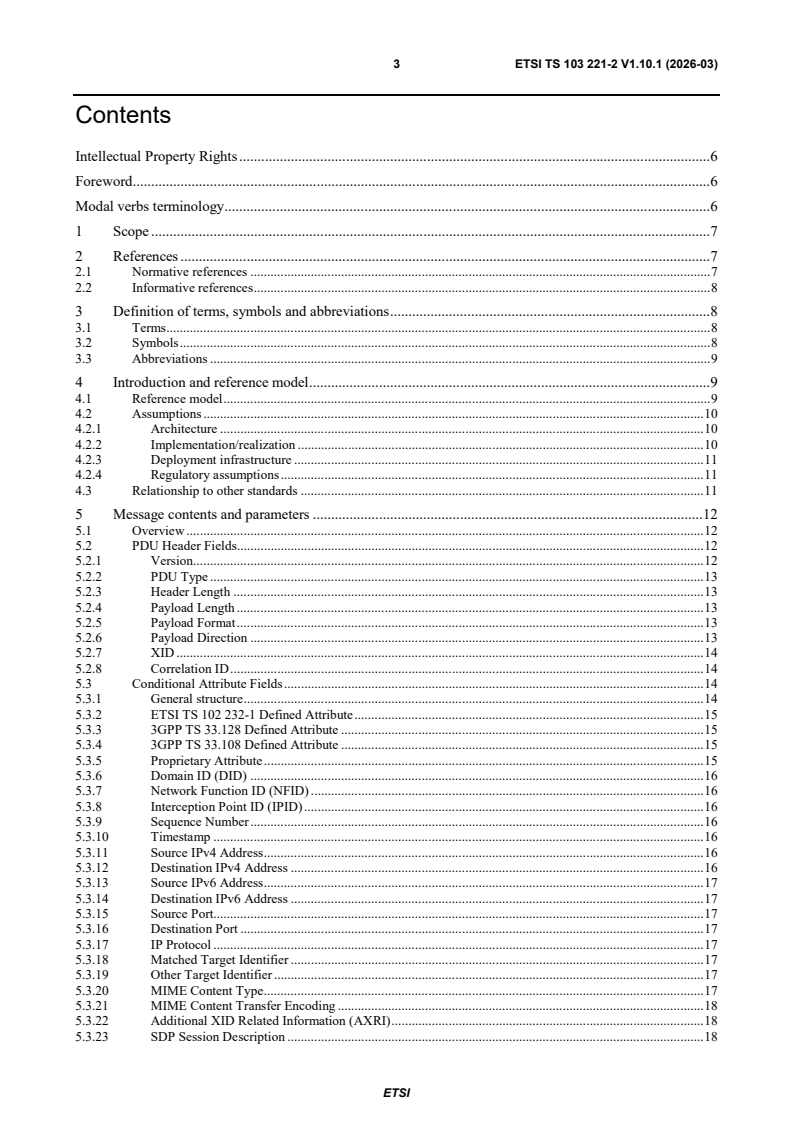
TECHNICAL SPECIFICATION
Lawful Interception (LI);
Internal Network Interfaces;
Part 2: X2/X3
2 ETSI TS 103 221-2 V1.10.1 (2026-03)
Reference
RTS/LI-00310-2
Keywords
interface, lawful interception
ETSI
650 Route des Lucioles
F-06921 Sophia Antipolis Cedex - FRANCE
Tel.: +33 4 92 94 42 00 Fax: +33 4 93 65 47 16
Siret N° 348 623 562 00017 - APE 7112B
Association à but non lucratif enregistrée à la
Sous-Préfecture de Grasse (06) N° w061004871
Important notice
The present document can be downloaded from the
ETSI Search & Browse Standards application.
The present document may be made available in electronic versions and/or in print. The content of any electronic and/or
print versions of the present document shall not be modified without the prior written authorization of ETSI. In case of any
existing or perceived difference in contents between such versions and/or in print, the prevailing version of an ETSI
deliverable is the one made publicly available in PDF format on ETSI deliver repository.
Users should be aware that the present document may be revised or have its status changed,
this information is available in the Milestones listing.
If you find errors in the present document, please send your comments to
the relevant service listed under Committee Support Staff.
If you find a security vulnerability in the present document, please report it through our
Coordinated Vulnerability Disclosure (CVD) program.
Notice of disclaimer & limitation of liability
The information provided in the present deliverable is directed solely to professionals who have the appropriate degree of
experience to understand and interpret its content in accordance with generally accepted engineering or
other professional standard and applicable regulations.
No recommendation as to products and services or vendors is made or should be implied.
No representation or warranty is made that this deliverable is technically accurate or sufficient or conforms to any law
and/or governmental rule and/or regulation and further, no representation or warranty is made of merchantability or fitness
for any particular purpose or against infringement of intellectual property rights.
In no event shall ETSI be held liable for loss of profits or any other incidental or consequential damages.
Any software contained in this deliverable is provided "AS IS" with no warranties, express or implied, including but not
limited to, the warranties of merchantability, fitness for a particular purpose and non-infringement of intellectual property
rights and ETSI shall not be held liable in any event for any damages whatsoever (including, without limitation, damages
for loss of profits, business interruption, loss of information, or any other pecuniary loss) arising out of or related to the use
of or inability to use the software.
Copyright Notification
No part may be reproduced or utilized in any form or by any means, electronic or mechanical, including photocopying and
microfilm except as authorized by written permission of ETSI.
The content of the PDF version shall not be modified without the written authorization of ETSI.
The copyright and the foregoing restriction extend to reproduction in all media.
© ETSI 2026.
All rights reserved.
ETSI
3 ETSI TS 103 221-2 V1.10.1 (2026-03)
Contents
Intellectual Property Rights . 6
Foreword . 6
Modal verbs terminology . 6
1 Scope . 7
2 References . 7
2.1 Normative references . 7
2.2 Informative references . 8
3 Definition of terms, symbols and abbreviations . 8
3.1 Terms . 8
3.2 Symbols . 8
3.3 Abbreviations . 9
4 Introduction and reference model . 9
4.1 Reference model . 9
4.2 Assumptions . 10
4.2.1 Architecture . 10
4.2.2 Implementation/realization . 10
4.2.3 Deployment infrastructure . 11
4.2.4 Regulatory assumptions . 11
4.3 Relationship to other standards . 11
5 Message contents and parameters . 12
5.1 Overview . 12
5.2 PDU Header Fields . 12
5.2.1 Version . 12
5.2.2 PDU Type . 13
5.2.3 Header Length . 13
5.2.4 Payload Length . 13
5.2.5 Payload Format . 13
5.2.6 Payload Direction . 13
5.2.7 XID . 14
5.2.8 Correlation ID . 14
5.3 Conditional Attribute Fields . 14
5.3.1 General structure . 14
5.3.2 ETSI TS 102 232-1 Defined Attribute . 15
5.3.3 3GPP TS 33.128 Defined Attribute . 15
5.3.4 3GPP TS 33.108 Defined Attribute . 15
5.3.5 Proprietary Attribute . 15
5.3.6 Domain ID (DID) . 16
5.3.7 Network Function ID (NFID) . 16
5.3.8 Interception Point ID (IPID) . 16
5.3.9 Sequence Number . 16
5.3.10 Timestamp . 16
5.3.11 Source IPv4 Address . 16
5.3.12 Destination IPv4 Address . 16
5.3.13 Source IPv6 Address . 17
5.3.14 Destination IPv6 Address . 17
5.3.15 Source Port. 17
5.3.16 Destination Port . 17
5.3.17 IP Protocol . 17
5.3.18 Matched Target Identifier . 17
5.3.19 Other Target Identifier . 17
5.3.20 MIME Content Type . 17
5.3.21 MIME Content Transfer Encoding . 18
5.3.22 Additional XID Related Information (AXRI) . 18
5.3.23 SDP Session Description . 18
ETSI
4 ETSI TS 103 221-2 V1.10.1 (2026-03)
5.4 Payload . 18
5.4.1 Overview . 18
5.4.2 ETSI TS 102 232-1 Defined Payload . 19
5.4.3 3GPP TS 33.128 Defined Payload . 19
5.4.4 3GPP TS 33.108 Defined Payload . 19
5.4.5 Proprietary Payload. 19
5.4.6 IPv4 Packet . 20
5.4.7 IPv6 Packet . 20
5.4.8 Ethernet Frame . 20
5.4.9 RTP Packet . 20
5.4.10 SIP Message. 20
5.4.11 DHCP Message . 20
5.4.12 RADIUS Packet . 20
5.4.13 GTP-U Message . 20
5.4.14 MSRP Message . 20
5.4.15 3GPP TS 33.108 EpsIRIContent. 20
5.4.16 MIME Message . 21
5.4.17 3GPP Unstructured PDU . 21
5.4.18 ETSI TS 102 232-1 PS-PDU.Payload. 21
6 Transport . 21
6.1 Summary . 21
6.2 TLS Transport Profile . 21
6.2.1 General . 21
6.2.2 Profile . 21
6.2.3 Authentication . 21
6.2.4 Keepalive mechanism for reliability . 22
Annex A (normative): Requirements . 23
A.1 X2 Protocol & Architecture requirements . 23
A.1.1 Basic Functionality . 23
A.1.2 Flexible . 23
A.1.3 Extensible . 23
A.1.4 Lightweight . 23
A.1.5 Delay . 23
A.1.6 Permanent and Dynamic Connections . 23
A.1.7 Reliability . 23
A.1.8 Error detection . 23
A.1.9 Redundancy . 23
A.1.10 Correlation . 24
A.1.11 Mediation into HI2/HI3 . 24
A.2 X2 Security requirements . 24
A.2.1 Authentication and Authorization . 24
A.2.2 Accounting and Audit . 24
A.2.3 Integrity Protection . 24
A.2.4 Confidentiality Protection . 24
A.2.5 Replay Protection . 24
A.2.6 Standalone interface . 24
A.2.7 Minimum Security Level . 24
A.2.8 Underlying Infrastructure Trust . 24
A.2.9 Firewall and NAT Transversal . 25
A.2.10 Certificate and Key Management . 25
A.3 X3 Protocol & Architecture requirements . 25
A.3.1 Basic Functionality . 25
A.3.2 Flexible . 25
A.3.3 Extensible . 25
A.3.4 Lightweight . 25
A.3.5 Delay . 25
A.3.6 Permanent and Dynamic Connections . 25
A.3.7 Reliability . 25
ETSI
5 ETSI TS 103 221-2 V1.10.1 (2026-03)
A.3.8 Error detection . 25
A.3.9 Redundancy . 26
A.3.10 Correlation . 26
A.3.11 Mediation into HI2/HI3 . 26
A.4 X3 Security requirements . 26
A.4.1 Authentication & Authorization . 26
A.4.2 Accounting/Audit . 26
A.4.3 Integrity Protection . 26
A.4.4 Confidentiality Protection . 26
A.4.5 Replay Protection . 26
A.4.6 Standalone interface . 26
A.4.7 Minimum Security Level . 27
A.4.8 Underlying Infrastructure Trust . 27
A.4.9 Firewall and NAT Transversal . 27
A.4.10 Certificate and Key Management . 27
Annex B (informative): Illustrative deployment scenarios . 28
B.1 Introduction . 28
B.2 Simple deployment scenario . 28
B.3 Individual X3 POIs with shared X2 POI . 28
B.4 Separated interfaces . 29
Annex C (normative): Configuration Information . 30
C.1 Introduction . 30
C.2 X2ConfigurationDetails . 30
C.3 X3ConfigurationDetails . 30
C.4 KeepAliveDetails . 30
Annex D (informative): Change history . 31
History . 33
ETSI
6 ETSI TS 103 221-2 V1.10.1 (2026-03)
Intellectual Property Rights
Essential patents
IPRs essential or potentially essential to normative deliverables may have been declared to ETSI. The declarations
pertaining to these essential IPRs, if any, are publicly available for ETSI members and non-members, and can be
found in ETSI SR 000 314: "Intellectual Property Rights (IPRs); Essential, or potentially Essential, IPRs notified to
ETSI in respect of ETSI standards", which is available from the ETSI Secretariat. Latest updates are available on the
ETSI IPR online database.
Pursuant to the ETSI Directives including the ETSI IPR Policy, no investigation regarding the essentiality of IPRs,
including IPR searches, has been carried out by ETSI. No guarantee can be given as to the existence of other IPRs not
referenced in ETSI SR 000 314 (or the updates on the ETSI Web server) which are, or may be, or may become,
essential to the present document.
Trademarks
The present document may include trademarks and/or tradenames which are asserted and/or registered by their owners.
ETSI claims no ownership of these except for any which are indicated as being the property of ETSI, and conveys no
right to use or reproduce any trademark and/or tradename. Mention of those trademarks in the present document does
not constitute an endorsement by ETSI of products, services or organizations associated with those trademarks.
DECT™, PLUGTESTS™, UMTS™ and the ETSI logo are trademarks of ETSI registered for the benefit of its
Members. 3GPP™, LTE™ and 5G™ logo are trademarks of ETSI registered for the benefit of its Members and of the
3GPP Organizational Partners. oneM2M™ logo is a trademark of ETSI registered for the benefit of its Members and of ®
the oneM2M Partners. GSM and the GSM logo are trademarks registered and owned by the GSM Association.
Foreword
This Technical Specification (TS) has been produced by ETSI Technical Committee Lawful Interception (LI).
The present document is part 2 of a multi-part deliverable. Full details of the entire series can be found in part 1 [1].
Modal verbs terminology
In the present document "shall", "shall not", "should", "should not", "may", "need not", "will", "will not", "can" and
"cannot" are to be interpreted as described in clause 3.2 of the ETSI Drafting Rules (Verbal forms for the expression of
provisions).
"must" and "must not" are NOT allowed in ETSI deliverables except when used in direct citation.
ETSI
7 ETSI TS 103 221-2 V1.10.1 (2026-03)
1 Scope
The present document defines an electronic interface for the transmission of intercepted information as part of Lawful
Interception. This interface is used from points of interception to LI mediation functions.
Typical reference models for LI define an interface between Law Enforcement Agencies (LEAs) and Communication
Service Providers (CSPs), called the handover interface. They also define an internal network interface within the CSP
domain between administration/mediation functions for lawful interception and network internal functions, which
facilitates the interception of communication. This internal network interface typically consists of several
sub-interfaces; initial configuration of the network internal elements of lawful interception (X0), administration (X1),
transmission of intercept related information (X2) and transmission of content of communication (X3). The present
document specifies a protocol for delivering X2 and X3.
2 References
2.1 Normative references
References are either specific (identified by date of publication and/or edition number or version number) or
non-specific. For specific references, only the cited version applies. For non-specific references, the latest version of the
referenced document (including any amendments) applies.
Referenced documents which are not found to be publicly available in the expected location might be found in the
ETSI docbox.
NOTE: While any hyperlinks included in this clause were valid at the time of publication, ETSI cannot guarantee
their long-term validity.
The following referenced documents are necessary for the application of the present document.
[1] ETSI TS 103 221-1: "Lawful Interception (LI); Internal Network Interfaces; Part 1: X1".
[2] ETSI TS 102 232-1: "Lawful Interception (LI); Handover Interface and Service-Specific Details
(SSD) for IP delivery; Part 1: Handover specification for IP delivery".
[3] IEEE Std 1003.1™-2017: "IEEE Approved Draft Standard for Information Technology -- Portable
™
Operating System Interface (POSIX )".
[4] IETF RFC 791: "Internet Protocol", (September 1981).
[5] IETF RFC 8200: "Internet Protocol, Version 6 (IPv6) Specification", (July 2017).
[6] IEEE 802.3™: "IEEE Standard for Ethernet".
[7] IETF RFC 3550: "RTP: A Transport Protocol for Real-Time Applications", (July 2003).
[8] IETF RFC 3261: "SIP: Session Initiation Protocol", (June 2002).
[9] IETF RFC 2131: "Dynamic Host Configuration Protocol", (March 1997).
[10] IETF RFC 2865: "Remote Authentication Dial In User Service (RADIUS)", (June 2000).
[11] ETSI TS 129 281: "Universal Mobile Telecommunications System (UMTS); LTE; 5G; General
Packet Radio System (GPRS) Tunnelling Protocol User Plane (GTPv1-U) (3GPP TS 29.281)".
[12] IETF RFC 5246: "The Transport Layer Security (TLS) Protocol Version 1.2", (August 2208).
NOTE: Obsoleted by IETF RFC 8446.
[13] IETF RFC 7525: "Recommendations for Secure Use of Transport Layer Security (TLS) and
Datagram Transport Layer Security (DTLS)", (May 2015).
ETSI
8 ETSI TS 103 221-2 V1.10.1 (2026-03)
[14] IETF RFC 6125: "Representation and Verification of Domain-Based Application Service Identity
within Internet Public Key Infrastructure Using X.509 (PKIX) Certificates in the Context of
Transport Layer Security (TLS)", (March 2011).
[15] ETSI TS 133 108: "Universal Mobile Telecommunications System (UMTS); LTE; Digital cellular
telecommunications system (Phase 2+) (GSM); 3G security; Handover interface for Lawful
Interception (LI) (3GPP TS 33.108)".
[16] IETF RFC 1123: "Requirements for Internet Hosts - Application and Support", (October 1989).
[17] IETF RFC 4975: "The Message Session Relay Protocol (MSRP)", (September 2007).
[18] Void.
[19] IETF RFC 8446: "The Transport Layer Security (TLS) Protocol Version 1.3", (August 2018).
[20] ETSI TS 133 128: "LTE; 5G; Digital cellular telecommunications system (Phase 2+) (GSM);
Universal Mobile Telecommunications System (UMTS); Security; Protocol and procedures for
Lawful Interception (LI); Stage 3 (3GPP TS 33.128)".
[21] IETF RFC 2045: "Multipurpose Internet Mail Extensions (MIME) Part One: Format of Internet
Message Bodies", (November 1996).
[22] IANA: "Assigned Internet Protocol Numbers".
[23] ETSI TS 123 501: "5G; System architecture for the 5G System (5GS) (3GPP TS 23.501)".
[24] ETSI TS 123 401: "LTE; General Packet Radio Service (GPRS) enhancements for Evolved
Universal Terrestrial Radio Access Network (E-UTRAN) access (3GPP TS 23.401)".
[25] IETF RFC 4566: "SDP: Session Description Protocol", (July 2006).
[26] ETSI TS 104 000: "Lawful Interception (LI); Internal Network Interface X0".
2.2 Informative references
References are either specific (identified by date of publication and/or edition number or version number) or
non-specific. For specific references, only the cited version applies. For non-specific references, the latest version of the
referenced document (including any amendments) applies.
NOTE: While any hyperlinks included in this clause were valid at the time of publication, ETSI cannot guarantee
their long-term validity.
The following referenced documents may be useful in implementing an ETSI deliverable or add to the reader's
understanding, but are not required for conformance to the present document.
[i.1] OWASP TLS Cheat Sheet.
[i.2] ETSI TS 102 232-5: "Lawful Interception (LI); Handover Interface and Service-Specific Details
(SSD) for IP delivery; Part 5: Service-specific details for IP Multimedia Services".
3 Definition of terms, symbols and abbreviations
3.1 Terms
For the purposes of the present document, the terms given in ETSI TS 103 221-1 [1] apply.
3.2 Symbols
Void.
ETSI
9 ETSI TS 103 221-2 V1.10.1 (2026-03)
3.3 Abbreviations
For the purposes of the present document, the abbreviations given in ETSI TS 103 221-1 [1] and the following apply:
rd
3GPP 3 Generation Partnership Project
AXRI Additional XID Related Information
CSP Communications Service Provider
DHCP Dynamic Host Configuration Protocol
DID Domain IDentifier
GTP GPRS Tunnelling Protocol
GTP-U GPRS Tunnelling Protocol - User
GW GateWay
IP Internet Protocol
IPID Interception Point IDentifier
LI Lawful Interception
MDF Mediation and Delivery Function
NAT Network Address Translation
NF Network Function
NFID Network Function IDentifier
OWASP Open Web Application Security Protocol
PDU Protocol Data Unit
POI Point Of Interception
RADIUS Remote Access Dial In User Service
RTP Realtime Transport Protocol
SDO Standards Development Organization
SIP Session Initiation Protocol
TC Technical Committee
TCP Transmission Control Protocol
TLS Transport Layer Security
TLV Tag - Length - Value
UDP User Datagram Protocol
UTC Coordinated Universal Time
UUID Unique Universal IDentifier
xCC X3 Content of Communications
xIRI X2 Intercept Related Information
XID X1 IDentifier
4 Introduction and reference model
4.1 Reference model
The X2/X3 interface is based on communication between:
a) The Point Of Interception (POI), which performs interception.
b) The Mediation and Delivery Function (MDF), which performs the necessary translation, correlation and
mediation for onward handover over material to LEAs via the HI2 and HI3 interfaces.
The X2/X3 reference model is shown in figure 4.1-1.
X2
POI MDF
X3
Figure 4.1-1: Reference Model
ETSI
10 ETSI TS 103 221-2 V1.10.1 (2026-03)
The POI produces internal interception product as part of its normal operation. This internal interception product may
consist of copies of network traffic that contain material related to Intercept Related Information (xIRI) or Content of
Communication (xCC). Material related to xIRI is transported via an X2 interface, while material related to xCC is
transported via an X3 interface.
Any given POI may have one or both interfaces, as specified by the relevant LI architecture. Implementation and
deployment scenarios may be more complex. An illustrative list of deployment scenarios is considered in annex B.
4.2 Assumptions
4.2.1 Architecture
The present document makes minimal assumptions about the LI architecture in which the X2/X3 interfaces are
deployed. The X2/X3 interface is intended to be sufficiently flexible to be used as part of LI architectures defined
elsewhere and assumes that the POI and MDF are deployed following an LI architecture defined separately (e.g. by
another SDO, industry body or local regulation).
As such, the present document makes no assumptions about the specific functional requirements on the POI with
respect to e.g. buffering, de-duplication, filtering. It is expected that these requirements will be supplied by a
combination of the relevant LI architecture and local regulation.
4.2.2 Implementation/realization
The present document assumes that implementations of an LI architecture which utilize X1, X2 and X3 can be
described by the high-level model as shown in figure 4.2.2-1.
X1
Implementation
Control
X2
NF POI
X3
Function
POI
Control X2
POI
NF
X3
Function
POI
Figure 4.2.2-1: Assumed Implementation Model
The model consists of the following entities:
• An Implementation: this is a concrete realization of one or more NFs as deployed by an implementer.
• A Network Function (NF): a function as defined by the relevant network and/or LI architecture (e.g. a P-GW
in 3GPP LTE).
• Control Function: the sub-function of the NF which accepts LI tasking messages. This may be supplied over a
standardized interface (e.g. X1 as defined by ETSI TS 103 221-1 [1]). However, it is assumed that tasking may
also be passed between NFs using other unspecified interfaces.
ETSI
11 ETSI TS 103 221-2 V1.10.1 (2026-03)
• Point of Interception (POI): the sub-function of the NF which performs interception and emits data. An NF
may contain multiple POIs; in this case it is assumed that the NF implementation will be responsible for
multiplexing the output of these POIs into a single X2 or X3 output stream.
The present document does not consider the means by which tasking information is communicated from an NF's
internal control function to the POI sub-functions but provides the NF implementation a means by which to identify on
which NF and POI each piece of data originated.
The present document assumes that the NF may be required to deliver high volumes of traffic (e.g. a broadband
connection), and may be implemented on a platform with tight resources and/or performance constraints (e.g. a packet
gateway), and as such X2/X3 is required to minimize, as far as is practical, the amount of processing and additional
bandwidth consumed (see clause A.1.4).
4.2.3 Deployment infrastructure
The present document assumes that the transport infrastructure between POI/NF and MDF is untrusted (see
clause A.2.8) but assumes that the platform on which the POI, NF and MDF are realized is appropriately secured. It
does not make any specific assumptions about whether either the platform or transport infrastructure are virtualized.
The present document does not assume that clocks on different POIs are synchronized. It assumes that while X3 event
timestamps may be required by local regulations and can be added to aid describing chronologies of events (e.g. in
court), timestamps will not in general permit re-ordering or re-synchronization of packets which have been intercepted
at different NFs.
The present document assumes that X2/X3 is required to provide sufficient information, together with X1, to detect loss
of material over X2/X3 (see clause 4.2.4 and clause A.1.8). Detection of loss of material is supported by the Sequence
Number field as defined in clause 5.3.9. A mechanism to detect and prevent link failures is supported by the
Keepalive/Keepalive Acknowledgement PDUs as defined in clause 6.2.4. Any other POI behaviour to support error
recovery is out of scope.
An illustrative list of deployment scenarios that have been considered as part of the design of the X2/X3 interface is
given in annex B.
4.2.4 Regulatory assumptions
The present document assumes that material delivered over X2/X3 may be used as evidence in court. As such, it
assumes that the X2/X3 interface is capable of indicating when data has been lost over the X2/X3 interface (see
clause A.1.8), but recovery of this data (e.g. by buffering and retransmission) are out of scope (as described in
clause 4.2.1).
The present document assumes that material over X2/X3 is required to be delivered without undue delay (see
clause A.1.5), but that any such latency requirements are not necessarily as stringent as those associated with the
underlying communications session (e.g. there is no need for a latency which facilitates a two-way conversation or
vehicle avoidance measures).
4.3 Relationship to other standards
The present document forms part of an overall set of standards together with ETSI TS 103 221-1 [1] (X1) and ETSI
TS 104 000 [26] (X0).
Some models of LI (e.g. 3GPP TS 33.108 [15], 3GPP TS 33.128 [20]) define interfaces for the purposes described in
clause 4.1 (e.g. X2, X3 defined by 3GPP TS 33.108 [15] or LI_X2, LI_X3 defined by 3GPP TS 33.128 [20]). The
present document is designed to fulfil the requirements for those interfaces.
ETSI
12 ETSI TS 103 221-2 V1.10.1 (2026-03)
5 Message contents and parameters
5.1 Overview
The POI sends data to the MDF as a binary stream of X2/X3 Protocol Data Units (PDUs). Each PDU is formatted as
described in the following clauses.
Each X2/X3 PDU consists of three main sections:
• A set of mandatory PDU header fields containing identifiers, routing and correlation information - see
clause 5.2.
• A set of additional conditional attributes conveying additional metadata about the intercepted material - see
clause 5.3.
• A copy of the intercepted payload material - see clause 5.4.
The Keepalive mechanism is described in clause 6.2.4. Each Keepalive and Keepalive Acknowledgement PDU consists
of:
• A set of mandatory header fields, where the Version, PDU Type and Header Length fields are populated as
specified and all other mandatory fields are set to zero - see clause 5.2.
• A Sequence Number - see clause 5.3.9.
NOTE: Populating all other mandatory fields to zero means the Keepalive and Keepalive Acknowledgement PDU
does not contain a Payload as defined in clause 5.4.
The binary structure of the PDU is described in table 5.1-1.
Table 5.1-1: X2/X3 PDU Structure
Field Name Length (octets) Defined in clause
Version 2 5.2.1
PDU Type 2 5.2.2
Header Length 4 5.2.3
Payload Length 4 5.2.4
Payload Format 2 5.2.5
Payload Direction 2 5.2.6
XID 16 5.2.7
Correlation ID 8 5.2.8
Conditional Attribute Fields Variable 5.3
Payload Variable 5.4
Each PDU is sent across an instance of either the X2 or X3 interface. The choice of which interface to use for any given
PDU shall be given by the relevant LI architecture.
Definitions and encodings for the fields are given in clauses 5.2, 5.3 and 5.4. Unless otherwise specified by the present
document or another referenced specification, header values shall be given as unsigned integers in network byte order
(i.e. big endian).
5.2 PDU Header Fields
5.2.1 Version
The POI shall populate the Version field with the version of the specification used to create the PDU, given as a 16-bit
unsigned integer.
The Version field consists of a major and minor version number.
ETSI
13 ETSI TS 103 221-2 V1.10.1 (2026-03)
For PDUs created according to the present document, the Version field is set to the value 6, comprised of the
major number 0 and minor number 6 (see below).
The
...
Questions, Comments and Discussion
Ask us and Technical Secretary will try to provide an answer. You can facilitate discussion about the standard in here.
Loading comments...