


ETSI GR F5G 021 V1.1.1 (2023-11)
Fifth Generation Fixed Network (F5G); F5G Advanced Generation Definition
Fifth Generation Fixed Network (F5G); F5G Advanced Generation Definition
DGR/F5G-0021
General Information
Standards Content (Sample)
GROUP REPORT
Fifth Generation Fixed Network (F5G);
F5G Advanced Generation Definition
Disclaimer
The present document has been produced and approved by the Fifth Generation Fixed Network (F5G) ETSI Industry
Specification Group (ISG) and represents the views of those members who participated in this ISG.
It does not necessarily represent the views of the entire ETSI membership.
2 ETSI GR F5G 021 V1.1.1 (2023-11)
Reference
DGR/F5G-0021
Keywords
definitions, F5G, fixed networks
ETSI
650 Route des Lucioles
F-06921 Sophia Antipolis Cedex - FRANCE
Tel.: +33 4 92 94 42 00 Fax: +33 4 93 65 47 16
Siret N° 348 623 562 00017 - APE 7112B
Association à but non lucratif enregistrée à la
Sous-Préfecture de Grasse (06) N° w061004871
Important notice
The present document can be downloaded from:
https://www.etsi.org/standards-search
The present document may be made available in electronic versions and/or in print. The content of any electronic and/or
print versions of the present document shall not be modified without the prior written authorization of ETSI. In case of any
existing or perceived difference in contents between such versions and/or in print, the prevailing version of an ETSI
deliverable is the one made publicly available in PDF format at www.etsi.org/deliver.
Users of the present document should be aware that the document may be subject to revision or change of status.
Information on the current status of this and other ETSI documents is available at
https://portal.etsi.org/TB/ETSIDeliverableStatus.aspx
If you find errors in the present document, please send your comment to one of the following services:
https://portal.etsi.org/People/CommiteeSupportStaff.aspx
If you find a security vulnerability in the present document, please report it through our
Coordinated Vulnerability Disclosure Program:
https://www.etsi.org/standards/coordinated-vulnerability-disclosure
Notice of disclaimer & limitation of liability
The information provided in the present deliverable is directed solely to professionals who have the appropriate degree of
experience to understand and interpret its content in accordance with generally accepted engineering or
other professional standard and applicable regulations.
No recommendation as to products and services or vendors is made or should be implied.
No representation or warranty is made that this deliverable is technically accurate or sufficient or conforms to any law
rule and/or regulation and further, no representation or warranty is made of merchantability or fitness
and/or governmental
for any particular purpose or against infringement of intellectual property rights.
In no event shall ETSI be held liable for loss of profits or any other incidental or consequential damages.
Any software contained in this deliverable is provided "AS IS" with no warranties, express or implied, including but not
limited to, the warranties of merchantability, fitness for a particular purpose and non-infringement of intellectual property
rights and ETSI shall not be held liable in any event for any damages whatsoever (including, without limitation, damages
for loss of profits, business interruption, loss of information, or any other pecuniary loss) arising out of or related to the use
of or inability to use the software.
Copyright Notification
No part may be reproduced or utilized in any form or by any means, electronic or mechanical, including photocopying and
microfilm except as authorized by written permission of ETSI.
The content of the PDF version shall not be modified without the written authorization of ETSI.
The copyright and the foregoing restriction extend to reproduction in all media.
© ETSI 2023.
All rights reserved.
ETSI
3 ETSI GR F5G 021 V1.1.1 (2023-11)
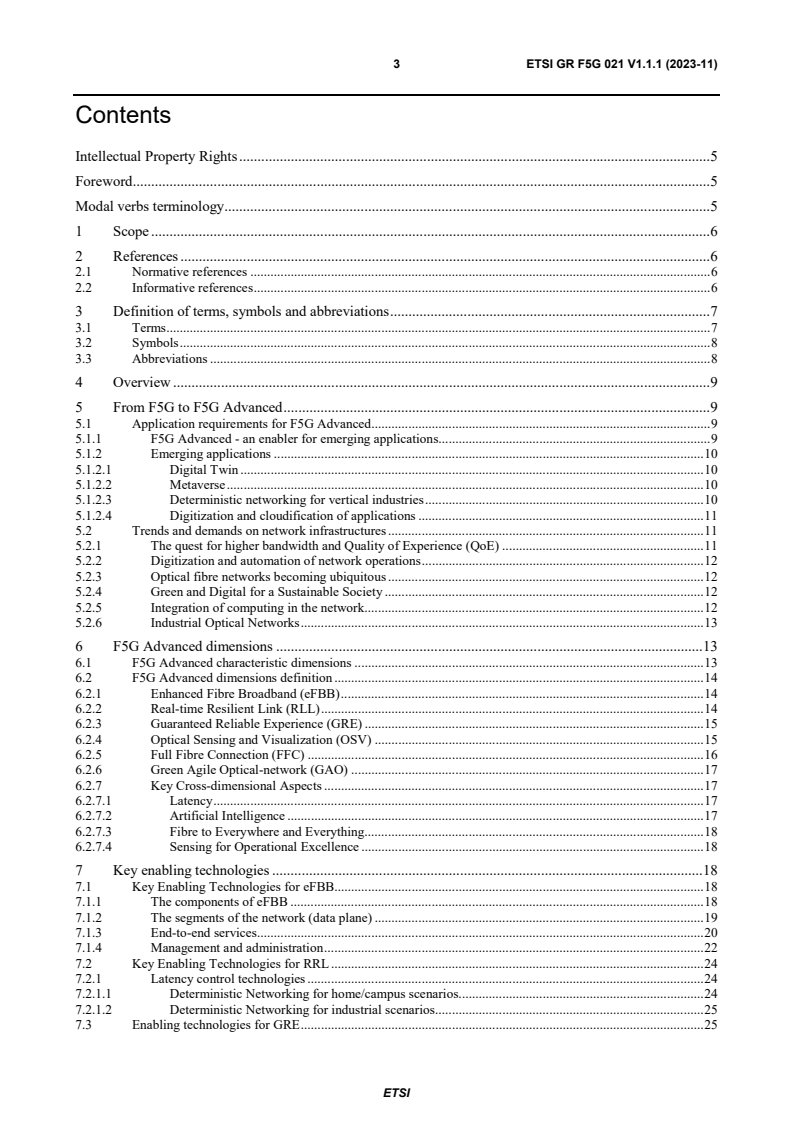
Contents
Intellectual Property Rights . 5
Foreword . 5
Modal verbs terminology . 5
1 Scope . 6
2 References . 6
2.1 Normative references . 6
2.2 Informative references . 6
3 Definition of terms, symbols and abbreviations . 7
3.1 Terms . 7
3.2 Symbols . 8
3.3 Abbreviations . 8
4 Overview . 9
5 From F5G to F5G Advanced . . 9
5.1 Application requirements for F5G Advanced. 9
5.1.1 F5G Advanced - an enabler for emerging applications. 9
5.1.2 Emerging applications . 10
5.1.2.1 Digital Twin . 10
5.1.2.2 Metaverse . 10
5.1.2.3 Deterministic networking for vertical industries . 10
5.1.2.4 Digitization and cloudification of applications . 11
5.2 Trends and demands on network infrastructures . 11
5.2.1 The quest for higher bandwidth and Quality of Experience (QoE) . 11
5.2.2 Digitization and automation of network operations . 12
5.2.3 Optical fibre networks becoming ubiquitous . 12
5.2.4 Green and Digital for a Sustainable Society . 12
5.2.5 Integration of computing in the network. 12
5.2.6 Industrial Optical Networks . 13
6 F5G Advanced dimensions . 13
6.1 F5G Advanced characteristic dimensions . 13
6.2 F5G Advanced dimensions definition . 14
6.2.1 Enhanced Fibre Broadband (eFBB) . 14
6.2.2 Real-time Resilient Link (RLL) . 14
6.2.3 Guaranteed Reliable Experience (GRE) . 15
6.2.4 Optical Sensing and Visualization (OSV) . 15
6.2.5 Full Fibre Connection (FFC) . 16
6.2.6 Green Agile Optical-network (GAO) . 17
6.2.7 Key Cross-dimensional Aspects . 17
6.2.7.1 Latency . 17
6.2.7.2 Artificial Intelligence . 17
6.2.7.3 Fibre to Everywhere and Everything. 18
6.2.7.4 Sensing for Operational Excellence . 18
7 Key enabling technologies . 18
7.1 Key Enabling Technologies for eFBB. 18
7.1.1 The components of eFBB . 18
7.1.2 The segments of the network (data plane) . 19
7.1.3 End-to-end services. 20
7.1.4 Management and administration . 22
7.2 Key Enabling Technologies for RRL . 24
7.2.1 Latency control technologies . 24
7.2.1.1 Deterministic Networking for home/campus scenarios. 24
7.2.1.2 Deterministic Networking for industrial scenarios . 25
7.3 Enabling technologies for GRE . 25
ETSI
4 ETSI GR F5G 021 V1.1.1 (2023-11)
7.3.1 Overview . 25
7.3.2 Improving the efficiency of network operation . 26
7.3.2.1 Autonomous Network . 26
7.3.2.2 Network digitalization . 26
7.3.2.3 Intent-driven management . 27
7.3.2.4 Intelligent fault management . 27
7.3.3 Improving the user experience of network services . 28
7.3.3.1 Overview . 28
7.3.3.2 Awareness of optical network information . 28
7.3.3.3 Elastic resource scaling . 28
7.3.3.4 Joint optimization of optical network and cloud computing resources . 29 ®
7.3.3.5 Guaranteed QoS of network transmission over on-premises Wi-Fi . 29
7.4 Enabling technologies for OSV . 29
7.4.1 Overview . 29
7.4.2 Distributed Fibre optical sensing . 30 ®
7.4.3 Wi-Fi Sensing . 31
7.4.4 Fibre optical cable network digitization and visualization. 31
7.5 Enabling technologies for FFC . 32
7.5.1 Overview . 32
7.5.2 Fibre To The Room (FTTR) . 32
7.5.3 Fibre To The Machine (FTTM) . 32
7.5.4 Fibre to the Office . 33
7.5.5 FTTThing . 34
7.6 Green Agile Optical-network (GAO) . 34
7.6.1 Overview . 34
7.6.2 Fine-grain OTN for replacing legacy SDH . 35
7.6.3 OXC for green, agile and flexible optical network . 36
7.6.4 Wavelength-Shared WDM aggregation network . 37
7.6.5 Agile Optical Service Provisioning Protocol . 38
8 Outlook . 38
8.1 Summary . 38
8.2 Actions and roadmap for F5G Advanced . 40
8.3 Outlook for F6G . 40
History . 42
ETSI
5 ETSI GR F5G 021 V1.1.1 (2023-11)
Intellectual Property Rights
Essential patents
IPRs essential or potentially essential to normative deliverables may have been declared to ETSI. The declarations
pertaining to these essential IPRs, if any, are publicly available for ETSI members and non-members, and can be
found in ETSI SR 000 314: "Intellectual Property Rights (IPRs); Essential, or potentially Essential, IPRs notified to
ETSI in respect of ETSI standards", which is available from the ETSI Secretariat. Latest updates are available on the
ETSI Web server (https://ipr.etsi.org/).
Pursuant to the ETSI Directives including the ETSI IPR Policy, no investigation regarding the essentiality of IPRs,
including IPR searches, has been carried out by ETSI. No guarantee can be given as to the existence of other IPRs not
referenced in ETSI SR 000 314 (or the updates on the ETSI Web server) which are, or may be, or may become,
essential to the present document.
Trademarks
The present document may include trademarks and/or tradenames which are asserted and/or registered by their owners.
ETSI claims no ownership of these except for any which are indicated as being the property of ETSI, and conveys no
right to use or reproduce any trademark and/or tradename. Mention of those trademarks in the present document does
not constitute an endorsement by ETSI of products, services or organizations associated with those trademarks.
DECT™, PLUGTESTS™, UMTS™ and the ETSI logo are trademarks of ETSI registered for the benefit of its
Members. 3GPP™ and LTE™ are trademarks of ETSI registered for the benefit of its Members and of the 3GPP
Organizational Partners. oneM2M™ logo is a trademark of ETSI registered for the benefit of its Members and of the ®
oneM2M Partners. GSM and the GSM logo are trademarks registered and owned by the GSM Association.
Foreword
This Group Report (GR) has been produced by ETSI Industry Specification Group (ISG) Fifth Generation Fixed
Network (F5G).
Modal verbs terminology
In the present document "should", "should not", "may", "need not", "will", "will not", "can" and "cannot" are to be
interpreted as described in clause 3.2 of the ETSI Drafting Rules (Verbal forms for the expression of provisions).
"must" and "must not" are NOT allowed in ETSI deliverables except when used in direct citation.
ETSI
6 ETSI GR F5G 021 V1.1.1 (2023-11)
1 Scope
The present document studies the driving forces and the characteristics of the fixed network evolution from F5G to F5G
Advanced. It includes all segments of E2E connectivity between on-premises networks and data centres, and extends
the F5G concepts and characteristics initially described in ETSI GR F5G 001 [i.12].
2 References
2.1 Normative references
Normative references are not applicable in the present document.
2.2 Informative references
References are either specific (identified by date of publication and/or edition number or version number) or
non-specific. For specific references, only the cited version applies. For non-specific references, the latest version of the
referenced document (including any amendments) applies.
NOTE: While any hyperlinks included in this clause were valid at the time of publication, ETSI cannot guarantee
their long-term validity.
The following referenced documents are not necessary for the application of the present document but they assist the
user with regard to a particular subject area.
[i.1] Cisco Annual Internet Report, 2018-2023.
[i.2] G.fgOTN project in ITU (in progress).
[i.3] Wikipedia: "Software as a Service".
[i.4] TM Forum: "Autonomous Networks: Empowering Digital Transformation for Smart Societies and
Industries".
[i.5] Recommendation ITU-T Series G Supplement 51 (05/2012).
[i.6] ETSI GR F5G 008 (V1.1.1): "Fifth Generation Fixed Network (F5G); F5G Use Cases Release #2".
[i.7] TM Forum IG1218 (V2.2.0): "Autonomous Networks - Business requirements & architecture".
[i.8] TM Forum IG1230 (V1.1.1): "Autonomous Networks Technical Architecture".
[i.9] ETSI GR ZSM 011 (V1.1.1): "Zero-touch network and Service Management (ZSM); Intent-driven
autonomous networks; Generic aspects".
[i.10] Introducing the Knowledge Graph: things, not strings.
[i.11] Wikipedia: "Large language model".
[i.12] ETSI GR F5G 001: "Fifth Generation Fixed Network (F5G); F5G Generation Definition
Release #1".
[i.13] ETSI GS F5G 006: "Fifth Generation Fixed Network (F5G); End-to-End Management and
Control; Release #1".
[i.14] ETSI GS F5G 011: "Fifth Generation Fixed Network (F5G); Telemetry Framework and
Requirements for Access Networks".
[i.15] ETSI GS F5G 005: "Fifth Generation Fixed Network (F5G) F5G High-Quality Service Experience
Factors Release #1".
[i.16] ETSI GR F5G 007 (V1.1.1): "Fifth Generation Fixed Network (F5G); F5G Industrial PON".
ETSI
7 ETSI GR F5G 021 V1.1.1 (2023-11)
[i.17] Europe's Digital Decade: digital targets for 2030.
[i.18] Recommendation ITU-T Y.2501: "Computing power network - Framework and architecture".
[i.19] ETSI TR 103 775: "Access, Terminals, Transmission and Multiplexing (ATTM); Optical
Distribution Network (ODN) Quick Construction and Digitalization".
[i.20] IEEE 802.11ax™: "IEEE Standard for Information Technology - Telecommunications and
Information Exchange between Systems Local and Metropolitan Area Networks - Specific
Requirementsv Part 11: Wireless LAN Medium Access Control (MAC) and Physical Layer (PHY)
Specifications Amendment 1: Enhancements for High-Efficiency WLAN".
[i.21] IEEE 802.11be™: "IEEE Draft Standard for Information technology - Telecommunications and
information exchange between systems Local and metropolitan area networks - Specific
requirements - Part 11: Wireless LAN Medium Access Control (MAC) and Physical Layer (PHY)
Specifications Amendment: Enhancements for Extremely High Throughput (EHT)".
[i.22] IEEE 802.11bf™: "IEEE Draft Standard for Information Technology -- Telecommunications and
Information Exchange Between Systems Local and Metropolitan Area Networks -- Specific
Requirements - Part 11: Wireless LAN Medium Access Control (MAC) and Physical Layer (PHY)
Specifications Amendment 2: Enhancements for Wireless LAN Sensing".
[i.23] Recommendation ITU-T G.9804 series: "Higher speed passive optical networks".
[i.24] Recommendation ITU-T G.984.series: " Gigabit-capable passive optical networks (GPON)".
[i.25] Recommendation ITU-T G.9701: " Fast access to subscriber terminals (G.fast) - Physical layer
specification".
[i.26] Recommendation ITU-T G.987 series: "10-Gigabit-capable passive optical network (XG-PON)
systems: Definitions, abbreviations and acronyms".
[i.27] Recommendation ITU-T G.9807 series: "10-Gigabit-capable symmetric passive optical network
(XGS-PON)".
[i.28] Fifth Generation Fixed Network (F5G); F5G Advanced Release Documentation (Release 3 and 4).
[i.29] Fifth Generation Fixed Network (F5G); F5G Release Documentation Release 1 and 2.
3 Definition of terms, symbols and abbreviations
3.1 Terms
For the purposes of the present document, the following terms apply:
Artificial intelligence as a Service (AIaaS): service that outsources AI-related computing to enable individuals and
companies to explore and scale AI techniques at a minimal cost
NOTE: The motivation for AIaaS is because developing in-house AI-based solutions is a complex process that
requires huge capital investment, outsourcing and getting it as service is beneficial
computing power networks: type of network that realizes optimized resource allocation, by distributing computing,
storage, network and other resource information of service nodes through a network control plane (such as a centralized
controller, distributed routing protocol, etc.)
NOTE: It combines network context and user requirements to provide optimal distribution, association,
transaction and scheduling of computing, storage and network resources (see
Recommendation ITU-T Y.2501 [i.18] for the definition).
digital twin: virtual representation of a physical object or system across its lifecycle, using real-time data to enable the
understanding, learning and reasoning
ETSI
8 ETSI GR F5G 021 V1.1.1 (2023-11)
Fibre to the thing (FTTThing): integrated technology scheme to provide connection to end devices in a
communication system, in which the fibre is directly connected to end device instead of a network terminal
metaverse: proposed network of immersive online worlds experienced typically through virtual reality or augmented
reality in which users would interact with each other and purchase goods and services, some of which would exist only
in the online world
3.2 Symbols
Void.
3.3 Abbreviations
For the purposes of the present document, the following abbreviations apply:
50G-PON 50 gigabit Passive Optical Network
AI Artificial Intelligence
AIaaS Artificial Intelligence as a Service
ANL Autonomous Network Level
API Application Programming Interface
AR Augmented Reality
CIaaS Compute Infrastructure as a Service
CO Central Office
DAS Distributed Acoustic Sensing
DSP Digital Signal Processing
DU Distributed Unit
E2E End to End
EC Edge Computing
EMI Electro-Magnetic Interference
F5G Fifth Generation Fixed Network
F5G-A F5G Advanced
FEC Forward Error Correction
fgOTN fine-grain OTN
FTTD Fibre To The Desk
FTTM Fibre To The Machine
FTTO Fibre To The Office
FTTThing Fibre To The Thing
FTTR Fibre To The Room
GPON Gigabit PON
HD High Definition
HMD Head-Mounted Display
IaaS Infrastructure as a Service
ICT Information & Communication Technology
IEEE Institute of Electrical and Electronic Engineers
IoT Internet of Things
IP Internet Protocol
IT Information Technology
LAN Local Area Network
LDPC Low Density Parity Check
NETCONF Network Configuration protocol
NFV Network Functions Virtualisation
NRZ Non Return to Zero
O&M Operation & Management
OAM Operation Administration and Maintenance
ODN Optical Distribution Network
ODU Optical channel Data Unit
OLT Optical Line Termination
ONU Optical Network Unit
OT Operational Technology
OXC Optical Cross-Connects
ETSI
9 ETSI GR F5G 021 V1.1.1 (2023-11)
PON Passive Optical Network
QoE Quality of Experience
QoS Quality of Service
SDH Synchronous Data Hierarchy
SNMP Simple Network Management Protocol
SaaS Software as a Service
SOHO Small Office and Home Office
SONET Synchronous Optical NETwork
TDM Time-Division-Multiplex
TDMA Time-Division-Multiple Access
UHD Ultra-High Definition
VNF Virtualized Network Function
VoIP Voice over IP
VPN Virtual Private Network
VR Virtual Reality
WDM-PON Wavelength Division Multiplexing Passive Optical Network ®
Wi-Fi Wireless Fidelity
XG 10 Gbps
XG-PON 10-Gigabit-capable Passive Optical Network
XGS 10 Gbps Symmetrical
XGS-PON 10-Gigabit-capable Symmetric Passive Optical Network
XR Extended Reality
YANG Yet Another Next Generation.
4 Overview
The ETSI Industry Specification Group (ISG) F5G has established a continuous evolutional approach to the fixed
network defining generations that may direct the industry toward a consistent E2E network vision.
ETSI GR F5G 001 [i.12] defines the Fifth Generation Fixed Network generation, to enable a wider technological
standards adoption and boost the creation of a global market. There are many drivers that motivate the advancement of
F5G networks towards their next evolutionary step, such as the digitization or cloudification of various services or
application domains, new emerging technologies and improvements to the network infrastructure, the growing density
and applicability of the network for various purposes and environments. The evolution of F5G needs to be considered
and the next steps to F5G Advanced are defined.
The present document explores the evolution path from F5G to F5G Advanced and details the six dimensions of F5G
Advanced. Three of the dimensions were already specified for F5G [i.12], and F5G Advanced introduces enhancements
for those. In addition, F5G Advanced introduces three new dimensions that will allow to meet the requirements of
emerging services. The key enabling technologies for these six dimensions are addressed. Looking forward, the outlook
of F5G Advanced and beyond is described in clause 8 of the present document.
5 From F5G to F5G Advanced
5.1 Application requirements for F5G Advanced
5.1.1 F5G Advanced - an enabler for emerging applications
In the ETSI GR F5G 001 [i.12], some major emerging application requirements are discussed. These requirements are
mainly from residential, business and vertical industries. Several typical applications are analysed as Cloud VR, 8K HD
videos, SOHO, as well as smart cities and smart manufacturing. These applications impose requirements such as ®
network bandwidth, E2E quality assurance, security and network coverage based on FTTR and Wi-Fi .
F5G Advanced supports the next generation of emerging digital services such as digital twins and metaverses, to name
two, and continues to accelerate the popularization of fibre services and meet people's needs for personalized and
higher-quality services. These emerging digital services impose more stringent requirements on the communication
network technologies.
ETSI
10 ETSI GR F5G 021 V1.1.1 (2023-11)
At the same time, the scientific, technological and industrial evolution are accelerating worldwide. Digital development
has become an important growth engine for the world economy. Industrial digitalization has promoted the
transformation of production methods achieving more intelligent infrastructure and higher quality.
The current F5G network technology, compared to the previous generations such as F4G, improved not only the
network performance, but also the energy efficiency by expanding fibre to everywhere and replacing power hungry
traditional copper networks. With the common global goal of reducing carbon emissions and achieving carbon
neutrality, it is necessary to promote further advances in F5G network technology to meet the future green transition
and low-carbon trends, e.g. achieving lower power per bit. At the same time, the low-carbon transformation of various
high-energy- industries can be supported by further enhancing F5G network technology to provide a more intelligent
network infrastructure to meet these needs.
5.1.2 Emerging applications
5.1.2.1 Digital Twin
The digital twin is an integration approach and an innovative application of multiple digital technologies, based on
advanced modelling tools to define accurate digital models of the physical objects, based on the collection of real-time
data for improved operation. The digital twin achieves the integration of physical objects and digital models, and
thereby builds a comprehensive decision-making capability, and supports the optimization of the operation of physical
objects.
The digital twin can be used to improve management decisions and outcomes via the visualization and support of
individual objects, like a car or a robot and up to the complexity of smart robotic fleets, complex manufacturing
operations and smart cities.
For the digital twins to achieve accurate real-time information capture and real-time interaction with the physical world,
improvements to the existing architecture and capabilities of networks need to be accomplished. F5G Advanced aims at
providing the needed key performances such as the connection of a large number of devices, high data throughput, and
deterministic transmission capabilities.
5.1.2.2 Metaverse
The Metaverse is a persistent and immersive digital environment of independent but interconnected networks. It enables
persistent, decentralized, collaborative, interoperable digital content that intersects with the physical world's objects.
The Metaverse needs the combined use of multiple technologies like Augmented Reality (AR), eXtended Reality (XR)
or Mixed Reality (MR), Internet of Things (IoT), Artificial Intelligence (AI) and cloud computing technologies. These
technologies combined, form a complete metaverse solution.
The Metaverse needs that the network supports the wide-scale interconnection of a large number of users, supporting
flexible and elastic networking, and imposes more extreme requirements for network performance. In terms of network
service interaction and collaboration, the network needs to change from capability-oriented to service-oriented,
enhancing the integration of network service applications, establishing a collaboration model, and better supporting the
needs of highly interactive services.
It is necessary to implement fine grain QoS assurance for multi-stream services, and coordinate transmission of various
data streams such as video, audio, network control signalling, and performance monitoring. This ensures the respective
QoS of all streams to achieve an excellent overall service experience.
Due to the high metaverse service requirements for network bandwidth and deterministic performance, serving
concurrent user poses greater challenges to the dynamic real-time optimization and adjustment of network resources.
5.1.2.3 Deterministic networking for vertical industries
The Internet technologies reached global coverage and are more and more used in industrial production. It is becoming
more difficult for the traditional best effort network architecture and capabilities to support future vertical industry
service requirements for differentiated networking, low latency and low jitter transmission capabilities.
ETSI
11 ETSI GR F5G 021 V1.1.1 (2023-11)
Deterministic network technologies, which optimize network latency, packet jitter, packet loss and other key parameters
that define the service quality metrics, can provide reliable and guaranteed transmission capabilities. The needs of smart
factories, smart grids, remote industrial control, traffic safety control, telemedicine, unmanned driving and other
applications can therefore be met, greatly improving real-world productivity and creativity.
Deterministic network technology can be combined with network virtualization and network slicing technology to
partition application scenarios, separate deterministic capabilities for different business needs, and realize differentiated
deterministic performances for different customers.
Deterministic network technology can also be employed to optimize the QoS of the computing power networks [i.18],
improving the support of the stringent network performance requirements. Thereby ensure the coordination of
end-to-end computing and networking, and assign tasks to the appropriate computing nodes in real-time. In addition, it
can meet the requirements of massive data processing, transmission, and storage access, providing customers with an
improved service experience of computing and networking convergence.
5.1.2.4 Digitization and cloudification of applications
The move to cloud environments is spreading in all market segments, adding network requirements on bandwidth,
availability, low latency and jitter. In addition, an efficient balance between computing, storage and networking in an
edge cloud architecture enables the optimisation of total energy consumption.
These factors largely influence the success of enterprise and campus digitization and cloudification. For network
operators, this creates the opportunity to develop premium computing power networks-based services in an "as a
Service" model, adding more intelligence for services creation and the improvement of customer interaction. Through
appropriate frontend portals, users are able to select and customize the needed services. F5G Advanced networks enable
this evolution, expanding the scope of Fibre To The Office (FTTO) solutions.
Another emerging area, either for business and or residential users, are the Ultra-High Definition (UHD) immersive
experience applications that frequently need cloud resources, and large bandwidth and low latency.
5.2 Trends and demands on network infrastructures
5.2.1 The quest for higher bandwidth and Quality of Experience (QoE)
Services and bandwidth evolution make up a virtuous cycle, where new services demand more bandwidth and more
bandwidth favours the creation of new services.
The digitization and cloudification is a trend in all segments including residential users, public services, health or
industry. The evolution to UHD video, extended reality or remote work generate an increase in the number of users and
endpoints and drive the quest for higher and improved broadband capacity and functionality.
F5G Advanced is the next step in the fixed network evolution, providing an ecosystem that integrates higher bandwidth
technologies with the appropriate architecture and E2E management, enabling the required flexibility and agility to
address a wide range of services and deployment environments.
This evolution can take different paces depending on specific services, applications and market segments. However, as
stated in the EU digital targets for 2030 [i.17], a next step is to ensure Gbit network access for everyone in 2030.
The vision of "fibre to everything and everywhere" set forward by ETSI ISG F5G is becoming a trend, extending fibre
deeper into several environment as FTTR, FTTD or FTTM.
Along with the growth of the number of end-points and diversity of applications, there is a growing demand for quality
of the network infrastructure, where the focus on speed is complemented by specific requirements on latency, jitter and
functionalities such as E2E slicing, providing premium Quality of Experience (QoE). The resources need to be available
and guaranteed for all services using the infrastructure. The rich service functionality needs the infrastructure to be able
to meet a variety of requirements along multiple dimensions of those represented in Figure 1.
An initial QoE framework was specified in ETSI GR F5G 005 [i.15] and is embedded in the evolution to F5G
Advanced.
ETSI
12 ETSI GR F5G 021 V1.1.1 (2023-11)
5.2.2 Digitization and automation of network operations
Optical networks are expanding fast in number of users, number of connected devices and diversity of service
requirements, covering different segments that may share the network resources. To address this growing dimension
and complexity, the digitization and automation of network operations is a key requirement. A holistic perspective on
the network management is needed. For the F5G generation these aspects are addressed in ETSI GS F5G 006 [i.13] and
ETSI GS F5G 011 [i.14]; an evolution will be required in F5G Advanced.
Furthermore, the adoption of autonomous network approaches adds intelligence and simplicity to Operation
Administration and Maintenance (OAM) increasing the ease of operation and reducing operational costs. This trend has
already started in ISG F5G and is expanded in further evolutions. Core technologies, such as service intent,
multi-dimensional experience awareness, and adaptive network adjustment, can be used to upgrade the network
management system to a higher Autonomous Network Level (ANL), as defined by the TMF. It includes achieving close
to zero wait for services, zero touch for network maintenance, and zero trouble in services.
5.2.3 Optical fibre networks becoming ubiquitous
Optical networks, either in access, aggregation or core, are a key infrastructure for broadband development, addressing
a growing number of applications and requirements from a wide range of segments such as residential, enterprise,
campus or industry. They are also fundamental to support many other networks such as offloading of mobile and ®
wireless networks (e.g. Wi-Fi ) or Data Centres interconnection.
This key role of optical networks, becoming ubiquitous, also leads to the massive and fast deployment of optical fibre
cable infrastructures, that being passive, face several management challenges such as the accumulation of a large
number of passive resources, assets location mapping, reliable real-time occupancy status and performance monitoring.
To address these challenges, new technologies and architectures need to be introduced, aiming to facilitate the
visualization of passive fibre resources, topologies, and connection status of the Optical Distribution Network (ODN).
ETSI TR 103 775 [i.19] addresses some of these questions. F5G Advanced improves the overall O&M efficiency of the
optical fibre infrastructure and the automation capability of upper-layer service networks.
Furthermore, optical fibre cables have "sensing" capabilities that are be exploited for the improvement of the optical
fibre infrastructure management. The optical fibre sensing technology, represented by Distributed Acoustic Sensing
(DAS), can capture and collect environmental information such as vibration, stress, and temperature changes. It has
been applied in oil and gas pipeline intrusion monitoring and coal mine conveyor belt monitoring, opening a new
dimension to optical networks.
5.2.4 Green and Digital for a Sustainable Society
The digital transformation is crossing all areas of the society, requiring capable and flexible networks that can adapt to
the needs of the various stakeholders. This transformation contributes to meet the challenges of a greener society and
reduction of CO emissions.
Optical networks are a key infrastructure to achieve the green and digital objectives.
Productivity gains, adoption of virtual meetings or remote work are just some examples of the energy savings brought
by the digital transformation supported by efficient networks. But the energy consumption of the network itself needs
also to be managed and reduced whenever possible, and optical networks have a key role also in this.
In access, the passive structure of PON networks makes it very energy efficient when compared with other options. In
aggregation and core networks, the development of optical switching and AI assisted enhanced routing intelligence,
ensuring the traffic paths with the highest energy efficiency.
Improvements in the optical fibre infrastructure management contributes to the reduction of carbon emissions. The field
operations require to perform maintenance and fix network faults, demanding for travel and human resources; they are
the major sources of cost and carbon emission in network operation. That leading to self-operating networks and,
ultimately, to self-healing networks is therefore an important trend.
5.2.5 Integration of computing in the network
The digital transformation implies the implementation of computing power networks, where Artificial Intelligence (AI)
is an enabler for flexibility, adaptability, and efficiency in infrastructure operations.
ETSI
13 ETSI GR F5G 021 V1.1.1 (2023-11)
The integration of computing, storage, and communication requires orchestration of the various resources and
...
Questions, Comments and Discussion
Ask us and Technical Secretary will try to provide an answer. You can facilitate discussion about the standard in here.
Loading comments...