


ETSI TS 102 796 V1.7.1 (2023-09)
Hybrid Broadcast Broadband TV
Hybrid Broadcast Broadband TV
RTS/JTC-116
General Information
Standards Content (Sample)
TECHNICAL SPECIFICATION
Hybrid Broadcast Broadband TV
2 ETSI TS 102 796 V1.7.1 (2023-09)
Reference
RTS/JTC-116
Keywords
broadcasting, DVB, HTML, internet, multimedia
ETSI
650 Route des Lucioles
F-06921 Sophia Antipolis Cedex - FRANCE
Tel.: +33 4 92 94 42 00 Fax: +33 4 93 65 47 16
Siret N° 348 623 562 00017 - APE 7112B
Association à but non lucratif enregistrée à la
Sous-Préfecture de Grasse (06) N° w061004871
Important notice
The present document can be downloaded from:
https://www.etsi.org/standards-search
The present document may be made available in electronic versions and/or in print. The content of any electronic and/or
print versions of the present document shall not be modified without the prior written authorization of ETSI. In case of any
existing or perceived difference in contents between such versions and/or in print, the prevailing version of an ETSI
deliverable is the one made publicly available in PDF format at www.etsi.org/deliver.
Users of the present document should be aware that the document may be subject to revision or change of status.
Information on the current status of this and other ETSI documents is available at
https://portal.etsi.org/TB/ETSIDeliverableStatus.aspx
If you find errors in the present document, please send your comment to one of the following services:
https://portal.etsi.org/People/CommiteeSupportStaff.aspx
If you find a security vulnerability in the present document, please report it through our
Coordinated Vulnerability Disclosure Program:
https://www.etsi.org/standards/coordinated-vulnerability-disclosure
Notice of disclaimer & limitation of liability
The information provided in the present deliverable is directed solely to professionals who have the appropriate degree of
experience to understand and interpret its content in accordance with generally accepted engineering or
other professional standard and applicable regulations.
No recommendation as to products and services or vendors is made or should be implied.
No representation or warranty is made that this deliverable is technically accurate or sufficient or conforms to any law
and/or governmental rule and/or regulation and further, no representation or warranty is made of merchantability or fitness
for any particular purpose or against infringement of intellectual property rights.
In no event shall ETSI be held liable for loss of profits or any other incidental or consequential damages.
Any software contained in this deliverable is provided "AS IS" with no warranties, express or implied, including but not
limited to, the warranties of merchantability, fitness for a particular purpose and non-infringement of intellectual property
rights and ETSI shall not be held liable in any event for any damages whatsoever (including, without limitation, damages
for loss of profits, business interruption, loss of information, or any other pecuniary loss) arising out of or related to the use
of or inability to use the software.
Copyright Notification
No part may be reproduced or utilized in any form or by any means, electronic or mechanical, including photocopying and
microfilm except as authorized by written permission of ETSI.
The content of the PDF version shall not be modified without the written authorization of ETSI.
The copyright and the foregoing restriction extend to reproduction in all media.
© ETSI 2023.
© European Broadcasting Union 2023.
All rights reserved.
ETSI
3 ETSI TS 102 796 V1.7.1 (2023-09)
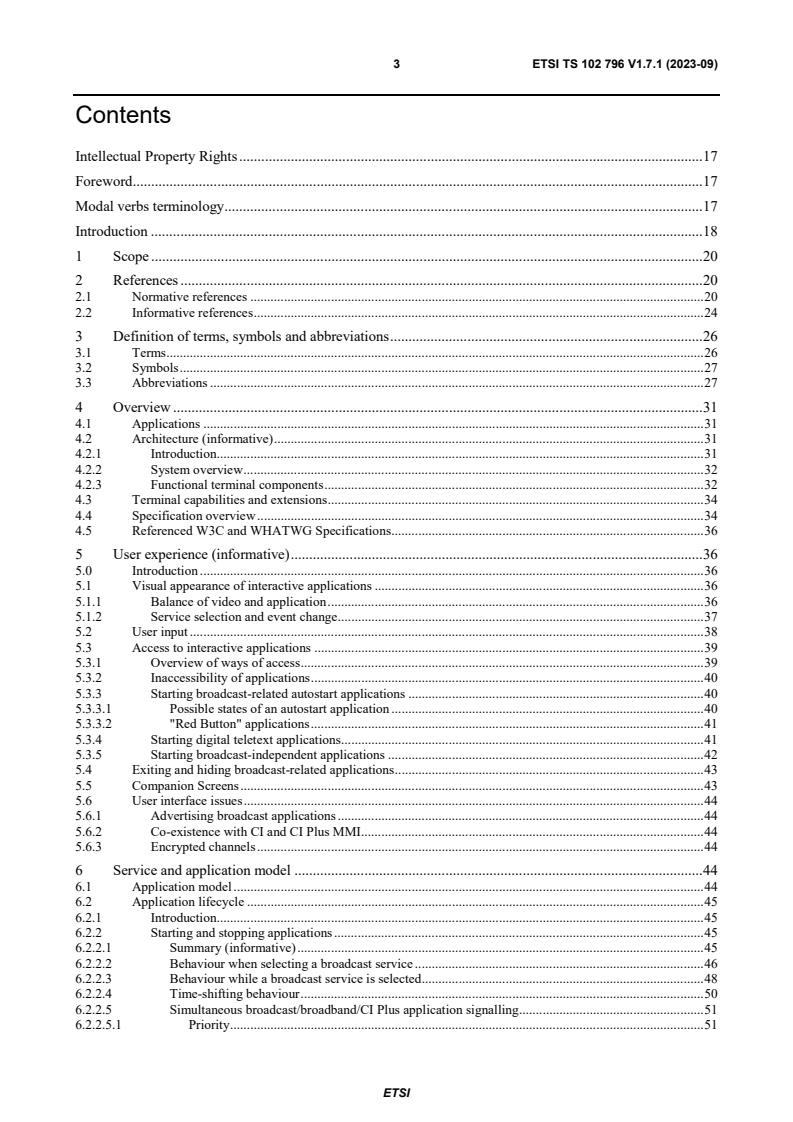
Contents
Intellectual Property Rights . 17
Foreword . 17
Modal verbs terminology . 17
Introduction . 18
1 Scope . 20
2 References . 20
2.1 Normative references . 20
2.2 Informative references . 24
3 Definition of terms, symbols and abbreviations . 26
3.1 Terms . 26
3.2 Symbols . 27
3.3 Abbreviations . 27
4 Overview . 31
4.1 Applications . 31
4.2 Architecture (informative) . 31
4.2.1 Introduction. 31
4.2.2 System overview . 32
4.2.3 Functional terminal components . 32
4.3 Terminal capabilities and extensions . 34
4.4 Specification overview . 34
4.5 Referenced W3C and WHATWG Specifications . 36
5 User experience (informative) . 36
5.0 Introduction . 36
5.1 Visual appearance of interactive applications . 36
5.1.1 Balance of video and application . 36
5.1.2 Service selection and event change . 37
5.2 User input . 38
5.3 Access to interactive applications . 39
5.3.1 Overview of ways of access . 39
5.3.2 Inaccessibility of applications . 40
5.3.3 Starting broadcast-related autostart applications . 40
5.3.3.1 Possible states of an autostart application . 40
5.3.3.2 "Red Button" applications . 41
5.3.4 Starting digital teletext applications . 41
5.3.5 Starting broadcast-independent applications . 42
5.4 Exiting and hiding broadcast-related applications . 43
5.5 Companion Screens . 43
5.6 User interface issues . 44
5.6.1 Advertising broadcast applications . 44
5.6.2 Co-existence with CI and CI Plus MMI. 44
5.6.3 Encrypted channels . 44
6 Service and application model . 44
6.1 Application model . 44
6.2 Application lifecycle . 45
6.2.1 Introduction. 45
6.2.2 Starting and stopping applications . 45
6.2.2.1 Summary (informative) . 45
6.2.2.2 Behaviour when selecting a broadcast service . 46
6.2.2.3 Behaviour while a broadcast service is selected . 48
6.2.2.4 Time-shifting behaviour . 50
6.2.2.5 Simultaneous broadcast/broadband/CI Plus application signalling . 51
6.2.2.5.1 Priority . 51
ETSI
4 ETSI TS 102 796 V1.7.1 (2023-09)
6.2.2.5.2 Not currently operational broadband connection . 51
6.2.2.5.3 Currently operational broadband connection and error accessing initial page . 51
6.2.2.5.4 Not currently operational CI Plus protocol . 51
6.2.2.5.5 Currently operational CI Plus connection and error accessing file system . 51
6.2.2.5.6 Application launch failure . 51
6.2.2.6 Broadcast-independent applications . 52
6.2.2.6.1 Lifecycle issues . 52
6.2.2.6.2 Launch context signalling (informative) . 53
6.2.2.7 Access to broadcast resources while presenting broadband-delivered A/V . 54
6.2.2.8 Behaviour on encrypted broadcast services . 54 ®
6.2.2.9 Applications launched from non-HbbTV application environments . 55
6.2.2.10 Parental ratings . 55
6.2.2.11 Other general behaviour . 55
6.2.3 Application lifecycle example (informative) . 57
6.2.4 Application visibility . 58
6.3 Application boundary . 59
6.3.1 Introduction. 59
6.3.2 Origin . 59
6.3.3 Application boundary definition . 60
7 Formats and protocols . 61
7.1 General formats and protocols . 61
7.1.1 Graphic formats . 61
7.1.2 Audio description . 61
7.2 Broadcast-specific format and protocols . 61
7.2.1 System, video, audio and subtitle formats . 61
7.2.2 Protocol for application transport . 62
7.2.3 Signalling of applications . 63
7.2.3.1 Broadcast signalling . 63
7.2.3.2 Broadcast-independent application signalling . 66
7.2.4 Synchronization . 69
7.2.5 DSM-CC carousel . 69
7.2.5.1 Mounting related constraints . 69
7.2.5.2 Initial carousel mounting . 69
7.2.5.3 Subsequent carousel mountings (during the lifecycle of an application) . 69
7.2.5.4 Constraints . 70
7.2.5.5 Performance (informative) . 70
7.2.6 Data services . 71
7.2.7 File system acceleration . 71
7.2.7.1 Introduction . 71 ®
7.2.7.2 HbbTV stored groups descriptor . 71
7.2.7.3 Group location descriptor . 72
7.2.7.4 Group Manifest file name . 72
7.2.7.5 File groups referenced by multiple carousels . 73
7.2.7.6 The use_version flag . 73
7.2.8 Protocol for download . 73
7.3 Broadband-specific format and protocols . 73
7.3.1 System, video and audio formats . 73
7.3.1.1 General requirements . 73
7.3.1.2 Systems layers . 75
7.3.1.3 Video . 76
7.3.1.4 Audio . 77
7.3.1.5 Subtitles . 78
7.3.1.5.1 TTML based subtitles . 78
7.3.1.5.2 Broadcast subtitles . 79
7.3.2 Protocols . 80
7.3.2.1 Protocols for streaming . 80
7.3.2.2 Protocols for download . 80
7.3.2.3 Void. 80
7.3.2.4 HTTP User-Agent header . 80
7.3.2.5 HTTP Redirects . 81
7.3.2.6 HTTP Caching . 81
ETSI
5 ETSI TS 102 796 V1.7.1 (2023-09)
7.3.2.7 Simultaneous HTTP connections . 82
7.3.2.8 HTTP/2 . 82
8 Browser application environment . 82
8.1 DAE specification usage . 82
8.2 Defined JavaScript APIs . 82
8.2.1 Acquisition of DSM-CC stream events . 82
8.2.1.1 Adding and removing stream event listeners . 82
8.2.1.2 DSM-CC StreamEvent event . 84
8.2.2 Carousel objects access with XMLHttpRequest . 84
8.2.3 APIs for media synchronization. 85
8.2.3.1 Introduction (informative) . 85
8.2.3.2 The MediaSynchroniser embedded object . 86
8.2.3.2.0 General . 86
8.2.3.2.1 Properties . 86
8.2.3.2.2 Methods . 89
8.2.3.2.3 DOM2 events . 93
8.2.3.2.4 Error codes . 93
8.2.3.3 The CorrelationTimestamp class . 94
8.2.3.3.1 General . 94
8.2.3.3.2 Properties . 94
8.2.4 APIs for automatic deletion of downloaded content . 95
8.2.5 APIs for obtaining the LCN of a service. 95
8.2.6 Companion Screen discovery APIs . 96
8.2.6.1 HbbTVCSManager embedded object . 96
8.2.6.2 DiscoveredTerminal class . 97
8.2.6.3 Void. 97
9 System integration . 98
9.1 Mapping from APIs to protocols . 98
9.1.1 Unicast streaming . 98
9.1.1.1 General streaming requirements. 98
9.1.1.2 HTTP streaming . 98
9.1.1.3 Media player implementations and API behaviour . 98
9.1.2 Unicast content download . 98
9.1.3 Seek accuracy . 98
9.2 URLs . 100
9.3 Other file formats . 102
9.3.1 Stream event . 102
9.3.2 MPEG DASH event integration. 102
9.3.2.1 General . 102
9.3.2.2 HTML5 media element . 103
9.4 Presentation of adaptive bitrate content . 105
9.4.1 General . 105
9.4.2 Behaviour for HTML5 media objects . 105
9.4.3 Behaviour for the A/V Control object . 107
9.5 Downloading content via FDP . 108
9.5.1 Download registration. 108
9.5.2 Single file with multiple URLs . 108
9.5.3 Properties of the Download object . 108
9.5.4 Download state diagram . 109
9.6 Media element integration . 111
9.6.1 General . 111
9.6.2 Resource management . 111
9.6.3 Transition behaviour . 113
9.6.4 Reporting and control of buffering . 113
9.6.5 Distinguishing multiple media tracks (informative) . 114
9.6.6 Controls attribute . 114
9.6.7 DRM . 114
9.6.8 Parental Rating Errors . 115
9.6.9 Downloaded Content . 115
9.6.10 Video presentation . 115
ETSI
6 ETSI TS 102 796 V1.7.1 (2023-09)
9.6.11 getStartDate method . 116
9.6.12 End of stream indication . 116
9.6.13 Media Source Extensions . 116
9.7 Synchronization . 118
9.7.1 Synchronization and video objects . 118
9.7.1.1 video/broadcast object . 118
9.7.1.2 HTML5 media element . 119
9.7.1.3 Void. 120
9.7.2 Tolerance . 121
9.7.3 Timeline availability . 121
9.7.4 Minimum synchronization accuracy . 122
9.8 Reliability and resilience . 123
9.9 WebSocket Server and JSON-RPC Implementation . 124
9.9.1 Introduction. 124
9.9.2 The Web Socket Server . 124
9.9.2.1 Discovery of the WebSocket Server . 124
9.9.2.2 Securing the WebSocket Server . 124
9.9.2.2.1 Mixed Content Issues . 124
9.9.2.2.2 Additional Security Considerations . 125
9.9.2.3 CORS Considerations . 125
9.9.3 JSON-RPC Messaging . 125
9.9.3.1 The JSON-RPC Message Format . 125
9.9.3.2 Message batching . 125
9.9.4 JSON-RPC Notifications from the terminal . 125
9.9.4.1 The JSON-RPC Notifications . 125
9.9.4.2 Registration for JSON-RPC Notifications (informative) . 126
9.9.4.3 Subscribe API . 126
9.9.4.4 Unsubscribe API . 127
9.9.5 Request capability negotiation . 127
9.9.6 Extensibility and compatibility . 129
9.9.7 JSON-RPC Response Error Codes . 129
9.9.8 JSON-RPC Response formats for non-Error Messages (informative) . 130
9.10 Switching between broadcast and broadband-delivered content . 130
10 Capabilities . 131
10.1 Display model . 131
10.2 Terminal capabilities and functions . 132
10.2.1 Minimum terminal capabilities . 132
10.2.2 User input . 137
10.2.2.1 Key events . 137
10.2.2.2 Mouse and wheel events . 139
10.2.3 Terminal functions . 139
10.2.3.1 Favourites and bookmarks . 139
10.2.3.2 Streaming and Download . 139
10.2.3.3 PVR . 140
10.2.3.4 Download via broadcast using FDP . 140 ®
10.2.4 HbbTV reported capabilities and option strings . 140
10.2.4.1 General structure . 140
10.2.4.2 Forward compatibility - Terminals . 140
10.2.4.3 Forward compatibility - Applications . 141
10.2.4.4 Third Party Extensions . 141
10.2.4.5 Namespaces . 142
10.2.4.6 Document Type Definition . 142
10.2.4.7 XML Contents . 142
10.2.4.8 Option strings . 148
10.2.5 Void . 149
10.2.6 Parental access control . 149
10.2.6.1 Broadcast channel . 149
10.2.6.2 Broadband delivered content . 150
10.2.6.3 Downloaded content. 150
10.2.6.4 PVR . 151
10.2.6.5 Synchronization and parental access control . 151
ETSI
7 ETSI TS 102 796 V1.7.1 (2023-09)
10.2.7 Component selection. 151
10.2.7.1 General . 151
10.2.7.2 Component selection by the terminal . 153
10.2.7.3 Component selection by the application . 154
10.2.7.4 Single decoder model . 155
10.2.7.5 Multi-decoder model . 155
10.2.7.6 Component selection with MSE (informative). 156
10.2.8 Multi-stream media synchronization . 156
10.2.8.1 General . 156
10.2.8.2 Void. 157
10.2.8.3 Other synchronization cases . 157
10.2.8.4 Supported combinations . 158
10.2.9 Inter-device media synchronization . 159
10.2.9.1 General . 159
10.2.9.2 Master terminal . 159
10.2.9.3 Void. 159
10.2.10 Application to media synchronization . 159
10.2.11 Combining audio from memory and broadcast/broadband audio/video . 159
10.2.12 Audio level adjustment for audio mixing . 160
11 Security. 161
11.1 Application and service security . 161
11.2 TLS and Root Certificates . 162
11.2.1 TLS support . 162
11.2.2 Cipher suites . 163
11.2.3 Root certificates . 164
11.2.4 Signature algorithms . 164
11.2.5 Key sizes and elliptic curves .
...
Questions, Comments and Discussion
Ask us and Technical Secretary will try to provide an answer. You can facilitate discussion about the standard in here.
Loading comments...