


ETSI GS NFV-SOL 014 V5.2.1 (2024-12)
Network Functions Virtualisation (NFV) Release 5; Protocols and Data Models; YAML data model specification for descriptor-based virtualised resource management
Network Functions Virtualisation (NFV) Release 5; Protocols and Data Models; YAML data model specification for descriptor-based virtualised resource management
RGS/NFV-SOL014ed521
General Information
Standards Content (Sample)
GROUP SPECIFICATION
Network Functions Virtualisation (NFV) Release 5;
Protocols and Data Models;
YAML data model specification for descriptor-based
virtualised resource management
Disclaimer
The present document has been produced and approved by the Network Functions Virtualisation (NFV) ETSI Industry
Specification Group (ISG) and represents the views of those members who participated in this ISG.
It does not necessarily represent the views of the entire ETSI membership.
2 ETSI GS NFV-SOL 014 V5.2.1 (2024-12)
Reference
RGS/NFV-SOL014ed521
Keywords
management, model, NFV
ETSI
650 Route des Lucioles
F-06921 Sophia Antipolis Cedex - FRANCE
Tel.: +33 4 92 94 42 00 Fax: +33 4 93 65 47 16
Siret N° 348 623 562 00017 - APE 7112B
Association à but non lucratif enregistrée à la
Sous-Préfecture de Grasse (06) N° w061004871
Important notice
The present document can be downloaded from the
ETSI Search & Browse Standards application.
The present document may be made available in electronic versions and/or in print. The content of any electronic and/or
print versions of the present document shall not be modified without the prior written authorization of ETSI. In case of any
existing or perceived difference in contents between such versions and/or in print, the prevailing version of an ETSI
deliverable is the one made publicly available in PDF format on ETSI deliver repository.
Users should be aware that the present document may be revised or have its status changed,
this information is available in the Milestones listing.
If you find errors in the present document, please send your comments to
the relevant service listed under Committee Support Staff.
If you find a security vulnerability in the present document, please report it through our
Coordinated Vulnerability Disclosure (CVD) program.
Notice of disclaimer & limitation of liability
The information provided in the present deliverable is directed solely to professionals who have the appropriate degree of
experience to understand and interpret its content in accordance with generally accepted engineering or
other professional standard and applicable regulations.
No recommendation as to products and services or vendors is made or should be implied.
No representation or warranty is made that this deliverable is technically accurate or sufficient or conforms to any law
and/or governmental rule and/or regulation and further, no representation or warranty is made of merchantability or fitness
for any particular purpose or against infringement of intellectual property rights.
In no event shall ETSI be held liable for loss of profits or any other incidental or consequential damages.
Any software contained in this deliverable is provided "AS IS" with no warranties, express or implied, including but not
limited to, the warranties of merchantability, fitness for a particular purpose and non-infringement of intellectual property
rights and ETSI shall not be held liable in any event for any damages whatsoever (including, without limitation, damages
for loss of profits, business interruption, loss of information, or any other pecuniary loss) arising out of or related to the use
of or inability to use the software.
Copyright Notification
No part may be reproduced or utilized in any form or by any means, electronic or mechanical, including photocopying and
microfilm except as authorized by written permission of ETSI.
The content of the PDF version shall not be modified without the written authorization of ETSI.
The copyright and the foregoing restriction extend to reproduction in all media.
© ETSI 2024.
All rights reserved.
ETSI
3 ETSI GS NFV-SOL 014 V5.2.1 (2024-12)
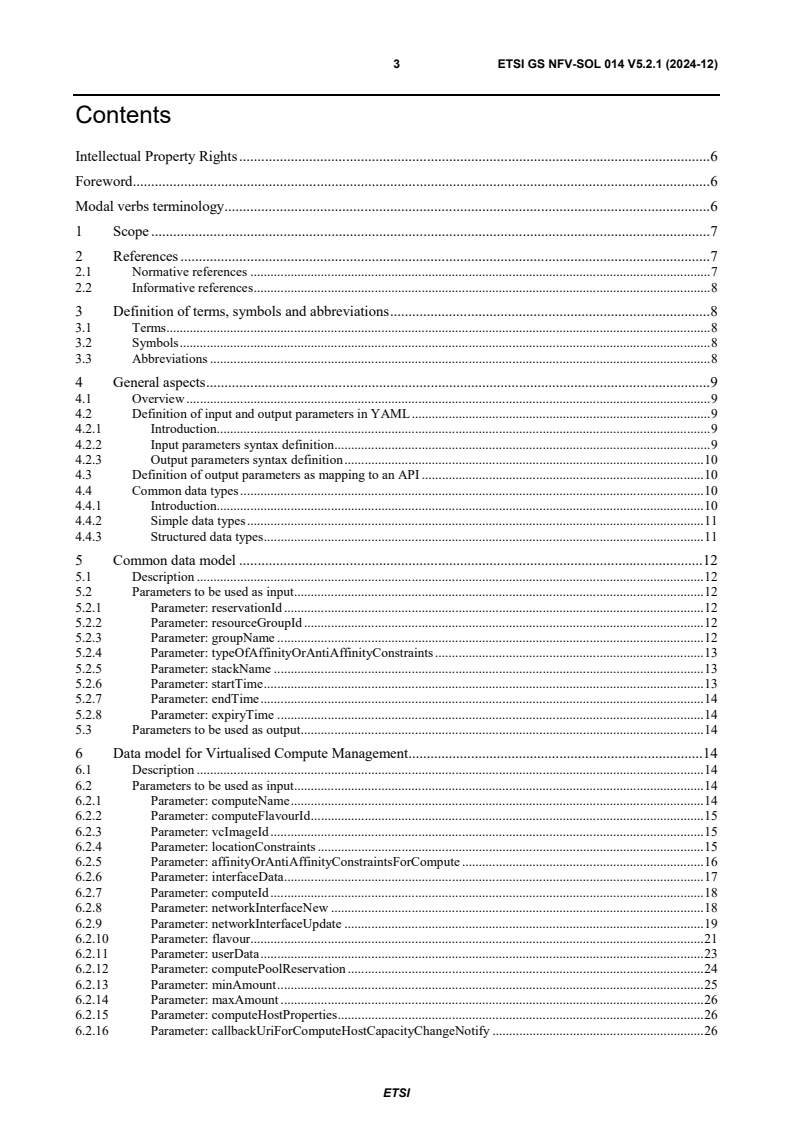
Contents
Intellectual Property Rights . 6
Foreword . 6
Modal verbs terminology . 6
1 Scope . 7
2 References . 7
2.1 Normative references . 7
2.2 Informative references . 8
3 Definition of terms, symbols and abbreviations . 8
3.1 Terms . 8
3.2 Symbols . 8
3.3 Abbreviations . 8
4 General aspects . 9
4.1 Overview . 9
4.2 Definition of input and output parameters in YAML . 9
4.2.1 Introduction. 9
4.2.2 Input parameters syntax definition . 9
4.2.3 Output parameters syntax definition . 10
4.3 Definition of output parameters as mapping to an API . 10
4.4 Common data types . 10
4.4.1 Introduction. 10
4.4.2 Simple data types . 11
4.4.3 Structured data types . 11
5 Common data model . 12
5.1 Description . 12
5.2 Parameters to be used as input . 12
5.2.1 Parameter: reservationId . 12
5.2.2 Parameter: resourceGroupId . 12
5.2.3 Parameter: groupName . 12
5.2.4 Parameter: typeOfAffinityOrAntiAffinityConstraints . 13
5.2.5 Parameter: stackName . 13
5.2.6 Parameter: startTime . 13
5.2.7 Parameter: endTime . 14
5.2.8 Parameter: expiryTime . 14
5.3 Parameters to be used as output . 14
6 Data model for Virtualised Compute Management . 14
6.1 Description . 14
6.2 Parameters to be used as input . 14
6.2.1 Parameter: computeName . 14
6.2.2 Parameter: computeFlavourId . 15
6.2.3 Parameter: vcImageId . 15
6.2.4 Parameter: locationConstraints . 15
6.2.5 Parameter: affinityOrAntiAffinityConstraintsForCompute . 16
6.2.6 Parameter: interfaceData . 17
6.2.7 Parameter: computeId . 18
6.2.8 Parameter: networkInterfaceNew . 18
6.2.9 Parameter: networkInterfaceUpdate . 19
6.2.10 Parameter: flavour. 21
6.2.11 Parameter: userData . 23
6.2.12 Parameter: computePoolReservation . 24
6.2.13 Parameter: minAmount . 25
6.2.14 Parameter: maxAmount . 26
6.2.15 Parameter: computeHostProperties . 26
6.2.16 Parameter: callbackUriForComputeHostCapacityChangeNotify . 26
ETSI
4 ETSI GS NFV-SOL 014 V5.2.1 (2024-12)
6.2.17 Parameter: inputFilterForComputeHostCapacityChangeNotify . 27
6.2.18 Parameter: changeIdForComputeHostCapacityChangeNotify . 28
6.2.19 Parameter: zoneIdForComputeHostCapacityChangeNotify . 28
6.2.20 Parameter: resourceDescriptorForComputeHostCapacityChangeNotify . 28
6.2.21 Parameter: capacityInformationForComputeHostCapacityChangeNotify . 29
6.2.22 Parameter: existingVirtualComputeResourcesTermination . 29
6.3 Parameters to be used as output . 30
6.3.1 Parameter: nfvComputeInfo. 30
7 Data model for Virtualised Network Management . 35
7.1 Description . 35
7.2 Parameters to be used as input . 35
7.2.1 Parameter: networkResourceName . 35
7.2.2 Parameter: networkResourceType . 36
7.2.3 Parameter: typeNetworkData . 36
7.2.4 Parameter: typeNetworkPortData . 38
7.2.5 Parameter: typeSubnetData . 39
7.2.6 Parameter: affinityOrAntiAffinityConstraintsForNetwork . 40
7.2.7 Void . 41
7.2.8 Parameter: locationConstraintsForNetwork . 41
7.2.9 Parameter: queryNetworkFilter . 42
7.2.10 Parameter: networkResourceId . 42
7.2.11 Parameter: updateNetworkData . 42
7.2.12 Parameter: updateSubnetData . 44
7.2.13 Parameter: updateNetworkPort . 46
7.2.14 Parameter: scopeOfAffinityOrAntiAffinityConstraintForNetwork . 46
7.2.15 Parameter: typeRoutingResourceData . 47
7.2.16 Parameter: mirroringJobName . 48
7.2.17 Parameter: descriptionForDataFlowMirroringJob . 48
7.2.18 Parameter: collectorDetails . 49
7.2.19 Parameter: dataFlowDetails . 49
7.3 Parameters to be used as output . 50
7.3.1 Parameter: nfvNetworkInfo . 50
7.3.2 Parameter: nfvSubnetInfo . 51
7.3.3 Parameter: nfvNetworkPortInfo. 52
7.3.4 Parameter: nfvRoutingResourceInfo . 54
7.3.5 Parameter: nfvMirroringJob. 55
8 Data model for Virtualised Storage Management . 56
8.1 Description . 56
8.2 Parameters to be used as input . 56
8.2.1 Parameter: storageName . 56
8.2.2 Parameter: affinityOrAntiAffinityConstraintsForStorage. 56
8.2.3 Parameter: storageData . 58
8.2.4 Parameter: updateStorageData . 58
8.2.5 Parameter: storageOperation . 59
8.2.6 Parameter: newSize. 59
8.2.7 Parameter: scopeOfAffinityOrAntiAffinityConstraintsForStorage . 60
8.3 Parameters to be used as output . 60
8.3.1 Parameter: nfvStorageInfo . 60
9 Data model for Virtualised Resources Change Notification . 61
9.1 Description . 61
9.2 Parameters to be used as input . 62
9.2.1 Parameter: callbackUriForChangeNotify . 62
9.2.2 Parameter: inputFilter . 62
9.2.3 Parameter: changeId . 62
9.2.4 Parameter: virtualisedResourceId . 63
9.2.5 Parameter: virtualisedResourceGroupId . 63
9.2.6 Parameter: endOfChange . 63
9.2.7 Parameter: changeTime . 64
9.2.8 Parameter: vimId . 64
9.2.9 Parameter: changeType . 64
ETSI
5 ETSI GS NFV-SOL 014 V5.2.1 (2024-12)
9.2.10 Parameter: changedResourceData . 65
9.3 Parameters to be used as output . 65
10 Data model for Virtualised Resources Fault Management . 65
10.1 Description . 65
10.2 Parameters to be used as input . 65
10.2.1 Parameter: callbackUriForFaultNotify . 65
10.2.2 Parameter: filter . 65
10.2.3 Parameter: alarm . 66
10.3 Parameters to be used as output . 68 ®
Annex A (informative): Examples using OpenStack Heat Orchestration Template . 69
A.1 Introduction . 69
A.2 Overview . 69
A.2.1 Introduction . 69
A.2.2 Template structure . 69
A.3 Examples . 69
A.3.1 Example#1: Allocate Virtualised Compute Resource operation . 69
A.3.2 Example#2: Allocate Virtualised Network Resource operation . 75
A.3.3 Example#3: Allocate Virtualised Storage Resource operation . 81
A.3.4 Example#4: Create Compute Flavour operation . 84
A.3.5 Example#5: API mapping of output parameters for Allocate Virtualised Storage Resource operation . 87
A.3.6 Example#6: OpenStack Heat API sequence . 87
A.3.7 Example#7: Virtualised Resources Change Notification Interface Subscribe operation . 89
A.3.8 Example#8: Virtualised Resources Fault Management Interface Subscribe operation . 92
A.3.9 Example#9: Create Compute Resource Reservation operation . 95
A.3.10 Example#10: Create Compute Host Reservation operation . 97
A.4 Complex templates . 98
Annex B (informative): Explanations of concepts . 99
B.1 Introduction . 99
B.2 Concept of descriptor-based virtualised resource management . 99
Annex C (informative): Change history . 101
History . 102
ETSI
6 ETSI GS NFV-SOL 014 V5.2.1 (2024-12)
Intellectual Property Rights
Essential patents
IPRs essential or potentially essential to normative deliverables may have been declared to ETSI. The declarations
pertaining to these essential IPRs, if any, are publicly available for ETSI members and non-members, and can be
found in ETSI SR 000 314: "Intellectual Property Rights (IPRs); Essential, or potentially Essential, IPRs notified to
ETSI in respect of ETSI standards", which is available from the ETSI Secretariat. Latest updates are available on the
ETSI IPR online database.
Pursuant to the ETSI Directives including the ETSI IPR Policy, no investigation regarding the essentiality of IPRs,
including IPR searches, has been carried out by ETSI. No guarantee can be given as to the existence of other IPRs not
referenced in ETSI SR 000 314 (or the updates on the ETSI Web server) which are, or may be, or may become,
essential to the present document.
Trademarks
The present document may include trademarks and/or tradenames which are asserted and/or registered by their owners.
ETSI claims no ownership of these except for any which are indicated as being the property of ETSI, and conveys no
right to use or reproduce any trademark and/or tradename. Mention of those trademarks in the present document does
not constitute an endorsement by ETSI of products, services or organizations associated with those trademarks.
DECT™, PLUGTESTS™, UMTS™ and the ETSI logo are trademarks of ETSI registered for the benefit of its
Members. 3GPP™, LTE™ and 5G™ logo are trademarks of ETSI registered for the benefit of its Members and of the
3GPP Organizational Partners. oneM2M™ logo is a trademark of ETSI registered for the benefit of its Members and of ®
the oneM2M Partners. GSM and the GSM logo are trademarks registered and owned by the GSM Association.
Foreword
This Group Specification (GS) has been produced by ETSI Industry Specification Group (ISG) Network Functions
Virtualisation (NFV).
Modal verbs terminology
In the present document "shall", "shall not", "should", "should not", "may", "need not", "will", "will not", "can" and
"cannot" are to be interpreted as described in clause 3.2 of the ETSI Drafting Rules (Verbal forms for the expression of
provisions).
"must" and "must not" are NOT allowed in ETSI deliverables except when used in direct citation.
ETSI
7 ETSI GS NFV-SOL 014 V5.2.1 (2024-12)
1 Scope
The present document specifies a set of YAML-based data models for descriptor-based virtualised resource
management fulfilling the requirements concerning the input and output information exchanged over the virtualised
resource management interfaces specified in the ETSI GS NFV-IFA 005 [1], and the ETSI GS NFV-IFA 006 [2]. The
present document focuses on data models used in the virtualised resource descriptors for the Virtualised Compute
interfaces, Virtualised Network interfaces and Virtualised Storage interfaces, which are used to perform orchestration
and lifecycle management for consumable virtualised resources comprised of compute, network and storage. The
present document also focuses on data models used in the virtualised resource descriptors for the Virtualised Resources
Change Notification interfaces and Virtualised Resources Fault Management interfaces. Other virtualised resource
management interfaces, as well as data models for information specified in ETSI GS NFV-IFA 011 [i.5] and ETSI
GS NFV-IFA 014 [i.4], are out of the scope of the present document.
2 References
2.1 Normative references
References are either specific (identified by date of publication and/or edition number or version number) or
non-specific. For specific references, only the cited version applies. For non-specific references, the latest version of the
referenced document (including any amendments) applies.
Referenced documents which are not found to be publicly available in the expected location might be found in the
ETSI docbox.
NOTE: While any hyperlinks included in this clause were valid at the time of publication, ETSI cannot guarantee
their long term validity.
The following referenced documents are necessary for the application of the present document.
[1] ETSI GS NFV-IFA 005: "Network Functions Virtualisation (NFV) Release 5; Management and
Orchestration; Or-Vi reference point - Interface and Information Model Specification".
[2] ETSI GS NFV-IFA 006: "Network Functions Virtualisation (NFV) Release 5; Management and
Orchestration; Vi-Vnfm reference point - Interface and Information Model Specification".
[3] Void.
rd
[4] "YAML Ain't Markup Language (YAML™) Version 1.2", 3 Edition. Oren Ben-Kiki,
Clark Evans, Ingy döt Net.
[5] IETF RFC 8259: "The JavaScript Object Notation (JSON) Data Interchange Format".
[6] ETSI GS NFV-SOL 001: "Network Functions Virtualisation (NFV) Release 5; Protocols and Data
Models; NFV descriptors based on TOSCA specification".
[7] JSON Schema.
[8] ETSI GS NFV-SOL 013: "Network Functions Virtualisation (NFV) Release 5; Protocols and Data
Models; Specification of common aspects for RESTful NFV MANO APIs".
[9] ETSI GS NFV-IFA 045: "Network Functions Virtualisation (NFV) Release 5; Management and
Orchestration; Faults and alarms modelling specification".
ETSI
8 ETSI GS NFV-SOL 014 V5.2.1 (2024-12)
2.2 Informative references
References are either specific (identified by date of publication and/or edition number or version number) or
non-specific. For specific references, only the cited version applies. For non-specific references, the latest version of the
referenced document (including any amendments) applies.
NOTE: While any hyperlinks included in this clause were valid at the time of publication, ETSI cannot guarantee
their long term validity.
The following referenced documents are not necessary for the application of the present document but they assist the
user with regard to a particular subject area.
[i.1] ETSI GR NFV 003: "Network Functions Virtualisation (NFV); Terminology for Main Concepts in
NFV".
[i.2] Heat Orchestration Template (HOT) specification. ®
[i.3] Openstack -heat - Orchestration Service APIs. ®
NOTE: The OpenStack Word Mark and OpenStack Logo are either registered trademarks/service marks or
trademarks/service marks of the OpenStack Foundation, in the United States and other countries and are
used with the OpenStack Foundation's permission. ETSI is not affiliated with, endorsed or sponsored by
the OpenStack Foundation, or the OpenStack community.
[i.4] ETSI GS NFV-IFA 014: "Network Functions Virtualisation (NFV) Release 5; Management and
Orchestration; Network Service Templates Specification".
[i.5] ETSI GS NFV-IFA 011: "Network Functions Virtualisation (NFV) Release 5; Management and
Orchestration; VNF Descriptor and Packaging Specification".
3 Definition of terms, symbols and abbreviations
3.1 Terms
For the purposes of the present document, the terms given in ETSI GR NFV 003 [i.1] apply.
3.2 Symbols
Void.
3.3 Abbreviations
For the purposes of the present document, the abbreviations given in ETSI GR NFV 003 [i.1] and the following apply:
JSON JavaScript Object Notation
YAML YAML Ain't Markup Language
ETSI
9 ETSI GS NFV-SOL 014 V5.2.1 (2024-12)
4 General aspects
4.1 Overview
The present document defines the data model for the following interfaces used over the Vi-Vnfm and Or-Vi reference
point, using YAML [4] as a data-serialization language:
• Virtualised Compute interfaces.
• Virtualised Network interfaces.
• Virtualised Storage interfaces.
• Virtualised Resources Change Notification interfaces.
• Virtualised Resources Fault Management interfaces.
The design of the data model for the above interfaces is based on the information model and requirements defined in
ETSI GS NFV-IFA 005 [1] and ETSI GS NFV-IFA 006 [2]. Protocols that use these data models are out of the scope of
the present version of the present document.
In clause 4, general aspects are specified that apply to multiple data model on the Vi-Vnfm and Or-Vi reference point.
The present document defines data models for input and output parameters derived from the above-mentioned
information model. The data instances are used as input and output parameters specified in a virtualised resource
descriptor, e.g. a HOT [i.2]. As an alternative, output parameters can also be obtained from an API provided by the
template system of the underlying VIM implementation, e.g. the HEAT API [i.3], and be mapped to the data model
defined in the present document.
In the subsequent clauses, the data model of the parameters to be used in virtualised resource descriptors as input and
output for the individual interfaces are specified. Annex A provides examples of the use of the input and output
parameters using HOT [i.2].
4.2 Definition of input and output parameters in YAML
4.2.1 Introduction
Clause 4.2 specifies the types and section definitions in YAML that are applicable for the present document, in
particular, for the declaration of the input and output parameters.
4.2.2 Input parameters syntax definition
The set of parameters that are used as input to an operation for which a corresponding template is defined shall be
prefixed by a tag named "nfv" and shall comply with the following YAML syntax definition:
nfv:
:
type:
description:
default:
enum:
-
-
...
:
...
Where applicable, then name of a structured input parameter ends with the string "Data" (e.g. subnetData).
A description of the syntax definition fields for declaring an input parameter follows. The fields shall comply with the
provisions set out in Table 4.2.2-1.
ETSI
10 ETSI GS NFV-SOL 014 V5.2.1 (2024-12)
Table 4.2.2-1: Input parameters syntax definition
Field Required Description
nfv yes The tag emphasizes a group of parameters defined in the present document.
yes The name of the first parameter.
no The name of the last parameter.
type yes The type of each parameter. It shall be a simple data type as defined in
clause 4.4.2 or structured data types in clause 4.4.3.
description yes A human readable description for each parameter.
default no A default value for each parameter.
enum no A set of enumerated values for a parameter to restrict the value. It is applicable to
parameters of type string or number.
4.2.3 Output parameters syntax definition
If a set of output parameters of an operation is defined in a template, these parameters shall comply with the following
YAML [4] syntax definition:
: value
description:
type:
Where applicable, then name of a structured output parameter ends with the string "Info" (e.g. nfvSubnetInfo). A
description of the syntax definition fields for declaring an output parameter follows. The fields shall comply with the
provisions set out in Table 4.2.3-1.
Table 4.2.3-1: Output parameters syntax definition
Field Required Description
parameter_name yes The name of the parameter, which shall start with the prefix "nfv".
type yes The type of the parameter.
description yes A human readable description for the parameter.
4.3 Definition of output parameters as mapping to an API
The present document defines the set of attributes for each output parameter in the data model in clauses 6, 7 and 8.
Besides providing the output parameters that are defined in the data model using the output parameters facility of a
template (e.g. parameters in the "outputs" section of a HOT [i.2]), it is also possible to obtain these parameters via
VIM-levels APIs such as (such as the HEAT API [i.3]). In the latter case, the output parameters of a VIM-level API can
be mapped to the data model for the output parameters defined in the present document. Taking this approach can offer
performance advantages in case many resources are required to be managed by the same template. The choice of the
mapping of a parameter to a template output parameter, or to a VIM-level API is a deployment decision outside the
scope of the present document.
4.4 Common data types
4.4.1 Introduction
Clause 4.4 specifies the common data types that are used for declaring the parameters and grammar elements
throughout the present document.
ETSI
11 ETSI GS NFV-SOL 014 V5.2.1 (2024-12)
4.4.2 Simple data types
The present document uses the following simple data types as defined in Table 4.4.2-1. In order to accommodate tags
with a broader meaning, the YAML specification recommends JSON schema [7] to be supported as an option. JSON
schema is commonly supported by modern computing languages. Virtualised resource descriptors complying with the
present document shall comply with the YAML v1.2 [4] and JSON schema [7] specifications.
Table 4.4.2-1: Simple data types
Type name Description Example(s)
String A string as defined in YAML v1.2 [4]. "a string"
Number A number as defined in IETF RFC 8259 [5] referred in JSON Schema [7]. "23", "-1.023E3"
Boolean A data type that can take the following values: true, false. The type is defined in JSON "true", "false"
Schema [7] and referred in YAML v1.2 [4].
4.4.3 Structured data types
Following the format stated with the label of "nfv" in Table 4.4.3-1, individual structured data type is represented in the
present document using ">" recursively as inlined definition.
Table 4.4.3-1: Input or Output data model for {parameter name}
Parameter Name and Attributes Type Description
{parameter name} {object, array} Type of the parameter
{description} - Description of the parameter
{attribute} {attribute type} Type of {attribute}
>{sub attribute} {sub attribute type in the attribute} Type of {sub attribute}
object in JSON schema [7] is a type representing mapping from "keys" to "values". The syntax of object for
parameter definition is represented with the following definition:
{parameter name}:
description:
type: object
required:
st
- {1 mandatory attribute}
nd
- {2 mandatory attribute}
- …
properties:
st
{1 attribute}:
type: e.g. object
properties:
{sub attribute}
nd
{2 attribute}:
…
array in JSON schema [7] is a type representing an ordered list of elements. The syntax of array for parameter
definition is represented with the following definition:
{parameter name}:
description:
type: array
minItems: {lower bound of cardinality}
maxItems: {upper bound of cardinality}
items:
- type: e.g. object
properties:
{sub attribute}
ETSI
12 ETSI GS NFV-SOL 014 V5.2.1 (2024-12)
5 Common data model
5.1 Description
This clause specifies data models for input and output parameters commonly used in different resource management.
5.2 Parameters to be used as input
5.2.1 Parameter: reservationId
The parameter used when pointing to a virtualised compute, network or storage resource shall follow the indications
provided in Table 5.2.1-1.
Table 5.2.1-1: Input data model for reservationId
Parameter Name and Attributes Type Description
reservationId String Identifier of the resource reservation applicable to this virtualised resource
management operation.
The syntax of the reservationId shall comply with the following definition:
reservationId:
type: string
description: >
Identifier of the resource reservation applicable to this virtualised resource
management operation
default: ""
5.2.2 Parameter: resourceGroupId
The parameter used when pointing to a logical grouping of virtual resources assigned to a tenant shall follow the
indications provided in Table 5.2.2-1.
Table 5.2.2-1: Input data model for resourceGroupId
Parameter Name and Attributes Type Description
resourceGroupId String Unique identifier of the "infrastructure resource group", logical grouping of
virtual resources assigned to a tenant within an Infrastructure Domain.
The syntax of the resourceGroupId shall comply with the following definition:
resourceGroupId:
description: >
The identifier of the infrastructure resource group, logical grouping of virtual
resources assigned to a tenant within an Infrastructure Domain of this
virtualised resource management operation
type: string
default: ""
5.2.3 Parameter: groupName
The parameter used when giving a group name of a virtualised compute, network or storage resource affinity or
anti-affinity constraints group to be created shall follow the indications provided in Table 5.2.3-1.
Table 5.2.3-1: Input data model for groupName
Parameter Name and Attributes Type Description
groupName String Name of the group, given by the consumer.
ETSI
13 ETSI GS NFV-SOL 014 V5.2.1 (2024-12)
The syntax of the groupName shall comply with the following definition:
groupName:
type: string
description: >
Name of the group, given by the consumer
default: ""
5.2.4 Parameter: typeOfAffinityOrAntiAffinityConstraints
The parameter used when indicating whether this is an affinity or anti-affinity group for virtualised compute, network or
storage resources shall follow the indications provided in Table 5.2.4-1.
Table 5.2.4-1: Input data model for typeOfAffinityOrAntiAffinityConstraints
Parameter Name and Attributes Type Description
typeOfAffinityOrAntiAffinityConstraints String Indicates whether this is an affinity or anti-affinity group.
The syntax of the typeOfAffinityOrAntiAffinityConstraints shall comply with the following definition:
typeOfAffinityOrAntiAffinityConstraints:
description: >
Indicates whether this is an affinity or anti-affinity group.
type: string
enum:
- affinity
- anti-affinity
5.2.5 Parameter: stackName
The parameter used when pointing to a stack of virtual resources defined by a descriptor shall
...
Questions, Comments and Discussion
Ask us and Technical Secretary will try to provide an answer. You can facilitate discussion about the standard in here.
Loading comments...