


ETSI EN 303 883-2 V2.1.1 (2024-08)
Short Range Devices (SRD) and Ultra Wide Band (UWB); Part 2: Measurement techniques for receiver requirements
Short Range Devices (SRD) and Ultra Wide Band (UWB); Part 2: Measurement techniques for receiver requirements
REN/ERM-TGUWB-619
Naprave kratkega dosega (SRD) in ultra širokopasovna (UWB) tehnologija - 2. del: Merilne tehnike za zahteve sprejemnika
Ta dokument določa merilne postopke za zahteve sprejemnika za obravnavo zahtev glede učinkovitosti spektra, določenih v členu 3.2 direktive o radijski opremi (RED) [i.7].
Koncept osnovnega sprejemnika je niz dveh parametrov, podanih v točki 5 tega dokumenta, ki zagotavlja smernice za pripravo harmoniziranega standarda (HS), ki ga lahko odgovorni tehnični odbor (TB) še dodatno izboljša.
Koncept osnovnega sprejemnika vključuje naslednja parametra:
• osnovno občutljivost sprejemnika (RBS); in
• osnovno odpornost sprejemnika (RBR).
Koncept osnovnega sprejemnika je izboljšava koncepta upravljanja motilnika signala (glej standard ETSI TS 103 361 [i.4]).
General Information
Standards Content (Sample)
Draft ETSI EN 303 883-2 V2.1.0 (2024-01)
EUROPEAN STANDARD
Short Range Devices (SRD)
and Ultra Wide Band (UWB);
Part 2: Measurement techniques
for receiver requirements
2 Draft ETSI EN 303 883-2 V2.1.0 (2024-01)
Reference
REN/ERM-TGUWB-619
Keywords
measurement, receiver, testing, UWB
ETSI
650 Route des Lucioles
F-06921 Sophia Antipolis Cedex - FRANCE
Tel.: +33 4 92 94 42 00 Fax: +33 4 93 65 47 16
Siret N° 348 623 562 00017 - APE 7112B
Association à but non lucratif enregistrée à la
Sous-Préfecture de Grasse (06) N° w061004871
Important notice
The present document can be downloaded from:
https://www.etsi.org/standards-search
The present document may be made available in electronic versions and/or in print. The content of any electronic and/or
print versions of the present document shall not be modified without the prior written authorization of ETSI. In case of any
existing or perceived difference in contents between such versions and/or in print, the prevailing version of an ETSI
deliverable is the one made publicly available in PDF format at www.etsi.org/deliver.
Users of the present document should be aware that the document may be subject to revision or change of status.
Information on the current status of this and other ETSI documents is available at
https://portal.etsi.org/TB/ETSIDeliverableStatus.aspx
If you find errors in the present document, please send your comment to one of the following services:
https://portal.etsi.org/People/CommiteeSupportStaff.aspx
If you find a security vulnerability in the present document, please report it through our
Coordinated Vulnerability Disclosure Program:
https://www.etsi.org/standards/coordinated-vulnerability-disclosure
Notice of disclaimer & limitation of liability
The information provided in the present deliverable is directed solely to professionals who have the appropriate degree of
experience to understand and interpret its content in accordance with generally accepted engineering or
other professional standard and applicable regulations.
No recommendation as to products and services or vendors is made or should be implied.
In no event shall ETSI be held liable for loss of profits or any other incidental or consequential damages.
Any software contained in this deliverable is provided "AS IS" with no warranties, express or implied, including but not
limited to, the warranties of merchantability, fitness for a particular purpose and non-infringement of intellectual property
rights and ETSI shall not be held liable in any event for any damages whatsoever (including, without limitation, damages
for loss of profits, business interruption, loss of information, or any other pecuniary loss) arising out of or related to the use
of or inability to use the software.
Copyright Notification
No part may be reproduced or utilized in any form or by any means, electronic or mechanical, including photocopying and
microfilm except as authorized by written permission of ETSI.
The content of the PDF version shall not be modified without the written authorization of ETSI.
The copyright and the foregoing restriction extend to reproduction in all media.
© ETSI 2024.
All rights reserved.
ETSI
3 Draft ETSI EN 303 883-2 V2.1.0 (2024-01)
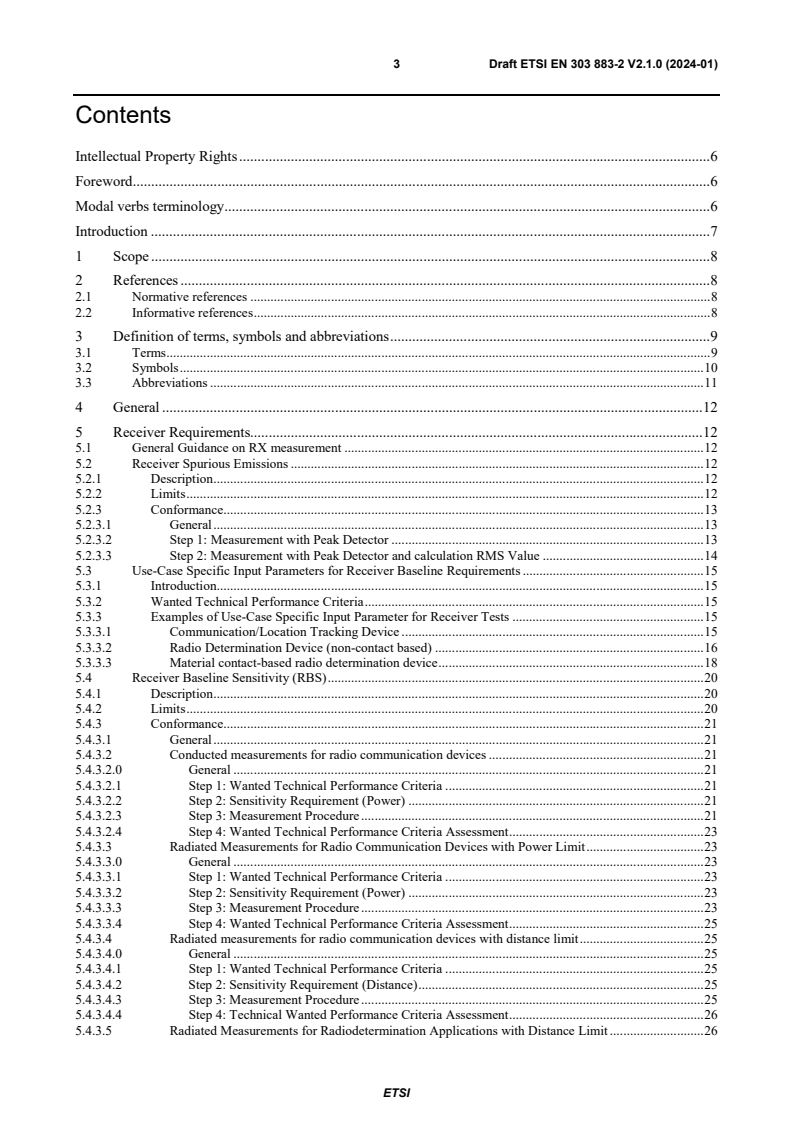
Contents
Intellectual Property Rights . 6
Foreword . 6
Modal verbs terminology . 6
Introduction . 7
1 Scope . 8
2 References . 8
2.1 Normative references . 8
2.2 Informative references . 8
3 Definition of terms, symbols and abbreviations . 9
3.1 Terms . 9
3.2 Symbols . 10
3.3 Abbreviations . 11
4 General . 12
5 Receiver Requirements. 12
5.1 General Guidance on RX measurement . 12
5.2 Receiver Spurious Emissions . 12
5.2.1 Description . 12
5.2.2 Limits . 12
5.2.3 Conformance. 13
5.2.3.1 General . 13
5.2.3.2 Step 1: Measurement with Peak Detector . 13
5.2.3.3 Step 2: Measurement with Peak Detector and calculation RMS Value . 14
5.3 Use-Case Specific Input Parameters for Receiver Baseline Requirements . 15
5.3.1 Introduction. 15
5.3.2 Wanted Technical Performance Criteria . 15
5.3.3 Examples of Use-Case Specific Input Parameter for Receiver Tests . 15
5.3.3.1 Communication/Location Tracking Device . 15
5.3.3.2 Radio Determination Device (non-contact based) . 16
5.3.3.3 Material contact-based radio determination device . 18
5.4 Receiver Baseline Sensitivity (RBS) . 20
5.4.1 Description . 20
5.4.2 Limits . 20
5.4.3 Conformance. 21
5.4.3.1 General . 21
5.4.3.2 Conducted measurements for radio communication devices . 21
5.4.3.2.0 General . 21
5.4.3.2.1 Step 1: Wanted Technical Performance Criteria . 21
5.4.3.2.2 Step 2: Sensitivity Requirement (Power) . 21
5.4.3.2.3 Step 3: Measurement Procedure . 21
5.4.3.2.4 Step 4: Wanted Technical Performance Criteria Assessment . 23
5.4.3.3 Radiated Measurements for Radio Communication Devices with Power Limit . 23
5.4.3.3.0 General . 23
5.4.3.3.1 Step 1: Wanted Technical Performance Criteria . 23
5.4.3.3.2 Step 2: Sensitivity Requirement (Power) . 23
5.4.3.3.3 Step 3: Measurement Procedure . 23
5.4.3.3.4 Step 4: Wanted Technical Performance Criteria Assessment . 25
5.4.3.4 Radiated measurements for radio communication devices with distance limit . 25
5.4.3.4.0 General . 25
5.4.3.4.1 Step 1: Wanted Technical Performance Criteria . 25
5.4.3.4.2 Step 2: Sensitivity Requirement (Distance) . 25
5.4.3.4.3 Step 3: Measurement Procedure . 25
5.4.3.4.4 Step 4: Technical Wanted Performance Criteria Assessment . 26
5.4.3.5 Radiated Measurements for Radiodetermination Applications with Distance Limit . 26
ETSI
4 Draft ETSI EN 303 883-2 V2.1.0 (2024-01)
5.4.3.5.0 General . 26
5.4.3.5.1 Step 1: Technical Performance Criteria . 26
5.4.3.5.2 Step 2: Sensitivity Requirement (Distance) . 27
5.4.3.5.3 Step 3: Measurement Procedure . 27
5.4.3.5.4 Step 4: Wanted Technical Performance Criteria Assessment . 28
5.4.3.6 Conducted measurements for radio determination devices . 28
5.4.3.6.0 General . 28
5.4.3.6.1 Step 1: Wanted Technical Performance Criteria . 28
5.4.3.6.2 Step 2: Sensitivity Requirement (Power) . 28
5.4.3.6.3 Step 3: Measurement Procedure . 29
5.4.3.6.4 Step 4: Wanted Technical Performance Criteria Assessment . 30
5.5 Receiver Baseline Resilience (RBR) . 30
5.5.1 Description . 30
5.5.2 RBR Requirements . 30
5.5.2.1 Interferer test signal. 30
5.5.2.2 RBR wanted performance criteria . 30
5.5.3 Conformance. 31
5.5.3.1 General . 31
5.5.3.2 Conducted Measurements for Radio Communication Devices . 31
5.5.3.2.1 Step 1: Start with the RBS Setup . 31
5.5.3.2.2 Step 2: Adding Interfering Signal Source . 31
5.5.3.2.3 Step 3: Degradation of Sensitivity Requirement . 31
5.5.3.2.4 Step 4: Test of Wanted Technical Performance Criteria . 31
5.5.3.2.5 Step 5: Measurement Assessment . 32
5.5.3.2.6 Step 6: Repetition of steps 4 and 5 . 32
5.5.3.3 Radiated Measurements for Radio Communication Devices with Power Limit . 32
5.5.3.3.1 Step 1: Start with the RBS Setup . 32
5.5.3.3.2 Step 2: Adding Interfering Signal Source . 32
5.5.3.3.3 Step 3: Degradation of Sensitivity Requirement . 33
5.5.3.3.4 Step 4: Test of Wanted Technical Performance Criteria . 33
5.5.3.3.5 Step 5: Measurement Assessment . 33
5.5.3.3.6 Step 6: Repetition of steps 4 and 5 . 33
5.5.3.4 Radiated Measurements for Radio Communication Devices with Distance Limit . 34
5.5.3.4.1 Step 1: Start with the RBS setup. 34
5.5.3.4.2 Step 2: Adding interfering signal source . 34
5.5.3.4.3 Step 3: Degradation of Sensitivity Requirement . 35
5.5.3.4.4 Step 4: Test of Wanted Technical Performance Criteria . 35
5.5.3.4.5 Step 5: Measurement Assessment . 35
5.5.3.4.6 Step 6: Repetition of steps 4 and 5 . 35
5.5.3.5 Radiated Measurements for Radiodetermination Applications with Distance Limit . 35
5.5.3.5.1 Step 1: Start with the RBS Setup . 35
5.5.3.5.2 Step 2: Adding interfering signal source . 35
5.5.3.5.3 Step 3: Degradation of Sensitivity Requirement . 37
5.5.3.5.4 Step 4: Test of Wanted Technical Performance Criteria . 37
5.5.3.5.5 Step 5: Measurement Assessment . 37
5.5.3.5.6 Step 6: Repetition of steps 4 and 5 . 37
5.5.3.6 Conducted Measurements for Radio Determination Devices . 37
5.5.3.6.1 Step 1: Start with the RBS Setup . 37
5.5.3.6.2 Step 2: Adding Interfering Signal Source . 37
5.5.3.6.3 Step 3: Degradation of Sensitivity Requirement . 38
5.5.3.6.4 Step 4: Test of Wanted Technical Performance Criteria . 38
5.5.3.6.5 Step 5: Measurement Assessment . 38
5.5.3.6.6 Step 6: Repetition of steps 4 and 5 . 38
Annex A (normative): Choose interferer for RBR . 39
A.1 Introduction . 39
A.2 Limits for the Interfering Signals . 40
A.2.1 Interferer within OFR . 40
A.2.1.0 Introduction. 40
A.2.1.1 Option 1 . 40
A.2.1.2 Option 2 . 40
ETSI
5 Draft ETSI EN 303 883-2 V2.1.0 (2024-01)
A.2.2 Interferer outside OFR . 41
A.3 Guidance to Setup the Power Level of the Interfering Signals @ EUT for RBR tests . 41
A.3.1 Radiated tests . 41
A.3.2 Conducted tests . 43
Annex B (informative): Guidance on Scaling Receiver Sensitivity . 44
B.1 General . 44
B.2 Scaling of power at the EUT . 44
B.3 Scaling distance . 44
Annex C (informative): Justification of receiver requirements from ETSI EG 203 336 . 46
C.1 General . 46
C.2 Justification . 46
C.3 Summary for the RBR requirement . 48
C.4 Justification RBS-requirement for radio determination devices . 49
Annex D (informative): Object and Radar Cross Section . 51
D.1 Wanted objects . 51
D.2 Direct Object Reflectors . 51
D.3 Delay Line Object Reflectors . 51
D.4 Electronic Object Reflectors . 52
D.5 Test Setup with Conventional RCS within Chamber . 52
D.6 Test Setup with Radar Object Generator . 53
Annex E (normative): Assessment procedure to find direction of the highest sensitivity . 54
E.1 General . 54
E.2 Assessment for communication devices . 54
E.3 Assessment for radiodetermination devices . 55
Annex F (informative): Parameter and Specification in related Standards . 56
Annex G (informative): Change history . 58
History . 59
ETSI
6 Draft ETSI EN 303 883-2 V2.1.0 (2024-01)
Intellectual Property Rights
Essential patents
IPRs essential or potentially essential to normative deliverables may have been declared to ETSI. The declarations
pertaining to these essential IPRs, if any, are publicly available for ETSI members and non-members, and can be
found in ETSI SR 000 314: "Intellectual Property Rights (IPRs); Essential, or potentially Essential, IPRs notified to
ETSI in respect of ETSI standards", which is available from the ETSI Secretariat. Latest updates are available on the
ETSI Web server (https://ipr.etsi.org/).
Pursuant to the ETSI Directives including the ETSI IPR Policy, no investigation regarding the essentiality of IPRs,
including IPR searches, has been carried out by ETSI. No guarantee can be given as to the existence of other IPRs not
referenced in ETSI SR 000 314 (or the updates on the ETSI Web server) which are, or may be, or may become,
essential to the present document.
Trademarks
The present document may include trademarks and/or tradenames which are asserted and/or registered by their owners.
ETSI claims no ownership of these except for any which are indicated as being the property of ETSI, and conveys no
right to use or reproduce any trademark and/or tradename. Mention of those trademarks in the present document does
not constitute an endorsement by ETSI of products, services or organizations associated with those trademarks.
DECT™, PLUGTESTS™, UMTS™ and the ETSI logo are trademarks of ETSI registered for the benefit of its
Members. 3GPP™ and LTE™ are trademarks of ETSI registered for the benefit of its Members and of the 3GPP
Organizational Partners. oneM2M™ logo is a trademark of ETSI registered for the benefit of its Members and of the ®
oneM2M Partners. GSM and the GSM logo are trademarks registered and owned by the GSM Association.
Foreword
This draft European Standard (EN) has been produced by ETSI Technical Committee Electromagnetic compatibility
and Radio spectrum Matters (ERM), and is now submitted for the combined Public Enquiry and Vote phase of the ETSI
EN Approval Procedure.
The present document is part 2 of a multi-part deliverable covering Short Range Devices (SRD) and Ultra Wide Band
(UWB), as identified below:
Part 1: "Measurement techniques for transmitter requirements";
Part 2: "Measurement techniques for receiver requirements".
Proposed national transposition dates
Date of latest announcement of this EN (doa): 3 months after ETSI publication
Date of latest publication of new National Standard
or endorsement of this EN (dop/e): 6 months after doa
Date of withdrawal of any conflicting National Standard (dow): 6 months after doa
Modal verbs terminology
In the present document "shall", "shall not", "should", "should not", "may", "need not", "will", "will not", "can" and
"cannot" are to be interpreted as described in clause 3.2 of the ETSI Drafting Rules (Verbal forms for the expression of
provisions).
"must" and "must not" are NOT allowed in ETSI deliverables except when used in direct citation.
ETSI
7 Draft ETSI EN 303 883-2 V2.1.0 (2024-01)
Introduction
The present document provides measurement procedures for receiver requirements to address the spectrum efficiency
requirements set out in article 3.2 of the RED [i.7].
The basis for this RX concept was developed by ETSI during two Special Task Forces.
First Special Task Force: ETSI STF 494; Update of the UWB related Harmonised Standards covering the essential
requirements set out in article 3.2 of the RED [i.7].
The STF 494:
• Started: 2015-05-25
• Ended: 2016-03-31
Outcome:
• ETSI TS 103 361 [i.4]
The second Special Task Force: ETSI STF 541; Signal interferer handling, a new RX requirement to cover the
essential requirements set out in article 3.2 of the RED [i.7], was a continuation to implement and consider comments
received after the publication of the ETSI TS 103 361 [i.4].
The STF 541:
• Started: 2017-10-06
• Ended: 2019-05-31
Outcome:
• ETSI TR 103 566 [i.2]
• ETSI TS 103 567 [i.3]
There is no specification of receiver parameter values within the present document. These values will be derived from
technical specification defined by the responsible ETSI Technical Committees and/or the findings of regulatory studies
conducted by the relevant bodies like CEPT/ECC WG SE. The limits/values for the baseline RX-conformance
requirements will be specified in the related standard.
In addition to two receiver baseline requirements, it can be necessary that the RX spurious emission requirement could
be a further RX requirement in the related standard. This could be necessary if the EUT has a receive only mode or if it
is not co-located to the transmitter. The present document specifies the receiver spurious emission requirement and the
corresponding test and measurement procedure in clause 5.2.
The present document provides practical information and guidance for the compliance receiver tests of UWB and Short
Range technology and related devices.
It is recommended that, in drafting the related standards, a thorough analysis is conducted on all possible applicable
receiver parameters (see annex C), selecting the most appropriate RX-requirements and having a robust reasoning for
those that are disregarded.
ETSI
8 Draft ETSI EN 303 883-2 V2.1.0 (2024-01)
1 Scope
The present document provides measurement procedures for receiver requirements to address the spectrum efficiency
requirements set out in article 3.2 of the RED [i.7].
The baseline receiver concept is a set of two parameters given in clause 5 of the present document providing guidance
for HS development, which can be further refined by the responsible TB.
Baseline receiver concept comprises the following parameters:
• Receiver Baseline Sensitivity (RBS); and
• Receiver Baseline Resilience (RBR).
The Baseline receiver concept is a further development of the signal interferer handling concept, see ETSI
TS 103 361 [i.4].
2 References
2.1 Normative references
References are either specific (identified by date of publication and/or edition number or version number) or
non-specific. For specific references, only the cited version applies. For non-specific references, the latest version of the
referenced document (including any amendments) applies.
Referenced documents which are not found to be publicly available in the expected location might be found at
https://docbox.etsi.org/Reference/.
NOTE: While any hyperlinks included in this clause were valid at the time of publication, ETSI cannot guarantee
their long term validity.
The following referenced documents are necessary for the application of the present document.
[1] ETSI EN 303 883-1 (V2.1.0): "Short Range Devices (SRD) and Ultra Wide Band (UWB);
Part 1: Measurement techniques for transmitter requirements".
2.2 Informative references
References are either specific (identified by date of publication and/or edition number or version number) or
non-specific. For specific references, only the cited version applies. For non-specific references, the latest version of the
referenced document (including any amendments) applies.
NOTE: While any hyperlinks included in this clause were valid at the time of publication, ETSI cannot guarantee
their long term validity.
The following referenced documents are not necessary for the application of the present document but they assist the
user with regard to a particular subject area.
[i.1] ETSI EG 203 336 (V1.2.1) (05-2020): "Guide for the selection of technical parameters for the
production of Harmonised Standards covering article 3.1(b) and article 3.2 of
Directive 2014/53/EU".
[i.2] ETSI TR 103 566 (V1.1.1) (10-2018): "Evaluation status on receiver requirement on Signal
interferer handling".
[i.3] ETSI TS 103 567 (V1.1.1) (09-2019): "Requirements on signal interferer handling".
[i.4] ETSI TS 103 361 (V1.1.1) (03-2016): "Short Range Devices (SRD) using Ultra Wide Band
technology (UWB); Receiver technical requirements, parameters and measurement procedures to
fulfil the requirements of the Directive 2014/53/EU".
ETSI
9 Draft ETSI EN 303 883-2 V2.1.0 (2024-01)
[i.5] ERC Recommendation 74-01: "Unwanted emissions in the spurious domain", approved 1998,
corrected May 2022.
[i.6] ETSI TR 103 181-2 (V1.1.1) (06-2014): "Electromagnetic compatibility and Radio spectrum
Matters (ERM); Short Range Devices (SRD) using Ultra Wide Band (UWB);Transmission
characteristics Part 2: UWB mitigation techniques".
[i.7] Directive 2014/53/EU of the European Parliament and of the Council of 16 April 2014 on the
harmonisation of the laws of the Member States relating to the making available on the market of
radio equipment and repealing Directive 1999/5/EC (RED).
[i.8] European Communications Office: "EFIS: ECO Frequency Information System".
[i.9] ETSI TR 103 181-1 (V1.1.1) (07-2015): "Short Range Devices (SRD) using Ultra Wide Band
(UWB); Technical Report Part 1: UWB signal characteristics and overview CEPT/ECC and EC
regulation".
[i.10] ETSI TS 103 788 (V1.1.1) (09-2022): "Short Range Devices (SRD) and Ultra Wide Band (UWB);
Measurement techniques and specification for RX conformance tests with target simulator".
[i.11] ETSI TS 103 789 (V1.1.1) (05-2023): "Short Range Devices (SRD) and Ultra Wide Band (UWB);
Radar related parameters and physical test setup for object detection, identification and RCS
measurement".
[i.12] ETSI TS 103 941 (V.0.1.1): "Ultra Wide Band (ERM); Radiated tests for UWB technology-based
devices under extreme environmental conditions".
3 Definition of terms, symbols and abbreviations
3.1 Terms
For the purposes of the present document, the terms given in ETSI EN 303 883-1 [1] and the following apply:
event failure rate: ratio of failed tests compared to total number of tests
received power at the EUT (P@EUT): received signal with a specified power level the EUT is able to detect
NOTE 1: P is similar to the specified sensitivity level for the EUT as specified in the related standard (kind of
@EUT
power (e.g. dBm or dBm/MHz) and limit, see note 2.
NOTE 2: ����������� @ ��� = � .
@���
Receiver Baseline Resilience (RBR): capability to maintain a pre-determined minimum acceptable level of
performance in the presence of unwanted signals over the frequency band of operation, applicable adjacent and remote
frequency bands
Receiver Baseline Sensitivity (RBS): capability to receive a wanted signal at application related defined input signal
levels while providing a pre-determined minimum acceptable level of technical performance
NOTE 1: The pre-determined minimum acceptable level of technical performance is the basis for all other receiver
parameters.
NOTE 2: The purpose of the sensitivity requirement is to assure a basic measure of efficient use of spectrum that
strikes balance between sensitivity and the need to avoid being sensitive to interference.
Wanted Technical Performance Criteria (WTPC): specified technical behaviour of the EUT (e.g. information via
use-interface) or specified measurable specified output signal to demonstrate that the EUT operates as intended
NOTE: The wanted technical performance will be specified in the rates standard and the requirement is closely
linked with the use-case of the EUT.
ETSI
10 Draft ETSI EN 303 883-2 V2.1.0 (2024-01)
3.2 Symbols
For the purposes of the present document, the following symbols apply:
σ Radar Cross Section
ΔD degradation of the distance from RBR test
∆f additional frequency range to increase the range (ORF ) for the RBR interferer assessment
RBR
A size of the antenna aperture
A effective area of the antenna [m²]
eff
att attenuation of the "Variable Attenuator" in [dB]
c the velocity of light [m/s]
ca cable attenuation
cf coupling factor of the coupler in [dB]
d degradation of the sensitivity in [dB]
g
dB decibel
dBi gain in decibels relative to an isotropic antenna
dBm gain in decibels relative to one milliwatt
dl attenuation of the "Delay Line" in [dB]
D measurement distance
D distance between interfering antenna and EUT
int
D minimum distance from EUT to a specified object the EUT is able to detect
min
D real distance between EUT and target simulator in [m]
real
D minimum range from an ideal/companion source to the EUT (RX) value in [m]
sens
D scaled distance for the RBS tests
scal
D simulated target distance within target simulator in [m]
sim
f test frequency in [GHz]
f centre frequency of the EUT OFR
C
F lowest frequency of receiver spurious emission test
LOWER
F highest frequency of receiver spurious emission test
UPPER
g measurement antenna gain in [dBi] at test frequency f
measure
g measurement test antenna gain in [dBi] at test frequency f
t
g EUT antenna gain in [dBi]
e
g measurement receiving test antenna gain in [dBi] at test frequency f
rt
G interfering transmit antenna
int
g antenna gain of test antenna to transmit interfering signal [dBi]
int
G gain of the receiving antenna
RX
G gain of the transmitting antenna
TX
il insertion loss of the coupler in [dB]
IP interfering Power@EUT
@EUT
IP output power of the interference signal source (generator)
out
ORF Frequency range for the RBR interferer assessment
RBR
P Sensitivity @ EUT
@EUT
P measured transmitted power of the EUT [e.g. dBm/MHz] or in [W]
EUT
P measured received power with the spectrum analyser
meas
P output power of the signal generator A
out
P maximum regulated radiated emission for ideal TX/companion device
reg
P power received back from the object by the EUT [W]
RX
P measured transmitted power from the EUT in [dB]
trans
P transmitter power [W]
TX
RBR frequency range for the RBR interferer assessment (ORF + 2∆f)
in-band RBR
RX sensitivity limit at antenna port
ref
RX scaled sensitivity limit for the RBS test
refsense
SCP Scaling factor (absolute value)
X symbol for a value/limit specified in the related standard
VALUE
ETSI
11 Draft ETSI EN 303 883-2 V2.1.0 (2024-01)
3.3 Abbreviations
For the purposes of the present document, the following abbreviations apply:
ACS Adjacent Channel Selectivity
ADM Accuracy in Distance Measurement
BER Bit Error Rate
CATR Compliant And TRansportable far-field
CEPT European Conference of Postal and Telecommunications administrations
CW Continuous Wave
DAA Detect And Avoid
ECC Electronic Communications Committee
ECO European Communications Office
EFIS ECO Frequency Information System
EFR Event Failure Ratio
EN European Norm
ENAP EN Approval Process
ERM Electromagnetic compatibility and Radio spectrum Matters
EUT Equipment Under Test
EUT-RX Receiver of the Equipment Under Test
FCC Federal Communications Commission
FMCW Frequency Modulated Continuous Wave
HH Horizontal - Horizontal
LAES Location tracking Applications for Emergency Services
LBT Listen Before Talk
LT1 Location Tracking type 1
LT2 Location Tracking type 2
MIMO Multiple Input Multiple Output
NA Not Applicable
ODP Object Detection Probability
OFR Operating Frequency Range
OOB Out Of Band
OTA Over The Air
PER Packet Error Rate
RBR Receiver Baseline Resilience
RBS Receiver Baseline Sensitivity
RBW Resolution BandWidth
RC Remote Consensus
RCS Radar Cross Section
RED Radio Equipment Directive
RF Radio Frequency
RMS Root Mean of Squares
RP Radiated Power
RX Receiver
SE Spectrum Engineering
SRD Short Range Device
STF Special Task Force of ETSI
TB Technical Body
TG Technical Group
TPC Total Power Control
TX Transmitter
UWB Ultra Wide Band
VBW Video BandWidth
VV Vertical - Vertical
WG Working Group
WTPC Wanted Technical Performance Criteria
ETSI
12 Draft ETSI EN 303 883-2 V2.1.0 (2024-01)
4 General
The present document provides practical information and guidance for the compliance receiver tests of UWB and Short
Range technology and devices.
The baseline receiver requirements were developed based on the findings of ETSI TR 103 566 [i.2] and ETSI
TS 103 567 [i.3], where the signal interferer handling concept from ETSI TS 103 361 [i.4] has been analysed on its
applicability for the RED [i.7].
The baseline receiver concept is a set of two parameters given in clause 5 of the present document providing guidance
for harmonised standard development, which can be further refined by the responsible TB.
Baseline receiver concept comprises the following parameters:
• Receiver Baseline Sensitivity (RBS); see clause 5.4; and
• Receiver Baseline Resilience (RBR); see clause 5.5.
The baseline receiver concept is a further development of the signal interferer handling concept, see ETSI
TS 103 361 [i.4].
In annex C these two parameters are put in relation to existing receiver parameters given in ETSI EG 203 336 [i.1] and
the assessments prepared by ETSI STF 494 and 541. Annex C additionally provides the summary
assessment/justification for this new baseline receiver concept described in the present document.
5 Receiver Requirements
5.1 General Guidance on RX measurement
Complementary information to the conformance tests in the clauses below are provided in annex A and B of ETSI
EN 303 883-1 [1], for example:
• test conditions, power supply and ambient temperatures (see clause A.5 of ETSI EN 303 883-1 [1]);
• measurement uncertainty and the interpretation of the measurement results (see clause A.8 of ETSI
EN 303 883-1 [1]);
• test setups and radiated measurements (see annex B of ETSI EN 303 883-1 [1]).
5.2 Receiver Spurious Emissions
5.2.1 Description
The RX spurious emissions shall be measured within the frequency range defined in table 2.
The receiver spurious emission requirement is applicable for communication and tracking EUT if the EUT is a receive
only device (TX not implemented) or for EUT which has a receive only mode (TX off, standby, idle).
For radiodetermination and sensor applications (e.g. radar sensor) the receiver spurious emission requirement is
applicable for EUT if it is a receive only device (receiver is separated from the transmitter within a separate housing) or
for EUT which has a receive only mode (TX off, standby, idle). The receive only mode shall be specified in the related
standard based on the intended-use and the EUT device categories. For EUT without a receive only mode than the
spurious emissions are covered by provisions of clause 5.5 of ETSI EN 303 883-1 [1] on TX unwanted emissions.
5.2.2 Limits
The limit for RX spurious emissions could be provided in the applicable related standard.
ETSI
13 Draft ETSI EN 303 883-2 V2.1.0 (2024-01)
If no limits for RX spurious emissions are provided in the related standard, then the limits in table 1 shall apply.
Table 1: Receiver spurious emission limits in line with ERC REC 74-01 [i.5]
Frequency range Limit values
F to 1 000 MHz (see note) -57 dBm
LOWER
1 GHz < f ≤ FUPPER (see note) -47 dBm
NOTE: FUPPER and FLOWER are linked with the OFR of the EUT, see table 2.
Table 2: Frequency range for the RX spurious emission test, linked with EUT OFR
in line with ERC REC 74-01 [i.5]
Fundamental frequency range Frequency range for measurements
defined by fL and fH (see note 2) Lower frequency (F ) (see note 3) Upper frequency (F )
LOWER UPPER
300 to 600 MHz 30 MHz 3 GHz
th
600 MHz to 5,2 GHz 30 MHz 5 harmonic (see note 1)
5,2 to 13 GHz 30 MHz 26 GHz
nd
13 to 150 GHz 30 MHz 2 harmonic (see note 1)
150 to 300 GHz 30 MHz 300 GHz
NOTE 1: FUPPER is the stated harmonic of fH (the upper edge of the OFR, which is measured in ETSI EN 303 883-1 [1],
clause 5.2).
NOTE 2: F has to be selected based on f and F based on f (f and f can be measured according to ETSI
LOWER L UPPER H L H
EN 303 883-1 [1], clause 5.2); for receive only devices fH and fL of the related EUT/companion device shall be
used.
NOTE 3: For EUT operating below 300 MHz the spurious emissions limits below 30 MHz shall be specified in the
related standard.
5.2.3 Conformance
5.2.3.1 General
The following conformance test shall be used for RX unwanted emissions (OOB and spurious emissions) if not
otherwise specified in the related standard.
In c
...
Final draft ETSI EN 303 883-2 V2.1.1 (2024-06)
EUROPEAN STANDARD
Short Range Devices (SRD) and
Ultra Wide Band (UWB);
Part 2: Measurement techniques
for receiver requirements
2 Final draft ETSI EN 303 883-2 V2.1.1 (2024-06)
Reference
REN/ERM-TGUWB-619
Keywords
measurement, receiver, testing, UWB
ETSI
650 Route des Lucioles
F-06921 Sophia Antipolis Cedex - FRANCE
Tel.: +33 4 92 94 42 00 Fax: +33 4 93 65 47 16
Siret N° 348 623 562 00017 - APE 7112B
Association à but non lucratif enregistrée à la
Sous-Préfecture de Grasse (06) N° w061004871
Important notice
The present document can be downloaded from:
https://www.etsi.org/standards-search
The present document may be made available in electronic versions and/or in print. The content of any electronic and/or
print versions of the present document shall not be modified without the prior written authorization of ETSI. In case of any
existing or perceived difference in contents between such versions and/or in print, the prevailing version of an ETSI
deliverable is the one made publicly available in PDF format at www.etsi.org/deliver.
Users of the present document should be aware that the document may be subject to revision or change of status.
Information on the current status of this and other ETSI documents is available at
https://portal.etsi.org/TB/ETSIDeliverableStatus.aspx
If you find errors in the present document, please send your comment to one of the following services:
https://portal.etsi.org/People/CommiteeSupportStaff.aspx
If you find a security vulnerability in the present document, please report it through our
Coordinated Vulnerability Disclosure Program:
https://www.etsi.org/standards/coordinated-vulnerability-disclosure
Notice of disclaimer & limitation of liability
The information provided in the present deliverable is directed solely to professionals who have the appropriate degree of
experience to understand and interpret its content in accordance with generally accepted engineering or
other professional standard and applicable regulations.
No recommendation as to products and services or vendors is made or should be implied.
In no event shall ETSI be held liable for loss of profits or any other incidental or consequential damages.
Any software contained in this deliverable is provided "AS IS" with no warranties, express or implied, including but not
limited to, the warranties of merchantability, fitness for a particular purpose and non-infringement of intellectual property
rights and ETSI shall not be held liable in any event for any damages whatsoever (including, without limitation, damages
for loss of profits, business interruption, loss of information, or any other pecuniary loss) arising out of or related to the use
of or inability to use the software.
Copyright Notification
No part may be reproduced or utilized in any form or by any means, electronic or mechanical, including photocopying and
microfilm except as authorized by written permission of ETSI.
The content of the PDF version shall not be modified without the written authorization of ETSI.
The copyright and the foregoing restriction extend to reproduction in all media.
© ETSI 2024.
All rights reserved.
ETSI
3 Final draft ETSI EN 303 883-2 V2.1.1 (2024-06)
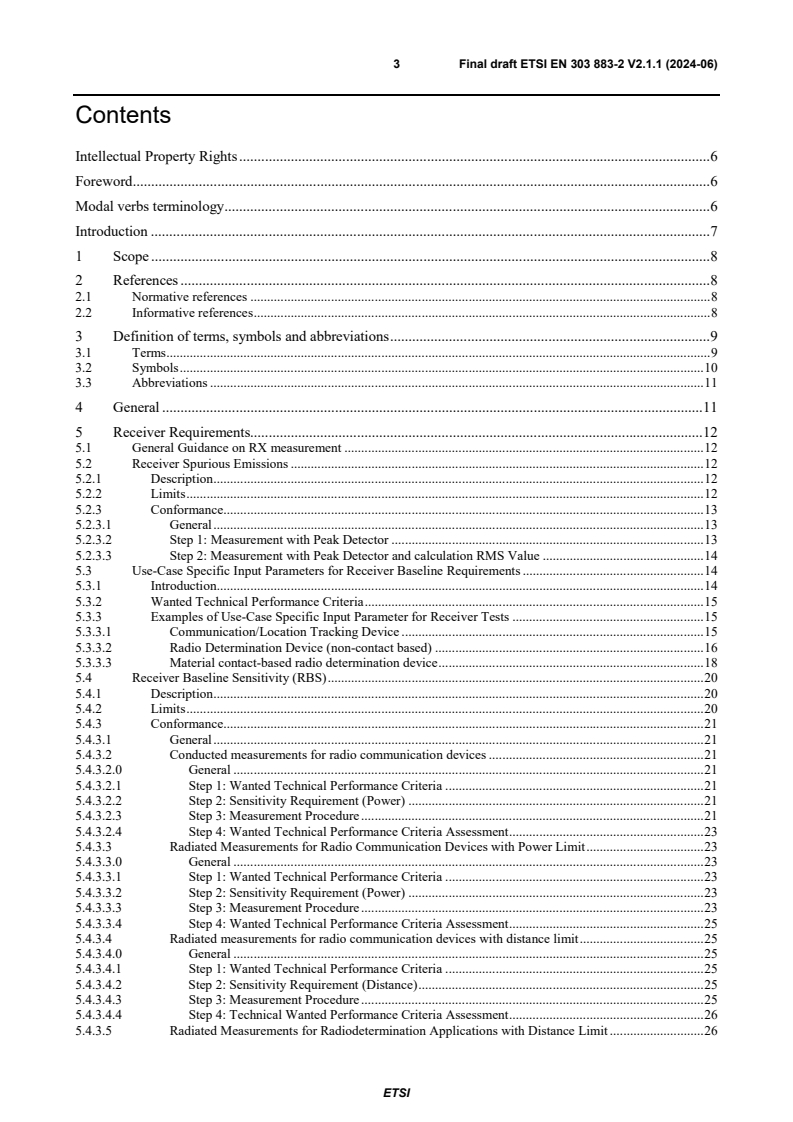
Contents
Intellectual Property Rights . 6
Foreword . 6
Modal verbs terminology . 6
Introduction . 7
1 Scope . 8
2 References . 8
2.1 Normative references . 8
2.2 Informative references . 8
3 Definition of terms, symbols and abbreviations . 9
3.1 Terms . 9
3.2 Symbols . 10
3.3 Abbreviations . 11
4 General . 11
5 Receiver Requirements. 12
5.1 General Guidance on RX measurement . 12
5.2 Receiver Spurious Emissions . 12
5.2.1 Description . 12
5.2.2 Limits . 12
5.2.3 Conformance. 13
5.2.3.1 General . 13
5.2.3.2 Step 1: Measurement with Peak Detector . 13
5.2.3.3 Step 2: Measurement with Peak Detector and calculation RMS Value . 14
5.3 Use-Case Specific Input Parameters for Receiver Baseline Requirements . 14
5.3.1 Introduction. 14
5.3.2 Wanted Technical Performance Criteria . 15
5.3.3 Examples of Use-Case Specific Input Parameter for Receiver Tests . 15
5.3.3.1 Communication/Location Tracking Device . 15
5.3.3.2 Radio Determination Device (non-contact based) . 16
5.3.3.3 Material contact-based radio determination device . 18
5.4 Receiver Baseline Sensitivity (RBS) . 20
5.4.1 Description . 20
5.4.2 Limits . 20
5.4.3 Conformance. 21
5.4.3.1 General . 21
5.4.3.2 Conducted measurements for radio communication devices . 21
5.4.3.2.0 General . 21
5.4.3.2.1 Step 1: Wanted Technical Performance Criteria . 21
5.4.3.2.2 Step 2: Sensitivity Requirement (Power) . 21
5.4.3.2.3 Step 3: Measurement Procedure . 21
5.4.3.2.4 Step 4: Wanted Technical Performance Criteria Assessment . 23
5.4.3.3 Radiated Measurements for Radio Communication Devices with Power Limit . 23
5.4.3.3.0 General . 23
5.4.3.3.1 Step 1: Wanted Technical Performance Criteria . 23
5.4.3.3.2 Step 2: Sensitivity Requirement (Power) . 23
5.4.3.3.3 Step 3: Measurement Procedure . 23
5.4.3.3.4 Step 4: Wanted Technical Performance Criteria Assessment . 25
5.4.3.4 Radiated measurements for radio communication devices with distance limit . 25
5.4.3.4.0 General . 25
5.4.3.4.1 Step 1: Wanted Technical Performance Criteria . 25
5.4.3.4.2 Step 2: Sensitivity Requirement (Distance) . 25
5.4.3.4.3 Step 3: Measurement Procedure . 25
5.4.3.4.4 Step 4: Technical Wanted Performance Criteria Assessment . 26
5.4.3.5 Radiated Measurements for Radiodetermination Applications with Distance Limit . 26
ETSI
4 Final draft ETSI EN 303 883-2 V2.1.1 (2024-06)
5.4.3.5.0 General . 26
5.4.3.5.1 Step 1: Technical Performance Criteria . 26
5.4.3.5.2 Step 2: Sensitivity Requirement (Distance) . 27
5.4.3.5.3 Step 3: Measurement Procedure . 27
5.4.3.5.4 Step 4: Wanted Technical Performance Criteria Assessment . 28
5.4.3.6 Conducted measurements for radio determination devices . 28
5.4.3.6.0 General . 28
5.4.3.6.1 Step 1: Wanted Technical Performance Criteria . 28
5.4.3.6.2 Step 2: Sensitivity Requirement (Power) . 28
5.4.3.6.3 Step 3: Measurement Procedure . 29
5.4.3.6.4 Step 4: Wanted Technical Performance Criteria Assessment . 30
5.5 Receiver Baseline Resilience (RBR) . 30
5.5.1 Description . 30
5.5.2 RBR Requirements . 30
5.5.2.1 Interferer test signal. 30
5.5.2.2 RBR wanted performance criteria . 30
5.5.3 Conformance. 31
5.5.3.1 General . 31
5.5.3.2 Conducted Measurements for Radio Communication Devices . 31
5.5.3.2.1 Step 1: Start with the RBS Setup . 31
5.5.3.2.2 Step 2: Adding Interfering Signal Source . 31
5.5.3.2.3 Step 3: Degradation of Sensitivity Requirement . 31
5.5.3.2.4 Step 4: Test of Wanted Technical Performance Criteria . 31
5.5.3.2.5 Step 5: Measurement Assessment . 32
5.5.3.2.6 Step 6: Repetition of steps 4 and 5 . 32
5.5.3.3 Radiated Measurements for Radio Communication Devices with Power Limit . 32
5.5.3.3.1 Step 1: Start with the RBS Setup . 32
5.5.3.3.2 Step 2: Adding Interfering Signal Source . 32
5.5.3.3.3 Step 3: Degradation of Sensitivity Requirement . 33
5.5.3.3.4 Step 4: Test of Wanted Technical Performance Criteria . 33
5.5.3.3.5 Step 5: Measurement Assessment . 33
5.5.3.3.6 Step 6: Repetition of steps 4 and 5 . 33
5.5.3.4 Radiated Measurements for Radio Communication Devices with Distance Limit . 34
5.5.3.4.1 Step 1: Start with the RBS setup. 34
5.5.3.4.2 Step 2: Adding interfering signal source . 34
5.5.3.4.3 Step 3: Degradation of Sensitivity Requirement . 35
5.5.3.4.4 Step 4: Test of Wanted Technical Performance Criteria . 35
5.5.3.4.5 Step 5: Measurement Assessment . 35
5.5.3.4.6 Step 6: Repetition of steps 4 and 5 . 35
5.5.3.5 Radiated Measurements for Radiodetermination Applications with Distance Limit . 35
5.5.3.5.1 Step 1: Start with the RBS Setup . 35
5.5.3.5.2 Step 2: Adding interfering signal source . 35
5.5.3.5.3 Step 3: Degradation of Sensitivity Requirement . 37
5.5.3.5.4 Step 4: Test of Wanted Technical Performance Criteria . 37
5.5.3.5.5 Step 5: Measurement Assessment . 37
5.5.3.5.6 Step 6: Repetition of steps 4 and 5 . 37
5.5.3.6 Conducted Measurements for Radio Determination Devices . 37
5.5.3.6.1 Step 1: Start with the RBS Setup . 37
5.5.3.6.2 Step 2: Adding Interfering Signal Source . 37
5.5.3.6.3 Step 3: Degradation of Sensitivity Requirement . 38
5.5.3.6.4 Step 4: Test of Wanted Technical Performance Criteria . 38
5.5.3.6.5 Step 5: Measurement Assessment . 38
5.5.3.6.6 Step 6: Repetition of steps 4 and 5 . 38
Annex A (normative): Choose interferer for RBR . 39
A.1 Introduction . 39
A.2 Limits for the Interfering Signals . 40
A.2.1 Interferer within OFR . 40
A.2.1.0 Introduction. 40
A.2.1.1 Option 1 . 40
A.2.1.2 Option 2 . 40
ETSI
5 Final draft ETSI EN 303 883-2 V2.1.1 (2024-06)
A.2.2 Interferer outside OFR . 41
A.3 Guidance to Setup the Power Level of the Interfering Signals @ EUT for RBR tests . 41
A.3.1 Radiated tests . 41
A.3.2 Conducted tests . 43
Annex B (informative): Guidance on Scaling Receiver Sensitivity . 44
B.1 General . 44
B.2 Scaling of power at the EUT . 44
B.3 Scaling distance . 44
Annex C (informative): Justification of receiver requirements from ETSI EG 203 336 . 46
C.1 General . 46
C.2 Justification . 46
C.3 Summary for the RBR requirement . 48
C.4 Justification RBS-requirement for radio determination devices . 49
Annex D (informative): Object and Radar Cross Section . 51
D.1 Wanted objects . 51
D.2 Direct Object Reflectors . 51
D.3 Delay Line Object Reflectors . 51
D.4 Electronic Object Reflectors . 52
D.5 Test Setup with Conventional RCS in a FAR . 52
D.6 Test Setup with Radar Object Generator . 53
Annex E (normative): Assessment procedure to find direction of the highest sensitivity . 54
E.1 General . 54
E.2 Assessment for communication devices . 54
E.3 Assessment for radiodetermination devices . 55
Annex F (informative): Parameter and Specification in related Standards . 56
Annex G (informative): Change history . 58
History . 59
ETSI
6 Final draft ETSI EN 303 883-2 V2.1.1 (2024-06)
Intellectual Property Rights
Essential patents
IPRs essential or potentially essential to normative deliverables may have been declared to ETSI. The declarations
pertaining to these essential IPRs, if any, are publicly available for ETSI members and non-members, and can be
found in ETSI SR 000 314: "Intellectual Property Rights (IPRs); Essential, or potentially Essential, IPRs notified to
ETSI in respect of ETSI standards", which is available from the ETSI Secretariat. Latest updates are available on the
ETSI Web server (https://ipr.etsi.org/).
Pursuant to the ETSI Directives including the ETSI IPR Policy, no investigation regarding the essentiality of IPRs,
including IPR searches, has been carried out by ETSI. No guarantee can be given as to the existence of other IPRs not
referenced in ETSI SR 000 314 (or the updates on the ETSI Web server) which are, or may be, or may become,
essential to the present document.
Trademarks
The present document may include trademarks and/or tradenames which are asserted and/or registered by their owners.
ETSI claims no ownership of these except for any which are indicated as being the property of ETSI, and conveys no
right to use or reproduce any trademark and/or tradename. Mention of those trademarks in the present document does
not constitute an endorsement by ETSI of products, services or organizations associated with those trademarks.
DECT™, PLUGTESTS™, UMTS™ and the ETSI logo are trademarks of ETSI registered for the benefit of its
Members. 3GPP™ and LTE™ are trademarks of ETSI registered for the benefit of its Members and of the 3GPP
Organizational Partners. oneM2M™ logo is a trademark of ETSI registered for the benefit of its Members and of the ®
oneM2M Partners. GSM and the GSM logo are trademarks registered and owned by the GSM Association.
Foreword
This final draft European Standard (EN) has been produced by ETSI Technical Committee Electromagnetic
compatibility and Radio spectrum Matters (ERM), and is now submitted for the Vote phase of the ETSI EN Approval
Procedure.
The present document is part 2 of a multi-part deliverable covering Short Range Devices (SRD) and Ultra Wide Band
(UWB), as identified below:
Part 1: "Measurement techniques for transmitter requirements";
Part 2: "Measurement techniques for receiver requirements".
Proposed national transposition dates
Date of latest announcement of this EN (doa): 3 months after ETSI publication
Date of latest publication of new National Standard
or endorsement of this EN (dop/e): 6 months after doa
Date of withdrawal of any conflicting National Standard (dow): 6 months after doa
Modal verbs terminology
In the present document "shall", "shall not", "should", "should not", "may", "need not", "will", "will not", "can" and
"cannot" are to be interpreted as described in clause 3.2 of the ETSI Drafting Rules (Verbal forms for the expression of
provisions).
"must" and "must not" are NOT allowed in ETSI deliverables except when used in direct citation.
ETSI
7 Final draft ETSI EN 303 883-2 V2.1.1 (2024-06)
Introduction
The present document provides measurement procedures for receiver requirements to address the spectrum efficiency
requirements set out in article 3.2 of the RED [i.7].
The basis for this RX concept was developed by ETSI during two Special Task Forces.
First Special Task Force: ETSI STF 494; Update of the UWB related Harmonised Standards covering the essential
requirements set out in article 3.2 of the RED [i.7].
The STF 494:
• Started: 2015-05-25
• Ended: 2016-03-31
Outcome:
• ETSI TS 103 361 [i.4]
The second Special Task Force: ETSI STF 541; Signal interferer handling, a new RX requirement to cover the
essential requirements set out in article 3.2 of the RED [i.7], was a continuation to implement and consider comments
received after the publication of the ETSI TS 103 361 [i.4].
The STF 541:
• Started: 2017-10-06
• Ended: 2019-05-31
Outcome:
• ETSI TR 103 566 [i.2]
• ETSI TS 103 567 [i.3]
There is no specification of receiver parameter values within the present document. These values will be derived from
technical specification defined by the responsible ETSI Technical Committees and/or the findings of regulatory studies
conducted by the relevant bodies like CEPT/ECC WG SE. The limits/values for the baseline RX-conformance
requirements will be specified in the related standard.
In addition to two receiver baseline requirements, it can be necessary that the RX spurious emission requirement could
be a further RX requirement in the related standard. This could be necessary if the EUT has a receive only mode or if it
is not co-located to the transmitter. The present document specifies the receiver spurious emission requirement and the
corresponding test and measurement procedure in clause 5.2.
The present document provides practical information and guidance for the compliance receiver tests of UWB and Short
Range technology and related devices.
It is recommended that, in drafting the related standards, a thorough analysis is conducted on all possible applicable
receiver parameters (see annex C), selecting the most appropriate RX-requirements and having a robust reasoning for
those that are disregarded.
ETSI
8 Final draft ETSI EN 303 883-2 V2.1.1 (2024-06)
1 Scope
The present document provides measurement procedures for receiver requirements to address the spectrum efficiency
requirements set out in article 3.2 of the RED [i.7].
The baseline receiver concept is a set of two parameters given in clause 5 of the present document providing guidance
for HS development, which can be further refined by the responsible TB.
Baseline receiver concept comprises the following parameters:
• Receiver Baseline Sensitivity (RBS); and
• Receiver Baseline Resilience (RBR).
The Baseline receiver concept is a further development of the signal interferer handling concept, see ETSI
TS 103 361 [i.4].
2 References
2.1 Normative references
References are either specific (identified by date of publication and/or edition number or version number) or
non-specific. For specific references, only the cited version applies. For non-specific references, the latest version of the
referenced document (including any amendments) applies.
Referenced documents which are not found to be publicly available in the expected location might be found at
https://docbox.etsi.org/Reference/.
NOTE: While any hyperlinks included in this clause were valid at the time of publication, ETSI cannot guarantee
their long term validity.
The following referenced documents are necessary for the application of the present document.
[1] ETSI EN 303 883-1 (V2.1.1): "Short Range Devices (SRD) and Ultra Wide Band (UWB); Part 1:
Measurement techniques for transmitter requirements".
2.2 Informative references
References are either specific (identified by date of publication and/or edition number or version number) or
non-specific. For specific references, only the cited version applies. For non-specific references, the latest version of the
referenced document (including any amendments) applies.
NOTE: While any hyperlinks included in this clause were valid at the time of publication, ETSI cannot guarantee
their long term validity.
The following referenced documents are not necessary for the application of the present document but they assist the
user with regard to a particular subject area.
[i.1] ETSI EG 203 336 (V1.2.1) (05-2020): "Guide for the selection of technical parameters for the
production of Harmonised Standards covering article 3.1(b) and article 3.2 of Directive
2014/53/EU".
[i.2] ETSI TR 103 566 (V1.1.1) (10-2018): "Evaluation status on receiver requirement on Signal
interferer handling".
[i.3] ETSI TS 103 567 (V1.1.1) (09-2019): "Requirements on signal interferer handling".
[i.4] ETSI TS 103 361 (V1.1.1) (03-2016): "Short Range Devices (SRD) using Ultra Wide Band
technology (UWB); Receiver technical requirements, parameters and measurement procedures to
fulfil the requirements of the Directive 2014/53/EU".
ETSI
9 Final draft ETSI EN 303 883-2 V2.1.1 (2024-06)
[i.5] ERC/REC 74-01: "Unwanted emissions in the spurious domain", approved 1998, corrected
May 2022.
[i.6] ETSI TR 103 181-2 (V1.1.1) (06-2014): "Electromagnetic compatibility and Radio spectrum
Matters (ERM); Short Range Devices (SRD) using Ultra Wide Band (UWB);Transmission
characteristics Part 2: UWB mitigation techniques".
[i.7] Directive 2014/53/EU of the European Parliament and of the Council of 16 April 2014 on the
harmonisation of the laws of the Member States relating to the making available on the market of
radio equipment and repealing Directive 1999/5/EC (RED).
[i.8] European Communications Office: "EFIS: ECO Frequency Information System".
[i.9] ETSI TR 103 181-1 (V1.1.1) (07-2015): "Short Range Devices (SRD) using Ultra Wide Band
(UWB); Technical Report Part 1: UWB signal characteristics and overview CEPT/ECC and EC
regulation".
[i.10] ETSI TS 103 788 (V1.1.1) (09-2022): "Short Range Devices (SRD) and Ultra Wide Band (UWB);
Measurement techniques and specification for RX conformance tests with target simulator".
[i.11] ETSI TS 103 789 (V1.1.1) (05-2023): "Short Range Devices (SRD) and Ultra Wide Band (UWB);
Radar related parameters and physical test setup for object detection, identification and RCS
measurement".
[i.12] ETSI TS 103 941 (V1.1.1): "Short Range Devices (SRD) and Ultra Wide Band (UWB);
Measurement setups and specifications for testing under full environmental profile (normal and
extreme environmental conditions)".
3 Definition of terms, symbols and abbreviations
3.1 Terms
For the purposes of the present document, the terms given in ETSI EN 303 883-1 [1] and the following apply:
event failure rate: ratio of failed tests compared to total number of tests
interfering transmit antenna: antenna which radiates the interfering signal to EUT during the RBR test
received power at the EUT (P@EUT): received signal with a specified power level the EUT is able to detect
NOTE 1: P is similar to the specified sensitivity level for the EUT as specified in the related standard (kind of
@EUT
power (e.g. dBm or dBm/MHz) and limit, see note 2.
NOTE 2: ����������� @ ��� = � .
@���
Receiver Baseline Resilience (RBR): capability to maintain a pre-determined minimum acceptable level of
performance in the presence of unwanted signals over the frequency band of operation, applicable adjacent and remote
frequency bands
Receiver Baseline Sensitivity (RBS): capability to receive a wanted signal at application related defined input signal
levels while providing a pre-determined minimum acceptable level of technical performance
NOTE 1: The pre-determined minimum acceptable level of technical performance is the basis for all other receiver
parameters.
NOTE 2: The purpose of the sensitivity requirement is to assure a basic measure of efficient use of spectrum that
strikes balance between sensitivity and the need to avoid being sensitive to interference.
Wanted Technical Performance Criteria (WTPC): specified technical behaviour of the EUT (e.g. information via
use-interface) or specified measurable specified output signal to demonstrate that the EUT operates as intended
NOTE: The wanted technical performance will be specified in the rates standard and the requirement is closely
linked with the use-case of the EUT.
ETSI
10 Final draft ETSI EN 303 883-2 V2.1.1 (2024-06)
3.2 Symbols
For the purposes of the present document, the following symbols apply:
σ Radar Cross Section
ΔD degradation of the distance from RBR test
∆f additional frequency range to increase the range (ORF ) for the RBR interferer assessment
RBR
A size of the antenna aperture
A effective area of the antenna [m²]
eff
att attenuation of the "Variable Attenuator" in [dB]
c the velocity of light [m/s]
ca cable attenuation
cf coupling factor of the coupler in [dB]
d degradation of the sensitivity in [dB]
g
dB decibel
dBi gain in decibels relative to an isotropic antenna
dBm gain in decibels relative to one milliwatt
dl attenuation of the "Delay Line" in [dB]
D measurement distance
D distance between interfering antenna and EUT
int
D minimum distance from EUT to a specified object the EUT is able to detect
min
D real distance between EUT and target simulator in [m]
real
D minimum range from an ideal/companion source to the EUT (RX) value in [m]
sens
D scaled distance for the RBS tests
scal
D simulated target distance within target simulator in [m]
sim
f test frequency in [GHz]
f centre frequency of the EUT OFR
C
F lowest frequency of receiver spurious emission test
LOWER
F highest frequency of receiver spurious emission test
UPPER
g measurement antenna gain in [dBi] at test frequency f
measure
g measurement test antenna gain in [dBi] at test frequency f
t
g EUT antenna gain in [dBi]
e
g measurement receiving test antenna gain in [dBi] at test frequency f
rt
G interfering transmit antenna
int
g antenna gain of test antenna to transmit interfering signal [dBi]
int
G gain of the receiving antenna
RX
G gain of the transmitting antenna
TX
il insertion loss of the coupler in [dB]
IP interfering Power@EUT
@EUT
IP output power of the interference signal source (generator)
out
ORF Frequency range for the RBR interferer assessment
RBR
P Sensitivity @ EUT
@EUT
P measured transmitted power of the EUT [e.g. dBm/MHz] or in [W]
EUT
P measured received power with the spectrum analyser
meas
P output power of the signal generator A
out
P maximum regulated radiated emission for ideal TX/companion device
reg
P power received back from the object by the EUT [W]
RX
P measured transmitted power from the EUT in [dB]
trans
P transmitter power [W]
TX
RBR frequency range for the RBR interferer assessment (ORF + 2∆f)
in-band RBR
RX sensitivity limit at antenna port
ref
RX scaled sensitivity limit for the RBS test
refsense
SCP Scaling factor (absolute value)
X symbol for a value/limit specified in the related standard
VALUE
ETSI
11 Final draft ETSI EN 303 883-2 V2.1.1 (2024-06)
3.3 Abbreviations
For the purposes of the present document, the following abbreviations apply:
ACS Adjacent Channel Selectivity
ADM Accuracy in Distance Measurement
BER Bit Error Rate
CEPT European Conference of Postal and Telecommunications administrations
CW Continuous Wave
DAA Detect And Avoid
ECC Electronic Communications Committee
ECO European Communications Office
EFIS ECO Frequency Information System
EFR Event Failure Ratio
EN European Norm
ENAP EN Approval Process
ERM Electromagnetic compatibility and Radio spectrum Matters
EUT Equipment Under Test
EUT-RX Receiver of the Equipment Under Test
FAR Fully Anechoic Room
FCC Federal Communications Commission
LAES Location tracking Applications for Emergency Services
LBT Listen Before Talk
LT1 Location Tracking type 1
LT2 Location Tracking type 2
NA Not Applicable
ODP Object Detection Probability
OFR Operating Frequency Range
OOB Out Of Band
PER Packet Error Rate
RBR Receiver Baseline Resilience
RBS Receiver Baseline Sensitivity
RBW Resolution BandWidth
RCS Radar Cross Section
RED Radio Equipment Directive
RF Radio Frequency
RMS Root Mean of Squares
RP Radiated Power
RX Receiver
SAC Semi Anechoic Chamber
SE Spectrum Engineering
SRD Short Range Device
STF Special Task Force of ETSI
TB Technical Body
TPC Total Power Control
TX Transmitter
UWB Ultra Wide Band
VBW Video BandWidth
WG Working Group
WTPC Wanted Technical Performance Criteria
4 General
The present document provides practical information and guidance for the compliance receiver tests of UWB and Short
Range technology and devices.
The baseline receiver requirements were developed based on the findings of ETSI TR 103 566 [i.2] and ETSI
TS 103 567 [i.3], where the signal interferer handling concept from ETSI TS 103 361 [i.4] has been analysed on its
applicability for the RED [i.7].
ETSI
12 Final draft ETSI EN 303 883-2 V2.1.1 (2024-06)
The baseline receiver concept is a set of two parameters given in clause 5 of the present document providing guidance
for harmonised standard development, which can be further refined by the responsible TB.
Baseline receiver concept comprises the following parameters:
• Receiver Baseline Sensitivity (RBS); see clause 5.4; and
• Receiver Baseline Resilience (RBR); see clause 5.5.
The baseline receiver concept is a further development of the signal interferer handling concept, see ETSI
TS 103 361 [i.4].
In annex C these two parameters are put in relation to existing receiver parameters given in ETSI EG 203 336 [i.1] and
the assessments prepared by ETSI STF 494 and 541. Annex C additionally provides the summary
assessment/justification for this new baseline receiver concept described in the present document.
5 Receiver Requirements
5.1 General Guidance on RX measurement
Complementary information to the conformance tests in the clauses below are provided in annex A and B of ETSI
EN 303 883-1 [1], for example:
• test conditions, power supply and ambient temperatures (see clause A.5 of ETSI EN 303 883-1 [1]);
• measurement uncertainty and the interpretation of the measurement results (see clause A.8 of ETSI
EN 303 883-1 [1]);
• test setups and radiated measurements (see annex B of ETSI EN 303 883-1 [1]).
5.2 Receiver Spurious Emissions
5.2.1 Description
The RX spurious emissions shall be measured within the frequency range defined in table 2.
The receiver spurious emission requirement is applicable for communication and tracking EUT if the EUT is a receive
only device (TX not implemented) or for EUT which has a receive only mode (TX off, standby, idle).
For radiodetermination and sensor applications (e.g. radar sensor) the receiver spurious emission requirement is
applicable for EUT if it is a receive only device (receiver is separated from the transmitter within a separate housing) or
for EUT which has a receive only mode (TX off, standby, idle). The receive only mode shall be specified in the related
standard based on the intended-use and the EUT device categories. For EUT without a receive only mode than the
spurious emissions are covered by provisions of clause 5.5 of ETSI EN 303 883-1 [1] on TX unwanted emissions.
5.2.2 Limits
The limit for RX spurious emissions could be provided in the applicable related standard.
If no limits for RX spurious emissions are provided in the related standard, then the limits in table 1 shall apply.
Table 1: Receiver spurious emission limits in line with ERC/REC 74-01 [i.5]
Frequency range Limit values
F to 1 000 MHz (see note) -57 dBm
LOWER
1 GHz < f ≤ F (see note) -47 dBm
UPPER
NOTE: F and F are linked with the OFR of the EUT, see table 2.
UPPER LOWER
ETSI
13 Final draft ETSI EN 303 883-2 V2.1.1 (2024-06)
Table 2: Frequency range for the RX spurious emission test, linked with EUT OFR
in line with ERC/REC 74-01 [i.5]
Fundamental frequency range Frequency range for measurements
defined by f and f (see note 2)
L H Lower frequency (FLOWER) (see note 3) Upper frequency (FUPPER)
300 to 600 MHz 30 MHz 3 GHz
th
600 MHz to 5,2 GHz 30 MHz 5 harmonic (see note 1)
5,2 to 13 GHz 30 MHz 26 GHz
nd
13 to 150 GHz 30 MHz 2 harmonic (see note 1)
150 to 300 GHz 30 MHz 300 GHz
NOTE 1: F is the stated harmonic of f (the upper edge of the OFR, which is measured in ETSI EN 303 883-1 [1],
UPPER H
clause 5.2).
NOTE 2: FLOWER has to be selected based on fL and FUPPER based on fH (fL and fH can be measured according to ETSI
EN 303 883-1 [1], clause 5.2); for receive only devices f and f of the related EUT/companion device shall be
H L
used.
NOTE 3: For EUT operating below 300 MHz the spurious emissions limits below 30 MHz shall be specified in the
related standard.
5.2.3 Conformance
5.2.3.1 General
The following conformance test shall be used for RX unwanted emissions (OOB and spurious emissions) i
...
EUROPEAN STANDARD
Short Range Devices (SRD) and
Ultra Wide Band (UWB);
Part 2: Measurement techniques
for receiver requirements
2 ETSI EN 303 883-2 V2.1.1 (2024-08)
Reference
REN/ERM-TGUWB-619
Keywords
measurement, receiver, testing, UWB
ETSI
650 Route des Lucioles
F-06921 Sophia Antipolis Cedex - FRANCE
Tel.: +33 4 92 94 42 00 Fax: +33 4 93 65 47 16
Siret N° 348 623 562 00017 - APE 7112B
Association à but non lucratif enregistrée à la
Sous-Préfecture de Grasse (06) N° w061004871
Important notice
The present document can be downloaded from the
ETSI Search & Browse Standards application.
The present document may be made available in electronic versions and/or in print. The content of any electronic and/or
print versions of the present document shall not be modified without the prior written authorization of ETSI. In case of any
existing or perceived difference in contents between such versions and/or in print, the prevailing version of an ETSI
deliverable is the one made publicly available in PDF format on ETSI deliver.
Users should be aware that the present document may be revised or have its status changed,
this information is available in the Milestones listing.
If you find errors in the present document, please send your comments to
the relevant service listed under Committee Support Staff.
If you find a security vulnerability in the present document, please report it through our
Coordinated Vulnerability Disclosure (CVD) program.
Notice of disclaimer & limitation of liability
The information provided in the present deliverable is directed solely to professionals who have the appropriate degree of
experience to understand and interpret its content in accordance with generally accepted engineering or
other professional standard and applicable regulations.
No recommendation as to products and services or vendors is made or should be implied.
In no event shall ETSI be held liable for loss of profits or any other incidental or consequential damages.
Any software contained in this deliverable is provided "AS IS" with no warranties, express or implied, including but not
limited to, the warranties of merchantability, fitness for a particular purpose and non-infringement of intellectual property
rights and ETSI shall not be held liable in any event for any damages whatsoever (including, without limitation, damages
for loss of profits, business interruption, loss of information, or any other pecuniary loss) arising out of or related to the use
of or inability to use the software.
Copyright Notification
No part may be reproduced or utilized in any form or by any means, electronic or mechanical, including photocopying and
microfilm except as authorized by written permission of ETSI.
The content of the PDF version shall not be modified without the written authorization of ETSI.
The copyright and the foregoing restriction extend to reproduction in all media.
© ETSI 2024.
All rights reserved.
ETSI
3 ETSI EN 303 883-2 V2.1.1 (2024-08)
Contents
Intellectual Property Rights . 6
Foreword . 6
Modal verbs terminology . 7
Introduction . 7
1 Scope . 8
2 References . 8
2.1 Normative references . 8
2.2 Informative references . 8
3 Definition of terms, symbols and abbreviations . 9
3.1 Terms . 9
3.2 Symbols . 10
3.3 Abbreviations . 11
4 General . 11
5 Receiver Requirements. 12
5.1 General Guidance on RX measurement . 12
5.2 Receiver Spurious Emissions . 12
5.2.1 Description . 12
5.2.2 Limits . 12
5.2.3 Conformance. 13
5.2.3.1 General . 13
5.2.3.2 Step 1: Measurement with Peak Detector . 13
5.2.3.3 Step 2: Measurement with Peak Detector and calculation RMS Value . 14
5.3 Use-Case Specific Input Parameters for Receiver Baseline Requirements . 14
5.3.1 Introduction. 14
5.3.2 Wanted Technical Performance Criteria . 15
5.3.3 Examples of Use-Case Specific Input Parameter for Receiver Tests . 15
5.3.3.1 Communication/Location Tracking Device . 15
5.3.3.2 Radio Determination Device (non-contact based) . 16
5.3.3.3 Material contact-based radio determination device . 18
5.4 Receiver Baseline Sensitivity (RBS) . 20
5.4.1 Description . 20
5.4.2 Limits . 20
5.4.3 Conformance. 21
5.4.3.1 General . 21
5.4.3.2 Conducted measurements for radio communication devices . 21
5.4.3.2.0 General . 21
5.4.3.2.1 Step 1: Wanted Technical Performance Criteria . 21
5.4.3.2.2 Step 2: Sensitivity Requirement (Power) . 21
5.4.3.2.3 Step 3: Measurement Procedure . 21
5.4.3.2.4 Step 4: Wanted Technical Performance Criteria Assessment . 23
5.4.3.3 Radiated Measurements for Radio Communication Devices with Power Limit . 23
5.4.3.3.0 General . 23
5.4.3.3.1 Step 1: Wanted Technical Performance Criteria . 23
5.4.3.3.2 Step 2: Sensitivity Requirement (Power) . 23
5.4.3.3.3 Step 3: Measurement Procedure . 23
5.4.3.3.4 Step 4: Wanted Technical Performance Criteria Assessment . 25
5.4.3.4 Radiated measurements for radio communication devices with distance limit . 25
5.4.3.4.0 General . 25
5.4.3.4.1 Step 1: Wanted Technical Performance Criteria . 25
5.4.3.4.2 Step 2: Sensitivity Requirement (Distance) . 25
5.4.3.4.3 Step 3: Measurement Procedure . 25
5.4.3.4.4 Step 4: Technical Wanted Performance Criteria Assessment . 26
5.4.3.5 Radiated Measurements for Radiodetermination Applications with Distance Limit . 26
ETSI
4 ETSI EN 303 883-2 V2.1.1 (2024-08)
5.4.3.5.0 General . 26
5.4.3.5.1 Step 1: Technical Performance Criteria . 26
5.4.3.5.2 Step 2: Sensitivity Requirement (Distance) . 27
5.4.3.5.3 Step 3: Measurement Procedure . 27
5.4.3.5.4 Step 4: Wanted Technical Performance Criteria Assessment . 28
5.4.3.6 Conducted measurements for radio determination devices . 28
5.4.3.6.0 General . 28
5.4.3.6.1 Step 1: Wanted Technical Performance Criteria . 28
5.4.3.6.2 Step 2: Sensitivity Requirement (Power) . 28
5.4.3.6.3 Step 3: Measurement Procedure . 29
5.4.3.6.4 Step 4: Wanted Technical Performance Criteria Assessment . 30
5.5 Receiver Baseline Resilience (RBR) . 30
5.5.1 Description . 30
5.5.2 RBR Requirements . 30
5.5.2.1 Interferer test signal. 30
5.5.2.2 RBR wanted performance criteria . 30
5.5.3 Conformance. 31
5.5.3.1 General . 31
5.5.3.2 Conducted Measurements for Radio Communication Devices . 31
5.5.3.2.1 Step 1: Start with the RBS Setup . 31
5.5.3.2.2 Step 2: Adding Interfering Signal Source . 31
5.5.3.2.3 Step 3: Degradation of Sensitivity Requirement . 31
5.5.3.2.4 Step 4: Test of Wanted Technical Performance Criteria . 31
5.5.3.2.5 Step 5: Measurement Assessment . 32
5.5.3.2.6 Step 6: Repetition of steps 4 and 5 . 32
5.5.3.3 Radiated Measurements for Radio Communication Devices with Power Limit . 32
5.5.3.3.1 Step 1: Start with the RBS Setup . 32
5.5.3.3.2 Step 2: Adding Interfering Signal Source . 32
5.5.3.3.3 Step 3: Degradation of Sensitivity Requirement . 33
5.5.3.3.4 Step 4: Test of Wanted Technical Performance Criteria . 33
5.5.3.3.5 Step 5: Measurement Assessment . 33
5.5.3.3.6 Step 6: Repetition of steps 4 and 5 . 33
5.5.3.4 Radiated Measurements for Radio Communication Devices with Distance Limit . 34
5.5.3.4.1 Step 1: Start with the RBS setup. 34
5.5.3.4.2 Step 2: Adding interfering signal source . 34
5.5.3.4.3 Step 3: Degradation of Sensitivity Requirement . 35
5.5.3.4.4 Step 4: Test of Wanted Technical Performance Criteria . 35
5.5.3.4.5 Step 5: Measurement Assessment . 35
5.5.3.4.6 Step 6: Repetition of steps 4 and 5 . 35
5.5.3.5 Radiated Measurements for Radiodetermination Applications with Distance Limit . 35
5.5.3.5.1 Step 1: Start with the RBS Setup . 35
5.5.3.5.2 Step 2: Adding interfering signal source . 35
5.5.3.5.3 Step 3: Degradation of Sensitivity Requirement . 37
5.5.3.5.4 Step 4: Test of Wanted Technical Performance Criteria . 37
5.5.3.5.5 Step 5: Measurement Assessment . 37
5.5.3.5.6 Step 6: Repetition of steps 4 and 5 . 37
5.5.3.6 Conducted Measurements for Radio Determination Devices . 37
5.5.3.6.1 Step 1: Start with the RBS Setup . 37
5.5.3.6.2 Step 2: Adding Interfering Signal Source . 37
5.5.3.6.3 Step 3: Degradation of Sensitivity Requirement . 38
5.5.3.6.4 Step 4: Test of Wanted Technical Performance Criteria . 38
5.5.3.6.5 Step 5: Measurement Assessment . 38
5.5.3.6.6 Step 6: Repetition of steps 4 and 5 . 38
Annex A (normative): Choose interferer for RBR . 39
A.1 Introduction . 39
A.2 Limits for the Interfering Signals . 40
A.2.1 Interferer within OFR . 40
A.2.1.0 Introduction. 40
A.2.1.1 Option 1 . 40
A.2.1.2 Option 2 . 40
ETSI
5 ETSI EN 303 883-2 V2.1.1 (2024-08)
A.2.2 Interferer outside OFR . 41
A.3 Guidance to Setup the Power Level of the Interfering Signals @ EUT for RBR tests . 41
A.3.1 Radiated tests . 41
A.3.2 Conducted tests . 43
Annex B (informative): Guidance on Scaling Receiver Sensitivity . 44
B.1 General . 44
B.2 Scaling of power at the EUT . 44
B.3 Scaling distance . 44
Annex C (informative): Justification of receiver requirements from ETSI EG 203 336 . 46
C.1 General . 46
C.2 Justification . 46
C.3 Summary for the RBR requirement . 48
C.4 Justification RBS-requirement for radio determination devices . 49
Annex D (informative): Object and Radar Cross Section . 51
D.1 Wanted objects . 51
D.2 Direct Object Reflectors . 51
D.3 Delay Line Object Reflectors . 51
D.4 Electronic Object Reflectors . 52
D.5 Test Setup with Conventional RCS in a FAR . 52
D.6 Test Setup with Radar Object Generator . 53
Annex E (normative): Assessment procedure to find direction of the highest sensitivity . 54
E.1 General . 54
E.2 Assessment for communication devices . 54
E.3 Assessment for radiodetermination devices . 55
Annex F (informative): Parameter and Specification in related Standards . 56
Annex G (informative): Change history . 58
History . 59
ETSI
6 ETSI EN 303 883-2 V2.1.1 (2024-08)
Intellectual Property Rights
Essential patents
IPRs essential or potentially essential to normative deliverables may have been declared to ETSI. The declarations
pertaining to these essential IPRs, if any, are publicly available for ETSI members and non-members, and can be
found in ETSI SR 000 314: "Intellectual Property Rights (IPRs); Essential, or potentially Essential, IPRs notified to
ETSI in respect of ETSI standards", which is available from the ETSI Secretariat. Latest updates are available on the
ETSI Web server (https://ipr.etsi.org/).
Pursuant to the ETSI Directives including the ETSI IPR Policy, no investigation regarding the essentiality of IPRs,
including IPR searches, has been carried out by ETSI. No guarantee can be given as to the existence of other IPRs not
referenced in ETSI SR 000 314 (or the updates on the ETSI Web server) which are, or may be, or may become,
essential to the present document.
Trademarks
The present document may include trademarks and/or tradenames which are asserted and/or registered by their owners.
ETSI claims no ownership of these except for any which are indicated as being the property of ETSI, and conveys no
right to use or reproduce any trademark and/or tradename. Mention of those trademarks in the present document does
not constitute an endorsement by ETSI of products, services or organizations associated with those trademarks.
DECT™, PLUGTESTS™, UMTS™ and the ETSI logo are trademarks of ETSI registered for the benefit of its
Members. 3GPP™ and LTE™ are trademarks of ETSI registered for the benefit of its Members and of the 3GPP
Organizational Partners. oneM2M™ logo is a trademark of ETSI registered for the benefit of its Members and of the ®
oneM2M Partners. GSM and the GSM logo are trademarks registered and owned by the GSM Association.
Foreword
This European Standard (EN) has been produced by ETSI Technical Committee Electromagnetic compatibility and
Radio spectrum Matters (ERM).
The present document is part 2 of a multi-part deliverable covering Short Range Devices (SRD) and Ultra Wide Band
(UWB), as identified below:
Part 1: "Measurement techniques for transmitter requirements";
Part 2: "Measurement techniques for receiver requirements".
National transposition dates
Date of adoption of this EN: 12 August 2024
Date of latest announcement of this EN (doa): 30 November 2024
Date of latest publication of new National Standard
or endorsement of this EN (dop/e): 31 May 2025
Date of withdrawal of any conflicting National Standard (dow): 31 May 2025
ETSI
7 ETSI EN 303 883-2 V2.1.1 (2024-08)
Modal verbs terminology
In the present document "shall", "shall not", "should", "should not", "may", "need not", "will", "will not", "can" and
"cannot" are to be interpreted as described in clause 3.2 of the ETSI Drafting Rules (Verbal forms for the expression of
provisions).
"must" and "must not" are NOT allowed in ETSI deliverables except when used in direct citation.
Introduction
The present document provides measurement procedures for receiver requirements to address the spectrum efficiency
requirements set out in article 3.2 of the RED [i.7].
The basis for this RX concept was developed by ETSI during two Special Task Forces.
First Special Task Force: ETSI STF 494; Update of the UWB related Harmonised Standards covering the essential
requirements set out in article 3.2 of the RED [i.7].
The STF 494:
• Started: 2015-05-25
• Ended: 2016-03-31
Outcome:
• ETSI TS 103 361 [i.4]
The second Special Task Force: ETSI STF 541; Signal interferer handling, a new RX requirement to cover the
essential requirements set out in article 3.2 of the RED [i.7], was a continuation to implement and consider comments
received after the publication of the ETSI TS 103 361 [i.4].
The STF 541:
• Started: 2017-10-06
• Ended: 2019-05-31
Outcome:
• ETSI TR 103 566 [i.2]
• ETSI TS 103 567 [i.3]
There is no specification of receiver parameter values within the present document. These values will be derived from
technical specification defined by the responsible ETSI Technical Committees and/or the findings of regulatory studies
conducted by the relevant bodies like CEPT/ECC WG SE. The limits/values for the baseline RX-conformance
requirements will be specified in the related standard.
In addition to two receiver baseline requirements, it can be necessary that the RX spurious emission requirement could
be a further RX requirement in the related standard. This could be necessary if the EUT has a receive only mode or if it
is not co-located to the transmitter. The present document specifies the receiver spurious emission requirement and the
corresponding test and measurement procedure in clause 5.2.
The present document provides practical information and guidance for the compliance receiver tests of UWB and Short
Range technology and related devices.
It is recommended that, in drafting the related standards, a thorough analysis is conducted on all possible applicable
receiver parameters (see annex C), selecting the most appropriate RX-requirements and having a robust reasoning for
those that are disregarded.
ETSI
8 ETSI EN 303 883-2 V2.1.1 (2024-08)
1 Scope
The present document provides measurement procedures for receiver requirements to address the spectrum efficiency
requirements set out in article 3.2 of the RED [i.7].
The baseline receiver concept is a set of two parameters given in clause 5 of the present document providing guidance
for HS development, which can be further refined by the responsible TB.
Baseline receiver concept comprises the following parameters:
• Receiver Baseline Sensitivity (RBS); and
• Receiver Baseline Resilience (RBR).
The Baseline receiver concept is a further development of the signal interferer handling concept, see ETSI
TS 103 361 [i.4].
2 References
2.1 Normative references
References are either specific (identified by date of publication and/or edition number or version number) or
non-specific. For specific references, only the cited version applies. For non-specific references, the latest version of the
referenced document (including any amendments) applies.
Referenced documents which are not found to be publicly available in the expected location might be found at
https://docbox.etsi.org/Reference/.
NOTE: While any hyperlinks included in this clause were valid at the time of publication, ETSI cannot guarantee
their long term validity.
The following referenced documents are necessary for the application of the present document.
[1] ETSI EN 303 883-1 (V2.1.1): "Short Range Devices (SRD) and Ultra Wide Band (UWB); Part 1:
Measurement techniques for transmitter requirements".
2.2 Informative references
References are either specific (identified by date of publication and/or edition number or version number) or
non-specific. For specific references, only the cited version applies. For non-specific references, the latest version of the
referenced document (including any amendments) applies.
NOTE: While any hyperlinks included in this clause were valid at the time of publication, ETSI cannot guarantee
their long term validity.
The following referenced documents are not necessary for the application of the present document but they assist the
user with regard to a particular subject area.
[i.1] ETSI EG 203 336 (V1.2.1) (05-2020): "Guide for the selection of technical parameters for the
production of Harmonised Standards covering article 3.1(b) and article 3.2 of Directive
2014/53/EU".
[i.2] ETSI TR 103 566 (V1.1.1) (10-2018): "Evaluation status on receiver requirement on Signal
interferer handling".
[i.3] ETSI TS 103 567 (V1.1.1) (09-2019): "Requirements on signal interferer handling".
[i.4] ETSI TS 103 361 (V1.1.1) (03-2016): "Short Range Devices (SRD) using Ultra Wide Band
technology (UWB); Receiver technical requirements, parameters and measurement procedures to
fulfil the requirements of the Directive 2014/53/EU".
ETSI
9 ETSI EN 303 883-2 V2.1.1 (2024-08)
[i.5] ERC/REC 74-01: "Unwanted emissions in the spurious domain", approved 1998, corrected
May 2022.
[i.6] ETSI TR 103 181-2 (V1.1.1) (06-2014): "Electromagnetic compatibility and Radio spectrum
Matters (ERM); Short Range Devices (SRD) using Ultra Wide Band (UWB);Transmission
characteristics Part 2: UWB mitigation techniques".
[i.7] Directive 2014/53/EU of the European Parliament and of the Council of 16 April 2014 on the
harmonisation of the laws of the Member States relating to the making available on the market of
radio equipment and repealing Directive 1999/5/EC (RED).
[i.8] European Communications Office: "EFIS: ECO Frequency Information System".
[i.9] ETSI TR 103 181-1 (V1.1.1) (07-2015): "Short Range Devices (SRD) using Ultra Wide Band
(UWB); Technical Report Part 1: UWB signal characteristics and overview CEPT/ECC and EC
regulation".
[i.10] ETSI TS 103 788 (V1.1.1) (09-2022): "Short Range Devices (SRD) and Ultra Wide Band (UWB);
Measurement techniques and specification for RX conformance tests with target simulator".
[i.11] ETSI TS 103 789 (V1.1.1) (05-2023): "Short Range Devices (SRD) and Ultra Wide Band (UWB);
Radar related parameters and physical test setup for object detection, identification and RCS
measurement".
[i.12] ETSI TS 103 941 (V1.1.1): "Short Range Devices (SRD) and Ultra Wide Band (UWB);
Measurement setups and specifications for testing under full environmental profile (normal and
extreme environmental conditions)".
3 Definition of terms, symbols and abbreviations
3.1 Terms
For the purposes of the present document, the terms given in ETSI EN 303 883-1 [1] and the following apply:
event failure rate: ratio of failed tests compared to total number of tests
interfering transmit antenna: antenna which radiates the interfering signal to EUT during the RBR test
received power at the EUT (P@EUT): received signal with a specified power level the EUT is able to detect
NOTE 1: P is similar to the specified sensitivity level for the EUT as specified in the related standard (kind of
@EUT
power (e.g. dBm or dBm/MHz) and limit, see note 2.
NOTE 2: ����������� @ ��� = � .
@���
Receiver Baseline Resilience (RBR): capability to maintain a pre-determined minimum acceptable level of
performance in the presence of unwanted signals over the frequency band of operation, applicable adjacent and remote
frequency bands
Receiver Baseline Sensitivity (RBS): capability to receive a wanted signal at application related defined input signal
levels while providing a pre-determined minimum acceptable level of technical performance
NOTE 1: The pre-determined minimum acceptable level of technical performance is the basis for all other receiver
parameters.
NOTE 2: The purpose of the sensitivity requirement is to assure a basic measure of efficient use of spectrum that
strikes balance between sensitivity and the need to avoid being sensitive to interference.
Wanted Technical Performance Criteria (WTPC): specified technical behaviour of the EUT (e.g. information via
use-interface) or specified measurable specified output signal to demonstrate that the EUT operates as intended
NOTE: The wanted technical performance will be specified in the rates standard and the requirement is closely
linked with the use-case of the EUT.
ETSI
10 ETSI EN 303 883-2 V2.1.1 (2024-08)
3.2 Symbols
For the purposes of the present document, the following symbols apply:
σ Radar Cross Section
ΔD degradation of the distance from RBR test
∆f additional frequency range to increase the range (ORF ) for the RBR interferer assessment
RBR
A size of the antenna aperture
A effective area of the antenna [m²]
eff
att attenuation of the "Variable Attenuator" in [dB]
c the velocity of light [m/s]
ca cable attenuation
cf coupling factor of the coupler in [dB]
d degradation of the sensitivity in [dB]
g
dB decibel
dBi gain in decibels relative to an isotropic antenna
dBm gain in decibels relative to one milliwatt
dl attenuation of the "Delay Line" in [dB]
D measurement distance
D distance between interfering antenna and EUT
int
D minimum distance from EUT to a specified object the EUT is able to detect
min
D real distance between EUT and target simulator in [m]
real
D minimum range from an ideal/companion source to the EUT (RX) value in [m]
sens
D scaled distance for the RBS tests
scal
D simulated target distance within target simulator in [m]
sim
f test frequency in [GHz]
f centre frequency of the EUT OFR
C
F lowest frequency of receiver spurious emission test
LOWER
F highest frequency of receiver spurious emission test
UPPER
g measurement antenna gain in [dBi] at test frequency f
measure
g measurement test antenna gain in [dBi] at test frequency f
t
g EUT antenna gain in [dBi]
e
g measurement receiving test antenna gain in [dBi] at test frequency f
rt
G interfering transmit antenna
int
g antenna gain of test antenna to transmit interfering signal [dBi]
int
G gain of the receiving antenna
RX
G gain of the transmitting antenna
TX
il insertion loss of the coupler in [dB]
IP interfering Power@EUT
@EUT
IP output power of the interference signal source (generator)
out
ORF Frequency range for the RBR interferer assessment
RBR
P Sensitivity @ EUT
@EUT
P measured transmitted power of the EUT [e.g. dBm/MHz] or in [W]
EUT
P measured received power with the spectrum analyser
meas
P output power of the signal generator A
out
P maximum regulated radiated emission for ideal TX/companion device
reg
P power received back from the object by the EUT [W]
RX
P measured transmitted power from the EUT in [dB]
trans
P transmitter power [W]
TX
RBR frequency range for the RBR interferer assessment (ORF + 2∆f)
in-band RBR
RX sensitivity limit at antenna port
ref
RX scaled sensitivity limit for the RBS test
refsense
SCP Scaling factor (absolute value)
X symbol for a value/limit specified in the related standard
VALUE
ETSI
11 ETSI EN 303 883-2 V2.1.1 (2024-08)
3.3 Abbreviations
For the purposes of the present document, the following abbreviations apply:
ACS Adjacent Channel Selectivity
ADM Accuracy in Distance Measurement
BER Bit Error Rate
CEPT European Conference of Postal and Telecommunications administrations
CW Continuous Wave
DAA Detect And Avoid
ECC Electronic Communications Committee
ECO European Communications Office
EFIS ECO Frequency Information System
EFR Event Failure Ratio
EN European Norm
ENAP EN Approval Process
ERM Electromagnetic compatibility and Radio spectrum Matters
EUT Equipment Under Test
EUT-RX Receiver of the Equipment Under Test
FAR Fully Anechoic Room
FCC Federal Communications Commission
LAES Location tracking Applications for Emergency Services
LBT Listen Before Talk
LT1 Location Tracking type 1
LT2 Location Tracking type 2
NA Not Applicable
ODP Object Detection Probability
OFR Operating Frequency Range
OOB Out Of Band
PER Packet Error Rate
RBR Receiver Baseline Resilience
RBS Receiver Baseline Sensitivity
RBW Resolution BandWidth
RCS Radar Cross Section
RED Radio Equipment Directive
RF Radio Frequency
RMS Root Mean of Squares
RP Radiated Power
RX Receiver
SAC Semi Anechoic Chamber
SE Spectrum Engineering
SRD Short Range Device
STF Special Task Force of ETSI
TB Technical Body
TPC Total Power Control
TX Transmitter
UWB Ultra Wide Band
VBW Video BandWidth
WG Working Group
WTPC Wanted Technical Performance Criteria
4 General
The present document provides practical information and guidance for the compliance receiver tests of UWB and Short
Range technology and devices.
The baseline receiver requirements were developed based on the findings of ETSI TR 103 566 [i.2] and ETSI
TS 103 567 [i.3], where the signal interferer handling concept from ETSI TS 103 361 [i.4] has been analysed on its
applicability for the RED [i.7].
ETSI
12 ETSI EN 303 883-2 V2.1.1 (2024-08)
The baseline receiver concept is a set of two parameters given in clause 5 of the present document providing guidance
for harmonised standard development, which can be further refined by the responsible TB.
Baseline receiver concept comprises the following parameters:
• Receiver Baseline Sensitivity (RBS); see clause 5.4; and
• Receiver Baseline Resilience (RBR); see clause 5.5.
The baseline receiver concept is a further development of the signal interferer handling concept, see ETSI
TS 103 361 [i.4].
In annex C these two parameters are put in relation to existing receiver parameters given in ETSI EG 203 336 [i.1] and
the assessments prepared by ETSI STF 494 and 541. Annex C additionally provides the summary
assessment/justification for this new baseline receiver concept described in the present document.
5 Receiver Requirements
5.1 General Guidance on RX measurement
Complementary information to the conformance tests in the clauses below are provided in annex A and B of ETSI
EN 303 883-1 [1], for example:
• test conditions, power supply and ambient temperatures (see clause A.5 of ETSI EN 303 883-1 [1]);
• measurement uncertainty and the interpretation of the measurement results (see clause A.8 of ETSI
EN 303 883-1 [1]);
• test setups and radiated measurements (see annex B of ETSI EN 303 883-1 [1]).
5.2 Receiver Spurious Emissions
5.2.1 Description
The RX spurious emissions shall be measured within the frequency range defined in table 2.
The receiver spurious emission requirement is applicable for communication and tracking EUT if the EUT is a receive
only device (TX not implemented) or for EUT which has a receive only mode (TX off, standby, idle).
For radiodetermination and sensor applications (e.g. radar sensor) the receiver spurious emission requirement is
applicable for EUT if it is a receive only device (receiver is separated from the transmitter within a separate housing) or
for EUT which has a receive only mode (TX off, standby, idle). The receive only mode shall be specified in the related
standard based on the intended-use and the EUT device categories. For EUT without a receive only mode than the
spurious emissions are covered by provisions of clause 5.5 of ETSI EN 303 883-1 [1] on TX unwanted emissions.
5.2.2 Limits
The limit for RX spurious emissions could be provided in the applicable related standard.
If no limits for RX spurious emissions are provided in the related standard, then the limits in table 1 shall apply.
Table 1: Receiver spurious emission limits in line with ERC/REC 74-01 [i.5]
Frequency range Limit values
-57 dBm
F ≤ f ≤ 1 000 MHz (see note)
LOWER
1 000 MHz < f ≤ FUPPER (see note) -47 dBm
NOTE: FUPPER and FLOWER are linked with the OFR of the EUT, see table 2.
ETSI
13 ETSI EN 303 883-2 V2.1.1 (2024-08)
Table 2: Frequency range for the RX spurious emission test, linked with EUT OFR
in line with ERC/REC 74-01 [i.5]
Fundamental frequency range Frequency range for measurements
defined by f and f (see note 2)
L H Lower frequency (FLOWER) (see note 3) Upper frequency (FUPPER)
300 MHz ≤ f < 600 MHz 30 MHz 3 GHz
th
600 MHz ≤ f < 5,2 GHz 30 MHz 5 harmonic (see note 1)
5,2 GHz ≤ f < 13 GHz
30 MHz 26 GHz
nd
13 GHz ≤ f < 150 GHz 30 MHz 2 harmonic (see note 1)
150 GHz ≤ f < 300 GHz 30 MHz 300 GHz
NOTE 1: F is the stated harmonic of f (the upper edge of the OFR, which is measured in ETSI EN 303 883-1 [1],
UPPER H
clause 5.2).
NOTE 2: FLOWER has to be selected based on fL and FUPPER based on fH (fL and fH can be measured according to ETSI
EN 303 883-1 [1], clause 5.2); for receive only devices f and f of the related EUT/companion device shall be
H L
used.
NOTE 3: For EUT operating below 300 MHz the spurious emissions limits below 30 MHz shall be specified in the
related standard.
5.2.3 Conformance
5.2.3.1 General
The following conformance test shall be used for RX unwanted emissions (OOB and spurious emissions) if not
otherwise specified in the related standard.
In case of integral antenna equipment with no antenna connector the measurement shall be radiated, otherwise
equipment with antenna connectors, the measurement shall be at the antenna port (conducted). Therefore, the related
standard need to specify the test setup (see for guidance ETSI EN 303 883-1 [1], clause B.1 for radiated or anne
...
SLOVENSKI STANDARD
01-oktober-2024
Naprave kratkega dosega (SRD) in ultra širokopasovna (UWB) tehnologija - 2. del:
Merilne tehnike za zahteve sprejemnika
Short Range Devices (SRD) and Ultra Wide Band (UWB) - Part 2: Measurement
techniques for receiver requirements
Ta slovenski standard je istoveten z: ETSI EN 303 883-2 V2.1.1 (2024-08)
ICS:
33.060.20 Sprejemna in oddajna Receiving and transmitting
oprema equipment
2003-01.Slovenski inštitut za standardizacijo. Razmnoževanje celote ali delov tega standarda ni dovoljeno.
EUROPEAN STANDARD
Short Range Devices (SRD) and
Ultra Wide Band (UWB);
Part 2: Measurement techniques
for receiver requirements
2 ETSI EN 303 883-2 V2.1.1 (2024-08)
Reference
REN/ERM-TGUWB-619
Keywords
measurement, receiver, testing, UWB
ETSI
650 Route des Lucioles
F-06921 Sophia Antipolis Cedex - FRANCE
Tel.: +33 4 92 94 42 00 Fax: +33 4 93 65 47 16
Siret N° 348 623 562 00017 - APE 7112B
Association à but non lucratif enregistrée à la
Sous-Préfecture de Grasse (06) N° w061004871
Important notice
The present document can be downloaded from the
ETSI Search & Browse Standards application.
The present document may be made available in electronic versions and/or in print. The content of any electronic and/or
print versions of the present document shall not be modified without the prior written authorization of ETSI. In case of any
existing or perceived difference in contents between such versions and/or in print, the prevailing version of an ETSI
deliverable is the one made publicly available in PDF format on ETSI deliver.
Users should be aware that the present document may be revised or have its status changed,
this information is available in the Milestones listing.
If you find errors in the present document, please send your comments to
the relevant service listed under Committee Support Staff.
If you find a security vulnerability in the present document, please report it through our
Coordinated Vulnerability Disclosure (CVD) program.
Notice of disclaimer & limitation of liability
The information provided in the present deliverable is directed solely to professionals who have the appropriate degree of
experience to understand and interpret its content in accordance with generally accepted engineering or
other professional standard and applicable regulations.
No recommendation as to products and services or vendors is made or should be implied.
In no event shall ETSI be held liable for loss of profits or any other incidental or consequential damages.
Any software contained in this deliverable is provided "AS IS" with no warranties, express or implied, including but not
limited to, the warranties of merchantability, fitness for a particular purpose and non-infringement of intellectual property
rights and ETSI shall not be held liable in any event for any damages whatsoever (including, without limitation, damages
for loss of profits, business interruption, loss of information, or any other pecuniary loss) arising out of or related to the use
of or inability to use the software.
Copyright Notification
No part may be reproduced or utilized in any form or by any means, electronic or mechanical, including photocopying and
microfilm except as authorized by written permission of ETSI.
The content of the PDF version shall not be modified without the written authorization of ETSI.
The copyright and the foregoing restriction extend to reproduction in all media.
© ETSI 2024.
All rights reserved.
ETSI
3 ETSI EN 303 883-2 V2.1.1 (2024-08)
Contents
Intellectual Property Rights . 6
Foreword . 6
Modal verbs terminology . 7
Introduction . 7
1 Scope . 8
2 References . 8
2.1 Normative references . 8
2.2 Informative references . 8
3 Definition of terms, symbols and abbreviations . 9
3.1 Terms . 9
3.2 Symbols . 10
3.3 Abbreviations . 11
4 General . 11
5 Receiver Requirements. 12
5.1 General Guidance on RX measurement . 12
5.2 Receiver Spurious Emissions . 12
5.2.1 Description . 12
5.2.2 Limits . 12
5.2.3 Conformance. 13
5.2.3.1 General . 13
5.2.3.2 Step 1: Measurement with Peak Detector . 13
5.2.3.3 Step 2: Measurement with Peak Detector and calculation RMS Value . 14
5.3 Use-Case Specific Input Parameters for Receiver Baseline Requirements . 14
5.3.1 Introduction. 14
5.3.2 Wanted Technical Performance Criteria . 15
5.3.3 Examples of Use-Case Specific Input Parameter for Receiver Tests . 15
5.3.3.1 Communication/Location Tracking Device . 15
5.3.3.2 Radio Determination Device (non-contact based) . 16
5.3.3.3 Material contact-based radio determination device . 18
5.4 Receiver Baseline Sensitivity (RBS) . 20
5.4.1 Description . 20
5.4.2 Limits . 20
5.4.3 Conformance. 21
5.4.3.1 General . 21
5.4.3.2 Conducted measurements for radio communication devices . 21
5.4.3.2.0 General . 21
5.4.3.2.1 Step 1: Wanted Technical Performance Criteria . 21
5.4.3.2.2 Step 2: Sensitivity Requirement (Power) . 21
5.4.3.2.3 Step 3: Measurement Procedure . 21
5.4.3.2.4 Step 4: Wanted Technical Performance Criteria Assessment . 23
5.4.3.3 Radiated Measurements for Radio Communication Devices with Power Limit . 23
5.4.3.3.0 General . 23
5.4.3.3.1 Step 1: Wanted Technical Performance Criteria . 23
5.4.3.3.2 Step 2: Sensitivity Requirement (Power) . 23
5.4.3.3.3 Step 3: Measurement Procedure . 23
5.4.3.3.4 Step 4: Wanted Technical Performance Criteria Assessment . 25
5.4.3.4 Radiated measurements for radio communication devices with distance limit . 25
5.4.3.4.0 General . 25
5.4.3.4.1 Step 1: Wanted Technical Performance Criteria . 25
5.4.3.4.2 Step 2: Sensitivity Requirement (Distance) . 25
5.4.3.4.3 Step 3: Measurement Procedure . 25
5.4.3.4.4 Step 4: Technical Wanted Performance Criteria Assessment . 26
5.4.3.5 Radiated Measurements for Radiodetermination Applications with Distance Limit . 26
ETSI
4 ETSI EN 303 883-2 V2.1.1 (2024-08)
5.4.3.5.0 General . 26
5.4.3.5.1 Step 1: Technical Performance Criteria . 26
5.4.3.5.2 Step 2: Sensitivity Requirement (Distance) . 27
5.4.3.5.3 Step 3: Measurement Procedure . 27
5.4.3.5.4 Step 4: Wanted Technical Performance Criteria Assessment . 28
5.4.3.6 Conducted measurements for radio determination devices . 28
5.4.3.6.0 General . 28
5.4.3.6.1 Step 1: Wanted Technical Performance Criteria . 28
5.4.3.6.2 Step 2: Sensitivity Requirement (Power) . 28
5.4.3.6.3 Step 3: Measurement Procedure . 29
5.4.3.6.4 Step 4: Wanted Technical Performance Criteria Assessment . 30
5.5 Receiver Baseline Resilience (RBR) . 30
5.5.1 Description . 30
5.5.2 RBR Requirements . 30
5.5.2.1 Interferer test signal. 30
5.5.2.2 RBR wanted performance criteria . 30
5.5.3 Conformance. 31
5.5.3.1 General . 31
5.5.3.2 Conducted Measurements for Radio Communication Devices . 31
5.5.3.2.1 Step 1: Start with the RBS Setup . 31
5.5.3.2.2 Step 2: Adding Interfering Signal Source . 31
5.5.3.2.3 Step 3: Degradation of Sensitivity Requirement . 31
5.5.3.2.4 Step 4: Test of Wanted Technical Performance Criteria . 31
5.5.3.2.5 Step 5: Measurement Assessment . 32
5.5.3.2.6 Step 6: Repetition of steps 4 and 5 . 32
5.5.3.3 Radiated Measurements for Radio Communication Devices with Power Limit . 32
5.5.3.3.1 Step 1: Start with the RBS Setup . 32
5.5.3.3.2 Step 2: Adding Interfering Signal Source . 32
5.5.3.3.3 Step 3: Degradation of Sensitivity Requirement . 33
5.5.3.3.4 Step 4: Test of Wanted Technical Performance Criteria . 33
5.5.3.3.5 Step 5: Measurement Assessment . 33
5.5.3.3.6 Step 6: Repetition of steps 4 and 5 . 33
5.5.3.4 Radiated Measurements for Radio Communication Devices with Distance Limit . 34
5.5.3.4.1 Step 1: Start with the RBS setup. 34
5.5.3.4.2 Step 2: Adding interfering signal source . 34
5.5.3.4.3 Step 3: Degradation of Sensitivity Requirement . 35
5.5.3.4.4 Step 4: Test of Wanted Technical Performance Criteria . 35
5.5.3.4.5 Step 5: Measurement Assessment . 35
5.5.3.4.6 Step 6: Repetition of steps 4 and 5 . 35
5.5.3.5 Radiated Measurements for Radiodetermination Applications with Distance Limit . 35
5.5.3.5.1 Step 1: Start with the RBS Setup . 35
5.5.3.5.2 Step 2: Adding interfering signal source . 35
5.5.3.5.3 Step 3: Degradation of Sensitivity Requirement . 37
5.5.3.5.4 Step 4: Test of Wanted Technical Performance Criteria . 37
5.5.3.5.5 Step 5: Measurement Assessment . 37
5.5.3.5.6 Step 6: Repetition of steps 4 and 5 . 37
5.5.3.6 Conducted Measurements for Radio Determination Devices . 37
5.5.3.6.1 Step 1: Start with the RBS Setup . 37
5.5.3.6.2 Step 2: Adding Interfering Signal Source . 37
5.5.3.6.3 Step 3: Degradation of Sensitivity Requirement . 38
5.5.3.6.4 Step 4: Test of Wanted Technical Performance Criteria . 38
5.5.3.6.5 Step 5: Measurement Assessment . 38
5.5.3.6.6 Step 6: Repetition of steps 4 and 5 . 38
Annex A (normative): Choose interferer for RBR . 39
A.1 Introduction . 39
A.2 Limits for the Interfering Signals . 40
A.2.1 Interferer within OFR . 40
A.2.1.0 Introduction. 40
A.2.1.1 Option 1 . 40
A.2.1.2 Option 2 . 40
ETSI
5 ETSI EN 303 883-2 V2.1.1 (2024-08)
A.2.2 Interferer outside OFR . 41
A.3 Guidance to Setup the Power Level of the Interfering Signals @ EUT for RBR tests . 41
A.3.1 Radiated tests . 41
A.3.2 Conducted tests . 43
Annex B (informative): Guidance on Scaling Receiver Sensitivity . 44
B.1 General . 44
B.2 Scaling of power at the EUT . 44
B.3 Scaling distance . 44
Annex C (informative): Justification of receiver requirements from ETSI EG 203 336 . 46
C.1 General . 46
C.2 Justification . 46
C.3 Summary for the RBR requirement . 48
C.4 Justification RBS-requirement for radio determination devices . 49
Annex D (informative): Object and Radar Cross Section . 51
D.1 Wanted objects . 51
D.2 Direct Object Reflectors . 51
D.3 Delay Line Object Reflectors . 51
D.4 Electronic Object Reflectors . 52
D.5 Test Setup with Conventional RCS in a FAR . 52
D.6 Test Setup with Radar Object Generator . 53
Annex E (normative): Assessment procedure to find direction of the highest sensitivity . 54
E.1 General . 54
E.2 Assessment for communication devices . 54
E.3 Assessment for radiodetermination devices . 55
Annex F (informative): Parameter and Specification in related Standards . 56
Annex G (informative): Change history . 58
History . 59
ETSI
6 ETSI EN 303 883-2 V2.1.1 (2024-08)
Intellectual Property Rights
Essential patents
IPRs essential or potentially essential to normative deliverables may have been declared to ETSI. The declarations
pertaining to these essential IPRs, if any, are publicly available for ETSI members and non-members, and can be
found in ETSI SR 000 314: "Intellectual Property Rights (IPRs); Essential, or potentially Essential, IPRs notified to
ETSI in respect of ETSI standards", which is available from the ETSI Secretariat. Latest updates are available on the
ETSI Web server (https://ipr.etsi.org/).
Pursuant to the ETSI Directives including the ETSI IPR Policy, no investigation regarding the essentiality of IPRs,
including IPR searches, has been carried out by ETSI. No guarantee can be given as to the existence of other IPRs not
referenced in ETSI SR 000 314 (or the updates on the ETSI Web server) which are, or may be, or may become,
essential to the present document.
Trademarks
The present document may include trademarks and/or tradenames which are asserted and/or registered by their owners.
ETSI claims no ownership of these except for any which are indicated as being the property of ETSI, and conveys no
right to use or reproduce any trademark and/or tradename. Mention of those trademarks in the present document does
not constitute an endorsement by ETSI of products, services or organizations associated with those trademarks.
DECT™, PLUGTESTS™, UMTS™ and the ETSI logo are trademarks of ETSI registered for the benefit of its
Members. 3GPP™ and LTE™ are trademarks of ETSI registered for the benefit of its Members and of the 3GPP
Organizational Partners. oneM2M™ logo is a trademark of ETSI registered for the benefit of its Members and of the ®
oneM2M Partners. GSM and the GSM logo are trademarks registered and owned by the GSM Association.
Foreword
This European Standard (EN) has been produced by ETSI Technical Committee Electromagnetic compatibility and
Radio spectrum Matters (ERM).
The present document is part 2 of a multi-part deliverable covering Short Range Devices (SRD) and Ultra Wide Band
(UWB), as identified below:
Part 1: "Measurement techniques for transmitter requirements";
Part 2: "Measurement techniques for receiver requirements".
National transposition dates
Date of adoption of this EN: 12 August 2024
Date of latest announcement of this EN (doa): 30 November 2024
Date of latest publication of new National Standard
or endorsement of this EN (dop/e): 31 May 2025
Date of withdrawal of any conflicting National Standard (dow): 31 May 2025
ETSI
7 ETSI EN 303 883-2 V2.1.1 (2024-08)
Modal verbs terminology
In the present document "shall", "shall not", "should", "should not", "may", "need not", "will", "will not", "can" and
"cannot" are to be interpreted as described in clause 3.2 of the ETSI Drafting Rules (Verbal forms for the expression of
provisions).
"must" and "must not" are NOT allowed in ETSI deliverables except when used in direct citation.
Introduction
The present document provides measurement procedures for receiver requirements to address the spectrum efficiency
requirements set out in article 3.2 of the RED [i.7].
The basis for this RX concept was developed by ETSI during two Special Task Forces.
First Special Task Force: ETSI STF 494; Update of the UWB related Harmonised Standards covering the essential
requirements set out in article 3.2 of the RED [i.7].
The STF 494:
• Started: 2015-05-25
• Ended: 2016-03-31
Outcome:
• ETSI TS 103 361 [i.4]
The second Special Task Force: ETSI STF 541; Signal interferer handling, a new RX requirement to cover the
essential requirements set out in article 3.2 of the RED [i.7], was a continuation to implement and consider comments
received after the publication of the ETSI TS 103 361 [i.4].
The STF 541:
• Started: 2017-10-06
• Ended: 2019-05-31
Outcome:
• ETSI TR 103 566 [i.2]
• ETSI TS 103 567 [i.3]
There is no specification of receiver parameter values within the present document. These values will be derived from
technical specification defined by the responsible ETSI Technical Committees and/or the findings of regulatory studies
conducted by the relevant bodies like CEPT/ECC WG SE. The limits/values for the baseline RX-conformance
requirements will be specified in the related standard.
In addition to two receiver baseline requirements, it can be necessary that the RX spurious emission requirement could
be a further RX requirement in the related standard. This could be necessary if the EUT has a receive only mode or if it
is not co-located to the transmitter. The present document specifies the receiver spurious emission requirement and the
corresponding test and measurement procedure in clause 5.2.
The present document provides practical information and guidance for the compliance receiver tests of UWB and Short
Range technology and related devices.
It is recommended that, in drafting the related standards, a thorough analysis is conducted on all possible applicable
receiver parameters (see annex C), selecting the most appropriate RX-requirements and having a robust reasoning for
those that are disregarded.
ETSI
8 ETSI EN 303 883-2 V2.1.1 (2024-08)
1 Scope
The present document provides measurement procedures for receiver requirements to address the spectrum efficiency
requirements set out in article 3.2 of the RED [i.7].
The baseline receiver concept is a set of two parameters given in clause 5 of the present document providing guidance
for HS development, which can be further refined by the responsible TB.
Baseline receiver concept comprises the following parameters:
• Receiver Baseline Sensitivity (RBS); and
• Receiver Baseline Resilience (RBR).
The Baseline receiver concept is a further development of the signal interferer handling concept, see ETSI
TS 103 361 [i.4].
2 References
2.1 Normative references
References are either specific (identified by date of publication and/or edition number or version number) or
non-specific. For specific references, only the cited version applies. For non-specific references, the latest version of the
referenced document (including any amendments) applies.
Referenced documents which are not found to be publicly available in the expected location might be found at
https://docbox.etsi.org/Reference/.
NOTE: While any hyperlinks included in this clause were valid at the time of publication, ETSI cannot guarantee
their long term validity.
The following referenced documents are necessary for the application of the present document.
[1] ETSI EN 303 883-1 (V2.1.1): "Short Range Devices (SRD) and Ultra Wide Band (UWB); Part 1:
Measurement techniques for transmitter requirements".
2.2 Informative references
References are either specific (identified by date of publication and/or edition number or version number) or
non-specific. For specific references, only the cited version applies. For non-specific references, the latest version of the
referenced document (including any amendments) applies.
NOTE: While any hyperlinks included in this clause were valid at the time of publication, ETSI cannot guarantee
their long term validity.
The following referenced documents are not necessary for the application of the present document but they assist the
user with regard to a particular subject area.
[i.1] ETSI EG 203 336 (V1.2.1) (05-2020): "Guide for the selection of technical parameters for the
production of Harmonised Standards covering article 3.1(b) and article 3.2 of Directive
2014/53/EU".
[i.2] ETSI TR 103 566 (V1.1.1) (10-2018): "Evaluation status on receiver requirement on Signal
interferer handling".
[i.3] ETSI TS 103 567 (V1.1.1) (09-2019): "Requirements on signal interferer handling".
[i.4] ETSI TS 103 361 (V1.1.1) (03-2016): "Short Range Devices (SRD) using Ultra Wide Band
technology (UWB); Receiver technical requirements, parameters and measurement procedures to
fulfil the requirements of the Directive 2014/53/EU".
ETSI
9 ETSI EN 303 883-2 V2.1.1 (2024-08)
[i.5] ERC/REC 74-01: "Unwanted emissions in the spurious domain", approved 1998, corrected
May 2022.
[i.6] ETSI TR 103 181-2 (V1.1.1) (06-2014): "Electromagnetic compatibility and Radio spectrum
Matters (ERM); Short Range Devices (SRD) using Ultra Wide Band (UWB);Transmission
characteristics Part 2: UWB mitigation techniques".
[i.7] Directive 2014/53/EU of the European Parliament and of the Council of 16 April 2014 on the
harmonisation of the laws of the Member States relating to the making available on the market of
radio equipment and repealing Directive 1999/5/EC (RED).
[i.8] European Communications Office: "EFIS: ECO Frequency Information System".
[i.9] ETSI TR 103 181-1 (V1.1.1) (07-2015): "Short Range Devices (SRD) using Ultra Wide Band
(UWB); Technical Report Part 1: UWB signal characteristics and overview CEPT/ECC and EC
regulation".
[i.10] ETSI TS 103 788 (V1.1.1) (09-2022): "Short Range Devices (SRD) and Ultra Wide Band (UWB);
Measurement techniques and specification for RX conformance tests with target simulator".
[i.11] ETSI TS 103 789 (V1.1.1) (05-2023): "Short Range Devices (SRD) and Ultra Wide Band (UWB);
Radar related parameters and physical test setup for object detection, identification and RCS
measurement".
[i.12] ETSI TS 103 941 (V1.1.1): "Short Range Devices (SRD) and Ultra Wide Band (UWB);
Measurement setups and specifications for testing under full environmental profile (normal and
extreme environmental conditions)".
3 Definition of terms, symbols and abbreviations
3.1 Terms
For the purposes of the present document, the terms given in ETSI EN 303 883-1 [1] and the following apply:
event failure rate: ratio of failed tests compared to total number of tests
interfering transmit antenna: antenna which radiates the interfering signal to EUT during the RBR test
received power at the EUT (P@EUT): received signal with a specified power level the EUT is able to detect
NOTE 1: P is similar to the specified sensitivity level for the EUT as specified in the related standard (kind of
@EUT
power (e.g. dBm or dBm/MHz) and limit, see note 2.
NOTE 2: ����������� @ ��� = � .
@���
Receiver Baseline Resilience (RBR): capability to maintain a pre-determined minimum acceptable level of
performance in the presence of unwanted signals over the frequency band of operation, applicable adjacent and remote
frequency bands
Receiver Baseline Sensitivity (RBS): capability to receive a wanted signal at application related defined input signal
levels while providing a pre-determined minimum acceptable level of technical performance
NOTE 1: The pre-determined minimum acceptable level of technical performance is the basis for all other receiver
parameters.
NOTE 2: The purpose of the sensitivity requirement is to assure a basic measure of efficient use of spectrum that
strikes balance between sensitivity and the need to avoid being sensitive to interference.
Wanted Technical Performance Criteria (WTPC): specified technical behaviour of the EUT (e.g. information via
use-interface) or specified measurable specified output signal to demonstrate that the EUT operates as intended
NOTE: The wanted technical performance will be specified in the rates standard and the requirement is closely
linked with the use-case of the EUT.
ETSI
10 ETSI EN 303 883-2 V2.1.1 (2024-08)
3.2 Symbols
For the purposes of the present document, the following symbols apply:
σ Radar Cross Section
ΔD degradation of the distance from RBR test
∆f additional frequency range to increase the range (ORF ) for the RBR interferer assessment
RBR
A size of the antenna aperture
A effective area of the antenna [m²]
eff
att attenuation of the "Variable Attenuator" in [dB]
c the velocity of light [m/s]
ca cable attenuation
cf coupling factor of the coupler in [dB]
d degradation of the sensitivity in [dB]
g
dB decibel
dBi gain in decibels relative to an isotropic antenna
dBm gain in decibels relative to one milliwatt
dl attenuation of the "Delay Line" in [dB]
D measurement distance
D distance between interfering antenna and EUT
int
D minimum distance from EUT to a specified object the EUT is able to detect
min
D real distance between EUT and target simulator in [m]
real
D minimum range from an ideal/companion source to the EUT (RX) value in [m]
sens
D scaled distance for the RBS tests
scal
D simulated target distance within target simulator in [m]
sim
f test frequency in [GHz]
f centre frequency of the EUT OFR
C
F lowest frequency of receiver spurious emission test
LOWER
F highest frequency of receiver spurious emission test
UPPER
g measurement antenna gain in [dBi] at test frequency f
measure
g measurement test antenna gain in [dBi] at test frequency f
t
g EUT antenna gain in [dBi]
e
g measurement receiving test antenna gain in [dBi] at test frequency f
rt
G interfering transmit antenna
int
g antenna gain of test antenna to transmit interfering signal [dBi]
int
G gain of the receiving antenna
RX
G gain of the transmitting antenna
TX
il insertion loss of the coupler in [dB]
IP interfering Power@EUT
@EUT
IP output power of the interference signal source (generator)
out
ORF Frequency range for the RBR interferer assessment
RBR
P Sensitivity @ EUT
@EUT
P measured transmitted power of the EUT [e.g. dBm/MHz] or in [W]
EUT
P measured received power with the spectrum analyser
meas
P output power of the signal generator A
out
P maximum regulated radiated emission for ideal TX/companion device
reg
P power received back from the object by the EUT [W]
RX
P measured transmitted power from the EUT in [dB]
trans
P transmitter power [W]
TX
RBR frequency range for the RBR interferer assessment (ORF + 2∆f)
in-band RBR
RX sensitivity limit at antenna port
ref
RX scaled sensitivity limit for the RBS test
refsense
SCP Scaling factor (absolute value)
X symbol for a value/limit specified in the related standard
VALUE
ETSI
11 ETSI EN 303 883-2 V2.1.1 (2024-08)
3.3 Abbreviations
For the purposes of the present document, the following abbreviations apply:
ACS Adjacent Channel Selectivity
ADM Accuracy in Distance Measurement
BER Bit Error Rate
CEPT European Conference of Postal and Telecommunications administrations
CW Continuous Wave
DAA Detect And Avoid
ECC Electronic Communications Committee
ECO European Communications Office
EFIS ECO Frequency Information System
EFR Event Failure Ratio
EN European Norm
ENAP EN Approval Process
ERM Electromagnetic compatibility and Radio spectrum Matters
EUT Equipment Under Test
EUT-RX Receiver of the Equipment Under Test
FAR Fully Anechoic Room
FCC Federal Communications Commission
LAES Location tracking Applications for Emergency Services
LBT Listen Before Talk
LT1 Location Tracking type 1
LT2 Location Tracking type 2
NA Not Applicable
ODP Object Detection Probability
OFR Operating Frequency Range
OOB Out Of Band
PER Packet Error Rate
RBR Receiver Baseline Resilience
RBS Receiver Baseline Sensitivity
RBW Resolution BandWidth
RCS Radar Cross Section
RED Radio Equipment Directive
RF Radio Frequency
RMS Root Mean of Squares
RP Radiated Power
RX Receiver
SAC Semi Anechoic Chamber
SE Spectrum Engineering
SRD Short Range Device
STF Special Task Force of ETSI
TB Technical Body
TPC Total Power Control
TX Transmitter
UWB Ultra Wide Band
VBW Video BandWidth
WG Working Group
WTPC Wanted Technical Performance Criteria
4 General
The present document provides practical information and guidance for the compliance receiver tests of UWB and Short
Range technology and devices.
The baseline receiver requirements were developed based on the findings of ETSI TR 103 566 [i.2] and ETSI
TS 103 567 [i.3], where the signal interferer handling concept from ETSI TS 103 361 [i.4] has been analysed on its
applicability for the RED [i.7].
ETSI
12 ETSI EN 303 883-2 V2.1.1 (2024-08)
The baseline receiver concept is a set of two parameters given in clause 5 of the present document providing guidance
for harmonised standard development, which can be further refined by the responsible TB.
Baseline receiver concept comprises the following parameters:
• Receiver Baseline Sensitivity (RBS); see clause 5.4; and
• Receiver Baseline Resilience (RBR); see clause 5.5.
The baseline receiver concept is a further development of the signal interferer handling concept, see ETSI
TS 103 361 [i.4].
In annex C these two parameters are put in relation to existing receiver parameters given in ETSI EG 203 336 [i.1] and
the assessments prepared by ETSI STF 494 and 541. Annex C additionally provides the summary
assessment/justification for this new baseline receiver concept described in the present document.
5 Receiver Requirements
5.1 General Guidance on RX measurement
Complementary information to the conformance tests in the clauses below are provided in annex A and B of ETSI
EN 303 883-1 [1], for example:
• test conditions, power supply and ambient temperatures (see clause A.5 of ETSI EN 303 883-1 [1]);
• measurement uncertainty and the interpretation of the measurement results (see clause A.8 of ETSI
EN 303 883-1 [1]);
• test setups and radiated measurements (see annex B of ETSI EN 303 883-1 [1]).
5.2 Receiver Spurious Emissions
5.2.1 Description
The RX spurious emissions shall be measured within the frequency range defined in table 2.
The receiver spurious emission requirement is applicable for communication and tracking EUT if the EUT is a receive
only device (TX not implemented) or for EUT which has a receive only mode (TX off, standby, idle).
For radiodetermination and sensor applications (e.g. radar sensor) the receiver spurious emission requirement is
applicable for EUT if it is a receive only device (receiver is separated from the transmitter within a separate housing) or
for EUT which has a receive only mode (TX off, standby, idle). The receive only mode shall be specified in the related
standard based on the intended-use and the EUT device categories. For EUT without a receive only mode than the
spurious emissions are covered by provisions of clause 5.5 of ETSI EN 303 883-1 [1] on TX unwanted emissions.
5.2.2 Limits
The limit for RX spurious emissions could be provided in the applicable related standard.
If no limits for RX spurious emissions are provided in the related standard, then the limits in table 1 shall apply.
Table 1: Receiver spurious emission limits in line with ERC/REC 74-01 [i.5]
Frequency range Limit values
-57 dBm
F ≤ f ≤ 1 000 MHz (see note)
LOWER
1 000 MHz < f ≤ FUPPER (see note) -47 dBm
NOTE: FUPPER and FLOWER are linked with the OFR of the EUT, see table 2.
ETSI
13 ETSI EN 303 883-2 V2.1.1 (2024-08)
Table 2: Frequency range for the RX spurious emission test, linked with EUT OFR
in line with ERC/REC 74-01 [i.5]
Fundamental frequency range Frequency range for measurements
defined by f and f (see note 2)
L H Lower frequency (FLOWER) (see note 3) Upper frequency (FUPPER)
300 MHz ≤ f < 600 MHz 30 MHz 3 GHz
th
600 MHz ≤ f < 5,2 GHz 30 MHz 5 harmonic (see note 1)
5,2
...
Questions, Comments and Discussion
Ask us and Technical Secretary will try to provide an answer. You can facilitate discussion about the standard in here.
Loading comments...