


ETSI GS CIM 029 V1.1.1 (2024-04)
Context Information Management (CIM); NGSI-LD Implementation Conformance Statement
Context Information Management (CIM); NGSI-LD Implementation Conformance Statement
DGS/CIM-0029
General Information
Standards Content (Sample)
GROUP SPECIFICATION
Context Information Management (CIM);
NGSI-LD Implementation Conformance Statement
Disclaimer
The present document has been produced and approved by the cross-cutting Context Information Management (CIM) ETSI
Industry Specification Group (ISG) and represents the views of those members who participated in this ISG.
It does not necessarily represent the views of the entire ETSI membership.
2 ETSI GS CIM 029 V1.1.1 (2024-04)
Reference
DGS/CIM-0029
Keywords
API, IoT, NGSI-LD, testing
ETSI
650 Route des Lucioles
F-06921 Sophia Antipolis Cedex - FRANCE
Tel.: +33 4 92 94 42 00 Fax: +33 4 93 65 47 16
Siret N° 348 623 562 00017 - APE 7112B
Association à but non lucratif enregistrée à la
Sous-Préfecture de Grasse (06) N° w061004871
Important notice
The present document can be downloaded from:
https://www.etsi.org/standards-search
The present document may be made available in electronic versions and/or in print. The content of any electronic and/or
print versions of the present document shall not be modified without the prior written authorization of ETSI. In case of any
existing or perceived difference in contents between such versions and/or in print, the prevailing version of an ETSI
deliverable is the one made publicly available in PDF format at www.etsi.org/deliver.
Users of the present document should be aware that the document may be subject to revision or change of status.
Information on the current status of this and other ETSI documents is available at
https://portal.etsi.org/TB/ETSIDeliverableStatus.aspx
If you find errors in the present document, please send your comment to one of the following services:
https://portal.etsi.org/People/CommiteeSupportStaff.aspx
If you find a security vulnerability in the present document, please report it through our
Coordinated Vulnerability Disclosure Program:
https://www.etsi.org/standards/coordinated-vulnerability-disclosure
Notice of disclaimer & limitation of liability
The information provided in the present deliverable is directed solely to professionals who have the appropriate degree of
experience to understand and interpret its content in accordance with generally accepted engineering or
other professional standard and applicable regulations.
No recommendation as to products and services or vendors is made or should be implied.
No representation or warranty is made that this deliverable is technically accurate or sufficient or conforms to any law
rule and/or regulation and further, no representation or warranty is made of merchantability or fitness
and/or governmental
for any particular purpose or against infringement of intellectual property rights.
In no event shall ETSI be held liable for loss of profits or any other incidental or consequential damages.
Any software contained in this deliverable is provided "AS IS" with no warranties, express or implied, including but not
limited to, the warranties of merchantability, fitness for a particular purpose and non-infringement of intellectual property
rights and ETSI shall not be held liable in any event for any damages whatsoever (including, without limitation, damages
for loss of profits, business interruption, loss of information, or any other pecuniary loss) arising out of or related to the use
of or inability to use the software.
Copyright Notification
No part may be reproduced or utilized in any form or by any means, electronic or mechanical, including photocopying and
microfilm except as authorized by written permission of ETSI.
The content of the PDF version shall not be modified without the written authorization of ETSI.
The copyright and the foregoing restriction extend to reproduction in all media.
© ETSI 2024.
All rights reserved.
ETSI
3 ETSI GS CIM 029 V1.1.1 (2024-04)
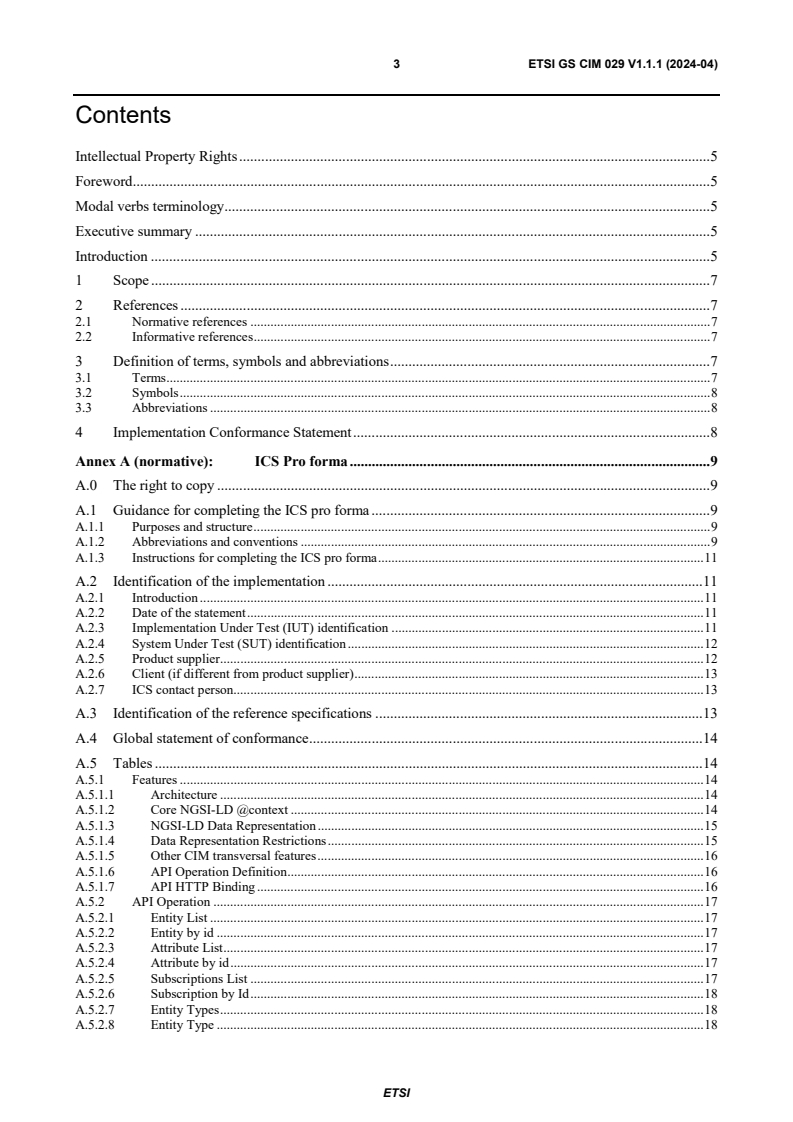
Contents
Intellectual Property Rights . 5
Foreword . 5
Modal verbs terminology . 5
Executive summary . 5
Introduction . 5
1 Scope . 7
2 References . 7
2.1 Normative references . 7
2.2 Informative references . 7
3 Definition of terms, symbols and abbreviations . 7
3.1 Terms . 7
3.2 Symbols . 8
3.3 Abbreviations . 8
4 Implementation Conformance Statement . 8
Annex A (normative): ICS Pro forma . 9
A.0 The right to copy . 9
A.1 Guidance for completing the ICS pro forma . 9
A.1.1 Purposes and structure . 9
A.1.2 Abbreviations and conventions . 9
A.1.3 Instructions for completing the ICS pro forma . 11
A.2 Identification of the implementation . 11
A.2.1 Introduction . 11
A.2.2 Date of the statement . 11
A.2.3 Implementation Under Test (IUT) identification . 11
A.2.4 System Under Test (SUT) identification . 12
A.2.5 Product supplier . 12
A.2.6 Client (if different from product supplier) . 13
A.2.7 ICS contact person. 13
A.3 Identification of the reference specifications . 13
A.4 Global statement of conformance . 14
A.5 Tables . 14
A.5.1 Features . 14
A.5.1.1 Architecture . 14
A.5.1.2 Core NGSI-LD @context . 14
A.5.1.3 NGSI-LD Data Representation . 15
A.5.1.4 Data Representation Restrictions . 15
A.5.1.5 Other CIM transversal features . 16
A.5.1.6 API Operation Definition . 16
A.5.1.7 API HTTP Binding . 16
A.5.2 API Operation . 17
A.5.2.1 Entity List . 17
A.5.2.2 Entity by id . 17
A.5.2.3 Attribute List . 17
A.5.2.4 Attribute by id . 17
A.5.2.5 Subscriptions List . 17
A.5.2.6 Subscription by Id . 18
A.5.2.7 Entity Types . 18
A.5.2.8 Entity Type . 18
ETSI
4 ETSI GS CIM 029 V1.1.1 (2024-04)
A.5.2.9 Attributes . 18
A.5.2.10 Attribute . 18
A.5.2.11 Context source registration list . 18
A.5.2.12 Context source registration by Id . 18
A.5.2.13 Context source registration subscription list . 19
A.5.2.14 Context source registration subscription by Id . 19
A.5.2.15 Entity Operations. Create . 19
A.5.2.16 Entity Operations. Upsert . 19
A.5.2.17 Entity Operations. Update . 19
A.5.2.18 Entity Operations. Delete . 19
A.5.2.19 Entity Operations. Query . 19
A.5.2.20 Entity Operations. Merge . 20
A.5.2.21 Temporal Evolution of Entities . 20
A.5.2.22 Temporal Evolution of an Entity by id . 20
A.5.2.23 Temporal Representation of Attribute List . 20
A.5.2.24 Temporal Representation of Attribute by id . 20
A.5.2.25 Temporal Representation of Attribute Instance by id . 20
A.5.2.26 Temporal Query Operation . 20
A.5.2.27 Add and List @context . 21
A.5.2.28 Serve, Delete and Reload @context . 21
A.5.2.29 Retrieve, Update and Delete Entity Maps . 21
A.5.2.30 Retrieve Context Source Identity Information . 21
A.6 Mnemonics for PICS . 21
A.6.1 Mnemonics for PICS reference . 21
Annex (informative): Change history . 24
History . 25
ETSI
5 ETSI GS CIM 029 V1.1.1 (2024-04)
Intellectual Property Rights
Essential patents
IPRs essential or potentially essential to normative deliverables may have been declared to ETSI. The declarations
pertaining to these essential IPRs, if any, are publicly available for ETSI members and non-members, and can be
found in ETSI SR 000 314: "Intellectual Property Rights (IPRs); Essential, or potentially Essential, IPRs notified to
ETSI in respect of ETSI standards", which is available from the ETSI Secretariat. Latest updates are available on the
ETSI Web server (https://ipr.etsi.org/).
Pursuant to the ETSI Directives including the ETSI IPR Policy, no investigation regarding the essentiality of IPRs,
including IPR searches, has been carried out by ETSI. No guarantee can be given as to the existence of other IPRs not
referenced in ETSI SR 000 314 (or the updates on the ETSI Web server) which are, or may be, or may become,
essential to the present document.
Trademarks
The present document may include trademarks and/or tradenames which are asserted and/or registered by their owners.
ETSI claims no ownership of these except for any which are indicated as being the property of ETSI, and conveys no
right to use or reproduce any trademark and/or tradename. Mention of those trademarks in the present document does
not constitute an endorsement by ETSI of products, services or organizations associated with those trademarks.
DECT™, PLUGTESTS™, UMTS™ and the ETSI logo are trademarks of ETSI registered for the benefit of its
Members. 3GPP™ and LTE™ are trademarks of ETSI registered for the benefit of its Members and of the 3GPP
Organizational Partners. oneM2M™ logo is a trademark of ETSI registered for the benefit of its Members and of the ®
oneM2M Partners. GSM and the GSM logo are trademarks registered and owned by the GSM Association.
Foreword
This Group Specification (GS) has been produced by ETSI Industry Specification Group (ISG) cross-cutting Context
Information Management (CIM).
Modal verbs terminology
In the present document "shall", "shall not", "should", "should not", "may", "need not", "will", "will not", "can" and
"cannot" are to be interpreted as described in clause 3.2 of the ETSI Drafting Rules (Verbal forms for the expression of
provisions).
"must" and "must not" are NOT allowed in ETSI deliverables except when used in direct citation.
Executive summary
The present document is providing operational guidance to the one developing and using the NGSI-LD test suites. It
lists the Implementation Conformance Statements (ICSs).
Introduction
The ISG CIM group has defined an API for exchange of information contextualized in time, space and relation to other
information using a property graph model with the intent that the associated protocol (called NGSI-LD) becomes the
"glue" between all kinds of applications and databases associated with services for Smart Cities, Smart Agriculture,
Smart Manufacturing, etc.
ETSI
6 ETSI GS CIM 029 V1.1.1 (2024-04)
To be successful, the NGSI-LD API specification needs to be well understood and well implemented. The community
of users will not be solely highly professional engineers employed by big companies but will include many small teams
and SMEs and even hobbyists. Therefore, it is essential that the developers have access to not only the standard but also
a test specification and a testing environment to check that their work is (and remains) conformant to the ETSI
NGSI-LD specification.
The developers will usually write integration tests to validate the behaviour of their NGSI-LD implementation, but it is
important to assert compliance to the specification based on a test suite agreed by the group creating the API
specification, i.e. ETSI ISG CIM. Therefore, it is very important to create a set of ETSI-approved test cases.
What is more, the existence of such a test suite will likely help to increase the adoption of the NGSI-LD specification
by giving developers a ready to use and complete set of sample requests.
The present document specifies the Implementation Conformance Statements (ICSs) aimed at listing the target
capabilities of the NGSI-LD specification.
ETSI
7 ETSI GS CIM 029 V1.1.1 (2024-04)
1 Scope
The present document provides the Implementation Conformance Statement which is basically a checklist for a
client-owner and developers of implementations so they know what parts of the specification will be tested and if any is
optional.
2 References
2.1 Normative references
References are either specific (identified by date of publication and/or edition number or version number) or
non-specific. For specific references, only the cited version applies. For non-specific references, the latest version of the
referenced document (including any amendments) applies.
Referenced documents which are not found to be publicly available in the expected location might be found at
https://docbox.etsi.org/Reference.
NOTE: While any hyperlinks included in this clause were valid at the time of publication, ETSI cannot guarantee
their long term validity.
The following referenced documents are necessary for the application of the present document.
[1] ETSI GS CIM 009 (V1.5.1): "Context Information Management (CIM); NGSI-LD API".
2.2 Informative references
References are either specific (identified by date of publication and/or edition number or version number) or
non-specific. For specific references, only the cited version applies. For non-specific references, the latest version of the
referenced document (including any amendments) applies.
NOTE: While any hyperlinks included in this clause were valid at the time of publication, ETSI cannot guarantee
their long term validity.
The following referenced documents are not necessary for the application of the present document but they assist the
user with regard to a particular subject area.
[i.1] ISO/IEC 9646-7: "Information technology -- Open Systems Interconnection -- Conformance
testing methodology and framework -- Part 7: Implementation Conformance Statements".
3 Definition of terms, symbols and abbreviations
3.1 Terms
For the purposes of the present document, the following terms apply:
NOTE: The letters "NGSI-LD" were added to most terms to confirm that they are distinct from other terms of
similar/same name in use in other organizations, however, in the present document the letters "NGSI-LD"
are generally omitted for brevity.
NGSI-LD Central Broker: NGSI-LD Context Broker that only uses a local storage when serving NGSI-LD requests,
without involving any external Context Sources
NGSI-LD Context Broker: architectural component that implements all the NGSI-LD interfaces
NGSI-LD Context Consumer: agent that uses the query and subscription functionality of NGSI-LD to retrieve context
information
ETSI
8 ETSI GS CIM 029 V1.1.1 (2024-04)
NGSI-LD Context Producer: agent that uses the NGSI-LD context provision and/or registration functionality to
provide or announce the availability of its context information to an NGSI-LD Context Broker
NGSI-LD Context Registry: software functional element where Context Sources register the information that they can
provide
NOTE: It is used by Distribution Brokers and Federation Brokers to find the appropriate Context Sources which
can provide the information required for serving an NGSI-LD request.
NGSI-LD Context Source: source of context information which implements the NGSI-LD consumption and
subscription (and possibly provision) interfaces defined by the present document
NOTE: It is usually registered with an NGSI-LD Registry so that it can announce what kind of information it can
provide, when requested, to Context Consumers and Brokers.
NGSI-LD Distribution Broker: NGSI-LD Context Broker that uses both local context information and registration
information from an NGSI-LD Context Registry, to access matching context information from a set of distributed
Context Sources
NGSI-LD Federation Broker: Distribution Broker that federates information from multiple underlying NGSI-LD
Context Brokers and across domains
3.2 Symbols
Void.
3.3 Abbreviations
For the purposes of the present document, the following abbreviations apply:
API Application Programming Interface
GS Group Specification
HTTP HyperText Transfer Protocol
ICS Implementation Conformance Statement
ISG Industry Specification Group
ISO International Organization for Standardization
IUT Implementation Under Test
JSON JavaScript Object Notation
JSON-LD JSON Linked Data
NGSI Next Generation Service Interfaces
PDU Protocol Data Unit
PICS Profile Implementation Conformance Statement
SUT Implementation Under Test
TB Technical Body
ToR Terms of Reference
TP Test Purposes
4 Implementation Conformance Statement
An ICS pro forma which conforms to this ICS pro forma specification shall be technically equivalent to annex A, and
shall preserve the numbering and ordering of the items in annex A.
An ICS which conforms to this PICS pro forma specification shall:
a) describe an implementation which claims to conform to ETSI GS CIM 009 [1];
b) be a conforming ICS pro forma which has been completed in accordance with the instructions for completion
given in clause A.1;
c) include the information necessary to uniquely identify both the supplier and the implementation.
ETSI
9 ETSI GS CIM 029 V1.1.1 (2024-04)
Annex A (normative):
ICS Pro forma
A.0 The right to copy
Notwithstanding the provisions of the copyright clause related to the text of the present document, ETSI grants that
users of the present document may freely reproduce the ICS pro forma in this annex so that it can be used for its
intended purposes and may further publish the completed ICS pro forma.
A.1 Guidance for completing the ICS pro forma
A.1.1 Purposes and structure
The purpose of this ICS pro forma is to provide a mechanism whereby a supplier of an implementation of the
requirements defined in ETSI GS CIM 009 may provide information about the implementation in a standardized
manner.
The ICS pro forma is subdivided into clauses for the following categories of information:
• guidance for completing the ICS pro forma;
• identification of the implementation;
• global statement of conformance;
• ICS pro forma tables.
A.1.2 Abbreviations and conventions
The ICS pro forma contained in annex A is comprised of information in tabular form in accordance with the guidelines
presented in ISO/IEC 9646-7.
Item column
The item column contains a number which identifies the item in the table.
Item description column
The item description column describes in free text each respective item (e.g. parameters, timers, etc.). It implicitly
means "is supported by the implementation?".
Reference column
The reference column gives reference to the relevant sections in core specifications.
Status column
The various status used in this annex are in accordance with the rules in table A.1.2-1.
ETSI
10 ETSI GS CIM 029 V1.1.1 (2024-04)
Table A.1.2-1: Key to status codes
Status code Status name Meaning
m mandatory The capability shall be supported. It is a static view of the fact that the
conformance requirements related to the capability in the reference
specification are mandatory requirements. This does not mean that a given
behaviour shall always be observed (this would be a dynamic view), but that it
shall be observed when the implementation is placed in conditions where the
conformance requirements from the reference specification compel it to do
so. For instance, if the support for a parameter in a sent PDU is mandatory, it
does not mean that it shall always be present, but that it shall be present
according to the description of the behaviour in the reference specification
(dynamic conformance requirement).
o optional The capability may or may not be supported. It is an implementation choice.
n/a not applicable It is impossible to use the capability. No answer in the support column is
required.
c. conditional The requirement on the capability ("m", "o", "n/a") depends on the support of
other optional or conditional items. is the identifier of the conditional
expressio
...
Questions, Comments and Discussion
Ask us and Technical Secretary will try to provide an answer. You can facilitate discussion about the standard in here.
Loading comments...