


ETSI TS 103 806 V1.1.1 (2023-11)
Smart Body Area Network (SmartBAN); Hub to Hub Communication for SmartBAN Medium Access Control (MAC)
Smart Body Area Network (SmartBAN); Hub to Hub Communication for SmartBAN Medium Access Control (MAC)
DTS/SmartBAN-0019
General Information
Standards Content (Sample)
TECHNICAL SPECIFICATION
Smart Body Area Network (SmartBAN);
Hub to Hub Communication for
SmartBAN Medium Access Control (MAC)
2 ETSI TS 103 806 V1.1.1 (2023-11)
Reference
DTS/SmartBAN-0019
Keywords
MAC
ETSI
650 Route des Lucioles
F-06921 Sophia Antipolis Cedex - FRANCE
Tel.: +33 4 92 94 42 00 Fax: +33 4 93 65 47 16
Siret N° 348 623 562 00017 - APE 7112B
Association à but non lucratif enregistrée à la
Sous-Préfecture de Grasse (06) N° w061004871
Important notice
The present document can be downloaded from:
https://www.etsi.org/standards-search
The present document may be made available in electronic versions and/or in print. The content of any electronic and/or
print versions of the present document shall not be modified without the prior written authorization of ETSI. In case of any
existing or perceived difference in contents between such versions and/or in print, the prevailing version of an ETSI
deliverable is the one made publicly available in PDF format at www.etsi.org/deliver.
Users of the present document should be aware that the document may be subject to revision or change of status.
Information on the current status of this and other ETSI documents is available at
https://portal.etsi.org/TB/ETSIDeliverableStatus.aspx
If you find errors in the present document, please send your comment to one of the following services:
https://portal.etsi.org/People/CommiteeSupportStaff.aspx
If you find a security vulnerability in the present document, please report it through our
Coordinated Vulnerability Disclosure Program:
https://www.etsi.org/standards/coordinated-vulnerability-disclosure
Notice of disclaimer & limitation of liability
The information provided in the present deliverable is directed solely to professionals who have the appropriate degree of
experience to understand and interpret its content in accordance with generally accepted engineering or
other professional standard and applicable regulations.
No recommendation as to products and services or vendors is made or should be implied.
No representation or warranty is made that this deliverable is technically accurate or sufficient or conforms to any law
and/or governmental rule and/or regulation and further, no representation or warranty is made of merchantability or fitness
for any particular purpose or against infringement of intellectual property rights.
In no event shall ETSI be held liable for loss of profits or any other incidental or consequential damages.
Any software contained in this deliverable is provided "AS IS" with no warranties, express or implied, including but not
limited to, the warranties of merchantability, fitness for a particular purpose and non-infringement of intellectual property
rights and ETSI shall not be held liable in any event for any damages whatsoever (including, without limitation, damages
for loss of profits, business interruption, loss of information, or any other pecuniary loss) arising out of or related to the use
of or inability to use the software.
Copyright Notification
No part may be reproduced or utilized in any form or by any means, electronic or mechanical, including photocopying and
microfilm except as authorized by written permission of ETSI.
The content of the PDF version shall not be modified without the written authorization of ETSI.
The copyright and the foregoing restriction extend to reproduction in all media.
© ETSI 2023.
All rights reserved.
ETSI
3 ETSI TS 103 806 V1.1.1 (2023-11)
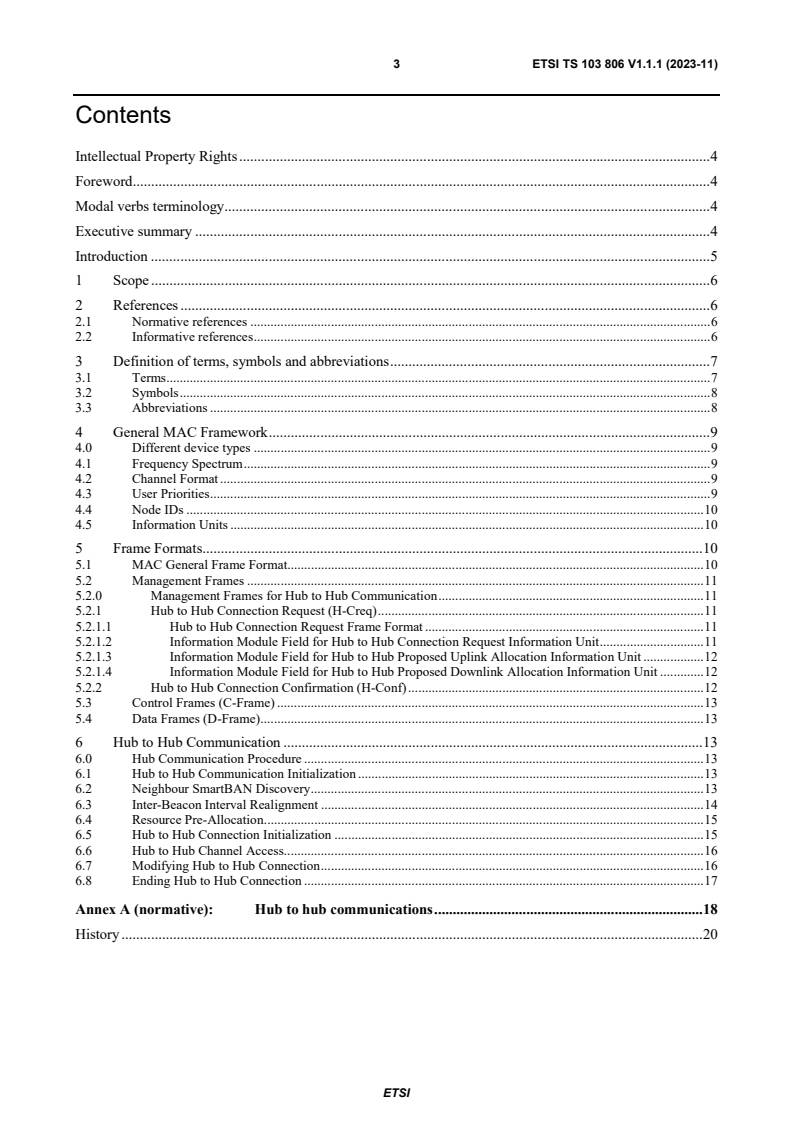
Contents
Intellectual Property Rights . 4
Foreword . 4
Modal verbs terminology . 4
Executive summary . 4
Introduction . 5
1 Scope . 6
2 References . 6
2.1 Normative references . 6
2.2 Informative references . 6
3 Definition of terms, symbols and abbreviations . 7
3.1 Terms . 7
3.2 Symbols . 8
3.3 Abbreviations . 8
4 General MAC Framework . 9
4.0 Different device types . 9
4.1 Frequency Spectrum . 9
4.2 Channel Format . 9
4.3 User Priorities . 9
4.4 Node IDs . 10
4.5 Information Units . 10
5 Frame Formats . 10
5.1 MAC General Frame Format. 10
5.2 Management Frames . 11
5.2.0 Management Frames for Hub to Hub Communication . 11
5.2.1 Hub to Hub Connection Request (H-Creq) . 11
5.2.1.1 Hub to Hub Connection Request Frame Format . 11
5.2.1.2 Information Module Field for Hub to Hub Connection Request Information Unit . 11
5.2.1.3 Information Module Field for Hub to Hub Proposed Uplink Allocation Information Unit . 12
5.2.1.4 Information Module Field for Hub to Hub Proposed Downlink Allocation Information Unit . 12
5.2.2 Hub to Hub Connection Confirmation (H-Conf) . 12
5.3 Control Frames (C-Frame) . 13
5.4 Data Frames (D-Frame) . 13
6 Hub to Hub Communication . 13
6.0 Hub Communication Procedure . 13
6.1 Hub to Hub Communication Initialization . 13
6.2 Neighbour SmartBAN Discovery . 13
6.3 Inter-Beacon Interval Realignment . 14
6.4 Resource Pre-Allocation . 15
6.5 Hub to Hub Connection Initialization . 15
6.6 Hub to Hub Channel Access. 16
6.7 Modifying Hub to Hub Connection . 16
6.8 Ending Hub to Hub Connection . 17
Annex A (normative): Hub to hub communications . 18
History . 20
ETSI
4 ETSI TS 103 806 V1.1.1 (2023-11)
Intellectual Property Rights
Essential patents
IPRs essential or potentially essential to normative deliverables may have been declared to ETSI. The declarations
pertaining to these essential IPRs, if any, are publicly available for ETSI members and non-members, and can be
found in ETSI SR 000 314: "Intellectual Property Rights (IPRs); Essential, or potentially Essential, IPRs notified to
ETSI in respect of ETSI standards", which is available from the ETSI Secretariat. Latest updates are available on the
ETSI Web server (https://ipr.etsi.org/).
Pursuant to the ETSI Directives including the ETSI IPR Policy, no investigation regarding the essentiality of IPRs,
including IPR searches, has been carried out by ETSI. No guarantee can be given as to the existence of other IPRs not
referenced in ETSI SR 000 314 (or the updates on the ETSI Web server) which are, or may be, or may become,
essential to the present document.
Trademarks
The present document may include trademarks and/or tradenames which are asserted and/or registered by their owners.
ETSI claims no ownership of these except for any which are indicated as being the property of ETSI, and conveys no
right to use or reproduce any trademark and/or tradename. Mention of those trademarks in the present document does
not constitute an endorsement by ETSI of products, services or organizations associated with those trademarks.
DECT™, PLUGTESTS™, UMTS™ and the ETSI logo are trademarks of ETSI registered for the benefit of its
Members. 3GPP™ and LTE™ are trademarks of ETSI registered for the benefit of its Members and of the 3GPP
Organizational Partners. oneM2M™ logo is a trademark of ETSI registered for the benefit of its Members and of the ®
oneM2M Partners. GSM and the GSM logo are trademarks registered and owned by the GSM Association.
Foreword
This Technical Specification (TS) has been produced by ETSI Technical Committee Smart Body Area Network
(SmartBAN).
Modal verbs terminology
In the present document "shall", "shall not", "should", "should not", "may", "need not", "will", "will not", "can" and
"cannot" are to be interpreted as described in clause 3.2 of the ETSI Drafting Rules (Verbal forms for the expression of
provisions).
"must" and "must not" are NOT allowed in ETSI deliverables except when used in direct citation.
Executive summary
The present document defines technical specifications for hub to hub communication capability for ETSI SmartBAN.
The specifications extend the general Medium Access Control (MAC) framework defined for SmartBAN by enabling
the communication between hubs of two neighbouring SmartBANs.
Hub to hub communication procedure can be divided into eight steps as follows:
1) Hub to hub communication initialization.
2) Neighbour SmartBAN discovery.
3) Inter-beacon interval realignment.
4) Resource pre-allocation.
5) Hub to hub connection initialization.
ETSI
5 ETSI TS 103 806 V1.1.1 (2023-11)
6) Hub to hub channel access.
7) Modifying hub to hub connection.
8) Ending hub to hub communication.
The present document is structured as follows: firstly, the additional management frames and information units required
for the hub to hub communication are defined. Secondly, the present document details the operational procedures for
the hub to hub communications. Finally, Annex A includes two normative flowcharts defining the hub to
communications.
Introduction
Modern medical and health monitoring equipment is moving towards the trend of wireless connectivity between the
data collection or control centre and the medical devices or sensors. Therefore, a standardized communication interface
and protocol between the actors are required. This network of actors performing some medical monitoring or functions
is called a Smart Body Area Network (SmartBAN).
A SmartBAN is a simple, low complexity, low energy communication network that allows wireless connectivity
between the devices and a hub. The distinct features of the SmartBAN are ease of access, minimal listening, reliable
data transfer, and provision of additional control messages (in the form of C-Beacons) for the low-duty cycling nodes
while maintaining a simple and flexible protocol. SmartBAN also provides a multi-use channel access mechanism for
emergency and other high-priority access and improved channel utilization.
The basic access specifications for Medium Access Control (MAC) are defined in [1] and for physical layer (PHY) in
[2]. The present document extends [1] by defining technical specifications for hub to hub communications enabling
communication between the hubs of neighbouring SmartBANs.
Additional information can be found in the following documents:
• ETSI EN 300 328-1 [i.1] defines requirements for equipment operating in the 2,4 GHz ISM band;
• IEEE 802.15.6-2012 [i.2] defines an alternative standard for Wireless Body Area Networks; and
• IEEE 802.15.4-2011 [i.3] defines a standard for Wireless Personal Area Networks;
• ETSI TS 103 805 [i.4] defines relay functionality for SmartBAN MAC defined in ETSI TS 103 325 [1].
ETSI
6 ETSI TS 103 806 V1.1.1 (2023-11)
1 Scope
The present document extends the low complexity Medium Access Control (MAC) for SmartBAN defined in ETSI
TS 103 325 [1] with hub to hub communication capability. The main scope of the present document is to define
specifications for enabling hub to hub communication between the hubs of neighbouring SmartBANs.
2 References
2.1 Normative references
References are either specific (identified by date of publication and/or edition number or version number) or
non-specific. For specific references, only the cited version applies. For non-specific references, the latest version of the
referenced document (including any amendments) applies.
Referenced documents which are not found to be publicly available in the expected location might be found at
https://docbox.etsi.org/Reference.
NOTE: While any hyperlinks included in this clause were valid at the time of publication, ETSI cannot guarantee
their long term validity.
The following referenced documents are necessary for the application of the present document.
[1] ETSI TS 103 325 (V1.2.1) (2022-07): "Smart Body Area Network (SmartBAN); Low Complexity
Medium Access Control (MAC) for SmartBAN".
[2] ETSI TS 103 326 (V1.2.1) (2021-07): "Smart Body Area Network (SmartBAN); Enhanced
Ultra-Low Power Physical Layer".
2.2 Informative references
References are either specific (identified by date of publication and/or edition number or version number) or
non-specific. For specific references, only the cited version applies. For non-specific references, the latest version of the
referenced document (including any amendments) applies.
NOTE: While any hyperlinks included in this clause were valid at the time of publication, ETSI cannot guarantee
their long term validity.
The following referenced documents are not necessary for the application of the present document but they assist the
user with regard to a particular subject area.
[i.1] ETSI EN 300 328-1 (V1.3.1): "Electromagnetic compatibility and Radio spectrum Matters (ERM);
Wideband Transmission systems; Data transmission equipment operating in the 2,4 GHz ISM
band and using spread spectrum modulation techniques; Part 1: Technical characteristics and test
conditions".
[i.2] IEEE™ 802.15.6-2012: "IEEE Standard for Local and metropolitan area networks -
Part 15.6: Wireless Body Area Networks".
[i.3] IEEE™ 802.15.4-2011: "IEEE Standard for Local and metropolitan area networks -
Part 15:4: Wireless Medium Access Control (MAC) and Physical Layer (PHY) Specification for
Low-Rate Wireless Personal Area Networks".
[i.4] ETSI TS 103 805: "Smart Body Area Network (SmartBAN); Relay Functionality for SmartBAN
Medium Access Control (MAC)".
ETSI
7 ETSI TS 103 806 V1.1.1 (2023-11)
3 Definition of terms, symbols and abbreviations
3.1 Terms
For the purposes of the present document, the following terms apply:
active period: period within the superframe period that is ready for frame reception and transmission
active state: internal power management state that is ready for the frame reception and transmission
allocation: one or more time intervals that a node or a hub obtains using an access method for initiating one or more
frame transactions
beacon: frame transmitted by a hub to facilitate network management, such as the coordination of medium access and
power management of the nodes in the SmartBAN, and to facilitate clock synchronization therein
beacon period: duration when a beacon is transmitted
connection: relation between a node and a hub in a Body Area Network (BAN), substantiated by an identification
assigned to the node by the hub and by access arrangement between them
device: entity conforming to the SmartBAN medium access control and physical interface to the wireless medium
downlink: communication link for transfer of management and data traffic from a hub to a node, or in the context of
the hub to hub communication, from target hub to initiating hub
frame: uninterrupted sequence of octets delivered by the Medium Access Control (MAC) sublayer to the Physical
(PHY) layer, or vice versa, within a node or a hub
hub: entity that possesses a node's functionality and coordinates the medium access and power management of the
nodes in the SmartBAN
hub to hub mode: optional enhanced operation mode where hubs of neighbouring SmartBANs may form a connection,
obtain allocation(s), and transmit and receive management and data traffic between them
inactive period: period in time following an active transmission sequence during which the equipment other than the
hub does not transmit or receive
medical device: any instrument, apparatus, appliance, software, material or other article, whether used alone or in
combination, together with any accessories, including the software intended by its manufacturer to be used specifically
for diagnostic and/or therapeutic purposes and necessary for its proper application, intended by the manufacturer to be
used for human beings for the purpose of:
• diagnosis, prevention, monitoring, treatment or alleviation of disease;
• diagnosis, monitoring, treatment, alleviation of or compensation for an injury or handicap;
• investigation, replacement or modification of the anatomy or of a physiological process;
• control of conception;
and which does not achieve its principal intended action in or on the human body by pharmacological, immunological
or metabolic means, but which may be assisted in its function by such means
...
Questions, Comments and Discussion
Ask us and Technical Secretary will try to provide an answer. You can facilitate discussion about the standard in here.
Loading comments...