


ETSI GS NFV-TST 013 V1.1.1 (2022-09)
Network Functions Virtualisation (NFV); Testing; Test Case Description Template Specification
Network Functions Virtualisation (NFV); Testing; Test Case Description Template Specification
DGS/NFV-TST013
General Information
Standards Content (Sample)
GROUP SPECIFICATION
Network Functions Virtualisation (NFV);
Testing;
Test Case Description Template Specification
Disclaimer
The present document has been produced and approved by the Network Functions Virtualisation (NFV) ETSI Industry
Specification Group (ISG) and represents the views of those members who participated in this ISG.
It does not necessarily represent the views of the entire ETSI membership.
2 ETSI GS NFV-TST 013 V1.1.1 (2022-09)
Reference
DGS/NFV-TST013
Keywords
NFV, script, testing
ETSI
650 Route des Lucioles
F-06921 Sophia Antipolis Cedex - FRANCE
Tel.: +33 4 92 94 42 00 Fax: +33 4 93 65 47 16
Siret N° 348 623 562 00017 - APE 7112B
Association à but non lucratif enregistrée à la
Sous-Préfecture de Grasse (06) N° w061004871
Important notice
The present document can be downloaded from:
http://www.etsi.org/standards-search
The present document may be made available in electronic versions and/or in print. The content of any electronic and/or
print versions of the present document shall not be modified without the prior written authorization of ETSI. In case of any
existing or perceived difference in contents between such versions and/or in print, the prevailing version of an ETSI
deliverable is the one made publicly available in PDF format at www.etsi.org/deliver.
Users of the present document should be aware that the document may be subject to revision or change of status.
Information on the current status of this and other ETSI documents is available at
https://portal.etsi.org/TB/ETSIDeliverableStatus.aspx
If you find errors in the present document, please send your comment to one of the following services:
https://portal.etsi.org/People/CommiteeSupportStaff.aspx
If you find a security vulnerability in the present document, please report it through our
Coordinated Vulnerability Disclosure Program:
https://www.etsi.org/standards/coordinated-vulnerability-disclosure
Notice of disclaimer & limitation of liability
The information provided in the present deliverable is directed solely to professionals who have the appropriate degree of
experience to understand and interpret its content in accordance with generally accepted engineering or
other professional standard and applicable regulations.
No recommendation as to products and services or vendors is made or should be implied.
No representation or warranty is made that this deliverable is technically accurate or sufficient or conforms to any law
and/or governmental rule and/or regulation and further, no representation or warranty is made of merchantability or fitness
for any particular purpose or against infringement of intellectual property rights.
In no event shall ETSI be held liable for loss of profits or any other incidental or consequential damages.
Any software contained in this deliverable is provided "AS IS" with no warranties, express or implied, including but not
limited to, the warranties of merchantability, fitness for a particular purpose and non-infringement of intellectual property
rights and ETSI shall not be held liable in any event for any damages whatsoever (including, without limitation, damages
for loss of profits, business interruption, loss of information, or any other pecuniary loss) arising out of or related to the use
of or inability to use the software.
Copyright Notification
No part may be reproduced or utilized in any form or by any means, electronic or mechanical, including photocopying and
microfilm except as authorized by written permission of ETSI.
The content of the PDF version shall not be modified without the written authorization of ETSI.
The copyright and the foregoing restriction extend to reproduction in all media.
© ETSI 2022.
All rights reserved.
ETSI
3 ETSI GS NFV-TST 013 V1.1.1 (2022-09)
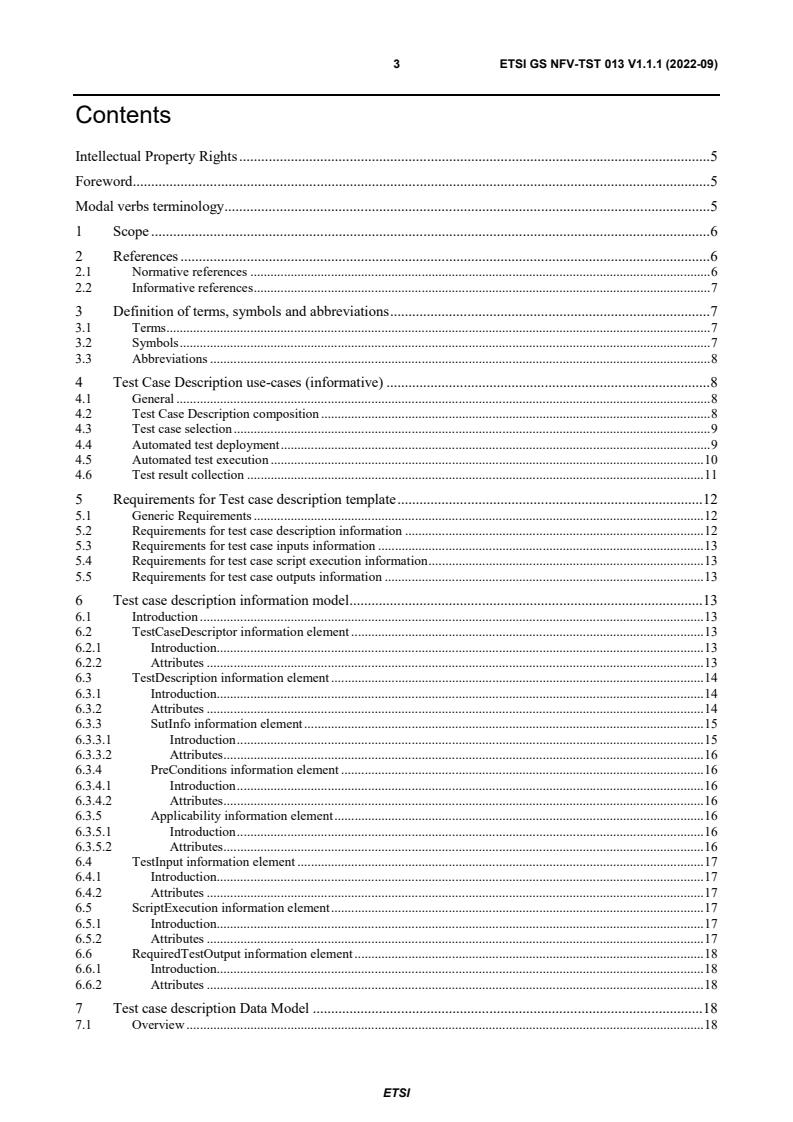
Contents
Intellectual Property Rights . 5
Foreword . 5
Modal verbs terminology . 5
1 Scope . 6
2 References . 6
2.1 Normative references . 6
2.2 Informative references . 7
3 Definition of terms, symbols and abbreviations . 7
3.1 Terms . 7
3.2 Symbols . 7
3.3 Abbreviations . 8
4 Test Case Description use-cases (informative) . 8
4.1 General . 8
4.2 Test Case Description composition . 8
4.3 Test case selection . 9
4.4 Automated test deployment . 9
4.5 Automated test execution . 10
4.6 Test result collection . 11
5 Requirements for Test case description template . 12
5.1 Generic Requirements . 12
5.2 Requirements for test case description information . 12
5.3 Requirements for test case inputs information . 13
5.4 Requirements for test case script execution information . 13
5.5 Requirements for test case outputs information . 13
6 Test case description information model . 13
6.1 Introduction . 13
6.2 TestCaseDescriptor information element . 13
6.2.1 Introduction. 13
6.2.2 Attributes . 13
6.3 TestDescription information element . 14
6.3.1 Introduction. 14
6.3.2 Attributes . 14
6.3.3 SutInfo information element . 15
6.3.3.1 Introduction . 15
6.3.3.2 Attributes . 16
6.3.4 PreConditions information element . 16
6.3.4.1 Introduction . 16
6.3.4.2 Attributes . 16
6.3.5 Applicability information element . 16
6.3.5.1 Introduction . 16
6.3.5.2 Attributes . 16
6.4 TestInput information element . 17
6.4.1 Introduction. 17
6.4.2 Attributes . 17
6.5 ScriptExecution information element . 17
6.5.1 Introduction. 17
6.5.2 Attributes . 17
6.6 RequiredTestOutput information element . 18
6.6.1 Introduction. 18
6.6.2 Attributes . 18
7 Test case description Data Model . 18
7.1 Overview . 18
ETSI
4 ETSI GS NFV-TST 013 V1.1.1 (2022-09)
7.2 Common data types . 18
7.2.1 Introduction. 18
7.2.2 Simple data types . 18
7.2.3 Structured data types . 19
7.3 Data model for TestDescription . 20
7.3.1 Introduction. 20
7.3.2 TestDescription element . 20
7.4 Data model for TestInput . 23
7.4.1 Introduction. 23
7.4.2 TestInput element . 23
7.5 Data model for ScriptExecution . 23
7.5.1 Introduction. 23
7.5.2 ScriptExecution element . 23
7.6 Data model for RequiredTestOutput . 24
7.6.1 Introduction. 24
7.6.2 RequiredTestOutput element . 24
Annex A (informative): Examples using test description template . 26
A.1 Example#1: VNF Traffic Forwarding Test Description . 26
Annex B (informative): Bibliography . 28
Annex C (informative): Change history . 29
History . 30
ETSI
5 ETSI GS NFV-TST 013 V1.1.1 (2022-09)
Intellectual Property Rights
Essential patents
IPRs essential or potentially essential to normative deliverables may have been declared to ETSI. The declarations
pertaining to these essential IPRs, if any, are publicly available for ETSI members and non-members, and can be
found in ETSI SR 000 314: "Intellectual Property Rights (IPRs); Essential, or potentially Essential, IPRs notified to
ETSI in respect of ETSI standards", which is available from the ETSI Secretariat. Latest updates are available on the
ETSI Web server (https://ipr.etsi.org/).
Pursuant to the ETSI Directives including the ETSI IPR Policy, no investigation regarding the essentiality of IPRs,
including IPR searches, has been carried out by ETSI. No guarantee can be given as to the existence of other IPRs not
referenced in ETSI SR 000 314 (or the updates on the ETSI Web server) which are, or may be, or may become,
essential to the present document.
Trademarks
The present document may include trademarks and/or tradenames which are asserted and/or registered by their owners.
ETSI claims no ownership of these except for any which are indicated as being the property of ETSI, and conveys no
right to use or reproduce any trademark and/or tradename. Mention of those trademarks in the present document does
not constitute an endorsement by ETSI of products, services or organizations associated with those trademarks.
DECT™, PLUGTESTS™, UMTS™ and the ETSI logo are trademarks of ETSI registered for the benefit of its
Members. 3GPP™ and LTE™ are trademarks of ETSI registered for the benefit of its Members and of the 3GPP
Organizational Partners. oneM2M™ logo is a trademark of ETSI registered for the benefit of its Members and of the ®
oneM2M Partners. GSM and the GSM logo are trademarks registered and owned by the GSM Association.
Foreword
This Group Specification (GS) has been produced by ETSI Industry Specification Group (ISG) Network Functions
Virtualisation (NFV).
Modal verbs terminology
In the present document "shall", "shall not", "should", "should not", "may", "need not", "will", "will not", "can" and
"cannot" are to be interpreted as described in clause 3.2 of the ETSI Drafting Rules (Verbal forms for the expression of
provisions).
"must" and "must not" are NOT allowed in ETSI deliverables except when used in direct citation.
ETSI
6 ETSI GS NFV-TST 013 V1.1.1 (2022-09)
1 Scope
The present document is based on the requirement of establishing a test case description convention between operators
and providers in DevOps automated testing. It proposes a test case description template, to be used for standardizing the
input and output information exchanged for test execution and result analysis.
The standardized test case description template in the present document aims at determining a standardized machine-
readable format to for (but not restricted to):
1) Test case description information
2) Test case input information
3) Test case script designation information
4) Test case output information
2 References
2.1 Normative references
References are either specific (identified by date of publication and/or edition number or version number) or
non-specific. For specific references, only the cited version applies. For non-specific references, the latest version of the
referenced document (including any amendments) applies.
Referenced documents which are not found to be publicly available in the expected location might be found at
https://docbox.etsi.org/Reference.
NOTE: While any hyperlinks included in this clause were valid at the time of publication, ETSI cannot guarantee
their long-term validity.
The following referenced documents are necessary for the application of the present document.
[1] ETSI GS NFV-TST 010: "Network Function Virtualisation (NFV) Release 2; Testing; API
Conformance Testing Specification".
[2] ETSI GS NFV-SOL 001: "Network Functions Virtualisation (NFV) Release 3; Protocols and Data
Models; NFV descriptors based on TOSCA specification".
[3] ETSI GS NFV-SOL 004: "Network Functions Virtualisation (NFV) Release 2; Protocols and Data
Models; VNF Package and PNFD Archive specification".
[4] ETSI GS NFV-SOL 006: "Network Functions Virtualisation (NFV) Release 3; Protocols and Data
Models; NFV descriptors based on YANG Specification".
[5] ETSI GS NFV-SOL 007: "Network Functions Virtualisation (NFV) Release 3; Protocols and Data
Models; Network Service Descriptor File Structure Specification".
[6] ETSI GS NFV-TST 009: "Network Functions Virtualisation (NFV) Release 3; Testing;
Specification of Networking Benchmarks and Measurement Methods for NFVI".
[7] ETSI GS NFV-SOL 014: "Network Functions Virtualisation (NFV) Release 3; Protocols and Data
Models; YAML data model specification for descriptor-based virtualised resource management".
rd
[8] "YAML Ain't Markup Language (YAML™) Version 1.2", 3 Edition. Oren Ben-Kiki,
Clark Evans, Ingy döt Net.
NOTE: Available at http://www.yaml.org/spec/1.2/spec.html.
[9] IETF RFC 8259: "The JavaScript Object Notation (JSON) Data Interchange Format".
NOTE: Available at https://tools.ietf.org/html/rfc8259.
ETSI
7 ETSI GS NFV-TST 013 V1.1.1 (2022-09)
[10] JSON Schema.
NOTE: Available at https://json-schema.org/.
2.2 Informative references
References are either specific (identified by date of publication and/or edition number or version number) or
non-specific. For specific references, only the cited version applies. For non-specific references, the latest version of the
referenced document (including any amendments) applies.
NOTE: While any hyperlinks included in this clause were valid at the time of publication, ETSI cannot guarantee
their long-term validity.
The following referenced documents are not necessary for the application of the present document but they assist the
user with regard to a particular subject area.
Not applicable.
3 Definition of terms, symbols and abbreviations
3.1 Terms
For the purpose of the present document, the following terms apply:
configuration: element of test case to describe information like network topology and the specific structure of the test
environment
pre-test conditions: element of test case to describe the dependent conditions before the test sequence is performed in
which the SUT/Test Function should be ready for executing the test and in which the test related
parameters/measurements are defined
reference function: reference implementation of NFV functional components in the test environment
NOTE: The NFV functional components which are neither SUT nor Test Function in the test environment are
Reference Function, the actual entity of Reference Function depends on the specific SUT.
test environment: environment which provides all the functional elements needed for the testing execution on SUT,
consists of test functions, reference functions
test function: entity that will be controlled (for example, by test controller) for test execution and monitored to obtain
measurements for test results in the test environment
test PNF: physical instrument as test function in the test environment
test sequence: element of test case which contains a series of test steps listed in sequence to describe the operation of
each step like controlling or checking the SUT/Test Function
test system: specialized tool (system) built for the purpose of testing that has the abilities including test case
management and execution, control and communication with SUT during testing, observation and measurement of test
result
test verdict: element of test case that is used to describe how to record the test result according to the checking step's
result in test sequence. For functionality or API testing, test verdict describes how the result is deemed as passed or
failed; for benchmark testing, test verdict describes which values should be recorded
test VNF: virtual instrument as test function in the test environment
3.2 Symbols
Void.
ETSI
8 ETSI GS NFV-TST 013 V1.1.1 (2022-09)
3.3 Abbreviations
For the purposes of the present document, the following abbreviations apply:
API Application Programming Interface
HTML Hyper Text Markup Language
JSON JavaScript Object Notation
MANO Management and Orchestration
NFV Network Function Virtualization
NFVI Network Function Virtualization Infrastructure
NFVO NFV Orchestrator
NS Network Service
SUT System Under Test
URL Uniform Resource Locator
VIM Virtual Infrastructure Manager
VM Virtual Machine
VNF Virtual Network Function
VNFM VNF Manager
vFW virtual Firewall
XML Extensible Markup Language
YAML YAML Ain't Markup Language
4 Test Case Description use-cases (informative)
4.1 General
The following use cases describe the steps involved in NFV automatic testing, the relevant information may be referred
in the Test Case Description file. The use cases capture the generic processes as well as the actions required to be
performed by actors playing different roles in order to identify the requirements for the standard Test Case Description
format. All the use cases presented in this clause are informative.
For the purpose of the use cases, the roles identified in table 4.1-1 have been identified.
Table 4.1-1: List of roles
Role Description
Test Case Description Provider Provide the Test Case Description file according to corresponding automated test.
Test Case Description Consumer System that parses the Test Case Description file and use the information
obtained from the test description file to automatically execute the test. (For
example, it could be a test framework.)
4.2 Test Case Description composition
Test cases are designed for SUT (in the present document are functional components of the NFV architecture), and
automated tests are implemented. The standardized Test Case Description defined in the present document provides key
information to describe the test, information about deployment automation, information about automated test execution,
and information about test result collection. The Test Case Description composition encompasses steps to describe that
the content in Test Case Description will be specified by which role.
Table 4.2-1: Roles
# Role
1 Test Case Description Provider
ETSI
9 ETSI GS NFV-TST 013 V1.1.1 (2022-09)
Table 4.2-2: Pre-conditions
# Pre-conditions Comment
1 Test case has been designed; automated test has
been implemented
Table 4.2-3: Post-conditions
# Post-conditions Comment
1 A Test Case Description file for corresponding test
case
Table 4.2-4: Base Flow
# Role Action/Description
1 Test Case Description provider According to the automated test, with the standard format,
specify the information including:
• key information to describe the test;
• information about deployment automation;
• information about automated test execution;
• information about test result collection.
4.3 Test case selection
By parsing the key description information of the test case provided in the test description files, the Test Case
Description Consumer may have the capability to select test cases according to the actual test task.
Table 4.3-1: Roles
# Role
1 Test Case Description Consumer
Table 4.3-2: Pre-conditions
# Pre-conditions Comment
1 Test Case Description composition is done
Table 4.3-3: Post-conditions
# Post-conditions Comment
1 The test cases to be executed have been selected
Table 4.3-4: Base Flow
# Role Action/Description
1 Test Case Description Consumer Obtain Test Case Description files.
2 Test Case Description Consumer Parse the key description information of the test case.
3 Test Case Description Consumer Select the test cases to be executed.
4.4 Automated test deployment
Automated test is closely related to the execution environment. SUT, Test Functions and Reference Functions may need
to be deployed automatically before the test execution. Considering the functional components of the NFV architecture
as different type of software, there are kinds of deployment automation solutions.
ETSI
10 ETSI GS NFV-TST 013 V1.1.1 (2022-09)
Typical examples of those solutions are:
• Setting up virtual machines by delivering VM images
• Managing VNF deployments via OpenStack Heat or according to ETSI GS NFV-SOL 001 [2], ETSI
GS NFV-SOL 004 [3], ETSI GS NFV-SOL 006 [4] and ETSI GS NFV-SOL 007 [5] ®
• Managing container deployments via Kubernetes
• Installing application software on top of an operating system
When SUT is a VNF under test, the relevant test functions are VNFs too, the deployment will be that VNFs are
instantiated through NFV MANO. In this case, Test Case Description file may need to specify the resource file
information required for deployment operation: VNF package, and other required parameters depending on demands.
NOTE: Other situations for non-VNF SUTs are FFS.
Table 4.4-1: Roles
# Role
1 Test Case Description Consumer
Table 4.4-2: Pre-conditions
# Pre-conditions Comment
1 The test cases have been selected to be run
Table 4.4-3: Post-conditions
# Post-conditions Comment
1 The SUT/Test Function/Reference Function involved
in the automated test have been deployed
Table 4.4-4: Base Flow
# Role Action/Description
1 Test Case Description Consumer Obtain Test Case Description files.
2 Test Case Description Consumer Map the related parameters to the corresponding values in
actual environment.
3 Test Case Description Consumer With the parameter values, perform the deployment
operation via execute automation scripts.
4.5 Automated test execution
If the role that implements the automated test and the role that executes the automated test are not hosted by the same
organization, a method is needed between these 2 roles to provide the information about how to execute automated
testing.
The test case description file may contain such information, so that the Test Case Description consumer can use the
information to execute the test via parsing the machine-readable test case description file.
During this process, the Test Case Description consumer may need to know:
• By which type of operation the test is performed (e.g. by running a command, by executing a test script or by
call an API).
• The details about the exact operation.
• On which system the operation is done.
ETSI
11 ETSI GS NFV-TST 013 V1.1.1 (2022-09)
• The relevant files for execution (e.g. the test script file).
• The parameters related to actual environment (mapping these parameters to the corresponding values in actual
environment).
• The parameters specified for values related to test steps (may have default values, but also capable to specify
the customized values when execute the test).
Table 4.5-1: Roles
# Role
1 Test Case Description Consumer
Table 4.5-2: Pre-conditions
# Pre-conditions Comment
1 The SUT/Test Function/Reference Function involved
in the automated test have been deployed
Table 4.5-3: Post-conditions
# Post-conditions Comment
1 The automated test execution has finished
Table 4.5-4: Base Flow
# Role Action/Description
1 Test Case Description Consumer Obtain the test case description files.
2 Test Case Description Consumer Parse and confirm the exact operation to execute the test,
fetch or find the related files.
3 Test Case Description Consumer Map the related parameters to the corresponding values in
the actual environment.
4 Test Case Description Consumer Specify the values related to test steps as parameters of
test execution. (Optional)
5 Test Case Description Consumer Execute the automated test.
4.6 Test result collection
The result of automated test execution may be presented differently depending on the implementation. For example, it
may be printed directly in the output, or saved as files with format like JSON, XML, HTML, text. Test results presented
in different forms increase complexity in the collection of test results.
The test case description file may provide information to describe how the test results are collected, such as by saving
the printed information directly, by fetching information through the API, or by obtaining files with specified
path/location. Then the Test Case Description Consumer can use the information above to collect test results.
Table 4.6-1: Roles
# Role
1 Test Case Description Consumer
ETSI
12 ETSI GS NFV-TST 013 V1.1.1 (2022-09)
Table 4.6-2: Pre-conditions
# Pre-conditions Comment
1 Test case description file contains information that
can be parsed by Test Case Description Consumer
about when to collect results (collection start/stop)
and how to collect results
2 The automated test execution is ready to begin
Table 4.6-3: Post-conditions
# Post-conditions Comment
1 Test result has been collected
Table 4.6-4: Base Flow
# Role Action/Description
1 Test Case Description Consumer Parse the test description file and confirm how to collect
the test result.
2 Test Case Description Consumer Collect test results based on the information parsed from
the file.
5 Requirements for Test case description template
5.1 Generic Requirements
Table 5.1-1 specifies generic requirements applicable to the standardised test case description file.
Table 5.1-1: Generic requirements for test case description file
Numbering Requirement Description
TEST_CASE_DESC.GEN.001 The test case description file shall contain the key information to describe the test,
information about deployment automation, information about automated test
execution, information about test result collection.
5.2 Requirements for test case description information
Table 5.2-1 specifies requirements applicable to the test case description information.
Table 5.2-1: Requirements for test case description information
Numbering Requirement Description
TEST_CASE_DESC.TD.001 The test description shall support a way to identify uniquely the test.
TEST_CASE_DESC.TD.002 The test description shall include the type of testing for test case selection.
TEST_CASE_DESC.TD.003 The test description shall include the information about SUT for test case selection.
TEST_CASE_DESC.TD.004 The test description shall include machine readable key information of test case for
test case selection.
TEST_CASE_DESC.TD.005 The test description shall include human readable key information of test case for
understanding.
TEST_CASE_DESC.TD.006 The test description shall include the information to describe the pre-conditions and
post-conditions of test case.
TEST_CASE_DESC.TD.007 The test description shall include the information to describe main steps of test case.
ETSI
13 ETSI GS NFV-TST 013 V1.1.1 (2022-09)
5.3 Requirements for test case inputs information
Table 5.3-1 specifies requirements applicable to the test case inputs information.
Table 5.3-1: Requirements for test case inputs information
Numbering Requirement Description
TEST_CASE_DESC.Inputs.001 The inputs shall provide the required information for the execution of test case.
TEST_CASE_DESC.Inputs.002 The inputs shall provide human readable description of the information for the
test case execution, including functional description, default values, etc.
5.4 Requirements for test case script execution information
Table 5.4-1 specifies requirements applicable to the test case script execution information.
Table 5.4-1: Requirements for test case script execution information
Numbering Requirement Description
TEST_CASE_DESC.SE.001 The test case description shall identify the location and the scripting language of
the script to be executed.
TEST_CASE_DESC.SE.002 The test case description shall define the environment requirements of script
execution.
5.5 Requirements for test case outputs information
Table 5.5-1 specifies requirements applicable to the test case outputs information.
Table 5.5-1: Requirements for test case outputs information
Numbering Requirement Description
TEST_CASE_DESC.Outputs.001 If required, the output shall include the result of functional tests.
TEST_CASE_DESC.Outputs.002 If required, the output shall include one or more measurements of test result.
TEST_CASE_DESC.Outputs.003 The output shall be available in a machine readable format.
TEST_CASE_DESC.Outputs.004 The output shall be available in a human readable format.
6 Test case description information model
6.1 Introduction
The clauses below define the information elements related to the Test Case Descriptor, which is also the Test case
description template.
6.2 TestCaseDescriptor information element
6.2.1 Introduction
A TestCaseDescriptor is a test case description template which describes a test case in terms of automated test including
inputs, execution, outputs.
6.2.2 Attributes
The attributes of the TestCaseDescriptor information element shall follow the indications provided in table 6.2.2-1.
ETSI
14 ETSI GS NFV-TST 013 V1.1.1 (2022-09)
Table 6.2.2-1: Attributes of the TestCaseDescriptor information element
Attribute Qualifier Cardinality Content Description
id M 1 Identifier Specifies this template uniquely.
testDescription M 1 TestDescription Specifies a test description plus the type
of test, type of evaluation, SUT to be
tested, provider of test case. See note.
See clause 6.3.
input M 0.N TestInput Specifies the input information of test
case.
See clause 6.4.
scriptExecution M 1 ScriptExecution Specifies the script designation
information of test case.
See clause 6.5.
output M 0.N RequiredTestOutput Specifies the output information of test
case.
See clause 6.6.
NOTE: The concept of a test description is coincident with the test description defined in other TST specifications
like ETSI GS NFV-TST 010 [1].
6.3 TestDescription information element
6.3.1 Introduction
A TestDescription information element describes the identifier of test case, the objective of test case, the type of testing,
the information about SUT, the configuration of test case, the provider of test case, the pre-conditions, the applicability,
the post-conditions and the test sequence of test case, etc.
6.3.2 Attributes
The attributes of the TestDescription information element shall follow the indications provided in table 6.3.2-1.
ETSI
15 ETSI GS NFV-TST 013 V1.1.1 (2022-09)
Table 6.3.2-1: Attributes of the TestDescription information element
Attribute Qualifier Cardinality Content Description
testId M 1 String Identifier of this test case.
testObjective M 1 String Provides human-readable information on
what is intended to be tested in the test
case.
reference M 1 String Indicates the specifications or requirements
documents where the tested requirements
are expressed.
testType M 1 Enum Specifies the type of testing that the test
case belongs to.
Allowed values:
• Compliance
• Functionality
• Benchmarking
• Interoperability
testEvaluation M 1 Enum Specifies how the test case evaluate the test
result.
Allowed values:
• Verification
• Measurement
See note 1.
sutInfo M 1 SutInfo Information that identifies the SUT targeted
by the test case, and properties related to
this SUT.
See clause 6.3.3.
provider M 1 String The provider of this test case. This attribute
may include name of the organization (like a
company name) and specific person or
department that defined the test case.
See note 2.
preConditions M 0.1 PreConditions Defines the conditions that in which states
the SUT should be before undergoing the
actual test execution. This element may
include identifiers (testId) of other test cases
which need to be executed to reach the pre-
conditions. See clause 6.3.4.
configId M 1 Identifier The name or id to identify the Configuration
for this test case.
See note 3.
applicability M 0.1 Applicability Specifies the features which are required to
be supported for this test case execution.
See clause 6.3.5.
postConditions M 0.1 String Defines the conditions that in which states
the SUT should be after the test execution.
testSequence M 1 String Provides human-readable brief description
for the steps of test case.
NOTE 1: The 'testEvaluation' describes in which way this test case will evaluate the test result. The value
can be one of two types: verification and measurement, 'verification' means at the end of the
execution there will be a result as pass/fail, and 'measurement' means there will be a result value
for recording or for further measure.
NOTE 2: A test case can be provided by vendor, Service Provider or third-party validator.
NOTE 3: In an ideal state, typical configurations used in specific type of testing for specific SUT are defined
in relevant specifications, and name or id are assigned to those Configurations. These names or
ids can be directly specified in 'configId'.
6.3.3 SutInfo information element
6.3.3.1 Introduction
The SutInfo information element includes attributes related to what SUT would be tested, the type of SUT, which
version would be tested, and by which vendor the SUT is provided.
ETSI
16 ETSI GS NFV-TST 013 V1.1.1 (2022-09)
6.3.3.2 Attributes
The attributes of the SutInfo information element shall follow the indications provided in table 6.3.3.2-1.
Table 6.3.3.2-1: Attributes of the SutInfo information element
Attribute Qualifier Cardinality Content Description
sutType 1 Enum Specifies the type of functional component of
M
NFV architecture to which the SUT belongs.
Allowed values:
• VNF
• NS
• NFVO
• VNFM
• NFVO+VNFM
• NFVI
• VIM
product 0.1 String Indicates what specific product to be tested in
M
human-readable format. See note.
vendor 1 String Indicates by which vendor the SUT is provided
M
NOTE: The value is used to identify what exactly would be tested. For example, when the SUT is a
vFW VNF, the 'product' could be 'FW'.
6.3.4 PreConditions information element
6.3.4.1 Introduction
The PreConditions information element includes attributes related to the testId values of dependent test cases, the
explanation of each pre-condition and if any, the automated script to make sure pre-conditions.
6.3.4.2 Attributes
The attributes of the PreConditions information element shall follow the indications provided in table 6.3.4.2-1.
Table 6.3.4.2-1: Attributes of the PreConditions information element
Attribute Qualifier Cardinality Content Description
dependency M 0.N String The testId value of other test cases which need
be executed to reach the pre-conditions.
condition M 0.N String Provides human-readable information on the
condition that SUT should reach before test
execution.
actionScript M 0.N String Specifies the automated script to be run to
ensure pre-conditions are achieved.
See note.
NOTE: The actionScript attribute shall not be present if the operations to make sure pre-conditions is
implemented as part of the test script itself.
6.3.5 Applicability information element
6.3.5.1 Introduction
The Applicability information element includes attributes related to the functions which are required for this specific
test case.
6.3.5.2 Attributes
The attributes of the Applicability information element shall follow the indications provided in table 6.3.5.2-1.
ETSI
17 ETSI GS NFV-TST 013 V1.1.1 (2022-09)
Table 6.3.5.2-1: Attributes of the PreConditions information element
Attribute Qualifier Cardinality Content Description
applicableFeature M 0.N String Lists the required features to be supported in
order to execute this TD.
6.4 TestInput information element
6.4.1 Introduction
The TestInput information element is used to give the input parameters and their values for enabling script execution in
the template, for example, testing traffic throughput and duration. The given attributes may differ from use cases.
6.4.2 Attributes
The attributes of the TestInput information element shall follow the indications provided in table 6.4.2-1.
Table 6.4.2-1: Attributes of the TestInput information element
Attribute Qualifier Cardinality Content Description
name 1 String Specifies the name of the attribute
M
required for testing execution.
description 1 String Provides human readable function
M
description of the attribute.
type 1 String Specifies the input attribute data type, it
M
can be string, integer, etc.
value 1
...
Questions, Comments and Discussion
Ask us and Technical Secretary will try to provide an answer. You can facilitate discussion about the standard in here.
Loading comments...