


ETSI TR 103 886 V1.1.1 (2025-03)
Satellite Earth Stations & Systems (SES); DVB-S2x/RCS2 versus 3GPP New Radio protocol technical comparison for broadband satellite systems
Satellite Earth Stations & Systems (SES); DVB-S2x/RCS2 versus 3GPP New Radio protocol technical comparison for broadband satellite systems
DTR/SES-00456
General Information
Standards Content (Sample)
TECHNICAL REPORT
Satellite Earth Stations & Systems (SES);
DVB-S2x/RCS2 versus 3GPP New Radio protocol technical
comparison for broadband satellite systems
2 ETSI TR 103 886 V1.1.1 (2025-03)
Reference
DTR/SES-00456
Keywords
5G, broadband, DVB, interface, mobile, NR,
protocol, radio, radio measurements, satellite,
system
ETSI
650 Route des Lucioles
F-06921 Sophia Antipolis Cedex - FRANCE
Tel.: +33 4 92 94 42 00 Fax: +33 4 93 65 47 16
Siret N° 348 623 562 00017 - APE 7112B
Association à but non lucratif enregistrée à la
Sous-Préfecture de Grasse (06) N° w061004871
Important notice
The present document can be downloaded from the
ETSI Search & Browse Standards application.
The present document may be made available in electronic versions and/or in print. The content of any electronic and/or
print versions of the present document shall not be modified without the prior written authorization of ETSI. In case of any
existing or perceived difference in contents between such versions and/or in print, the prevailing version of an ETSI
deliverable is the one made publicly available in PDF format on ETSI deliver repository.
Users should be aware that the present document may be revised or have its status changed,
this information is available in the Milestones listing.
If you find errors in the present document, please send your comments to
the relevant service listed under Committee Support Staff.
If you find a security vulnerability in the present document, please report it through our
Coordinated Vulnerability Disclosure (CVD) program.
Notice of disclaimer & limitation of liability
The information provided in the present deliverable is directed solely to professionals who have the appropriate degree of
experience to understand and interpret its content in accordance with generally accepted engineering or
other professional standard and applicable regulations.
No recommendation as to products and services or vendors is made or should be implied.
No representation or warranty is made that this deliverable is technically accurate or sufficient or conforms to any law
and/or governmental rule and/or regulation and further, no representation or warranty is made of merchantability or fitness
for any particular purpose or against infringement of intellectual property rights.
In no event shall ETSI be held liable for loss of profits or any other incidental or consequential damages.
Any software contained in this deliverable is provided "AS IS" with no warranties, express or implied, including but not
limited to, the warranties of merchantability, fitness for a particular purpose and non-infringement of intellectual property
rights and ETSI shall not be held liable in any event for any damages whatsoever (including, without limitation, damages
for loss of profits, business interruption, loss of information, or any other pecuniary loss) arising out of or related to the use
of or inability to use the software.
Copyright Notification
No part may be reproduced or utilized in any form or by any means, electronic or mechanical, including photocopying and
microfilm except as authorized by written permission of ETSI.
The content of the PDF version shall not be modified without the written authorization of ETSI.
The copyright and the foregoing restriction extend to reproduction in all media.
© ETSI 2025.
All rights reserved.
ETSI
3 ETSI TR 103 886 V1.1.1 (2025-03)
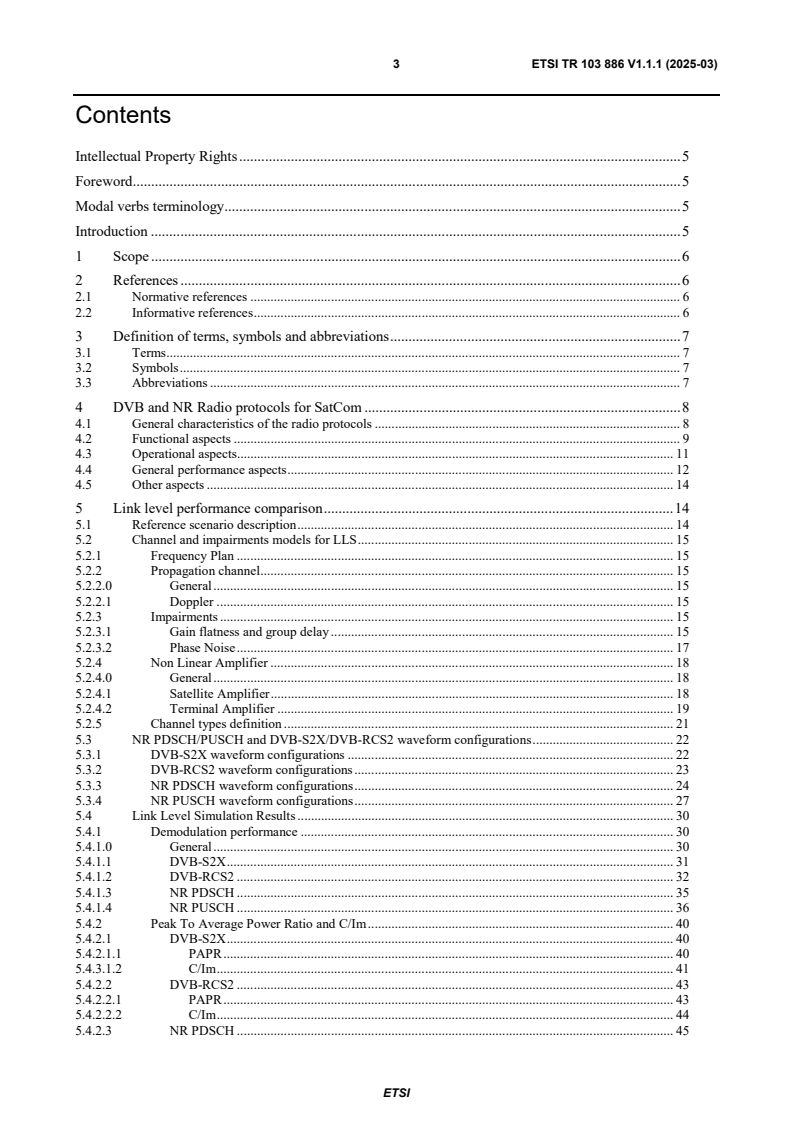
Contents
Intellectual Property Rights . 5
Foreword . 5
Modal verbs terminology . 5
Introduction . 5
1 Scope . 6
2 References . 6
2.1 Normative references . 6
2.2 Informative references . 6
3 Definition of terms, symbols and abbreviations . 7
3.1 Terms . 7
3.2 Symbols . 7
3.3 Abbreviations . 7
4 DVB and NR Radio protocols for SatCom . 8
4.1 General characteristics of the radio protocols . 8
4.2 Functional aspects . 9
4.3 Operational aspects. 11
4.4 General performance aspects . 12
4.5 Other aspects . 14
5 Link level performance comparison . 14
5.1 Reference scenario description . 14
5.2 Channel and impairments models for LLS . 15
5.2.1 Frequency Plan . 15
5.2.2 Propagation channel . 15
5.2.2.0 General . 15
5.2.2.1 Doppler . 15
5.2.3 Impairments . 15
5.2.3.1 Gain flatness and group delay . 15
5.2.3.2 Phase Noise . 17
5.2.4 Non Linear Amplifier . 18
5.2.4.0 General . 18
5.2.4.1 Satellite Amplifier . 18
5.2.4.2 Terminal Amplifier . 19
5.2.5 Channel types definition . 21
5.3 NR PDSCH/PUSCH and DVB-S2X/DVB-RCS2 waveform configurations . 22
5.3.1 DVB-S2X waveform configurations . 22
5.3.2 DVB-RCS2 waveform configurations . 23
5.3.3 NR PDSCH waveform configurations . 24
5.3.4 NR PUSCH waveform configurations . 27
5.4 Link Level Simulation Results . 30
5.4.1 Demodulation performance . 30
5.4.1.0 General . 30
5.4.1.1 DVB-S2X . 31
5.4.1.2 DVB-RCS2 . 32
5.4.1.3 NR PDSCH . 35
5.4.1.4 NR PUSCH . 36
5.4.2 Peak To Average Power Ratio and C/Im . 40
5.4.2.1 DVB-S2X . 40
5.4.2.1.1 PAPR . 40
5.4.3.1.2 C/Im . 41
5.4.2.2 DVB-RCS2 . 43
5.4.2.2.1 PAPR . 43
5.4.2.2.2 C/Im . 44
5.4.2.3 NR PDSCH . 45
ETSI
4 ETSI TR 103 886 V1.1.1 (2025-03)
5.4.2.3.1 PAPR . 45
5.4.2.3.2 C/Im . 46
5.4.2.4 NR PUSCH . 47
5.4.2.4.1 PAPR . 47
5.4.2.4.2 C/Im . 49
5.5 Spectral Efficiencies Evaluation . 50
5.5.1 DVB-S2X Spectral Efficiencies . 50
5.5.2 DVB-RCS2 Spectral Efficiencies . 52
5.5.3 NR PDSCH Spectral Efficiencies . 54
5.5.4 NR PUSCH Spectral Efficiencies . 57
5.6 Link Level Comparison . 60
5.6.1 DVB-S2X vs NR PDSCH demodulation performance comparison . 60
5.6.1.1 General . 60
5.6.1.2 DVB-S2X vs NR PDSCH demodulation performance comparison summary . 63
5.6.2 DVB-S2X vs NR PDSCH: PAPR and C/Im Comparison . 63
5.6.2.1 Peak To Average Power Ratio . 63
5.6.2.2 C/IM vs IBO/OBO . 64
5.6.3 DVB-RCS2 vs NR PUSCH demodulation performance comparison . 65
5.6.3.1 Allocated bandwidth of 28 MHz . 65
5.6.3.2 DVB-RCS2 vs NR PUSCH demodulation performance in AWGN conditions comparison
summary . 68
5.6.4 DVB-RCS2 vs NR PUSCH: PAPR and C/Im Comparison . 69
5.6.4.1 Peak To Average Power Ratio . 69
5.6.4.2 C/Im vs IBO/OBO . 69
6 System level performance comparison . 70
6.1 Reference scenario description . 70
6.1.0 General . 70
6.1.1 Space segment . 73
6.1.2 User terminal types . 73
6.1.2.1 Technical Objective . 73
6.1.2.2 Terminal Characteristics . 73
6.1.3 Channel Model . 73
6.2 Comparison criteria . 74
6.3 Simulation assumptions . 75
6.4 Simulation results . 76
6.4.0 General . 76
6.4.1 NR PDSCH vs. DVB-S2X . 77
6.4.2 NR PUSCH vs. DVB-RCS2 . 78
7 Conclusion . 79
History . 80
ETSI
5 ETSI TR 103 886 V1.1.1 (2025-03)
Intellectual Property Rights
Essential patents
IPRs essential or potentially essential to normative deliverables may have been declared to ETSI. The declarations
pertaining to these essential IPRs, if any, are publicly available for ETSI members and non-members, and can be
found in ETSI SR 000 314: "Intellectual Property Rights (IPRs); Essential, or potentially Essential, IPRs notified to
ETSI in respect of ETSI standards", which is available from the ETSI Secretariat. Latest updates are available on the
ETSI IPR online database.
Pursuant to the ETSI Directives including the ETSI IPR Policy, no investigation regarding the essentiality of IPRs,
including IPR searches, has been carried out by ETSI. No guarantee can be given as to the existence of other IPRs not
referenced in ETSI SR 000 314 (or the updates on the ETSI Web server) which are, or may be, or may become,
essential to the present document.
Trademarks
The present document may include trademarks and/or tradenames which are asserted and/or registered by their owners.
ETSI claims no ownership of these except for any which are indicated as being the property of ETSI, and conveys no
right to use or reproduce any trademark and/or tradename. Mention of those trademarks in the present document does
not constitute an endorsement by ETSI of products, services or organizations associated with those trademarks.
DECT™, PLUGTESTS™, UMTS™ and the ETSI logo are trademarks of ETSI registered for the benefit of its
Members. 3GPP™, LTE™ and 5G™ logo are trademarks of ETSI registered for the benefit of its Members and of the
3GPP Organizational Partners. oneM2M™ logo is a trademark of ETSI registered for the benefit of its Members and of ®
the oneM2M Partners. GSM and the GSM logo are trademarks registered and owned by the GSM Association.
Foreword
This Technical Report (TR) has been produced by ETSI Technical Committee Satellite Earth Stations and Systems
(SES).
Modal verbs terminology
In the present document "should", "should not", "may", "need not", "will", "will not", "can" and "cannot" are to be
interpreted as described in clause 3.2 of the ETSI Drafting Rules (Verbal forms for the expression of provisions).
"must" and "must not" are NOT allowed in ETSI deliverables except when used in direct citation.
Introduction
In view of the recent extension of 3GPP defined New Radio (NR) to support Non-Terrestrial Networks (NTN)
operating in the Ka- and Ku-band allocated satellite services, it is necessary to understand the merits and limitations of
this access technology in comparison with the long-established satellite access technology defined by the DVB forum as
'DVB-S2x/RCS2'.
The present document includes a qualitative and quantitative comparison of both access technologies in the context of
broadband satellite networks, based on GSO space segment operating in above 10 GHz frequencies. The quantitative
analysis is leveraging link- and system level simulation methodologies typically adopted in 3GPP.
Clause 2 provides the references. Clause 3 provides the definitions of terms, explains symbols and expands
abbreviations. Clause 4 provides qualitative technology analysis on functional, operational, performance, and other
non-technical aspects. Clause 5 provides a comprehensive quantitative link level analysis, including the simulation
configuration and results. Clause 6 provides a system level comparison with simulation configurations and results,
leveraging the link level results. Clause 7 concludes the technical comparison.
ETSI
6 ETSI TR 103 886 V1.1.1 (2025-03)
1 Scope
The present document contains a technical comparison of DVB-S2x/RCS2 and 3GPP New Radio (NR) Non Terrestrial
Networks (NTN) radio interface/access technology for broadband satellite communication systems operating above
10 GHz for fixed satellite services. Possible enhancements (e.g. Peak-to-Average Power Ratio (PAPR) mitigation) for
NR taking into account backward compatibility aspects and 3GPP specification impacts are identified and assessed.
Applicability of the study to frequencies below 10 GHz is not considered.
NOTE 1: The comparison analysis considered both Single SFPB and MFPB (with BFN) payload architectures.
NOTE 2: The GEO scenario is considered.
NOTE 3: The same carrier bandwidth is considered for the comparison between DVB and NR.
2 References
2.1 Normative references
Normative references are not applicable in the present document.
2.2 Informative references
References are either specific (identified by date of publication and/or edition number or version number) or
non-specific. For specific references, only the cited version applies. For non-specific references, the latest version of the
referenced document (including any amendments) applies.
NOTE: While any hyperlinks included in this clause were valid at the time of publication ETSI cannot guarantee
their long term validity.
The following referenced documents are not necessary for the application of the present document but they assist the
user with regard to a particular subject area.
[i.1] ETSI EN 302 307-2: "Digital Video Broadcasting (DVB); Second generation framing structure,
channel coding and modulation systems for Broadcasting, Interactive Services, News Gathering
and other broadband satellite applications; Part 2: DVB-S2 Extensions (DVB-S2X)".
[i.2] ETSI EN 302 307-1: "Digital Video Broadcasting (DVB); Second generation framing structure,
channel coding and modulation systems for Broadcasting, Interactive Services, News Gathering
and other broadband satellite applications; Part 1: DVB-S2".
[i.3] ETSI EN 301 545-2: "Digital Video Broadcasting (DVB); Second Generation DVB Interactive
Satellite System (DVB-RCS2); Part 2: Lower Layers for Satellite standard".
[i.4] ETSI TS 138 214: "5G; NR; Physical layer procedures for data (3GPP TS 38.214)".
[i.5] 3GPP TR 38.886 (V16.3.0) (03-2021): "V2X Services based on NR; User Equipment (UE) radio
transmission and reception (Release 16)".
[i.6] 3GPP TR 38.821: "Solutions for NR to support non-terrestrial networks (NTN)".
[i.7] 3GPP TR 38.811: "Study on New Radio (NR) to support non-terrestrial networks".
[i.8] Recommendation ITU-R P.1853-2: "Time Series synthesis of tropospheric impairments", Geneva,
August 2019.
[i.9] 3GPP TR 36.889: "Study on Licensed-Assisted Access to Unlicensed Spectrum".
[i.10] ETSI TR 101 545-4: "Digital Video Broadcasting (DVB); Second Generation DVB Interactive
Satellite System (DVB-RCS2); Part 4: Guidelines for Implementation and Use of EN 301 545-2".
ETSI
7 ETSI TR 103 886 V1.1.1 (2025-03)
[i.11] ETSI TR 103 297: "Satellite Earth Stations and Systems (SES); SC-FDMA based radio waveform
technology for Ku/Ka band satellite service".
[i.12] IEEE 802.1ad™: "IEEE Standard for Local and Metropolitan Area Networks -- Virtual Bridged
Local Area Networks -- Amendment 4: Provider Bridges".
[i.13] IEEE 802.1ah™: "IEEE Standard for Local and metropolitan area networks -- Virtual Bridged
Local Area Networks -- Amendment 7: Provider Backbone Bridges".
[i.14] IETF RFC 3135: "Performance Enhancing Proxies Intended to Mitigate Link-Related
Degradations".
[i.15] ETSI TS 122 261: "5G; Service requirements for the 5G system (3GPP TS 22.261)".
[i.16] ETSI TS 123 501: "5G; System architecture for the 5G System (5GS) (3GPP TS 23.501)".
[i.17] ETSI TS 101 545-1: "Digital Video Broadcasting (DVB); Second Generation DVB Interactive
Satellite System (DVB-RCS2); Part 1: Overview and System Level specification".
[i.18] Void.
[i.19] ETSI TS 138 104: "5G; NR; Base Station (BS) radio transmission and reception (3GPP
TS 38.104)".
[i.20] ETSI TS 138 101-5: "5G; NR; User Equipment (UE) radio transmission and reception; Part 5:
Satellite access Radio Frequency (RF) and performance requirements (3GPP TS 38.101-5)".
[i.21] 3GPP R1-2005311: "Considerations on PAPR requirements for NR NTN downlink transmission",
Thales.
[i.22] ETSI TS 138 101-2 (V18.0.0): "5G; NR; User Equipment (UE) radio transmission and reception;
Part 2: Range 2 Standalone (3GPP TS 38.101-2 version 18.8.0 Release 18)".
3 Definition of terms, symbols and abbreviations
3.1 Terms
Void.
3.2 Symbols
Void.
3.3 Abbreviations
For the purposes of the present document, the following abbreviations apply:
ARQ Automatic ReQuest
BAP Backhaul Adaptation Protocol
BHTP Beam Hopping Time Plan
BTP Burst Time Plan
CMT Correction Message Table
CSI Channel State Information
DL Down Link
DVB Digital Video Broadcasting
FDD Frequency Division Duplexing
GEO Geostationary
GSE Generic Stream Encapsulation
HARQ Hybrid Automatic ReQuest
ETSI
8 ETSI TR 103 886 V1.1.1 (2025-03)
IBO Input Back-Off
LLC Logical Link Control
MAC Medium Access Control
NCR Network Clock Reference
NR New Radio
OBO Output Back-Off
PDCP Packet Data Convergence Protocol
PEP Performance-Enhancing Proxy
PRB Physical Resource Block
PTRS Phase Tracking Reference Signal
RLC Radio Link Control
RLE Return Link Encapsulation
SCS Sub Carrier Spacing
SDAP Service Data Adaptation Protocol
TIM Terminal Information Message
Tput Throughput
UL Up Link
4 DVB and NR Radio protocols for SatCom
4.1 General characteristics of the radio protocols
Table 1 provides in synthetic table comparing the radio protocol stacks of both radio protocols: DVB-S2x/DVB-RCS2
and 3GPP NR with NTN enhancements.
Table 1: Protocol stacks of the candidate Radio protocols for the service link
DVB-S2x/RCS2 3GPP NR radio protocol with NTN
enhancements
Sources DVB forum. Published via ETSI TC www.3gpp.org
BROADCAST. Pre-standard: 3GPP TR 38.811 [i.7] & 3GPP
Down-link (DL): ETSI EN 302 307-1 [i.1] & TR 38.821 [i.6].
2 [i.2]. Standard: 3GPP TS 38.XXX series with
Uplink (UL): ETSI EN 301 545-2 [i.3]. Change Request defined by 3GPP work items
"NR_NTN_solutions", "NR_NTN_enh" and
"NR_NTN_ph3".
Physical layer Down-link (DL): M-ary APSK TDM (S2x). Down-link (DL): M-ary QAM CP-OFDM.
(Waveform) Uplink (UL): M-ary PSK, 16QAM or CPM Uplink (UL): M-ary QAM CP-OFDM or
MF-TDMA (RCS2). DFT-s-OFDM.
Access layer User plane: MAC (Medium Access Control), User plane: MAC, Radio Link Control (RLC),
LLC (Logical Link Control). Packet Data Convergence Protocol (PDCP),
Downlink: GSE (Generic Stream Service Data Adaptation Protocol (SDAP).
Encapsulation). Control plane: RRC, PDCP, RLC, MAC and
Uplink: RLE (Return Link Encapsulation). PHY sub-layers (terminated in UE and gNB);
NAS protocol (terminated in the UE and the
AMF).
Network layer IPv4/IPv6. IPv4/IPv6.
For backhaul: IEEE 802.1ad [i.12] / For backhaul: Backhaul Adaptation Protocol
802.1ah [i.13]. (BAP).
Transport layer TCP, UDP, Performance Enhancing Proxy TCP, UDP, Performance Enhancing Proxy
(PEP - IETF RFC 3135 [i.14]) is possible to (PEP - IETF RFC 3135 [i.14]) is possible to
mitigate latency with GEO satellites. mitigate latency with GEO satellites only.
Overall both protocols feature a similar stack structure. However, NR has been designed to optimize mobile broadband
and low latency communications, while DVB has been designed for fixed broadband communications re-using the
DVB-S2x video broadcast channel.
This leads to some differences between the radio protocols with respect to a number of key technical operational,
functional, performance as well as non-technical requirements as identified in the next paragraphs.
ETSI
9 ETSI TR 103 886 V1.1.1 (2025-03)
Although NR can operate in FR1 (frequency range) 410 MHz to 7 125 MHz, FR2 (24 250 MHz to 52 600 MHz) and
soon in frequency bands beyond 52,6 GHz which are being studied in 3GPP Release 17, the comparison below will be
mainly focused on Ku and Ka band Satcoms since DVB applies to bands allocated to satellite services above 3,4 GHz.
4.2 Functional aspects
Table 2 hereunder compares both radio protocols with respect to different functional criteria.
Table 2: Functional characteristics of DVB-S2x/DVB-RCS2 and of 3GPP NR with NTN enhancements
DVB-S2x/RCS2 3GPP NR radio protocol with NTN enhancements
QoS Multi-CoS specific to SatCom. Multi-CoS: 3GPP defined 5QI classes (see ETSI
management TS 122 261 [i.15] and ETSI TS 123 501 [i.16]).
Terminal states (Not) Connected mode. Idle, Inactive, Connected mode.
from radio
access point of
view once
registered
Terminal mobility Connected mode (hand-over). Idle and inactive mode (cell (re)selection) connected mode
(hand-over).
Hand-over Make before break (with dual Make before break supported (with single reception chain).
reception chain) and break before
make supported.
Data DL: DVB-S2X: Continuous DL & UL: Discontinuous or continuous transmission of
transmission transmission of medium to large data small to medium data blocks (Code-block size range
principles blocks (FECFrame of typically dependent [24 bits; 8 424 bits], see ETSI TS 138 214 [i.4]).
64 800 bits).
UL: DVB-RCS2: Discontinuous
transmission of small to medium data
blocks (Burst length: [304 bits;
4 792 bits]).
Contention For initial access. 1) During initial access: Contention based: UEs
channel For short data transmission (CRDSA randomly select preamble, More than 1 UE may
Access with replicate suppression). select same preamble (collision).
2) For hand-over: Non-contention based: gNB
dedicates preamble to UE, No collision possible.
3) For short burst transmission: grant free access
may be considered as part of a future release.
System
The access network is designed to The 5G NR protocol is part of a 3GPP defined system
architecture connect to the IP network. architecture including 5GC, NG-RAN and UE, API
rd
context interfaces to 3 party service providers, interface to
network management system.
Inter system No. Natively supported.
mobility (with
4G/5G system)
Support of 5G Via an Inter Working Function. DVB Natively supported.
Core network forum plans to define this feature.
Multi connectivity No. At core network level (Traffic Steering Switching Splitting).
satellite / 5G At radio access level (to be defined in future 3GPP
cellular access releases).
Multi connectivity Possibly at service level through At core network level (Traffic Steering Switching Splitting).
NGSO satellite / proprietary scheme. At radio access level (to be defined in future 3GPP
GEO satellite releases).
access
Terminal Not supported. embedded GNSS receiver in the UE
Location service + other network based methods.
Use of GNSS for Not necessary. Yes.
operation
Trusted location Not supported. RAN-based NTN NR positioning solutions via 3GPP
of terminal defined LCS framework for LEO.
(i.e. network
verified/provided)
Reliability (see Yes with automatic request at access Yes with automatic request at both physical (Hybrid
note ) layer. Automatic Repeat Request = HARQ) and access layer
RLC/PDCP (Automatic Repeat Request = ARQ).
ETSI
10 ETSI TR 103 886 V1.1.1 (2025-03)
DVB-S2x/RCS2 3GPP NR radio protocol with NTN enhancements
Energy saving No scheme defined in the standard. Idle and inactive mode defined in the standard with all the
Proprietary scheme can be radio protocol signalling.
implemented. Management aspects of RAN and CN elements are also
defined in the standard including all the related metrics (at
Network side and UE side).
Synchronization DL: Continuous synchronization DL/UL: Burst synchronization in DL and Timing Advance
except in beam hoping mode. (TA) mechanism for UL synchronization.
UL: Burst synchronization.
Network slicing Not supported in the standard. E2E network slicing across RAN is natively supported.
However, a satellite radio link Support of dynamic control of radio resources to support
(hub - terminal) can be statically the different slices.
configured to support VPNs that can
be considered as slices.
Dynamic control of radio resources to
support the different slices can be
achieved through proprietary
implementation and appropriate
interface exposure.
Cellular backhaul Support with static and quasi dynamic Support with dynamic control of the backhaul connection in
service control of the backhaul connection terms of Radio Resource Management adapted to the
irrespective of the traffic variation of traffic variation of the connection.
the connection. Support the 5G security architecture and the 3GPP defined
Backhauling service may be QoS framework.
implemented by IEEE 802.1ad [i.12] /
802.1ah [i.13] technics.
Requires specific mapping of 3GPP
QoS to DVB QoS.
Spectrum sharing Un coordinated only approach Through uncoordinated or coordinated approach between
(Adjacent between independent satcom and the satcom and the terrestrial systems. The coordinated
channel terrestrial systems. approach can leverage existing techniques used for the
coexistence) of spectrum coexistence between Macro and Femto cells.
SatCom with
terrestrial system
(Mobile,
microwave links)
Security Security aspects are described in 3GPP has specified a 5G security architecture supporting
framework ETSI TS 101 545-1 [i.17] and ETSI user authentication, secured communications.
TR 101 545-4 [i.10] Guidelines Leveraging this 5G security framework, further additional
(DVB-RCS2). security features can be developed to meet specific
In practice the security framework of European requirements.
DVB system is proprietary and specific
for each SatCom vendor. It can be
adapted to meet specific European
requirements.
NOTE: Reliability is defined in ETSI TS 122 261 [i.15] as "in the context of network layer packet transmissions,
percentage value of the amount of sent network layer packets successfully delivered to a given system entity
within the time constraint required by the targeted service, divided by the total number of sent network layer
packets". The relation of communication service availability and reliability is explained in Annex C
(informative) of the same document.
Compared to DVB-S2x/RCS2, the NR protocol is best suited to support:
• mobility procedures and energy saving features at both idle and connected modes;
• slicing including at RAN level;
• QoS management in 5G system including RAN and core network;
• mobility/multi connectivity across satellite/cellular access technology though integration of satellite networks
in 5G system at different levels including RAN;
• backhaul service thanks to dynamic control of radio resources and the integrity of the 5G E2E security
framework.
ETSI
11 ETSI TR 103 886 V1.1.1 (2025-03)
Beam hopping, both NR and DVB can in theory support Traffic-Driven Beam Hopping capability on the downlink with
Beam Hopping Time Plan (BHTP):
• for DVB-S2x: See ETSI EN 302 307-1 [i.18];
• for NR, the flexibility of radio resource block allocation in both time and frequency domain and bandwidth
part adaptations can be used to implement an equivalent beam hopping scheme.
4.3 Operational aspects
Table 3 hereunder compares both radio protocols with respect to operational criteria.
Table 3: Operational characteristics of DVB-S2x/DVB-RCS2 and of 3GPP NR with
NTN enhancements
DVB-S2x/RCS2 3GPP NR radio protocol with NTN
enhancements
Spectrum supported In theory all bands allocated to satellite FR1: (frequency range) 410 - 7 125 MHz.
services above 3,4 GHz. FR2: 24 250 - 52 600 MHz + frequency
bands beyond 52,6 GHz are being studied
in 3GPP Release 17.
Space segment GEO and NGSO. GEO and NGSO.
supported
Min channel bandwidth DL: 1 MHz carrier. DL: 5 MHz in FR1, 50 MHz for FR2.
requirements (DL/UL) for UL: 64 kHz carrier in practice. UL: 5 MHz in FR1, 50 MHz for FR2.
traffic For UL transmissions, minimum size is
one physical resource block (PRB,
bandwidth 12* Subcarrier Spacing = 12*
[15, 30, 60, 120 kHz]).
Min log-on burst signal Same as carrier bandwidth. 1,08 MHz with 1,25 kHz SCS (FR1, Long
bandwidth requirements PRACH formats).
(UL) 8,64 MHz with 60 kHz SCS (FR2, Short
PRACH formats).
17,28 MHz with 120 kHz SCS (FR2, Short
PRACH formats).
Max channel bandwidth DL: 500 MHz in practice (state of the art). DL & UL: 100 MHz in FR1, 400 MHz in
capability UL: 167 MHz as per standard. FR2.
Higher channel bandwidth is possible on Multiple channels (set of sub- carriers can
DL only through channel bonding scheme. be aggregated to achieve up to 6,4 GHz of
transmission bandwidth through carrier
aggregation scheme.
Duplex mode supported FDD. FDD and TDD.
TDD made possible with DVB-S2X Beam
Hopping and RCS2 (though not defined as
such in the technical specifications).
Radio resource allocation DL: Frame structure dependent on symbol DL & UL: Allocation per UE is one PRB at
flexibility rate hence creating variable size of data a time or on a continuous periodical basis.
blocks. One frame can be allocated to
several UEs.
UL: Single frame is allocated to one UE.
Allocation can be volume or rate based.
Min radio resource On DL: typically a normal FECFrame of On both DL & UL: Min radio resource
granularity assigned by [64 800 bits], but also possible a short corresponds to one PRB (Physical
the scheduler to a UE FECFrame [16 200 bits]. Resource Block) mapped over
On UL: very short bursts of 266 symbols 12 sub-carriers.
(QPSK 5/6 to 16QAM 5/6). The slot duration is 14 OFDM symbols
and depends on Sub Carrier Spacing
(SCS) configuration (1 ms with 15 kHz
sub-carrier spacing; 0,250 ms with 60 kHz
SCS, 0,125 ms with 120 kHz sub-carrier
spacing).
1 frame is always 1 ms duration and the
number of slot per frame depends on
SCS. The useful OFDM symbol size is
inversely proportional with the SCS.
ETSI
12 ETSI TR 103 886 V1.1.1 (2025-03)
DVB-S2x/RCS2 3GPP NR radio protocol with NTN
enhancements
Radio resource allocation DL: Combination of Multi UE allocation and DL/UL: The granularity can be extremely
efficiency ACM scheme applied to one BB frame small (On the order of 1 symbol) that risk
create the risk of resource waste since of mismatch between allocated resource
some BB frames are not usable by all UEs. and traffic load creating waste of resource
UL: High risk of mismatch between usage is low.
allocated resource and traffic load creating
waste of resource usage.
Radio resource Beam hoping and fractional frequency Beam hoping and fractional frequency re-
management flexibility re-use supported. use supported.
Robustness to payload's DL: phase noise can be tracked using pilot Configurable Phase Tracking Reference
phase noise symbols in case of continuous Signal (PTRS) is a low density pilot
transmission. For burst transmission sequence sent at regular time interval, it
(beam hoping), super framing structure used to enable tracking of phase noise in
help to handle phase noise and synchro both UL/DL.
issues.
UL: phase noise can be tracked using pilot
symbols.
Robustness to the Sensitive for carriers with hundreds of Not sensitive.
payload's Group Delay Mega Symbol per seconds partially
mitigated by wide-band equalizers.
Both radio protocols are able to support LEO and GEO systems operating in Ku and Ka bands and are able to support
the same operational constraints.
Frequency Division Duplexing (FDD) mode is required by Regulations (space-earth & earth-space paired bands
allocated).
4.4 General performance aspects
Table 4 hereunder compares both radio protocols with respect to different performance criteria.
Table 4: Performance characteristics of DVB-S2x/DVB-RCS2 and of 3GPP NR with
NTN enhancements
DVB-S2x/RCS2 3GPP NR radio protocol with NTN
enhancements
PAPR on UL (at Reference performance which is based on 3GPP defines SC-FDMA (DFT-s-OFDM)
terminal level) the 20 % roll-off as per standard. mode for UL. Standard assumes 2,5 % of
guard band (ETSI TS 138 104 [i.19] and
ETSI TS 138 101 [i.20]).
In terms of OBO, ETSI has demonstrated
that NR Uplink performs comparably to
DVB-RCS2 (see ETSI TR 103 297 [i.11]
"SC-FDMA based radio waveform
technology for Ku/Ka band satellite
service".
PAPR on DL (at Mono carrier per amplifier: ~0 dB in QPSK See note 1.
satellite level) (for broadcast payload) => not relevant for
broadband.
Multi carrier (> 3) per amplifier/active
antenna: See note 1.
Overhead due to DL: between 2 and 4 % (first order) mainly DL & UL: up to 4 % (due to MAC, RLC,
access layer in user due to allocation tables + to a lower extent PDCP + control plane signalling).
plane (number of UE GSE encapsulation.
dependent) UL: 2,1 % to 3,93 % mainly due to RLE
encapsulation.
ETSI
13 ETSI TR 103 886 V1.1.1 (2025-03)
DVB-S2x/RCS2 3GPP NR radio protocol with NTN
enhancements
Overhead due to DL: 5 % to 10 % (main due to Roll off and Depending on Frequency Range:
physical layer to a lower extent Physical Layer framing DL: Up to 18 % (mainly due to SSB, DL
(modulation and including CRC). reference signals and DCI signalling). Note
coding dependent) UL: up to 20 % (main due to Roll off and to that the DL overhead can be optimized to
a lower extent guard times and CRC). 8,25 % to 12 % (through configuration of
the reference signals and related MIMO
layers).
UL: Up to 10 % (Mainly due to PRACH,
Sounding reference signal and
demodulation reference signal).
Min spectral DL: 0,1 bit/symbol @ BPSK-S 1/5 SF5 DL: From 0,0586 bit/symbol @ QPSK
efficiency/Max (VL-SNR mode for traffic). 30/1 024 (for traffic).
modcod UL: 0,25 bit/symbol @ BPSK 1/3 (for UL: From 0,0586 bit/symbol @ π/2-BPSK
traffic). 30/1 024 or QPSK 30/1 024 (for traffic).
UL: 0,02 bit/symbol @ π/2 BPSK with code
rate 1/3 and SF 16.
Highest spectral DL: Up to 5,9 bits/symbol @ 256APSK DL: Up to 7,4063 bits/symbol @ 256QAM
efficiency (and 135/180 (also called 3/4). 948/1 024.
related modcod) but UL: Up to 3 bits/symbol @ 16 QAM 5/6. UL: Up to 5,5547 bits/symbol @ 64QAM
link budget 948/1 024.
dependent
User plane latency DL: 7ms (at least 100 MHz bandwidth). DL & UL: < 4 ms (at least 5 MHz
(note 2) UL:1ms (at least 5 MHz bandwidth). bandwidth) for eMBB service category
Latencies depend on the selected QoS
classes (see ETSI TS 123 501 [i.16]).
Control plane latency Not applicable. 10 ms.
(note 2)
Throughput versus Comparable performances can be expected thanks to similar coding techniques (LDPC
SNR based for the traffic) for a given error rate.
Min required SNR ModCod type and frame type (2 options) ModCod, Transport block size, HARQ, pilot
performance dependent. density configuration, 5QI (target BLER)
Target PER is 10E-5 for typically SatCom dependent.
operation.
Min Signal to Noise DVB-S2X supports down to -9,90 dB SNR = -9,20 dB (on PSS/SSS burst).
Ratio for (VL-SNR: Very Low SNR).
π/2-BPSK
synchronization on (Makes use of specific
DL MODCOD).
Min Signal to Noise DVB-S2X supports down to -9,90 dB @ SNR = -12,2 dB @ QPSK 30/1 024 and for
Ratio for traffic on DL BPSK-S 1/5 (VL-SNR: Very Low SNR) for BLER = 1E-02 or 1 %.
FER 1E-5 (AWGN con
...
Questions, Comments and Discussion
Ask us and Technical Secretary will try to provide an answer. You can facilitate discussion about the standard in here.
Loading comments...