


ETSI GR PDL 032 V1.1.1 (2025-04)
Permissioned Distributed Ledger (PDL); Artificial Intelligence for Permissioned Distributed Ledger
Permissioned Distributed Ledger (PDL); Artificial Intelligence for Permissioned Distributed Ledger
DGR/PDL-0032_AI_4PDL
General Information
Standards Content (Sample)
GROUP REPORT
Permissioned Distributed Ledger (PDL);
Artificial Intelligence for Permissioned Distributed Ledger
Disclaimer
The present document has been produced and approved by the Permissioned Distributed Ledger (PDL) ETSI Industry
Specification Group (ISG) and represents the views of those members who participated in this ISG.
It does not necessarily represent the views of the entire ETSI membership.
2 ETSI GR PDL 032 V1.1.1 (2025-04)
Reference
DGR/PDL-0032_AI_4PDL
Keywords
artificial intelligence, identity, PDL, scalability,
security
ETSI
650 Route des Lucioles
F-06921 Sophia Antipolis Cedex - FRANCE
Tel.: +33 4 92 94 42 00 Fax: +33 4 93 65 47 16
Siret N° 348 623 562 00017 - APE 7112B
Association à but non lucratif enregistrée à la
Sous-Préfecture de Grasse (06) N° w061004871
Important notice
The present document can be downloaded from the
ETSI Search & Browse Standards application.
The present document may be made available in electronic versions and/or in print. The content of any electronic and/or
print versions of the present document shall not be modified without the prior written authorization of ETSI. In case of any
existing or perceived difference in contents between such versions and/or in print, the prevailing version of an ETSI
deliverable is the one made publicly available in PDF format on ETSI deliver repository.
Users should be aware that the present document may be revised or have its status changed,
this information is available in the Milestones listing.
If you find errors in the present document, please send your comments to
the relevant service listed under Committee Support Staff.
If you find a security vulnerability in the present document, please report it through our
Coordinated Vulnerability Disclosure (CVD) program.
Notice of disclaimer & limitation of liability
The information provided in the present deliverable is directed solely to professionals who have the appropriate degree of
experience to understand and interpret its content in accordance with generally accepted engineering or
other professional standard and applicable regulations.
No recommendation as to products and services or vendors is made or should be implied.
No representation or warranty is made that this deliverable is technically accurate or sufficient or conforms to any law
and/or governmental rule and/or regulation and further, no representation or warranty is made of merchantability or fitness
for any particular purpose or against infringement of intellectual property rights.
In no event shall ETSI be held liable for loss of profits or any other incidental or consequential damages.
Any software contained in this deliverable is provided "AS IS" with no warranties, express or implied, including but not
limited to, the warranties of merchantability, fitness for a particular purpose and non-infringement of intellectual property
rights and ETSI shall not be held liable in any event for any damages whatsoever (including, without limitation, damages
for loss of profits, business interruption, loss of information, or any other pecuniary loss) arising out of or related to the use
of or inability to use the software.
Copyright Notification
No part may be reproduced or utilized in any form or by any means, electronic or mechanical, including photocopying and
microfilm except as authorized by written permission of ETSI.
The content of the PDF version shall not be modified without the written authorization of ETSI.
The copyright and the foregoing restriction extend to reproduction in all media.
© ETSI 2025.
All rights reserved.
ETSI
3 ETSI GR PDL 032 V1.1.1 (2025-04)
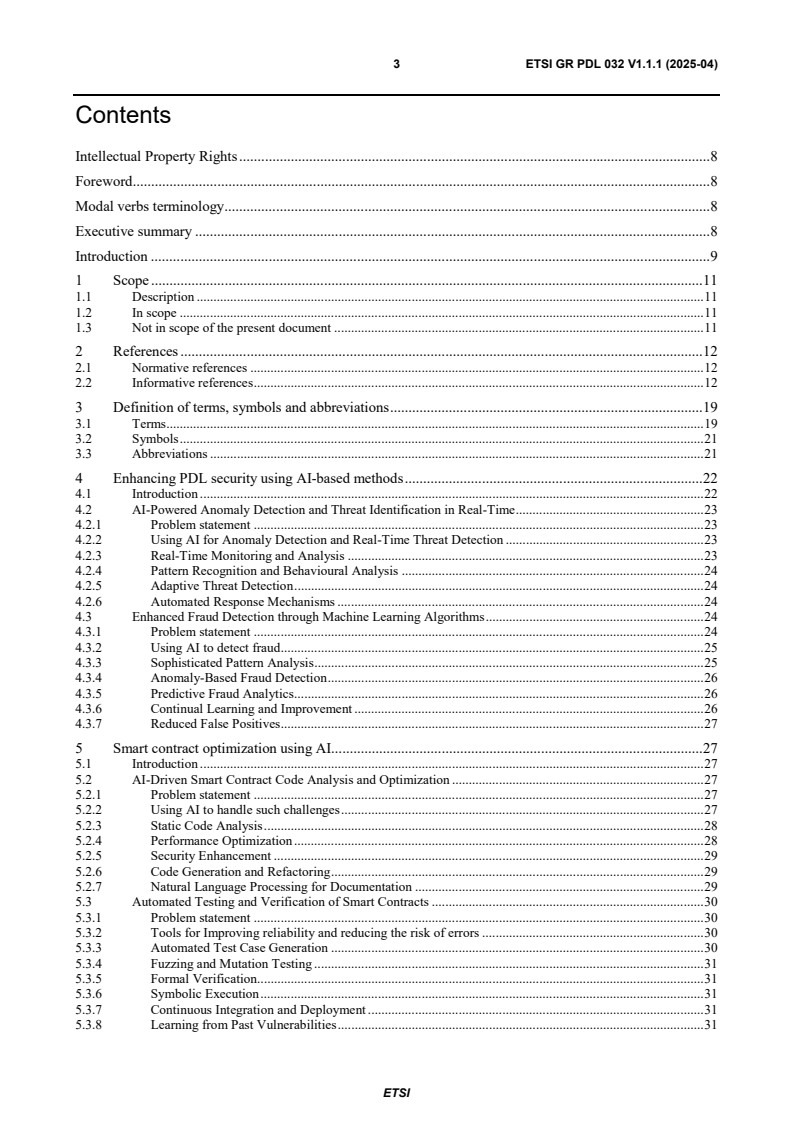
Contents
Intellectual Property Rights . 8
Foreword . 8
Modal verbs terminology . 8
Executive summary . 8
Introduction . 9
1 Scope . 11
1.1 Description . 11
1.2 In scope . 11
1.3 Not in scope of the present document . 11
2 References . 12
2.1 Normative references . 12
2.2 Informative references . 12
3 Definition of terms, symbols and abbreviations . 19
3.1 Terms . 19
3.2 Symbols . 21
3.3 Abbreviations . 21
4 Enhancing PDL security using AI-based methods . 22
4.1 Introduction . 22
4.2 AI-Powered Anomaly Detection and Threat Identification in Real-Time . 23
4.2.1 Problem statement . 23
4.2.2 Using AI for Anomaly Detection and Real-Time Threat Detection . 23
4.2.3 Real-Time Monitoring and Analysis . 23
4.2.4 Pattern Recognition and Behavioural Analysis . 24
4.2.5 Adaptive Threat Detection . 24
4.2.6 Automated Response Mechanisms . 24
4.3 Enhanced Fraud Detection through Machine Learning Algorithms . 24
4.3.1 Problem statement . 24
4.3.2 Using AI to detect fraud . 25
4.3.3 Sophisticated Pattern Analysis . 25
4.3.4 Anomaly-Based Fraud Detection . 26
4.3.5 Predictive Fraud Analytics . 26
4.3.6 Continual Learning and Improvement . 26
4.3.7 Reduced False Positives . 27
5 Smart contract optimization using AI. 27
5.1 Introduction . 27
5.2 AI-Driven Smart Contract Code Analysis and Optimization . 27
5.2.1 Problem statement . 27
5.2.2 Using AI to handle such challenges . 27
5.2.3 Static Code Analysis . 28
5.2.4 Performance Optimization . 28
5.2.5 Security Enhancement . 29
5.2.6 Code Generation and Refactoring . 29
5.2.7 Natural Language Processing for Documentation . 29
5.3 Automated Testing and Verification of Smart Contracts . 30
5.3.1 Problem statement . 30
5.3.2 Tools for Improving reliability and reducing the risk of errors . 30
5.3.3 Automated Test Case Generation . 30
5.3.4 Fuzzing and Mutation Testing . 31
5.3.5 Formal Verification. 31
5.3.6 Symbolic Execution . 31
5.3.7 Continuous Integration and Deployment . 31
5.3.8 Learning from Past Vulnerabilities . 31
ETSI
4 ETSI GR PDL 032 V1.1.1 (2025-04)
6 AI-Enhanced Consensus Mechanisms in Permissioned Distributed Ledger Systems . 32
6.1 Consensus mechanisms for PDL functionality . 32
6.2 AI-enhanced consensus algorithms for faster and more efficient agreement . 32
6.3 Adaptive consensus mechanisms based on network conditions . 33
7 Data analytics and insights using AI . 33
7.1 Introduction and problem statement . 33
7.2 Analysing Large Volumes of Transaction Data for Valuable Insights using AI . 34
7.2.1 AI's capabilities to handle large volumes . 34
7.2.2 Pattern Recognition and Trend Analysis . 34
7.2.3 Anomaly Detection . 34
7.2.4 Customer Segmentation and Personalization . 35
7.2.5 Predictive Analytics . 35
7.2.6 Real-time Processing and Decision Making . 35
7.3 Predictive Analytics for Business Intelligence . 35
7.3.1 Predictive Analytics capabilities of AI . 35
7.3.2 Customer Behaviour Prediction . 35
7.3.3 Sales Forecasting . 36
7.3.4 Risk Assessment and Management . 36
7.3.5 Demand Forecasting . 36
7.3.6 Trend Analysis and Market Prediction . 36
7.3.7 Operational Efficiency Optimization . 36
7.3.8 Customer Lifetime Value Prediction . 37
8 Privacy-preserving techniques using AI . 37
8.1 Introduction and problem statement . 37
8.2 Developing Advanced Privacy-Preserving Computation Methods using AI . 38
8.3 Homomorphic Encryption and Secure Multi-Party Computation . 38
8.4 Federated Learning . 39
8.5 Differential Privacy in Machine Learning . 39
8.6 Generative Adversarial Networks (GANs) for Synthetic Data. 40
9 AI Tools for Network Optimization . 41
9.1 Problem statement . 41
9.2 Network Performance and Resource Allocation . 41
9.3 Predictive Maintenance of Network Nodes . 42
9.4 AI-Driven Network Topology Optimization . 43
9.5 Intelligent Data Sharding . 43
9.6 AI-Enhanced Network Security . 43
9.7 Energy-Efficient Network Operations . 44
9.8 AI-Powered Network Congestion Management. . 44
9.9 Adaptive Protocol Optimization . 44
10 Governance and compliance using AI . 45
10.1 Introduction and problem statement . 45
10.2 AI Assisted Governance Rules and Compliance Checks Enforcement . 45
10.3 AI Assisted Automated Auditing and Reporting . 46
10.4 AI-Enhanced Governance Participation . 47
10.5 Regulatory Compliance Monitoring . 47
10.6 Intelligent Dispute Resolution . 48
11 Identity management using AI . 48
11.1 Introduction and problem statement . 48
11.2 AI-Enhanced Identity Verification and Management Processes . 49
11.2.1 AI-Powered Facial Recognition . 49
11.2.2 AI-Powered Document Verification System . 49
11.2.3 Anomaly Detection: AI-Powered Behavioural Biometrics for Continuous Authentication . 49
11.3 Additional Scenarios and Examples . 49
11.3.1 Federated Identity Management . 49
11.3.2 Adaptive Access Control . 50
11.3.3 Identity Recovery and Remediation . 50
11.3.4 Decentralized Identity Verification . 50
11.3.5 Cross-Chain Identity Management . 50
ETSI
5 ETSI GR PDL 032 V1.1.1 (2025-04)
12 AI-Assisted PDL Interoperability . 51
12.1 PDL Interoperability in the context of AI - problem statement . 51
12.2 AI-Facilitated Cross-Chain Communication and Data Exchange . 51
12.3 Smart Routing of Transactions Between Different Ledgers . 52
13 AI based PDL Scalability solutions . 52
13.1 Problem statement . 52
13.2 Developing More Efficient Scaling Solutions using AI . 52
13.3 Dynamic Sharding Based on Network Traffic and Usage Patterns . 53
14 Conclusion and Recommendations . 53
Annex A: List of AI-tools referenced in the present document with brief descriptions and
application for PDL . 55
A.1 Examples related to clause 4 (Enhanced security) . 55
A.1.1 Examples of AI Algorithms for Continuous Monitoring . 55
A.1.1.1 Temporal Graph Convolutional Networks (TGCNs) . 55
A.1.1.2 Federated Attention Mechanism with Differential Privacy . 55
A.1.1.3 Hierarchical Long Short-Term Memory Networks with Adaptive Thresholding . 56
A.1.2 Examples of Advanced Machine Learning Models for Pattern Recognition . 57
A.1.2.1 Graph Neural Networks (GNNs) . 57
A.1.2.2 Transformer-based Models . 57
A.1.2.3 Deep Clustering Networks (DCNs) . 58
A.1.3 Examples of Adaptive AI Systems for Evolving Threat Detection . 58
A.1.3.1 Continual Learning Networks . 58
A.1.3.2 Meta-Learning Systems . 59
A.1.3.3 Reinforcement Learning for Adaptive Security . 59
A.1.4 Examples of AI Systems for Automated Response Mechanisms in PDL Networks . 60
A.1.4.1 Reinforcement Learning-based Autonomous Defence Systems . 60
A.1.4.2 Federated Learning-based Collaborative Defence Systems . 60
A.1.4.3 Explainable AI (XAI) for Automated Incident Response . 61
A.1.5 Examples of AI-Based Machine Learning Models for Fraud Detection . 61
A.1.5.1 Graph Neural Networks (GNNs) for Fraud Detection . 61
A.1.5.2 Transformer-based Models for Sequential Fraud Detection . 61
A.1.5.3 Federated Deep Learning for Privacy-Preserving Fraud Detection . 62
A.1.6 Examples of unsupervised learning algorithms used to establish baseline behaviours . 62
A.1.6.1 Graph Autoencoders (GAEs) for Network Behaviour Modelling . 62
A.1.6.2 Variational Autoencoders (VAEs) for Anomaly Detection . 63
A.1.6.3 Temporal Convolutional Networks (TCNs) for Time Series Analysis . 63
A.1.7 Examples of Predictive Machine Learning Models for Fraud Detection . 64
A.1.7.1 Graph Neural Networks (GNNs) with Temporal Attention . 64
A.1.7.2 Transformer-based Models with Self-Supervised Pre-training . 64
A.1.7.3 Federated Deep Learning with Differential Privacy . 65
A.1.8 Examples of Continuous Learning Machine Learning Models for Fraud Detection . 65
A.1.8.1 Online Adaptive Graph Neural Networks (OAGNNs) . 65
A.1.8.2 Incremental Learning with Ensemble Methods . 66
A.1.8.3 Federated Continual Learning. 66
A.1.9 Examples of Machine Learning Models for Reducing False Positives in Fraud Detection . 67
A.1.9.1 Attention-based Graph Neural Networks with Explainable AI . 67
A.1.9.2 Hybrid Models Combining Anomaly Detection with Supervised Learning . 67
A.1.9.3 Federated Learning with Adaptive Boosting . 68
A.2 Examples related to clause 5 (Smart contract optimization using AI) . 68
A.2.1 Examples of AI-Powered Static Code Analysis Tools . 68
A.2.1.1 DeepCode . 68 ®
A.2.1.2 Infer . 69 ®
A.2.1.3 CodeQL . 69
A.2.2 Examples of AI-Based Machine Learning Algorithms for Smart Contract Optimization . 69
A.2.2.1 Deep Reinforcement Learning for Dynamic Gas Optimization . 69
A.2.2.2 Graph Neural Networks with Attention for Code Pattern Recognition . 69
A.2.2.3 Transformer-based Model with Transfer Learning for Cross-Language Optimization . 70 ®
A.2.2.4 Hyperledger Caliper . 70
ETSI
6 ETSI GR PDL 032 V1.1.1 (2025-04)
A.2.2.5 OptSmart . 70
A.2.3 Examples of AI Algorithms for Identifying Smart Contract Vulnerabilities . 71
A.2.3.1 Graph Neural Networks (GNNs) with Semantic-Aware Embedding . 71
A.2.3.2 Transformer-based Models with Transfer Learning . 71
A.2.3.3 Reinforcement Learning with Symbolic Execution . 71
A.2.4 Examples of AI Algorithms for Code Generation and Optimization in PDL Platforms . 72
A.2.4.1 Large Language Models with Few-Shot Learning . 72
A.2.4.2 Graph-to-Code Neural Networks with Attention . 72
A.2.4.3 Hierarchical Transformers with Code Semantic Embedding . 72
A.2.5 Examples of AI-Powered NLP Tools for Smart Contract Documentation . 73
A.2.5.1 CodeBERT-based Documentation Generation . 73
A.2.5.2 Graph-to-Sequence Neural Networks for Contract Summarization. 73
A.2.5.3 Hierarchical Transformer with Code-Text Alignment . 73
A.2.6 Examples of AI-Based Machine Learning Algorithms for Smart Contract Test Case Generation . 74
A.2.6.1 Deep Reinforcement Learning for Adaptive Fuzzing . 74
A.2.6.2 Graph Neural Networks with Symbolic Execution . 74
A.2.6.3 Transformer-based Models with Program Synthesis . 74
A.2.7 Examples of AI-Driven Fuzzing Techniques for Smart Contract Testing. 75
A.2.7.1 Reinforcement Learning-based Adaptive Fuzzing . 75
A.2.7.2 Neuro-Symbolic Execution with Mutation . 75
A.2.7.3 Evolutionary Fuzzing with Natural Language Processing (NLP) . 76
A.2.8 Examples of AI-Based Tools for Formal Verification of Smart Contracts . 76
A.2.8.1 Neural-Guided Theorem Prover (NGTP) . 76
A.2.8.2 Transformer-based Model Checker (TMC) . 76
A.2.8.3 Graph Neural Network-based Invariant Synthesizer (GNNIS) . 77
A.2.9 Examples of AI-Enhanced Symbolic Execution Techniques for Smart Contract Analysis . 77
A.2.9.1 Neural-Guided Symbolic Execution (NGSE) . 77
A.2.9.2 Reinforcement Learning-based Concolic Testing (RLCT) . 78
A.2.9.3 Graph Neural Network-Enhanced Symbolic Execution (GNN-SE) . 78
A.2.10 Examples of AI-Based Tools for Smart Contract DevSecOps Pipelines . 78
A.2.10.1 SmartBugs: AI-Enhanced Vulnerability Detection Pipeline . 78
A.2.10.2 ContractGuard: Automated Verification and Deployment Framework . 79
A.2.10.3 AISecOps: AI-Driven Security Operations for Smart Contracts . 79
A.2.11 Examples of AI Systems for Continuous Improvement in Smart Contract Security . 80
A.2.11.1 VELMA: Vulnerability-driven Evolutionary Learning for Smart Contract Auditing . 80
A.2.11.2 SCSCAN: Self-Correcting Smart Contract Vulnerability Scanner . 80
A.2.11.3 ASTRAEA: Adaptive Smart conTRact Auto-Evaluation and Auditing . 80
A.3 Examples related to clause 8: Privacy-preserving techniques . 81
A.3.1 Examples of Federated Learning . 81
A.3.1.1 PySyft . 81
A.3.1.2 Flower . 81
A.3.1.3 OpenFL . 81
A.3.1.4 FedML . 81
A.3.2 Examples of Differential Privacy in Machine Learning . 81
A.3.2.1 Differentially Private Stochastic Gradient Descent (DP-SGD) . 81
A.3.2.2 Differentially Private Follow The Regularized Leader (DP-FTRL) . 82
A.3.2.3 Gaussian Differential Privacy (GDP) . 82
A.3.3 Examples of Generative Adversarial Networks (GANs) for synthetic data generation . 82
A.3.3.1 Privacy-Preserving Synthetic Data Generation Using Conditional GANs . 82
A.3.3.2 TabFairGAN: Fair Tabular Data Generation with Generative Adversarial Networks . 83
A.3.3.3 SynSig: Generating Synthetic Signatures for Large-Scale Time Series Anomaly Detection . 84
A.4 Examples related to clause 11 (Identity management using AI) . 85
A.4.1 AI-Powered Facial Recognition . 85
A.4.1.1 Description . 85
A.4.1.2 Use Case . 85
A.4.2 AI-Powered Document Verification System . 85
A.4.2.1 Description . 85
A.4.2.2 Key components . 85
A.4.2.3 Process . 86
A.4.2.4 Performance . 86
ETSI
7 ETSI GR PDL 032 V1.1.1 (2025-04)
A.4.3 Anomaly Detection: AI-Powered Behavioural Biometrics for Continuous Authentication . 86
A.4.3.1 Description . 86
A.4.3.2 Examples . 86
A.4.3.3 Application . 87
A.4.3.4 Key Advantages . 87
A.5 Examples and recent research related to clause 12 (AI-Assisted PDL Interoperability). 87
A.5.1 AI-Facilitated Cross-Chain Communication and Data Exchange . 87
A.5.1.1 Examples of AI applications in cross-chain communication . 87
A.5.1.2 Recent research in this area. 87
A.5.2 Examples of AI applications in Smart Routing of Transactions Between Different Ledgers . 88
A.5.2.1 Reinforcement Learning for Optimal Path Finding . 88
A.5.2.2 Predictive Analytics for Network Congestion . 88
A.5.2.3 Federated Learning for Collaborative Routing Optimization . 88
A.5.2.4 Graph Neural Networks for Dynamic Topology Analysis. 88
A.5.2.5 Multi-Agent Systems for Decentralized Routing . 88
A.5.3 Additional Scenarios and Examples . 88
A.6 Examples and recent research related to clause 13 (AI based PDL Scalability solutions) . 89
A.6.1 Developing More Efficient Scaling Solutions using AI . 89
A.6.1.1 Adaptive Consensus Optimization . 89
A.6.1.2 Intelligent Sharding. 89
A.6.1.3 Smart Contract Parallelization . 89
A.6.1.4 Predictive Caching . 89
A.6.1.5 Network Topology Optimization . 89
A.6.2 Dynamic Sharding Based on Network Traffic and Usage Patterns . 90
A.6.2.1 Predictive Sharding . 90
A.6.2.2 Adaptive Shard Allocation . 90
A.6.2.3 Intelligent Cross-Shard Transaction Management . 90
A.6.2.4 Anomaly-Aware Sharding . 90
A.6.2.5 Federated Learning for Collaborative Sharding . 90
A.6.3 Additional Scenarios and Examples . 90
History . 92
ETSI
8 ETSI GR PDL 032 V1.1.1 (2025-04)
Intellectual Property Rights
Essential patents
IPRs essential or potentially essential to normative deliverables may have been declared to ETSI. The declarations
pertaining to these essential IPRs, if any, are publicly available for ETSI members and non-members, and can be
found in ETSI SR 000 314: "Intellectual Property Rights (IPRs); Essential, or potentially Essential, IPRs notified to
ETSI in respect of ETSI standards", which is available from the ETSI Secretariat. Latest updates are available on the
ETSI IPR online database.
Pursuant to the ETSI Directives including the ETSI IPR Policy, no investigation regarding the essentiality of IPRs,
including IPR searches, has been carried out by ETSI. No guarantee can be given as to the existence of other IPRs not
referenced in ETSI SR 000 314 (or the updates on the ETSI Web server) which are, or may be, or may become,
essential to the present document.
Trademarks
The present document may include trademarks and/or tradenames which are asserted and/or registered by their owners.
ETSI claims no ownership of these except for any which are indicated as being the property of ETSI, and conveys no
right to use or reproduce any trademark and/or tradename. Mention of those trademarks in the present document does
not constitute an endorsement by ETSI of products, services or organizations associated with those trademarks.
DECT™, PLUGTESTS™, UMTS™ and the ETSI logo are trademarks of ETSI registered for the benefit of its
Members. 3GPP™, LTE™ and 5G™ logo are trademarks of ETSI registered for the benefit of its Members and of the
3GPP Organizational Partners. oneM2M™ logo is a trademark of ETSI registered for the benefit of its Members and of ®
the oneM2M Partners. GSM and the GSM logo are trademarks registered and owned by the GSM Association.
Foreword
This Group Report (GR) has been produced by ETSI Industry Specification Group (ISG) Permissioned Distributed
Ledger (PDL).
Modal verbs terminology
In the present document "should", "should not", "may", "need not", "will", "will not", "can" and "cannot" are to be
interpreted as described in clause 3.2 of the ETSI Drafting Rules (Verbal forms for the expression of provisions).
"must" and "must not" are
...
Questions, Comments and Discussion
Ask us and Technical Secretary will try to provide an answer. You can facilitate discussion about the standard in here.
Loading comments...