


ETSI TR 104 060 V1.1.1 (2025-02)
Human Factors (HF); Guidance on how to apply the EN 301 549 to digital television products
Human Factors (HF); Guidance on how to apply the EN 301 549 to digital television products
DTR/HF-00301565
General Information
Standards Content (Sample)
TECHNICAL REPORT
Human Factors (HF);
Guidance on how to apply the EN 301 549 to
digital television products
2 ETSI TR 104 060 V1.1.1 (2025-02)
Reference
DTR/HF-00301565
Keywords
accessibility, digital, television products
ETSI
650 Route des Lucioles
F-06921 Sophia Antipolis Cedex - FRANCE
Tel.: +33 4 92 94 42 00 Fax: +33 4 93 65 47 16
Siret N° 348 623 562 00017 - APE 7112B
Association à but non lucratif enregistrée à la
Sous-Préfecture de Grasse (06) N° w061004871
Important notice
The present document can be downloaded from the
ETSI Search & Browse Standards application.
The present document may be made available in electronic versions and/or in print. The content of any electronic and/or
print versions of the present document shall not be modified without the prior written authorization of ETSI. In case of any
existing or perceived difference in contents between such versions and/or in print, the prevailing version of an ETSI
deliverable is the one made publicly available in PDF format on ETSI deliver repository.
Users should be aware that the present document may be revised or have its status changed,
this information is available in the Milestones listing.
If you find errors in the present document, please send your comments to
the relevant service listed under Committee Support Staff.
If you find a security vulnerability in the present document, please report it through our
Coordinated Vulnerability Disclosure (CVD) program.
Notice of disclaimer & limitation of liability
The information provided in the present deliverable is directed solely to professionals who have the appropriate degree of
experience to understand and interpret its content in accordance with generally accepted engineering or
other professional standard and applicable regulations.
No recommendation as to products and services or vendors is made or should be implied.
No representation or warranty is made that this deliverable is technically accurate or sufficient or conforms to any law
and/or governmental rule and/or regulation and further, no representation or warranty is made of merchantability or fitness
for any particular purpose or against infringement of intellectual property rights.
In no event shall ETSI be held liable for loss of profits or any other incidental or consequential damages.
Any software contained in this deliverable is provided "AS IS" with no warranties, express or implied, including but not
limited to, the warranties of merchantability, fitness for a particular purpose and non-infringement of intellectual property
rights and ETSI shall not be held liable in any event for any damages whatsoever (including, without limitation, damages
for loss of profits, business interruption, loss of information, or any other pecuniary loss) arising out of or related to the use
of or inability to use the software.
Copyright Notification
No part may be reproduced or utilized in any form or by any means, electronic or mechanical, including photocopying and
microfilm except as authorized by written permission of ETSI.
The content of the PDF version shall not be modified without the written authorization of ETSI.
The copyright and the foregoing restriction extend to reproduction in all media.
© ETSI 2025.
All rights reserved.
ETSI
3 ETSI TR 104 060 V1.1.1 (2025-02)
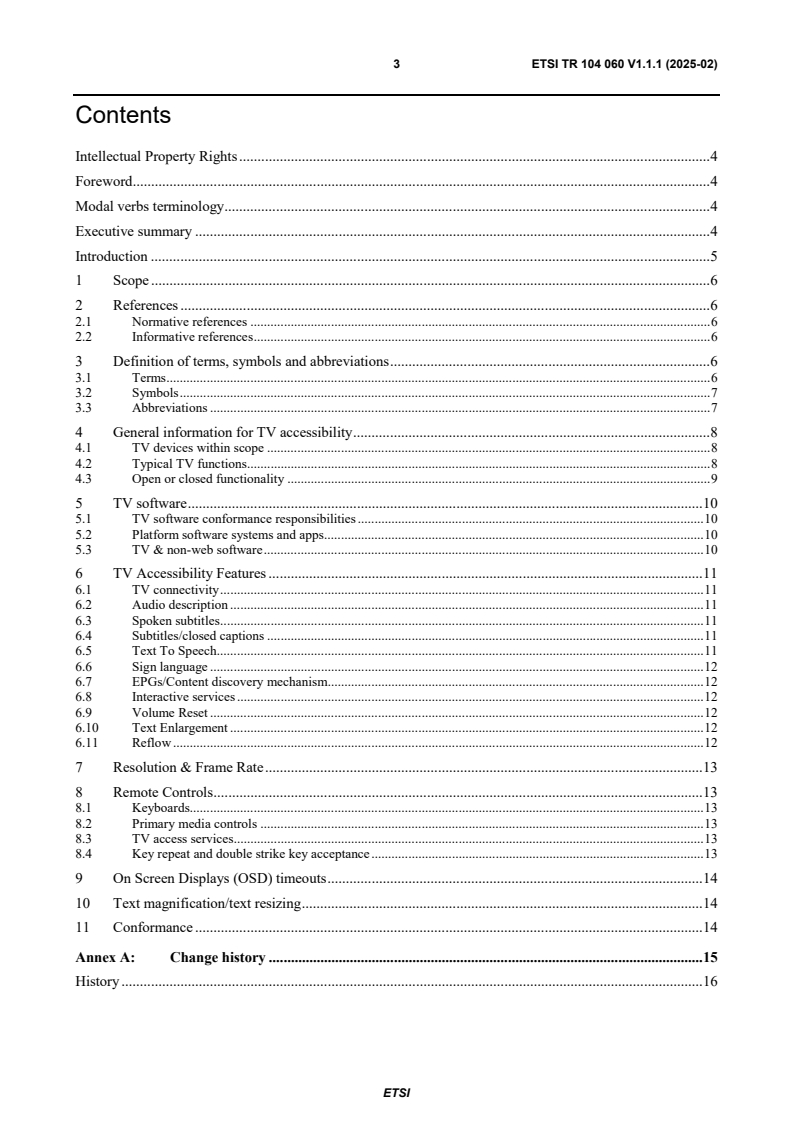
Contents
Intellectual Property Rights . 4
Foreword . 4
Modal verbs terminology . 4
Executive summary . 4
Introduction . 5
1 Scope . 6
2 References . 6
2.1 Normative references . 6
2.2 Informative references . 6
3 Definition of terms, symbols and abbreviations . 6
3.1 Terms . 6
3.2 Symbols . 7
3.3 Abbreviations . 7
4 General information for TV accessibility . 8
4.1 TV devices within scope . 8
4.2 Typical TV functions . 8
4.3 Open or closed functionality . 9
5 TV software . 10
5.1 TV software conformance responsibilities . 10
5.2 Platform software systems and apps . 10
5.3 TV & non-web software . 10
6 TV Accessibility Features . 11
6.1 TV connectivity . 11
6.2 Audio description . 11
6.3 Spoken subtitles . 11
6.4 Subtitles/closed captions . 11
6.5 Text To Speech . 11
6.6 Sign language . 12
6.7 EPGs/Content discovery mechanism. 12
6.8 Interactive services . 12
6.9 Volume Reset . 12
6.10 Text Enlargement . 12
6.11 Reflow . 12
7 Resolution & Frame Rate . 13
8 Remote Controls . 13
8.1 Keyboards. 13
8.2 Primary media controls . 13
8.3 TV access services. 13
8.4 Key repeat and double strike key acceptance . 13
9 On Screen Displays (OSD) timeouts . 14
10 Text magnification/text resizing . 14
11 Conformance . 14
Annex A: Change history . 15
History . 16
ETSI
4 ETSI TR 104 060 V1.1.1 (2025-02)
Intellectual Property Rights
Essential patents
IPRs essential or potentially essential to normative deliverables may have been declared to ETSI. The declarations
pertaining to these essential IPRs, if any, are publicly available for ETSI members and non-members, and can be
found in ETSI SR 000 314: "Intellectual Property Rights (IPRs); Essential, or potentially Essential, IPRs notified to
ETSI in respect of ETSI standards", which is available from the ETSI Secretariat. Latest updates are available on the
ETSI IPR online database.
Pursuant to the ETSI Directives including the ETSI IPR Policy, no investigation regarding the essentiality of IPRs,
including IPR searches, has been carried out by ETSI. No guarantee can be given as to the existence of other IPRs not
referenced in ETSI SR 000 314 (or the updates on the ETSI Web server) which are, or may be, or may become,
essential to the present document.
Trademarks
The present document may include trademarks and/or tradenames which are asserted and/or registered by their owners.
ETSI claims no ownership of these except for any which are indicated as being the property of ETSI, and conveys no
right to use or reproduce any trademark and/or tradename. Mention of those trademarks in the present document does
not constitute an endorsement by ETSI of products, services or organizations associated with those trademarks.
DECT™, PLUGTESTS™, UMTS™ and the ETSI logo are trademarks of ETSI registered for the benefit of its
Members. 3GPP™, LTE™ and 5G™ logo are trademarks of ETSI registered for the benefit of its Members and of the
3GPP Organizational Partners. oneM2M™ logo is a trademark of ETSI registered for the benefit of its Members and of ®
the oneM2M Partners. GSM and the GSM logo are trademarks registered and owned by the GSM Association. ®
BLUETOOTH is a trademark registered and owned by Bluetooth SIG, Inc. ®
HbbTV is a registered trademark of the HbbTV Association.
Foreword
This Technical Report (TR) has been produced by ETSI Technical Committee Human Factors (HF).
Modal verbs terminology
In the present document "should", "should not", "may", "need not", "will", "will not", "can" and "cannot" are to be
interpreted as described in clause 3.2 of the ETSI Drafting Rules (Verbal forms for the expression of provisions).
"must" and "must not" are NOT allowed in ETSI deliverables except when used in direct citation.
Executive summary
The present document complements ETSI EN 301 549 [i.1] which covers a wide range of requirements for a variety of
ICT solutions. TV manufacturers identified the need to develop a technical report with a focus on TV products [3.1].
TV has a unique set of features which typically operate as a system in combination with content providers offerings. As
a result TV manufacturers developed the present document to give clarification for manufacturers towards producing
TV that comply with the European Accessibility Act (EAA) [i.3] and the associated Harmonised Standard ETSI
EN 301 549 [i.1].
ETSI
5 ETSI TR 104 060 V1.1.1 (2025-02)
Introduction
The present document complements ETSI EN 301 549 [i.1] and is targeted at manufacturers and providers of digital
television products. A mapping of the provisions of ETSI EN 301 549 [i.1] is provided and the present document
references the normative work of ETSI EN 301 549 [i.1]. The present document is intended to clarify and explain how
accessibility requirements of ETSI EN 301 549 [i.1] should be applied for TVs and provide consistency of
interpretation.
ETSI
6 ETSI TR 104 060 V1.1.1 (2025-02)
1 Scope
The present document describes the application of accessibility requirements as listed in ETSI EN 301 549 [i.1] herein
called "ETSI EN 301 549 [i.1]" to TVs. The focus is on the device capability rather than the whole digital TV field. The
scope excludes content provision and delivery.
2 References
2.1 Normative references
Normative references are not applicable in the present document.
2.2 Informative references
References are either specific (identified by date of publication and/or edition number or version number) or
non-specific. For specific references, only the cited version applies. For non-specific references, the latest version of the
referenced document (including any amendments) applies.
NOTE: While any hyperlinks included in this clause were valid at the time of publication ETSI cannot guarantee
their long term validity.
The following referenced documents are not necessary for the application of the present document but they assist the
user with regard to a particular subject area.
[i.1] ETSI EN 301 549 (V4.1.1): "Accessibility requirements for ICT products and services".
NOTE: The following reference is not publicly available at the date of publication and may be unavailable for a
period of time.
[i.2] IEC 62944: "Audio, video and multimedia systems and equipment - Digital television
accessibility - Functional specifications".
[i.3] Directive (EU) 2019/882 of the European Parliament and of the Council of 17 April 2019 on the
accessibility requirements for products and services.
[i.4] ETSI TS 103 205 (V1.2.1): "Digital Video Broadcasting (DVB); Extensions to the CI Plus™
Specification".
3 Definition of terms, symbols and abbreviations
3.1 Terms
For the purposes of the present document, the following terms apply:
rd rd
3 party approved software: application which is supplied by a 3 party (other than the device manufacturer) as
already installed at the point of sale/purchase
rd
3 party software vendor: independent entity that develops, supports and markets software designed to integrate with
another company's product or platform
NOTE: These offerings extend functionality or address specific needs not covered by the main system. They are
independent from the product manufacturer.
approved software: software that has been provided by the TV manufacturer
ETSI
7 ETSI TR 104 060 V1.1.1 (2025-02)
caption: synchronized visual and/or text alternative for both speech and non-speech audio information needed to
understand the media content
NOTE: This is also variously described using terms such as "subtitles" or variants such as "subtitles for the deaf
and hard-of-hearing".
downloaded software: application which the user has downloaded from an application store or other source and
installed under the control of the user (not the device manufacturer)
firmware: embedded software including Operating Systems, provided by the TV manufacturer as an essential part of
the functionality, without which the product would not work as specified
providers: manufacturer, authorized representative, or importer of digital TV devices
set top box: device which is connected to a TV typically via HDMI which is capable of receiving that media content
from either broadcasting via different types of transmission systems or can stream media content via the Internet
smart monitor: multi-function monitor without a broadcast TV tuner
NOTE: In contrast non-smart monitors (e.g. gaming monitors) feature a display screen and external input ports
but lack multi-function AV receiving capabilities (such as integrated streaming applications) is
considered out of scope.
soft link (stub) (download on demand software): software which is downloaded and installed after a user request
TV (Television) (television products): device whose primary purpose is to display media content and is capable of
receiving that media content from either broadcasting via different types of transmission systems and can stream media
content via the Internet
NOTE: TVs include smart monitors, set-top-boxes and TV streaming sticks.
rd
party approved software, software or download on
TV software: software that is firmware, approved software, 3
demand software
TV streaming stick: device that plugs directly into a TV's HDMI port and can stream media content via the Internet
3.2 Symbols
Void.
3.3 Abbreviations
For the purposes of the present document, the following abbreviations apply:
app(s) application(s)
API Application Programming Interface
AV AudioVisual/Audio-Visual
EPG Electronic Programme Guide
DRM Digital Rights Management
FCC Federal Communications Commission ®
HbbTV Hybrid broadcast broadband TV
HD High Definition (1920 x 1080 resolution)
HDMI High Definition Multimedia Interface
ICT Information and Communication Technology
IP Internet Protocol
OS Operating System
OSD On Screen Display
SD Standard Definition (640 x 480 or 720 x 480 resolution)
SW Software
TV Television
UHD Ultra High Definition (3840 x 2160 resolution)
TTS Text-To-Speech
WCAG Web Content Accessibility Guidelines
ETSI
8 ETSI TR 104 060 V1.1.1 (2025-02)
4 General information for TV accessibility
4.1 TV devices within scope
The present document describes the application of ETSI EN 301 549 [i.1] in relation to TV to understand how
accessibility requirements should be applied. Examples of TVs include smart monitors, set-top-boxes and TV streaming
sticks.
As per Art. 2 (Scope) of the EAA [i.3] directive, a TV only falls within the following scope definition:
"(d) consumer terminal equipment with interactive computing capability, used for accessing audiovisual media
services."
NOTE 1: While TVs contain various types of functions that vary between manufacturers and platforms, the present
document focuses on the typical functions specified in clause 4.2 which are considered within the scope
of ETSI EN 301 549 [i.1].
NOTE 2: A TV is not assistive technology in itself as per the definition of assistive technology in clause 3 of ETSI
EN 301 549 [i.1].
NOTE 3: Video or Audio content (for example, containing au
...
Questions, Comments and Discussion
Ask us and Technical Secretary will try to provide an answer. You can facilitate discussion about the standard in here.
Loading comments...