


ETSI GS NFV-SOL 013 V4.3.1 (2022-07)
Network Functions Virtualisation (NFV) Release 4; Protocols and Data Models; Specification of common aspects for RESTful NFV MANO APIs
Network Functions Virtualisation (NFV) Release 4; Protocols and Data Models; Specification of common aspects for RESTful NFV MANO APIs
RGS/NFV-SOL013ed431
General Information
Standards Content (Sample)
GROUP SPECIFICATION
Network Functions Virtualisation (NFV) Release 4;
Protocols and Data Models;
Specification of common aspects for RESTful NFV MANO APIs
Disclaimer
The present document has been produced and approved by the Network Functions Virtualisation (NFV) ETSI Industry
Specification Group (ISG) and represents the views of those members who participated in this ISG.
It does not necessarily represent the views of the entire ETSI membership.
2 ETSI GS NFV-SOL 013 V4.3.1 (2022-07)
Reference
RGS/NFV-SOL013ed431
Keywords
API, NFV, protocol
ETSI
650 Route des Lucioles
F-06921 Sophia Antipolis Cedex - FRANCE
Tel.: +33 4 92 94 42 00 Fax: +33 4 93 65 47 16
Siret N° 348 623 562 00017 - APE 7112B
Association à but non lucratif enregistrée à la
Sous-Préfecture de Grasse (06) N° w061004871
Important notice
The present document can be downloaded from:
http://www.etsi.org/standards-search
The present document may be made available in electronic versions and/or in print. The content of any electronic and/or
print versions of the present document shall not be modified without the prior written authorization of ETSI. In case of any
existing or perceived difference in contents between such versions and/or in print, the prevailing version of an ETSI
deliverable is the one made publicly available in PDF format at www.etsi.org/deliver.
Users of the present document should be aware that the document may be subject to revision or change of status.
Information on the current status of this and other ETSI documents is available at
https://portal.etsi.org/TB/ETSIDeliverableStatus.aspx
If you find errors in the present document, please send your comment to one of the following services:
https://portal.etsi.org/People/CommiteeSupportStaff.aspx
If you find a security vulnerability in the present document, please report it through our
Coordinated Vulnerability Disclosure Program:
https://www.etsi.org/standards/coordinated-vulnerability-disclosure
Notice of disclaimer & limitation of liability
The information provided in the present deliverable is directed solely to professionals who have the appropriate degree of
experience to understand and interpret its content in accordance with generally accepted engineering or
other professional standard and applicable regulations.
No recommendation as to products and services or vendors is made or should be implied.
No representation or warranty is made that this deliverable is technically accurate or sufficient or conforms to any law
and/or governmental rule and/or regulation and further, no representation or warranty is made of merchantability or fitness
for any particular purpose or against infringement of intellectual property rights.
In no event shall ETSI be held liable for loss of profits or any other incidental or consequential damages.
Any software contained in this deliverable is provided "AS IS" with no warranties, express or implied, including but not
limited to, the warranties of merchantability, fitness for a particular purpose and non-infringement of intellectual property
rights and ETSI shall not be held liable in any event for any damages whatsoever (including, without limitation, damages
for loss of profits, business interruption, loss of information, or any other pecuniary loss) arising out of or related to the use
of or inability to use the software.
Copyright Notification
No part may be reproduced or utilized in any form or by any means, electronic or mechanical, including photocopying and
microfilm except as authorized by written permission of ETSI.
The content of the PDF version shall not be modified without the written authorization of ETSI.
The copyright and the foregoing restriction extend to reproduction in all media.
© ETSI 2022.
All rights reserved.
ETSI
3 ETSI GS NFV-SOL 013 V4.3.1 (2022-07)
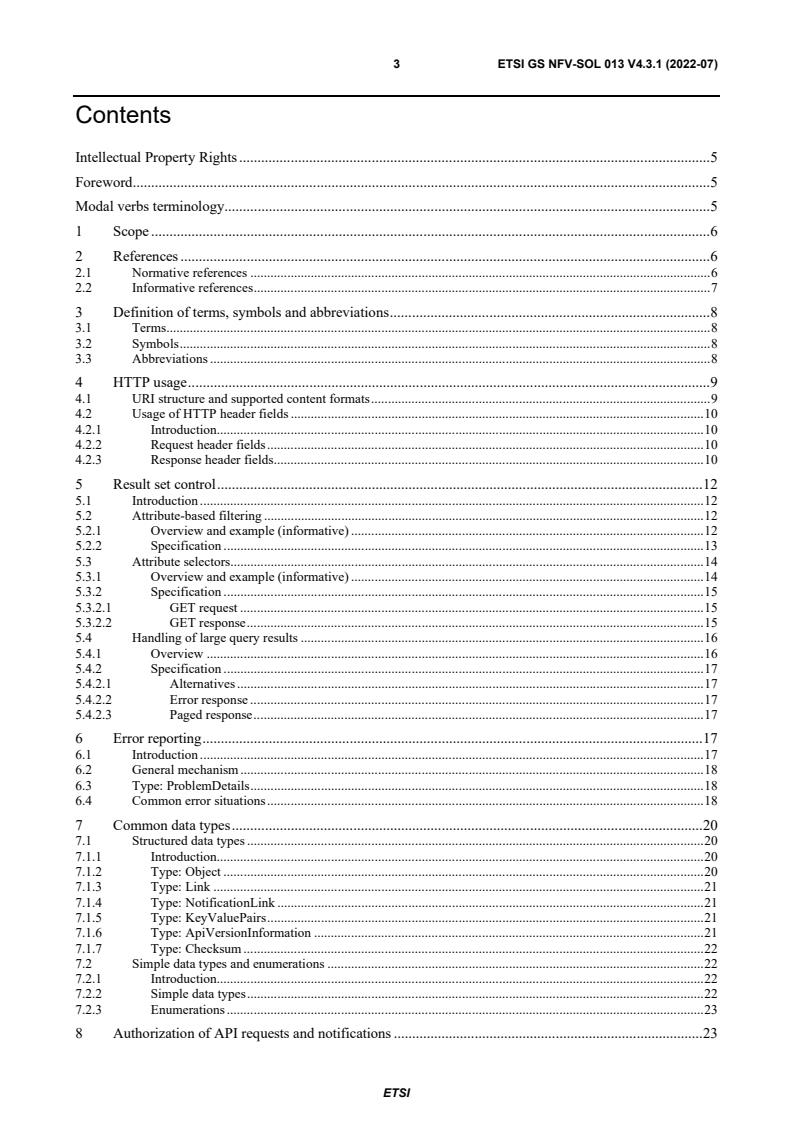
Contents
Intellectual Property Rights . 5
Foreword . 5
Modal verbs terminology . 5
1 Scope . 6
2 References . 6
2.1 Normative references . 6
2.2 Informative references . 7
3 Definition of terms, symbols and abbreviations . 8
3.1 Terms . 8
3.2 Symbols . 8
3.3 Abbreviations . 8
4 HTTP usage . 9
4.1 URI structure and supported content formats . 9
4.2 Usage of HTTP header fields . 10
4.2.1 Introduction. 10
4.2.2 Request header fields . 10
4.2.3 Response header fields . 10
5 Result set control . 12
5.1 Introduction . 12
5.2 Attribute-based filtering . 12
5.2.1 Overview and example (informative) . 12
5.2.2 Specification . 13
5.3 Attribute selectors. 14
5.3.1 Overview and example (informative) . 14
5.3.2 Specification . 15
5.3.2.1 GET request . 15
5.3.2.2 GET response . 15
5.4 Handling of large query results . 16
5.4.1 Overview . 16
5.4.2 Specification . 17
5.4.2.1 Alternatives . 17
5.4.2.2 Error response . 17
5.4.2.3 Paged response . 17
6 Error reporting . 17
6.1 Introduction . 17
6.2 General mechanism . 18
6.3 Type: ProblemDetails . 18
6.4 Common error situations . 18
7 Common data types . 20
7.1 Structured data types . 20
7.1.1 Introduction. 20
7.1.2 Type: Object . 20
7.1.3 Type: Link . 21
7.1.4 Type: NotificationLink . 21
7.1.5 Type: KeyValuePairs . 21
7.1.6 Type: ApiVersionInformation . 21
7.1.7 Type: Checksum . 22
7.2 Simple data types and enumerations . 22
7.2.1 Introduction. 22
7.2.2 Simple data types . 22
7.2.3 Enumerations . 23
8 Authorization of API requests and notifications . 23
ETSI
4 ETSI GS NFV-SOL 013 V4.3.1 (2022-07)
8.1 Introduction . 23
8.2 Flows (informative) . 24
8.2.1 General . 24
8.2.2 Authorization of API requests using OAuth 2.0 access tokens . 24
8.2.3 Authorization of API requests using TLS certificates . 26
8.2.4 Authorization of notifications using the HTTP Basic authentication scheme . 26
8.2.5 Authorization of notifications using OAuth 2.0 access tokens . 26
8.2.6 Authorization of notifications using TLS certificates . 28
8.3 Specification . 29
8.3.1 Introduction. 29
8.3.2 General mechanism. 29
8.3.3 Authorizing API requests . 30
8.3.4 Authorizing the sending of notifications . 30
8.3.5 Client roles . 32
8.3.6 Support of authorization . 32
8.3.6.1 Authorization of API requests . 32
8.3.6.2 Authorization of notification requests . 32
9 Version management . 33
9.1 Version identifiers and parameters . 33
9.1.1 Version identifiers . 33
9.1.2 Version parameters . 33
9.2 Rules for incrementing version identifier fields . 33
9.2.1 General . 33
9.2.2 Examples of backward and non-backward compatible changes . 34
9.3 Version information retrieval . 35
9.3.1 General . 35
9.3.2 Resource structure and methods . 35
9.3.3 Resource: API versions . 36
9.3.3.1 Description . 36
9.3.3.2 Resource definition . 36
9.3.3.3 Resource methods . 36
9.3.3.3.1 POST . 36
9.3.3.3.2 GET . 36
9.3.3.3.3 PUT . 37
9.3.3.3.4 PATCH . 37
9.3.3.3.5 DELETE . 37
9.4 Version signalling. 37
Annex A (informative): Change History . 38
History . 40
ETSI
5 ETSI GS NFV-SOL 013 V4.3.1 (2022-07)
Intellectual Property Rights
Essential patents
IPRs essential or potentially essential to normative deliverables may have been declared to ETSI. The declarations
pertaining to these essential IPRs, if any, are publicly available for ETSI members and non-members, and can be
found in ETSI SR 000 314: "Intellectual Property Rights (IPRs); Essential, or potentially Essential, IPRs notified to
ETSI in respect of ETSI standards", which is available from the ETSI Secretariat. Latest updates are available on the
ETSI Web server (https://ipr.etsi.org/).
Pursuant to the ETSI Directives including the ETSI IPR Policy, no investigation regarding the essentiality of IPRs,
including IPR searches, has been carried out by ETSI. No guarantee can be given as to the existence of other IPRs not
referenced in ETSI SR 000 314 (or the updates on the ETSI Web server) which are, or may be, or may become,
essential to the present document.
Trademarks
The present document may include trademarks and/or tradenames which are asserted and/or registered by their owners.
ETSI claims no ownership of these except for any which are indicated as being the property of ETSI, and conveys no
right to use or reproduce any trademark and/or tradename. Mention of those trademarks in the present document does
not constitute an endorsement by ETSI of products, services or organizations associated with those trademarks.
DECT™, PLUGTESTS™, UMTS™ and the ETSI logo are trademarks of ETSI registered for the benefit of its
Members. 3GPP™ and LTE™ are trademarks of ETSI registered for the benefit of its Members and of the 3GPP
Organizational Partners. oneM2M™ logo is a trademark of ETSI registered for the benefit of its Members and of the ®
oneM2M Partners. GSM and the GSM logo are trademarks registered and owned by the GSM Association.
Foreword
This Group Specification (GS) has been produced by ETSI Industry Specification Group (ISG) Network Functions
Virtualisation (NFV).
Modal verbs terminology
In the present document "shall", "shall not", "should", "should not", "may", "need not", "will", "will not", "can" and
"cannot" are to be interpreted as described in clause 3.2 of the ETSI Drafting Rules (Verbal forms for the expression of
provisions).
"must" and "must not" are NOT allowed in ETSI deliverables except when used in direct citation.
ETSI
6 ETSI GS NFV-SOL 013 V4.3.1 (2022-07)
1 Scope
The present document specifies common aspects of RESTful protocols and data models for ETSI NFV management
and orchestration (MANO) interfaces.
2 References
2.1 Normative references
References are either specific (identified by date of publication and/or edition number or version number) or
non-specific. For specific references, only the cited version applies. For non-specific references, the latest version of the
referenced document (including any amendments) applies.
Referenced documents which are not found to be publicly available in the expected location might be found at
https://docbox.etsi.org/Reference/.
NOTE: While any hyperlinks included in this clause were valid at the time of publication, ETSI cannot guarantee
their long term validity.
The following referenced documents are necessary for the application of the present document.
[1] Void.
[2] IETF RFC 3339: "Date and Time on the Internet: Timestamps".
NOTE: Available at https://tools.ietf.org/html/rfc3339.
[3] IETF RFC 3986: "Uniform Resource Identifier (URI): Generic Syntax".
NOTE: Available at https://tools.ietf.org/html/rfc3986.
[4] IETF RFC 4918: "HTTP Extensions for Web Distributed Authoring and Versioning (WebDAV)".
NOTE: Available at https://tools.ietf.org/html/rfc4918.
[5] IETF RFC 5246: "The Transport Layer Security (TLS) Protocol Version 1.2".
NOTE: Available at https://tools.ietf.org/html/rfc5246.
[6] IETF RFC 6585: "Additional HTTP Status Codes".
NOTE: Available at https://tools.ietf.org/html/rfc6585.
[7] IETF RFC 6749: "The OAuth 2.0 Authorization Framework".
NOTE: Available from https://tools.ietf.org/html/rfc6749.
[8] IETF RFC 6750: "The OAuth 2.0 Authorization Framework: Bearer Token Usage".
NOTE: Available from https://tools.ietf.org/html/rfc6750.
[9] IETF RFC 8259: "The JavaScript Object Notation (JSON) Data Interchange Format".
NOTE: Available at https://tools.ietf.org/html/rfc8259.
[10] IETF RFC 7231: "Hypertext Transfer Protocol (HTTP/1.1): Semantics and Content".
NOTE: Available at https://tools.ietf.org/html/rfc7231.
[11] IETF RFC 7232: "Hypertext Transfer Protocol (HTTP/1.1): Conditional Requests".
NOTE: Available at https://tools.ietf.org/html/rfc7232.
ETSI
7 ETSI GS NFV-SOL 013 V4.3.1 (2022-07)
[12] IETF RFC 7233: "Hypertext Transfer Protocol (HTTP/1.1): Range Requests".
NOTE: Available at https://tools.ietf.org/html/rfc7233.
[13] IETF RFC 7235: "Hypertext Transfer Protocol (HTTP/1.1): Authentication".
NOTE: Available at https://tools.ietf.org/html/rfc7235.
[14] IETF RFC 7617: "The 'Basic' HTTP Authentication Scheme".
NOTE: Available from https://tools.ietf.org/html/rfc7617.
[15] IETF RFC 7807: "Problem Details for HTTP APIs".
NOTE: Available at https://tools.ietf.org/html/rfc7807.
[16] IETF RFC 6901: "JavaScript Object Notation (JSON) Pointer".
NOTE: Available at https://tools.ietf.org/html/rfc6901.
[17] IETF RFC 8288: "Web Linking".
NOTE: Available at https://tools.ietf.org/html/rfc8288.
[18] Semantic Versioning 2.0.0.
NOTE: Available at https://semver.org/.
[19] IETF RFC 4229: "HTTP Header Field Registrations".
NOTE: Available at https://tools.ietf.org/html/rfc4229.
[20] ETSI GS NFV-SEC 022: "Network Functions Virtualisation (NFV) Release 2; Security; Access
Token Specification for API Access".
[21] ETSI TS 133 210: "Digital cellular telecommunications system (Phase 2+) (GSM); Universal
Mobile Telecommunications System (UMTS); LTE; 5G; Network Domain Security (NDS); IP
network layer security (3GPP TS 33.210)".
[22] IETF RFC 8446: "The Transport Layer Security (TLS) Protocol Version 1.3".
NOTE: Available at https://tools.ietf.org/html/rfc8446.
[23] IETF RFC 7515: "JSON Web Signature (JWS)".
NOTE: Available at https://tools.ietf.org/html/rfc7515.
2.2 Informative references
References are either specific (identified by date of publication and/or edition number or version number) or
non-specific. For specific references, only the cited version applies. For non-specific references, the latest version of the
referenced document (including any amendments) applies.
NOTE: While any hyperlinks included in this clause were valid at the time of publication, ETSI cannot guarantee
their long term validity.
The following referenced documents are not necessary for the application of the present document but they assist the
user with regard to a particular subject area.
[i.1] ETSI GS NFV 003: "Network Functions Virtualisation (NFV); Terminology for Main Concepts in
NFV".
[i.2] Void.
[i.3] IANA: "Hypertext Transfer Protocol (HTTP) Status Code Registry".
NOTE: Available at http://www.iana.org/assignments/http-status-codes.
ETSI
8 ETSI GS NFV-SOL 013 V4.3.1 (2022-07)
[i.4] ETSI NFV OpenAPI repository.
NOTE: Available at https://forge.etsi.org/rep/nfv/.
[i.5] JSON Schema Validation: A Vocabulary for Structural Validation of JSON.
NOTE: JSON schema is documented at http://json-schema.org/.
[i.6] OpenAPI™ Specification.
NOTE: Available at https://github.com/OAI/OpenAPI-Specification.
[i.7] IANA registry for Hash Function Textual Names.
NOTE: Available at https://www.iana.org/assignments/hash-function-text-names/hash-function-text-
names.xhtml.
3 Definition of terms, symbols and abbreviations
3.1 Terms
For the purposes of the present document, the terms given in ETSI GS NFV 003 [i.1] apply.
3.2 Symbols
Void.
3.3 Abbreviations
For the purposes of the present document, the following abbreviations apply:
API Application Programming Interface
EM Element Manager
ETSI European Telecommunications Standards Institute
GMT Greenwich Mean Time
GS Group Specification
HATEOAS Hypermedia As The Engine Of Application State
HTML HyperText Markup Language
HTTP HyperText Transfer Protocol
HTTPS HTTP Secure
IANA Internet Assigned Numbers Authority
IETF Internet Engineering Task Force
JSON JavaScript Object Notation
MAC Medium Access Control
MANO Management and Orchestration
MIME Multipurpose Internet Mail Extensions
NFV Network Functions Virtualisation
NFVO NFV Orchestrator
REST REpresentational State Transfer
RFC Request For Comments
TLS Transport Layer Security
URI Uniform Resource Identifier
VIM Virtualised Infrastructure Manager
VNF Virtualised Network Function
VNFM VNF Manager
ETSI
9 ETSI GS NFV-SOL 013 V4.3.1 (2022-07)
4 HTTP usage
4.1 URI structure and supported content formats
This clause specifies the URI prefix and the supported formats applicable to the RESTful NFV-MANO APIs.
All resource URIs of the APIs shall have the following prefix, except the "API versions" resource which shall follow
the rules specified in clause 9.3:
{apiRoot}/{apiName}/{apiMajorVersion}/
where:
{apiRoot} indicates the scheme ("https"), the host name and optional port, and an optional
sequence of path segments that together represent a prefix path.
EXAMPLE: http://orchestrator.example.com/nfv_apis/abc
{apiName} indicates the interface name in an abbreviated form. The {apiName} of each interface
is defined in the clause specifying the corresponding interface.
{apiMajorVersion} indicates the current major version (see clause 9.1) of the API and is defined in the
clause specifying the corresponding interface.
For HTTP requests and responses that have a body, the content format JSON (see IETF RFC 8259 [9]) shall be
supported. The JSON format shall be signalled by the content type "application/json".
HTTP shall be run as an application protocol over TLS, a combination that is known as HTTPS. All APIs shall use TLS
version 1.2 as defined by IETF RFC 5246 [5] or later. Versions of TLS earlier than 1.2 shall neither be supported nor
used.
NOTE 1: The HTTP protocol elements mentioned in the RESTful NFV-MANO API specifications originate from
the HTTP specification; HTTPS runs the HTTP protocol on top of a TLS layer. The RESTful
NFV-MANO specifications therefore use the statement above to mention "HTTP request", "HTTP
header", etc., without explicitly calling out whether or not these are run over TLS.
TLS implementations shall meet or exceed the security algorithm, key length and strength requirements specified in
clause 6.2.3 (if TLS version 1.2 as defined by IETF RFC 5246 [5] is used) or clause 6.2.2 (if TLS version 1.3 as defined
by IETF RFC 8446 [22] is used) of ETSI TS 133 210 [21] (3GPP Release 16 or later).
All resource URIs of the API shall comply with the URI syntax as defined in IETF RFC 3986 [3]. An implementation
that dynamically generates resource URI parts (individual path segments, sequences of path segments that are separated
by "/", query parameter values) shall ensure that these parts only use the character set that is allowed by IETF
RFC 3986 [3] for these parts.
NOTE 2: This means that characters not part of this allowed set are escaped using percent-encoding as defined by
IETF RFC 3986 [3].
Unless otherwise specified explicitly, all request URI parameters that are part of the path of the resource URI shall be
individual path segments, i.e. shall not contain the "/" character.
NOTE 3: A request URI parameter is denoted by a string in curly brackets, e.g. {subscriptionId}.
ETSI
10 ETSI GS NFV-SOL 013 V4.3.1 (2022-07)
4.2 Usage of HTTP header fields
4.2.1 Introduction
HTTP headers are components of the header section of the HTTP request and response messages. They contain the
information about the server/client and metadata of the transaction. The use of HTTP header fields shall comply with
the provisions defined for those header fields in the specifications referenced from tables 4.2.2-1 and 4.2.3-1. The
following clauses describe more details related to selected HTTP header fields.
4.2.2 Request header fields
This clause describes the usage of selected HTTP header fields of the request messages in the RESTful NFV-MANO
APIs. The HTTP header fields used in the request messages are specified in table 4.2.2-1.
Table 4.2.2-1: Header fields supported in the request message
Header field name Reference Example Descriptions
Accept IETF RFC 7231 [10] application/json Content-Types that are acceptable
for the response.
This header field shall be present if
the response is expected to have a
non-empty message body.
Content-Type IETF RFC 7231 [10] application/json The MIME type of the body of the
request.
This header field shall be present if
the request has a non-empty
message body.
Authorization IETF RFC 7235 [13] Bearer mF_9.B5f-4.1JqM The authorization token for the
request. Details are specified in
clause 8.3.
Range IETF RFC 7233 [12] 1 000-2 000 Requested range of bytes from a
file.
Version IETF RFC 4229 [19] 1.2.0
Version of the API requested to use
or when responding to this request.
1.2.0-
impl:example.com:myProduct:4
If-Unmodified-Since IETF RFC 7232 [11] Sat, 29 Oct 1994 19:43:31 GMT Used to make the request method
conditional on the selected resource
representation's last modification
date being earlier than or equal to
the date provided in the field-value.
If the condition is not met, the
request fails with a "412
Precondition Failed" response.
If-Match IETF RFC 7232 [11] "xyzzy" Used to make the request method
or conditional on the recipient origin
"xyzzy", "r2d2xxxx", "c3piozzzz" server either having at least one
or current representation of the target
* resource, when the field-value is "*",
or having a current representation
of the target resource that has an
entity-tag matching a member of the
list of entity-tags provided in the
field-value. If the condition is not
met, the request fails with a "412
Precondition Failed" response.
4.2.3 Response header fields
This clause describes the usage of selected HTTP header fields of the response messages in the RESTful NFV-MANO
APIs. The HTTP header fields used in the response messages are specified in table 4.2.3-1.
ETSI
11 ETSI GS NFV-SOL 013 V4.3.1 (2022-07)
Table 4.2.3-1: Header fields supported in the response message
Header field name Reference Example Descriptions
Content-Type IETF RFC 7231 [10] application/json The MIME type of the body of the
response.
This header field shall be present if
the response has a non-empty
message body.
Location IETF RFC 7231 [10] http://www.example.com/vnflcm/v1/ Used in redirection, or when a new
vnf_instances/123 resource has been created.
This header field shall be present if
the response status code is 201 or
3xx.
In the RESTful NFV-MANO APIs
this header field is also used if the
response status code is 202 and a
new resource was created.
WWW-Authenticate IETF RFC 7235 [13] Bearer realm="example" Challenge if the corresponding
HTTP request has not provided
authorization, or error details if the
corresponding HTTP request has
provided an invalid authorization
token.
Accept-Ranges IETF RFC 7233 [12] bytes Used by the server to signal
whether or not it supports ranges for
certain resources.
Content-Range IETF RFC 7233 [12] bytes 21 010 - 47 021/47 022 Signals the byte range that is
contained in the response, and the
total length of the file.
Retry-After IETF RFC 7231 [10] Fri, 31 Dec 1999 23:59:59 GMT Used to indicate how long the user
or agent ought to wait before making a
120 follow-up request.
It can be used with 503 responses.
The value of this field can be an
HTTP-date or a number of seconds
to delay after the response is
received.
Link IETF RFC 8288 [17]
tpage_opaque_marker=abc123>; for paging in the present document,
rel="next" see clause 5.4.2.1.
Version IETF RFC 4229 [19] 1.2.0 Version of the API requested to use
or when responding to this request.
1.2.0-
impl:example.com:myProduct:4
ETag IETF RFC 7232 [11] "33a64df551425fcc55e4d42a14879 Used to provide the current entity-
5d9f25f89d4" tag for the selected resource
or representation. It can be sent in
W/"0815" "200 OK", "201 Created" and "204
No Content" responses.
Last-Modified IETF RFC 7232 [11] Tue, 15 Nov 1994 12:45:26 GMT Used to provide a timestamp
indicating the date and time at
which the server believes the
selected resource representation
was last modified. It can be sent in
"200 OK", "201 Created" and "204
No Content" responses.
ETSI
12 ETSI GS NFV-SOL 013 V4.3.1 (2022-07)
5 Result set control
5.1 Introduction
This clause specifies procedures that allow to control the size of the result set of GET requests with respect to the
number of entries in a response list (using attribute-based filtering) or with respect to the number of attributes returned
in a response (using attribute selection).
5.2 Attribute-based filtering
5.2.1 Overview and example (informative)
Attribute-based filtering allows to reduce the number of objects returned by a query operation. Typically,
attribute-based filtering is applied to a GET request that reads a resource which represents a list of objects (e.g. child
resources). Only those objects that match the filter are returned as part of the resource representation in the payload
body of the GET response.
Attribute-based filtering can test a simple (scalar) attribute of the resource representation against a constant value, for
instance for equality, inequality, greater or smaller than, etc. Attribute-based filtering is requested by adding a set of
URI query parameters, the "attribute-based filtering parameters" or "filter" for short, to a resource URI.
The following example illustrates the principle. Assume a resource "container" with the following objects:
EXAMPLE 1: Objects:
obj1: {"id":123, "weight":100, "parts":[{"id":1, "color":"red"}, {"id":2, "color":"green"}]}
obj2: {"id":456, "weight":500, "parts":[{"id":3, "color":"green"}, {"id":4, "color":"blue"}]}
A GET request on the "container" resource would deliver the following response:
EXAMPLE 2: Unfiltered GET:
Request:
GET …/container
Response:
[
{"id":123, "weight":100, "parts":[{"id":1, "color":"red"}, {"id":2, "color":"green"}]},
{"id":456, "weight":500, "parts":[{"id":3, "color":"green"}, {"id":4, "color":"blue"}]}
]
A GET request with a filter on the "container" resource would deliver the following response:
EXAMPLE 3: GET with filter:
Request:
GET …/container?filter=(eq,weight,100)
Response:
[
{"id":123, "weight":100, "parts":[{"id":1, "color":"red"}, {"id":2, "color":"green"}]}
]
For hierarchically-structured data, filters can also be applied to attributes deeper in the hierarchy. In case of arrays, a
filter matches if any of the elements of the array matches. In other words, when applying the filter
"(eq,parts/color,green)" to the objects in Example 1, the filter matches obj1 when evaluating the second entry in the
"parts" array of obj1 and matches obj2 already when evaluating the first entry in the "parts" array of obj2. As the result,
both obj1 and obj2 match the filter.
If a filter contains multiple sub-parts that only differ in the leaf attribute (i.e. they share the same attribute prefix), they
are evaluated together per array entry when traversing an array. As an example, the two expressions in the filter
"(eq,parts/color,green);(eq,parts/id,3)" would be evaluated together for each entry in the array "parts". As the result,
obj2 matches the filter.
ETSI
13 ETSI GS NFV-SOL 013 V4.3.1 (2022-07)
5.2.2 Specification
An attribute-based filter shall be represented by a URI query parameter named "filter". The value of this parameter shall
consist of one or more strings formatted according to "simpleFilterExpr", concatenated using the ";" character:
simpleFilterExprOne := ","["/"]*","
simpleFilterExprMulti := ","["/"]*","[","]*
simpleFilterExpr := "("")" | "("")"
filterExpr := [";"]*
filter := "filter"=
opOne := "eq" | "neq" | "gt" | "lt" | "gte" | "lte"
opMulti := "in" | "nin" | "cont" | "ncont"
attrName := string
value := string
where:
* zero or more occurrences
[] grouping of expressions to be used with *
"" quotation marks for marking string constants
<> name separator
| separator of alternatives
"AttrName" is the name of one attribute in the data type that defines the representation of the resource. The slash ("/")
character in "simpleFilterExprOne" and " simpleFilterExprMulti" allows concatenation of entries to filter
by attributes deeper in the hierarchy of a structured document. The special attribute name "@key" refers to the key of a
map.
EXAMPLE: Referencing the key of a map
GET …/resource?filter=(eq,mymap/@key,abc123)
The elements "opOne" and "opMulti" stand for the comparison operators (accepting one comparison value or a list of
such values). If the expression has concatenated entries, it means that the operator is applied to the attribute
addressed by the last entry included in the concatenation. All simple filter expressions are combined by the
"AND" logical operator, denoted by ";".
In a concatenation of entries in a or , the rightmost
entry is called "leaf attribute". The concatenation of all "attrName" entries except the leaf attribute is called
the "attribute prefix". If an attribute referenced in an expression is an array, an object that contains a corresponding
array shall be considered to match the expression if any of the elements in the array matches all expressions that have
the same attribute prefix.
The leaf attribute of a or shall not be structured but shall be of a
simple (scalar) type such as String, Number, Boolean or DateTime, or shall be an array of simple (scalar) values.
Attempting to apply a filter with a structured leaf attribute shall be rejected with "400 Bad request". A
shall not contain any invalid entry.
The operators listed in table 5.2.2-1 shall be supported.
Table 5.2.2-1: Operators for attribute-based filtering
Operator with parameters Meaning
eq,, Attribute equal to
neq,, Attribute not equal to
in,,[,]* Attribute equal to one of the values in the list ("in set" relationship)
nin,,[,]* Attribute not equal to any of the values in the list ("not in set" relationship)
gt,, Attribute greater than
gte,, Attribute greater than or equal to
lt,, Attribute less than
lte,, Attribute less than or equal to
cont,,[,]* String attribute contains (at least) one of the values in the list
ncont,,[,]* String attribute does not contain any of the values in the list
ETSI
14 ETSI GS NFV-SOL 013 V4.3.1 (2022-07)
Table 5.2.2-2: Applicability of the operators to data types
Operator String Number DateTime Enumeration Boolean
eq x x - x x
neq x x - x x
in x x - x -
nin x x - x -
gt x x x - -
gte x x x - -
lt x x x - -
lte x x x - -
cont x - - - -
ncont x - - - -
Table 5.2.2-2 defines which operators are applicable for which data types. All combinations marked with a "x" shall be
supported.
All objects that match the filter shall be returned as response to a GET request that contains a filter.
A entry shall contain a scalar value of type Number, String, Boolean, Enum or DateTime. The content of a
entry shall be formatted the same way as the representation of the related attribute in the resource
representation: The syntax of DateTime entries shall follow the "date-time" production of IETF RFC 3339 [2].
The syntax of Boolean and Number entries shall follow IETF RFC 8259 [9].
A entry of type String shall be enclosed in single quotes (') if it contains any of the characters ")", "'" or ",", and
may be enclosed in single quotes otherwise. Any single quote (') character contained in a entry shall be
represented as a sequence of two single quote characters.
The "/" and "~" characters in shall be escaped according to the rules defined in section 3 of IETF
RFC 6901 [16]. If the "," character appears in it shall be escaped by replacing it with "~a". If the "@"
character appears in other than in the keyword "@key", it shall be escaped by replacing it with "~b".
In the resulting , percent-encoding as defined in IETF RFC 3986 [3] shall be applied to the characters that
are not allowed in a URI query part according to Appendix A of IETF RFC 3986 [3], and to the ampersand "&"
character.
NOTE: In addition to the statement on percent-encoding above, it is reminded that the percent "%" character is
always percent-encoded when used in parts of a URI, according to IETF RFC 3986 [3].
Attribute-based filters are supported for certain resources. Details are defined in the clauses specifying the actual
r
...
Questions, Comments and Discussion
Ask us and Technical Secretary will try to provide an answer. You can facilitate discussion about the standard in here.
Loading comments...