


ETSI TR 103 937 V1.1.1 (2024-08)
Cyber Security (CYBER); Cyber Resiliency and Supply Chain Management
Cyber Security (CYBER); Cyber Resiliency and Supply Chain Management
DTR/CYBER-0099
General Information
Standards Content (Sample)
TECHNICAL REPORT
Cyber Security (CYBER);
Cyber Resiliency and Supply Chain Management
2 ETSI TR 103 937 V1.1.1 (2024-08)
Reference
DTR/CYBER-0099
Keywords
cyber security, cyber-defence, risk management
ETSI
650 Route des Lucioles
F-06921 Sophia Antipolis Cedex - FRANCE
Tel.: +33 4 92 94 42 00 Fax: +33 4 93 65 47 16
Siret N° 348 623 562 00017 - APE 7112B
Association à but non lucratif enregistrée à la
Sous-Préfecture de Grasse (06) N° w061004871
Important notice
The present document can be downloaded from the
ETSI Search & Browse Standards application.
The present document may be made available in electronic versions and/or in print. The content of any electronic and/or
print versions of the present document shall not be modified without the prior written authorization of ETSI. In case of any
existing or perceived difference in contents between such versions and/or in print, the prevailing version of an ETSI
deliverable is the one made publicly available in PDF format on ETSI deliver.
Users should be aware that the present document may be revised or have its status changed,
this information is available in the Milestones listing.
If you find errors in the present document, please send your comments to
the relevant service listed under Committee Support Staff.
If you find a security vulnerability in the present document, please report it through our
Coordinated Vulnerability Disclosure (CVD) program.
Notice of disclaimer & limitation of liability
The information provided in the present deliverable is directed solely to professionals who have the appropriate degree of
experience to understand and interpret its content in accordance with generally accepted engineering or
other professional standard and applicable regulations.
No recommendation as to products and services or vendors is made or should be implied.
No representation or warranty is made that this deliverable is technically accurate or sufficient or conforms to any law
and/or governmental rule and/or regulation and further, no representation or warranty is made of merchantability or fitness
for any particular purpose or against infringement of intellectual property rights.
In no event shall ETSI be held liable for loss of profits or any other incidental or consequential damages.
Any software contained in this deliverable is provided "AS IS" with no warranties, express or implied, including but not
limited to, the warranties of merchantability, fitness for a particular purpose and non-infringement of intellectual property
rights and ETSI shall not be held liable in any event for any damages whatsoever (including, without limitation, damages
for loss of profits, business interruption, loss of information, or any other pecuniary loss) arising out of or related to the use
of or inability to use the software.
Copyright Notification
No part may be reproduced or utilized in any form or by any means, electronic or mechanical, including photocopying and
microfilm except as authorized by written permission of ETSI.
The content of the PDF version shall not be modified without the written authorization of ETSI.
The copyright and the foregoing restriction extend to reproduction in all media.
© ETSI 2024.
All rights reserved.
ETSI
3 ETSI TR 103 937 V1.1.1 (2024-08)
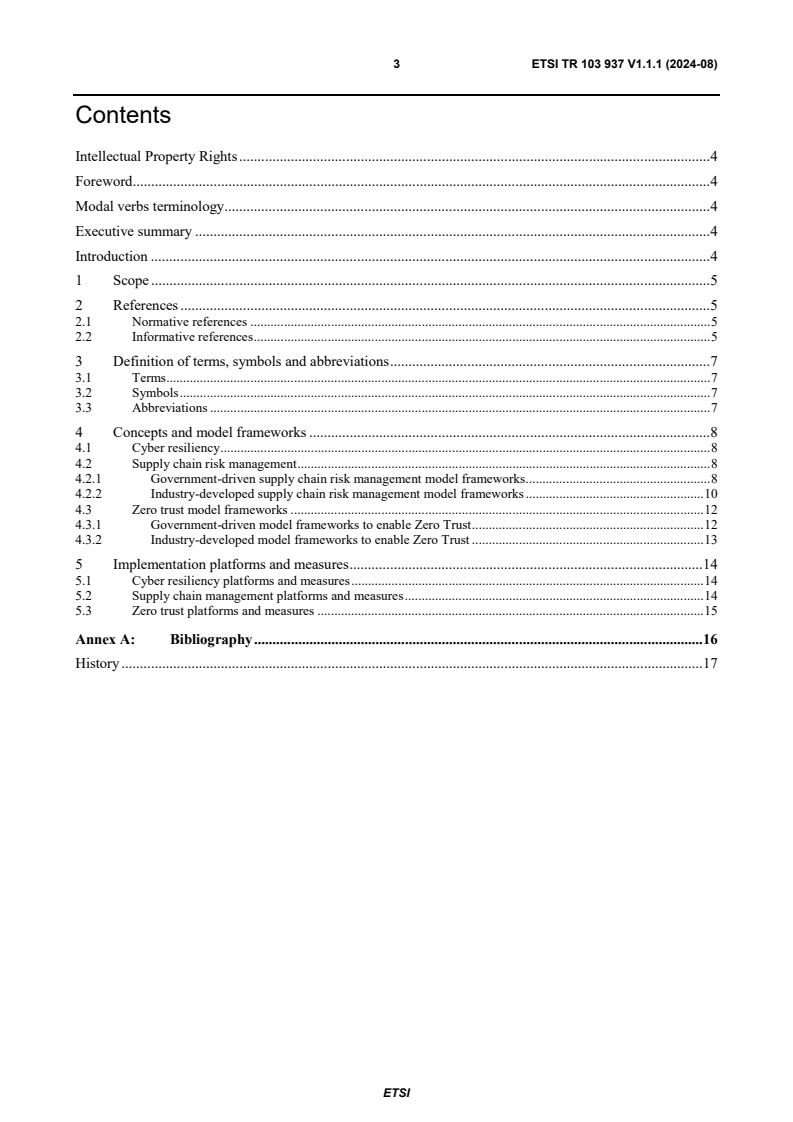
Contents
Intellectual Property Rights . 4
Foreword . 4
Modal verbs terminology . 4
Executive summary . 4
Introduction . 4
1 Scope . 5
2 References . 5
2.1 Normative references . 5
2.2 Informative references . 5
3 Definition of terms, symbols and abbreviations . 7
3.1 Terms . 7
3.2 Symbols . 7
3.3 Abbreviations . 7
4 Concepts and model frameworks . 8
4.1 Cyber resiliency . 8
4.2 Supply chain risk management . 8
4.2.1 Government-driven supply chain risk management model frameworks . 8
4.2.2 Industry-developed supply chain risk management model frameworks . 10
4.3 Zero trust model frameworks . 12
4.3.1 Government-driven model frameworks to enable Zero Trust . 12
4.3.2 Industry-developed model frameworks to enable Zero Trust . 13
5 Implementation platforms and measures . 14
5.1 Cyber resiliency platforms and measures . 14
5.2 Supply chain management platforms and measures . 14
5.3 Zero trust platforms and measures . 15
Annex A: Bibliography . 16
History . 17
ETSI
4 ETSI TR 103 937 V1.1.1 (2024-08)
Intellectual Property Rights
Essential patents
IPRs essential or potentially essential to normative deliverables may have been declared to ETSI. The declarations
pertaining to these essential IPRs, if any, are publicly available for ETSI members and non-members, and can be
found in ETSI SR 000 314: "Intellectual Property Rights (IPRs); Essential, or potentially Essential, IPRs notified to
ETSI in respect of ETSI standards", which is available from the ETSI Secretariat. Latest updates are available on the
ETSI Web server (https://ipr.etsi.org/).
Pursuant to the ETSI Directives including the ETSI IPR Policy, no investigation regarding the essentiality of IPRs,
including IPR searches, has been carried out by ETSI. No guarantee can be given as to the existence of other IPRs not
referenced in ETSI SR 000 314 (or the updates on the ETSI Web server) which are, or may be, or may become,
essential to the present document.
Trademarks
The present document may include trademarks and/or tradenames which are asserted and/or registered by their owners.
ETSI claims no ownership of these except for any which are indicated as being the property of ETSI, and conveys no
right to use or reproduce any trademark and/or tradename. Mention of those trademarks in the present document does
not constitute an endorsement by ETSI of products, services or organizations associated with those trademarks.
DECT™, PLUGTESTS™, UMTS™ and the ETSI logo are trademarks of ETSI registered for the benefit of its
Members. 3GPP™ and LTE™ are trademarks of ETSI registered for the benefit of its Members and of the 3GPP
Organizational Partners. oneM2M™ logo is a trademark of ETSI registered for the benefit of its Members and of the ®
oneM2M Partners. GSM and the GSM logo are trademarks registered and owned by the GSM Association.
Foreword
This Technical Report (TR) has been produced by ETSI Technical Committee Cyber Security (CYBER).
Modal verbs terminology
In the present document "should", "should not", "may", "need not", "will", "will not", "can" and "cannot" are to be
interpreted as described in clause 3.2 of the ETSI Drafting Rules (Verbal forms for the expression of provisions).
"must" and "must not" are NOT allowed in ETSI deliverables except when used in direct citation.
Executive summary
The development of tools for cyber resiliency under a broad "Zero Trust Model" aegis continue evolve and include
Supply Chain Bill of Materials (SBOM), community exchange of vulnerability and remediation code, Continuous
Monitoring for threat anomalies, and application of Critical Security Controls.
Introduction
Over the past several years, the increasing significant attacks on ICT infrastructure has led to a return to cybersecurity
fundamentals developed after the conceptualization of packet data networks to provide access to computer resources. It
was a realization that persistent vulnerabilities in every digital element and system will always exist, that "ex ante" trust
certifications were minimally useful, and that a different set of tools was necessary. The development of these tools for
cyber resiliency proceeded under a broad "Zero Trust Model" aegis that includes Supply chain Bill Of Materials
(SBOM), community exchange of vulnerability and remediation code, Continuous Monitoring for threat anomalies, and
application of Critical Security Controls.
ETSI
5 ETSI TR 103 937 V1.1.1 (2024-08)
1 Scope
The present document addresses cyber resiliency throughout the supply chain and the various related frameworks and
measures using risk-based, system of trust, and zero trust approaches, including the proposed EU Cyber Resilience Act,
[i.1] through [i.8].
2 References
2.1 Normative references
Normative references are not applicable in the present document.
2.2 Informative references
References are either specific (identified by date of publication and/or edition number or version number) or
non-specific. For specific references, only the cited version applies. For non-specific references, the latest version of the
referenced document (including any amendments) applies.
NOTE: While any hyperlinks included in this clause were valid at the time of publication ETSI cannot guarantee
their long term validity.
The following referenced documents are not necessary for the application of the present document but they assist the
user with regard to a particular subject area.
[i.1] Proposal for a Regulation of the European Parliament and of the Council on horizontal
cybersecurity requirements for products with digital elements and amending Regulation (EU)
2019/1020.
[i.2] Regulation (EU) 2019/1020 of the European Parliament and of the Council of 20 June 2019 on
market surveillance and compliance of products and amending Directive 2004/42/EC and
Regulations (EC) No 765/2008 and (EU) No 305/2011.
[i.3] Directive (EU) 2022/2555 of the European Parliament and of the Council of 14 December 2022 on
measures for a high common level of cybersecurity across the Union, amending Regulation (EU)
No 910/2014 and Directive (EU) 2018/1972, and repealing Directive (EU) 2016/1148 (NIS 2
Directive).
[i.4] Directive (EU) 2022/2557 of the European Parliament and of the Council of 14 December 2022 on
the resilience of critical entities and repealing Council Directive 2008/114/EC (Text with EEA
relevance).
[i.5] Regulation (EU) 2022/2554 of the European Parliament and of the Council of 14 December 2022
on digital operational resilience for the financial sector and amending Regulations (EC) No
1060/2009, (EU) No 648/2012, (EU) No 600/2014, (EU) No 909/2014 and (EU) 2016/1011.
[i.6] Consolidated text: Commission Delegated Regulation (EU) 2021/2106 of 28 September 2021 on
supplementing Regulation (EU) 2021/241 of the European Parliament and of the Council
establishing the Recovery and Resilience Facility by setting out the common indicators and the
detailed elements of the recovery and resilience scoreboard.
[i.7] United Kingdom: "Product Security and Telecommunications Infrastructure Act 2022".
[i.8] Switzerland: "120.73 Ordinance of 27 May 2020 on Protection against Cyber Risks in the Federal
Administration (Cyber Risks Ordinance, CyRV)".
[i.9] Regulation (EU) 2019/881 of the European Parliament and of the Council of 17 April 2019 on
ENISA (the European Union Agency for Cybersecurity) and on information and communications
technology cybersecurity certification and repealing Regulation (EU) No 526/2013 (Cybersecurity
Act) (Text with EEA relevance).
ETSI
6 ETSI TR 103 937 V1.1.1 (2024-08)
[i.10] ETSI TR 103 866: "Cyber Security (CYBER); Implementation of the Revised Network and
Information Security (NIS2) Directive applying Critical Security Controls".
[i.11] ETSI TR 103 305-1: "Cyber Security (CYBER); Critical Security Controls for Effective Cyber
Defence; Part 1: The Critical Security Controls".
[i.12] ETSI TR 103 305-4: "Cyber Security (CYBER); Critical Security Controls for Effective Cyber
Defence; Part 4: Facilitation Mechanisms".
[i.13] NIST SP 800-161r1: "Cybersecurity Supply Chain Risk Management Practices for Systems and
Organizations".
[i.14] MITRE: "System of Trust™: Supply Chain Security".
[i.15] NIST SP 800-207: "Zero Trust Architecture".
[i.16] 3GPP TR 33.894: "Technical Specification Group Services and System Aspects; Study on
applicability of the Zero Trust Security principles in mobile networks (Release 18)".
[i.17] Cloud Security Alliance, Zero Trust publications.
[i.18] NIST NCCoE: "Implementing a Zero Trust Architecture".
[i.19] CISA: "Zero Trust Maturity Model", Version 2.0.
[i.20] National Security Agency: "Cybersecurity Information: Embracing a Zero Trust Security Model".
[i.21] NCSC: "Zero trust architecture design principles".
[i.22] ITU-T: "MITRE"s System of Trust™, Software Supply Chair Risks That May Need to Be
Addressed".
[i.23] IETF RFC charter-ietf-scitt: "Supply Chain Integrity, Transparency, and Trust (scitt)".
[i.24] IETF RFC draft-ietf-scitt-architecture: "An Architecture for Trustworthy and Transparent Digital
Supply Chains".
[i.25] US ODNI, NSA, CISA: "Securing the Software Supply Chain: Recommended Practices for
Software Bill of Materials Consumption".
[i.26] NCSC: "Guidelines for secure AI system development".
[i.27] NSA: "Advancing Zero Trust Maturity Throughout the Device Pillar".
[i.28] GSMA: "Supply Chain Toolbox".
[i.29] NTIA: "Software Bill of Materials".
[i.30] ITU-T TR.zt-acp: "Technical Report on Guidelines for zero trust based access control platform in
telecommunication networks".
[i.31] ITU-T X.st-ssc: "Security threats of software supply chain".
[i.32] CISA: "Information and Communications Technology Supply Chain Security".
[i.34] U.S. Executive Office of the President, NSM-22: "National Security Memorandum on Critical
Infrastructure Security and Resilience", 30 April 2024.
ETSI
7 ETSI TR 103 937 V1.1.1 (2024-08)
3 Definition of terms, symbols and abbreviations
3.1 Terms
For the purposes of the present document, the following terms apply:
cyber resiliency: ability to anticipate, withstand, recover from, and adapt to adverse conditions, stresses, attacks or
compromises on systems that use or are enabled by cyber resources
NOTE: As defined in NIST SP 800-161r1 [i.13].
cybersecurity risk: potential for loss or disruption caused by an incident and is to be expressed as a combination of the
magnitude of such loss or disruption and the likelihood of occurrence of that incident
NOTE: As defined in [i.1] and [i.3].
software bill of materials: formal, machine-readable inventory of software components and dependencies, information
about those components, and their hierarchical relationships
supply chain: linked set of resources and processes between and among multiple levels of an enterprise, each of which
is an acquirer that begins with the sourcing of products and services and extends through the product and service life
cycle
NOTE: As defined in NIST SP 800-161r1 [i.13].
supply chain risk management: potential for harm or compromise that may arise from suppliers, their supply chains,
their products, or their services - which are the results of threats that exploit vulnerabilities or exposures within products
and services that traverse the supply chain or threats that exploit vulnerabilities or exposures within the supply chain
itself
NOTE: As defined in NIST SP 800-161r1 [i.13].
system of trust: framework aimed at defining, aligning, and addressing the specific concerns and risks that stand in the
way of organizations' trusting suppliers, supplies, and service providers
vulnerability exploitability eXchange: concept and format created through a multistakeholder process for software
component transparency used to implement Software Bills Of Materials (SBOM)
zero trust: collection of concepts and ideas designed to minimize uncertainty in enforcing accurate, least privilege per-
request access decisions in information systems and services in the face of a network viewed as compromised
NOTE: As defined in NIST SP 800-207 [i.15].
zero trust architecture: architecture that treats all users as potential threats and prevents access to data and resources
until the users can be properly authenticated and their access authorized
NOTE: As defined in [i.18].
3.2 Symbols
Void.
3.3 Abbreviations
For the purposes of the present document, the following abbreviations apply:
AI Artificial Intelligence
ANSSI Agence Nationale de la Sécurité des Systèmes d'Information
BMI Bundesministerium des Innern und für Heimat (Germany)
BoK Body of Knowledge
BSI Bundesamt für Sicherheit in der Informationstechnik
ETSI
8 ETSI TR 103 937 V1.1.1 (2024-08)
CISA Cybersecurity and Infrastructure Security Agency
CSA Cloud Security Alliance
C-SCRM Cybersecurity Supply Chain Risk Management
EU European Union
GSMA GSM Association
IAM Identity and Access Management
MPCVD Multi-Party Coordinated Vulnerability Disclosure
NCCoE National Cyber security Center of Excellence
NCSC National Cyber Security Centre
NIST National Institute for Standards and Technology
NSA National Security Agency (US)
NSTAC National Security Telecommunications Advisory Committee
NTIA National Telecommunications and Information Administration (US)
ODNI Office of the Director of National Intelligence (US)
SBOM Software Bill Of Materials
SCITT Supply Chain Integrity, Transparency and Trust
SEI Software Engineering Institute (US Carnegie-Mellon University)
SME Small or Medium Enterprise
SoT System of Trust
SP Special Publication
VEX Vulnerability Exploitability eXchange
ZTA Zero Trust Architecture
ZTaaS Zero Trust as a Service
ZTMM Zero Trust Maturity Model
4 Concepts and model frameworks
4.1 Cyber resiliency
The concept of cyber resiliency has a long history typically associated with national critical infrastructure and
emergency preparedness. The requirements for re
...
Questions, Comments and Discussion
Ask us and Technical Secretary will try to provide an answer. You can facilitate discussion about the standard in here.
Loading comments...