


ETSI GR NFV-EVE 018 V5.1.1 (2024-05)
Network Functions Virtualisation (NFV) Release 5; Evolution and Ecosystem; Report on Multi-tenancy in NFV
Network Functions Virtualisation (NFV) Release 5; Evolution and Ecosystem; Report on Multi-tenancy in NFV
DGR/NFV-EVE018
General Information
Standards Content (Sample)
GROUP REPORT
Network Functions Virtualisation (NFV) Release 5;
Evolution and Ecosystem;
Report on Multi-tenancy in NFV
Disclaimer
The present document has been produced and approved by the Network Functions Virtualisation (NFV) ETSI Industry
Specification Group (ISG) and represents the views of those members who participated in this ISG.
It does not necessarily represent the views of the entire ETSI membership.
2 ETSI GR NFV-EVE 018 V5.1.1 (2024-05)
Reference
DGR/NFV-EVE018
Keywords
functional, isolation, management, MANO, NFV,
orchestration, tenancy, virtualisation
ETSI
650 Route des Lucioles
F-06921 Sophia Antipolis Cedex - FRANCE
Tel.: +33 4 92 94 42 00 Fax: +33 4 93 65 47 16
Siret N° 348 623 562 00017 - APE 7112B
Association à but non lucratif enregistrée à la
Sous-Préfecture de Grasse (06) N° w061004871
Important notice
The present document can be downloaded from:
https://www.etsi.org/standards-search
The present document may be made available in electronic versions and/or in print. The content of any electronic and/or
print versions of the present document shall not be modified without the prior written authorization of ETSI. In case of any
existing or perceived difference in contents between such versions and/or in print, the prevailing version of an ETSI
deliverable is the one made publicly available in PDF format at www.etsi.org/deliver.
Users of the present document should be aware that the document may be subject to revision or change of status.
Information on the current status of this and other ETSI documents is available at
https://portal.etsi.org/TB/ETSIDeliverableStatus.aspx
If you find errors in the present document, please send your comment to one of the following services:
https://portal.etsi.org/People/CommiteeSupportStaff.aspx
If you find a security vulnerability in the present document, please report it through our
Coordinated Vulnerability Disclosure Program:
https://www.etsi.org/standards/coordinated-vulnerability-disclosure
Notice of disclaimer & limitation of liability
The information provided in the present deliverable is directed solely to professionals who have the appropriate degree of
experience to understand and interpret its content in accordance with generally accepted engineering or
other professional standard and applicable regulations.
No recommendation as to products and services or vendors is made or should be implied.
No representation or warranty is made that this deliverable is technically accurate or sufficient or conforms to any law
rule and/or regulation and further, no representation or warranty is made of merchantability or fitness
and/or governmental
for any particular purpose or against infringement of intellectual property rights.
In no event shall ETSI be held liable for loss of profits or any other incidental or consequential damages.
Any software contained in this deliverable is provided "AS IS" with no warranties, express or implied, including but not
limited to, the warranties of merchantability, fitness for a particular purpose and non-infringement of intellectual property
rights and ETSI shall not be held liable in any event for any damages whatsoever (including, without limitation, damages
for loss of profits, business interruption, loss of information, or any other pecuniary loss) arising out of or related to the use
of or inability to use the software.
Copyright Notification
No part may be reproduced or utilized in any form or by any means, electronic or mechanical, including photocopying and
microfilm except as authorized by written permission of ETSI.
The content of the PDF version shall not be modified without the written authorization of ETSI.
The copyright and the foregoing restriction extend to reproduction in all media.
© ETSI 2024.
All rights reserved.
ETSI
3 ETSI GR NFV-EVE 018 V5.1.1 (2024-05)
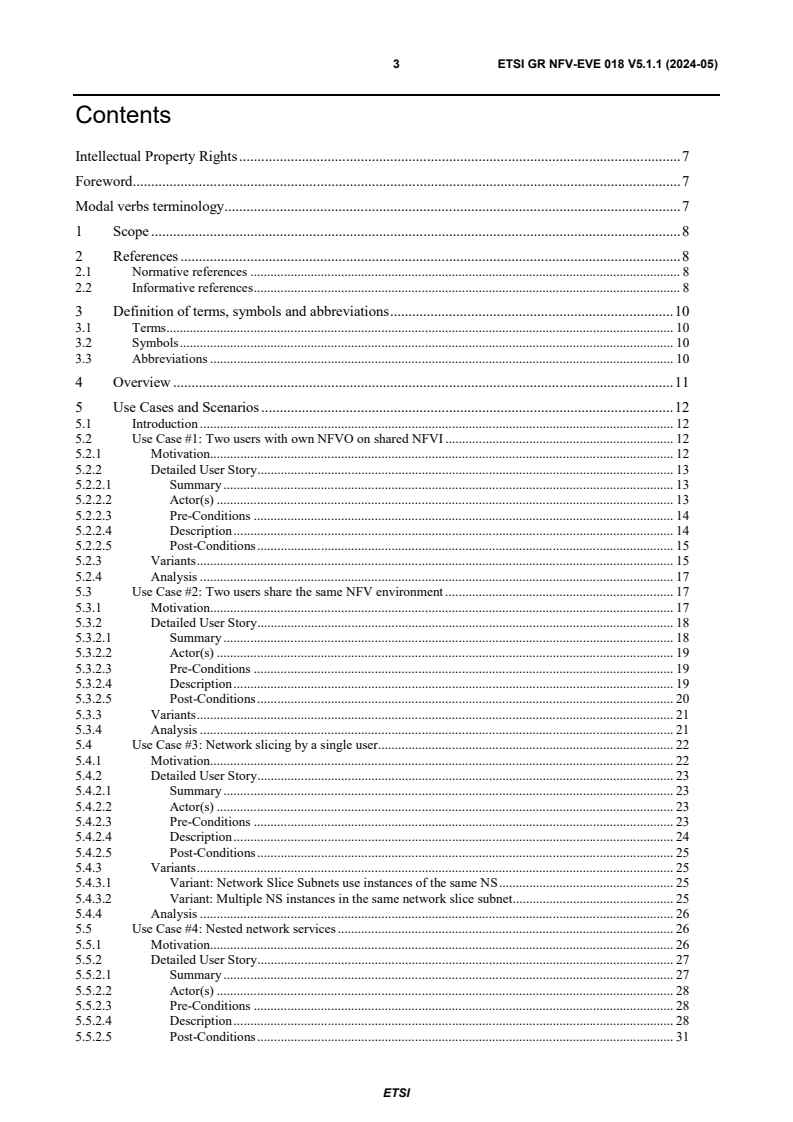
Contents
Intellectual Property Rights . 7
Foreword . 7
Modal verbs terminology . 7
1 Scope . 8
2 References . 8
2.1 Normative references . 8
2.2 Informative references . 8
3 Definition of terms, symbols and abbreviations . 10
3.1 Terms . 10
3.2 Symbols . 10
3.3 Abbreviations . 10
4 Overview . 11
5 Use Cases and Scenarios . 12
5.1 Introduction . 12
5.2 Use Case #1: Two users with own NFVO on shared NFVI . 12
5.2.1 Motivation. 12
5.2.2 Detailed User Story . 13
5.2.2.1 Summary . 13
5.2.2.2 Actor(s) . 13
5.2.2.3 Pre-Conditions . 14
5.2.2.4 Description . 14
5.2.2.5 Post-Conditions . 15
5.2.3 Variants . 15
5.2.4 Analysis . 17
5.3 Use Case #2: Two users share the same NFV environment . 17
5.3.1 Motivation. 17
5.3.2 Detailed User Story . 18
5.3.2.1 Summary . 18
5.3.2.2 Actor(s) . 19
5.3.2.3 Pre-Conditions . 19
5.3.2.4 Description . 19
5.3.2.5 Post-Conditions . 20
5.3.3 Variants . 21
5.3.4 Analysis . 21
5.4 Use Case #3: Network slicing by a single user. 22
5.4.1 Motivation. 22
5.4.2 Detailed User Story . 23
5.4.2.1 Summary . 23
5.4.2.2 Actor(s) . 23
5.4.2.3 Pre-Conditions . 23
5.4.2.4 Description . 24
5.4.2.5 Post-Conditions . 25
5.4.3 Variants . 25
5.4.3.1 Variant: Network Slice Subnets use instances of the same NS . 25
5.4.3.2 Variant: Multiple NS instances in the same network slice subnet . 25
5.4.4 Analysis . 26
5.5 Use Case #4: Nested network services . 26
5.5.1 Motivation. 26
5.5.2 Detailed User Story . 27
5.5.2.1 Summary . 27
5.5.2.2 Actor(s) . 28
5.5.2.3 Pre-Conditions . 28
5.5.2.4 Description . 28
5.5.2.5 Post-Conditions . 31
ETSI
4 ETSI GR NFV-EVE 018 V5.1.1 (2024-05)
5.5.3 Variants . 31
5.5.4 Analysis . 31
5.6 Use Case #5: Tenants of a service provider . 32
5.6.1 Motivation. 32
5.6.2 Detailed User Story . 33
5.6.3 Variants . 34
5.6.4 Analysis . 34
5.7 Use Case #6: Two users with their own MANO stack managed by provider MANO . 34
5.7.1 Motivation. 34
5.7.2 Detailed User Story . 35
5.7.2.1 Summary . 35
5.7.2.2 Example flow instantiating MANO-T instance for an NMT . 36
5.7.2.2.1 Actor(s) . 36
5.7.2.2.2 Pre-Conditions . 36
5.7.2.2.3 Description . 37
5.7.2.2.4 Post-Conditions . 38
5.7.2.3 Example flow of MANO-T instance performing NS LCM operation . 38
5.7.2.3.1 Actor(s) . 38
5.7.2.3.2 Pre-Conditions . 39
5.7.2.3.3 Description . 39
5.7.2.3.4 Post-Conditions . 39
5.7.2.4 Example flow of LCM operation exceeding MLA bounds . 40
5.7.2.4.1 Actor(s) . 40
5.7.2.4.2 Pre-Conditions . 40
5.7.2.4.3 Description . 40
5.7.2.4.4 Post-Conditions . 41
5.7.3 Variants . 42
5.7.4 Analysis . 42
5.8 Use Case #7: Provide Isolation on different levels . 43
5.8.1 Motivation. 43
5.8.2 Detailed User Story . 44
5.8.2.1 Summary . 44
5.8.2.2 Usage of anti-affinity groups for isolation . 45
5.8.2.3 Example of flow instantiating network services with isolation . 46
5.8.2.3.1 Actors . 46
5.8.2.3.2 Pre-Conditions . 47
5.8.2.3.3 Description . 47
5.8.2.3.4 Post-Conditions . 48
5.8.3 Variants . 48
5.8.4 Analysis . 49
5.9 Use Case #8: Isolation of containerized VNF instances . 49
5.9.1 Motivation. 49
5.9.2 Detailed User Story . 51
5.9.2.1 Summary . 51
5.9.2.2 Actors . 51
5.9.2.3 Pre-Conditions . 52
5.9.2.4 Description . 52
5.9.2.5 Post-Conditions . 53
5.9.3 Variants . 54
5.9.4 Analysis . 54
5.10 Use Case #9: Multiple NMTs use the same entity . 55
5.10.1 Introduction. 55
5.10.2 Sharing of VNF packages and descriptors . 56
5.10.2.1 Motivation . 56
5.10.2.2 Detailed User Story . 58
5.10.2.2.1 Summary . 58
5.10.2.2.2 Actor(s) . 58
5.10.2.2.3 Pre-Conditions . 58
5.10.2.2.4 Description . 58
5.10.2.2.5 Post-Conditions . 59
5.10.3 Sharing of NS or VNF instances . 59
5.10.3.1 Motivation . 59
ETSI
5 ETSI GR NFV-EVE 018 V5.1.1 (2024-05)
5.10.3.2 Isolation aspects of shared entities . 61
5.10.4 Special case: Shared storage . 62
5.10.5 Special case: Common Services . 62
5.10.6 Analysis with regards to License management . 62
5.10.7 Conclusions of Use Case #9 . 63
6 Key Issues . 63
6.1 Key Issue #1: Specifying Resource Isolation . 63
6.1.1 Description . 63
6.1.2 Solution Proposal #1.1: Affinity-or-antiaffinity Groups . 64
6.1.3 Solution Proposal #1.2: Affinity-or-anti-affinity constraints group identification . 66
6.1.4 Solution Proposal #1.3: Infrastructure resource groups . 67
6.1.5 Solution Proposal #1.4: Use nested NSs to express tenant isolation . 67
6.1.6 Recommendations . 67
6.2 Key Issue #2: Tenant Identification . 68
6.2.1 Description . 68
6.2.2 Solution Proposal #2.1: Tenant management . 69
6.2.3 Solution Proposal #2.2: Tenant authorization . 70
6.2.4 Solution Proposal #2.3: Ownership . 70
6.2.5 Solution Proposal #2.4: Management isolation . 71
6.2.6 Solution Proposal #2.5: Levels of permission. 71
6.2.7 Recommendations . 71
6.3 Key issue #3: Sharing of artifacts . 73
6.3.1 Description . 73
6.3.2 Solution Proposal #3.1: Multiple onboarding of a VNF package . 73
6.3.3 Solution Proposal #3.2: Multiple tenants using the same onboarded VNF package . 74
6.3.4 Solution Proposal #3.3: Multiple tenants onboarding the same VNF package using different
vnfdId . 74
6.3.5 Solution Proposal #3.4: Multiple onboarding of an NSD . 74
6.3.6 Solution Proposal #3.5: Catalogue for NFV artifacts . 75
6.3.7 Solution Proposal #3.6: External locations of VNF artifacts . 75
6.3.8 Solution Proposal #3.7: Multi-tenancy of the CIR. 75
6.3.9 Solution Proposal #3.8: License management in case of shared artifacts . 75
6.3.10 Recommendations . 75
6.4 Key issue #4: Management of Privileges . 76
6.4.1 Description . 76
6.4.2 Recommendations . 76
6.5 Key issue #5: Sharing virtual storage and PaaS services. 76
6.5.1 Description . 76
6.5.2 Solution Proposal #5.1: Sharing virtual storage . 76
6.5.3 Solution Proposal #5.2: Sharing PaaS services . 76
6.5.4 Recommendations . 77
6.6 Key issue #6: Quota management for tenants . 77
6.6.1 Description . 77
6.6.2 Solution Proposal #6.1: Tenant quota management . 77
6.6.3 Recommendations . 77
6.7 Key Issue # 7 - Management of MLA . 78
6.7.1 Description . 78
6.7.2 Solution Proposal #7.1: Specifying MLA Parameters . 78
6.7.3 Solution Proposal #7.2: MLA Compliance . 78
6.7.4 Recommendations . 79
7 Recommendations . 80
8 Conclusions . 80
Annex A: Multi-Tenancy in Open Source . 81 ®
A.1 Multi-Tenancy in OpenStack . 81
A.1.1 General . 81
A.1.2 Feedback from Tacker . 82 ®
A.2 Multi-Tenancy in Kubernetes . 85
A.2.1 Introduction . 85
ETSI
6 ETSI GR NFV-EVE 018 V5.1.1 (2024-05)
A.2.2 Isolation considerations for tenants . 85
A.2.2.1 Same cluster . 85
A.2.2.1.1 General . 85
A.2.2.1.2 Control plane isolation . 85
A.2.2.1.3 Data plane isolation . 86
A.2.2.2 Multiple clusters . 86
A.2.3 Relation with multi-tenancy in NFV . 86
A.3 Multi-Tenancy in Anuket . 87
Annex B: Change History . 88
History . 91
ETSI
7 ETSI GR NFV-EVE 018 V5.1.1 (2024-05)
Intellectual Property Rights
Essential patents
IPRs essential or potentially essential to normative deliverables may have been declared to ETSI. The declarations
pertaining to these essential IPRs, if any, are publicly available for ETSI members and non-members, and can be
found in ETSI SR 000 314: "Intellectual Property Rights (IPRs); Essential, or potentially Essential, IPRs notified to
ETSI in respect of ETSI standards", which is available from the ETSI Secretariat. Latest updates are available on the
ETSI Web server (https://ipr.etsi.org/).
Pursuant to the ETSI Directives including the ETSI IPR Policy, no investigation regarding the essentiality of IPRs,
including IPR searches, has been carried out by ETSI. No guarantee can be given as to the existence of other IPRs not
referenced in ETSI SR 000 314 (or the updates on the ETSI Web server) which are, or may be, or may become,
essential to the present document.
Trademarks
The present document may include trademarks and/or tradenames which are asserted and/or registered by their owners.
ETSI claims no ownership of these except for any which are indicated as being the property of ETSI, and conveys no
right to use or reproduce any trademark and/or tradename. Mention of those trademarks in the present document does
not constitute an endorsement by ETSI of products, services or organizations associated with those trademarks.
DECT™, PLUGTESTS™, UMTS™ and the ETSI logo are trademarks of ETSI registered for the benefit of its
Members. 3GPP™ and LTE™ are trademarks of ETSI registered for the benefit of its Members and of the 3GPP
Organizational Partners. oneM2M™ logo is a trademark of ETSI registered for the benefit of its Members and of the ®
oneM2M Partners. GSM and the GSM logo are trademarks registered and owned by the GSM Association.
Foreword
This Group Report (GR) has been produced by ETSI Industry Specification Group (ISG) Network Functions
Virtualisation (NFV).
Modal verbs terminology
In the present document "should", "should not", "may", "need not", "will", "will not", "can" and "cannot" are to be
interpreted as described in clause 3.2 of the ETSI Drafting Rules (Verbal forms for the expression of provisions).
"must" and "must not" are NOT allowed in ETSI deliverables except when used in direct citation.
ETSI
8 ETSI GR NFV-EVE 018 V5.1.1 (2024-05)
1 Scope
The present document studies multi-tenancy related Use Cases and concepts for NFV, with the goal to remove the gap
between the existing general functional requirements on multi-tenancy as described in ETSI GS NFV-IFA 010 [i.10]
and the missing requirement details regarding NFV elements consumed by different tenants. Key issues on
multi-tenancy in NFV (e.g. tenant-dependent LCM, tenant-dependent resource management, traffic separation,
management isolation, etc.) are identified and analysed as well as recommendations for further work are provided.
2 References
2.1 Normative references
Normative references are not applicable in the present document.
2.2 Informative references
References are either specific (identified by date of publication and/or edition number or version number) or
non-specific. For specific references, only the cited version applies. For non-specific references, the latest version of the
referenced document (including any amendments) applies.
Referenced documents which are not found to be publicly available in the expected location might be found at
https://docbox.etsi.org/Reference/.
NOTE: While any hyperlinks included in this clause were valid at the time of publication, ETSI cannot guarantee
their long term validity.
The following referenced documents are necessary for the application of the present document.
[i.1] ETSI GR NFV 001: "Network Functions Virtualisation (NFV); Use Cases".
[i.2] ETSI GS NFV 002: "Network Functions Virtualisation (NFV); Architectural Framework".
[i.3] ETSI GS NFV 003: "Network Functions Virtualisation (NFV); Terminology for Main Concepts in
NFV".
[i.4] ETSI GS NFV 004: "Network Functions Virtualisation (NFV); Virtualisation Requirements".
[i.5] ETSI GS NFV-IFA 005: "Network Functions Virtualisation (NFV) Release 4; Management and
Orchestration; Or-Vi reference point - Interface and Information Model Specification".
[i.6] ETSI GS NFV-IFA 006: "Network Functions Virtualisation (NFV) Release 4; Management and
Orchestration; Vi-Vnfm reference point - Interface and Information Model Specification".
[i.7] ETSI GS NFV-IFA 007: "Network Functions Virtualisation (NFV) Release 4; Management and
Orchestration; Or-Vnfm reference point - Interface and Information Model Specification".
[i.8] ETSI GS NFV-IFA 008: "Network Functions Virtualisation (NFV) Release 4; Management and
Orchestration; Ve-Vnfm reference point - Interface and Information Model Specification".
[i.9] ETSI GS NFV-SOL 001: "Network Functions Virtualisation (NFV) Release 4; Protocols and Data
Models; NFV descriptors based on TOSCA specification".
[i.10] ETSI GS NFV-IFA 010: "Network Functions Virtualisation (NFV) Release 4; Management and
Orchestration; Functional requirements specification".
[i.11] ETSI GS NFV-IFA 011: "Network Functions Virtualisation (NFV) Release 4; Management and
Orchestration; VNF Descriptor and Packaging Specification".
[i.12] ETSI GR NFV-EVE 012: "Network Functions Virtualisation (NFV) Release 3; Evolution and
Ecosystem; Report on Network Slicing Support with ETSI NFV Architecture Framework".
ETSI
9 ETSI GR NFV-EVE 018 V5.1.1 (2024-05)
[i.13] ETSI GS NFV-IFA 013: "Network Functions Virtualisation (NFV) Release 4; Management and
Orchestration; Os-Ma-nfvo reference point - Interface and Information Model Specification".
[i.14] ETSI GS NFV-IFA 014: "Network Functions Virtualisation (NFV) Release 4; Management and
Orchestration; Network Service Templates Specification".
[i.15] ETSI GR NFV-IFA 028: "Network Functions Virtualisation (NFV) Release 3; Management and
Orchestration; Report on architecture options to support multiple administrative domains".
[i.16] ETSI GS NFV-IFA 030: "Network Functions Virtualisation (NFV) Release 4; Management and
Orchestration; Multiple Administrative Domain Aspect Interfaces Specification".
[i.17] ETSI GR NFV-IFA 034: "Network Functions Virtualisation (NFV) Release 4; Management and
Orchestration; Report on Architectural enhancement for VNF License Management support and
use of VNF licenses".
[i.18] ETSI GS NFV-IFA 036: "Network Functions Virtualisation (NFV) Release 4; Management and
Orchestration; Requirements for service interfaces and object model for container cluster
management and orchestration specification".
[i.19] ETSI GS NFV-IFA 040: "Network Functions Virtualisation (NFV) Release 4; Management and
Orchestration; Requirements for service interfaces and object model for OS container management
and orchestration specification".
[i.20] ETSI GS NFV-SOL 014: "Network Functions Virtualisation (NFV) Release 4; Protocols and Data
Models; YAML data model specification for descriptor-based virtualised resource management".
[i.21] ETSI GS NFV-SEC 023 (V0.0.7): "Network Functions Virtualisation (NFV) Release 5; Security;
Container Security Specification".
[i.22] ETSI GR ZSM 010: "Zero Touch Network and Service Management (ZSM); General Security
Aspects".
rd
[i.23] 3GPP TR 28.804: "3 Generation Partnership Project; Technical Specification Group Services and
System Aspects; Telecommunication management; Study on tenancy concept in 5G networks and
network slicing management (Release 16)".
® ®
documentation: "OpenStack Operations Guide".
[i.24] OpenStack
[i.25] ETSI GS NFV-SEC 025 (V0.0.15): "Network Functions Virtualisation (NFV); Security; Secure
End-to-End VNF and NS management specification".
[i.26] ETSI GS NFV-SEC 026 (V0.0.10): "Network Functions Virtualisation (NFV); Security; Isolation
and trust domain specification".
[i.27] ENISA NFV 5G security report: "NFV Security in 5G - Challenges and Best Practices".
[i.28] Kata Containers project page.
[i.29] ETSI GS NFV-SOL 003: "Network Functions Virtualisation (NFV) Release 4; Protocols and Data
Models; RESTful protocols specification for the Or-Vnfm Reference Point".
[i.30] ETSI GS NFV-IFA 048: "Network Functions Virtualisation (NFV) Release 4; Management and
Orchestration; Policy Information Model Specification".
[i.31] ETSI GS NFV-SOL 013: "Network Functions Virtualisation (NFV) Release 4; Protocols and Data
Models; Specification of common aspects for RESTful NFV MANO APIs".
[i.32] ETSI GS NFV-SOL 005: "Network Functions Virtualisation (NFV) Release 4; Protocols and Data
Models; RESTful protocols specification for the Os-Ma-nfvo Reference Point".
[i.33] ETSI GS NFV-SOL 002: "Network Functions Virtualisation (NFV) Release 4; Protocols and Data
Models; RESTful protocols specification for the Ve-Vnfm Reference Point".
[i.34] ETSI GS NFV-SEC 022: "Network Functions Virtualisation (NFV) Release 4; Security; Access
Token Specification for API Access".
ETSI
10 ETSI GR NFV-EVE 018 V5.1.1 (2024-05)
[i.35] ETSI GS NFV-SOL 004: "Network Functions Virtualisation (NFV) Release 4; Protocols and Data
Models; VNF Package and PNFD Archive specification".
[i.36] ETSI GS NFV-SEC 021: "Network Functions Virtualisation (NFV) Release 4; Security; VNF
Package Security Specification".
[i.37] Anuket project web site.
[i.38] Anuket: "Reference Model for Cloud Infrastructure (RM)".
[i.39] Anuket: "Reference Architecture for OpenStack based cloud infrastructure (RA1)".
[i.40] Anuket: "Reference Architecture for Kubernetes based cloud infrastructure (RA2)". ®
[i.41] Kubernetes reference documentation: "Multi-tenancy". ®
[i.42] Official Kubernetes reference documentation. ®
[i.43] Kubernetes Cluster API.
[i.44] vCluster Documentation (provided by Loft Labs, Inc.). ®
[i.45] The Kubernetes API documentation.
[i.46] ETSI GR NFV-IFA 037: "Network Functions Virtualisation (NFV) Release 4; Architectural
Framework; Report on further NFV support for 5G".
[i.47] ETSI GS NFV-SOL 016: "Network Functions Virtualisation (NFV) Release 3; Protocols and Data
Models; NFV-MANO procedures specification".
[i.48] ETSI GR NFV-EVE 022 (V5.1.1): "Network Functions Virtualisation (NFV) Release 5;
Architectural Framework; Report on VNF configuration".
[i.49] ETSI GS NFV-IFA 049 (V5.1.1): "Network Functions Virtualisation (NFV) Release 5;
Architectural Framework; VNF generic OAM functions specification".
3 Definition of terms, symbols and abbreviations
3.1 Terms
For the purposes of the present document, the terms given in ETSI GS NFV 003 [i.3] apply.
3.2 Symbols
Void.
3.3 Abbreviations
For the purposes of the present document, the abbreviations given in ETSI GS NFV 003 [i.3] and the following apply.
NOTE: An abbreviation defined in the present document takes precedence over the definition of the same
abbreviation, if any, in ETSI GS NFV 003 [i.3].
MANO-P Provider MANO
MANO-T Tenant MANO
MLA Management Level Agreement
NFVO-P Provider NFVO
NFVO-T Tenant NFVO
NMT NFV-MANO Tenant
VIM-P Provider VIM
ETSI
11 ETSI GR NFV-EVE 018 V5.1.1 (2024-05)
VIM-T Tenant VIM
VNFM-P Provider VNFM
VNFM-T Tenant VNFM
4 Overview
According to ETSI GR ZSM 010 [i.22], "multi-tenancy refers to an architecture in which a single instance of software
runs on a server and serves multiple tenants". In NFV deployments this refers not only to VNF instances but also to
NFV-MANO components (NFVO, VNFM, VIM as specified in ETSI GS NFV 002 [i.2]) and to entities like CISM (see
ETSI GS NFV-IFA 040 [i.19]) and CCM (see ETSI GS NFV-IFA 036 [i.18]).
The present document focuses on Use Cases where multiple users consume services from the same NFV-MANO
environment that are offered via the Os-Ma-nfvo reference point (see ETSI GS NFV-IFA 013 [i.13]). It is analysed e.g.
how the NFV-MANO can be enabled to protect a consumer (NFV-MANO Tenant, NMT) against another consumer.
The Use Cases in clause 5 show example configurations where such isolation or protection is provided.
The ways of protection and isolation can be grouped in two groups:
• The first group is related to management actions. This type of protection can use some access control and
ownership of entities. This is sometimes called management isolation:
- Resources created by NMT-A cannot be managed by NMT-B (see note 1).
- Resources created by NMT-A cannot be used by NMT-B (e.g. bandwidth on a VL of NMT-A cannot be
consumed by NMT-B).
- NMT-B is not able to access information about resources created by NMT-A.
- NMT-B is not able to monitor usage of resources created by NMT-A.
- NMT-B is not able to access traffic on resources created by NMT-A.
• The second group is relat
...
Questions, Comments and Discussion
Ask us and Technical Secretary will try to provide an answer. You can facilitate discussion about the standard in here.
Loading comments...