


ETSI EN 302 769 V1.2.1 (2011-04)
Digital Video Broadcasting (DVB); Frame structure channel coding and modulation for a second generation digital transmission system for cable systems (DVB-C2)
Digital Video Broadcasting (DVB); Frame structure channel coding and modulation for a second generation digital transmission system for cable systems (DVB-C2)
REN/JTC-DVB-288
Digitalna videoradiodifuzija (DVB) - Struktura okvirov pri kanalskem kodiranju in modulacija za drugo generacijo prenosnega sistema za kabelske sisteme (DVB-C2)
Ta verzija zagotavlja potrebne spremembe po potrditvi in verifikaciji specifikacije DVB-C2.
General Information
- Status
- Published
- Publication Date
- 20-Apr-2011
- Technical Committee
- BROADCAS - EBU/CENELEC/ETSI on Broadcasting
- Current Stage
- 12 - Completion
- Due Date
- 02-May-2011
- Completion Date
- 21-Apr-2011
Overview
ETSI EN 302 769 V1.2.1 (2011-04) specifies the frame structure, channel coding and modulation for the second‑generation Digital Video Broadcasting system for cable (DVB‑C2). This Slovenian adoption of ETSI EN 302 769 V1.2.1 (2011‑04) defines how DVB‑C2 frames are built, how data is protected and mapped to constellations, and how signalling, pilots and preambles are managed. This version incorporates the changes resulting from the Validation & Verification process to ensure interoperability and implementer guidance.
Key Topics and Technical Requirements
The standard covers detailed technical mechanisms required for a compliant DVB‑C2 implementation, including:
- System architecture and target performance: overview of DVB‑C2 components and performance objectives.
- Input processing and mode adaptation: input formats, interface, stream synchronization, optional null‑packet deletion, CRC‑8 encoding and Baseband Header (BBHeader) insertion.
- Stream adaptation: scheduling, padding and baseband scrambling for smooth payload delivery.
- FEC (forward error correction): layered coding with BCH outer code and LDPC inner code for robust error protection; parameters for normal and short FECFrames.
- Bit interleaving and mapping: bit interleaver design and mapping of cell words onto I/Q constellations (QAM).
- Data Slice Packet generation: formats for different data slice types, FECFrame header coding, stuffing and cell mapping.
- L1 signalling (part 2): generation, CRC, padding, FEC encoding and modulation for signalling carrying essential frame parameters.
- Frame Builder and OFDM: C2 Frame structure, preamble and pilot design, data slice placement, time and frequency interleaving, notches and pilot insertion.
- Pilot, scrambling and notch handling: scattered and continual pilot locations/modulation and procedures for narrowband and broadband notches.
These topics define precise signalling, error‑coding and modulation behavior required for interoperability.
Practical Applications and Users
This standard is essential for:
- Broadcast equipment manufacturers (modulators, demodulators, headend gear) implementing DVB‑C2.
- Silicon vendors / chipset designers building integrated DVB‑C2 tuners and demodulators.
- Cable operators and system integrators planning and deploying second‑generation cable distribution networks.
- Test laboratories and certification bodies performing conformance and interoperability testing.
- Firmware/software developers for set‑top boxes and headend systems implementing mode adaptation, FEC and frame building.
Adopting SIST EN 302 769 V1.2.1 helps ensure reliable high‑throughput cable delivery, interoperability across vendors and compliance with DVB‑C2 performance targets.
Related Standards
- ETSI EN 302 769 V1.2.1 (identical reference / European normative text)
- Other DVB family specifications (contextual relevance for multi‑platform deployments)
Keywords: DVB‑C2, digital video broadcasting, cable systems, frame structure, channel coding, modulation, LDPC, BCH, FECFrame, OFDM, QAM, L1 signalling, pilot insertion.
Buy Documents
en_302769v010201o - Digital Video Broadcasting (DVB); Frame structure channel coding and modulation for a second generation digital transmission system for cable systems (DVB-C2)
en_302769v010201p - Digital Video Broadcasting (DVB); Frame structure channel coding and modulation for a second generation digital transmission system for cable systems (DVB-C2)

Frequently Asked Questions
ETSI EN 302 769 V1.2.1 (2011-04) is a standard published by the European Telecommunications Standards Institute (ETSI). Its full title is "Digital Video Broadcasting (DVB); Frame structure channel coding and modulation for a second generation digital transmission system for cable systems (DVB-C2)". This standard covers: REN/JTC-DVB-288
REN/JTC-DVB-288
ETSI EN 302 769 V1.2.1 (2011-04) is available in PDF format for immediate download after purchase. The document can be added to your cart and obtained through the secure checkout process. Digital delivery ensures instant access to the complete standard document.
Standards Content (Sample)
Final draft ETSI EN 302 769 V1.2.1 (2010-12)
European Standard (Telecommunications series)
Digital Video Broadcasting (DVB);
Frame structure channel coding and modulation
for a second generation digital transmission system
for cable systems (DVB-C2)
2 Final draft ETSI EN 302 769 V1.2.1 (2010-12)
Reference
REN/JTC-DVB-288
Keywords
audio, broadcasting, cable, data, digital, DVB,
MPEG, TV, video
ETSI
650 Route des Lucioles
F-06921 Sophia Antipolis Cedex - FRANCE
Tel.: +33 4 92 94 42 00 Fax: +33 4 93 65 47 16
Siret N° 348 623 562 00017 - NAF 742 C
Association à but non lucratif enregistrée à la
Sous-Préfecture de Grasse (06) N° 7803/88
Important notice
Individual copies of the present document can be downloaded from:
http://www.etsi.org
The present document may be made available in more than one electronic version or in print. In any case of existing or
perceived difference in contents between such versions, the reference version is the Portable Document Format (PDF).
In case of dispute, the reference shall be the printing on ETSI printers of the PDF version kept on a specific network drive
within ETSI Secretariat.
Users of the present document should be aware that the document may be subject to revision or change of status.
Information on the current status of this and other ETSI documents is available at
http://portal.etsi.org/tb/status/status.asp
If you find errors in the present document, please send your comment to one of the following services:
http://portal.etsi.org/chaircor/ETSI_support.asp
Copyright Notification
No part may be reproduced except as authorized by written permission.
The copyright and the foregoing restriction extend to reproduction in all media.
© European Telecommunications Standards Institute 2010.
© European Broadcasting Union 2010.
All rights reserved.
TM TM TM TM
DECT , PLUGTESTS , UMTS , TIPHON , the TIPHON logo and the ETSI logo are Trade Marks of ETSI registered
for the benefit of its Members.
TM
3GPP is a Trade Mark of ETSI registered for the benefit of its Members and of the 3GPP Organizational Partners.
LTE™ is a Trade Mark of ETSI currently being registered
for the benefit of its Members and of the 3GPP Organizational Partners.
GSM® and the GSM logo are Trade Marks registered and owned by the GSM Association.
ETSI
3 Final draft ETSI EN 302 769 V1.2.1 (2010-12)
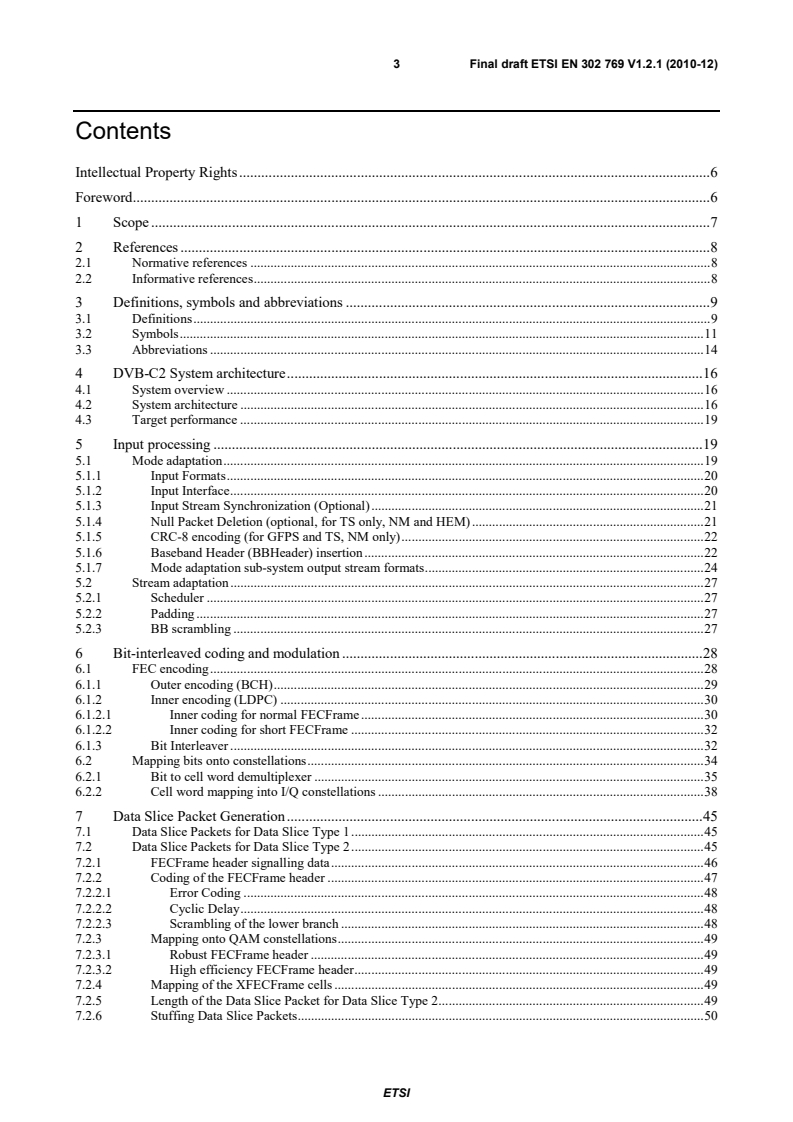
Contents
Intellectual Property Rights . 6
Foreword . 6
1 Scope . 7
2 References . 8
2.1 Normative references . 8
2.2 Informative references . 8
3 Definitions, symbols and abbreviations . 9
3.1 Definitions . 9
3.2 Symbols . 11
3.3 Abbreviations . 14
4 DVB-C2 System architecture . 16
4.1 System overview . 16
4.2 System architecture . 16
4.3 Target performance . 19
5 Input processing . 19
5.1 Mode adaptation . 19
5.1.1 Input Formats . 20
5.1.2 Input Interface . 20
5.1.3 Input Stream Synchronization (Optional) . 21
5.1.4 Null Packet Deletion (optional, for TS only, NM and HEM) . 21
5.1.5 CRC-8 encoding (for GFPS and TS, NM only) . 22
5.1.6 Baseband Header (BBHeader) insertion . 22
5.1.7 Mode adaptation sub-system output stream formats . 24
5.2 Stream adaptation . 27
5.2.1 Scheduler . 27
5.2.2 Padding . 27
5.2.3 BB scrambling . 27
6 Bit-interleaved coding and modulation . 28
6.1 FEC encoding . 28
6.1.1 Outer encoding (BCH) . 29
6.1.2 Inner encoding (LDPC) . 30
6.1.2.1 Inner coding for normal FECFrame . 30
6.1.2.2 Inner coding for short FECFrame . 32
6.1.3 Bit Interleaver . 32
6.2 Mapping bits onto constellations . 34
6.2.1 Bit to cell word demultiplexer . 35
6.2.2 Cell word mapping into I/Q constellations . 38
7 Data Slice Packet Generation . 45
7.1 Data Slice Packets for Data Slice Type 1 . 45
7.2 Data Slice Packets for Data Slice Type 2 . 45
7.2.1 FECFrame header signalling data . 46
7.2.2 Coding of the FECFrame header . 47
7.2.2.1 Error Coding . 48
7.2.2.2 Cyclic Delay . 48
7.2.2.3 Scrambling of the lower branch . 48
7.2.3 Mapping onto QAM constellations . 49
7.2.3.1 Robust FECFrame header . 49
7.2.3.2 High efficiency FECFrame header . 49
7.2.4 Mapping of the XFECFrame cells . 49
7.2.5 Length of the Data Slice Packet for Data Slice Type 2 . 49
7.2.6 Stuffing Data Slice Packets . 50
ETSI
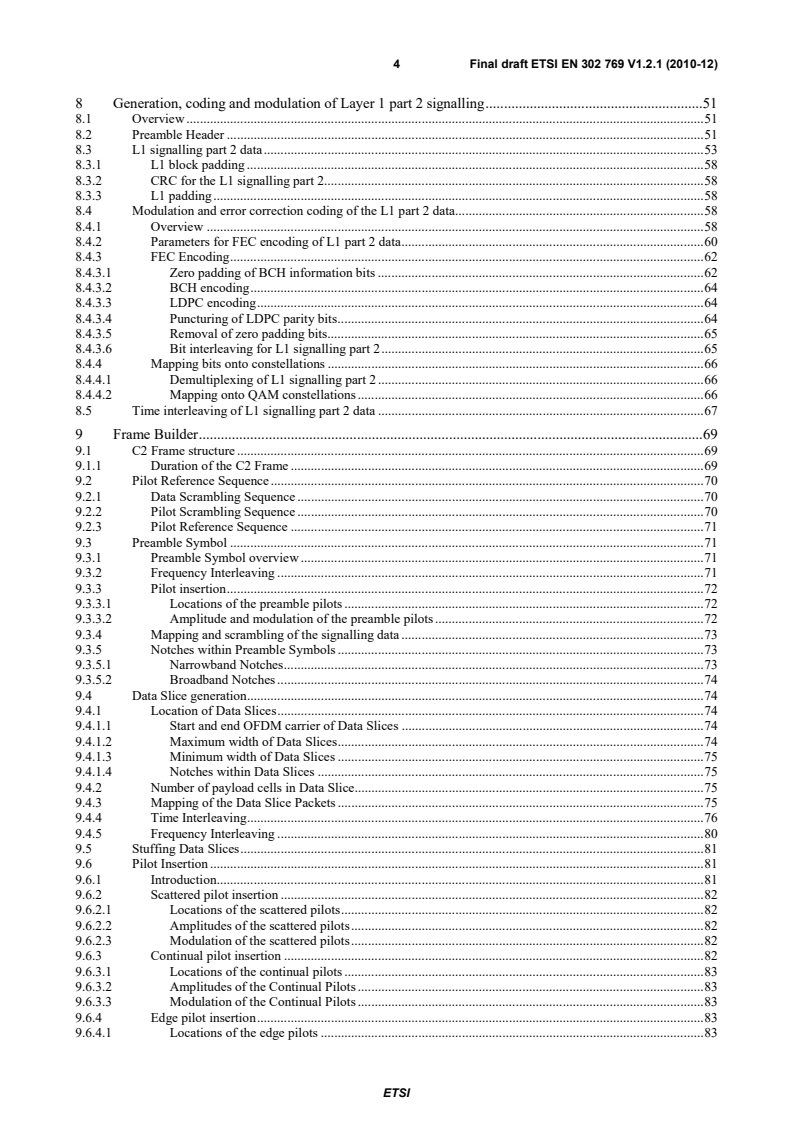
4 Final draft ETSI EN 302 769 V1.2.1 (2010-12)
8 Generation, coding and modulation of Layer 1 part 2 signalling . 51
8.1 Overview . 51
8.2 Preamble Header . 51
8.3 L1 signalling part 2 data . 53
8.3.1 L1 block padding . 58
8.3.2 CRC for the L1 signalling part 2. 58
8.3.3 L1 padding . 58
8.4 Modulation and error correction coding of the L1 part 2 data . 58
8.4.1 Overview . 58
8.4.2 Parameters for FEC encoding of L1 part 2 data . 60
8.4.3 FEC Encoding . 62
8.4.3.1 Zero padding of BCH information bits . 62
8.4.3.2 BCH encoding . 64
8.4.3.3 LDPC encoding . 64
8.4.3.4 Puncturing of LDPC parity bits . 64
8.4.3.5 Removal of zero padding bits. 65
8.4.3.6 Bit interleaving for L1 signalling part 2 . 65
8.4.4 Mapping bits onto constellations . 66
8.4.4.1 Demultiplexing of L1 signalling part 2 . 66
8.4.4.2 Mapping onto QAM constellations . 66
8.5 Time interleaving of L1 signalling part 2 data . 67
9 Frame Builder . 69
9.1 C2 Frame structure . 69
9.1.1 Duration of the C2 Frame . 69
9.2 Pilot Reference Sequence . 70
9.2.1 Data Scrambling Sequence . 70
9.2.2 Pilot Scrambling Sequence . 70
9.2.3 Pilot Reference Sequence . 71
9.3 Preamble Symbol . 71
9.3.1 Preamble Symbol overview . 71
9.3.2 Frequency Interleaving . 71
9.3.3 Pilot insertion . 72
9.3.3.1 Locations of the preamble pilots . 72
9.3.3.2 Amplitude and modulation of the preamble pilots . 72
9.3.4 Mapping and scrambling of the signalling data . 73
9.3.5 Notches within Preamble Symbols . 73
9.3.5.1 Narrowband Notches . 73
9.3.5.2 Broadband Notches . 74
9.4 Data Slice generation . 74
9.4.1 Location of Data Slices . 74
9.4.1.1 Start and end OFDM carrier of Data Slices . 74
9.4.1.2 Maximum width of Data Slices . 74
9.4.1.3 Minimum width of Data Slices . 75
9.4.1.4 Notches within Data Slices . 75
9.4.2 Number of payload cells in Data Slice. 75
9.4.3 Mapping of the Data Slice Packets . 75
9.4.4 Time Interleaving . 76
9.4.5 Frequency Interleaving . 80
9.5 Stuffing Data Slices . 81
9.6 Pilot Insertion . 81
9.6.1 Introduction. 81
9.6.2 Scattered pilot insertion . 82
9.6.2.1 Locations of the scattered pilots . 82
9.6.2.2 Amplitudes of the scattered pilots . 82
9.6.2.3 Modulation of the scattered pilots . 82
9.6.3 Continual pilot insertion . 82
9.6.3.1 Locations of the continual pilots . 83
9.6.3.2 Amplitudes of the Continual Pilots . 83
9.6.3.3 Modulation of the Continual Pilots . 83
9.6.4 Edge pilot insertion . 83
9.6.4.1 Locations of the edge pilots . 83
ETSI
5 Final draft ETSI EN 302 769 V1.2.1 (2010-12)
9.6.4.2 Amplitudes of the Edge Pilots . 84
9.6.4.3 Modulation of the Edge Pilots . 84
9.7 Dummy carrier reservation . 85
10 OFDM generation . 85
10.1 IFFT - OFDM Modulation . 85
10.2 Guard interval insertion . 87
10.3 Spectrum characteristics . 87
Annex A (normative): Addresses of parity bit accumulators for Nldpc = 64 800 . 89
Annex B (normative): Addresses of parity bit accumulators for Nldpc = 16 200 . 95
Annex C (normative): Input stream synchronizer . 97
Annex D (normative): Input Remultiplexing Subsystem: Splitting of input MPEG-2
Transport Streams into Data PLPs, generation of a Common PLP of
a group of PLPs and insertion of Null Packets into Transport
Streams . 99
D.1 Overview . . 99
D.2 Splitting of a group of input TSs into TSPSs streams and a TSPSC stream . 100
D.2.1 General . 100
D.2.2 Extraction of the Common PLP from a group of TS . 100
D.2.3 Insertion of additional Null Packets into TSPSs. 101
D.3 Receiver Implementation Considerations. 102
D.3.1 Recombination of TSPSS and TSPSC in a receiver . 102
Annex E (normative): Calculation of the CRC word . 104
Annex F (normative): Bundling of PLPs . 105
Annex G (informative): Transport Stream regeneration and clock recovery using ISCR . 106
Annex H (informative): Pilot patterns . 107
Annex I (informative): Bibliography . 110
History . 111
ETSI
6 Final draft ETSI EN 302 769 V1.2.1 (2010-12)
Intellectual Property Rights
IPRs essential or potentially essential to the present document may have been declared to ETSI. The information
pertaining to these essential IPRs, if any, is publicly available for ETSI members and non-members, and can be found
in ETSI SR 000 314: "Intellectual Property Rights (IPRs); Essential, or potentially Essential, IPRs notified to ETSI in
respect of ETSI standards", which is available from the ETSI Secretariat. Latest updates are available on the ETSI Web
server (http://webapp.etsi.org/IPR/home.asp).
Pursuant to the ETSI IPR Policy, no investigation, including IPR searches, has been carried out by ETSI. No guarantee
can be given as to the existence of other IPRs not referenced in ETSI SR 000 314 (or the updates on the ETSI Web
server) which are, or may be, or may become, essential to the present document.
Foreword
This European Standard (Telecommunications series) has been produced by Joint Technical Committee (JTC)
Broadcast of the European Broadcasting Union (EBU), Comité Européen de Normalisation ELECtrotechnique
(CENELEC) and the European Telecommunications Standards Institute (ETSI), and is now submitted for the ETSI
standards One-step Approval Procedure.
NOTE: The EBU/ETSI JTC Broadcast was established in 1990 to co-ordinate the drafting of standards in the
specific field of broadcasting and related fields. Since 1995 the JTC Broadcast became a tripartite body
by including in the Memorandum of Understanding also CENELEC, which is responsible for the
standardization of radio and television receivers. The EBU is a professional association of broadcasting
organizations whose work includes the co-ordination of its members' activities in the technical, legal,
programme-making and programme-exchange domains. The EBU has active members in about
60 countries in the European broadcasting area; its headquarters is in Geneva.
European Broadcasting Union
CH-1218 GRAND SACONNEX (Geneva)
Switzerland
Tel: +41 22 717 21 11
Fax: +41 22 717 24 81
The Digital Video Broadcasting Project (DVB) is an industry-led consortium of broadcasters, manufacturers, network
operators, software developers, regulatory bodies, content owners and others committed to designing global standards
for the delivery of digital television and data services. DVB fosters market driven solutions that meet the needs and
economic circumstances of broadcast industry stakeholders and consumers. DVB standards cover all aspects of digital
television from transmission through interfacing, conditional access and interactivity for digital video, audio and data.
The consortium came together in 1993 to provide global standardisation, interoperability and future proof
specifications.
Proposed national transposition dates
Date of latest announcement of this EN (doa): 3 months after ETSI publication
Date of latest publication of new National Standard
or endorsement of this EN (dop/e): 6 months after doa
Date of withdrawal of any conflicting National Standard (dow): 6 months after doa
ETSI
7 Final draft ETSI EN 302 769 V1.2.1 (2010-12)
1 Scope
The present document describes a second generation baseline transmission system for digital television broadcasting via
Hybrid Fibre Coax (HFC) cable networks and Master Antenna Television (MATV) installations. It specifies the channel
coding, modulation and lower layer signalling protocol system intended for the provision of digital television services
and generic data streams.
The scope is as follows:
• it gives a general description of the Baseline System for digital cable TV;
• it specifies the digital signal processing in order to establish compatibility between pieces of equipment
developed by different manufacturers. This is achieved by describing in detail the signal processing at the
transmitting side, while the processing at the receiving side is left open to individual implementations.
However, for the purpose of securing interoperability it is necessary in this text to refer to certain
implementation aspects of the receiving end.
DVB-C [i.4] was introduced as a European Norm in 1994. It specifies single carrier QAM modulation and
Reed-Solomon channel coding and is used today by many cable operators worldwide for television and data
broadcasting as well as for forward channel transmission of the Data Over Cable System defined in [i.7].
Since 1994 enhanced digital transmission technologies have evolved somewhat:
• New channel coding schemes, combined with higher order modulation, promise more powerful alternatives to
the DVB-C coding and modulation schemes. The result is a capacity gain in the order of 30 % at a given cable
channel bandwidth and CATV network performance.
• Variable Coding and Modulation (VCM) may be applied to provide different levels of error protection to
different services (e.g. SDTV and HDTV, audio, multimedia).
• In the case of interactive and point-to-point applications, the VCM functionality may be combined with the use
of return channels, to achieve Adaptive Coding and Modulation (ACM). This technique provides more exact
channel protection and dynamic link adaptation to propagation conditions, targeting each individual receiving
terminal.
• DVB-C is strictly focused on a unique data format, the MPEG Transport Stream (ISO/IEC 13818-1 [i.1] or a
reference to it). Extended flexibility to cope with other input data formats (such as multiple Transport Streams,
or generic data formats) is now possible without significant complexity increase.
The present document defines a "second generation" modulation and channel coding system (denoted the "C2 System"
or "DVB-C2" for the purposes of the present document) to make use of the improvements listed above. DVB-C2 is a
single, very flexible standard, covering a variety of applications by cable, as described below. It is characterized by:
• a flexible input stream adapter, suitable for operation with single and multiple input streams of various formats
(packetized or continuous);
• a powerful FEC system based on LDPC (Low-Density Parity Check) codes concatenated with BCH (Bose
Chaudhuri Hocquenghem) codes, allowing Quasi Error Free operation close to the Shannon limit, depending on
the transmission mode (AWGN channel, modulation constrained Shannon limit);
• a wide range of code rates (from 2/3 up to 9/10); 5 constellations, ranging in spectrum efficiency from 1 to
10,8 bit/s/Hz, optimized for operation in cable networks;
• Adaptive Coding and Modulation (ACM) functionality, optimizing channel coding and modulation on a
frame-by-frame basis.
ETSI
8 Final draft ETSI EN 302 769 V1.2.1 (2010-12)
2 References
References are either specific (identified by date of publication and/or edition number or version number) or
non-specific. For specific references, only the cited version applies. For non-specific references, the latest version of the
reference document (including any amendments) applies.
Referenced documents which are not found to be publicly available in the expected location might be found at
http://docbox.etsi.org/Reference.
NOTE: While any hyperlinks included in this clause were valid at the time of publication ETSI cannot guarantee
their long term validity.
2.1 Normative references
The following referenced documents are necessary for the application of the present document.
[1] ETSI TS 101 162: "Digital Video Broadcasting (DVB); Allocation of Service Information (SI) and
Data Broadcasting Codes for Digital Video Broadcasting (DVB) systems".
2.2 Informative references
The following referenced documents are not necessary for the application of the present document but they assist the
user with regard to a particular subject area.
[i.1] ISO/IEC 13818-1: "Information technology - Generic coding of moving pictures and associated
audio information: Systems".
[i.2] ETSI TS 102 606: "Digital Video Broadcasting (DVB); Generic Stream Encapsulation (GSE)
Protocol".
[i.3] ETSI EN 302 307: "Digital Video Broadcasting (DVB); Second generation framing structure,
channel coding and modulation systems for Broadcasting, Interactive Services, News Gathering
and other broadband satellite applications (DVB-S2)".
[i.4] ETSI EN 300 468: "Digital Video Broadcasting (DVB); Specification for Service Information (SI)
in DVB systems".
[i.5] ETSI EN 300 429: "Digital Video Broadcasting (DVB); Framing structure, channel coding and
modulation for cable systems".
[i.6] ETSI EN 302 755: "Digital Video Broadcasting (DVB); Frame structure channel coding and
modulation for a second generation digital terrestrial television broadcasting system (DVB-T2)".
[i.7] CENELEC EN 50083-2:2006: "Cable networks for television signals, sound signals and
interactive services - Part 2: Electromagnetic compatibility for equipment".
[i.8] ETSI EN 300 421: "Digital Video Broadcasting (DVB); Framing structure, channel coding and
modulation for 11/12 GHz satellite services".
ETSI
9 Final draft ETSI EN 302 769 V1.2.1 (2010-12)
3 Definitions, symbols and abbreviations
3.1 Definitions
For the purposes of the present document, the following terms and definitions apply:
⊕: Exclusive OR / modulo-2 addition operation
0xkk: digits 'kk' should be interpreted as a hexadecimal number
active cell: OFDM Cell carrying a constellation point for L1 signalling or a PLP
auxiliary data: sequence of cells carrying data of as yet undefined modulation and coding, which may be used for
stuffing Data Slices or stuffing Data Slice Packets
BBFrame: signal format of an input signal after mode and stream adaptation
BBHeader: header in front of a baseband data field
NOTE: See clause 5.1.
BUFS: maximum size of the requested receiver buffer to compensate delay variations
BUFSTAT: actual status of the receiver buffer
C2 frame: fixed physical layer TDM frame that is further divided into variable size Data Slices
NOTE: C2 Frame starts with one or more Preamble Symbol.
C2 system: complete transmitted DVB-C2 signal, as described in the L1-part2 block of the related Preamble
common PLP: special PLP, which contains data shared by multiple PLPs (Transport Stream)
data cell: OFDM Cell which is not a pilot or tone reservation cell
data PLP: PLP carrying payload data
data slice: group of OFDM Cells carrying one or multiple PLPs in a certain frequency sub-band
NOTE: This set consists of OFDM Cells within a fixed range of consecutive cell addresses within each Data
Symbol and spans over the complete C2 Frame, except the Preamble Symbols.
data slice packet: XFECFrame including the related FECFrame Header
data symbol: OFDM Symbol in a C2 Frame which is not a Preamble Symbol
div: integer division operator, defined as:
⎢ ⎥
x
x div y =
⎢ ⎥
y
⎣ ⎦
dummy cell: OFDM Cell carrying a pseudo-random value used to fill the remaining capacity not used for L1
signalling, PLPs or Auxiliary Data
elementary period: time period which depends on the channel raster and is used to define the other time periods in the
C2 System
FECFrame: set of N (16 200 or 64 800) bits of one LDPC encoding operation
LDPC
NOTE: In case of Data Slices carrying a single PLP and constant modulation and encoding is applied, FECFrame
Header information may be carried in Layer1 part2 and the Data Slice Packet is identical with the
XFECFrame.
ETSI
10 Final draft ETSI EN 302 769 V1.2.1 (2010-12)
FFT size: nominal FFT size for a DVB-C2 receiver is 4K
NOTE: Further details are discussed in clause 10.1.
for i=0.xxx-1: when used with the signalling loops, this means that the corresponding signalling loop is repeated as
many times as there are elements of the loop
NOTE: If there are no elements, the whole loop is omitted.
Im(x): Imaginary part of x
Layer 1 (L1): name of the first layer of the DVB-C2 signalling scheme (signalling of physical layer parameters)
L1 block: set of L1-part2 COFDM Cells, cyclically repeated in the frequency domain
NOTE: L1 Blocks are transmitted in the Preamble.
L1-part1: signalling carried in the header of the Data Slice Packets carrying modulation and coding parameters of the
related XFECFrame
NOTE: L1-part1 parameters may change per XFECFrame.
L1-part2: Layer 1 Signalling cyclically transmitted in the preamble carrying more detailed L1 information about the
C2 System, Data Slices, Notches and the PLPs
NOTE: L1-part2 parameters may change per C2 Frame.
Layer 2 (L2): name of the second layer of the DVB-C2 signalling scheme (signalling of transport layer parameters)
mod: modulo operator, defined as:
⎢ x⎥
x mod y = x − y
⎢ ⎥
y
⎣ ⎦
mode adapter: input signal processing block, delivering BBFrames at its output
nn : digits 'nn' should be interpreted as a decimal number
D
notch: set of adjacent OFDM Cells within each OFDM Symbol without transmitted energy
null packet: MPEG Packet with the Packet_ID 0x1FFF, carrying no payload data and intended for padding
OFDM cell: modulation value for one OFDM carrier during one OFDM Symbol, e.g. a single constellation point
OFDM symbol: waveform Ts in duration comprising all the active carriers modulated with their corresponding
modulation values and including the guard interval
Physical Layer Pipe (PLP): logical channel carried within one or multiple Data Slice(s)
NOTE 1: All signal components within a PLP share the same transmission parameters such as robustness, latency.
NOTE 2: A PLP may carry one or multiple services. In case of PLP Bundling a PLP may be carried in several Data
Slices. Transmission parameters may change each XFECFrame.
PLP bundling: transmission of one PLP via multiple Data Slices
PLP_ID: this 8-bit field identifies uniquely a PLP within a C2 transmission signal
preamble header: fixed size signalling transmitted in the first part of the Preamble, carrying the length and
Interleaving parameters of Layer 1 part 2 data
preamble symbol: one or multiple OFDM Symbols, transmitted at the beginning of each C2 Frame, carrying Layer 1
part 2 signalling data
Re(x): Real part of x
ETSI
11 Final draft ETSI EN 302 769 V1.2.1 (2010-12)
reserved for future use: value of any field indicated as "reserved for future use" shall be set to "0" unless otherwise
defined
START_FREQUENCY: index of lowest used OFDM subcarrier of a C2 System. The value of
START_FREQUENCY shall be a multiple of D
X
x*: Complex conjugate of x
XFECFrame: FECFrame mapped onto QAM constellations:
• x : round towards minus infinity: the most positive integer less than or equal to x.
⎣⎦
• : round towards plus infinity: the most negative integer greater than or equal to x.
⎡⎤x
⎢⎥
3.2 Symbols
For the purposes of the present document, the following symbols apply:
Δ Absolute guard interval duration
Λ LDPC codeword of size N
ldpc
λ LDPC codeword bits
i
RM
λ 32 output bits of Reed-Muller encoder
RM
λ Bit number of index i of 32 bit long output bits of Reed-Muller encoder
i
η η (i) Number of transmitted bits per constellation symbol (for PLP i)
MOD, MOD
π Permutation operator defining parity bit groups to be punctured for L1 signalling
p
π Permutation operator defining bit-groups to be padded for L1 signalling
s
A Output vector of the frequency interleaver of OFDM Symbol l and C2 Frame m
m,l
A Amplitude of the continual pilot cells
CP
A Amplitude of the scattered pilot cells
SP
a Frequency-Interleaved cell value, cell index q of symbol l of C2 Frame m
m,l,q
B(n) Location of the first Data Cell of symbol l allocated to Data Slice n in the frequency
interleaver
b 16 bit long FECFrame signalling data vector
b Output from the demultiplexer, depending on the demultiplexed bit sub-stream number e
e,do
and the input bit number d of the bit interleaver demultiplexer
i
b Bit number of index i of 16 bit long FECFrame signalling data vector
i
C/N Carrier-to-noise power ratio
C/N+I Carrier-to-(Noise+Interference) ratio
C Column of index i of time interleaver
i
c Column of index i of bit interleaver
i
c(x) Equivalent BCH codeword polynomial
c Cell value for carrier k of symbol l of C2 Frame m
m,l,k
DFL Data field length
D Difference in carrier index between adjacent preamble-pilot-bearing carriers
P
D Difference in carrier index between adjacent scattered-pilot-bearing carriers
x
D Difference in symbol number between successive scattered pilots on a given carrier
y
d(x) Remainder of dividing message polynomial by the generator polynomial g(x) during BCH
encoding
d Input bit number d of the bit interleaver demultiplexer
i i
d Bit number of a given stream at the output of the demultiplexer of the bit interleaver
o
e Demultiplexed bit sub stream number (0 ≤ e < N ), depending on input bit number
substreams
d of the bit interleaver demultiplexer
i
f Constellation point normalized to mean energy of 1
q
G Reed-Muller encoder matrix
g(x) BCH generator polynomial
ETSI
12 Final draft ETSI EN 302 769 V1.2.1 (2010-12)
g (x), g (x), …, g (x) Polynomials to obtain BCH code generator polynomial
1 2 12
g Complex cell of index q of a Data Slice Packet
q
H(q) Frequency interleaver permutation function, element q
I Output codeword of BCH encoder
i BCH codeword bits which form the LDPC information bits
j
j
−1
K Number of bits of BCH uncoded Block
bch
K L1 signalling part 2 parameter selected as N (K ) <= N ×η
i L1part2 i L1part2_Cells MOD
K Number of bits of LDPC uncoded Block
ldpc
K Length of L1_PADDING field
L1_PADDING
K Length of L1-part2 signalling field including the padding field
L1part2
K Number of information bits in L1-part2 signalling excluding the padding field
L1part2_ex_pad
K Lowest frequency carrier index of a frequency Notch
N,min
K Highest frequency carrier index of a frequency Notch
N,max
K Number of signalling bits per FEC block for L1 signalling part 2
sig
K Lowest frequency carrier index of a C2 signal, shall be identical to the
min
START_FREQUENCY and shall be multiple of D
X
K Highest frequency carrier index of a C2 signal, shall be multiple of D
X
max
K Number of OFDM carriers per OFDM symbol
total
k Absolute OFDM carrier index
L Number of data OFDM Symbols per C2 Frame (excluding Preamble)
data
L Number of OFDM Symbols per C2 Frame including excluding preamble
F
L Number of preamble OFDM Symbols within the C2 Frame
P
l Index of OFDM Symbol within the C2 Frame (excluding preamble)
l Index of preamble OFDM Symbol in C2 Frame
P
m C2 Frame number
m(x) Message polynomial within BCH encoding
m Input bit of index i from uncoded bit vector M before BCH encoder
i
M Uncoded bit vector before BCH encoder
M Maximum Sequence length for the frequency interleaver
max
N Number of bits of BCH coded Block
bch
N Number of BCH parity bits
bch_parity
N Number of columns of bit or time interleaver
c
N Number of Data Cells in a Data Slice in frequency interleaver
data
N Number of complex cells per Data Slice Packet
DP
N Number of bit-groups for BCH shortening
group
N Length of punctured and shortened LDPC codeword for L1-part2 signalling
L1part2
N Number of available cells for L1 signalling part 2 in one OFDM Symbol
L1part2_Cells
N Number of LDPC blocks for the L1 signalling part 2
L1part2_FEC_Block
N Maximum number of L1 information bits for transmitting the encoded L1 signalling part 2
L1part2_max_per_Symbol
through one OFDM Symbol
N Time interleaving depth for L1 signalling part 2
L1_TI_Depth
N Intermediate value used in L1 puncturing calculation
L1part2_temp
N Number of bits of LDPC coded Block
ldpc
N Number of modulated cells per FEC block for the L1-part2 signalling
MOD_per_Block
N Total number of modulated cells for the L1-part2 signalling
MOD_Total
N Number of BCH bit-groups in which all bits will be padded for L1-part2 signalling
pad
N Number of LDPC parity bits to be punctured
punc
N Number of parity groups in which all parity bits are punctured for L1 signalling
punc_groups
N Intermediate value used in L1 puncturing calculation
punc_temp
N Number of bits in Frequency Interleaver sequence
r
N Number of rows of bit or time interleaver
r
ETSI
13 Final draft ETSI EN 302 769 V1.2.1 (2010-12)
N Number of reserved carriers
RT
N Number of substreams produced by the bit-to-sub-stream demultiplexer
substreams
n Data slice number
P (f) Power spectral density
k
p LDPC parity bits
i
Q Code-rate dependent LDPC constant
ldpc
q Data Cell index within the OFDM Symbol prior to frequency interleaving and pilot
...
European Standard
Digital Video Broadcasting (DVB);
Frame structure channel coding and modulation
for a second generation digital transmission system
for cable systems (DVB-C2)
2 ETSI EN 302 769 V1.2.1 (2011-04)
Reference
REN/JTC-DVB-288
Keywords
audio, broadcasting, cable, data, digital, DVB,
MPEG, TV, video
ETSI
650 Route des Lucioles
F-06921 Sophia Antipolis Cedex - FRANCE
Tel.: +33 4 92 94 42 00 Fax: +33 4 93 65 47 16
Siret N° 348 623 562 00017 - NAF 742 C
Association à but non lucratif enregistrée à la
Sous-Préfecture de Grasse (06) N° 7803/88
Important notice
Individual copies of the present document can be downloaded from:
http://www.etsi.org
The present document may be made available in more than one electronic version or in print. In any case of existing or
perceived difference in contents between such versions, the reference version is the Portable Document Format (PDF).
In case of dispute, the reference shall be the printing on ETSI printers of the PDF version kept on a specific network drive
within ETSI Secretariat.
Users of the present document should be aware that the document may be subject to revision or change of status.
Information on the current status of this and other ETSI documents is available at
http://portal.etsi.org/tb/status/status.asp
If you find errors in the present document, please send your comment to one of the following services:
http://portal.etsi.org/chaircor/ETSI_support.asp
Copyright Notification
No part may be reproduced except as authorized by written permission.
The copyright and the foregoing restriction extend to reproduction in all media.
© European Telecommunications Standards Institute 2011.
© European Broadcasting Union 2011.
All rights reserved.
TM TM TM TM
DECT , PLUGTESTS , UMTS , TIPHON , the TIPHON logo and the ETSI logo are Trade Marks of ETSI registered
for the benefit of its Members.
TM
3GPP is a Trade Mark of ETSI registered for the benefit of its Members and of the 3GPP Organizational Partners.
LTE™ is a Trade Mark of ETSI currently being registered
for the benefit of its Members and of the 3GPP Organizational Partners.
GSM® and the GSM logo are Trade Marks registered and owned by the GSM Association.
ETSI
3 ETSI EN 302 769 V1.2.1 (2011-04)
Contents
Intellectual Property Rights . 6
Foreword . 6
1 Scope . 7
2 References . 8
2.1 Normative references . 8
2.2 Informative references . 8
3 Definitions, symbols and abbreviations . 9
3.1 Definitions . 9
3.2 Symbols . 11
3.3 Abbreviations . 14
4 DVB-C2 System architecture . 16
4.1 System overview . 16
4.2 System architecture . 16
4.3 Target performance . 19
5 Input processing . 19
5.1 Mode adaptation . 19
5.1.1 Input Formats . 20
5.1.2 Input Interface . 20
5.1.3 Input Stream Synchronization (Optional) . 21
5.1.4 Null Packet Deletion (optional, for TS only, NM and HEM) . 21
5.1.5 CRC-8 encoding (for GFPS and TS, NM only) . 22
5.1.6 Baseband Header (BBHeader) insertion . 22
5.1.7 Mode adaptation sub-system output stream formats . 24
5.2 Stream adaptation . 27
5.2.1 Scheduler . 27
5.2.2 Padding . 27
5.2.3 BB scrambling . 27
6 Bit-interleaved coding and modulation . 28
6.1 FEC encoding . 28
6.1.1 Outer encoding (BCH) . 29
6.1.2 Inner encoding (LDPC) . 30
6.1.2.1 Inner coding for normal FECFrame . 30
6.1.2.2 Inner coding for short FECFrame . 32
6.1.3 Bit Interleaver . 32
6.2 Mapping bits onto constellations . 34
6.2.1 Bit to cell word demultiplexer . 35
6.2.2 Cell word mapping into I/Q constellations . 38
7 Data Slice Packet Generation . 45
7.1 Data Slice Packets for Data Slice Type 1 . 45
7.2 Data Slice Packets for Data Slice Type 2 . 45
7.2.1 FECFrame header signalling data . 46
7.2.2 Coding of the FECFrame header . 47
7.2.2.1 Error Coding . 48
7.2.2.2 Cyclic Delay . 48
7.2.2.3 Scrambling of the lower branch . 48
7.2.3 Mapping onto QAM constellations . 49
7.2.3.1 Robust FECFrame header . 49
7.2.3.2 High efficiency FECFrame header . 49
7.2.4 Mapping of the XFECFrame cells . 49
7.2.5 Length of the Data Slice Packet for Data Slice Type 2 . 49
7.2.6 Stuffing Data Slice Packets . 50
ETSI
4 ETSI EN 302 769 V1.2.1 (2011-04)
8 Generation, coding and modulation of Layer 1 part 2 signalling . 51
8.1 Overview . 51
8.2 Preamble Header . 51
8.3 L1 signalling part 2 data . 53
8.3.1 L1 block padding . 58
8.3.2 CRC for the L1 signalling part 2. 58
8.3.3 L1 padding . 58
8.4 Modulation and error correction coding of the L1 part 2 data . 58
8.4.1 Overview . 58
8.4.2 Parameters for FEC encoding of L1 part 2 data . 60
8.4.3 FEC Encoding . 62
8.4.3.1 Zero padding of BCH information bits . 62
8.4.3.2 BCH encoding . 64
8.4.3.3 LDPC encoding . 64
8.4.3.4 Puncturing of LDPC parity bits . 64
8.4.3.5 Removal of zero padding bits. 65
8.4.3.6 Bit interleaving for L1 signalling part 2 . 65
8.4.4 Mapping bits onto constellations . 66
8.4.4.1 Demultiplexing of L1 signalling part 2 . 66
8.4.4.2 Mapping onto QAM constellations . 66
8.5 Time interleaving of L1 signalling part 2 data . 67
9 Frame Builder . 69
9.1 C2 Frame structure . 69
9.1.1 Duration of the C2 Frame . 69
9.2 Pilot Reference Sequence . 70
9.2.1 Data Scrambling Sequence . 70
9.2.2 Pilot Scrambling Sequence . 70
9.2.3 Pilot Reference Sequence . 71
9.3 Preamble Symbol . 71
9.3.1 Preamble Symbol overview . 71
9.3.2 Frequency Interleaving . 71
9.3.3 Pilot insertion . 72
9.3.3.1 Locations of the preamble pilots . 72
9.3.3.2 Amplitude and modulation of the preamble pilots . 72
9.3.4 Mapping and scrambling of the signalling data . 73
9.3.5 Notches within Preamble Symbols . 73
9.3.5.1 Narrowband Notches . 73
9.3.5.2 Broadband Notches . 74
9.4 Data Slice generation . 74
9.4.1 Location of Data Slices . 74
9.4.1.1 Start and end OFDM carrier of Data Slices . 74
9.4.1.2 Maximum width of Data Slices . 74
9.4.1.3 Minimum width of Data Slices . 75
9.4.1.4 Notches within Data Slices . 75
9.4.2 Number of payload cells in Data Slice. 75
9.4.3 Mapping of the Data Slice Packets . 75
9.4.4 Time Interleaving . 76
9.4.5 Frequency Interleaving . 80
9.5 Stuffing Data Slices . 81
9.6 Pilot Insertion . 81
9.6.1 Introduction. 81
9.6.2 Scattered pilot insertion . 82
9.6.2.1 Locations of the scattered pilots . 82
9.6.2.2 Amplitudes of the scattered pilots . 82
9.6.2.3 Modulation of the scattered pilots . 82
9.6.3 Continual pilot insertion . 82
9.6.3.1 Locations of the continual pilots . 83
9.6.3.2 Amplitudes of the Continual Pilots . 83
9.6.3.3 Modulation of the Continual Pilots . 83
9.6.4 Edge pilot insertion . 83
9.6.4.1 Locations of the edge pilots . 83
ETSI
5 ETSI EN 302 769 V1.2.1 (2011-04)
9.6.4.2 Amplitudes of the Edge Pilots . 84
9.6.4.3 Modulation of the Edge Pilots . 84
9.7 Dummy carrier reservation . 85
10 OFDM generation . 85
10.1 IFFT - OFDM Modulation . 85
10.2 Guard interval insertion . 87
10.3 Spectrum characteristics . 87
Annex A (normative): Addresses of parity bit accumulators for Nldpc = 64 800 . 89
Annex B (normative): Addresses of parity bit accumulators for Nldpc = 16 200 . 95
Annex C (normative): Input stream synchronizer . 97
Annex D (normative): Input Remultiplexing Subsystem: Splitting of input MPEG-2
Transport Streams into Data PLPs, generation of a Common PLP of
a group of PLPs and insertion of Null Packets into Transport
Streams . 99
D.1 Overview . . 99
D.2 Splitting of a group of input TSs into TSPSs streams and a TSPSC stream . 100
D.2.1 General . 100
D.2.2 Extraction of the Common PLP from a group of TS . 100
D.2.3 Insertion of additional Null Packets into TSPSs. 101
D.3 Receiver Implementation Considerations. 102
D.3.1 Recombination of TSPSS and TSPSC in a receiver . 102
Annex E (normative): Calculation of the CRC word . 104
Annex F (normative): Bundling of PLPs . 105
Annex G (informative): Transport Stream regeneration and clock recovery using ISCR . 106
Annex H (informative): Pilot patterns . 107
Annex I (informative): Bibliography . 110
History . 111
ETSI
6 ETSI EN 302 769 V1.2.1 (2011-04)
Intellectual Property Rights
IPRs essential or potentially essential to the present document may have been declared to ETSI. The information
pertaining to these essential IPRs, if any, is publicly available for ETSI members and non-members, and can be found
in ETSI SR 000 314: "Intellectual Property Rights (IPRs); Essential, or potentially Essential, IPRs notified to ETSI in
respect of ETSI standards", which is available from the ETSI Secretariat. Latest updates are available on the ETSI Web
server (http://webapp.etsi.org/IPR/home.asp).
Pursuant to the ETSI IPR Policy, no investigation, including IPR searches, has been carried out by ETSI. No guarantee
can be given as to the existence of other IPRs not referenced in ETSI SR 000 314 (or the updates on the ETSI Web
server) which are, or may be, or may become, essential to the present document.
Foreword
This European Standard (EN) has been produced by Joint Technical Committee (JTC) Broadcast of the European
Broadcasting Union (EBU), Comité Européen de Normalisation ELECtrotechnique (CENELEC) and the European
Telecommunications Standards Institute (ETSI).
NOTE: The EBU/ETSI JTC Broadcast was established in 1990 to co-ordinate the drafting of standards in the
specific field of broadcasting and related fields. Since 1995 the JTC Broadcast became a tripartite body
by including in the Memorandum of Understanding also CENELEC, which is responsible for the
standardization of radio and television receivers. The EBU is a professional association of broadcasting
organizations whose work includes the co-ordination of its members' activities in the technical, legal,
programme-making and programme-exchange domains. The EBU has active members in about
60 countries in the European broadcasting area; its headquarters is in Geneva.
European Broadcasting Union
CH-1218 GRAND SACONNEX (Geneva)
Switzerland
Tel: +41 22 717 21 11
Fax: +41 22 717 24 81
The Digital Video Broadcasting Project (DVB) is an industry-led consortium of broadcasters, manufacturers, network
operators, software developers, regulatory bodies, content owners and others committed to designing global standards
for the delivery of digital television and data services. DVB fosters market driven solutions that meet the needs and
economic circumstances of broadcast industry stakeholders and consumers. DVB standards cover all aspects of digital
television from transmission through interfacing, conditional access and interactivity for digital video, audio and data.
The consortium came together in 1993 to provide global standardisation, interoperability and future proof
specifications.
National transposition dates
Date of adoption of this EN: 18 April 2011
Date of latest announcement of this EN (doa): 31 July 2011
Date of latest publication of new National Standard
or endorsement of this EN (dop/e): 31 January 2012
Date of withdrawal of any conflicting National Standard (dow): 31 January 2012
ETSI
7 ETSI EN 302 769 V1.2.1 (2011-04)
1 Scope
The present document describes a second generation baseline transmission system for digital television broadcasting via
Hybrid Fibre Coax (HFC) cable networks and Master Antenna Television (MATV) installations. It specifies the channel
coding, modulation and lower layer signalling protocol system intended for the provision of digital television services
and generic data streams.
The scope is as follows:
• it gives a general description of the Baseline System for digital cable TV;
• it specifies the digital signal processing in order to establish compatibility between pieces of equipment
developed by different manufacturers. This is achieved by describing in detail the signal processing at the
transmitting side, while the processing at the receiving side is left open to individual implementations.
However, for the purpose of securing interoperability it is necessary in this text to refer to certain
implementation aspects of the receiving end.
DVB-C [i.4] was introduced as a European Norm in 1994. It specifies single carrier QAM modulation and
Reed-Solomon channel coding and is used today by many cable operators worldwide for television and data
broadcasting as well as for forward channel transmission of the Data Over Cable System defined in [i.7].
Since 1994 enhanced digital transmission technologies have evolved somewhat:
• New channel coding schemes, combined with higher order modulation, promise more powerful alternatives to
the DVB-C coding and modulation schemes. The result is a capacity gain in the order of 30 % at a given cable
channel bandwidth and CATV network performance.
• Variable Coding and Modulation (VCM) may be applied to provide different levels of error protection to
different services (e.g. SDTV and HDTV, audio, multimedia).
• In the case of interactive and point-to-point applications, the VCM functionality may be combined with the use
of return channels, to achieve Adaptive Coding and Modulation (ACM). This technique provides more exact
channel protection and dynamic link adaptation to propagation conditions, targeting each individual receiving
terminal.
• DVB-C is strictly focused on a unique data format, the MPEG Transport Stream (ISO/IEC 13818-1 [i.1] or a
reference to it). Extended flexibility to cope with other input data formats (such as multiple Transport Streams,
or generic data formats) is now possible without significant complexity increase.
The present document defines a "second generation" modulation and channel coding system (denoted the "C2 System"
or "DVB-C2" for the purposes of the present document) to make use of the improvements listed above. DVB-C2 is a
single, very flexible standard, covering a variety of applications by cable, as described below. It is characterized by:
• a flexible input stream adapter, suitable for operation with single and multiple input streams of various formats
(packetized or continuous);
• a powerful FEC system based on LDPC (Low-Density Parity Check) codes concatenated with BCH (Bose
Chaudhuri Hocquenghem) codes, allowing Quasi Error Free operation close to the Shannon limit, depending on
the transmission mode (AWGN channel, modulation constrained Shannon limit);
• a wide range of code rates (from 2/3 up to 9/10); 5 constellations, ranging in spectrum efficiency from 1 to
10,8 bit/s/Hz, optimized for operation in cable networks;
• Adaptive Coding and Modulation (ACM) functionality, optimizing channel coding and modulation on a
frame-by-frame basis.
ETSI
8 ETSI EN 302 769 V1.2.1 (2011-04)
2 References
References are either specific (identified by date of publication and/or edition number or version number) or
non-specific. For specific references, only the cited version applies. For non-specific references, the latest version of the
reference document (including any amendments) applies.
Referenced documents which are not found to be publicly available in the expected location might be found at
http://docbox.etsi.org/Reference.
NOTE: While any hyperlinks included in this clause were valid at the time of publication ETSI cannot guarantee
their long term validity.
2.1 Normative references
The following referenced documents are necessary for the application of the present document.
[1] ETSI TS 101 162: "Digital Video Broadcasting (DVB); Allocation of Service Information (SI) and
Data Broadcasting Codes for Digital Video Broadcasting (DVB) systems".
2.2 Informative references
The following referenced documents are not necessary for the application of the present document but they assist the
user with regard to a particular subject area.
[i.1] ISO/IEC 13818-1: "Information technology - Generic coding of moving pictures and associated
audio information: Systems".
[i.2] ETSI TS 102 606: "Digital Video Broadcasting (DVB); Generic Stream Encapsulation (GSE)
Protocol".
[i.3] ETSI EN 302 307: "Digital Video Broadcasting (DVB); Second generation framing structure,
channel coding and modulation systems for Broadcasting, Interactive Services, News Gathering
and other broadband satellite applications (DVB-S2)".
[i.4] ETSI EN 300 468: "Digital Video Broadcasting (DVB); Specification for Service Information (SI)
in DVB systems".
[i.5] ETSI EN 300 429: "Digital Video Broadcasting (DVB); Framing structure, channel coding and
modulation for cable systems".
[i.6] ETSI EN 302 755: "Digital Video Broadcasting (DVB); Frame structure channel coding and
modulation for a second generation digital terrestrial television broadcasting system (DVB-T2)".
[i.7] CENELEC EN 50083-2:2006: "Cable networks for television signals, sound signals and
interactive services - Part 2: Electromagnetic compatibility for equipment".
[i.8] ETSI EN 300 421: "Digital Video Broadcasting (DVB); Framing structure, channel coding and
modulation for 11/12 GHz satellite services".
ETSI
9 ETSI EN 302 769 V1.2.1 (2011-04)
3 Definitions, symbols and abbreviations
3.1 Definitions
For the purposes of the present document, the following terms and definitions apply:
⊕: Exclusive OR / modulo-2 addition operation
0xkk: digits 'kk' should be interpreted as a hexadecimal number
active cell: OFDM Cell carrying a constellation point for L1 signalling or a PLP
auxiliary data: sequence of cells carrying data of as yet undefined modulation and coding, which may be used for
stuffing Data Slices or stuffing Data Slice Packets
BBFrame: signal format of an input signal after mode and stream adaptation
BBHeader: header in front of a baseband data field
NOTE: See clause 5.1.
BUFS: maximum size of the requested receiver buffer to compensate delay variations
BUFSTAT: actual status of the receiver buffer
C2 frame: fixed physical layer TDM frame that is further divided into variable size Data Slices
NOTE: C2 Frame starts with one or more Preamble Symbol.
C2 system: complete transmitted DVB-C2 signal, as described in the L1-part2 block of the related Preamble
common PLP: special PLP, which contains data shared by multiple PLPs (Transport Stream)
data cell: OFDM Cell which is not a pilot or tone reservation cell
data PLP: PLP carrying payload data
data slice: group of OFDM Cells carrying one or multiple PLPs in a certain frequency sub-band
NOTE: This set consists of OFDM Cells within a fixed range of consecutive cell addresses within each Data
Symbol and spans over the complete C2 Frame, except the Preamble Symbols.
data slice packet: XFECFrame including the related FECFrame Header
data symbol: OFDM Symbol in a C2 Frame which is not a Preamble Symbol
div: integer division operator, defined as:
⎢ ⎥
x
x div y =
⎢ ⎥
y
⎣ ⎦
dummy cell: OFDM Cell carrying a pseudo-random value used to fill the remaining capacity not used for L1
signalling, PLPs or Auxiliary Data
elementary period: time period which depends on the channel raster and is used to define the other time periods in the
C2 System
FECFrame: set of N (16 200 or 64 800) bits of one LDPC encoding operation
LDPC
NOTE: In case of Data Slices carrying a single PLP and constant modulation and encoding is applied, FECFrame
Header information may be carried in Layer1 part2 and the Data Slice Packet is identical with the
XFECFrame.
ETSI
10 ETSI EN 302 769 V1.2.1 (2011-04)
FFT size: nominal FFT size for a DVB-C2 receiver is 4K
NOTE: Further details are discussed in clause 10.1.
for i=0.xxx-1: when used with the signalling loops, this means that the corresponding signalling loop is repeated as
many times as there are elements of the loop
NOTE: If there are no elements, the whole loop is omitted.
Im(x): Imaginary part of x
Layer 1 (L1): name of the first layer of the DVB-C2 signalling scheme (signalling of physical layer parameters)
L1 block: set of L1-part2 COFDM Cells, cyclically repeated in the frequency domain
NOTE: L1 Blocks are transmitted in the Preamble.
L1-part1: signalling carried in the header of the Data Slice Packets carrying modulation and coding parameters of the
related XFECFrame
NOTE: L1-part1 parameters may change per XFECFrame.
L1-part2: Layer 1 Signalling cyclically transmitted in the preamble carrying more detailed L1 information about the
C2 System, Data Slices, Notches and the PLPs
NOTE: L1-part2 parameters may change per C2 Frame.
Layer 2 (L2): name of the second layer of the DVB-C2 signalling scheme (signalling of transport layer parameters)
mod: modulo operator, defined as:
⎢ x⎥
x mod y = x − y
⎢ ⎥
y
⎣ ⎦
mode adapter: input signal processing block, delivering BBFrames at its output
nn : digits 'nn' should be interpreted as a decimal number
D
notch: set of adjacent OFDM Cells within each OFDM Symbol without transmitted energy
null packet: MPEG Packet with the Packet_ID 0x1FFF, carrying no payload data and intended for padding
OFDM cell: modulation value for one OFDM carrier during one OFDM Symbol, e.g. a single constellation point
OFDM symbol: waveform Ts in duration comprising all the active carriers modulated with their corresponding
modulation values and including the guard interval
Physical Layer Pipe (PLP): logical channel carried within one or multiple Data Slice(s)
NOTE 1: All signal components within a PLP share the same transmission parameters such as robustness, latency.
NOTE 2: A PLP may carry one or multiple services. In case of PLP Bundling a PLP may be carried in several Data
Slices. Transmission parameters may change each XFECFrame.
PLP bundling: transmission of one PLP via multiple Data Slices
PLP_ID: this 8-bit field identifies uniquely a PLP within a C2 transmission signal
preamble header: fixed size signalling transmitted in the first part of the Preamble, carrying the length and
Interleaving parameters of Layer 1 part 2 data
preamble symbol: one or multiple OFDM Symbols, transmitted at the beginning of each C2 Frame, carrying Layer 1
part 2 signalling data
Re(x): Real part of x
ETSI
11 ETSI EN 302 769 V1.2.1 (2011-04)
reserved for future use: value of any field indicated as "reserved for future use" shall be set to "0" unless otherwise
defined
START_FREQUENCY: index of lowest used OFDM subcarrier of a C2 System. The value of
START_FREQUENCY shall be a multiple of D
X
x*: Complex conjugate of x
XFECFrame: FECFrame mapped onto QAM constellations:
• x : round towards minus infinity: the most positive integer less than or equal to x.
⎣⎦
• : round towards plus infinity: the most negative integer greater than or equal to x.
⎡⎤x
⎢⎥
3.2 Symbols
For the purposes of the present document, the following symbols apply:
Δ Absolute guard interval duration
Λ LDPC codeword of size N
ldpc
λ LDPC codeword bits
i
RM
λ 32 output bits of Reed-Muller encoder
RM
λ Bit number of index i of 32 bit long output bits of Reed-Muller encoder
i
η η (i) Number of transmitted bits per constellation symbol (for PLP i)
MOD, MOD
π Permutation operator defining parity bit groups to be punctured for L1 signalling
p
π Permutation operator defining bit-groups to be padded for L1 signalling
s
A Output vector of the frequency interleaver of OFDM Symbol l and C2 Frame m
m,l
A Amplitude of the continual pilot cells
CP
A Amplitude of the scattered pilot cells
SP
a Frequency-Interleaved cell value, cell index q of symbol l of C2 Frame m
m,l,q
B(n) Location of the first Data Cell of symbol l allocated to Data Slice n in the frequency
interleaver
b 16 bit long FECFrame signalling data vector
b Output from the demultiplexer, depending on the demultiplexed bit sub-stream number e
e,do
and the input bit number d of the bit interleaver demultiplexer
i
b Bit number of index i of 16 bit long FECFrame signalling data vector
i
C/N Carrier-to-noise power ratio
C/N+I Carrier-to-(Noise+Interference) ratio
C Column of index i of time interleaver
i
c Column of index i of bit interleaver
i
c(x) Equivalent BCH codeword polynomial
c Cell value for carrier k of symbol l of C2 Frame m
m,l,k
DFL Data field length
D Difference in carrier index between adjacent preamble-pilot-bearing carriers
P
D Difference in carrier index between adjacent scattered-pilot-bearing carriers
x
D Difference in symbol number between successive scattered pilots on a given carrier
y
d(x) Remainder of dividing message polynomial by the generator polynomial g(x) during BCH
encoding
d Input bit number d of the bit interleaver demultiplexer
i i
d Bit number of a given stream at the output of the demultiplexer of the bit interleaver
o
e Demultiplexed bit sub stream number (0 ≤ e < N ), depending on input bit number
substreams
d of the bit interleaver demultiplexer
i
f Constellation point normalized to mean energy of 1
q
G Reed-Muller encoder matrix
g(x) BCH generator polynomial
ETSI
12 ETSI EN 302 769 V1.2.1 (2011-04)
g (x), g (x), …, g (x) Polynomials to obtain BCH code generator polynomial
1 2 12
g Complex cell of index q of a Data Slice Packet
q
H(q) Frequency interleaver permutation function, element q
I Output codeword of BCH encoder
i BCH codeword bits which form the LDPC information bits
j
j
−1
K Number of bits of BCH uncoded Block
bch
K L1 signalling part 2 parameter selected as N (K ) <= N ×η
i L1part2 i L1part2_Cells MOD
K Number of bits of LDPC uncoded Block
ldpc
K Length of L1_PADDING field
L1_PADDING
K Length of L1-part2 signalling field including the padding field
L1part2
K Number of information bits in L1-part2 signalling excluding the padding field
L1part2_ex_pad
K Lowest frequency carrier index of a frequency Notch
N,min
K Highest frequency carrier index of a frequency Notch
N,max
K Number of signalling bits per FEC block for L1 signalling part 2
sig
K Lowest frequency carrier index of a C2 signal, shall be identical to the
min
START_FREQUENCY and shall be multiple of D
X
K Highest frequency carrier index of a C2 signal, shall be multiple of D
X
max
K Number of OFDM carriers per OFDM symbol
total
k Absolute OFDM carrier index
L Number of data OFDM Symbols per C2 Frame (excluding Preamble)
data
L Number of OFDM Symbols per C2 Frame including excluding preamble
F
L Number of preamble OFDM Symbols within the C2 Frame
P
l Index of OFDM Symbol within the C2 Frame (excluding preamble)
l Index of preamble OFDM Symbol in C2 Frame
P
m C2 Frame number
m(x) Message polynomial within BCH encoding
m Input bit of index i from uncoded bit vector M before BCH encoder
i
M Uncoded bit vector before BCH encoder
M Maximum Sequence length for the frequency interleaver
max
N Number of bits of BCH coded Block
bch
N Number of BCH parity bits
bch_parity
N Number of columns of bit or time interleaver
c
N Number of Data Cells in a Data Slice in frequency interleaver
data
N Number of complex cells per Data Slice Packet
DP
N Number of bit-groups for BCH shortening
group
N Length of punctured and shortened LDPC codeword for L1-part2 signalling
L1part2
N Number of available cells for L1 signalling part 2 in one OFDM Symbol
L1part2_Cells
N Number of LDPC blocks for the L1 signalling part 2
L1part2_FEC_Block
N Maximum number of L1 information bits for transmitting the encoded L1 signalling part 2
L1part2_max_per_Symbol
through one OFDM Symbol
N Time interleaving depth for L1 signalling part 2
L1_TI_Depth
N Intermediate value used in L1 puncturing calculation
L1part2_temp
N Number of bits of LDPC coded Block
ldpc
N Number of modulated cells per FEC block for the L1-part2 signalling
MOD_per_Block
N Total number of modulated cells for the L1-part2 signalling
MOD_Total
N Number of BCH bit-groups in which all bits will be padded for L1-part2 signalling
pad
N Number of LDPC parity bits to be punctured
punc
N Number of parity groups in which all parity bits are punctured for L1 signalling
punc_groups
N Intermediate value used in L1 puncturing calculation
punc_temp
N Number of bits in Frequency Interleaver sequence
r
N Number of rows of bit or time interleaver
r
ETSI
13 ETSI EN 302 769 V1.2.1 (2011-04)
N Number of reserved carriers
RT
N Number of substreams produced by the bit-to-sub-stream demultiplexer
substreams
n Data slice number
P (f) Power spectral density
k
p LDPC parity bits
i
Q Code-rate dependent LDPC constant
ldpc
q Data Cell index within the OFDM Symbol prior to frequency interleaving and pilot
insertion
R Effective code rate of 16K LDPC with nominal rate ½
eff_16K_LDPC_1_2
R Effective code rate of L1-part2 signalling
eff_L1part2
R Row of index i of time interleaver
i
R Value of element i of the frequency interleaver sequence following bit per
...
2003-01.Slovenski inštitut za standardizacijo. Razmnoževanje celote ali delov tega standarda ni dovoljeno.Digitalna videoradiodifuzija (DVB) - Struktura okvirov pri kanalskem kodiranju in modulacija za drugo generacijo prenosnega sistema za kabelske sisteme (DVB-C2)Digital Video Broadcasting (DVB) - Frame structure channel coding and modulation for a second generation digital transmission system for cable systems (DVB-C2)33.170Televizijska in radijska difuzijaTelevision and radio broadcastingICS:Ta slovenski standard je istoveten z:EN 302 769 Version 1.2.1SIST EN 302 769 V1.2.1:2011en01-junij-2011SIST EN 302 769 V1.2.1:2011SLOVENSKI
STANDARD
ETSI ETSI EN 302 769 V1.2.1 (2011-04) 2
Reference REN/JTC-DVB-288 Keywords audio, broadcasting, cable, data, digital, DVB, MPEG, TV, video ETSI 650 Route des Lucioles F-06921 Sophia Antipolis Cedex - FRANCE
Tel.: +33 4 92 94 42 00
Fax: +33 4 93 65 47 16
Siret N° 348 623 562 00017 - NAF 742 C Association à but non lucratif enregistrée à la Sous-Préfecture de Grasse (06) N° 7803/88
Important notice Individual copies of the present document can be downloaded from: http://www.etsi.org The present document may be made available in more than one electronic version or in print. In any case of existing or perceived difference in contents between such versions, the reference version is the Portable Document Format (PDF). In case of dispute, the reference shall be the printing on ETSI printers of the PDF version kept on a specific network drive within ETSI Secretariat. Users of the present document should be aware that the document may be subject to revision or change of status. Information on the current status of this and other ETSI documents is available at http://portal.etsi.org/tb/status/status.asp If you find errors in the present document, please send your comment to one of the following services: http://portal.etsi.org/chaircor/ETSI_support.asp Copyright Notification No part may be reproduced except as authorized by written permission. The copyright and the foregoing restriction extend to reproduction in all media.
© European Telecommunications Standards Institute 2011. © European Broadcasting Union 2011. All rights reserved.
DECTTM, PLUGTESTSTM, UMTSTM, TIPHONTM, the TIPHON logo and the ETSI logo are Trade Marks of ETSI registered for the benefit of its Members. 3GPPTM is a Trade Mark of ETSI registered for the benefit of its Members and of the 3GPP Organizational Partners. LTE™ is a Trade Mark of ETSI currently being registered for the benefit of its Members and of the 3GPP Organizational Partners. GSM® and the GSM logo are Trade Marks registered and owned by the GSM Association. SIST EN 302 769 V1.2.1:2011
ETSI ETSI EN 302 769 V1.2.1 (2011-04) 3 Contents Intellectual Property Rights . 6 Foreword . 6 1 Scope . 7 2 References . 8 2.1 Normative references . 8 2.2 Informative references . 8 3 Definitions, symbols and abbreviations . 9 3.1 Definitions . 9 3.2 Symbols . 11 3.3 Abbreviations . 14 4 DVB-C2 System architecture . 16 4.1 System overview . 16 4.2 System architecture . 16 4.3 Target performance . 19 5 Input processing . 19 5.1 Mode adaptation . 19 5.1.1 Input Formats . 20 5.1.2 Input Interface . 20 5.1.3 Input Stream Synchronization (Optional) . 21 5.1.4 Null Packet Deletion (optional, for TS only, NM and HEM) . 21 5.1.5 CRC-8 encoding (for GFPS and TS, NM only) . 22 5.1.6 Baseband Header (BBHeader) insertion . 22 5.1.7 Mode adaptation sub-system output stream formats . 24 5.2 Stream adaptation . 27 5.2.1 Scheduler . 27 5.2.2 Padding . 27 5.2.3 BB scrambling . 27 6 Bit-interleaved coding and modulation . 28 6.1 FEC encoding . 28 6.1.1 Outer encoding (BCH) . 29 6.1.2 Inner encoding (LDPC) . 30 6.1.2.1 Inner coding for normal FECFrame . 30 6.1.2.2 Inner coding for short FECFrame . 32 6.1.3 Bit Interleaver . 32 6.2 Mapping bits onto constellations . 34 6.2.1 Bit to cell word demultiplexer . 35 6.2.2 Cell word mapping into I/Q constellations . 38 7 Data Slice Packet Generation . 45 7.1 Data Slice Packets for Data Slice Type 1 . 45 7.2 Data Slice Packets for Data Slice Type 2 . 45 7.2.1 FECFrame header signalling data . 46 7.2.2 Coding of the FECFrame header . 47 7.2.2.1 Error Coding . 48 7.2.2.2 Cyclic Delay . 48 7.2.2.3 Scrambling of the lower branch . 48 7.2.3 Mapping onto QAM constellations . 49 7.2.3.1 Robust FECFrame header . 49 7.2.3.2 High efficiency FECFrame header . 49 7.2.4 Mapping of the XFECFrame cells . 49 7.2.5 Length of the Data Slice Packet for Data Slice Type 2 . 49 7.2.6 Stuffing Data Slice Packets . 50 SIST EN 302 769 V1.2.1:2011
ETSI ETSI EN 302 769 V1.2.1 (2011-04) 4 8 Generation, coding and modulation of Layer 1 part 2 signalling . 51 8.1 Overview . 51 8.2 Preamble Header . 51 8.3 L1 signalling part 2 data . 53 8.3.1 L1 block padding . 58 8.3.2 CRC for the L1 signalling part 2. 58 8.3.3 L1 padding . 58 8.4 Modulation and error correction coding of the L1 part 2 data . 58 8.4.1 Overview . 58 8.4.2 Parameters for FEC encoding of L1 part 2 data . 60 8.4.3 FEC Encoding . 62 8.4.3.1 Zero padding of BCH information bits . 62 8.4.3.2 BCH encoding . 64 8.4.3.3 LDPC encoding . 64 8.4.3.4 Puncturing of LDPC parity bits . 64 8.4.3.5 Removal of zero padding bits. 65 8.4.3.6 Bit interleaving for L1 signalling part 2 . 65 8.4.4 Mapping bits onto constellations . 66 8.4.4.1 Demultiplexing of L1 signalling part 2 . 66 8.4.4.2 Mapping onto QAM constellations . 66 8.5 Time interleaving of L1 signalling part 2 data . 67 9 Frame Builder . 69 9.1 C2 Frame structure . 69 9.1.1 Duration of the C2 Frame . 69 9.2 Pilot Reference Sequence . 70 9.2.1 Data Scrambling Sequence . 70 9.2.2 Pilot Scrambling Sequence . 70 9.2.3 Pilot Reference Sequence . 71 9.3 Preamble Symbol . 71 9.3.1 Preamble Symbol overview . 71 9.3.2 Frequency Interleaving . 71 9.3.3 Pilot insertion . 72 9.3.3.1 Locations of the preamble pilots . 72 9.3.3.2 Amplitude and modulation of the preamble pilots . 72 9.3.4 Mapping and scrambling of the signalling data . 73 9.3.5 Notches within Preamble Symbols . 73 9.3.5.1 Narrowband Notches . 73 9.3.5.2 Broadband Notches . 74 9.4 Data Slice generation . 74 9.4.1 Location of Data Slices . 74 9.4.1.1 Start and end OFDM carrier of Data Slices . 74 9.4.1.2 Maximum width of Data Slices . 74 9.4.1.3 Minimum width of Data Slices . 75 9.4.1.4 Notches within Data Slices . 75 9.4.2 Number of payload cells in Data Slice. 75 9.4.3 Mapping of the Data Slice Packets . 75 9.4.4 Time Interleaving . 76 9.4.5 Frequency Interleaving . 80 9.5 Stuffing Data Slices . 81 9.6 Pilot Insertion . 81 9.6.1 Introduction. 81 9.6.2 Scattered pilot insertion . 82 9.6.2.1 Locations of the scattered pilots . 82 9.6.2.2 Amplitudes of the scattered pilots . 82 9.6.2.3 Modulation of the scattered pilots . 82 9.6.3 Continual pilot insertion . 82 9.6.3.1 Locations of the continual pilots . 83 9.6.3.2 Amplitudes of the Continual Pilots . 83 9.6.3.3 Modulation of the Continual Pilots . 83 9.6.4 Edge pilot insertion . 83 9.6.4.1 Locations of the edge pilots . 83 SIST EN 302 769 V1.2.1:2011
ETSI ETSI EN 302 769 V1.2.1 (2011-04) 5 9.6.4.2 Amplitudes of the Edge Pilots . 84 9.6.4.3 Modulation of the Edge Pilots . 84 9.7 Dummy carrier reservation . 85 10 OFDM generation . 85 10.1 IFFT - OFDM Modulation . 85 10.2 Guard interval insertion . 87 10.3 Spectrum characteristics . 87 Annex A (normative): Addresses of parity bit accumulators for Nldpc = 64 800 . 89 Annex B (normative): Addresses of parity bit accumulators for Nldpc = 16 200 . 95 Annex C (normative): Input stream synchronizer . 97 Annex D (normative): Input Remultiplexing Subsystem: Splitting of input MPEG-2 Transport Streams into Data PLPs, generation of a Common PLP of a group of PLPs and insertion of Null Packets into Transport Streams . 99 D.1 Overview . 99 D.2 Splitting of a group of input TSs into TSPSs streams and a TSPSC stream . 100 D.2.1 General . 100 D.2.2 Extraction of the Common PLP from a group of TS . 100 D.2.3 Insertion of additional Null Packets into TSPSs. 101 D.3 Receiver Implementation Considerations. 102 D.3.1 Recombination of TSPSS and TSPSC in a receiver . 102 Annex E (normative): Calculation of the CRC word . 104 Annex F (normative): Bundling of PLPs . 105 Annex G (informative): Transport Stream regeneration and clock recovery using ISCR . 106 Annex H (informative): Pilot patterns . 107 Annex I (informative): Bibliography . 110 History . 111
ETSI ETSI EN 302 769 V1.2.1 (2011-04) 6 Intellectual Property Rights IPRs essential or potentially essential to the present document may have been declared to ETSI. The information pertaining to these essential IPRs, if any, is publicly available for ETSI members and non-members, and can be found in ETSI SR 000 314: "Intellectual Property Rights (IPRs); Essential, or potentially Essential, IPRs notified to ETSI in respect of ETSI standards", which is available from the ETSI Secretariat. Latest updates are available on the ETSI Web server (http://webapp.etsi.org/IPR/home.asp). Pursuant to the ETSI IPR Policy, no investigation, including IPR searches, has been carried out by ETSI. No guarantee can be given as to the existence of other IPRs not referenced in ETSI SR 000 314 (or the updates on the ETSI Web server) which are, or may be, or may become, essential to the present document. Foreword This European Standard (EN) has been produced by Joint Technical Committee (JTC) Broadcast of the European Broadcasting Union (EBU), Comité Européen de Normalisation ELECtrotechnique (CENELEC) and the European Telecommunications Standards Institute (ETSI). NOTE: The EBU/ETSI JTC Broadcast was established in 1990 to co-ordinate the drafting of standards in the specific field of broadcasting and related fields. Since 1995 the JTC Broadcast became a tripartite body by including in the Memorandum of Understanding also CENELEC, which is responsible for the standardization of radio and television receivers. The EBU is a professional association of broadcasting organizations whose work includes the co-ordination of its members' activities in the technical, legal, programme-making and programme-exchange domains. The EBU has active members in about 60 countries in the European broadcasting area; its headquarters is in Geneva. European Broadcasting Union CH-1218 GRAND SACONNEX (Geneva) Switzerland Tel: +41 22 717 21 11 Fax: +41 22 717 24 81
The Digital Video Broadcasting Project (DVB) is an industry-led consortium of broadcasters, manufacturers, network operators, software developers, regulatory bodies, content owners and others committed to designing global standards for the delivery of digital television and data services. DVB fosters market driven solutions that meet the needs and economic circumstances of broadcast industry stakeholders and consumers. DVB standards cover all aspects of digital television from transmission through interfacing, conditional access and interactivity for digital video, audio and data. The consortium came together in 1993 to provide global standardisation, interoperability and future proof specifications.
National transposition dates Date of adoption of this EN: 18 April 2011 Date of latest announcement of this EN (doa): 31 July 2011 Date of latest publication of new National Standard or endorsement of this EN (dop/e):
31 January 2012 Date of withdrawal of any conflicting National Standard (dow): 31 January 2012
ETSI ETSI EN 302 769 V1.2.1 (2011-04) 7 1 Scope The present document describes a second generation baseline transmission system for digital television broadcasting via Hybrid Fibre Coax (HFC) cable networks and Master Antenna Television (MATV) installations. It specifies the channel coding, modulation and lower layer signalling protocol system intended for the provision of digital television services and generic data streams. The scope is as follows: • it gives a general description of the Baseline System for digital cable TV; • it specifies the digital signal processing in order to establish compatibility between pieces of equipment developed by different manufacturers. This is achieved by describing in detail the signal processing at the transmitting side, while the processing at the receiving side is left open to individual implementations. However, for the purpose of securing interoperability it is necessary in this text to refer to certain implementation aspects of the receiving end. DVB-C [i.4] was introduced as a European Norm in 1994. It specifies single carrier QAM modulation and Reed-Solomon channel coding and is used today by many cable operators worldwide for television and data broadcasting as well as for forward channel transmission of the Data Over Cable System defined in [i.7]. Since 1994 enhanced digital transmission technologies have evolved somewhat: • New channel coding schemes, combined with higher order modulation, promise more powerful alternatives to the DVB-C coding and modulation schemes. The result is a capacity gain in the order of 30 % at a given cable channel bandwidth and CATV network performance. • Variable Coding and Modulation (VCM) may be applied to provide different levels of error protection to different services (e.g. SDTV and HDTV, audio, multimedia). • In the case of interactive and point-to-point applications, the VCM functionality may be combined with the use of return channels, to achieve Adaptive Coding and Modulation (ACM). This technique provides more exact channel protection and dynamic link adaptation to propagation conditions, targeting each individual receiving terminal. • DVB-C is strictly focused on a unique data format, the MPEG Transport Stream (ISO/IEC 13818-1 [i.1] or a reference to it). Extended flexibility to cope with other input data formats (such as multiple Transport Streams, or generic data formats) is now possible without significant complexity increase. The present document defines a "second generation" modulation and channel coding system (denoted the "C2 System" or "DVB-C2" for the purposes of the present document) to make use of the improvements listed above. DVB-C2 is a single, very flexible standard, covering a variety of applications by cable, as described below. It is characterized by:
• a flexible input stream adapter, suitable for operation with single and multiple input streams of various formats (packetized or continuous); • a powerful FEC system based on LDPC (Low-Density Parity Check) codes concatenated with BCH (Bose Chaudhuri Hocquenghem) codes, allowing Quasi Error Free operation close to the Shannon limit, depending on the transmission mode (AWGN channel, modulation constrained Shannon limit); • a wide range of code rates (from 2/3 up to 9/10); 5 constellations, ranging in spectrum efficiency from 1 to 10,8 bit/s/Hz, optimized for operation in cable networks; • Adaptive Coding and Modulation (ACM) functionality, optimizing channel coding and modulation on a frame-by-frame basis. SIST EN 302 769 V1.2.1:2011
ETSI ETSI EN 302 769 V1.2.1 (2011-04) 8 2 References References are either specific (identified by date of publication and/or edition number or version number) or non-specific. For specific references, only the cited version applies. For non-specific references, the latest version of the reference document (including any amendments) applies. Referenced documents which are not found to be publicly available in the expected location might be found at http://docbox.etsi.org/Reference. NOTE: While any hyperlinks included in this clause were valid at the time of publication ETSI cannot guarantee their long term validity. 2.1 Normative references The following referenced documents are necessary for the application of the present document. [1] ETSI TS 101 162: "Digital Video Broadcasting (DVB); Allocation of Service Information (SI) and Data Broadcasting Codes for Digital Video Broadcasting (DVB) systems". 2.2 Informative references The following referenced documents are not necessary for the application of the present document but they assist the user with regard to a particular subject area. [i.1] ISO/IEC 13818-1: "Information technology - Generic coding of moving pictures and associated audio information: Systems". [i.2] ETSI TS 102 606: "Digital Video Broadcasting (DVB); Generic Stream Encapsulation (GSE) Protocol". [i.3] ETSI EN 302 307: "Digital Video Broadcasting (DVB); Second generation framing structure, channel coding and modulation systems for Broadcasting, Interactive Services, News Gathering and other broadband satellite applications (DVB-S2)". [i.4] ETSI EN 300 468: "Digital Video Broadcasting (DVB); Specification for Service Information (SI) in DVB systems". [i.5] ETSI EN 300 429: "Digital Video Broadcasting (DVB); Framing structure, channel coding and modulation for cable systems". [i.6] ETSI EN 302 755: "Digital Video Broadcasting (DVB); Frame structure channel coding and modulation for a second generation digital terrestrial television broadcasting system (DVB-T2)". [i.7] CENELEC EN 50083-2:2006: "Cable networks for television signals, sound signals and interactive services - Part 2: Electromagnetic compatibility for equipment". [i.8] ETSI EN 300 421: "Digital Video Broadcasting (DVB); Framing structure, channel coding and modulation for 11/12 GHz satellite services". SIST EN 302 769 V1.2.1:2011
ETSI ETSI EN 302 769 V1.2.1 (2011-04) 9 3 Definitions, symbols and abbreviations 3.1 Definitions For the purposes of the present document, the following terms and definitions apply: ⊕: Exclusive OR / modulo-2 addition operation 0xkk: digits 'kk' should be interpreted as a hexadecimal number active cell: OFDM Cell carrying a constellation point for L1 signalling or a PLP auxiliary data: sequence of cells carrying data of as yet undefined modulation and coding, which may be used for stuffing Data Slices or stuffing Data Slice Packets BBFrame: signal format of an input signal after mode and stream adaptation BBHeader: header in front of a baseband data field NOTE: See clause 5.1. BUFS: maximum size of the requested receiver buffer to compensate delay variations BUFSTAT: actual status of the receiver buffer C2 frame: fixed physical layer TDM frame that is further divided into variable size Data Slices NOTE: C2 Frame starts with one or more Preamble Symbol. C2 system: complete transmitted DVB-C2 signal, as described in the L1-part2 block of the related Preamble common PLP: special PLP, which contains data shared by multiple PLPs (Transport Stream) data cell: OFDM Cell which is not a pilot or tone reservation cell data PLP: PLP carrying payload data data slice: group of OFDM Cells carrying one or multiple PLPs in a certain frequency sub-band NOTE: This set consists of OFDM Cells within a fixed range of consecutive cell addresses within each Data Symbol and spans over the complete C2 Frame, except the Preamble Symbols. data slice packet: XFECFrame including the related FECFrame Header data symbol: OFDM Symbol in a C2 Frame which is not a Preamble Symbol div: integer division operator, defined as:
x div y⎥⎦⎥⎢⎣⎢=yx dummy cell: OFDM Cell carrying a pseudo-random value used to fill the remaining capacity not used for L1 signalling, PLPs or Auxiliary Data elementary period: time period which depends on the channel raster and is used to define the other time periods in the C2 System FECFrame: set of NLDPC (16 200 or 64 800) bits of one LDPC encoding operation NOTE: In case of Data Slices carrying a single PLP and constant modulation and encoding is applied, FECFrame Header information may be carried in Layer1 part2 and the Data Slice Packet is identical with the XFECFrame. SIST EN 302 769 V1.2.1:2011
ETSI ETSI EN 302 769 V1.2.1 (2011-04) 10 FFT size: nominal FFT size for a DVB-C2 receiver is 4K NOTE: Further details are discussed in clause 10.1. for i=0.xxx-1: when used with the signalling loops, this means that the corresponding signalling loop is repeated as many times as there are elements of the loop NOTE: If there are no elements, the whole loop is omitted. Im(x): Imaginary part of x Layer 1 (L1): name of the first layer of the DVB-C2 signalling scheme (signalling of physical layer parameters) L1 block: set of L1-part2 COFDM Cells, cyclically repeated in the frequency domain NOTE: L1 Blocks are transmitted in the Preamble.
L1-part1: signalling carried in the header of the Data Slice Packets carrying modulation and coding parameters of the related XFECFrame NOTE: L1-part1 parameters may change per XFECFrame. L1-part2: Layer 1 Signalling cyclically transmitted in the preamble carrying more detailed L1 information about the C2 System, Data Slices, Notches and the PLPs NOTE: L1-part2 parameters may change per C2 Frame. Layer 2 (L2): name of the second layer of the DVB-C2 signalling scheme (signalling of transport layer parameters) mod: modulo operator, defined as:
⎥⎦⎥⎢⎣⎢−=yxyxyxmod mode adapter: input signal processing block, delivering BBFrames at its output nnD: digits 'nn' should be interpreted as a decimal number notch: set of adjacent OFDM Cells within each OFDM Symbol without transmitted energy null packet: MPEG Packet with the Packet_ID 0x1FFF, carrying no payload data and intended for padding OFDM cell: modulation value for one OFDM carrier during one OFDM Symbol, e.g. a single constellation point OFDM symbol: waveform Ts in duration comprising all the active carriers modulated with their corresponding modulation values and including the guard interval Physical Layer Pipe (PLP): logical channel carried within one or multiple Data Slice(s) NOTE 1: All signal components within a PLP share the same transmission parameters such as robustness, latency.
NOTE 2: A PLP may carry one or multiple services. In case of PLP Bundling a PLP may be carried in several Data Slices. Transmission parameters may change each XFECFrame. PLP bundling: transmission of one PLP via multiple Data Slices PLP_ID: this 8-bit field identifies uniquely a PLP within a C2 transmission signal preamble header: fixed size signalling transmitted in the first part of the Preamble, carrying the length and Interleaving parameters of Layer 1 part 2 data preamble symbol: one or multiple OFDM Symbols, transmitted at the beginning of each C2 Frame, carrying Layer 1 part 2 signalling data Re(x): Real part of x SIST EN 302 769 V1.2.1:2011
ETSI ETSI EN 302 769 V1.2.1 (2011-04) 11 reserved for future use: value of any field indicated as "reserved for future use" shall be set to "0" unless otherwise defined START_FREQUENCY: index of lowest used OFDM subcarrier of a C2 System. The value of START_FREQUENCY shall be a multiple of DX x*: Complex conjugate of x XFECFrame: FECFrame mapped onto QAM constellations: • ⎣⎦x: round towards minus infinity: the most positive integer less than or equal to x. • x⎡⎤⎢⎥: round towards plus infinity: the most negative integer greater than or equal to x. 3.2 Symbols For the purposes of the present document, the following symbols apply: Δ Absolute guard interval duration Λ LDPC codeword of size Nldpc λi LDPC codeword bits λRM 32 output bits of Reed-Muller encoder λiRM Bit number of index i of 32 bit long output bits of Reed-Muller encoder ηMOD, ηMOD(i) Number of transmitted bits per constellation symbol (for PLP i) πp Permutation operator defining parity bit groups to be punctured for L1 signalling πs Permutation operator defining bit-groups to be padded for L1 signalling Am,l Output vector of the frequency interleaver of OFDM Symbol l and C2 Frame m ACP Amplitude of the continual pilot cells ASP Amplitude of the scattered pilot cells a m,l,q
Frequency-Interleaved cell value, cell index q of symbol l of C2 Frame m B(n) Location of the first Data Cell of symbol l allocated to Data Slice n in the frequency interleaver b 16 bit long FECFrame signalling data vector be,do Output from the demultiplexer, depending on the demultiplexed bit sub-stream number e and the input bit number di of the bit interleaver demultiplexer bi Bit number of index i of 16 bit long FECFrame signalling data vector C/N Carrier-to-noise power ratio C/N+I Carrier-to-(Noise+Interference) ratio Ci Column of index i of time interleaver ci Column of index i of bit interleaver c(x) Equivalent BCH codeword polynomial cm,l,k Cell value for carrier k of symbol l of C2 Frame m DFL Data field length DP Difference in carrier index between adjacent preamble-pilot-bearing carriers Dx Difference in carrier index between adjacent scattered-pilot-bearing carriers Dy Difference in symbol number between successive scattered pilots on a given carrier d(x) Remainder of dividing message polynomial by the generator polynomial g(x) during BCH encoding di Input bit number di of the bit interleaver demultiplexer do Bit number of a given stream at the output of the demultiplexer of the bit interleaver e Demultiplexed bit sub stream number (0 ≤ e < Nsubstreams), depending on input bit number di of the bit interleaver demultiplexer fq Constellation point normalized to mean energy of 1 G Reed-Muller encoder matrix g(x) BCH generator polynomial SIST EN 302 769 V1.2.1:2011
ETSI ETSI EN 302 769 V1.2.1 (2011-04) 12 g1(x), g2(x), …, g12(x) Polynomials to obtain BCH code generator polynomial gq Complex cell of index q of a Data Slice Packet H(q) Frequency interleaver permutation function, element q I Output codeword of BCH encoder ij BCH codeword bits which form the LDPC information bits j 1− Kbch Number of bits of BCH uncoded Block Ki L1 signalling part 2 parameter selected as NL1part2(Ki) <= NL1part2_Cells×ηMOD Kldpc Number of bits of LDPC uncoded Block KL1_PADDING Length of L1_PADDING field KL1part2 Length of L1-part2 signalling field including the padding field KL1part2_ex_pad Number of information bits in L1-part2 signalling excluding the padding field KN,min Lowest frequency carrier index of a frequency Notch KN,max Highest frequency carrier index of a frequency Notch Ksig Number of signalling bits per FEC block for L1 signalling part 2 Kmin Lowest frequency carrier index of a C2 signal, shall be identical to the START_FREQUENCY and shall be multiple of DX Kmax Highest frequency carrier index of a C2 signal, shall be multiple of DX Ktotal Number of OFDM carriers per OFDM symbol k Absolute OFDM carrier index Ldata Number of data OFDM Symbols per C2 Frame (excluding Preamble) LF Number of OFDM Symbols per C2 Frame including excluding preamble LP Number of preamble OFDM Symbols within the C2 Frame l Index of OFDM Symbol within the C2 Frame (excluding preamble) lP Index of preamble OFDM Symbol in C2 Frame m C2 Frame number m(x) Message polynomial within BCH encoding mi Input bit of index i from uncoded bit vector M before BCH encoder M Uncoded bit vector before BCH encoder Mmax Maximum Sequence length for the frequency interleaver Nbch Number of bits of BCH coded Block Nbch_parity Number of BCH parity bits Nc Number of columns of bit or time interleaver Ndata Number of Data Cells in a Data Slice in frequency interleaver NDP Number of complex cells per Data Slice Packet Ngroup Number of bit-groups for BCH shortening NL1part2 Length of punctured and shortened LDPC codeword for L1-part2 signalling NL1part2_Cells Number of available cells for L1 signalling part 2 in one OFDM Symbol
NL1part2_FEC_Block Number of LDPC blocks for the L1 signalling part 2 NL1part2_max_per_Symbol Maximum number of L1 information bits for transmitting the encoded L1 signalling part 2 through one OFDM Symbol
NL1_TI_Depth Time interleaving depth for L1 signalling part 2 NL1part2_temp Intermediate value used in L1 puncturing calculation Nldpc Number of bits of LDPC coded Block NMOD_per_Block Number of modulated cells per FEC block for the L1-part2 signalling NMOD_Total Total number of modulated cells for the L1-part2 signalling Npad Number of BCH bit-groups in which all bits will be padded for L1-part2 signalling Npunc Number of LDPC parity bits to be punctured Npunc_groups Number of parity groups in which all parity bits are punctured for L1 signalling Npunc_temp Intermediate value used in L1 puncturing calculation Nr Number of bits in Frequency Interleaver sequence Nr Number of rows of bit or time interleaver SIST EN 302 769 V1.2.1:2011
ETSI ETSI EN 302 769 V1.2.1 (2011-04) 13 NRT Number of reserved carriers Nsubstreams Number of substreams produced by the bit-to-sub-stream demultiplexer n Data slice number Pk(f) Power spectral density
pi LDPC parity bits Qldpc Code-rate dependent LDPC constant q Data Cell index within the OFDM Symbol prior to frequency interleaving and pilot insertion Reff_16K_LDPC_1_2 Effective code rate of 16K LDPC with nominal rate ½ Reff_L1part2 Effective code rate of L1-part2 signalling Ri Row of index i of time interleaver Ri Value of element i of the frequency interleaver sequence following bit permutations R'i Value of element i of the frequency interleaver sequence prior to bit permutations ri Row of index i of bit interleaver rk DBPSK modulated pilot reference sequence S0 List of reserved carriers T Elementary period TCi Column-twist value for column C of time interleaver TCH Component set
...
Questions, Comments and Discussion
Ask us and Technical Secretary will try to provide an answer. You can facilitate discussion about the standard in here.
Loading comments...