


ETSI GS MEC 002 V3.2.1 (2024-02)
Multi-access Edge Computing (MEC); Use Cases and Requirements
Multi-access Edge Computing (MEC); Use Cases and Requirements
RGS/MEC-0002v321TechReq
General Information
Standards Content (Sample)
GROUP SPECIFICATION
Multi-access Edge Computing (MEC);
Use Cases and Requirements
Disclaimer
The present document has been produced and approved by the Multi-access Edge Computing (MEC) ETSI Industry
Specification Group (ISG) and represents the views of those members who participated in this ISG.
It does not necessarily represent the views of the entire ETSI membership.
2 ETSI GS MEC 002 V3.2.1 (2024-02)
Reference
RGS/MEC-0002v321TechReq
Keywords
MEC, requirements, use case
ETSI
650 Route des Lucioles
F-06921 Sophia Antipolis Cedex - FRANCE
Tel.: +33 4 92 94 42 00 Fax: +33 4 93 65 47 16
Siret N° 348 623 562 00017 - APE 7112B
Association à but non lucratif enregistrée à la
Sous-Préfecture de Grasse (06) N° w061004871
Important notice
The present document can be downloaded from:
https://www.etsi.org/standards-search
The present document may be made available in electronic versions and/or in print. The content of any electronic and/or
print versions of the present document shall not be modified without the prior written authorization of ETSI. In case of any
existing or perceived difference in contents between such versions and/or in print, the prevailing version of an ETSI
deliverable is the one made publicly available in PDF format at www.etsi.org/deliver.
Users of the present document should be aware that the document may be subject to revision or change of status.
Information on the current status of this and other ETSI documents is available at
https://portal.etsi.org/TB/ETSIDeliverableStatus.aspx
If you find errors in the present document, please send your comment to one of the following services:
https://portal.etsi.org/People/CommiteeSupportStaff.aspx
If you find a security vulnerability in the present document, please report it through our
Coordinated Vulnerability Disclosure Program:
https://www.etsi.org/standards/coordinated-vulnerability-disclosure
Notice of disclaimer & limitation of liability
The information provided in the present deliverable is directed solely to professionals who have the appropriate degree of
experience to understand and interpret its content in accordance with generally accepted engineering or
other professional standard and applicable regulations.
No recommendation as to products and services or vendors is made or should be implied.
No representation or warranty is made that this deliverable is technically accurate or sufficient or conforms to any law
and/or governmental rule and/or regulation and further, no representation or warranty is made of merchantability or fitness
for any particular purpose or against infringement of intellectual property rights.
In no event shall ETSI be held liable for loss of profits or any other incidental or consequential damages.
Any software contained in this deliverable is provided "AS IS" with no warranties, express or implied, including but not
limited to, the warranties of merchantability, fitness for a particular purpose and non-infringement of intellectual property
rights and ETSI shall not be held liable in any event for any damages whatsoever (including, without limitation, damages
for loss of profits, business interruption, loss of information, or any other pecuniary loss) arising out of or related to the use
of or inability to use the software.
Copyright Notification
No part may be reproduced or utilized in any form or by any means, electronic or mechanical, including photocopying and
microfilm except as authorized by written permission of ETSI.
The content of the PDF version shall not be modified without the written authorization of ETSI.
The copyright and the foregoing restriction extend to reproduction in all media.
© ETSI 2024.
All rights reserved.
ETSI
3 ETSI GS MEC 002 V3.2.1 (2024-02)
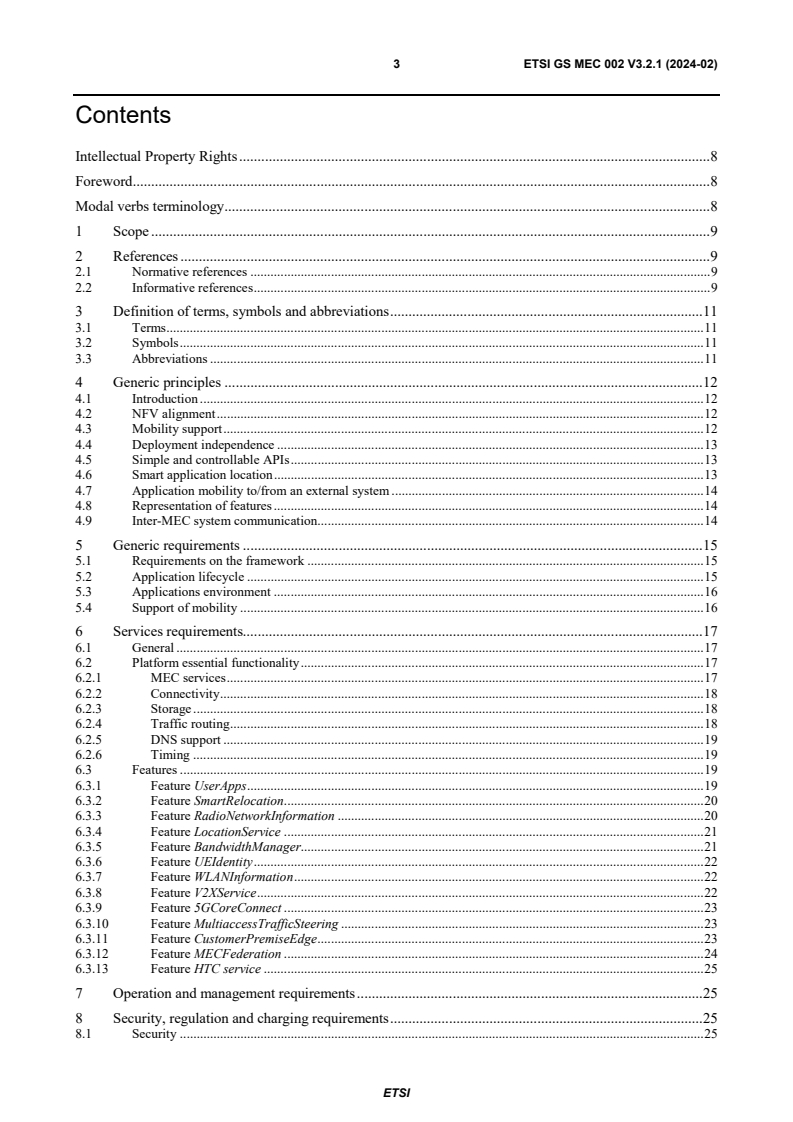
Contents
Intellectual Property Rights . 8
Foreword . 8
Modal verbs terminology . 8
1 Scope . 9
2 References . 9
2.1 Normative references . 9
2.2 Informative references . 9
3 Definition of terms, symbols and abbreviations . 11
3.1 Terms . 11
3.2 Symbols . 11
3.3 Abbreviations . 11
4 Generic principles . 12
4.1 Introduction . 12
4.2 NFV alignment . 12
4.3 Mobility support . 12
4.4 Deployment independence . 13
4.5 Simple and controllable APIs . 13
4.6 Smart application location . 13
4.7 Application mobility to/from an external system . 14
4.8 Representation of features . 14
4.9 Inter-MEC system communication . 14
5 Generic requirements . 15
5.1 Requirements on the framework . 15
5.2 Application lifecycle . 15
5.3 Applications environment . 16
5.4 Support of mobility . 16
6 Services requirements. 17
6.1 General . 17
6.2 Platform essential functionality . 17
6.2.1 MEC services . 17
6.2.2 Connectivity . 18
6.2.3 Storage . 18
6.2.4 Traffic routing . 18
6.2.5 DNS support . 19
6.2.6 Timing . 19
6.3 Features . 19
6.3.1 Feature UserApps . 19
6.3.2 Feature SmartRelocation . 20
6.3.3 Feature RadioNetworkInformation . 20
6.3.4 Feature LocationService . 21
6.3.5 Feature BandwidthManager. 21
6.3.6 Feature UEIdentity . 22
6.3.7 Feature WLANInformation . 22
6.3.8 Feature V2XService . 22
6.3.9 Feature 5GCoreConnect . 23
6.3.10 Feature MultiaccessTrafficSteering . 23
6.3.11 Feature CustomerPremiseEdge . 23
6.3.12 Feature MECFederation . 24
6.3.13 Feature HTC service . 25
7 Operation and management requirements . 25
8 Security, regulation and charging requirements . 25
8.1 Security . 25
ETSI
4 ETSI GS MEC 002 V3.2.1 (2024-02)
8.2 Regulation . 25
8.3 Charging . 26
Annex A (informative): Use cases . 27
A.0 Labelling of related requirements . 27
A.1 Use case categorization . 27
A.2 Mobile video delivery optimization using throughput guidance for TCP and other transport
protocols . 28
A.2.1 Description . 28
A.2.2 Use of MEC . 29
A.2.2.1 Throughput Guidance radio analytics application . 29
A.2.2.2 Transport layer congestion control assisted by MEC services . 29
A.2.3 Related requirements . 31
A.3 Local content caching at the mobile edge . 31
A.3.1 Description . 31
A.3.2 Use of MEC . 32
A.3.3 Related requirements . 32
A.4 Security, safety, data analytics . 32
A.4.1 Description . 32
A.4.2 Use of MEC . 33
A.4.3 Related requirements . 33
A.5 Augmented reality, assisted reality, virtual reality, cognitive assistance . 33
A.5.1 Description . 33
A.5.2 Use of MEC . 34
A.5.3 Related requirements . 34
A.6 Gaming and low latency cloud applications . 35
A.6.1 Description . 35
A.6.2 Use of MEC . 36
A.6.3 Related requirements . 36
A.7 Active device location tracking . 36
A.7.1 Description . 36
A.7.2 Use of MEC . 37
A.7.3 Related requirements . 37
A.8 Application portability . 37
A.8.1 Description . 37
A.8.2 Use of MEC . 37
A.8.3 Related requirements . 37
A.9 SLA management . 37
A.9.1 Description . 37
A.9.2 Related requirements . 38
A.10 MEC edge video orchestration . 38
A.10.1 Description . 38
A.10.2 Use of MEC . 38
A.10.3 Related requirements . 38
A.11 Mobile backhaul optimization . 39
A.11.1 Description . 39
A.11.2 Use of MEC . 39
A.11.3 Related requirements . 39
A.12 Direct interaction with MEC application . 39
A.12.1 Description . 39
A.12.2 Use of MEC . 40
A.12.3 Related requirements . 40
A.13 Traffic deduplication . 41
ETSI
5 ETSI GS MEC 002 V3.2.1 (2024-02)
A.13.1 Description . 41
A.13.2 Use of MEC . 41
A.13.3 Related requirements . 41
A.14 Vehicle-to-infrastructure communication . 41
A.14.1 Description . 41
A.14.2 Use of MEC . 42
A.14.3 Related requirements . 42
A.15 Location-based service recommendation . 43
A.15.1 Description . 43
A.15.2 Use of MEC . 43
A.15.3 Related requirements . 43
A.16 Bandwidth allocation manager for applications . 43
A.16.1 Description . 43
A.16.2 Use of MEC . 44
A.16.3 Related requirements . 44
A.17 MEC platform consuming information from operator trusted MEC application . 44
A.17.1 Description . 44
A.17.2 Use of MEC . 45
A.17.3 Related requirements . 45
A.18 Video caching, compression and analytics service chaining . 45
A.18.1 Description . 45
A.18.2 Use of MEC . 46
A.18.3 Related requirements . 46
A.19 Radio access bearer monitoring . 46
A.19.1 Description . 46
A.19.2 Use of MEC . 47
A.19.3 Related requirements . 47
A.20 MEC host deployment in dense-network environment . 47
A.20.1 Description . 47
A.20.2 Use of MEC . 47
A.20.3 Related requirements . 47
A.21 Radio network information generation in aggregation point . 48
A.21.1 Description . 48
A.21.2 Use of MEC . 48
A.21.3 Related requirements . 48
A.22 Unified enterprise communications . 48
A.22.1 Description . 48
A.22.2 Use of MEC . 49
A.22.3 Related requirements . 50
A.23 Application computation off-loading . 50
A.23.1 Description . 50
A.23.2 Value proposition . 50
A.23.3 Use of MEC . 51
A.23.4 Related requirements . 51
A.24 Optimizing QoE and resource utilization in multi-access network . 51
A.24.1 Description . 51
A.24.2 Use of MEC . 52
A.24.3 Related requirements . 52
A.25 Camera as a service . 53
A.25.1 Description . 53
A.25.2 Use of MEC . 54
A.25.3 Related requirements . 54
A.26 Video production and delivery in a stadium environment . 54
A.26.1 Description . 54
ETSI
6 ETSI GS MEC 002 V3.2.1 (2024-02)
A.26.2 Use of MEC . 56
A.26.3 Related requirements . 56
A.27 Media Delivery Optimizations at the Edge . 57
A.27.1 Description . 57
A.27.2 Use of MEC . 57
A.27.3 Related requirements . 58
A.28 Factories of the Future . 58
A.28.1 Description . 58
A.28.2 Use of MEC . 59
A.29 Flexible development with Containers . 59
A.29.1 Description . 59
A.29.2 Use of Multi-access Edge Computing . 60
A.30 Third Party Cloud Provider . 61
A.30.1 Description . 61
A.30.2 Use of MEC . 62
A.30.3 Related requirements . 62
A.31 Multi user, multi network applications . 63
A.31.1 Description . 63
A.31.2 Use of MEC . 64
A.31.3 Related requirements . 64
A.32 Indoor Precise Positioning and Content Pushing . 64
A.32.1 Description . 64
A.32.2 Use of MEC . 64
A.32.3 Related requirements . 65
A.33 Multi-RAT application computation offloading . 65
A.33.1 Description . 65
A.33.2 Use of MEC . 65
A.33.3 Related requirements . 65
A.34 IPTV over WTTx . 66
A.34.1 Description . 66
A.34.2 Use of MEC . 66
A.34.3 Related requirements . 67
A.35 MEC System deployment in 5G environment. 67
A.35.1 Description . 67
A.35.2 Use of Multi-access Edge Computing . 68
A.35.3 Related requirements . 68
A.36 In-vehicle MEC hosts supporting automotive workloads . 68
A.36.1 Description . 68
A.36.2 Use of MEC . 69
A.36.3 Related requirements . 69
A.37 Future Home . 69
A.37.1 Description . 69
A.37.2 Use of MEC . 70
A.37.3 Related requirements . 71
A.38 Future Vertical Applications . 71
A.38.1 Description . 71
A.38.2 Use of MEC . 73
A.39 V2X multi-stakeholder scenario . 75
A.39.1 Description . 75
A.39.2 Use of MEC . 75
A.39.3 Related requirements . 76
A.40 Multi-player immersive AR game . 76
A.40.1 Description . 76
ETSI
7 ETSI GS MEC 002 V3.2.1 (2024-02)
A.40.2 Use of MEC . 77
A.40.3 Related requirements . 79
A.41 Holographic Type Communications . 79
A.41.1 Description . 79
A.41.2 Use of MEC . 80
A.41.3 Related requirements . 81
Annex B (informative): Operator trusted MEC applications . 82
History . 83
ETSI
8 ETSI GS MEC 002 V3.2.1 (2024-02)
Intellectual Property Rights
Essential patents
IPRs essential or potentially essential to normative deliverables may have been declared to ETSI. The declarations
pertaining to these essential IPRs, if any, are publicly available for ETSI members and non-members, and can be
found in ETSI SR 000 314: "Intellectual Property Rights (IPRs); Essential, or potentially Essential, IPRs notified to
ETSI in respect of ETSI standards", which is available from the ETSI Secretariat. Latest updates are available on the
ETSI Web server (https://ipr.etsi.org/).
Pursuant to the ETSI Directives including the ETSI IPR Policy, no investigation regarding the essentiality of IPRs,
including IPR searches, has been carried out by ETSI. No guarantee can be given as to the existence of other IPRs not
referenced in ETSI SR 000 314 (or the updates on the ETSI Web server) which are, or may be, or may become,
essential to the present document.
Trademarks
The present document may include trademarks and/or tradenames which are asserted and/or registered by their owners.
ETSI claims no ownership of these except for any which are indicated as being the property of ETSI, and conveys no
right to use or reproduce any trademark and/or tradename. Mention of those trademarks in the present document does
not constitute an endorsement by ETSI of products, services or organizations associated with those trademarks.
DECT™, PLUGTESTS™, UMTS™ and the ETSI logo are trademarks of ETSI registered for the benefit of its
Members. 3GPP™ and LTE™ are trademarks of ETSI registered for the benefit of its Members and of the 3GPP
Organizational Partners. oneM2M™ logo is a trademark of ETSI registered for the benefit of its Members and of the ®
oneM2M Partners. GSM and the GSM logo are trademarks registered and owned by the GSM Association.
Foreword
This Group Specification (GS) has been produced by ETSI Industry Specification Group (ISG) Multi-access Edge
Computing (MEC).
Modal verbs terminology
In the present document "shall", "shall not", "should", "should not", "may", "need not", "will", "will not", "can" and
"cannot" are to be interpreted as described in clause 3.2 of the ETSI Drafting Rules (Verbal forms for the expression of
provisions).
"must" and "must not" are NOT allowed in ETSI deliverables except when used in direct citation.
ETSI
9 ETSI GS MEC 002 V3.2.1 (2024-02)
1 Scope
The present document specifies the requirements for Multi-access Edge Computing with the aim of promoting
interoperability and deployments. It contains normative and informative parts.
The present document also contains an annex describing example use cases and their technical benefits, for the purpose
of deriving requirements.
2 References
2.1 Normative references
References are either specific (identified by date of publication and/or edition number or version number) or non-
specific. For specific references, only the cited version applies. For non-specific references, the latest version of the
referenced document (including any amendments) applies.
Referenced documents which are not found to be publicly available in the expected location might be found at
https://docbox.etsi.org/Reference.
NOTE: While any hyperlinks included in this clause were valid at the time of publication, ETSI cannot guarantee
their long term validity.
The following referenced documents are necessary for the application of the present document.
Not applicable.
2.2 Informative references
References are either specific (identified by date of publication and/or edition number or version number) or non-
specific. For specific references, only the cited version applies. For non-specific references, the latest version of the
referenced document (including any amendments) applies.
NOTE: While any hyperlinks included in this clause were valid at the time of publication, ETSI cannot guarantee
their long term validity.
The following referenced documents are not necessary for the application of the present document but they assist the
user with regard to a particular subject area.
[i.1] ETSI GR MEC 001: "Multi-access Edge Computing (MEC); Terminology".
[i.2] Mobile-Edge Computing - Introductory Technical White Paper, September 2014.
[i.3] IETF draft-flinck-mobile-throughput-guidance-03.txt: "Mobile Throughput Guidance Inband
Signaling Protocol".
[i.4] ETSI GS NFV 002: "Network Functions Virtualisation (NFV); Architectural Framework".
[i.5] "Byte Caching in Wireless Networks", IEEE 32nd International Conference on Distributed
Computing Systems. Franck Le; Mudhakar Srivatsa; Arun K. Iyengar Macau. China
...
Questions, Comments and Discussion
Ask us and Technical Secretary will try to provide an answer. You can facilitate discussion about the standard in here.
Loading comments...