


ETSI TR 138 901 V19.3.0 (2026-04)
5G; Study on channel model for frequencies from 0.5 to 100 GHz (3GPP TR 38.901 version 19.3.0 Release 19)
5G; Study on channel model for frequencies from 0.5 to 100 GHz (3GPP TR 38.901 version 19.3.0 Release 19)
RTR/TSGR-0138901vj30
General Information
- Status
- Not Published
- Technical Committee
- 3GPP RAN 1 - Radio layer 1 specification
- Current Stage
- 12 - Citation in the OJ (auto-insert)
- Completion Date
- 09-Apr-2026
Frequently Asked Questions
ETSI TR 138 901 V19.3.0 (2026-04) is a standard published by the European Telecommunications Standards Institute (ETSI). Its full title is "5G; Study on channel model for frequencies from 0.5 to 100 GHz (3GPP TR 38.901 version 19.3.0 Release 19)". This standard covers: RTR/TSGR-0138901vj30
RTR/TSGR-0138901vj30
ETSI TR 138 901 V19.3.0 (2026-04) is available in PDF format for immediate download after purchase. The document can be added to your cart and obtained through the secure checkout process. Digital delivery ensures instant access to the complete standard document.
Standards Content (Sample)
TECHNICAL REPORT
5G;
Study on channel model for frequencies from 0.5 to 100 GHz
(3GPP TR 38.901 version 19.3.0 Release 19)
3GPP TR 38.901 version 19.3.0 Release 19 1 ETSI TR 138 901 V19.3.0 (2026-04)
Reference
RTR/TSGR-0138901vj30
Keywords
5G
ETSI
650 Route des Lucioles
F-06921 Sophia Antipolis Cedex - FRANCE
Tel.: +33 4 92 94 42 00 Fax: +33 4 93 65 47 16
Siret N° 348 623 562 00017 - APE 7112B
Association à but non lucratif enregistrée à la
Sous-Préfecture de Grasse (06) N° w061004871
Important notice
The present document can be downloaded from the
ETSI Search & Browse Standards application.
The present document may be made available in electronic versions and/or in print. The content of any electronic and/or
print versions of the present document shall not be modified without the prior written authorization of ETSI. In case of any
existing or perceived difference in contents between such versions and/or in print, the prevailing version of an ETSI
deliverable is the one made publicly available in PDF format on ETSI deliver repository.
Users should be aware that the present document may be revised or have its status changed,
this information is available in the Milestones listing.
If you find errors in the present document, please send your comments to
the relevant service listed under Committee Support Staff.
If you find a security vulnerability in the present document, please report it through our
Coordinated Vulnerability Disclosure (CVD) program.
Notice of disclaimer & limitation of liability
The information provided in the present deliverable is directed solely to professionals who have the appropriate degree of
experience to understand and interpret its content in accordance with generally accepted engineering or
other professional standard and applicable regulations.
No recommendation as to products and services or vendors is made or should be implied.
No representation or warranty is made that this deliverable is technically accurate or sufficient or conforms to any law
and/or governmental rule and/or regulation and further, no representation or warranty is made of merchantability or fitness
for any particular purpose or against infringement of intellectual property rights.
In no event shall ETSI be held liable for loss of profits or any other incidental or consequential damages.
Any software contained in this deliverable is provided "AS IS" with no warranties, express or implied, including but not
limited to, the warranties of merchantability, fitness for a particular purpose and non-infringement of intellectual property
rights and ETSI shall not be held liable in any event for any damages whatsoever (including, without limitation, damages
for loss of profits, business interruption, loss of information, or any other pecuniary loss) arising out of or related to the use
of or inability to use the software.
Copyright Notification
No part may be reproduced or utilized in any form or by any means, electronic or mechanical, including photocopying and
microfilm except as authorized by written permission of ETSI.
The content of the PDF version shall not be modified without the written authorization of ETSI.
The copyright and the foregoing restriction extend to reproduction in all media.
© ETSI 2026.
All rights reserved.
ETSI
3GPP TR 38.901 version 19.3.0 Release 19 2 ETSI TR 138 901 V19.3.0 (2026-04)
Intellectual Property Rights
Essential patents
IPRs essential or potentially essential to normative deliverables may have been declared to ETSI. The declarations
pertaining to these essential IPRs, if any, are publicly available for ETSI members and non-members, and can be
found in ETSI SR 000 314: "Intellectual Property Rights (IPRs); Essential, or potentially Essential, IPRs notified to
ETSI in respect of ETSI standards", which is available from the ETSI Secretariat. Latest updates are available on the
ETSI IPR online database.
Pursuant to the ETSI Directives including the ETSI IPR Policy, no investigation regarding the essentiality of IPRs,
including IPR searches, has been carried out by ETSI. No guarantee can be given as to the existence of other IPRs not
referenced in ETSI SR 000 314 (or the updates on the ETSI Web server) which are, or may be, or may become,
essential to the present document.
Trademarks
The present document may include trademarks and/or tradenames which are asserted and/or registered by their owners.
ETSI claims no ownership of these except for any which are indicated as being the property of ETSI, and conveys no
right to use or reproduce any trademark and/or tradename. Mention of those trademarks in the present document does
not constitute an endorsement by ETSI of products, services or organizations associated with those trademarks.
DECT™, PLUGTESTS™, UMTS™ and the ETSI logo are trademarks of ETSI registered for the benefit of its
Members. 3GPP™, LTE™ and 5G™ logo are trademarks of ETSI registered for the benefit of its Members and of the
3GPP Organizational Partners. oneM2M™ logo is a trademark of ETSI registered for the benefit of its Members and of ®
the oneM2M Partners. GSM and the GSM logo are trademarks registered and owned by the GSM Association.
Legal Notice
This Technical Specification (TS) has been produced by the ETSI 3rd Generation Partnership Project (3GPP).
The present document may refer to technical specifications or reports using their 3GPP identities. These shall be
interpreted as being references to the corresponding ETSI deliverables.
The cross reference between 3GPP and ETSI identities can be found at 3GPP to ETSI numbering cross-referencing.
Modal verbs terminology
In the present document "shall", "shall not", "should", "should not", "may", "need not", "will", "will not", "can" and
"cannot" are to be interpreted as described in clause 3.2 of the ETSI Drafting Rules (Verbal forms for the expression of
provisions).
"must" and "must not" are NOT allowed in ETSI deliverables except when used in direct citation.
ETSI
3GPP TR 38.901 version 19.3.0 Release 19 3 ETSI TR 138 901 V19.3.0 (2026-04)
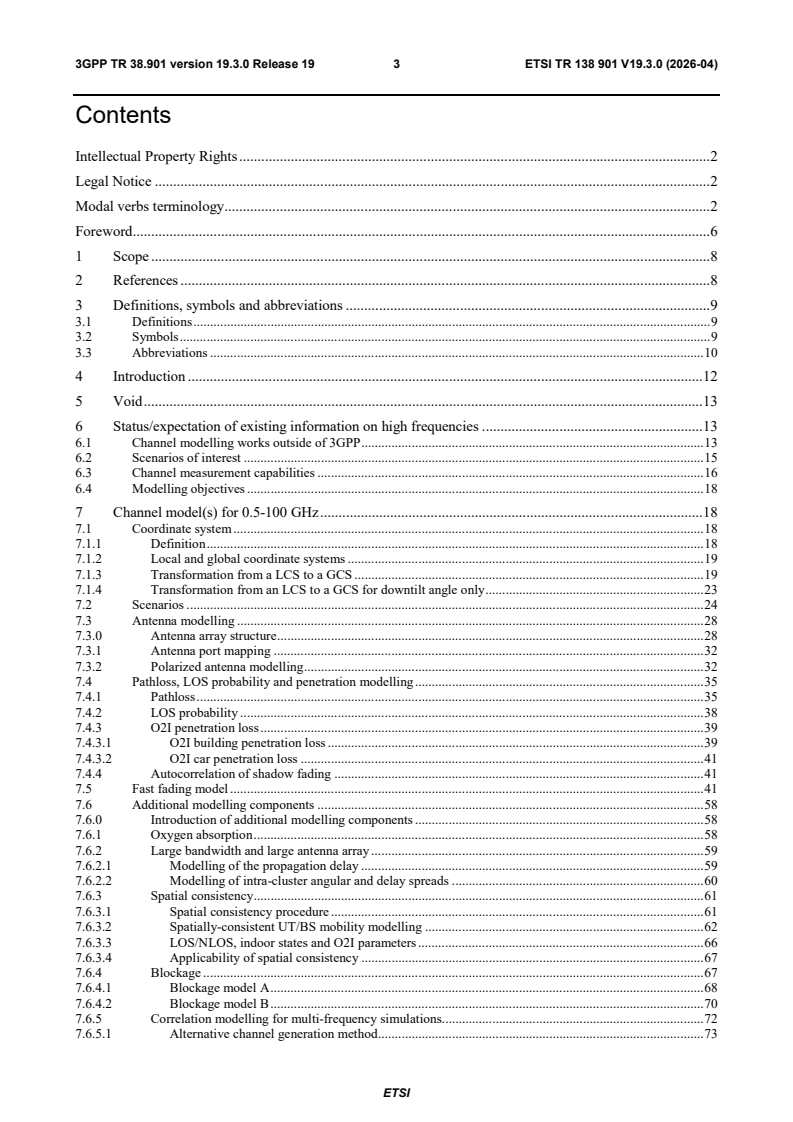
Contents
Intellectual Property Rights . 2
Legal Notice . 2
Modal verbs terminology . 2
Foreword . 6
1 Scope . 8
2 References . 8
3 Definitions, symbols and abbreviations . 9
3.1 Definitions . 9
3.2 Symbols . 9
3.3 Abbreviations . 10
4 Introduction . 12
5 Void . 13
6 Status/expectation of existing information on high frequencies . 13
6.1 Channel modelling works outside of 3GPP . 13
6.2 Scenarios of interest . 15
6.3 Channel measurement capabilities . 16
6.4 Modelling objectives . 18
7 Channel model(s) for 0.5-100 GHz . 18
7.1 Coordinate system . 18
7.1.1 Definition . 18
7.1.2 Local and global coordinate systems . 19
7.1.3 Transformation from a LCS to a GCS . 19
7.1.4 Transformation from an LCS to a GCS for downtilt angle only . 23
7.2 Scenarios . 24
7.3 Antenna modelling . 28
7.3.0 Antenna array structure . 28
7.3.1 Antenna port mapping . 32
7.3.2 Polarized antenna modelling . 32
7.4 Pathloss, LOS probability and penetration modelling . 35
7.4.1 Pathloss . 35
7.4.2 LOS probability . 38
7.4.3 O2I penetration loss . 39
7.4.3.1 O2I building penetration loss . 39
7.4.3.2 O2I car penetration loss . 41
7.4.4 Autocorrelation of shadow fading . 41
7.5 Fast fading model . 41
7.6 Additional modelling components . 58
7.6.0 Introduction of additional modelling components . 58
7.6.1 Oxygen absorption . 58
7.6.2 Large bandwidth and large antenna array . 59
7.6.2.1 Modelling of the propagation delay . 59
7.6.2.2 Modelling of intra-cluster angular and delay spreads . 60
7.6.3 Spatial consistency . 61
7.6.3.1 Spatial consistency procedure . 61
7.6.3.2 Spatially-consistent UT/BS mobility modelling . 62
7.6.3.3 LOS/NLOS, indoor states and O2I parameters . 66
7.6.3.4 Applicability of spatial consistency . 67
7.6.4 Blockage . 67
7.6.4.1 Blockage model A . 68
7.6.4.2 Blockage model B . 70
7.6.5 Correlation modelling for multi-frequency simulations. 72
7.6.5.1 Alternative channel generation method . 73
ETSI
3GPP TR 38.901 version 19.3.0 Release 19 4 ETSI TR 138 901 V19.3.0 (2026-04)
7.6.6 Time-varying Doppler shift . 75
7.6.7 UT rotation. 75
7.6.8 Explicit ground reflection model . 75
7.6.9 Absolute time of arrival . 78
7.6.10 Dual mobility . 79
7.6.11 Sources of EM interference . 79
7.6.12 Embedded devices . 79
7.6.13 Near-field channel model . 80
7.6.14 Spatial non-stationarity channel model . 81
7.6.14.1 Spatial non-stationarity channel model at TRP side . 81
7.6.14.1.1 Introduction . 81
7.6.14.1.2 Physical blocker-based Model . 82
7.6.14.1.3 Stochastic based Model . 83
7.6.14.2 Spatial non-stationarity channel model at UT side . 84
7.6.15 Number of cluster variability model . 85
7.6.16 Polarization power variability model . 85
7.7 Channel models for link-level evaluations . 86
7.7.1 Clustered Delay Line (CDL) models . 86
7.7.2 Tapped Delay Line (TDL) models . 90
7.7.3 Scaling of delays . 93
7.7.4 Spatial filter for generating TDL channel model . 94
7.7.4.1 Exemplary filters/antenna patterns . 94
7.7.4.2 Generation procedure . 95
7.7.5 Extension for MIMO simulations . 95
7.7.5.1 CDL extension: Scaling of angles . 95
7.7.5.2 TDL extension: Applying a correlation matrix . 97
7.7.6 K-factor for LOS channel models . 97
7.8 Channel model calibration . 98
7.8.1 Large scale calibration . 98
7.8.2 Full calibration . 100
7.8.3 Calibration of additional features . 102
7.8.4 Calibration of the indoor factory scenario . 110
7.9 Channel model(s) for ISAC . 111
7.9.0 Introduction. 111
7.9.1 Scenarios . 112
7.9.2 Physical object model . 117
7.9.2.0 Introduction . 117
7.9.2.1 RCS of a sensing target . 117
7.9.2.2 Cross-polarization matrix of a sensing target . 119
7.9.3 Reference channel models and required updates . 120
7.9.4 Fast fading model . 125
7.9.4.0 Introduction . 125
7.9.4.1 Target channel . 127
7.9.4.2 Background channel . 132
7.9.4.3 Combining target channel and background channel . 134
7.9.5 Additional modelling components . 134
7.9.5.0 Introduction . 134
7.9.5.1 Spatial consistency . 134
7.9.5.2 Type-2 environment object . 136
7.9.5.3 Power normalization across target channel and background channel . 139
7.9.5.4 Doppler of mobile scatterers . 139
7.9.5.5 Lower power clusters . 139
7.9.5.6 Blockage . 140
7.9.6 Channel model calibration . 140
7.9.6.1 Large scale calibration . 140
7.9.6.2 Full calibration . 145
7.9.6.3 Calibration of additional features . 146
8 Map-based hybrid channel model (Alternative channel model methodology) . 150
8.1 Coordinate system . 150
8.2 Scenarios . 150
8.3 Antenna modelling . 150
ETSI
3GPP TR 38.901 version 19.3.0 Release 19 5 ETSI TR 138 901 V19.3.0 (2026-04)
8.4 Channel generation . 150
Annex A: Further parameter definitions . 161
A.1 Calculation of angular spread . 161
A.2 Calculation of mean angle . 161
A.3 Calculation of cluster angular spread . 161
A.4 Calculation of cluster mean angle . 161
A.5 Calculation of scaling factor for changing CDL model angular spread . 161
Annex B: Change history . 163
History . 164
ETSI
3GPP TR 38.901 version 19.3.0 Release 19 6 ETSI TR 138 901 V19.3.0 (2026-04)
Foreword
rd
This Technical Report has been produced by the 3 Generation Partnership Project (3GPP).
The contents of the present document are subject to continuing work within the TSG and may change following formal
TSG approval. Should the TSG modify the contents of the present document, it will be re-released by the TSG with an
identifying change of release date and an increase in version number as follows:
Version x.y.z
where:
x the first digit:
1 presented to TSG for information;
2 presented to TSG for approval;
3 or greater indicates TSG approved document under change control.
y the second digit is incremented for all changes of substance, i.e. technical enhancements, corrections,
updates, etc.
z the third digit is incremented when editorial only changes have been incorporated in the document.
In the present document, modal verbs have the following meanings:
shall indicates a mandatory requirement to do something
shall not indicates an interdiction (prohibition) to do something
The constructions "shall" and "shall not" are confined to the context of normative provisions, and do not appear in
Technical Reports.
The constructions "must" and "must not" are not used as substitutes for "shall" and "shall not". Their use is avoided
insofar as possible, and they are not used in a normative context except in a direct citation from an external, referenced,
non-3GPP document, or so as to maintain continuity of style when extending or modifying the provisions of such a
referenced document.
should indicates a recommendation to do something
should not indicates a recommendation not to do something
may indicates permission to do something
need not indicates permission not to do something
The construction "may not" is ambiguous and is not used in normative elements. The unambiguous constructions
"might not" or "shall not" are used instead, depending upon the meaning intended.
can indicates that something is possible
cannot indicates that something is impossible
The constructions "can" and "cannot" are not substitutes for "may" and "need not".
will indicates that something is certain or expected to happen as a result of action taken by an agency
the behaviour of which is outside the scope of the present document
will not indicates that something is certain or expected not to happen as a result of action taken by an
agency the behaviour of which is outside the scope of the present document
might indicates a likelihood that something will happen as a result of action taken by some agency the
behaviour of which is outside the scope of the present document
ETSI
3GPP TR 38.901 version 19.3.0 Release 19 7 ETSI TR 138 901 V19.3.0 (2026-04)
might not indicates a likelihood that something will not happen as a result of action taken by some agency
the behaviour of which is outside the scope of the present document
In addition:
is (or any other verb in the indicative mood) indicates a statement of fact
is not (or any other negative verb in the indicative mood) indicates a statement of fact
The constructions "is" and "is not" do not indicate requirements.
ETSI
3GPP TR 38.901 version 19.3.0 Release 19 8 ETSI TR 138 901 V19.3.0 (2026-04)
1 Scope
The present document captures the findings of the study item, "Study on channel model for frequency spectrum above 6
GHz" [2] and from further findings of:
- the study item, "Study on New Radio Access Technology [22]",
- the study item "Study on Channel Modeling for Indoor Industrial Scenarios [23]",
- the study item "New SID: Study on channel modelling enhancements for 7-24GHz for NR [24]",
- and the study item "Study on channel modelling for Integrated Sensing And Communication (ISAC) for NR
[26]".
The channel models in the present document address the frequency range 0.5-100 GHz. The purpose of this TR is to
help TSG RAN WG1 to properly model and evaluate the performance of physical layer techniques using the
appropriate channel model(s). Therefore, the TR will be kept up-to-date via CRs in the future.
This document relates to the 3GPP evaluation methodology and covers the modelling of the physical layer of both
Mobile Equipment and Access Network of 3GPP systems.
This document is intended to capture the channel model(s) for frequencies from 0.5GHz up to 100GHz.
2 References
The following documents contain provisions which, through reference in this text, constitute provisions of the present
document.
- References are either specific (identified by date of publication, edition number, version number, etc.) or
non-specific.
- For a specific reference, subsequent revisions do not apply.
- For a non-specific reference, the latest version applies. In the case of a reference to a 3GPP document (including
a GSM document), a non-specific reference implicitly refers to the latest version of that document in the same
Release as the present document.
[1] 3GPP TR 21.905: "Vocabulary for 3GPP Specifications".
[2] 3GPP TD RP-151606: "Study on channel model for frequency spectrum above 6 GHz".
[3] 3GPP TR 36.873 (V12.2.0): "Study on 3D channel model for LTE".
[4] 3GPP RP-151847: "Report of RAN email discussion about >6GHz channel modelling", Samsung.
[5] 3GPP TD R1-163408: "Additional Considerations on Building Penetration Loss Modelling for 5G
System Performance Evaluation", Straight Path Communications.
[6] ICT-317669-METIS/D1.4: "METIS channel model, METIS 2020, Feb, 2015".
[7] Glassner, A S: "An introduction to ray tracing. Elsevier, 1989".
[8] McKown, J. W., Hamilton, R. L.: "Ray tracing as a design tool for radio networks, Network,
IEEE, 1991(6): 27-30".
[9] Kurner, T., Cichon, D. J., Wiesbeck, W.: "Concepts and results for 3D digital terrain-based wave
propagation models: An overview", IEEE J.Select. Areas Commun., vol. 11, pp. 1002–1012, 1993.
[10] Born, M., Wolf, E.: "Principles of optics: electromagnetic theory of propagation, interference and
diffraction of light", CUP Archive, 2000.
[11] Friis, H.: "A note on a simple transmission formula", proc. IRE, vol. 34, no. 5, pp. 254–256, 1946.
ETSI
3GPP TR 38.901 version 19.3.0 Release 19 9 ETSI TR 138 901 V19.3.0 (2026-04)
[12] Kouyoumjian, R.G., Pathak, P.H.: "A uniform geometrical theory of diffraction for an edge in a
perfectly conducting surface" Proc. IEEE, vol. 62, pp. 1448–1461, Nov. 1974.
[13] Pathak, P.H., Burnside, W., Marhefka, R.: "A Uniform GTD Analysis of the Diffraction of
Electromagnetic Waves by a Smooth Convex Surface", IEEE Transactions on Antennas and
Propagation, vol. 28, no. 5, pp. 631–642, 1980.
[14] IST-WINNER II Deliverable 1.1.2 v.1.2, "WINNER II Channel Models", IST-WINNER2, Tech.
Rep., 2007 (http://www.ist-winner.org/deliverables.html).
[15] 3GPP TR36.101: "User Equipment (UE) radio transmission and reception".
[16] 3GPP TR36.104: "Base Station (BS) radio transmission and reception".
[17] Asplund, H., Medbo, J., Göransson, B., Karlsson, J., Sköld, J.: "A simplified approach to applying
the 3GPP spatial channel model", in Proc. of PIMRC 2006.
[18] ITU-R Rec. P.1816: "The prediction of the time and the spatial profile for broadband land mobile
services using UHF and SHF bands".
[19] ITU-R Rec. P.2040-1: "Effects of building materials and structures on radiowave propagation
above about 100 MHz", International Telecommunication Union Radiocommunication Sector
ITU-R, 07/2015.
[20] ITU-R Rec. P.527-3: "Electrical characteristics of the surface of the earth", International
Telecommunication Union Radiocommunication Sector ITU-R, 03/1992.
[21] Jordan, E.C., Balmain, K.G.: "Electromagnetic Waves and Radiating Systems", Prentice-Hall Inc.,
1968.
[22] 3GPP TD RP-162469: "Study on New Radio (NR) Access Technology".
[23] 3GPP TD RP-182138: "SID on Channel Modeling for Indoor Industrial Scenarios".
[24] 3GPP TD RP-234018: "New SID: Study on channel modelling enhancements for 7-24GHz for
NR"
[25] 3GPP TD R1-2504960: "Data source descriptions for 7 – 24 GHz SI".
[26] 3GPP TD RP-242348: "Study on channel modelling for Integrated Sensing And Communication
(ISAC) for NR".
[27] 3GPP TD R1-2504948: "Information on validations for ISAC"
3 Definitions, symbols and abbreviations
3.1 Definitions
For the purposes of the present document, the terms and definitions given in TR 21.905 [1] apply.
3.2 Symbols
For the purposes of the present document, the following symbols apply:
A antenna radiation power pattern
A maximum attenuation
max
d 2D distance between Tx and Rx
2D
d 3D distance between Tx and Rx
3D
ETSI
3GPP TR 38.901 version 19.3.0 Release 19 10 ETSI TR 138 901 V19.3.0 (2026-04)
d antenna element spacing in horizontal direction
H
d antenna element spacing in vertical direction
V
f frequency
f center frequency / carrier frequency
c
ˆ
θ
F Receive antenna element u field pattern in the direction of the spherical basis vector
rx,u,θ
ˆ
φ
F Receive antenna element u field pattern in the direction of the spherical basis vector
rx,u,ϕ
ˆ
θ
F Transmit antenna element s field pattern in the direction of the spherical basis vector
tx,s,θ
ˆ
φ
F Transmit antenna element s field pattern in the direction of the spherical basis vector
rx,s,ϕ
h antenna height for BS
BS
h antenna height for UT
UT
ˆ spherical unit vector of cluster n, ray m, for receiver
r
rx,n,m
rˆ spherical unit vector of cluster n, ray m, for transmitter
tx,n,m
α bearing angle
β downtilt angle
γ slant angle
λ wavelength
κ cross-polarization power ratio in linear scale
μ mean value of 10-base logarithm of azimuth angle spread of arrival
lgASA
μ mean value of 10-base logarithm of azimuth angle spread of departure
lgASD
μlgDS mean value of 10-base logarithm of delay spread
μ mean value of 10-base logarithm of zenith angle spread of arrival
lgZSA
μ mean value of 10-base logarithm of zenith angle spread of departure
lgZSD
Pr LOS probability
LOS
SLA side-lobe attenuation in vertical direction
V
σ standard deviation of 10-base logarithm of azimuth angle spread of arrival
lgASA
σ standard deviation of 10-base logarithm of azimuth angle spread of departure
lgASD
σ standard deviation value of 10-base logarithm of delay spread
lgDS
σ standard deviation of 10-base logarithm of zenith angle spread of arrival
lgZSA
σ standard deviation of 10-base logarithm of zenith angle spread of departure
lgZSD
σ standard deviation of SF
SF
azimuth angle
φ
zenith angle
θ
ˆ
φ spherical basis vector (unit vector) for GCS
ˆ
φ′ spherical basis vector (unit vector) for LCS
φ horizontal 3 dB beamwidth of an antenna
3dB
ˆ ˆ
θ spherical basis vector (unit vector), orthogonal to φ , for GCS
ˆ
ˆ
′ ′
θ spherical basis vector (unit vector), orthogonal to φ , for LCS
θ electrical steering angle in vertical direction
etilt
θ vertical 3 dB beamwidth of an antenna
3dB
ψ Angular displacement between two pairs of unit vectors
3.3 Abbreviations
For the purposes of the present document, the abbreviations given in TR 21.905 [1] and the following apply. An
abbreviation defined in the present document takes precedence over the definition of the same abbreviation, if any, in
TR 21.905 [1].
2D two-dimensional
ETSI
3GPP TR 38.901 version 19.3.0 Release 19 11 ETSI TR 138 901 V19.3.0 (2026-04)
3D three-dimensional
AGV Automated Guided Vehicles
AOA Azimuth angle Of Arrival
AOD Azimuth angle Of Departure
AS Angular Spread
ASA Azimuth angle Spread of Arrival
ASD Azimuth angle Spread of Departure
BF Beamforming
BS Base Station
BP Breakpoint
BW Beamwidth
CDF Cumulative Distribution Function
CDL Clustered Delay Line
CRS Common Reference Signal
D2D Device-to-Device
DFT Discrete Fourier Transform
DS Delay Spread
EO Environment Object
GCS Global Coordinate System
IID Independent and identically distributed
InF Indoor Factory
InF-SL Indoor Factory with Sparse clutter and Low base station height (both Tx and Rx are below the
average height of the clutter)
InF-DL Indoor Factory with Dense clutter and Low base station height (both Tx and Rx are below the
average height of the clutter)
InF-SH Indoor Factory with Sparse clutter and High base station height (Tx or Rx elevated above the
clutter)
InF-DH Indoor Factory with Dense clutter and High base station height (Tx or Rx elevated above the
clutter)
InF-HH Indoor Factory with High Tx and High Rx (both elevated above the clutter)
InH Indoor Hotspot
IRR Infrared Reflecting
ISAC Integrated Sensing and Communication
ISD Intersite Distance
K Ricean K factor
LCS Local Coordinate System
LOS Line Of Sight
MIMO Multiple-Input-Multiple-Output
MPC Multipath Component
NLOS Non-LOS
O2I Outdoor-to-Indoor
O2O Outdoor-to-Outdoor
OFDM Orthogonal Frequency-Division Multiplexing
PAS Power angular spectrum
PL Path Loss
PRB Physical Resource Block
RCS Radar cross-section
RMa Rural Macro
RMS Root Mean Square
RP Reference Point
RSRP Reference Signal Received Power
Rx Receiver
SCM Spatial Channel Model
SINR Signal-to-Interference-plus-Noise Ratio
SIR Signal-to-Interference Ratio
SSCM Statistical Spatial Channel Model
SF Shadow Fading
SLA Sidelobe Attenuation
SPST Scattering Point of a ST
SRX Sensing Receiver
ST Sensing Target
STX Sensing Transmitter
ETSI
3GPP TR 38.901 version 19.3.0 Release 19 12 ETSI TR 138 901 V19.3.0 (2026-04)
TDL Tapped Delay Line
TOA Time Of Arrival
TRP Transmission Reception Point
Tx Transmitter
UAV Unmanned Aerial Vehicle
UMa Urban Macro
UMi Urban Micro
UT User Terminal
UTD Uniform Theory of Diffraction
V2V Vehicle-to-Vehicle
XPR Cross-Polarization Ratio
ZOA Zenith angle Of Arrival
ZOD Zenith angle Of Departure
ZSA Zenith angle Spread of Arrival
ZSD Zenith angle Spread of Departure
4 Introduction
At TSG RAN #69 meeting the Study Item Description on "Study on channel model for frequency spectrum above 6
GHz" was approved [2]. This study item covers the identification of the status/expectation of existing information on
high frequencies (e.g. spectrum allocation, scenarios of interest, measurements, etc), and the channel model(s) for
frequencies up to 100 GHz. This technical report documents the channel model(s). The new channel model has to a
large degree been aligned with earlier channel models for <6 GHz such as the 3D SCM model (TR 36.873) or IMT-
Advanced (ITU-R M.2135). The new model supports comparisons across frequency bands over the range 0.5-100 GHz.
The modelling methods defined in this technical report are generally applicable over the range 0.5-100 GHz, unless
explicitly mentioned otherwise in this technical report for specific modelling method, involved parameters and/or
scenario.
Subsequently, at the TSG RAN #81 meeting the Study Item Description "Study on Channel Modeling for Indoor
Industrial Scenarios" was approved [23]. The findings from this study item is also captured in the present technical
report. The Industrial channel model was developed by considering new measurements and information in the literature.
An overview list of all such contributions and sources is available in tdoc R1-1909706.
Subsequently, at the TSG RAN #102 meeting the Study Item Description "Study on channel modelling enhancements
for 7-24GHz for NR" was approved [24]. The findings from this study are also captured in the present technical report.
Channel modeling was further updated by considering new measurements and information in the literature. An
overview of the information sources is available in tdoc R1-2504960 [25].
At TSG RAN #102 meeting the Study Item Description “Study on channel modelling for Integrated Sensing And
Communication (ISAC) for NR” was approved. The findings from this study item are captured in Clause 7.9. The ISAC
channel model was developed considering new measurements and information in the literature. The RCS validation
results are obtained based on certain object sizes. An overview list of the sources is available in [27].
The channel model is applicable for link and system level simulations in the following conditions:
- For system level simulations, supported scenarios are urban microcell street canyon, urban macrocell, indoor
office, rural macrocell, indoor factory, and suburban macrocell.
- Bandwidth is supported up to 10% of the center frequency but no larger than 2GHz.
- Mobility of either one end of the link or both ends of the link is supported
- For the stochastic model, spatial consistency is supported by correlation of LSPs and SSPs as well as
LOS/NLOS state.
- Large array support is based on far field assumption and stationary channel over the size of the array.
- Near field channel modeling (i.e., characteristics of spherical wavefront) and spatial non-stationarity (i.e.,
antenna element-wise power variation) are supported.
ETSI
3GPP TR 38.901 version 19.3.0 Release 19 13 ETSI TR 138 901 V19.3.0 (2026-04)
- The sensing target is assumed in the far field of the sensing transmitter/receiver for the channel model(s) for
ISAC in Clause 7.9.
5 Void
6 Status/expectation of existing information on high
frequencies
6.1 Channel modelling works outside of 3GPP
This clause summarizes the channel modelling work outside of 3GPP based on the input from companies.
Groups and projects with channel models:
- METIS (Mobile and wireless communications Enablers for the Twenty-twenty Information Society)
- MiWEBA (Millimetre-Wave Evolution for Backhaul and Access)
- ITU-R M
- COST2100
- IEEE 802.11
- NYU WIRELESS: interdisciplinary academic research center
- Fraunhofer HHI has developed the QuaDRiGa channel model, Matlab implementation is available at
http://quadriga-channel-model.de
Groups and projects which intend to develop channel models:
- 5G mmWave Channel Model Alliance: NIST initiated, North America based
- mmMAGIC (Millimetre-Wave Based Mobile Radio Access Network for Fifth Generation Integrated
Communications): Europe based
- IMT-2020 5G promotion association: China based
METIS Channel Models:
- Identified 5G requirements (e.g., wide frequency range, high bandwidth, massive MIMO, 3-D and accurate
polarization modelling)
- Performed channel measurements at various bands between 2GHz and 60 GHz
- Provided different channel model methodologies (map-based model, stochastic model or hybrid model). For
stochastic model, the proposed channel is focused on outdoor square, Indoor cafeteria and indoor shopping mall
scenarios.
MiWEBA Channel Models:
- Addressed various challenges: Shadowing, spatial consistency, environment dynamics, spherical wave
modelling, dual mobility Doppler model, ratio between diffuse and specular reflections, polarization
- Proposed Quasi-deterministic channel model
- Performed channel measurements
...
Questions, Comments and Discussion
Ask us and Technical Secretary will try to provide an answer. You can facilitate discussion about the standard in here.
Loading comments...