


ETSI TS 124 571 V19.4.0 (2026-03)
5G; 5G System (5GS); Control plane Location Services (LCS) procedures; Stage 3 (3GPP TS 24.571 version 19.4.0 Release 19)
5G; 5G System (5GS); Control plane Location Services (LCS) procedures; Stage 3 (3GPP TS 24.571 version 19.4.0 Release 19)
RTS/TSGC-0124571vj40
General Information
- Status
- Not Published
- Technical Committee
- 3GPP CT 1 - MM/CC/SM [lu] (formely CN1)
- Current Stage
- 8 - Draft receipt by ETSI Secretariat
- Completion Date
- 10-Mar-2026
Frequently Asked Questions
ETSI TS 124 571 V19.4.0 (2026-03) is a standard published by the European Telecommunications Standards Institute (ETSI). Its full title is "5G; 5G System (5GS); Control plane Location Services (LCS) procedures; Stage 3 (3GPP TS 24.571 version 19.4.0 Release 19)". This standard covers: RTS/TSGC-0124571vj40
RTS/TSGC-0124571vj40
ETSI TS 124 571 V19.4.0 (2026-03) is available in PDF format for immediate download after purchase. The document can be added to your cart and obtained through the secure checkout process. Digital delivery ensures instant access to the complete standard document.
Standards Content (Sample)
TECHNICAL SPECIFICATION
5G;
5G System (5GS);
Control plane Location Services (LCS) procedures;
Stage 3
(3GPP TS 24.571 version 19.4.0 Release 19)
3GPP TS 24.571 version 19.4.0 Release 19 1 ETSI TS 124 571 V19.4.0 (2026-03)
Reference
RTS/TSGC-0124571vj40
Keywords
5G
ETSI
650 Route des Lucioles
F-06921 Sophia Antipolis Cedex - FRANCE
Tel.: +33 4 92 94 42 00 Fax: +33 4 93 65 47 16
Siret N° 348 623 562 00017 - APE 7112B
Association à but non lucratif enregistrée à la
Sous-Préfecture de Grasse (06) N° w061004871
Important notice
The present document can be downloaded from the
ETSI Search & Browse Standards application.
The present document may be made available in electronic versions and/or in print. The content of any electronic and/or
print versions of the present document shall not be modified without the prior written authorization of ETSI. In case of any
existing or perceived difference in contents between such versions and/or in print, the prevailing version of an ETSI
deliverable is the one made publicly available in PDF format on ETSI deliver repository.
Users should be aware that the present document may be revised or have its status changed,
this information is available in the Milestones listing.
If you find errors in the present document, please send your comments to
the relevant service listed under Committee Support Staff.
If you find a security vulnerability in the present document, please report it through our
Coordinated Vulnerability Disclosure (CVD) program.
Notice of disclaimer & limitation of liability
The information provided in the present deliverable is directed solely to professionals who have the appropriate degree of
experience to understand and interpret its content in accordance with generally accepted engineering or
other professional standard and applicable regulations.
No recommendation as to products and services or vendors is made or should be implied.
No representation or warranty is made that this deliverable is technically accurate or sufficient or conforms to any law
and/or governmental rule and/or regulation and further, no representation or warranty is made of merchantability or fitness
for any particular purpose or against infringement of intellectual property rights.
In no event shall ETSI be held liable for loss of profits or any other incidental or consequential damages.
Any software contained in this deliverable is provided "AS IS" with no warranties, express or implied, including but not
limited to, the warranties of merchantability, fitness for a particular purpose and non-infringement of intellectual property
rights and ETSI shall not be held liable in any event for any damages whatsoever (including, without limitation, damages
for loss of profits, business interruption, loss of information, or any other pecuniary loss) arising out of or related to the use
of or inability to use the software.
Copyright Notification
No part may be reproduced or utilized in any form or by any means, electronic or mechanical, including photocopying and
microfilm except as authorized by written permission of ETSI.
The content of the PDF version shall not be modified without the written authorization of ETSI.
The copyright and the foregoing restriction extend to reproduction in all media.
© ETSI 2026.
All rights reserved.
ETSI
3GPP TS 24.571 version 19.4.0 Release 19 2 ETSI TS 124 571 V19.4.0 (2026-03)
Intellectual Property Rights
Essential patents
IPRs essential or potentially essential to normative deliverables may have been declared to ETSI. The declarations
pertaining to these essential IPRs, if any, are publicly available for ETSI members and non-members, and can be
found in ETSI SR 000 314: "Intellectual Property Rights (IPRs); Essential, or potentially Essential, IPRs notified to
ETSI in respect of ETSI standards", which is available from the ETSI Secretariat. Latest updates are available on the
ETSI IPR online database.
Pursuant to the ETSI Directives including the ETSI IPR Policy, no investigation regarding the essentiality of IPRs,
including IPR searches, has been carried out by ETSI. No guarantee can be given as to the existence of other IPRs not
referenced in ETSI SR 000 314 (or the updates on the ETSI Web server) which are, or may be, or may become,
essential to the present document.
Trademarks
The present document may include trademarks and/or tradenames which are asserted and/or registered by their owners.
ETSI claims no ownership of these except for any which are indicated as being the property of ETSI, and conveys no
right to use or reproduce any trademark and/or tradename. Mention of those trademarks in the present document does
not constitute an endorsement by ETSI of products, services or organizations associated with those trademarks.
DECT™, PLUGTESTS™, UMTS™ and the ETSI logo are trademarks of ETSI registered for the benefit of its
Members. 3GPP™, LTE™ and 5G™ logo are trademarks of ETSI registered for the benefit of its Members and of the
3GPP Organizational Partners. oneM2M™ logo is a trademark of ETSI registered for the benefit of its Members and of ®
the oneM2M Partners. GSM and the GSM logo are trademarks registered and owned by the GSM Association.
Legal Notice
This Technical Specification (TS) has been produced by ETSI 3rd Generation Partnership Project (3GPP).
The present document may refer to technical specifications or reports using their 3GPP identities. These shall be
interpreted as being references to the corresponding ETSI deliverables.
The cross reference between 3GPP and ETSI identities can be found at 3GPP to ETSI numbering cross-referencing.
Modal verbs terminology
In the present document "shall", "shall not", "should", "should not", "may", "need not", "will", "will not", "can" and
"cannot" are to be interpreted as described in clause 3.2 of the ETSI Drafting Rules (Verbal forms for the expression of
provisions).
"must" and "must not" are NOT allowed in ETSI deliverables except when used in direct citation.
ETSI
3GPP TS 24.571 version 19.4.0 Release 19 3 ETSI TS 124 571 V19.4.0 (2026-03)
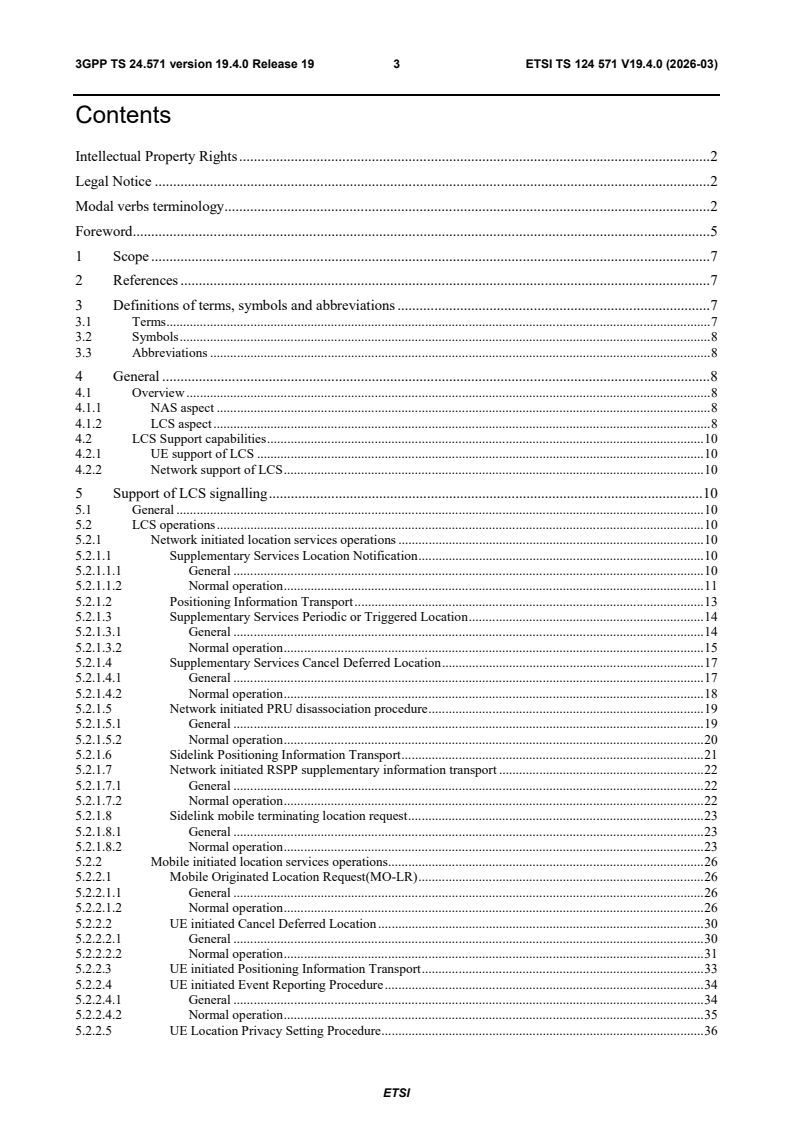
Contents
Intellectual Property Rights . 2
Legal Notice . 2
Modal verbs terminology . 2
Foreword . 5
1 Scope . 7
2 References . 7
3 Definitions of terms, symbols and abbreviations . 7
3.1 Terms . 7
3.2 Symbols . 8
3.3 Abbreviations . 8
4 General . 8
4.1 Overview . 8
4.1.1 NAS aspect . 8
4.1.2 LCS aspect . 8
4.2 LCS Support capabilities . 10
4.2.1 UE support of LCS . 10
4.2.2 Network support of LCS . 10
5 Support of LCS signalling . 10
5.1 General . 10
5.2 LCS operations . 10
5.2.1 Network initiated location services operations . 10
5.2.1.1 Supplementary Services Location Notification . 10
5.2.1.1.1 General . 10
5.2.1.1.2 Normal operation . 11
5.2.1.2 Positioning Information Transport . 13
5.2.1.3 Supplementary Services Periodic or Triggered Location . 14
5.2.1.3.1 General . 14
5.2.1.3.2 Normal operation . 15
5.2.1.4 Supplementary Services Cancel Deferred Location . 17
5.2.1.4.1 General . 17
5.2.1.4.2 Normal operation . 18
5.2.1.5 Network initiated PRU disassociation procedure . 19
5.2.1.5.1 General . 19
5.2.1.5.2 Normal operation . 20
5.2.1.6 Sidelink Positioning Information Transport . 21
5.2.1.7 Network initiated RSPP supplementary information transport . 22
5.2.1.7.1 General . 22
5.2.1.7.2 Normal operation . 22
5.2.1.8 Sidelink mobile terminating location request . 23
5.2.1.8.1 General . 23
5.2.1.8.2 Normal operation . 23
5.2.2 Mobile initiated location services operations . 26
5.2.2.1 Mobile Originated Location Request(MO-LR) . 26
5.2.2.1.1 General . 26
5.2.2.1.2 Normal operation . 26
5.2.2.2 UE initiated Cancel Deferred Location . 30
5.2.2.2.1 General . 30
5.2.2.2.2 Normal operation . 31
5.2.2.3 UE initiated Positioning Information Transport . 33
5.2.2.4 UE initiated Event Reporting Procedure . 34
5.2.2.4.1 General . 34
5.2.2.4.2 Normal operation . 35
5.2.2.5 UE Location Privacy Setting Procedure . 36
ETSI
3GPP TS 24.571 version 19.4.0 Release 19 4 ETSI TS 124 571 V19.4.0 (2026-03)
5.2.2.5.1 General . 36
5.2.2.5.2 Normal operation . 37
5.2.2.6 UE initiated Event Reporting Procedure for Low Power Event Reporting and Triggered 5GC-
MT-LR . 38
5.2.2.6.1 General . 38
5.2.2.6.2 Normal operation . 39
5.2.2.7 PRU association procedure . 39
5.2.2.7.1 General . 39
5.2.2.7.2 Normal operation . 40
5.2.2.8 UE initiated PRU disassociation procedure . 42
5.2.2.8.1 General . 42
5.2.2.8.2 Normal operation . 43
5.2.2.9 Sidelink Mobile Originated Location Request (SL-MO-LR) . 45
5.2.2.9.1 General . 45
5.2.2.9.2 Normal operation . 46
5.2.2.10 UE initiated Sidelink Positioning Information Transport. 50
5.2.2.11 UE initiated RSPP supplementary information transport . 51
5.2.2.11.1 General . 51
5.2.2.11.2 Normal operation . 51
5.3 LCS message and coding . 52
5.3.1 Messages for Location services operations . 52
5.3.2 Messages for LTE Positioning Protocol (LPP) . 53
5.3.2.1 Downlink Positioning Information Transport using LPP messages . 53
5.3.2.2 Uplink Positioning Information Transport using LPP messages . 53
5.3.3 Messages for SideLink Positioning Protocol (SLPP) . 53
5.3.3.1 Downlink Positioning Information Transport using SLPP messages . 53
5.3.3.2 Uplink Positioning Information Transport using SLPP messages . 53
Annex A (informative): Change history . 54
History . 57
ETSI
3GPP TS 24.571 version 19.4.0 Release 19 5 ETSI TS 124 571 V19.4.0 (2026-03)
Foreword
This Technical Specification has been produced by the 3rd Generation Partnership Project (3GPP).
The contents of the present document are subject to continuing work within the TSG and may change following formal
TSG approval. Should the TSG modify the contents of the present document, it will be re-released by the TSG with an
identifying change of release date and an increase in version number as follows:
Version x.y.z
where:
x the first digit:
1 presented to TSG for information;
2 presented to TSG for approval;
3 or greater indicates TSG approved document under change control.
y the second digit is incremented for all changes of substance, i.e. technical enhancements, corrections,
updates, etc.
z the third digit is incremented when editorial only changes have been incorporated in the document.
In the present document, modal verbs have the following meanings:
shall indicates a mandatory requirement to do something
shall not indicates an interdiction (prohibition) to do something
The constructions "shall" and "shall not" are confined to the context of normative provisions, and do not appear in
Technical Reports.
The constructions "must" and "must not" are not used as substitutes for "shall" and "shall not". Their use is avoided
insofar as possible, and they are not used in a normative context except in a direct citation from an external, referenced,
non-3GPP document, or so as to maintain continuity of style when extending or modifying the provisions of such a
referenced document.
should indicates a recommendation to do something
should not indicates a recommendation not to do something
may indicates permission to do something
need not indicates permission not to do something
The construction "may not" is ambiguous and is not used in normative elements. The unambiguous constructions
"might not" or "shall not" are used instead, depending upon the meaning intended.
can indicates that something is possible
cannot indicates that something is impossible
The constructions "can" and "cannot" are not substitutes for "may" and "need not".
will indicates that something is certain or expected to happen as a result of action taken by an agency
the behaviour of which is outside the scope of the present document
will not indicates that something is certain or expected not to happen as a result of action taken by an
agency the behaviour of which is outside the scope of the present document
might indicates a likelihood that something will happen as a result of action taken by some agency the
behaviour of which is outside the scope of the present document
ETSI
3GPP TS 24.571 version 19.4.0 Release 19 6 ETSI TS 124 571 V19.4.0 (2026-03)
might not indicates a likelihood that something will not happen as a result of action taken by some agency
the behaviour of which is outside the scope of the present document
In addition:
is (or any other verb in the indicative mood) indicates a statement of fact
is not (or any other negative verb in the indicative mood) indicates a statement of fact
The constructions "is" and "is not" do not indicate requirements.
ETSI
3GPP TS 24.571 version 19.4.0 Release 19 7 ETSI TS 124 571 V19.4.0 (2026-03)
1 Scope
The present document specifies the operations and information coding for the Non-Access Stratum (NAS) layer
protocol for supporting the Location Services (LCS) in the NG-RAN.
The present document is applicable to the User Equipment (UE) and to the Access and Mobility Management Function
(AMF) or Location Management Function (LMF) in the 5G System (5GS).
The present document is developed in accordance to the general principles stated in 3GPP TS 23.273 [2].
2 References
The following documents contain provisions which, through reference in this text, constitute provisions of the present
document.
- References are either specific (identified by date of publication, edition number, version number, etc.) or
non-specific.
- For a specific reference, subsequent revisions do not apply.
- For a non-specific reference, the latest version applies. In the case of a reference to a 3GPP document (including
a GSM document), a non-specific reference implicitly refers to the latest version of that document in the same
Release as the present document.
[1] 3GPP TR 21.905: "Vocabulary for 3GPP Specifications".
[2] 3GPP TS 23.273: "5G System (5GS) Location Services (LCS); Stage 2".
[3] 3GPP TS 24.501: "Non-Access-Stratum (NAS) protocol for 5G System (5GS); Stage 3".
[4] 3GPP TS 37.355: "LTE Positioning Protocol (LPP)".
[4a] 3GPP TS 38.355: "Sidelink Positioning Protocol (SLPP); Protocol specification".
[5] 3GPP TS 24.080: "Mobile radio interface layer 3 supplementary services specification; Formats
and coding".
[6] 3GPP TS 29.572: "5G System; Location Management Services; Stage 3".
[7] 3GPP TS 38.305: "Stage 2 functional specification of User Equipment (UE) positioning in NG-
RAN".
[8] 3GPP TS 22.261: "Service requirements for the 5G system; Stage 1".
[9] 3GPP TS 24.572: "User Plane Location Services (LCS) Protocols And Procedures; Stage 3".
[10] 3GPP TS 23.586: "Architectural Enhancements to support; Ranging based services and Sidelink
Positioning".
[11] 3GPP TS 38.455: "NG-RAN; NR Positioning Protocol A (NRPPa)".
3 Definitions of terms, symbols and abbreviations
3.1 Terms
For the purposes of the present document, the terms given in 3GPP TR 21.905 [1] and the following apply. A term
defined in the present document takes precedence over the definition of the same term, if any, in 3GPP TR 21.905 [1].
ExtendedFacility IE for 5G LCS: Usage of ExtendedFacility information element in the LCS operations as specified
in clause 5.
ETSI
3GPP TS 24.571 version 19.4.0 Release 19 8 ETSI TS 124 571 V19.4.0 (2026-03)
For the purposes of the present document, the following terms and definitions given in 3GPP TS 22.261 [8] apply:
satellite NG-RAN
PRU ON/OFF state: This state is defined for a UE associated as a PRU with an LMF (i.e. after the successful
completion of PRU association procedure). This state indicates whether the PRU functionality of the UE is activated
(i.e. ON state) or deactivated (i.e. OFF state) while it is associated with an LMF.
UE operating as PRU: From the UE perspective, a UE which supports PRU functionality and operates as PRU. From
the network perspective, the UE allowed to operate as a PRU based on the UE subscription data and the PRU state is
ON.
3.2 Symbols
3.3 Abbreviations
For the purposes of the present document, the abbreviations given in 3GPP TR 21.905 [1] and the following apply. An
abbreviation defined in the present document takes precedence over the definition of the same abbreviation, if any, in
3GPP TR 21.905 [1].
5GCN 5G Core Network
5GS 5G System
AMF Access and Mobility Management Function
DL Downlink
IE Information Element
GMLC Gateway Mobile Location Centre
LCS Location Services
LDR Location Deferred Request
LMF Location Management Function
LPP LTE Positioning Protocol
MO-LR Mobile Originated Location Request
MT-LR Mobile Terminated Location Request
NAS Non-access Stratum
PRU Positioning Reference Unit
RSPP Ranging and sidelink positioning protocol
SLPP SideLink Positioning Protocol
SNPN Stand-alone Non-Public Network
UE User Equipment
UL Uplink
4 General
4.1 Overview
4.1.1 NAS aspect
To enable transfer of Location Services (LCS) signaling messages between the 5G core network (5GCN) and the UE,
two Payload container types are defined in the downlink (DL NAS TRANSPORT message) and the uplink (UL NAS
TRANSPORT message or CONTROL PLANE SERVICE REQUEST message). The message protocol and procedures
are described in 3GPP TS 24.501 [3].
4.1.2 LCS aspect
LCS uses the defined payload container to transfer LCS signalling messages between the UE and the network.
The corresponding LCS signaling messages include:
ETSI
3GPP TS 24.571 version 19.4.0 Release 19 9 ETSI TS 124 571 V19.4.0 (2026-03)
a) LTE Positioning Protocol (LPP) messages (see 3GPP TS 37.355 [4]):
- Both downlink and uplink LPP messages are supported.
- Routing information is transported as the Additional information IE in UL NAS TRANSPORT message or
DL NAS TRANSPORT message for LPP messages (see 3GPP TS 24.501 [3]).
a1) SideLink Positioning Protocol (SLPP) messages (see 3GPP TS 38.355 [4a]):
- Both downlink and uplink SLPP messages are supported.
- Routing information is transported as the Additional information IE in UL NAS TRANSPORT message or
DL NAS TRANSPORT message for SLPP messages (see 3GPP TS 24.501 [3]).
b) Location services messages:
- Messages for lcs-MOLR operations (see 3GPP TS 24.080 [5]).
- Messages for lcs-LocationNotification operations (see 3GPP TS 24.080 [5]).
- Messages for lcs-EventReport operations (see 3GPP TS 24.080 [5]).
- Messages for lcs-PeriodicTriggeredInvoke operations (see 3GPP TS 24.080 [5]).
- Messages for lcs-CancelDeferredLocation operations (see 3GPP TS 24.080 [5]).
- Messages for lcs-MSCancelDeferredLocation operations (see 3GPP TS 24.080 [5]).
- Messages for lcs-LocationPrivacySetting operations (see 3GPP TS 24.080 [5]).
- Messages for lcs-PruAssociation operations (see 3GPP TS 24.080 [5]).
- Messages for lcs-PruDisassociation operations (see 3GPP TS 24.080 [5]).
- Messages for lcs-SLMOLR operations (see 3GPP TS 24.080 [5]).
- Messages for lcs-SLMTLR operations (see 3GPP TS 24.080 [5]).
- Routing information associated with the LMF is transported as the Additional information IE in UL NAS
TRANSPORT message or DL NAS TRANSPORT message or CONTROL PLANE SERVICE REQUEST
message (see clause 5.2.2.6.1) for Location services messages that are transported between the UE and the
LMF (see 3GPP TS 24.501 [3]).
c) RSPP transport messages:
- Messages for lcs-ULRSPPTransport operations (see 3GPP TS 24.080 [5]).
- Messages for lcs-DLRSPPTransport operations (see 3GPP TS 24.080 [5]).
The Routing information transported as the Additional information IE can be Routing identifier in the current
specification, which includes immediate routing identifier and deferred routing identifier, which have LCS session level
granularity (i.e. these identifiers are allocated per each LCS session). The immediate routing identifier transported as the
Additional information IE is the LCS correlation identifier, which is allocated by the AMF and can be used in the UL
NAS TRANSPORT message or DL NAS TRANSPORT message (see clause 5.2 and clause 5.3). The deferred routing
identifier transported as the Additional information IE can be used in the UL NAS TRANSPORT and CONTROL
PLANE SERVICE REQUEST message for the AMF routing the LCS messages to the particular LMF (see
clause 5.2.2).
The messages for lcs-PeriodicTriggeredInvoke operations can be used to enable the location events reporting over user
plane connection, and the messages for lcs-EventReport operations can be used for the cumulative event report, as
described in clause 6.16.1 of 3GPP TS 23.273 [2]. The location events reporting over user plane connection is defined
in 3GPP TS 24.572 [9]).
ETSI
3GPP TS 24.571 version 19.4.0 Release 19 10 ETSI TS 124 571 V19.4.0 (2026-03)
4.2 LCS Support capabilities
4.2.1 UE support of LCS
The UE announces to the network its ability to support:
a) LCS notification mechanism;
b) LPP messages;
c) ExtendedFacility IE for 5G LCS; or
d) any combination of a, b and c;
using the 5GMM capability IE defined in 3GPP TS 24.501 [3].
The UE supporting LCS notification mechanism and LPP messages may support PRU (defined in 3GPP TS 38.305 [7]).
The UE’s ability to support PRU is stored in the UDM (see 3GPP TS 23.273 [2]) without any indication in 5GMM
capability IE defined in 3GPP TS 24.501 [3].
A UE accessing 5G network via satellite NG-RAN shall not operate as a PRU.
4.2.2 Network support of LCS
The network announces to the UE its ability to support LCS in 5GC using the 5GS network feature support IE defined
in 3GPP TS 24.501 [3]. The information is taken into account by the UE, in addition to UE's LCS capabilities, for the
UE to determine whether to initiate MO-LR procedure in NG-RAN as specified in 3GPP TS 23.273 [3], clause 6.2.
If the ExtendedFacility IE for 5G LCS is supported homogeneously across all LMFs and is supported by the AMF, the
network announces to the UE its ability to support ExtendedFacility IE for 5G LCS using the 5GS network feature
support IE defined in 3GPP TS 24.501 [3].
NOTE: An SNPN can provide Location Services except for the cases of interworking with EPC, and roaming,
which are not supported in an SNPN.
5 Support of LCS signalling
5.1 General
This clause defines the NG-RAN LCS operations (clause 5.2) and the format and coding of the messages (clause 5.3).
The messages defined in this clause can be transported in the UL NAS TRANSPORT message or DL NAS
TRANSPORT message defined in 3GPP TS 24.501 [3].
5.2 LCS operations
5.2.1 Network initiated location services operations
5.2.1.1 Supplementary Services Location Notification
5.2.1.1.1 General
The supplementary services Location Notification operation enables the AMF to trigger the end-user notification
verification process on the UE using NAS signalling. The supplementary services messages are transported using the
DL NAS TRANSPORT message and the UL NAS TRANSPORT message defined in 3GPP TS 24.501 [3]. UE
Location Privacy Indication information may be included in Location Notification Return Result to indicate whether
subsequent LCS requests or ranging and sidelink positioning requests will be allowed or disallowed by the UE.
ETSI
3GPP TS 24.571 version 19.4.0 Release 19 11 ETSI TS 124 571 V19.4.0 (2026-03)
Figure 5.2.1.1.1.1 illustrates an example of the NAS signalling transport applicable to a 5GC-MT-LR procedure for
immediate or deferred location or to an SL-MT-LR procedure for immediate or deferred location.
UE AMF
When a 5GC-MT-LR location Procedure or a SL-MT-LR location procedure is
initiated at the AMF, if the LCS notification/verification is required and is
supported by the UE, the AMF sets the Payload container type to “Location
services message container”, and includes lcs-LocationNotification invoke in the
Payload container in the DL NAS Transport message.
DL NAS Transport
(Payload container, (REGISTER (Facility or ExtendedFacility (lcs-LocationNotification invoke))))
After user notification and verification, the UE sets the Payload container type to
“Location services message container”, and includes an lcs-LocationNotification
return result in the Payload container in the UL NAS Transport message.
UL NAS Transport
(Payload container (RELEASE COMPLETE (Facility or ExtendedFacility (lcs-LocationNotification
return result))))
Figure 5.2.1.1.1.1: NAS signalling transport for Supplementary Services Location Notification
NOTE: The optional Additional information IE of the DL NAS TRANSPORT message or UL NAS
TRANSPORT message is not included when the LCS Location Notification signalling is transported in
the Payload container.
5.2.1.1.2 Normal operation
The network invokes a location notification procedure by sending a REGISTER message containing an lcs-
LocationNotification invoke component to the UE as defined in 3GPP TS 24.080 [5]. This may be sent either to request
verification for a 5GC-MT-LR or to notify the UE about an already authorized 5GC-MT-LR.
In case of privacy verification for LCS or ranging and sidelink positioning, the UE shall respond to the request by
sending a RELEASE COMPLETE message containing the user's response and optionally UE Location Privacy
Indication information in a lcs-LocationNotification return result component (see figure 5.2.1.1.2.1). If rangingSlExt is
included, the privacy verification is for ranging and sidelink positioning and the corresponding verification result for
ranging and sidelink positioning is included in UE Location Privacy Indication information.
During the supplementary services Location Notification operation, the network shall run the timer T(LCSN) defined in
3GPP TS 24.080 [5]. This timer is started when the operation is sent, and stopped when a response is received from the
UE. If the timer T(LCSN) expires in the network before any response from the UE (e.g. due to no response from the
user), the network shall interpret this by applying the default treatment defined in 3GPP TS 23.273 [2] (i.e. disallow
location if barred by subscription or allow location if allowed by subscription). The network may also terminate the
dialogue by sending a RELEASE COMPLETE message.
In the case of location notification, the UE shall terminate the dialogue immediately by sending a RELEASE
COMPLETE message containing a lcs-LocationNotification return result.
If the UE is unable to process the request received from the network, it shall return an error indication by sending a
RELEASE COMPLETE message containing a return error component. Error values are specified in
3GPP TS 24.080 [5].
ETSI
3GPP TS 24.571 version 19.4.0 Release 19 12 ETSI TS 124 571 V19.4.0 (2026-03)
The use of Facility or ExtendedFacility IE in figure 5.2.1.1.2.1 is specified in clause 5.3.1.
ETSI
3GPP TS 24.571 version 19.4.0 Release 19 13 ETSI TS 124 571 V19.4.0 (2026-03)
UE Network
REGISTER
<------------------------------------------------------------------------------------------------------------------------
Facility or ExtendedFacility (Invoke =lcs-LocationNotification (notificationType, locationType, lcsClientExternalID,
lcsClientName, lcsRequestorID, lcsCodeword, lcsServiceTypeId, deferredLocationExt, rangingSlExt))
RELEASE COMPLETE
------------------------------------------------------------------------------------------------------------------------>
Facility or ExtendedFacility (Return result = lcs-LocationNotification (verificationResponse, locationPrivacyIndication,
validTimePeriod))
RELEASE COMPLETE
- - - - - - - - - - - - - - - - - - - - - - - - - - - - - - - - - - - - - - - - - - - - - - - ->
Facility or ExtendedFacility (Return error (Error))
RELEASE COMPLETE
- - - - - - - - - - - - - - - - - - - - - - - - - - - - - - - - - - - - - - - - - - - - - - - ->
Facility or ExtendedFacility (Reject (Invoke_problem))
RELEASE COMPLETE
<- - - - - - - - - - - - - - - - - - - - - - - - - - - - - - - - - - - - - - - - - - - - - - - -
Figure 5.2.1.1.2.1: Location Notification
5.2.1.2 Positioning Information Transport
The AMF sends an LPP message and a Routing identifier which is the associated LCS correlation identifier in the DL
NAS TRANSPORT message (refer to 3GPP TS 24.501 [3] and 3GPP TS 23.273 [2] clause 6.11.1) to a UE, or a UE
operating as PRU, or both. Figure 5.2.1.2.1 illustrates an example of the NAS signalling transport for downlink LPP
messages.
ETSI
3GPP TS 24.571 version 19.4.0 Release 19 14 ETSI TS 124 571 V19.4.0 (2026-03)
UE AMF LMF
NAS signaling for 5GC-MO-LR, 5GC-MT-LR, or 5GC-NI-LR session initiation
may have occurred.
Case A: The AMF invokes an Nlmf_Location_DetermineLocation service
operation towards the LMF to request an immediate UE location, initiation of a
deferred location, transfer of assistance data to the UE or verify a UE geographical
area for satellite NG-RAN. The AMF also assigns and includes a LCS correlation
identifier as described in 3GPP TS 23.273 clause 6.11.1 [2].
Case B: The AMF invokes an Namf_Communication_N1MessageNotify service
operation towards the LMF to transfer a supplementary services event report
message to the LMF for periodic or triggered location of the UE as described in
clause 6.3.1 of 3GPP TS 23.273 [2].
The LMF decides to exchange information with the UE using LPP messages and
invokes an Namf_Communication_N1N2MessageTransfer service operation
towards the AMF to request the transfer of an LPP message. For Case A, the LMF
includes the LCS correlation identifier received from the AMF. For Case B, the
LMF assigns and includes a LCS correlation identifier that identifies the LMF.
The AMF sets the Payload container type to "LPP message container" and
forwards the LPP message in the Payload container in the DL NAS Transport
message.
The AMF includes the LCS correlation identifier received from the LMF in the
Additional Information IE of the DL NAS Transport message .
DL NAS Transport
(Payload container (LPP message), Additional Information
(LCS correlation identifier))
Figure 5.2.1.2.1: NAS signalling transport for downlink LPP messages
NOTE 1: If a scheduled location time is received in the LPP message, the UE in 5GMM-IDLE mode can initiate a
service request procedure shortly before the scheduled location time.
NOTE 2: If the LMF determines that simultaneous measurements for UE and PRU(s) are needed, the LMF may
send the time window(s) rather than the scheduled location time in the LPP messages to the UE, PRU(s)
and NG-RAN. Definition of the time window and the associated configuration parameters are specified in
TS 37.355 [4] and TS 38.455 [11].
5.2.1.3 Supplementary Services Periodic or Triggered Location
5.2.1.3.1 General
The supplementary services LCS PeriodicTriggered Invoke operation enables the LMF to initiate periodic or triggered
location event reporting by a target UE as described in clause 6.3.1 of 3GPP TS 23.273 [2]. lcs-
PeriodicTriggeredInvoke invoke component is transferred to the target UE via the serving AMF in a DL NAS
TRANSPORT message. A response from the target UE is similarly returned to the LMF via the serving AMF and is
transferred to the AMF in an UL NAS TRANSPORT message. If the lcs-PeriodicTriggeredInvoke invoke component in
the Payload container IE of a DL NAS TRANSPORT message includes the deferred routing identifier, the UE shall
ETSI
3GPP TS 24.571 version 19.4.0 Release 19 15 ETSI TS 124 571 V19.4.0 (2026-03)
include the deferred routing identifier in the Additional information IE of an UL NAS TRANSPORT message during
the subsequent procedures as specified in clause 5.2.2.
Figure 5.2.1.3.1.1 illustrates an example of the NAS signalling transport for initiation of periodic or triggered location.
Figure 5.2.1.3.1.1: NAS signalling transport for LCS PeriodicTriggered messages
NOTE: If a scheduled location time is received in the lcs-PeriodicTriggeredInvoke invoke component, the UE in
5GMM-IDLE mode can initiate a service request procedure shortly before the scheduled location time.
5.2.1.3.2 Normal operation
The LMF sends a REGISTER message to the UE containing lcs-PeriodicTriggeredInvoke invoke component as defined
in 3GPP TS 24.080 [5]. The REGISTER message is transported to the UE via the serving AMF as described in
figure 5.2.1.3.1.1.
ETSI
3GPP TS 24.571 version 19.4.0 Release 19 16 ETSI TS 124 571 V19.4.0 (2026-03)
If the UE can support the periodic or triggered location, the UE returns a RELEASE COMPLETE message to the LMF
containing an lcs-PeriodicTriggeredInvoke return result component. The RELEASE COMPLETE message is
transported to the LMF via the serving AMF as described in figure 5.2.1.3.1.1.
For supporting of the location events reporting over user plane connection, as described in clause 6.16.1 of
3GPP TS 23.273 [2], the LMF provides the UE with the following:
a) the endpoint address for the location reporting over user plane connection;
b) the security information for the location reporting over user plane connection;
c) the cumulative event report timer, if available; or
d) the maximum number of events reporting counter, if available.
If the UE receives the cumulative event report timer or the maximum number of events reporting counter from the
LMF, the UE shall perform the UE initiated Event Reporting procedure as defined in clause 5.2.2.4 with including the
indication for the cumulative event report.
If the UE is unable to process or support the request received from the network, it shall return an error indication by
sending a RELEASE COMPLETE message containing a return error component or reject component. Error values are
specified in 3GPP TS 24.080 [5].
During the supplementary services periodic or triggered location operation, the network shall run a timer T. This timer
is started when the operation is sent, and stopped when a response is received from the UE. If this timer expires the
network shall assume that the operation has failed, and may terminate the dialogue by sending a RELEASE
COMPLETE message.
Figure 5.2.1.3.2.1 illustrates the signalling for normal operation between the UE and the network. The use of Facility or
ExtendedFacility IE is specified in clause 5.3.1.
ETSI
3GPP TS 24.571 version 19.4.0 Release 19 17 ETSI TS 124 571 V19.4.0 (2026-03)
UE Network
REGISTER
<-------------------------------------------------------------------------------------
...
Questions, Comments and Discussion
Ask us and Technical Secretary will try to provide an answer. You can facilitate discussion about the standard in here.
Loading comments...