


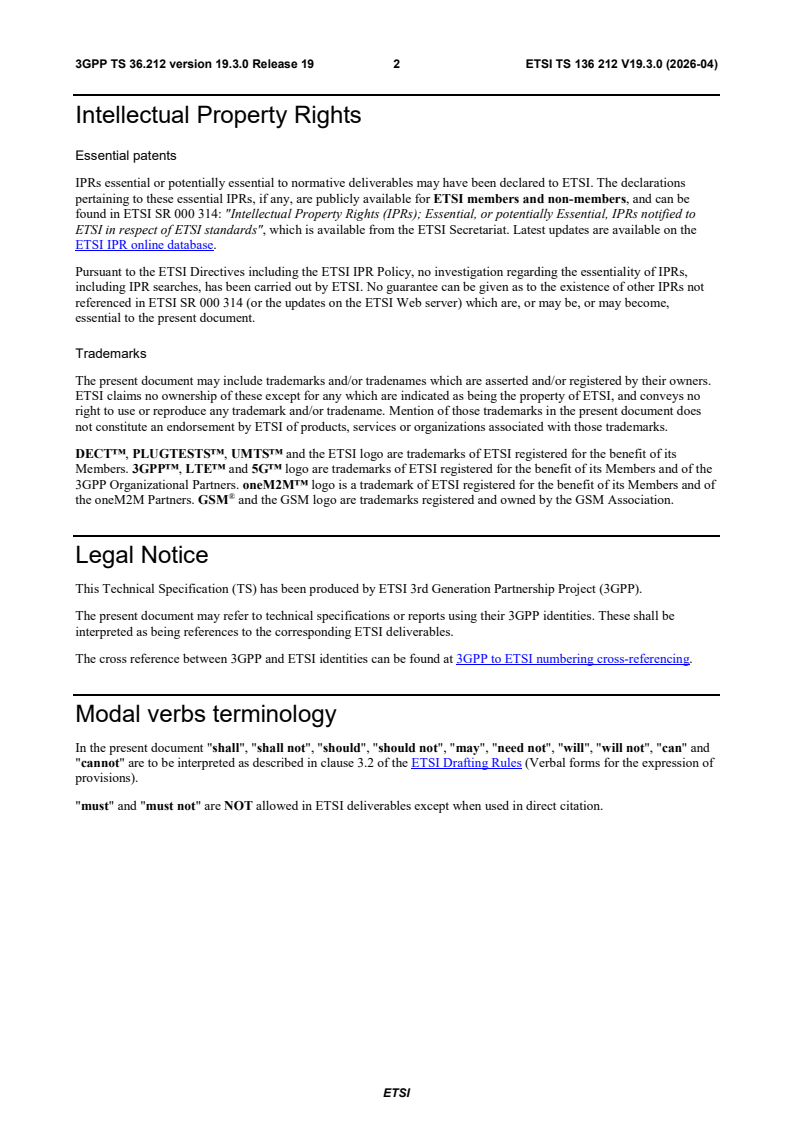
ETSI TS 136 212 V19.3.0 (2026-04)
LTE; Evolved Universal Terrestrial Radio Access (E-UTRA); Multiplexing and channel coding (3GPP TS 36.212 version 19.3.0 Release 19)
LTE; Evolved Universal Terrestrial Radio Access (E-UTRA); Multiplexing and channel coding (3GPP TS 36.212 version 19.3.0 Release 19)
RTS/TSGR-0136212vj30
General Information
- Status
- Not Published
- Technical Committee
- 3GPP RAN 1 - Radio layer 1 specification
- Current Stage
- 12 - Citation in the OJ (auto-insert)
- Completion Date
- 02-Apr-2026
Frequently Asked Questions
ETSI TS 136 212 V19.3.0 (2026-04) is a standard published by the European Telecommunications Standards Institute (ETSI). Its full title is "LTE; Evolved Universal Terrestrial Radio Access (E-UTRA); Multiplexing and channel coding (3GPP TS 36.212 version 19.3.0 Release 19)". This standard covers: RTS/TSGR-0136212vj30
RTS/TSGR-0136212vj30
ETSI TS 136 212 V19.3.0 (2026-04) is available in PDF format for immediate download after purchase. The document can be added to your cart and obtained through the secure checkout process. Digital delivery ensures instant access to the complete standard document.
Standards Content (Sample)
TECHNICAL SPECIFICATION
LTE;
Evolved Universal Terrestrial Radio Access (E-UTRA);
Multiplexing and channel coding
(3GPP TS 36.212 version 19.3.0 Release 19)
3GPP TS 36.212 version 19.3.0 Release 19 1 ETSI TS 136 212 V19.3.0 (2026-04)
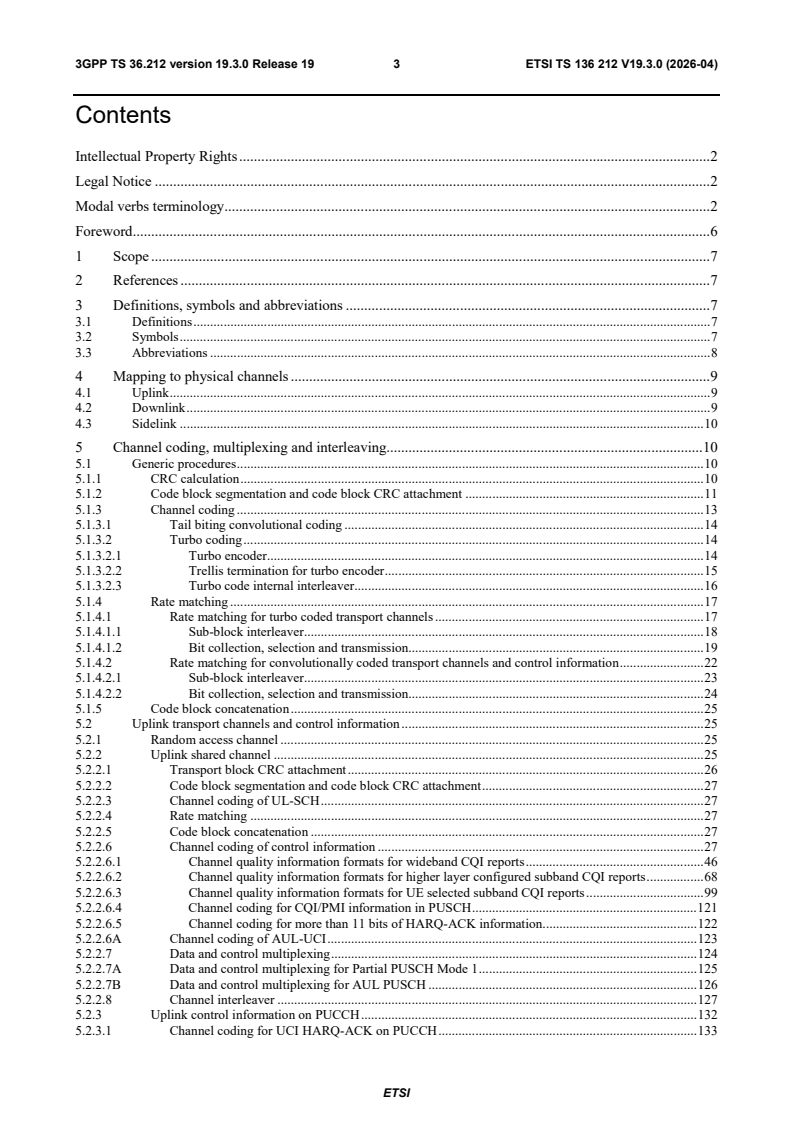
Reference
RTS/TSGR-0136212vj30
Keywords
LTE
ETSI
650 Route des Lucioles
F-06921 Sophia Antipolis Cedex - FRANCE
Tel.: +33 4 92 94 42 00 Fax: +33 4 93 65 47 16
Siret N° 348 623 562 00017 - APE 7112B
Association à but non lucratif enregistrée à la
Sous-Préfecture de Grasse (06) N° w061004871
Important notice
The present document can be downloaded from the
ETSI Search & Browse Standards application.
The present document may be made available in electronic versions and/or in print. The content of any electronic and/or
print versions of the present document shall not be modified without the prior written authorization of ETSI. In case of any
existing or perceived difference in contents between such versions and/or in print, the prevailing version of an ETSI
deliverable is the one made publicly available in PDF format on ETSI deliver repository.
Users should be aware that the present document may be revised or have its status changed,
this information is available in the Milestones listing.
If you find errors in the present document, please send your comments to
the relevant service listed under Committee Support Staff.
If you find a security vulnerability in the present document, please report it through our
Coordinated Vulnerability Disclosure (CVD) program.
Notice of disclaimer & limitation of liability
The information provided in the present deliverable is directed solely to professionals who have the appropriate degree of
experience to understand and interpret its content in accordance with generally accepted engineering or
other professional standard and applicable regulations.
No recommendation as to products and services or vendors is made or should be implied.
No representation or warranty is made that this deliverable is technically accurate or sufficient or conforms to any law
and/or governmental rule and/or regulation and further, no representation or warranty is made of merchantability or fitness
for any particular purpose or against infringement of intellectual property rights.
In no event shall ETSI be held liable for loss of profits or any other incidental or consequential damages.
Any software contained in this deliverable is provided "AS IS" with no warranties, express or implied, including but not
limited to, the warranties of merchantability, fitness for a particular purpose and non-infringement of intellectual property
rights and ETSI shall not be held liable in any event for any damages whatsoever (including, without limitation, damages
for loss of profits, business interruption, loss of information, or any other pecuniary loss) arising out of or related to the use
of or inability to use the software.
Copyright Notification
No part may be reproduced or utilized in any form or by any means, electronic or mechanical, including photocopying and
microfilm except as authorized by written permission of ETSI.
The content of the PDF version shall not be modified without the written authorization of ETSI.
The copyright and the foregoing restriction extend to reproduction in all media.
© ETSI 2026.
All rights reserved.
ETSI
3GPP TS 36.212 version 19.3.0 Release 19 2 ETSI TS 136 212 V19.3.0 (2026-04)
Intellectual Property Rights
Essential patents
IPRs essential or potentially essential to normative deliverables may have been declared to ETSI. The declarations
pertaining to these essential IPRs, if any, are publicly available for ETSI members and non-members, and can be
found in ETSI SR 000 314: "Intellectual Property Rights (IPRs); Essential, or potentially Essential, IPRs notified to
ETSI in respect of ETSI standards", which is available from the ETSI Secretariat. Latest updates are available on the
ETSI IPR online database.
Pursuant to the ETSI Directives including the ETSI IPR Policy, no investigation regarding the essentiality of IPRs,
including IPR searches, has been carried out by ETSI. No guarantee can be given as to the existence of other IPRs not
referenced in ETSI SR 000 314 (or the updates on the ETSI Web server) which are, or may be, or may become,
essential to the present document.
Trademarks
The present document may include trademarks and/or tradenames which are asserted and/or registered by their owners.
ETSI claims no ownership of these except for any which are indicated as being the property of ETSI, and conveys no
right to use or reproduce any trademark and/or tradename. Mention of those trademarks in the present document does
not constitute an endorsement by ETSI of products, services or organizations associated with those trademarks.
DECT™, PLUGTESTS™, UMTS™ and the ETSI logo are trademarks of ETSI registered for the benefit of its
Members. 3GPP™, LTE™ and 5G™ logo are trademarks of ETSI registered for the benefit of its Members and of the
3GPP Organizational Partners. oneM2M™ logo is a trademark of ETSI registered for the benefit of its Members and of ®
the oneM2M Partners. GSM and the GSM logo are trademarks registered and owned by the GSM Association.
Legal Notice
This Technical Specification (TS) has been produced by ETSI 3rd Generation Partnership Project (3GPP).
The present document may refer to technical specifications or reports using their 3GPP identities. These shall be
interpreted as being references to the corresponding ETSI deliverables.
The cross reference between 3GPP and ETSI identities can be found at 3GPP to ETSI numbering cross-referencing.
Modal verbs terminology
In the present document "shall", "shall not", "should", "should not", "may", "need not", "will", "will not", "can" and
"cannot" are to be interpreted as described in clause 3.2 of the ETSI Drafting Rules (Verbal forms for the expression of
provisions).
"must" and "must not" are NOT allowed in ETSI deliverables except when used in direct citation.
ETSI
3GPP TS 36.212 version 19.3.0 Release 19 3 ETSI TS 136 212 V19.3.0 (2026-04)
Contents
Intellectual Property Rights . 2
Legal Notice . 2
Modal verbs terminology . 2
Foreword . 6
1 Scope . 7
2 References . 7
3 Definitions, symbols and abbreviations . 7
3.1 Definitions . 7
3.2 Symbols . 7
3.3 Abbreviations . 8
4 Mapping to physical channels . 9
4.1 Uplink . 9
4.2 Downlink . 9
4.3 Sidelink . 10
5 Channel coding, multiplexing and interleaving. 10
5.1 Generic procedures . 10
5.1.1 CRC calculation . 10
5.1.2 Code block segmentation and code block CRC attachment . 11
5.1.3 Channel coding . 13
5.1.3.1 Tail biting convolutional coding . 14
5.1.3.2 Turbo coding . 14
5.1.3.2.1 Turbo encoder . 14
5.1.3.2.2 Trellis termination for turbo encoder . 15
5.1.3.2.3 Turbo code internal interleaver . 16
5.1.4 Rate matching . 17
5.1.4.1 Rate matching for turbo coded transport channels . 17
5.1.4.1.1 Sub-block interleaver . 18
5.1.4.1.2 Bit collection, selection and transmission. 19
5.1.4.2 Rate matching for convolutionally coded transport channels and control information . 22
5.1.4.2.1 Sub-block interleaver . 23
5.1.4.2.2 Bit collection, selection and transmission. 24
5.1.5 Code block concatenation . 25
5.2 Uplink transport channels and control information . 25
5.2.1 Random access channel . 25
5.2.2 Uplink shared channel . 25
5.2.2.1 Transport block CRC attachment . 26
5.2.2.2 Code block segmentation and code block CRC attachment . 27
5.2.2.3 Channel coding of UL-SCH . 27
5.2.2.4 Rate matching . 27
5.2.2.5 Code block concatenation . 27
5.2.2.6 Channel coding of control information . 27
5.2.2.6.1 Channel quality information formats for wideband CQI reports . 46
5.2.2.6.2 Channel quality information formats for higher layer configured subband CQI reports . 68
5.2.2.6.3 Channel quality information formats for UE selected subband CQI reports . 99
5.2.2.6.4 Channel coding for CQI/PMI information in PUSCH . 121
5.2.2.6.5 Channel coding for more than 11 bits of HARQ-ACK information . 122
5.2.2.6A Channel coding of AUL-UCI . 123
5.2.2.7 Data and control multiplexing . 124
5.2.2.7A Data and control multiplexing for Partial PUSCH Mode 1 . 125
5.2.2.7B Data and control multiplexing for AUL PUSCH . 126
5.2.2.8 Channel interleaver . 127
5.2.3 Uplink control information on PUCCH . 132
5.2.3.1 Channel coding for UCI HARQ-ACK on PUCCH . 133
ETSI
3GPP TS 36.212 version 19.3.0 Release 19 4 ETSI TS 136 212 V19.3.0 (2026-04)
5.2.3.1A Channel coding for UCI HARQ-ACK on SPUCCH . 139
5.2.3.2 Channel coding for UCI scheduling request . 142
5.2.3.3 Channel coding for UCI channel quality information . 142
5.2.3.3.1 Channel quality information formats for wideband reports . 143
5.2.3.3.2 Channel quality information formats for UE-selected sub-band reports . 157
5.2.3.4 Channel coding for UCI channel quality information and HARQ-ACK . 171
5.2.4 Uplink control information on PUSCH without UL-SCH data . 172
5.2.4.1 Channel coding of control information . 172
5.2.4.2 Control information mapping . 174
5.2.4.3 Channel interleaver . 174
5.3 Downlink transport channels and control information . 174
5.3.1 Broadcast channel . 174
5.3.1.1 Transport block CRC attachment . 175
5.3.1.2 Channel coding . 175
5.3.1.3 Rate matching . 176
5.3.2 Downlink shared channel, Paging channel and Multicast channel . 176
5.3.2.1 Transport block CRC attachment . 177
5.3.2.2 Code block segmentation and code block CRC attachment . 177
5.3.2.3 Channel coding . 177
5.3.2.4 Rate matching . 177
5.3.2.5 Code block concatenation . 177
5.3.3 Downlink control information . 178
5.3.3.1 DCI formats. 178
5.3.3.1.1 Format 0 . 178
5.3.3.1.1A Format 0A . 180
5.3.3.1.1B Format 0B . 182
5.3.3.1.1C Format 0C . 184
5.3.3.1.2 Format 1 . 185
5.3.3.1.3 Format 1A . 187
5.3.3.1.3A Format 1B . 190
5.3.3.1.4 Format 1C . 191
5.3.3.1.4A Format 1D . 192
5.3.3.1.5 Format 2 . 194
5.3.3.1.5A Format 2A . 198
5.3.3.1.5B Format 2B . 200
5.3.3.1.5C Format 2C . 202
5.3.3.1.5D Format 2D . 205
5.3.3.1.6 Format 3 . 207
5.3.3.1.7 Format 3A . 208
5.3.3.1.7A Format 3B . 208
5.3.3.1.8 Format 4 . 209
5.3.3.1.8A Format 4A . 211
5.3.3.1.8B Format 4B . 213
5.3.3.1.9 Format 5 . 215
5.3.3.1.9A Format 5A . 215
5.3.3.1.10 Format 6-0A . 216
5.3.3.1.11 Format 6-0B . 219
5.3.3.1.12 Format 6-1A . 221
5.3.3.1.13 Format 6-1B . 227
5.3.3.1.14 Format 6-2 . 230
5.3.3.1.15 Format 7-0A . 230
5.3.3.1.16 Format 7-0B . 231
5.3.3.1.17 Format 7-1A . 233
5.3.3.1.18 Format 7-1B . 234
5.3.3.1.19 Format 7-1C . 235
5.3.3.1.20 Format 7-1D . 237
5.3.3.1.21 Format 7-1E . 239
5.3.3.1.22 Format 7-1F . 239
5.3.3.1.23 Format 7-1G . 241
5.3.3.2 CRC attachment . 241
5.3.3.3 Channel coding . 242
5.3.3.4 Rate matching . 242
ETSI
3GPP TS 36.212 version 19.3.0 Release 19 5 ETSI TS 136 212 V19.3.0 (2026-04)
5.3.4 Control format indicator . 242
5.3.4.1 Channel coding . 242
5.3.5 HARQ indicator (HI) . 243
5.3.5.1 Channel coding . 243
5.4 Sidelink transport channels and control information . 243
5.4.1 Sidelink broadcast channel . 243
5.4.1.1 Transport block CRC attachment . 244
5.4.1.2 Channel coding . 244
5.4.1.3 Rate matching . 244
5.4.2 Sidelink shared channel . 245
5.4.3 Sidelink control information . 245
5.4.3.1 SCI formats . 245
5.4.3.1.1 SCI format 0 . 245
5.4.3.1.2 SCI format 1 . 246
5.4.4 Sidelink discovery channel . 246
6 Narrowband IoT . 246
6.1 Mapping to physical channels . 246
6.2 Generic procedures . 247
6.3 Uplink transport channels and control information . 247
6.3.1 Random access channel . 247
6.3.2 Uplink shared channel . 248
6.3.3 Uplink control information on NPUSCH without UL-SCH data. 248
6.3.4 Scheduling request . 249
6.4 Downlink transport channels and control information . 249
6.4.1 Broadcast channel . 249
6.4.2 Downlink shared channel and Paging channel. 249
6.4.3 Downlink control information . 250
6.4.3.1 DCI Format N0 . 250
6.4.3.2 DCI Format N1 . 251
6.4.3.3 DCI Format N2 . 253
Annex A (informative): Change history . 254
History . 262
ETSI
3GPP TS 36.212 version 19.3.0 Release 19 6 ETSI TS 136 212 V19.3.0 (2026-04)
Foreword
rd
This Technical Specification has been produced by the 3 Generation Partnership Project (3GPP).
The contents of the present document are subject to continuing work within the TSG and may change following formal
TSG approval. Should the TSG modify the contents of the present document, it will be re-released by the TSG with an
identifying change of release date and an increase in version number as follows:
Version x.y.z
where:
x the first digit:
1 presented to TSG for information;
2 presented to TSG for approval;
3 or greater indicates TSG approved document under change control.
Y the second digit is incremented for all changes of substance, i.e. technical enhancements, corrections,
updates, etc.
z the third digit is incremented when editorial only changes have been incorporated in the document.
ETSI
3GPP TS 36.212 version 19.3.0 Release 19 7 ETSI TS 136 212 V19.3.0 (2026-04)
1 Scope
The present document specifies the coding, multiplexing and mapping to physical channels for E-UTRA.
2 References
The following documents contain provisions which, through reference in this text, constitute provisions of the present
document.
- References are either specific (identified by date of publication, edition number, version number, etc.) or
non-specific.
- For a specific reference, subsequent revisions do not apply.
- For a non-specific reference, the latest version applies. In the case of a reference to a 3GPP document (including
a GSM document), a non-specific reference implicitly refers to the latest version of that document in the same
Release as the present document.
[1] 3GPP TR 21.905: "Vocabulary for 3GPP Specifications".
[2] 3GPP TS 36.211: "Evolved Universal Terrestrial Radio Access (E-UTRA); Physical channels and
modulation".
[3] 3GPP TS 36.213: "Evolved Universal Terrestrial Radio Access (E-UTRA); Physical layer
procedures".
[4] 3GPP TS 36.306: "Evolved Universal Terrestrial Radio Access (E-UTRA); User Equipment (UE)
radio access capabilities".
[5] 3GPP TS36.321, "Evolved Universal Terrestrial Radio Access (E-UTRA); Medium Access
Control (MAC) protocol specification"
[6] 3GPP TS36.331, "Evolved Universal Terrestrial Radio Access (E-UTRA); Radio Resource
Control (RRC) protocol specification"
[7] 3GPP TS23.285, "Technical Specification Group Services and System Aspects; Architecture
enhancements for V2X services"
[8] 3GPP TS 37.213: "Physical layer procedures for shared spectrum channel access".
3 Definitions, symbols and abbreviations
3.1 Definitions
For the purposes of the present document, the terms and definitions given in [1] and the following apply. A term
defined in the present document takes precedence over the definition of the same term, if any, in [1].
BL/CE: A Bandwidth-reduced Low-complexity or Coverage Enhanced (BL/CE) UE is capable of coverage
enhancement mode A support and intends to access a cell in a coverage enhancement mode or is configured in a
coverage enhancement mode.
Non-BL/CE: A non-BL/CE UE is a UE that does not fulfil the conditions in the above definition of a BL/CE UE.
3.2 Symbols
For the purposes of the present document, the following symbols apply:
ETSI
3GPP TS 36.212 version 19.3.0 Release 19 8 ETSI TS 136 212 V19.3.0 (2026-04)
DL
N Downlink bandwidth configuration, expressed in number of resource blocks [2]
RB
UL
N Uplink bandwidth configuration, expressed in number of resource blocks [2]
RB
SL
N Sidelink bandwidth configuration, expressed in number of resource blocks [2]
RB
SL
N Number of sidelink subchannels configured on the resource pool of a subcarrier [2]
subchannel
RB
N Resource block size in the frequency domain, expressed as a number of subcarriers
sc
PUSCH
N
Number of SC-FDMA symbols carrying PUSCH in a subframe
symb
PUSCH -initial
N Number of SC-FDMA symbols carrying PUSCH in the initial PUSCH transmission subframe
symb
UL
N Number of SC-FDMA symbols in an uplink slot
symb
SL
N
Number of SC-FDMA symbols in a sidelink slot
symb
N Number of SC-FDMA symbols used for SRS transmission in a subframe (0 or 1).
SRS
3.3 Abbreviations
For the purposes of the present document, the following abbreviations apply:
AUL Autonomous Uplink
AUL-DFI AUL downlink feedback information
AUL-UCI AUL uplink control information
BCH Broadcast channel
CFI Control Format Indicator
COT Channel Occupancy Time
CP Cyclic Prefix
CSI Channel State Information
DCI Downlink Control Information
DL-SCH Downlink Shared channel
EN-DC E-UTRA NR Dual Connectivity with MCG using E-UTRA and SCG using NR
EPDCCH Enhanced Physical Downlink Control channel
FDD Frequency Division Duplexing
HI HARQ indicator
LAA Licensed-Assisted Access
MCH Multicast channel
MPDCCH MTC Physical Downlink Control Channel
MUST Multiuser Superposition Transmission
NE-DC NR E-UTRA Dual Connectivity with MCG using NR and SCG using E-UTRA
NPBCH Narrowband Physical Broadcast channel
NPDCCH Narrowband Physical Downlink Control channel
NPDSCH Narrowband Physical Downlink Shared channel
NPRACH Narrowband Physical Random Access channel
NPUSCH Narrowband Physical Uplink Shared channel
OCC Orthogonal Cover Code
PBCH Physical Broadcast channel
PCFICH Physical Control Format Indicator channel
PCH Paging channel
PDCCH Physical Downlink Control channel
PDSCH Physical Downlink Shared channel
PHICH Physical HARQ indicator channel
PMCH Physical Multicast channel
PMI Precoding Matrix Indicator
PRACH Physical Random Access channel
PSBCH Physical Sidelink Broadcast Channel
PSCCH Physical Sidelink Control Channel
PSDCH Physical Sidelink Discovery Channel
PSSCH Physical Sidelink Shared Channel
PUCCH Physical Uplink Control channel
PUSCH Physical Uplink Shared channel
ETSI
3GPP TS 36.212 version 19.3.0 Release 19 9 ETSI TS 136 212 V19.3.0 (2026-04)
RACH Random Access channel
RI Rank Indication
SCI Sidelink Control Information
SL-BCH Sidelink Broadcast Channel
SL-DCH Sidelink Discovery Channel
SL-SCH Sidelink Shared Channel
SPDCCH Short Physical Downlink Control channel
SPUCCH Short Physical Uplink Control channel
SR Scheduling Request
SRS Sounding Reference Signal
TDD Time Division Duplexing
TPMI Transmitted Precoding Matrix Indicator
UCI Uplink Control Information
UL-SCH Uplink Shared channel
4 Mapping to physical channels
The mapping to physical channels for Narrowband IoT is provided in clause 6.1.
4.1 Uplink
Table 4.1-1 specifies the mapping of the uplink transport channels to their corresponding physical channels. Table 4.1-2
specifies the mapping of the uplink control channel information to its corresponding physical channel.
Table 4.1-1
TrCH Physical Channel
UL-SCH PUSCH
RACH PRACH
Table 4.1-2
Control information Physical Channel
UCI PUCCH, PUSCH, SPUCCH
4.2 Downlink
Table 4.2-1 specifies the mapping of the downlink transport channels to their corresponding physical channels. Table
4.2-2 specifies the mapping of the downlink control channel information to its corresponding physical channel.
ETSI
3GPP TS 36.212 version 19.3.0 Release 19 10 ETSI TS 136 212 V19.3.0 (2026-04)
Table 4.2-1
TrCH Physical Channel
DL-SCH PDSCH
BCH PBCH
PCH PDSCH
MCH PMCH
Table 4.2-2
Control information Physical Channel
CFI PCFICH
HI PHICH
DCI PDCCH, EPDCCH, MPDCCH,
SPDCCH
4.3 Sidelink
Table 4.3-1 specifies the mapping of the sidelink transport channels to their corresponding physical channels. Table 4.3-
2 specifies the mapping of the sidelink control information to its corresponding physical channel.
Table 4.3-1
TrCH Physical Channel
SL-SCH PSSCH
SL-BCH PSBCH
SL-DCH PSDCH
Table 4.3-2
Control information Physical Channel
SCI PSCCH
5 Channel coding, multiplexing and interleaving
Data and control streams from/to MAC layer are encoded /decoded to offer transport and control services over the radio
transmission link. Channel coding scheme is a combination of error detection, error correcting, rate matching,
interleaving and transport channel or control information mapping onto/splitting from physical channels.
5.1 Generic procedures
This clause contains coding procedures which are used for more than one transport channel or control information type.
5.1.1 CRC calculation
Denote the input bits to the CRC computation by a , a , a , a ,., a , and the parity bits by p , p , p , p ,., p . A
0 1 2 3 A−1 0 1 2 3 L−1
is the size of the input sequence and L is the number of parity bits. The parity bits are generated by one of the following
cyclic generator polynomials:
24 23 18 17 14 11 10 7 6 5 4 3
- g (D) = [D + D + D + D + D + D + D + D + D + D + D + D + D + 1] and;
CRC24A
24 23 6 5
- g (D) = [D + D + D + D + D + 1] for a CRC length L = 24 and;
CRC24B
16 12 5
- g (D) = [D + D + D + 1] for a CRC length L = 16.
CRC16
ETSI
3GPP TS 36.212 version 19.3.0 Release 19 11 ETSI TS 136 212 V19.3.0 (2026-04)
8 7 4 3
- g (D) = [D + D + D + D + D + 1] for a CRC length of L = 8.
CRC8
The encoding is performed in a systematic form, which means that in GF(2), the polynomial:
A+23 A+22 24 23 22 1
a D + a D + . + a D + p D + p D + . + p D + p
0 1 A−1 0 1 22 23
yields a remainder equal to 0 when divided by the corresponding length-24 CRC generator polynomial, g (D) or
CRC24A
g (D), the polynomial:
CRC24B
A+15 A+14 16 15 14 1
a D + a D + . + a D + p D + p D + . + p D + p
0 1 A−1 0 1 14 15
yields a remainder equal to 0 when divided by g (D), and the polynomial:
CRC16
A+7 A+6 8 7 6 1
a D + a D + .+ a D + p D + p D +.+ p D + p
0 1 A−1 0 1 6 7
yields a remainder equal to 0 when divided by g (D).
CRC8
The bits after CRC attachment are denoted by b , b , b , b ,., b , where B = A+ L. The relation between a and b is:
k k
0 1 2 3 B−1
b = a for k = 0, 1, 2, …, A-1
k k
b = p for k = A, A+1, A+2, ., A+L-1.
k k − A
5.1.2 Code block segmentation and code block CRC attachment
The input bit sequence to the code block segmentation is denoted by b , b , b , b ,., b , where B > 0. If B is larger
0 1 2 3 B−1
than the maximum code block size Z, segmentation of the input bit sequence is performed and an additional CRC
sequence of L = 24 bits is attached to each code block. The maximum code block size is:
- Z = 6144.
If the number of filler bits F calculated below is not 0, filler bits are added to the beginning of the first block.
Note that if B < 40, filler bits are added to the beginning of the code block.
The filler bits shall be set to at the input to the encoder.
Total number of code blocks C is determined by:
if B ≤ Z
L = 0
Number of code blocks: C =1
′
B = B
else
L = 24
Number of code blocks: C = B /()Z − L .
′
B = B + C ⋅ L
end if
The bits output from code block segmentation, for C ≠ 0, are denoted by , where r is the
c , c , c , c ,., c
r0 r1 r 2 r3 r()K −1
r
code block number, and K is the number of bits for the code block number r.
r
Number of bits in each code block (applicable for C ≠ 0 only):
ETSI
3GPP TS 36.212 version 19.3.0 Release 19 12 ETSI TS 136 212 V19.3.0 (2026-04)
′
First segmentation size: K = minimum K in table 5.1.3-3 such that C ⋅ K ≥ B
+
if C =1
the number of code blocks with length K is C =1, K = 0 , C = 0
+ + − −
C >1
else if
Second segmentation size: K = maximum K in table 5.1.3-3 such that K < K
− +
Δ = K − K
K + −
′
C ⋅ K − B
+
Number of segments of size K : C = .
− −
Δ
K
Number of segments of size K : C = C − C .
+ + −
end if
Number of filler bits: F = C ⋅ K + C ⋅ K − B′
+ + − −
for k = 0 to F-1 -- Insertion of filler bits
c =< NULL >
0k
end for
k = F
s = 0
for r = 0 to C-1
if r < C
−
K = K
r −
else
K = K
r +
end if
while k < K − L
r
c = b
rk s
k = k +1
s = s +1
end while
if C >1
The sequence is used to calculate the CRC parity bits
c ,c ,c ,c ,.,c p , p , p ,., p
r0 r1 r2 r3 r()K −L−1 r0 r1 r2 r()L−1
r
according to clause 5.1.1 with the generator polynomial g (D). For CRC calculation it is assumed
CRC24B
that filler bits, if present, have the value 0.
while k < K
r
c = p
rk r(k+L−K )
r
ETSI
3GPP TS 36.212 version 19.3.0 Release 19 13 ETSI TS 136 212 V19.3.0 (2026-04)
k = k +1
end while
end if
k = 0
end for
5.1.3 Channel coding
The bit sequence input for a given code block to channel coding is denoted by c , c , c , c ,., c , where K is the
0 1 2 3 K −1
(i) (i) (i) (i) (i)
number of bits to encode. After encoding the bits are denoted by d , d , d , d ,.,d , where D is the number of
0 1 2 3 D−1
(i)
encoded bits per output stream and i indexes the encoder output stream. The relation between c and d and between
k
k
K and D is dependent on the channel coding scheme.
The following channel coding schemes can be applied to TrCHs:
- tail biting convolutional coding;
- turbo coding.
Usage of coding scheme and coding rate for the different types of TrCH is shown in table 5.1.3-1. Usage of coding
scheme and coding rate for the different control information types is shown in table 5.1.3-2.
The values of D in connection with each coding scheme:
- tail biting convolutional coding with rate 1/3: D = K;
- turbo coding with rate 1/3: D = K + 4.
The range for the output stream index i is 0, 1 and 2 for both coding schemes.
Table 5.1.3-1: Usage of channel coding scheme and coding rate for TrCHs
TrCH Coding scheme Coding rate
UL-SCH
DL-SCH
PCH
Turbo coding 1/3
MCH
SL-SCH
SL-DCH
BCH Tail biting
convolutional 1/3
SL-BCH
coding
Table 5.1.3-2: Usage of channel coding scheme and coding rate for control information
Control Information Coding scheme Coding rate
Tail biting
DCI convolutional 1/3
coding
CFI Block code 1/16
HI Repetition code 1/3
Block code variable
Tail biting
UCI
convolutional 1/3
coding
SCI Tail biting
convolutional 1/3
coding
ETSI
3GPP TS 36.212 version 19.3.0 Release 19 14 ETSI TS 136 212 V19.3.0 (2026-04)
5.1.3.1 Tail biting convolutional coding
A tail biting convolutional code with constraint length 7 and coding rate 1/3 is defined.
The configuration of the convolutional encoder is presented in figure 5.1.3-1.
The initial value of the shift register of the encoder shall be set to the values corresponding to the last 6 information bits
in the input stream so that the initial and final states of the shift register are the same. Therefore, denoting the shift
register of the encoder by s , s , s ,., s , then the initial value of the shift register shall be set to
0 1 2 5
s = c
i ()K −1−i
c
k
(0)
d
k
(1)
d
k
(2)
d
k
Figure 5.1.3-1: Rate 1/3 tail biting convolutional encoder
(0) (1) (2)
The encoder output streams d , d and d correspond to the first, second and third parity streams, respectively as
k k k
shown in Figure 5.1.3-1.
5.1.3.2 Turbo coding
5.1.3.2.1 Turbo encoder
The scheme of turbo encoder is a Parallel Concatenated Convolutional Code (PCCC) with two 8-state constituent
encoders and one turbo code internal interleaver. The coding rate of turbo encoder is 1/3. The structure of turbo encoder
is illustrated in figu
...
Questions, Comments and Discussion
Ask us and Technical Secretary will try to provide an answer. You can facilitate discussion about the standard in here.
Loading comments...