


ETSI EN 319 403 V2.2.2 (2015-08)
Electronic Signatures and Infrastructures (ESI); Trust Service Provider Conformity Assessment - Requirements for conformity assessment bodies assessing Trust Service Providers
Electronic Signatures and Infrastructures (ESI); Trust Service Provider Conformity Assessment - Requirements for conformity assessment bodies assessing Trust Service Providers
REN/ESI-0019403
Elektronski podpisi in infrastruktura (ESI) - Ocenjevanje skladnosti ponudnikov storitev zaupanja - Zahteve za ocenjevanje skladnosti organov, ki ocenjujejo ponudnike storitev zaupanja
Ta dokument vključuje zahteve za konkurenčnost, dosledno delovanje in nepristranskost organov, ki ocenjujejo in potrjujejo skladnost ponudnikov skrbniških storitev (TSP) in ponujenih skrbniških storitev glede na določene kriterije, s katerimi naj bile skladne.
OPOMBA: Te zahteve so neodvisne od vrste in razreda ponujene skrbniške storitve.
V tem dokumentu so posebne zahteve pri ugotavljanju skladnosti ponudnikov skrbniških storitev dopolnjene s splošnimi zahtevami standarda ISO/IEC 17065 [1].
General Information




Standards Content (Sample)
Draft ETSI EN 319 403 V2.1.1 (2014-12)
EUROPEAN STANDARD
Electronic Signatures and Infrastructures (ESI);
Trust Service Provider Conformity Assessment -
Requirements for conformity assessment bodies assessing
Trust Service Providers
2 Draft ETSI EN 319 403 V2.1.1 (2014-12)
Reference
REN/ESI-0019403
Keywords
conformity, e-commerce, electronic signature,
security, trust services
ETSI
650 Route des Lucioles
F-06921 Sophia Antipolis Cedex - FRANCE
Tel.: +33 4 92 94 42 00 Fax: +33 4 93 65 47 16
Siret N° 348 623 562 00017 - NAF 742 C
Association à but non lucratif enregistrée à la
Sous-Préfecture de Grasse (06) N° 7803/88
Important notice
The present document can be downloaded from:
http://www.etsi.org
The present document may be made available in electronic versions and/or in print. The content of any electronic and/or
print versions of the present document shall not be modified without the prior written authorization of ETSI. In case of any
existing or perceived difference in contents between such versions and/or in print, the only prevailing document is the
print of the Portable Document Format (PDF) version kept on a specific network drive within ETSI Secretariat.
Users of the present document should be aware that the document may be subject to revision or change of status.
Information on the current status of this and other ETSI documents is available at
http://portal.etsi.org/tb/status/status.asp
If you find errors in the present document, please send your comment to one of the following services:
http://portal.etsi.org/chaircor/ETSI_support.asp
Copyright Notification
No part may be reproduced or utilized in any form or by any means, electronic or mechanical, including photocopying
and microfilm except as authorized by written permission of ETSI.
The content of the PDF version shall not be modified without the written authorization of ETSI.
The copyright and the foregoing restriction extend to reproduction in all media.
© European Telecommunications Standards Institute 2014.
All rights reserved.
TM TM TM
DECT , PLUGTESTS , UMTS and the ETSI logo are Trade Marks of ETSI registered for the benefit of its Members.
TM
3GPP and LTE™ are Trade Marks of ETSI registered for the benefit of its Members and
of the 3GPP Organizational Partners.
GSM® and the GSM logo are Trade Marks registered and owned by the GSM Association.
ETSI
3 Draft ETSI EN 319 403 V2.1.1 (2014-12)
Contents
Intellectual Property Rights . 5
Foreword . 5
Modal verbs terminology . 5
Introduction . 5
1 Scope . 7
2 References . 7
2.1 Normative references . 7
2.2 Informative references . 7
3 Definitions and abbreviations . 8
3.1 Definitions . 8
3.2 Abbreviations . 8
4 General requirements . 9
4.1 Legal and contractual matters . 9
4.1.1 Legal responsibility. 9
4.1.2 Certification agreement . 9
4.1.3 Use of license, certificates and marks of conformity . 9
4.2 Management of impartiality . 9
4.2.1 Activities not conflicting with impartiality . 9
4.3 Liability and financing . 9
4.4 Non-discriminatory conditions . 9
5 Structural requirements . 10
5.1 Organizational structure and top management . 10
5.2 Mechanism for safeguarding impartiality . 10
6 Resource requirements . 10
6.1 Conformity Assessment Body personnel . 10
6.1.1 General . 10
6.1.2 Management of competence for personnel involved in the audit process. 10
6.1.2.1 General considerations . 10
6.1.2.2 Training of audit teams . 10
6.2 Resources for evaluation . 11
6.2.1 Internal resources . 11
6.2.1.1 Competence of Conformity Assessment Body personnel . 11
6.2.1.2 Competences for all functions . 11
6.2.1.3 Competences for application review . 11
6.2.1.4 Competences for auditing . 11
6.2.1.5 Competences for review . 12
6.2.1.6 Competences for certification decision . 12
6.2.1.7 Competences for Technical Experts . 12
6.2.1.8 Audit team . 13
6.2.1.9 Audit team leader . 13
7 Process requirements . 13
7.1 General . 13
7.1.1 Criteria and audit methodology . 13
7.1.1.1 TSP audit criteria . 13
7.1.1.2 Audit Team Mandate. 14
7.1.1.3 Audit Methodology . 14
7.1.1.4 Audit Frequency . 14
7.2 Application . 15
7.3 Application Review . 15
7.3.1 Contract review . 15
7.4 Audit . 15
ETSI
4 Draft ETSI EN 319 403 V2.1.1 (2014-12)
7.4.1 Audit Scope . 15
7.4.2 Audit time . 15
7.4.2.1 Policies and procedures . 16
7.4.3 Multiple sites . 16
7.4.3.1 When to Consider Sample Based Approach . 16
7.4.3.2 Requirements of Sample Based Approach . 16
7.4.4 Audit Report . 17
7.4.4.1 Report contents . 17
7.4.4.2 Report contents details to be provided . 17
7.4.5 Audit process . 18
7.4.5.1 General preparations for the initial audit . 18
7.4.5.2 Audit Process . 18
7.4.5.3 Stage 1 audit . 18
7.4.5.3.1 Stage 1 audit . 19
7.4.5.4 Stage 2 audit . 19
7.5 Review . 20
7.6 Certification decision . 20
7.7 Certification documentation . 20
7.8 Directory of certified products . 20
7.9 Surveillance . 20
7.9.1 Programme of periodic surveillance . 20
7.10 Changes affecting certification . 21
7.11 Termination, reduction, suspension or withdrawal of certification . 21
7.12 Records . 22
7.13 Complaints and appeals . 22
8 Management system requirements . 22
8.1 Options . 22
8.2 General management system documentation . 22
8.3 Control of documents . 22
8.4 Control of records . 22
8.5 Management review . 22
8.6 Internal audits . 22
8.7 Corrective actions . 22
8.8 Preventive actions. 22
Annex A (informative): Auditors' code of conduct . 23
Annex B (informative): Bibliography . 24
History . 25
ETSI
5 Draft ETSI EN 319 403 V2.1.1 (2014-12)
Intellectual Property Rights
IPRs essential or potentially essential to the present document may have been declared to ETSI. The information
pertaining to these essential IPRs, if any, is publicly available for ETSI members and non-members, and can be found
in ETSI SR 000 314: "Intellectual Property Rights (IPRs); Essential, or potentially Essential, IPRs notified to ETSI in
respect of ETSI standards", which is available from the ETSI Secretariat. Latest updates are available on the ETSI Web
server (http://ipr.etsi.org).
Pursuant to the ETSI IPR Policy, no investigation, including IPR searches, has been carried out by ETSI. No guarantee
can be given as to the existence of other IPRs not referenced in ETSI SR 000 314 (or the updates on the ETSI Web
server) which are, or may be, or may become, essential to the present document.
Foreword
This draft European Standard (EN) has been produced by ETSI Technical Committee Electronic Signatures and
Infrastructures (ESI), and is now submitted for the combined Public Enquiry and Vote phase of the ETSI standards EN
Approval Procedure.
The technical content of the present document is the same as in TS 119 403 V2.1.1.
Proposed national transposition dates
Date of latest announcement of this EN (doa): 3 months after ETSI publication
Date of latest publication of new National Standard
or endorsement of this EN (dop/e): 6 months after doa
Date of withdrawal of any conflicting National Standard (dow): 1 July 2017
Modal verbs terminology
In the present document "shall", "shall not", "should", "should not", "may", "may not", "need", "need not", "will",
"will not", "can" and "cannot" are to be interpreted as described in clause 3.2 of the ETSI Drafting Rules (Verbal forms
for the expression of provisions).
"must" and "must not" are NOT allowed in ETSI deliverables except when used in direct citation.
Introduction
ISO/IEC 17065 [1] is an international standard which specifies general requirements for conformity assessment bodies
(CABs) performing certification of products, processes, or services. These requirements are not focussed on any
specific application domain where CABs work.
In the present document the general requirements are supplemented to provide additional dedicated requirements for
CABs performing certification of Trust Service Providers (TSPs) and the trust services they provide towards defined
criteria against which they claim conformance.
The present document is aiming to meet the general requirements of the international community to provide trust and
confidence in electronic transactions including, amongst others, applicable requirements from Regulation (EU)
No 910/2014 [i.1], and from CA Browser Forum [i.10].
ETSI
6 Draft ETSI EN 319 403 V2.1.1 (2014-12)
EXAMPLE: The present document's aims include support of national accreditation bodies as specified in
Regulation (EC) No. 765/2008 [i.4] in applying ISO/IEC 17065 [1] for the accreditation of CABs
that certify TSPs and the trust services they provide so that this is carried out in a consistent
manner. In accordance with [i.4], attestations issued by conformity assessment bodies accredited
by a national accreditation body can be formally recognised across Europe.
The present document does not repeat requirements from ISO/IEC 17065 [1] but follows its document structure. Where
needed, additional requirements are specified. This is mainly the case for requirements on resources (clause 6) and on
the assessment process (clause 7). For all other chapters of ISO/IEC 17065 [1] few or no additional requirements are
needed.
ETSI
7 Draft ETSI EN 319 403 V2.1.1 (2014-12)
1 Scope
The present document contains requirements for the competence, consistent operation and impartiality of conformity
assessment bodies assessing and certifying conformity of trust service providers (TSPs) and the trust services they
provide towards defined criteria against which they claim conformance.
NOTE: Those requirements are independent of the type and class of trust service provided.
The present document applies the general requirements of ISO/IEC 17065 [1] to the specific requirements of
conformity assessment of TSPs.
2 References
References are either specific (identified by date of publication and/or edition number or version number) or
non-specific. For specific references, only the cited version applies. For non-specific references, the latest version of the
reference document (including any amendments) applies.
Referenced documents which are not found to be publicly available in the expected location might be found at
http://docbox.etsi.org/Reference.
NOTE: While any hyperlinks included in this clause were valid at the time of publication, ETSI cannot guarantee
their long term validity.
2.1 Normative references
The following referenced documents are necessary for the application of the present document.
[1] ISO/IEC 17065:2012: "Conformity assessment - Requirements for bodies certifying products,
processes and services".
2.2 Informative references
The following referenced documents are not necessary for the application of the present document but they assist the
user with regard to a particular subject area.
[i.1] Regulation 910/2014 of the European Parliament and of the Council of 23 July 2014 on electronic
identification and trust services for electronic transactions in the internal market and repealing
Directive 1999/93/EC.
[i.2] ETSI EN 319 411-1: "Electronic Signatures and Infrastructures (ESI); Policy and security
requirements for Trust Service Providers issuing certificates; Part 1: General Requirements for
Trust Service Providers issuing certificates".
[i.3] ETSI EN 319 411-2: "Electronic Signatures and Infrastructures (ESI); Policy and security
requirements for Trust Service Providers issuing certificates; Part 2: Requirements for Trust
Service Providers issuing qualified certificates".
[i.4] EC Regulation No 765/2008 of the European Parliament and of the Council of 9 July 2008 setting
out the requirements for accreditation and market surveillance relating to the marketing of
products and repealing Regulation (EEC) No 339/93.
[i.5] ISO/IEC 17000:2004: "Conformity assessment - Vocabulary and general principles".
[i.6] ETSI EN 319 401: "Electronic Signatures and Infrastructures (ESI); General Policy Requirements
for Trust Service Providers supporting Electronic Signatures".
[i.7] ISO/IEC 15408: "Information technology -- Security techniques -- Evaluation criteria for IT
security".
ETSI
8 Draft ETSI EN 319 403 V2.1.1 (2014-12)
[i.8] ISO/IEC 27001: "Information technology -- Security techniques -- Information security
management systems -- Requirements".
[i.9] ETSI EN 319 421: "Electronic Signatures and Infrastructures (ESI); Policy and Security
Requirements for Trust Service Providers providing Time-Stamping Services".
[i.10] CA/Browser Forum Baseline Requirements for the Issuance and Management of Publicly-Trusted
Certificates.
3 Definitions and abbreviations
3.1 Definitions
For the purposes of the present document, the terms and definitions given in ISO/IEC 17065 [1] and the following
apply:
auditor: person who assesses conformity to requirements as specified in a given requirements document
competence: ability to apply knowledge and skills to achieve intended results
conformity assessment: process demonstrating whether specified requirements relating to a product, process, service,
system, person or body have been fulfilled
NOTE: From Regulation (EC) No 765/2008 [i.4] and section 2.1 of ISO/IEC 17000:2004 [i.5].
conformity assessment body: body that performs conformity assessment services which is accredited as competent to
carry out conformity assessment of a qualified trust service provider and the qualified trust services it provides
NOTE: This is equivalent to conformity assessment body as specified in point 13 Article 2 of Regulation (EC)
No 765/2008 [i.4].
national accreditation body: sole body in a State that performs accreditation with authority derived from the State
NOTE: This is equivalent to national accreditation body as specified in point 11 Article 2 of Regulation (EC)
No 765/2008 [i.4].
technical expert: person who provides specific knowledge or expertise to the audit team
NOTE 1: Specific knowledge or expertise relates to the organization, the process or activity to be audited, or
language or culture.
NOTE 2: A technical expert does not act as an auditor in the audit team.
trust service: electronic service which enhances trust and confidence in electronic transactions
NOTE: Such trust services are typically but not necessarily using cryptographic techniques or involving
confidential material.
Trust Service Provider (TSP): entity which provides one or more electronic trust services
3.2 Abbreviations
For the purposes of the present document, the following abbreviations apply:
CAB Conformity Assessment Body
EA European Cooperation for Accreditation
EC European Commission
EU European Union
IAF International Accreditation Forum
IT Information Technology
TSP Trust Service Provider
ETSI
9 Draft ETSI EN 319 403 V2.1.1 (2014-12)
4 General requirements
4.1 Legal and contractual matters
4.1.1 Legal responsibility
The requirements from ISO/IEC 17065 [1], clause 4.1.1 shall apply.
4.1.2 Certification agreement
The requirements from ISO/IEC 17065 [1], clause 4.1.2 shall apply.
4.1.3 Use of license, certificates and marks of conformity
The requirements from ISO/IEC 17065 [1], clause 4.1.3 shall apply.
4.2 Management of impartiality
The requirements from ISO/IEC 17065 [1], clause 4.2 shall apply. In addition, the following TSP-specific requirements
and guidance apply.
4.2.1 Activities not conflicting with impartiality
Conformity Assessment Bodies and its personnel may carry out additional activities provided they do not constitute a
risk to its impartiality. These activities may include but are not limited to:
a) organizing and participating in information meetings about the certification scheme in general;
b) arranging and participating as a lecturer in training courses, provided that, where these courses relate to TSPs,
related security controls or auditing, lecturers shall confine themselves to the provision of generic information
and advice which is freely available in the public domain;
c) activities prior to audit, solely aimed at determining readiness for audit; however, such activities shall not
result in the provision of recommendations or advice for specific solutions and shall not result in a reduction in
the eventual audit duration;
d) performing third party audits according to standards, publicly available specifications or regulatory
requirements other than those being part of the scope of accreditation; or
e) adding value during audits.
EXAMPLE: Adding value during audits includes identifying opportunities for improvement, as they become
evident during the audit, without recommending specific solutions.
4.3 Liability and financing
The requirements from ISO/IEC 17065 [1], clause 4.3 shall apply.
4.4 Non-discriminatory conditions
The requirements from ISO/IEC 17065 [1], clause 4.4 shall apply.
ETSI
10 Draft ETSI EN 319 403 V2.1.1 (2014-12)
5 Structural requirements
5.1 Organizational structure and top management
The requirements from ISO/IEC 17065 [1], clause 5.1 shall apply.
5.2 Mechanism for safeguarding impartiality
The requirements from ISO/IEC 17065 [1], clause 5.2 shall apply.
6 Resource requirements
6.1 Conformity Assessment Body personnel
6.1.1 General
The requirements from ISO/IEC 17065 [1], clause 6.1.1 shall apply.
6.1.2 Management of competence for personnel involved in the audit
process
The requirements from ISO/IEC 17065 [1], clause 6.1.2 shall apply. In addition, the following TSP-specific
requirements and guidance apply.
6.1.2.1 General considerations
The performance of the following functions as defined in clause 7 of ISO/IEC 17065 [1] shall need specific
competences with respect to Trust Service Provider as described in clause 6.1.2.2:
a) application review;
b) audit;
c) review; and
d) certification decision.
6.1.2.2 Training of audit teams
The Conformity Assessment Body shall have criteria for the training of audit teams that support the ability to
demonstrate competence in:
a) knowledge of the TSP standards and other relevant publicly available specifications;
b) understanding of trust services and information security including network security issues;
c) understanding of risk assessment and risk management from the business perspective;
d) technical knowledge of the activity to be audited;
e) general knowledge of regulatory requirements relevant to TSPs; and
f) knowledge of security policies and controls.
ETSI
11 Draft ETSI EN 319 403 V2.1.1 (2014-12)
6.2 Resources for evaluation
The requirements from ISO/IEC 17065 [1], clause 6.2 shall apply.
6.2.1 Internal resources
The requirements from ISO/IEC 17065 [1], clause 6.2.1 shall apply. In addition, the following TSP-specific
requirements and guidance apply.
6.2.1.1 Competence of Conformity Assessment Body personnel
The Conformity Assessment Body shall have personnel competent to:
a) select and verify the competence of TSP auditors for audit teams appropriate for the audit;
b) brief TSP auditors and arrange any necessary training;
c) decide on the granting, maintaining, withdrawing, suspending, extending, or reducing of certifications; and
d) set up and operate an appeals and complaints process.
6.2.1.2 Competences for all functions
The Conformity Assessment Body personnel shall have knowledge of:
a) standards and publicly available specifications relevant to TSP conformity assessment;
b) TSPs general concepts and relevant requirements;
c) TSPs' legal and regulatory requirements;
d) trust services functioning, and information security management including network security;
e) TSPs' security policies and controls; and
f) TSPs' risk assessment and risk management.
6.2.1.3 Competences for application review
The Conformity Assessment Body personnel reviewing TSPs' applications shall have the following specific
competences:
a) technological and legal understanding of the areas of activity of the TSP and the associated business risks;
b) technical understanding of the evaluation process;
c) understanding of the competences and capabilities of the Conformity Assessment Body; and
d) communication and analytic skills to explain certification requirements to the client and to resolve possible
difference in understanding regarding standards, other publicly available specifications or regulatory
requirements.
6.2.1.4 Competences for auditing
The Conformity Assessment Body personnel performing audit as described in clause 7.4 shall have the following
specific competences:
a) formal academic qualifications or professional training or extensive experience indicating general capability to
carry out complex tasks in an intelligent manner;
b) at least four years full time practical workplace experience in information technology, of which at least two
years have been in a role or function relating to relevant trust services, public key infrastructure, information
security including risk assessment / management, network security, and physical security;
ETSI
12 Draft ETSI EN 319 403 V2.1.1 (2014-12)
c) knowledge of audit principles, practices and techniques in the field of TSP audit gained in a training course of
at least five days;
d) knowledge of the issues related to various areas of trust services, public key infrastructure, information
security including risk assessment/management, network security and physical security;
e) knowledge of the applicable standards, publicly available specifications and regulatory requirements for TSPs
and other relevant publicly available specifications including standards for IT product evaluation;
EXAMPLE: ISO/IEC 15408 [i.7].
f) thorough knowledge of the Conformity Assessment Body's processes;
g) language skills appropriate for all organizational levels within the TSP organization;
h) note-taking, report-writing, presentation, and interviewing skills;
i) personal attributes: object
...
Final draft ETSI EN 319 403 V2.2.0 (2015-06)
EUROPEAN STANDARD
Electronic Signatures and Infrastructures (ESI);
Trust Service Provider Conformity Assessment -
Requirements for conformity assessment bodies
assessing Trust Service Providers
2 Final draft ETSI EN 319 403 V2.2.0 (2015-06)
Reference
REN/ESI-0019403
Keywords
conformity, e-commerce, electronic signature,
security, trust services
ETSI
650 Route des Lucioles
F-06921 Sophia Antipolis Cedex - FRANCE
Tel.: +33 4 92 94 42 00 Fax: +33 4 93 65 47 16
Siret N° 348 623 562 00017 - NAF 742 C
Association à but non lucratif enregistrée à la
Sous-Préfecture de Grasse (06) N° 7803/88
Important notice
The present document can be downloaded from:
http://www.etsi.org/standards-search
The present document may be made available in electronic versions and/or in print. The content of any electronic and/or
print versions of the present document shall not be modified without the prior written authorization of ETSI. In case of any
existing or perceived difference in contents between such versions and/or in print, the only prevailing document is the
print of the Portable Document Format (PDF) version kept on a specific network drive within ETSI Secretariat.
Users of the present document should be aware that the document may be subject to revision or change of status.
Information on the current status of this and other ETSI documents is available at
http://portal.etsi.org/tb/status/status.asp
If you find errors in the present document, please send your comment to one of the following services:
https://portal.etsi.org/People/CommiteeSupportStaff.aspx
Copyright Notification
No part may be reproduced or utilized in any form or by any means, electronic or mechanical, including photocopying
and microfilm except as authorized by written permission of ETSI.
The content of the PDF version shall not be modified without the written authorization of ETSI.
The copyright and the foregoing restriction extend to reproduction in all media.
© European Telecommunications Standards Institute 2015.
All rights reserved.
TM TM TM
DECT , PLUGTESTS , UMTS and the ETSI logo are Trade Marks of ETSI registered for the benefit of its Members.
TM
3GPP and LTE™ are Trade Marks of ETSI registered for the benefit of its Members and
of the 3GPP Organizational Partners.
GSM® and the GSM logo are Trade Marks registered and owned by the GSM Association.
ETSI
3 Final draft ETSI EN 319 403 V2.2.0 (2015-06)
Contents
Intellectual Property Rights . 5
Foreword . 5
Modal verbs terminology . 5
Introduction . 5
1 Scope . 7
2 References . 7
2.1 Normative references . 7
2.2 Informative references . 7
3 Definitions and abbreviations . 8
3.1 Definitions . 8
3.2 Abbreviations . 9
4 General requirements . 9
4.1 Legal and contractual matters . 9
4.1.1 Legal responsibility. 9
4.1.2 Certification agreement . 9
4.1.3 Use of license, certificates and marks of conformity . 9
4.2 Management of impartiality . 9
4.2.0 General requirements . 9
4.2.1 Activities not conflicting with impartiality . 9
4.3 Liability and financing . 9
4.4 Non-discriminatory conditions . 10
4.5 Confidentiality . 10
4.6 Publicly available information . 10
5 Structural requirements . 10
5.1 Organizational structure and top management . 10
5.2 Mechanism for safeguarding impartiality . 10
6 Resource requirements . 10
6.1 Conformity Assessment Body personnel . 10
6.1.1 General . 10
6.1.2 Management of competence for personnel involved in the audit process. 10
6.1.2.0 General requirements . 10
6.1.2.1 Management of competence. 10
6.1.2.2 Training of audit teams . 10
6.2 Resources for evaluation . 11
6.2.0 General requirements . 11
6.2.1 Internal resources . 11
6.2.1.0 General requirement . 11
6.2.1.1 Competence of Conformity Assessment Body personnel . 11
6.2.1.2 Competences for all functions . 11
6.2.1.3 Competences for application review . 11
6.2.1.4 Competences and prerequisites for auditing. 12
6.2.1.5 Competences for review . 12
6.2.1.6 Competences for certification decision . 12
6.2.1.7 Competences for Technical Experts . 12
6.2.1.8 Audit team . 13
6.2.1.9 Audit team leader . 13
7 Process requirements . 14
7.1 General requirements . 14
7.2 Application . 14
7.3 Application Review . 14
7.3.0 General requirements . 14
7.4 Audit . 14
ETSI
4 Final draft ETSI EN 319 403 V2.2.0 (2015-06)
7.4.0 General requirements . 14
7.4.1 Audit Scope . 14
7.4.1.0 Audit Scope General . 14
7.4.1.1 Audit Team Mandate. 15
7.4.1.2 Audit Methodology . 15
7.4.2 Audit time . 16
7.4.3 Multiple sites . 16
7.4.3.1 When to Consider Sample Based Approach . 16
7.4.3.2 Requirements of Sample Based Approach . 16
7.4.4 Audit Report . 17
7.4.4.1 Report contents . 17
7.4.4.2 Report contents details to be provided . 17
7.4.5 Audit process . 18
7.4.5.1 General preparation for the initial audit . 18
7.4.5.2 Audit Process . 18
7.4.5.3 Stage 1 audit . 18
7.4.5.4 Stage 2 audit . 19
7.4.6 Audit Frequency . 20
7.5 Review . 20
7.6 Certification decision . 20
7.7 Certification documentation . 20
7.8 Directory of certified products . 20
7.9 Surveillance . 20
7.10 Changes affecting certification . 21
7.11 Termination, reduction, suspension or withdrawal of certification . 21
7.12 Records . 21
7.13 Complaints and appeals . 22
8 Management system requirements . 22
8.1 Options . 22
8.2 General management system documentation . 22
8.3 Control of documents . 22
8.4 Control of records . 22
8.5 Management review . 22
8.6 Internal audits . 22
8.7 Corrective actions . 22
8.8 Preventive actions. 22
Annex A (informative): Auditors' code of conduct . 23
Annex B (informative): Bibliography . 24
History . 25
ETSI
5 Final draft ETSI EN 319 403 V2.2.0 (2015-06)
Intellectual Property Rights
IPRs essential or potentially essential to the present document may have been declared to ETSI. The information
pertaining to these essential IPRs, if any, is publicly available for ETSI members and non-members, and can be found
in ETSI SR 000 314: "Intellectual Property Rights (IPRs); Essential, or potentially Essential, IPRs notified to ETSI in
respect of ETSI standards", which is available from the ETSI Secretariat. Latest updates are available on the ETSI Web
server (http://ipr.etsi.org).
Pursuant to the ETSI IPR Policy, no investigation, including IPR searches, has been carried out by ETSI. No guarantee
can be given as to the existence of other IPRs not referenced in ETSI SR 000 314 (or the updates on the ETSI Web
server) which are, or may be, or may become, essential to the present document.
Foreword
This final draft European Standard (EN) has been produced by ETSI Technical Committee Electronic Signatures and
Infrastructures (ESI), and is now submitted for the Vote phase of the ETSI standards EN Approval Procedure.
Proposed national transposition dates
Date of latest announcement of this EN (doa): 3 months after ETSI publication
Date of latest publication of new National Standard
or endorsement of this EN (dop/e): 6 months after doa
Date of withdrawal of any conflicting National Standard (dow): 18 months after doa
Modal verbs terminology
In the present document "shall", "shall not", "should", "should not", "may", "need not", "will", "will not", "can" and
(Verbal forms for the expression of
"cannot" are to be interpreted as described in clause 3.2 of the ETSI Drafting Rules
provisions).
"must" and "must not" are NOT allowed in ETSI deliverables except when used in direct citation.
Introduction
ISO/IEC 17065 [1] is an international standard which specifies general requirements for conformity assessment bodies
(CABs) performing certification of products, processes, or services. These requirements are not focussed on any
specific application domain where CABs work.
In the present document the general requirements are supplemented to provide additional dedicated requirements for
CABs performing certification of Trust Service Providers (TSPs) and the trust services they provide towards defined
criteria against which they claim conformance.
The present document is aiming to meet the general requirements of the international community to provide trust and
confidence in electronic transactions including, amongst others, applicable requirements from Regulation (EU)
No 910/2014 [i.1], and from CA Browser Forum [i.10].
The present document's aims include support of national accreditation bodies as specified in Regulation (EC)
No. 765/2008 [i.4] in applying ISO/IEC 17065 [1] for the accreditation of CABs that certify TSPs and the trust services
they provide so that this is carried out in a consistent manner. In accordance with [i.4], attestations issued by conformity
assessment bodies accredited by a national accreditation body can be formally recognized across Europe.
The present document does not repeat requirements from ISO/IEC 17065 [1] but follows its document structure. Where
needed, additional requirements are specified. This is mainly the case for requirements on resources (clause 6) and on
the assessment process (clause 7). For all other chapters of ISO/IEC 17065 [1] few or no additional requirements are
needed.
ETSI
6 Final draft ETSI EN 319 403 V2.2.0 (2015-06)
The present document also incorporates many requirements relating to the audit of a TSP’s management system, as
defined in ISO/IEC 17021 [i.12]. In particular this relates to the information security management system (ISMS), as
defined in ISO/IEC 27006 [i.11]. These requirements are incorporated by including text to derived from these
documents in the present document, as well indirectly through references to requirements of ISO/IEC 17021 [i.12].
ETSI
7 Final draft ETSI EN 319 403 V2.2.0 (2015-06)
1 Scope
The present document contains requirements for the competence, consistent operation and impartiality of conformity
assessment bodies assessing and certifying conformity of trust service providers (TSPs) and the trust services they
provide towards defined criteria against which they claim conformance.
NOTE: Those requirements are independent of the type and class of trust service provided.
The present document applies the general requirements of ISO/IEC 17065 [1] to the specific requirements of
conformity assessment of TSPs.
2 References
2.1 Normative references
References are either specific (identified by date of publication and/or edition number or version number) or
non-specific. For specific references, only the cited version applies. For non-specific references, the latest version of the
reference document (including any amendments) applies.
Referenced documents which are not found to be publicly available in the expected location might be found at
http://docbox.etsi.org/Reference.
NOTE: While any hyperlinks included in this clause were valid at the time of publication, ETSI cannot guarantee
their long term validity.
The following referenced documents are necessary for the application of the present document.
[1] ISO/IEC 17065: "Conformity assessment - Requirements for bodies certifying products, processes
and services".
2.2 Informative references
References are either specific (identified by date of publication and/or edition number or version number) or
non-specific. For specific references, only the cited version applies. For non-specific references, the latest version of the
reference document (including any amendments) applies.
NOTE: While any hyperlinks included in this clause were valid at the time of publication, ETSI cannot guarantee
their long term validity.
The following referenced documents are not necessary for the application of the present document but they assist the
user with regard to a particular subject area.
[i.1] Regulation 910/2014 of the European Parliament and of the Council of 23 July 2014 on electronic
identification and trust services for electronic transactions in the internal market and repealing
Directive 1999/93/EC.
[i.2] ETSI EN 319 411-1: "Electronic Signatures and Infrastructures (ESI); Policy and security
requirements for Trust Service Providers issuing certificates; Part 1: General Requirements for
Trust Service Providers issuing certificates".
[i.3] ETSI EN 319 411-2: "Electronic Signatures and Infrastructures (ESI); Policy and security
requirements for Trust Service Providers issuing certificates; Part 2: Requirements for Trust
Service Providers issuing qualified certificates".
[i.4] EC Regulation No 765/2008 of the European Parliament and of the Council of 9 July 2008 setting
out the requirements for accreditation and market surveillance relating to the marketing of
products and repealing Regulation (EEC) No 339/93.
[i.5] ISO/IEC 17000:2004: "Conformity assessment - Vocabulary and general principles".
[i.6] ETSI EN 319 401: "Electronic Signatures and Infrastructures (ESI); General Policy Requirements
for Trust Service Providers supporting Electronic Signatures".
ETSI
8 Final draft ETSI EN 319 403 V2.2.0 (2015-06)
[i.7] ISO/IEC 15408: "Information technology -- Security techniques -- Evaluation criteria for IT
security".
[i.8] ISO/IEC 27001: "Information technology -- Security techniques -- Information security
management systems -- Requirements".
[i.9] ETSI EN 319 421: "Electronic Signatures and Infrastructures (ESI); Policy and Security
Requirements for Trust Service Providers providing Time-Stamping Services".
[i.10] CA/Browser Forum Baseline Requirements for the Issuance and Management of Publicly-Trusted
Certificates.
[i.11] ISO/IEC 27006: "Information technology - Security techniques - Requirements for bodies
providing audit and certification of information security management systems.
[i.12] ISO/IEC 17021: Conformity assessment - Requirements for bodies providing audit and
certification of management systems.
[i.13] ISO/IEC 27002: "Information technology -- Security techniques -- Code of practice for
information security controls".
3 Definitions and abbreviations
3.1 Definitions
For the purposes of the present document, the terms and definitions given in ISO/IEC 17065 [1] and the following
apply:
auditor: person who assesses conformity to requirements as specified in a given requirements document
competence: ability to apply knowledge and skills to achieve intended results
conformity assessment: process demonstrating whether specified requirements relating to a product, process, service,
system, person or body have been fulfilled
NOTE: From Regulation (EC) No 765/2008 [i.4] and section 2.1 of ISO/IEC 17000:2004 [i.5].
conformity assessment body: body that performs conformity assessment services which is accredited as competent to
carry out conformity assessment of a qualified trust service provider and the qualified trust services it provides
NOTE: This is equivalent to conformity assessment body as specified in point 13 Article 2 of Regulation (EC)
No 765/2008 [i.4].
national accreditation body: sole body in a State that performs accreditation with authority derived from the State
NOTE: This is equivalent to national accreditation body as specified in point 11 Article 2 of Regulation (EC)
No 765/2008 [i.4].
technical expert: person who provides specific knowledge or expertise to the audit team
NOTE 1: Specific knowledge or expertise relates to the organization, the process or activity to be audited, or
language or culture.
NOTE 2: A technical expert does not act as an auditor in the audit team.
trust service: electronic service which enhances trust and confidence in electronic transactions
NOTE: Such trust services are typically but not necessarily using cryptographic techniques or involving
confidential material.
Trust Service Provider (TSP): entity which provides one or more electronic trust services
ETSI
9 Final draft ETSI EN 319 403 V2.2.0 (2015-06)
3.2 Abbreviations
For the purposes of the present document, the following abbreviations apply:
CA Certification Authority
CAB Conformity Assessment Body
EC European Commission
EU European Union
ISMS Information Security Management System
IT Information Technology
TSP Trust Service Provider
4 General requirements
4.1 Legal and contractual matters
4.1.1 Legal responsibility
The requirements from ISO/IEC 17065 [1], clause 4.1.1 shall apply.
4.1.2 Certification agreement
The requirements from ISO/IEC 17065 [1], clause 4.1.2 shall apply.
4.1.3 Use of license, certificates and marks of conformity
The requirements from ISO/IEC 17065 [1], clause 4.1.3 shall apply.
4.2 Management of impartiality
4.2.0 General requirements
The requirements from ISO/IEC 17065 [1], clause 4.2 shall apply. In addition, the following TSP-specific requirements
and guidance apply.
4.2.1 Activities not conflicting with impartiality
Conformity Assessment Bodies and its personnel may carry out additional activities provided they do not constitute a
risk to its impartiality. These activities may include but are not limited to:
a) organizing and participating in information meetings about the certification scheme in general;
b) arranging and participating as a lecturer in training courses, provided that, where these courses relate to TSPs,
related security controls or auditing, lecturers shall confine themselves to the provision of generic information
and advice which is publicly available;
c) activities prior to audit, solely aimed at determining readiness for audit; however, such activities shall not
result in the provision of recommendations or advice for specific solutions and shall not result in a reduction in
the eventual audit duration;
d) performing third party audits according to standards, publicly available specifications or regulatory
requirements other than those being part of the scope of accreditation; or
e) adding value during audits.
EXAMPLE: Adding value during audits includes identifying opportunities for improvement, as they become
evident during the audit, without recommending specific solutions.
4.3 Liability and financing
The requirements from ISO/IEC 17065 [1], clause 4.3 shall apply.
ETSI
10 Final draft ETSI EN 319 403 V2.2.0 (2015-06)
4.4 Non-discriminatory conditions
The requirements from ISO/IEC 17065 [1], clause 4.4 shall apply.
4.5 Confidentiality
The requirements from ISO/IEC 17065 [1], clause 4.5 shall apply.
4.6 Publicly available information
The requirements from ISO/IEC 17065 [1], clause 4.6 shall apply.
5 Structural requirements
5.1 Organizational structure and top management
The requirements from ISO/IEC 17065 [1], clause 5.1 shall apply.
5.2 Mechanism for safeguarding impartiality
The requirements from ISO/IEC 17065 [1], clause 5.2 shall apply.
6 Resource requirements
6.1 Conformity Assessment Body personnel
6.1.1 General
The requirements from ISO/IEC 17065 [1], clause 6.1.1 shall apply.
6.1.2 Management of competence for personnel involved in the audit
process
6.1.2.0 General requirements
The requirements from ISO/IEC 17065 [1], clause 6.1.2 shall apply. In addition, the following TSP-specific
requirements and guidance apply.
6.1.2.1 Management of competence
The performance of the following functions as defined in clause 7 of ISO/IEC 17065 [1] shall need specific
competences with respect to Trust Service Provider as described in clause 6.2:
a) application review;
b) audit;
c) review; and
d) certification decision.
6.1.2.2 Training of audit teams
The Conformity Assessment Body shall have criteria for the training of audit teams that support the ability to
demonstrate competence in:
a) knowledge of the TSP standards and other relevant publicly available specifications;
b) understanding of trust services and information security including network security issues;
ETSI
11 Final draft ETSI EN 319 403 V2.2.0 (2015-06)
c) understanding of risk assessment and risk management from the business perspective;
d) technical knowledge of the activity to be audited;
e) general knowledge of regulatory requirements relevant to TSPs; and
f) knowledge of security policies and controls.
6.2 Resources for evaluation
6.2.0 General requirements
The requirements from ISO/IEC 17065 [1], clause 6.2 shall apply.
6.2.1 Internal resources
6.2.1.0 General requirement
The requirements from ISO/IEC 17065 [1], clause 6.2.1 shall apply. In addition, the following TSP-specific
requirements and guidance apply.
6.2.1.1 Competence of Conformity Assessment Body personnel
The Conformity Assessment Body shall have personnel competent to:
a) select and verify the competence of TSP auditors for audit teams appropriate for the audit;
b) brief TSP auditors and arrange any necessary training;
c) decide on the granting, maintaining, withdrawing, suspending, extending, or reducing of certifications; and
d) set up and operate an appeals and complaints process.
6.2.1.2 Competences for all functions
The Conformity Assessment Body personnel shall have knowledge of:
a) standards and publicly available specifications relevant to TSP conformity assessment;
b) TSPs general concepts and relevant requirements;
c) TSPs' legal and regulatory requirements;
d) trust services functioning, and information security management including network security;
e) TSPs' security policies and controls; and
f) TSPs' risk assessment and risk management.
6.2.1.3 Competences for application review
The Conformity Assessment Body personnel reviewing TSPs' applications shall have the following specific
competences:
a) technological and legal understanding of the areas of activity of the TSP and the associated business risks;
b) technical understanding of the evaluation process;
c) understanding of the competences and capabilities of the Conformity Assessment Body; and
d) communication and analytic skills to explain certification requirements to the client and to resolve possible
difference in understanding regarding standards, other publicly available specifications or regulatory
requirements.
ETSI
12 Final draft ETSI EN 319 403 V2.2.0 (2015-06)
6.2.1.4 Competences and prerequisites for auditing
The Conformity Assessment Body personnel performing audit as described in clause 7.4 shall have the following
specific competences and knowledge, and fulfil the following requirements:
a) Requirements:
1) formal academic qualifications or professional training or extensive experience indicating general
capability to carry out audits based on the knowledge given below; and
2) at least four years full time practical workplace experience in information technology, of which at least
two years have been in a role or function relating to relevant trust services, public key infrastructure,
information security including risk assessment/management, network security, and physical
security.Knowledge of:
1) audit principles, practices and techniques in the field of TSP audit gained in a training course of at least
five days;
2) the issues related to various areas of trust services, public key infrastructure, information security
including risk assessment/management, network security and physical security;
3) the applicable standards, publicly available specifications and regulatory requirements for TSPs and
other relevant publicly available specifications including standards for IT product evaluation; and
EXAMPLE: Applicable standards such as ISO/IEC 27002 [i.13], ETSI EN 319 401 [i.6],
ETSI EN 319 411-1 [i.2], ETSI EN 319 411-2 [i.3], ETSI EN 319 421 [i.9] or
ISO/IEC 15408 [i.7].
4) the Conformity Assessment Body's processes.
c) Competences:
1) language skills appropriate for all organizational levels within the TSP organization;
2) note-taking, report-writing, presentation, and interviewing skills; and
3) personal attributes: objective, mature, discerning, analytical, persistent and realistic.
The Conformity Assessment Body personnel performing audit shall maintain competence on the basis of appropriate
education, training or experience. All relevant experience shall be current and prior to assuming responsibility for
performing as an auditor, the candidate shall have gained experience in the entire process of TSP audit. This experience
shall have been gained by participation under supervision of lead auditors in a minimum of four TSP audits for a total of
at least 20 days, including documentation review, on-site audit and audit reporting.
6.2.1.5 Competences for review
The Conformity Assessment Body personnel performing assessment information and results reviews shall have the
specific competences described in clause 6.2.1.4 and have acted as auditor in, at least, three complete TSP assessments.
6.2.1.6 Competences for certification decision
The Conformity Assessment Body personnel performing assessment information and results revisions shall have the
competences described in clause 6.2.1.2 and knowledge of certification process.
6.2.1.7 Competences for Technical Experts
Technical experts assisting the audit team provide specific knowledge or expertise during the audit process.
NOTE 1: Technical experts are not considered as auditors and do not need to have the complete auditor
competences as described in clause 6.2.1.4.
ETSI
13 Final draft ETSI EN 319 403 V2.2.0 (2015-06)
Technical experts shall, at all times, be responsible to the audit team leader.
NOTE 2: Typical knowledge provided by technical experts includes the following:
a) knowledge of the legislative and regulatory requirements and of legal compliance in the particular
field of TSP and information security;
b) knowledge of the current technical state-of-art regarding Public Key Infrastructure;
c) knowledge in technologies applicable to the TSP trust service being audited;
d) knowledge of performing information security related risk assessments so as to identify TSP assets,
threats and vulnerabilities providing understanding of their occurrence, impact and their mitigation;
e) knowledge of network security vulnerability analysis including penetration testing;
f) knowledge of assessing TSP security controls; and
g) knowledge of product evaluation (e.g. as per ISO/IEC 15408 [i.7]) being able to assess secure
operation of evaluated products or trustworthy systems such as cryptographic modules.
6.2.1.8 Audit team
Audit teams shall be competent for the duties assigned to them. The following requirements shall apply to the audit
team as a whole. In each of the following areas at least one auditor in the team shall satisfy auditors' criteria for taking
responsibility within the audit team:
a) managing the team (lead auditor);
b) demonstrated knowledge of the legislative and regulatory requirements and of legal compliance in the
particular field of TSP and information security;
c) demonstrated knowledge of the current technical state-of-art regarding TSP and Public Key Infrastructure;
d) demonstrated knowledge in technologies applicable to the TSP trust service being audited;
e) demonstrated knowledge of performing information security related risk assessments so as to identify assets,
threats and the vulnerabilities of the TSP and understanding their impact and their mitigation and control; and
f) demonstrated knowledge of organizational reliability issues.
The audit team should be competent to trace indications of security incidents in the TSP operations back to the
appropriate elements of the TSP controls.
An audit team may consist of one person provided that the person meets all criteria set out above.
6.2.1.9 Audit team leader
In addition to the requirements in clause 6.2.1.4, audit team leaders shall have gained the following experiences and
skills in audits under guidance and supervision:
a) having acted as auditor in at least three complete TSP audits;
b) having adequate knowledge and attributes to manage the audit process; and
c) having the competence to communicate effectively, both orally and in writing.
ETSI
14 Final draft ETSI EN 319 403 V2.2.0 (2015-06)
7 Process requirements
7.1 General requirements
The requirements from ISO/IEC 17065 [1], clause 7.1 shall apply. In addition, the following TSP-specific requirements
and guidance apply.
The evaluation of the TSP and the trust service(s) it provides shall take the form of an audit carried out against defined
criteria that should:
a) take into account specificities of the type of trust service to be assessed;
b) ensure that all aspects of the TSP activity are fully covered; and
c) be based on standards, publicly available specifications and/or regulatory requirements.
EXAMPLE: Standards on which those criteria could be based include ETSI EN 319 401 [i.6],
ETSI EN 319 411-1 [i.2], or ETSI EN 319 411-2 [i.3] or ETSI EN 319 421 [i.9]. Regulatory
requirements on which those criteria could be based include those defined in Regulation (EU)
No 910/2014 [i.1].
7.2 Application
The requirements from ISO/IEC 17065 [1], clause 7.2 shall apply.
7.3 Application Review
7.3.0 General requirements
The requirements from ISO/IEC 17065 [1], clause 7.3 shall apply.
For each TSP, the Conformity Assessment Body shall ensure that it does not accept any application for which it is not
competent or otherwise unable to carry out audit. The Conformity Assessment Body shall then review the contract with
the TSP, based on the results of this competence analysis. In particular, the Conformity Assessment Body shall be able
to demonstrate that it is able to:
a) understand the areas of activity of the TSP and the associated business risks;
b) define the competencies needed in the Conformity Assessment Body to certify, in relation to the TSP
identified activities, to the concerned trust services it provides, and to the relevant security risks, vulnerabilities
and impacts on the TSP; and
c) confirm the availability of the required competences.
7.4 Audit
7.4.0 General requirements
The requirements from ISO/IEC 17065 [1], clause 7.4 shall apply. In addition, the following TSP-specific requirements
and guidance apply.
7.4.1 Audit Scope
7.4.1.0 Audit Scope General
The documentation of the Conformity Assessment Body shall include the policies and procedures for implementing the
audit process, including check lists used in the audit, and the procedures for assessing the conformity of the TSP and the
trust services it provides with the criteria against which the audit is carried out.
The audit team shall audit the TSP and the trust service(s) it provides, covered by the defined scope, against all
applicable audit requirements.
ETSI
15 Final draft ETSI EN 319 403 V2.2.0 (2015-06)
The Conformity Assessment Body shall ensure that the scope and boundaries of the trust services of the TSP are clearly
defined in terms of the characteristics of the business, the organization, facilities, assets and technology.
The Conformity Assessment Body shall ensure that the TSP's information security risk assessment and risk treatment
properly reflect its activities and extend to the boundaries of its trust services activities.
The Conformity Assessment Body shall ensure that interfaces with services or activities that are not completely within
the scope of the trust services are included in the TSP's information security risk assessment.
EXAMPLE: Sharing of facilities (e.g. IT systems, databases and telecommunication systems) with other
organizations.
7.4.1.1 Audit Team Mandate
The mandate given to the audit team shall be clearly defined and made known to the TSP, and shall require the audit
team to examine the structure, policies, procedures, practices, management, and operation of the TSP, and confirm that
these meet all the requirements relevant to the scope of certification and that the procedures are implemented and are
such as to give confidence in the trust services of the TSP.
When required, the audit team may be complemented by technical experts.
Technical experts cannot be used in place of auditors but advise auditors on matters of technical adequacy in the context
of the trust service being subject to audit.
The Conformity Assessment Body shall have a procedure for:
a) selecting auditors and technical experts on the basis of their competence, training, qualifications and
experience; and
b) monitoring the performance of auditors during audits.
7.4.1.2 Audit Methodology
The plan for and the date of the audit shall be agreed to with the TSP. The Conformity Assessment Body may adopt
reporting procedures that suit its needs but as a minimum these procedures shall ensure that:
a) a meeting takes place, prior to leaving the TSP's premises, between the audit team and the TSP's management
to which the audit team provides:
1) a written or oral ind
...
EUROPEAN STANDARD
Electronic Signatures and Infrastructures (ESI);
Trust Service Provider Conformity Assessment -
Requirements for conformity assessment bodies
assessing Trust Service Providers
2 ETSI EN 319 403 V2.2.2 (2015-08)
Reference
REN/ESI-0019403
Keywords
conformity, e-commerce, electronic signature,
security, trust services
ETSI
650 Route des Lucioles
F-06921 Sophia Antipolis Cedex - FRANCE
Tel.: +33 4 92 94 42 00 Fax: +33 4 93 65 47 16
Siret N° 348 623 562 00017 - NAF 742 C
Association à but non lucratif enregistrée à la
Sous-Préfecture de Grasse (06) N° 7803/88
Important notice
The present document can be downloaded from:
http://www.etsi.org/standards-search
The present document may be made available in electronic versions and/or in print. The content of any electronic and/or
print versions of the present document shall not be modified without the prior written authorization of ETSI. In case of any
existing or perceived difference in contents between such versions and/or in print, the only prevailing document is the
print of the Portable Document Format (PDF) version kept on a specific network drive within ETSI Secretariat.
Users of the present document should be aware that the document may be subject to revision or change of status.
Information on the current status of this and other ETSI documents is available at
http://portal.etsi.org/tb/status/status.asp
If you find errors in the present document, please send your comment to one of the following services:
https://portal.etsi.org/People/CommiteeSupportStaff.aspx
Copyright Notification
No part may be reproduced or utilized in any form or by any means, electronic or mechanical, including photocopying
and microfilm except as authorized by written permission of ETSI.
The content of the PDF version shall not be modified without the written authorization of ETSI.
The copyright and the foregoing restriction extend to reproduction in all media.
© European Telecommunications Standards Institute 2015.
All rights reserved.
TM TM TM
DECT , PLUGTESTS , UMTS and the ETSI logo are Trade Marks of ETSI registered for the benefit of its Members.
TM
3GPP and LTE™ are Trade Marks of ETSI registered for the benefit of its Members and
of the 3GPP Organizational Partners.
GSM® and the GSM logo are Trade Marks registered and owned by the GSM Association.
ETSI
3 ETSI EN 319 403 V2.2.2 (2015-08)
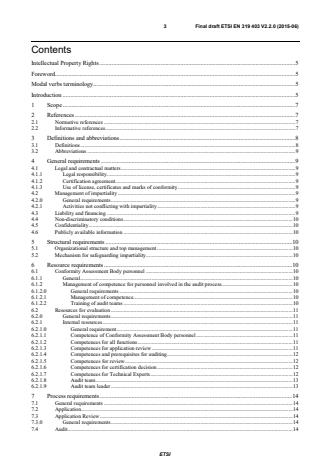
Contents
Intellectual Property Rights . 5
Foreword . 5
Modal verbs terminology . 5
Introduction . 5
1 Scope . 7
2 References . 7
2.1 Normative references . 7
2.2 Informative references . 7
3 Definitions and abbreviations . 8
3.1 Definitions . 8
3.2 Abbreviations . 9
4 General requirements . 9
4.1 Legal and contractual matters . 9
4.1.1 Legal responsibility. 9
4.1.2 Certification agreement . 9
4.1.3 Use of license, certificates and marks of conformity . 9
4.2 Management of impartiality . 9
4.2.0 General requirements . 9
4.2.1 Activities not conflicting with impartiality . 9
4.3 Liability and financing . 9
4.4 Non-discriminatory conditions . 10
4.5 Confidentiality . 10
4.6 Publicly available information . 10
5 Structural requirements . 10
5.1 Organizational structure and top management . 10
5.2 Mechanism for safeguarding impartiality . 10
6 Resource requirements . 10
6.1 Conformity Assessment Body personnel . 10
6.1.1 General . 10
6.1.2 Management of competence for personnel involved in the audit process. 10
6.1.2.0 General requirements . 10
6.1.2.1 Management of competence. 10
6.1.2.2 Training of audit teams . 10
6.2 Resources for evaluation . 11
6.2.0 General requirements . 11
6.2.1 Internal resources . 11
6.2.1.0 General requirement . 11
6.2.1.1 Competence of Conformity Assessment Body personnel . 11
6.2.1.2 Competences for all functions . 11
6.2.1.3 Competences for application review . 11
6.2.1.4 Competences and prerequisites for auditing. 12
6.2.1.5 Competences for review . 12
6.2.1.6 Competences for certification decision . 12
6.2.1.7 Competences for Technical Experts . 12
6.2.1.8 Audit team . 13
6.2.1.9 Audit team leader . 13
7 Process requirements . 13
7.1 General requirements . 13
7.2 Application . 14
7.3 Application Review . 14
7.4 Audit . 14
7.4.0 General requirements . 14
ETSI
4 ETSI EN 319 403 V2.2.2 (2015-08)
7.4.1 Audit Scope . 14
7.4.1.0 Audit Scope General . 14
7.4.1.1 Audit Team Mandate. 15
7.4.1.2 Audit Methodology . 15
7.4.2 Audit time . 15
7.4.3 Multiple sites . 16
7.4.3.1 When to Consider Sample Based Approach . 16
7.4.3.2 Requirements of Sample Based Approach . 16
7.4.4 Audit Report . 17
7.4.4.1 Report contents . 17
7.4.4.2 Report contents details to be provided . 17
7.4.5 Audit process . 18
7.4.5.1 General preparation for the initial audit . 18
7.4.5.2 Audit Process . 18
7.4.5.3 Stage 1 audit . 18
7.4.5.4 Stage 2 audit . 19
7.4.6 Audit Frequency . 19
7.5 Review . 19
7.6 Certification decision . 20
7.7 Certification documentation . 20
7.8 Directory of certified products . 20
7.9 Surveillance . 20
7.10 Changes affecting certification . 21
7.11 Termination, reduction, suspension or withdrawal of certification . 21
7.12 Records . 21
7.13 Complaints and appeals . 21
8 Management system requirements . 21
8.1 Options . 21
8.2 General management system documentation . 21
8.3 Control of documents . 21
8.4 Control of records . 22
8.5 Management review . 22
8.6 Internal audits . 22
8.7 Corrective actions . 22
8.8 Preventive actions. 22
Annex A (informative): Auditors' code of conduct . 23
Annex B (informative): Bibliography . 24
History . 25
ETSI
5 ETSI EN 319 403 V2.2.2 (2015-08)
Intellectual Property Rights
IPRs essential or potentially essential to the present document may have been declared to ETSI. The information
pertaining to these essential IPRs, if any, is publicly available for ETSI members and non-members, and can be found
in ETSI SR 000 314: "Intellectual Property Rights (IPRs); Essential, or potentially Essential, IPRs notified to ETSI in
respect of ETSI standards", which is available from the ETSI Secretariat. Latest updates are available on the ETSI Web
server (http://ipr.etsi.org).
Pursuant to the ETSI IPR Policy, no investigation, including IPR searches, has been carried out by ETSI. No guarantee
can be given as to the existence of other IPRs not referenced in ETSI SR 000 314 (or the updates on the ETSI Web
server) which are, or may be, or may become, essential to the present document.
Foreword
This European Standard (EN) has been produced by ETSI Technical Committee Electronic Signatures and
Infrastructures (ESI).
National transposition dates
Date of adoption of this EN: 21 August 2015
Date of latest announcement of this EN (doa): 30 November 2015
Date of latest publication of new National Standard
or endorsement of this EN (dop/e): 31 May 2016
Date of withdrawal of any conflicting National Standard (dow): 30 June 2017
Modal verbs terminology
In the present document "shall", "shall not", "should", "should not", "may", "need not", "will", "will not", "can" and
"cannot" are to be interpreted as described in clause 3.2 of the ETSI Drafting Rules (Verbal forms for the expression of
provisions).
"must" and "must not" are NOT allowed in ETSI deliverables except when used in direct citation.
Introduction
ISO/IEC 17065 [1] is an international standard which specifies general requirements for conformity assessment bodies
(CABs) performing certification of products, processes, or services. These requirements are not focussed on any
specific application domain where CABs work.
In the present document the general requirements are supplemented to provide additional dedicated requirements for
CABs performing certification of Trust Service Providers (TSPs) and the trust services they provide towards defined
criteria against which they claim conformance.
The present document is aiming to meet the general requirements of the international community to provide trust and
confidence in electronic transactions including, amongst others, applicable requirements from Regulation (EU)
No 910/2014 [i.1], and from CA Browser Forum [i.10].
The present document's aims include support of national accreditation bodies as specified in Regulation (EC)
No. 765/2008 [i.4] in applying ISO/IEC 17065 [1] for the accreditation of CABs that certify TSPs and the trust services
they provide so that this is carried out in a consistent manner. In accordance with [i.4], attestations issued by conformity
assessment bodies accredited by a national accreditation body can be formally recognized across Europe.
ETSI
6 ETSI EN 319 403 V2.2.2 (2015-08)
The present document does not repeat requirements from ISO/IEC 17065 [1] but follows its document structure. Where
needed, additional requirements are specified. This is mainly the case for requirements on resources (clause 6) and on
the assessment process (clause 7). For all other chapters of ISO/IEC 17065 [1] few or no additional requirements are
needed.
The present document also incorporates many requirements relating to the audit of a TSP's management system, as
defined in ISO/IEC 17021 [i.12] and in ISO/IEC 27006 [i.11]. These requirements are incorporated by including text to
derived from these documents in the present document, as well indirectly through references to requirements of
ISO/IEC 17021 [i.12].
ETSI
7 ETSI EN 319 403 V2.2.2 (2015-08)
1 Scope
The present document contains requirements for the competence, consistent operation and impartiality of conformity
assessment bodies assessing and certifying conformity of trust service providers (TSPs) and the trust services they
provide towards defined criteria against which they claim conformance.
NOTE: Those requirements are independent of the type and class of trust service provided.
The present document applies the general requirements of ISO/IEC 17065 [1] to the specific requirements of
conformity assessment of TSPs.
2 References
2.1 Normative references
References are either specific (identified by date of publication and/or edition number or version number) or
non-specific. For specific references, only the cited version applies. For non-specific references, the latest version of the
reference document (including any amendments) applies.
Referenced documents which are not found to be publicly available in the expected location might be found at
http://docbox.etsi.org/Reference.
NOTE: While any hyperlinks included in this clause were valid at the time of publication, ETSI cannot guarantee
their long term validity.
The following referenced documents are necessary for the application of the present document.
[1] ISO/IEC 17065: "Conformity assessment -- Requirements for bodies certifying products,
processes and services".
2.2 Informative references
References are either specific (identified by date of publication and/or edition number or version number) or
non-specific. For specific references, only the cited version applies. For non-specific references, the latest version of the
reference document (including any amendments) applies.
NOTE: While any hyperlinks included in this clause were valid at the time of publication, ETSI cannot guarantee
their long term validity.
The following referenced documents are not necessary for the application of the present document but they assist the
user with regard to a particular subject area.
[i.1] Regulation 910/2014 of the European Parliament and of the Council of 23 July 2014 on electronic
identification and trust services for electronic transactions in the internal market and repealing
Directive 1999/93/EC.
[i.2] ETSI EN 319 411-1: "Electronic Signatures and Infrastructures (ESI); Policy and security
requirements for Trust Service Providers issuing certificates; Part 1: General Requirements for
Trust Service Providers issuing certificates".
[i.3] ETSI EN 319 411-2: "Electronic Signatures and Infrastructures (ESI); Policy and security
requirements for Trust Service Providers issuing certificates; Part 2: Requirements for Trust
Service Providers issuing qualified certificates".
[i.4] EC Regulation No 765/2008 of the European Parliament and of the Council of 9 July 2008 setting
out the requirements for accreditation and market surveillance relating to the marketing of
products and repealing Regulation (EEC) No 339/93.
[i.5] ISO/IEC 17000:2004: "Conformity assessment -- Vocabulary and general principles".
[i.6] ETSI EN 319 401: "Electronic Signatures and Infrastructures (ESI); General Policy Requirements
for Trust Service Providers supporting Electronic Signatures".
ETSI
8 ETSI EN 319 403 V2.2.2 (2015-08)
[i.7] ISO/IEC 15408: "Information technology -- Security techniques -- Evaluation criteria for IT
security".
[i.8] ISO/IEC 27001: "Information technology -- Security techniques -- Information security
management systems -- Requirements".
[i.9] ETSI EN 319 421: "Electronic Signatures and Infrastructures (ESI); Policy and Security
Requirements for Trust Service Providers providing Time-Stamping Services".
[i.10] CA/Browser Forum Baseline Requirements for the Issuance and Management of Publicly-Trusted
Certificates.
[i.11] ISO/IEC 27006: "Information technology -- Security techniques -- Requirements for bodies
providing audit and certification of information security management systems".
[i.12] ISO/IEC 17021: "Conformity assessment -- Requirements for bodies providing audit and
certification of management systems".
[i.13] ISO/IEC 27002: "Information technology -- Security techniques -- Code of practice for
information security controls".
3 Definitions and abbreviations
3.1 Definitions
For the purposes of the present document, the terms and definitions given in ISO/IEC 17065 [1] and the following
apply:
auditor: person who assesses conformity to requirements as specified in a given requirements document
competence: ability to apply knowledge and skills to achieve intended results
conformity assessment: process demonstrating whether specified requirements relating to a product, process, service,
system, person or body have been fulfilled
NOTE: From Regulation (EC) No 765/2008 [i.4] and section 2.1 of ISO/IEC 17000:2004 [i.5].
conformity assessment body: body that performs conformity assessment services which is accredited as competent to
carry out conformity assessment of a qualified trust service provider and the qualified trust services it provides
NOTE: This is equivalent to conformity assessment body as specified in point 13 Article 2 of Regulation (EC)
No 765/2008 [i.4].
national accreditation body: sole body in a State that performs accreditation with authority derived from the State
NOTE: This is equivalent to national accreditation body as specified in point 11 Article 2 of Regulation (EC)
No 765/2008 [i.4].
technical expert: person who provides specific knowledge or expertise to the audit team
NOTE 1: Specific knowledge or expertise relates to the organization, the process or activity to be audited, or
language or culture.
NOTE 2: A technical expert does not act as an auditor in the audit team.
trust service: electronic service which enhances trust and confidence in electronic transactions
NOTE: Such trust services are typically but not necessarily using cryptographic techniques or involving
confidential material.
Trust Service Provider (TSP): entity which provides one or more electronic trust services
ETSI
9 ETSI EN 319 403 V2.2.2 (2015-08)
3.2 Abbreviations
For the purposes of the present document, the following abbreviations apply:
CA Certification Authority
CAB Conformity Assessment Body
EC European Commission
EU European Union
ISMS Information Security Management System
IT Information Technology
TSP Trust Service Provider
4 General requirements
4.1 Legal and contractual matters
4.1.1 Legal responsibility
The requirements from ISO/IEC 17065 [1], clause 4.1.1 shall apply.
4.1.2 Certification agreement
The requirements from ISO/IEC 17065 [1], clause 4.1.2 shall apply.
4.1.3 Use of license, certificates and marks of conformity
The requirements from ISO/IEC 17065 [1], clause 4.1.3 shall apply.
4.2 Management of impartiality
4.2.0 General requirements
The requirements from ISO/IEC 17065 [1], clause 4.2 shall apply. In addition, the following TSP-specific requirements
and guidance apply.
4.2.1 Activities not conflicting with impartiality
Conformity Assessment Bodies and its personnel may carry out additional activities provided they do not constitute a
risk to its impartiality. These activities may include but are not limited to:
a) organizing and participating in information meetings about the certification scheme in general;
b) arranging and participating as a lecturer in training courses, provided that, where these courses relate to TSPs,
related security controls or auditing, lecturers shall confine themselves to the provision of generic information
and advice which is publicly available;
c) activities prior to audit, solely aimed at determining readiness for audit; however, such activities shall not
result in the provision of recommendations or advice for specific solutions and shall not result in a reduction in
the eventual audit duration;
d) performing third party audits according to standards, publicly available specifications or regulatory
requirements other than those being part of the scope of accreditation; or
e) adding value during audits.
EXAMPLE: Adding value during audits includes identifying opportunities for improvement, as they become
evident during the audit, without recommending specific solutions.
4.3 Liability and financing
The requirements from ISO/IEC 17065 [1], clause 4.3 shall apply.
ETSI
10 ETSI EN 319 403 V2.2.2 (2015-08)
4.4 Non-discriminatory conditions
The requirements from ISO/IEC 17065 [1], clause 4.4 shall apply.
4.5 Confidentiality
The requirements from ISO/IEC 17065 [1], clause 4.5 shall apply.
4.6 Publicly available information
The requirements from ISO/IEC 17065 [1], clause 4.6 shall apply.
5 Structural requirements
5.1 Organizational structure and top management
The requirements from ISO/IEC 17065 [1], clause 5.1 shall apply.
5.2 Mechanism for safeguarding impartiality
The requirements from ISO/IEC 17065 [1], clause 5.2 shall apply.
6 Resource requirements
6.1 Conformity Assessment Body personnel
6.1.1 General
The requirements from ISO/IEC 17065 [1], clause 6.1.1 shall apply.
6.1.2 Management of competence for personnel involved in the audit
process
6.1.2.0 General requirements
The requirements from ISO/IEC 17065 [1], clause 6.1.2 shall apply. In addition, the following TSP-specific
requirements and guidance apply.
6.1.2.1 Management of competence
The performance of the following functions as defined in clause 7 of ISO/IEC 17065 [1] shall need specific
competences with respect to Trust Service Provider as described in clause 6.2:
a) application review;
b) audit;
c) review; and
d) certification decision.
6.1.2.2 Training of audit teams
The Conformity Assessment Body shall have criteria for the training of audit teams that support the ability to
demonstrate competence in:
a) knowledge of the TSP standards and other relevant publicly available specifications;
b) understanding of trust services and information security including network security issues;
ETSI
11 ETSI EN 319 403 V2.2.2 (2015-08)
c) understanding of risk assessment and risk management from the business perspective;
d) technical knowledge of the activity to be audited;
e) general knowledge of regulatory requirements relevant to TSPs; and
f) knowledge of security policies and controls.
6.2 Resources for evaluation
6.2.0 General requirements
The requirements from ISO/IEC 17065 [1], clause 6.2 shall apply.
6.2.1 Internal resources
6.2.1.0 General requirement
The requirements from ISO/IEC 17065 [1], clause 6.2.1 shall apply. In addition, the following TSP-specific
requirements and guidance apply.
6.2.1.1 Competence of Conformity Assessment Body personnel
The Conformity Assessment Body shall have personnel competent to:
a) select and verify the competence of TSP auditors for audit teams appropriate for the audit;
b) brief TSP auditors and arrange any necessary training;
c) decide on the granting, maintaining, withdrawing, suspending, extending, or reducing of certifications; and
d) set up and operate an appeals and complaints process.
6.2.1.2 Competences for all functions
The Conformity Assessment Body personnel shall have knowledge of:
a) standards and publicly available specifications relevant to TSP conformity assessment;
b) TSPs general concepts and relevant requirements;
c) TSPs' legal and regulatory requirements;
d) trust services functioning, and information security management including network security;
e) TSPs' security policies and controls; and
f) TSPs' risk assessment and risk management.
6.2.1.3 Competences for application review
The Conformity Assessment Body personnel reviewing TSPs' applications shall have the following specific
competences:
a) technological and legal understanding of the areas of activity of the TSP and the associated business risks;
b) technical understanding of the evaluation process;
c) understanding of the competences and capabilities of the Conformity Assessment Body; and
d) communication and analytic skills to explain certification requirements to the client and to resolve possible
difference in understanding regarding standards, other publicly available specifications or regulatory
requirements.
ETSI
12 ETSI EN 319 403 V2.2.2 (2015-08)
6.2.1.4 Competences and prerequisites for auditing
The Conformity Assessment Body personnel performing audit as described in clause 7.4 shall have the following
specific competences and knowledge, and fulfil the following requirements:
a) Requirements:
1) formal academic qualifications or professional training or extensive experience indicating general
capability to carry out audits based on the knowledge given below; and
2) at least four years full time practical workplace experience in information technology, of which at least
two years have been in a role or function relating to relevant trust services, public key infrastructure,
information security including risk assessment/management, network security, and physical security.
b) Knowledge of:
1) audit principles, practices and techniques in the field of TSP audit gained in a training course of at least
five days;
2) the issues related to various areas of trust services, public key infrastructure, information security
including risk assessment/management, network security and physical security;
3) the applicable standards, publicly available specifications and regulatory requirements for TSPs and
other relevant publicly available specifications including standards for IT product evaluation; and
EXAMPLE: Applicable standards such as ISO/IEC 27002 [i.13], ETSI EN 319 401 [i.6],
ETSI EN 319 411-1 [i.2], ETSI EN 319 411-2 [i.3], ETSI EN 319 421 [i.9] or
ISO/IEC 15408 [i.7].
4) the Conformity Assessment Body's processes.
c) Competences:
1) language skills appropriate for all organizational levels within the TSP organization;
2) note-taking, report-writing, presentation, and interviewing skills; and
3) personal attributes: objective, mature, discerning, analytical, persistent and realistic.
The Conformity Assessment Body personnel performing audit shall maintain competence on the basis of appropriate
education, training or experience. All relevant experience shall be current and prior to assuming responsibility for
performing as an auditor, the candidate shall have gained experience in the entire process of TSP audit. This experience
shall have been gained by participation under supervision of lead auditors in a minimum of four TSP audits for a total of
at least 20 days, including documentation review, on-site audit and audit reporting.
6.2.1.5 Competences for review
The Conformity Assessment Body personnel performing assessment information and results reviews shall have the
specific competences described in clause 6.2.1.4 and have acted as auditor in, at least, three complete TSP assessments.
6.2.1.6 Competences for certification decision
The Conformity Assessment Body personnel performing assessment information and results revisions shall have the
competences described in clause 6.2.1.2 and knowledge of certification process.
6.2.1.7 Competences for Technical Experts
Technical experts assisting the audit team provide specific knowledge or expertise during the audit process.
NOTE 1: Technical experts are not considered as auditors and do not need to have the complete auditor
competences as described in clause 6.2.1.4.
Technical experts shall, at all times, be responsible to the audit team leader.
ETSI
13 ETSI EN 319 403 V2.2.2 (2015-08)
NOTE 2: Typical knowledge provided by technical experts includes the following:
a) knowledge of the legislative and regulatory requirements and of legal compliance in the particular
field of TSP and information security;
b) knowledge of the current technical state-of-art regarding Public Key Infrastructure;
c) knowledge in technologies applicable to the TSP trust service being audited;
d) knowledge of performing information security related risk assessments so as to identify TSP assets,
threats and vulnerabilities providing understanding of their occurrence, impact and their mitigation;
e) knowledge of network security vulnerability analysis including penetration testing;
f) knowledge of assessing TSP security controls; and
g) knowledge of product evaluation (e.g. as per ISO/IEC 15408 [i.7]) being able to assess secure
operation of evaluated products or trustworthy systems such as cryptographic modules.
6.2.1.8 Audit team
Audit teams shall be competent for the duties assigned to them. The following requirements shall apply to the audit
team as a whole. In each of the following areas at least one auditor in the team shall satisfy auditors' criteria for taking
responsibility within the audit team:
a) managing the team (lead auditor);
b) demonstrated knowledge of the legislative and regulatory requirements and of legal compliance in the
particular field of TSP and information security;
c) demonstrated knowledge of the current technical state-of-art regarding TSP and Public Key Infrastructure;
d) demonstrated knowledge in technologies applicable to the TSP trust service being audited;
e) demonstrated knowledge of performing information security related risk assessments so as to identify assets,
threats and the vulnerabilities of the TSP and understanding their impact and their mitigation and control; and
f) demonstrated knowledge of organizational reliability issues.
The audit team should be competent to trace indications of security incidents in the TSP operations back to the
appropriate elements of the TSP controls.
An audit team may consist of one person provided that the person meets all criteria set out above.
6.2.1.9 Audit team leader
In addition to the requirements in clause 6.2.1.4, audit team leaders shall have gained the following experiences and
skills in audits under guidance and supervision:
a) having acted as auditor in at least three complete TSP audits;
b) having adequate knowledge and attributes to manage the audit process; and
c) having the competence to communicate effectively, both orally and in writing.
7 Process requirements
7.1 General requirements
The requirements from ISO/IEC 17065 [1], clause 7.1 shall apply. In addition, the following TSP-specific requirements
and guidance apply.
ETSI
14 ETSI EN 319 403 V2.2.2 (2015-08)
The evaluation of the TSP and the trust service(s) it provides shall take the form of an audit carried out against defined
criteria that should:
a) take into account specificities of the type of trust service to be assessed;
b) ensure that all aspects of the TSP activity are fully covered; and
c) be based on standards, publicly available specifications and/or regulatory requirements.
EXAMPLE: Standards on which those criteria could be based include ETSI EN 319 401 [i.6],
ETSI EN 319 411-1 [i.2], or ETSI EN 319 411-2 [i.3] or ETSI EN 319 421 [i.9]. Regulatory
requirements on which those criteria could be based include those defined in Regulation (EU)
No 910/2014 [i.1].
7.2 Application
The requirements from ISO/IEC 17065 [1], clause 7.2 shall apply.
7.3 Application Review
The requirements from ISO/IEC 17065 [1], clause 7.3 shall apply.
For each TSP, the Conformity Assessment Body shall ensure that it does not accept any application for which it is not
competent or otherwise unable to carry out audit. The Conformity Assessment Body shall then review the contract with
the TSP, based on the results of this competence analysis. In particular, the Conformity Assessment Body shall be able
to demonstrate that it is able to:
a) understand the areas of activity of the TSP and the associated business risks;
b) define the competencies needed in the Conformity Assessment Body to certify, in relation to the TSP
identified activities, to the concerned trust services it provides, and to the relevant security risks, vulnerabilities
and impacts on the TSP; and
c) confirm the availability of the required competences.
7.4 Audit
7.4.0 General requirements
The requirements from ISO/IEC 17065 [1], clause 7.4 shall apply. In addition, the following TSP-specific requirements
and guidance apply.
7.4.1 Audit Scope
7.4.1.0 Audit Scope General
The documentation of the Conformity Assessment Body shall include the policies and procedures for implementing the
audit process, including check lists used in the audit, and the procedures for assessing the conformity of the TSP and the
trust services it provides with the criteria against which the audit is carried out.
The audit team shall audit the TSP and the trust service(s) it provides, covered by the defined scope, against all
applicable audit requirements.
The Conformity Assessment Body shall ensure that the scope and boundaries of the trust services of the TSP are clearly
defined in terms of the characteristics of the business, the organization, facilities, assets and technology.
The Conformity Assessment Body shall ensure that the TSP's information security risk assessment and risk treatment
properly reflect its activities and extend to the boundaries of its trust services activities.
The Conformity Assessment Body shall ensure that interfaces with services or activities that are not completely within
the scope of the trust services are included in the TSP's information security risk assessment.
EXAMPLE: Sharing of facilities (e.g. IT systems, databases and telecommunication systems) with other
organizations.
ETSI
15 ETSI EN 319 403 V2.2.2 (2015-08)
7.4.1.1 Audit Team Mandate
The mandate given to the audit team shall be clearly defined and made known to the TSP, and shall require the audit
team to examine the structure, policies, procedures, practices, management, and operation of the TSP, and confirm that
these meet all the requirements relevant to the scope of certification and that the procedures are implemented and are
such as to give confidence in the trust services of the TSP.
When required, the audit team may be complemented by technical experts.
Technical experts cannot be used in place of auditors but advise auditors on matters of technical adequacy in the context
of the trust service being subject to audit.
The Conformity Assessment Body shall have a procedure for:
a) selecting auditors and technical experts on the basis of their competence, training, qualifications and
experience; and
b) monitoring the performance of auditors during audits.
7.4.1.2 Audit Methodology
The plan for and the date of the audit shall be agreed to with the TSP. The Conformity Assessment Body may adopt
reporting procedures that suit its needs but as a minimum these procedures shall ensure that:
a) a meeting takes place, prior to leaving the TSP's premises, between the audit team and the TSP's management
to which the audit team provides:
1) a written or oral indication regarding the conformity of the TSP and the trust service(s) it provides with
the criteria against which the audit has been carried out, and
2) an opportunity for the TSP to ask questions about the findings and their basis.
b) the audit team leader provides the conformity assessment body with a report of its findings as to the
conformity of the TSP and the trust service(s) it provides with the criteria against which the audit has been
carried out.
The Conformity Assessment Body shall have procedures, which are
...
2003-01.Slovenski inštitut za standardizacijo. Razmnoževanje celote ali delov tega standarda ni dovoljeno.Elektronski podpisi in infrastruktura (ESI) - Ocenjevanje skladnosti ponudnikov storitev zaupanja - Zahteve za ocenjevanje skladnosti organov, ki ocenjujejo ponudnike storitev zaupanjaElectronic Signatures and Infrastructures (ESI);Trust Service Provider Conformity Assessment - Requirements for conformity assessment bodies assessing Trust Service Providers35.040.01Kodiranje informacij na splošnoInformation coding in general03.080.99Druge storitveOther servicesICS:Ta slovenski standard je istoveten z:ETSI EN 319 403 V2.2.2 (2015-08)SIST EN 319 403 V2.2.2:2016en,fr,de01-februar-2016SIST EN 319 403 V2.2.2:2016SLOVENSKI
STANDARD
EUROPEAN STANDARD SIST EN 319 403 V2.2.2:2016
ETSI ETSI EN 319 403 V2.2.2 (2015-08) 2
Reference REN/ESI-0019403 Keywords conformity, e-commerce, electronic signature, security, trust services ETSI 650 Route des Lucioles F-06921 Sophia Antipolis Cedex - FRANCE
Tel.: +33 4 92 94 42 00
Fax: +33 4 93 65 47 16
Siret N° 348 623 562 00017 - NAF 742 C Association à but non lucratif enregistrée à la Sous-Préfecture de Grasse (06) N° 7803/88
Important notice The present document can be downloaded from: http://www.etsi.org/standards-search The present document may be made available in electronic versions and/or in print. The content of any electronic and/or print versions of the present document shall not be modified without the prior written authorization of ETSI. In case of any existing or perceived difference in contents between such versions and/or in print, the only prevailing document is the print of the Portable Document Format (PDF) version kept on a specific network drive within ETSI Secretariat. Users of the present document should be aware that the document may be subject to revision or change of status. Information on the current status of this and other ETSI documents is available at http://portal.etsi.org/tb/status/status.asp If you find errors in the present document, please send your comment to one of the following services: https://portal.etsi.org/People/CommiteeSupportStaff.aspx Copyright Notification No part may be reproduced or utilized in any form or by any means, electronic or mechanical, including photocopying and microfilm except as authorized by written permission of ETSI. The content of the PDF version shall not be modified without the written authorization of ETSI. The copyright and the foregoing restriction extend to reproduction in all media.
© European Telecommunications Standards Institute 2015. All rights reserved.
DECTTM, PLUGTESTSTM, UMTSTM and the ETSI logo are Trade Marks of ETSI registered for the benefit of its Members. 3GPPTM and LTE™ are Trade Marks of ETSI registered for the benefit of its Members and of the 3GPP Organizational Partners. GSM® and the GSM logo are Trade Marks registered and owned by the GSM Association. SIST EN 319 403 V2.2.2:2016
ETSI ETSI EN 319 403 V2.2.2 (2015-08) 3 Contents Intellectual Property Rights . 5 Foreword . 5 Modal verbs terminology . 5 Introduction . 5 1 Scope . 7 2 References . 7 2.1 Normative references . 7 2.2 Informative references . 7 3 Definitions and abbreviations . 8 3.1 Definitions . 8 3.2 Abbreviations . 9 4 General requirements . 9 4.1 Legal and contractual matters . 9 4.1.1 Legal responsibility. 9 4.1.2 Certification agreement . 9 4.1.3 Use of license, certificates and marks of conformity . 9 4.2 Management of impartiality . 9 4.2.0 General requirements . 9 4.2.1 Activities not conflicting with impartiality . 9 4.3 Liability and financing . 9 4.4 Non-discriminatory conditions . 10 4.5 Confidentiality . 10 4.6 Publicly available information . 10 5 Structural requirements . 10 5.1 Organizational structure and top management . 10 5.2 Mechanism for safeguarding impartiality . 10 6 Resource requirements . 10 6.1 Conformity Assessment Body personnel . 10 6.1.1 General . 10 6.1.2 Management of competence for personnel involved in the audit process. 10 6.1.2.0 General requirements . 10 6.1.2.1 Management of competence. 10 6.1.2.2 Training of audit teams . 10 6.2 Resources for evaluation . 11 6.2.0 General requirements . 11 6.2.1 Internal resources . 11 6.2.1.0 General requirement . 11 6.2.1.1 Competence of Conformity Assessment Body personnel . 11 6.2.1.2 Competences for all functions . 11 6.2.1.3 Competences for application review . 11 6.2.1.4 Competences and prerequisites for auditing. 12 6.2.1.5 Competences for review . 12 6.2.1.6 Competences for certification decision . 12 6.2.1.7 Competences for Technical Experts . 12 6.2.1.8 Audit team . 13 6.2.1.9 Audit team leader . 13 7 Process requirements . 13 7.1 General requirements . 13 7.2 Application . 14 7.3 Application Review . 14 7.4 Audit . 14 7.4.0 General requirements . 14 SIST EN 319 403 V2.2.2:2016
ETSI ETSI EN 319 403 V2.2.2 (2015-08) 4 7.4.1 Audit Scope . 14 7.4.1.0 Audit Scope General . 14 7.4.1.1 Audit Team Mandate. 15 7.4.1.2 Audit Methodology . 15 7.4.2 Audit time . 15 7.4.3 Multiple sites . 16 7.4.3.1 When to Consider Sample Based Approach . 16 7.4.3.2 Requirements of Sample Based Approach . 16 7.4.4 Audit Report . 17 7.4.4.1 Report contents . 17 7.4.4.2 Report contents details to be provided . 17 7.4.5 Audit process . 18 7.4.5.1 General preparation for the initial audit . 18 7.4.5.2 Audit Process . 18 7.4.5.3 Stage 1 audit . 18 7.4.5.4 Stage 2 audit . 19 7.4.6 Audit Frequency . 19 7.5 Review . 19 7.6 Certification decision . 20 7.7 Certification documentation . 20 7.8 Directory of certified products . 20 7.9 Surveillance . 20 7.10 Changes affecting certification . 21 7.11 Termination, reduction, suspension or withdrawal of certification . 21 7.12 Records . 21 7.13 Complaints and appeals . 21 8 Management system requirements . 21 8.1 Options . 21 8.2 General management system documentation . 21 8.3 Control of documents . 21 8.4 Control of records . 22 8.5 Management review . 22 8.6 Internal audits . 22 8.7 Corrective actions . 22 8.8 Preventive actions. 22 Annex A (informative): Auditors' code of conduct . 23 Annex B (informative): Bibliography . 24 History . 25
ETSI ETSI EN 319 403 V2.2.2 (2015-08) 5 Intellectual Property Rights IPRs essential or potentially essential to the present document may have been declared to ETSI. The information pertaining to these essential IPRs, if any, is publicly available for ETSI members and non-members, and can be found in ETSI SR 000 314: "Intellectual Property Rights (IPRs); Essential, or potentially Essential, IPRs notified to ETSI in respect of ETSI standards", which is available from the ETSI Secretariat. Latest updates are available on the ETSI Web server (http://ipr.etsi.org). Pursuant to the ETSI IPR Policy, no investigation, including IPR searches, has been carried out by ETSI. No guarantee can be given as to the existence of other IPRs not referenced in ETSI SR 000 314 (or the updates on the ETSI Web server) which are, or may be, or may become, essential to the present document. Foreword This European Standard (EN) has been produced by ETSI Technical Committee Electronic Signatures and Infrastructures (ESI).
National transposition dates Date of adoption of this EN: 21 August 2015 Date of latest announcement of this EN (doa): 30 November 2015 Date of latest publication of new National Standard or endorsement of this EN (dop/e):
31 May 2016 Date of withdrawal of any conflicting National Standard (dow): 30 June 2017
Modal verbs terminology In the present document "shall", "shall not", "should", "should not", "may", "need not", "will", "will not", "can" and "cannot" are to be interpreted as described in clause 3.2 of the ETSI Drafting Rules (Verbal forms for the expression of provisions). "must" and "must not" are NOT allowed in ETSI deliverables except when used in direct citation. Introduction ISO/IEC 17065 [1] is an international standard which specifies general requirements for conformity assessment bodies (CABs) performing certification of products, processes, or services. These requirements are not focussed on any specific application domain where CABs work. In the present document the general requirements are supplemented to provide additional dedicated requirements for CABs performing certification of Trust Service Providers (TSPs) and the trust services they provide towards defined criteria against which they claim conformance. The present document is aiming to meet the general requirements of the international community to provide trust and confidence in electronic transactions including, amongst others, applicable requirements from Regulation (EU) No 910/2014 [i.1], and from CA Browser Forum [i.10]. The present document's aims include support of national accreditation bodies as specified in Regulation (EC) No. 765/2008 [i.4] in applying ISO/IEC 17065 [1] for the accreditation of CABs that certify TSPs and the trust services they provide so that this is carried out in a consistent manner. In accordance with [i.4], attestations issued by conformity assessment bodies accredited by a national accreditation body can be formally recognized across Europe. SIST EN 319 403 V2.2.2:2016
ETSI ETSI EN 319 403 V2.2.2 (2015-08) 6 The present document does not repeat requirements from ISO/IEC 17065 [1] but follows its document structure. Where needed, additional requirements are specified. This is mainly the case for requirements on resources (clause 6) and on the assessment process (clause 7). For all other chapters of ISO/IEC 17065 [1] few or no additional requirements are needed. The present document also incorporates many requirements relating to the audit of a TSP's management system, as defined in ISO/IEC 17021 [i.12] and in ISO/IEC 27006 [i.11]. These requirements are incorporated by including text to derived from these documents in the present document, as well indirectly through references to requirements of ISO/IEC 17021 [i.12].
ETSI ETSI EN 319 403 V2.2.2 (2015-08) 7 1 Scope The present document contains requirements for the competence, consistent operation and impartiality of conformity assessment bodies assessing and certifying conformity of trust service providers (TSPs) and the trust services they provide towards defined criteria against which they claim conformance. NOTE: Those requirements are independent of the type and class of trust service provided. The present document applies the general requirements of ISO/IEC 17065 [1] to the specific requirements of conformity assessment of TSPs. 2 References 2.1 Normative references References are either specific (identified by date of publication and/or edition number or version number) or non-specific. For specific references, only the cited version applies. For non-specific references, the latest version of the reference document (including any amendments) applies. Referenced documents which are not found to be publicly available in the expected location might be found at http://docbox.etsi.org/Reference. NOTE: While any hyperlinks included in this clause were valid at the time of publication, ETSI cannot guarantee their long term validity. The following referenced documents are necessary for the application of the present document. [1] ISO/IEC 17065: "Conformity assessment -- Requirements for bodies certifying products, processes and services". 2.2 Informative references References are either specific (identified by date of publication and/or edition number or version number) or non-specific. For specific references, only the cited version applies. For non-specific references, the latest version of the reference document (including any amendments) applies. NOTE: While any hyperlinks included in this clause were valid at the time of publication, ETSI cannot guarantee their long term validity. The following referenced documents are not necessary for the application of the present document but they assist the user with regard to a particular subject area. [i.1] Regulation 910/2014 of the European Parliament and of the Council of 23 July 2014 on electronic identification and trust services for electronic transactions in the internal market and repealing Directive 1999/93/EC. [i.2] ETSI EN 319 411-1: "Electronic Signatures and Infrastructures (ESI); Policy and security requirements for Trust Service Providers issuing certificates; Part 1: General Requirements for Trust Service Providers issuing certificates". [i.3] ETSI EN 319 411-2: "Electronic Signatures and Infrastructures (ESI); Policy and security requirements for Trust Service Providers issuing certificates; Part 2: Requirements for Trust Service Providers issuing qualified certificates". [i.4] EC Regulation No 765/2008 of the European Parliament and of the Council of 9 July 2008 setting out the requirements for accreditation and market surveillance relating to the marketing of products and repealing Regulation (EEC) No 339/93. [i.5] ISO/IEC 17000:2004: "Conformity assessment -- Vocabulary and general principles". [i.6] ETSI EN 319 401: "Electronic Signatures and Infrastructures (ESI); General Policy Requirements for Trust Service Providers supporting Electronic Signatures". SIST EN 319 403 V2.2.2:2016
ETSI ETSI EN 319 403 V2.2.2 (2015-08) 8 [i.7] ISO/IEC 15408: "Information technology -- Security techniques -- Evaluation criteria for IT security". [i.8] ISO/IEC 27001: "Information technology -- Security techniques -- Information security management systems -- Requirements". [i.9] ETSI EN 319 421: "Electronic Signatures and Infrastructures (ESI); Policy and Security Requirements for Trust Service Providers providing Time-Stamping Services". [i.10] CA/Browser Forum Baseline Requirements for the Issuance and Management of Publicly-Trusted Certificates. [i.11] ISO/IEC 27006: "Information technology -- Security techniques -- Requirements for bodies providing audit and certification of information security management systems". [i.12] ISO/IEC 17021: "Conformity assessment -- Requirements for bodies providing audit and certification of management systems". [i.13] ISO/IEC 27002: "Information technology -- Security techniques -- Code of practice for information security controls". 3 Definitions and abbreviations 3.1 Definitions For the purposes of the present document, the terms and definitions given in ISO/IEC 17065 [1] and the following apply: auditor: person who assesses conformity to requirements as specified in a given requirements document competence: ability to apply knowledge and skills to achieve intended results conformity assessment: process demonstrating whether specified requirements relating to a product, process, service, system, person or body have been fulfilled NOTE: From Regulation (EC) No 765/2008 [i.4] and section 2.1 of ISO/IEC 17000:2004 [i.5]. conformity assessment body: body that performs conformity assessment services which is accredited as competent to carry out conformity assessment of a qualified trust service provider and the qualified trust services it provides NOTE: This is equivalent to conformity assessment body as specified in point 13 Article 2 of Regulation (EC) No 765/2008 [i.4]. national accreditation body: sole body in a State that performs accreditation with authority derived from the State NOTE: This is equivalent to national accreditation body as specified in point 11 Article 2 of Regulation (EC) No 765/2008 [i.4]. technical expert: person who provides specific knowledge or expertise to the audit team NOTE 1: Specific knowledge or expertise relates to the organization, the process or activity to be audited, or language or culture. NOTE 2: A technical expert does not act as an auditor in the audit team. trust service: electronic service which enhances trust and confidence in electronic transactions NOTE: Such trust services are typically but not necessarily using cryptographic techniques or involving confidential material. Trust Service Provider (TSP): entity which provides one or more electronic trust services SIST EN 319 403 V2.2.2:2016
ETSI ETSI EN 319 403 V2.2.2 (2015-08) 9 3.2 Abbreviations For the purposes of the present document, the following abbreviations apply: CA Certification Authority CAB Conformity Assessment Body EC European Commission EU European Union ISMS Information Security Management System IT Information Technology TSP Trust Service Provider 4 General requirements 4.1 Legal and contractual matters 4.1.1 Legal responsibility The requirements from ISO/IEC 17065 [1], clause 4.1.1 shall apply. 4.1.2 Certification agreement The requirements from ISO/IEC 17065 [1], clause 4.1.2 shall apply. 4.1.3 Use of license, certificates and marks of conformity The requirements from ISO/IEC 17065 [1], clause 4.1.3 shall apply. 4.2 Management of impartiality 4.2.0 General requirements The requirements from ISO/IEC 17065 [1], clause 4.2 shall apply. In addition, the following TSP-specific requirements and guidance apply. 4.2.1 Activities not conflicting with impartiality Conformity Assessment Bodies and its personnel may carry out additional activities provided they do not constitute a risk to its impartiality. These activities may include but are not limited to: a) organizing and participating in information meetings about the certification scheme in general; b) arranging and participating as a lecturer in training courses, provided that, where these courses relate to TSPs, related security controls or auditing, lecturers shall confine themselves to the provision of generic information and advice which is publicly available; c) activities prior to audit, solely aimed at determining readiness for audit; however, such activities shall not result in the provision of recommendations or advice for specific solutions and shall not result in a reduction in the eventual audit duration; d) performing third party audits according to standards, publicly available specifications or regulatory requirements other than those being part of the scope of accreditation; or e) adding value during audits. EXAMPLE: Adding value during audits includes identifying opportunities for improvement, as they become evident during the audit, without recommending specific solutions. 4.3 Liability and financing The requirements from ISO/IEC 17065 [1], clause 4.3 shall apply. SIST EN 319 403 V2.2.2:2016
ETSI ETSI EN 319 403 V2.2.2 (2015-08) 10 4.4 Non-discriminatory conditions The requirements from ISO/IEC 17065 [1], clause 4.4 shall apply. 4.5 Confidentiality The requirements from ISO/IEC 17065 [1], clause 4.5 shall apply. 4.6 Publicly available information The requirements from ISO/IEC 17065 [1], clause 4.6 shall apply. 5 Structural requirements 5.1 Organizational structure and top management The requirements from ISO/IEC 17065 [1], clause 5.1 shall apply. 5.2 Mechanism for safeguarding impartiality The requirements from ISO/IEC 17065 [1], clause 5.2 shall apply. 6 Resource requirements 6.1 Conformity Assessment Body personnel 6.1.1 General The requirements from ISO/IEC 17065 [1], clause 6.1.1 shall apply. 6.1.2 Management of competence for personnel involved in the audit process 6.1.2.0 General requirements
The requirements from ISO/IEC 17065 [1], clause 6.1.2 shall apply. In addition, the following TSP-specific requirements and guidance apply. 6.1.2.1 Management of competence The performance of the following functions as defined in clause 7 of ISO/IEC 17065 [1] shall need specific competences with respect to Trust Service Provider as described in clause 6.2: a) application review; b) audit; c) review; and d) certification decision. 6.1.2.2 Training of audit teams The Conformity Assessment Body shall have criteria for the training of audit teams that support the ability to demonstrate competence in: a) knowledge of the TSP standards and other relevant publicly available specifications; b) understanding of trust services and information security including network security issues; SIST EN 319 403 V2.2.2:2016
ETSI ETSI EN 319 403 V2.2.2 (2015-08) 11 c) understanding of risk assessment and risk management from the business perspective; d) technical knowledge of the activity to be audited; e) general knowledge of regulatory requirements relevant to TSPs; and f) knowledge of security policies and controls. 6.2 Resources for evaluation 6.2.0 General requirements
The requirements from ISO/IEC 17065 [1], clause 6.2 shall apply. 6.2.1 Internal resources 6.2.1.0 General requirement The requirements from ISO/IEC 17065 [1], clause 6.2.1 shall apply. In addition, the following TSP-specific requirements and guidance apply. 6.2.1.1 Competence of Conformity Assessment Body personnel The Conformity Assessment Body shall have personnel competent to: a) select and verify the competence of TSP auditors for audit teams appropriate for the audit; b) brief TSP auditors and arrange any necessary training; c) decide on the granting, maintaining, withdrawing, suspending, extending, or reducing of certifications; and d) set up and operate an appeals and complaints process. 6.2.1.2 Competences for all functions The Conformity Assessment Body personnel shall have knowledge of: a) standards and publicly available specifications relevant to TSP conformity assessment; b) TSPs general concepts and relevant requirements; c) TSPs' legal and regulatory requirements; d) trust services functioning, and information security management including network security; e) TSPs' security policies and controls; and f) TSPs' risk assessment and risk management. 6.2.1.3 Competences for application review The Conformity Assessment Body personnel reviewing TSPs' applications shall have the following specific competences: a) technological and legal understanding of the areas of activity of the TSP and the associated business risks; b) technical understanding of the evaluation process; c) understanding of the competences and capabilities of the Conformity Assessment Body; and d) communication and analytic skills to explain certification requirements to the client and to resolve possible difference in understanding regarding standards, other publicly available specifications or regulatory requirements. SIST EN 319 403 V2.2.2:2016
ETSI ETSI EN 319 403 V2.2.2 (2015-08) 12 6.2.1.4 Competences and prerequisites for auditing The Conformity Assessment Body personnel performing audit as described in clause 7.4 shall have the following specific competences and knowledge, and fulfil the following requirements: a) Requirements: 1) formal academic qualifications or professional training or extensive experience indicating general capability to carry out audits based on the knowledge given below; and 2) at least four years full time practical workplace experience in information technology, of which at least two years have been in a role or function relating to relevant trust services, public key infrastructure, information security including risk assessment/management, network security, and physical security. b) Knowledge of: 1) audit principles, practices and techniques in the field of TSP audit gained in a training course of at least five days; 2) the issues related to various areas of trust services, public key infrastructure, information security including risk assessment/management, network security and physical security;
3) the applicable standards, publicly available specifications and regulatory requirements for TSPs and other relevant publicly available specifications including standards for IT product evaluation; and EXAMPLE: Applicable standards such as ISO/IEC 27002 [i.13], ETSI EN 319 401 [i.6], ETSI EN 319 411-1 [i.2], ETSI EN 319 411-2 [i.3], ETSI EN 319 421 [i.9] or ISO/IEC 15408 [i.7]. 4) the Conformity Assessment Body's processes. c) Competences: 1) language skills appropriate for all organizational levels within the TSP organization; 2) note-taking, report-writing, presentation, and interviewing skills; and 3) personal attributes: objective, mature, discerning, analytical, persistent and realistic. The Conformity Assessment Body personnel performing audit shall maintain competence on the basis of appropriate education, training or experience. All relevant experience shall be current and prior to assuming responsibility for performing as an auditor, the candidate shall have gained experience in the entire process of TSP audit. This experience shall have been gained by participation under supervision of lead auditors in a minimum of four TSP audits for a total of at least 20 days, including documentation review, on-site audit and audit reporting.
6.2.1.5 Competences for review The Conformity Assessment Body personnel performing assessment information and results reviews shall have the specific competences described in clause 6.2.1.4 and have acted as auditor in, at least, three complete TSP assessments. 6.2.1.6 Competences for certification decision The Conformity Assessment Body personnel performing assessment information and results revisions shall have the competences described in clause 6.2.1.2 and knowledge of certification process. 6.2.1.7 Competences for Technical Experts Technical experts assisting the audit team provide specific knowledge or expertise during the audit process.
NOTE 1: Technical experts are not considered as auditors and do not need to have the complete auditor competences as described in clause 6.2.1.4. Technical experts shall, at all times, be responsible to the audit team leader. SIST EN 319 403 V2.2.2:2016
ETSI ETSI EN 319 403 V2.2.2 (2015-08) 13 NOTE 2: Typical knowledge provided by technical experts includes the following: a) knowledge of the legislative and regulatory requirements and of legal compliance in the particular field of TSP and information security; b) knowledge of the current technical state-of-art regarding Public Key Infrastructure; c) knowledge in technologies applicable to the TSP trust service being audited; d) knowledge of performing information security related risk assessments so as to identify TSP assets, threats and vulnerabilities providing understanding of their occurrence, impact and their mitigation; e) knowledge of network security vulnerability analysis including penetration testing; f) knowledge of assessing TSP security controls; and g) knowledge of product evaluation (e.g. as per ISO/IEC 15408 [i.7]) being able to assess secure operation of evaluated products or trustworthy systems such as cryptographic modules. 6.2.1.8 Audit team Audit teams shall be competent for the duties assigned to them. The following requirements shall apply to the audit team as a whole. In each of the following areas at least one auditor in the team shall satisfy auditors' criteria for taking responsibility within the audit team: a) managing the team (lead auditor); b) demonstrated knowledge of the legislative and regulatory requirements and of legal compliance in the particular field of TSP and information security; c) demonstrated knowledge of the current technical state-of-art regarding TSP and Public Key Infrastructure; d) demonstrated knowledge in technologies applicable to the TSP trust service being audited; e) demonstrated knowledge of performing information security related risk assessments so as to identify assets, threats and the vulnerabilities of the TSP and understanding their impact and their mitigation and control; and f) demonstrated knowledge of organizational reliability issues. The audit team should be competent to trace indications of security incidents in the TSP operations back to the appropriate elements of the TSP controls. An audit team may consist of one person provided that the person meets all criteria set out above. 6.2.1.9 Audit team leader In addition to the requirements in clause 6.2.1.4, audit team leaders shall have gained the following experiences and skills in audits under guidance and supervision: a) having acted as auditor in at least three complete TSP audits; b) having adequate knowledge and attributes to manage the audit process; and c) having the competence to communicate effectively, both orally and in writing. 7 Process requirements 7.1 General requirements The requirements from ISO/IEC 17065 [1], clause 7.1 shall apply. In addition, the following TSP-specific requirements and guidance apply. SIST EN 319 403 V2.2.2:2016
ETSI ETSI EN 319 403 V2.2.2 (2015-08) 14 The evaluation of the TSP and the trust service(s) it provides shall take the form of an audit carried out against defined criteria that should: a) take into account specificities of the type of trust service to be assessed; b) ensure that all aspects of the TSP activity are fully covered; and c) be based on standards, publicly available specifications and/or regulatory requirements. EXAMPLE: Standards on which those criteria could be based include ETSI EN 319 401 [i.6], ETSI EN 319 411-1 [i.2], or ETSI EN 319 411-2 [i.3] or ETSI EN 319 421 [i.9]. Regulatory requirements on which those criteria could be based include those defined in Regulation (EU) No 910/2014 [i.1]. 7.2 Application The requirements from ISO/IEC 17065 [1], clause 7.2 shall apply. 7.3 Application Review The requirements from ISO/IEC 17065 [1], clause 7.3 shall apply. For each TSP, the Conformity Assessment Body shall ensure that it does not accept any application for which it is not competent or otherwise unable to carry out audit. The Conformity Assessment Body shall then review the contract with the TSP, based on the results of this competence analysis. In particular, the Conformity Assessment Body shall be able to demonstrate that it is able to: a) understand the areas of activity of the TSP and the associated business risks; b) define the competencies needed in the Conformity Assessment Body to certify, in relation to the TSP identified activities, to the concerned trust services it provides, and to the relevant security risks, vulnerabilities and impacts on the TSP; and c) confirm the availability of the required competences. 7.4 Audit 7.4.0 General requirements The requirements from ISO/IEC 17065 [1], clause 7.4 shall apply. In addition, the following TSP-specific requirements and guidance apply. 7.4.1 Audit Scope 7.4.1.0 Audit Scope General The documentation of the Conformity Assessment Body shall include the policies and procedures for implementing the audit process, including check lists used in the audit, and the procedures for assessing the conformity of the TSP and the trust services it provides with the criteria against which the audit is carried out. The audit team shall audit the TSP and the trust service(s) it provides, covered by the defined scope, against all applicable audit requirements. The Conformity Assessment Body shall ensure that the scope and boundaries of the trust services of the TSP are clearly defined in terms of the characteristics of the business, the organization, facilities, assets and technology. The Conformity Assessment Body shall ensure that the TSP's information security risk assessment and risk treatment properly reflect its activities and extend to the boundaries of its trust services activities. The Conformity Assessment Body shall ensure that interfaces with services or activities that are not completely within the scope of the trust services are included in the TSP's information security risk assessment. EXAMPLE: Sharing of facilities (e.g. IT systems, databases and telecommunication systems) with other organizations. SIST EN 319 403 V2.2.2:2016
ETSI ETSI EN 319 403 V2.2.2 (2015-08) 15 7.4.1.1 Audit Team Mandate The mandate given to the audit team shall be clearly defined and made known to the TSP, and shall require the audit team to examine the structure, policies, procedures, practices, management, and operation of the TSP, and confirm that these meet all the requirements relevant to the scope of certification and that the procedures are implemented and are such as to give confidence in the trust services of the TSP. When required, the audit team may be complemented by technical experts. Technical experts cannot be used in place of auditors but advise auditors on matters of technical adequacy in the context of the trust service being subject to audit. The Conformity Assessment Body shall have a procedure for: a) selecting auditors and technical experts on the basis of their competence, training, qualifications and experience; and b) monitoring the performance of auditors during audits. 7.4.1.2 Audit Methodology The plan for and the date of the audit shall be agreed to with the TSP. The Conformity Assessment Body may adopt reporting procedures that suit its needs but as a minimum these procedures shall ensure that: a) a meeting takes place, prior to leaving the TSP's premises, between the audit team and the TSP's management to which the audit team provides: 1) a written or oral indication regarding the conformity of the TSP and the trust service(s) it provides with the criteria against which the audit has been carried out, and 2) an opportunity for the TSP to ask questions about the findings and their basis. b) the audit team leader provides the conformity assessment body with a report of its findings as to the conformity of the TSP and the trust service(s) it provides with the criteria against which the audit has been carried out. The Conformity Assessment Body shall have procedures, which are able to verify if the TSP has, prior to the audit for conformity assessment, already established an audit programme or passed other external audits or certifications for th
...
Questions, Comments and Discussion
Ask us and Technical Secretary will try to provide an answer. You can facilitate discussion about the standard in here.
Loading comments...