


ETSI GR NFV-SEC 009 V1.3.1 (2025-01)
Network Functions Virtualisation (NFV); NFV Security; Report on use cases and technical approaches for multi-layer host administration
Network Functions Virtualisation (NFV); NFV Security; Report on use cases and technical approaches for multi-layer host administration
RGR/NFV-SEC009ed131
General Information
Standards Content (Sample)
GROUP REPORT
Network Functions Virtualisation (NFV);
NFV Security;
Report on use cases and technical approaches
for multi-layer host administration
Disclaimer
The present document has been produced and approved by the Network Functions Virtualisation (NFV) ETSI Industry
Specification Group (ISG) and represents the views of those members who participated in this ISG.
It does not necessarily represent the views of the entire ETSI membership.
2 ETSI GR NFV-SEC 009 V1.3.1 (2025-01)
Reference
RGR/NFV-SEC009ed131
Keywords
administration, regulation, security
ETSI
650 Route des Lucioles
F-06921 Sophia Antipolis Cedex - FRANCE
Tel.: +33 4 92 94 42 00 Fax: +33 4 93 65 47 16
Siret N° 348 623 562 00017 - APE 7112B
Association à but non lucratif enregistrée à la
Sous-Préfecture de Grasse (06) N° w061004871
Important notice
The present document can be downloaded from the
ETSI Search & Browse Standards application.
The present document may be made available in electronic versions and/or in print. The content of any electronic and/or
print versions of the present document shall not be modified without the prior written authorization of ETSI. In case of any
existing or perceived difference in contents between such versions and/or in print, the prevailing version of an ETSI
deliverable is the one made publicly available in PDF format on ETSI deliver repository.
Users should be aware that the present document may be revised or have its status changed,
this information is available in the Milestones listing.
If you find errors in the present document, please send your comments to
the relevant service listed under Committee Support Staff.
If you find a security vulnerability in the present document, please report it through our
Coordinated Vulnerability Disclosure (CVD) program.
Notice of disclaimer & limitation of liability
The information provided in the present deliverable is directed solely to professionals who have the appropriate degree of
experience to understand and interpret its content in accordance with generally accepted engineering or
other professional standard and applicable regulations.
No recommendation as to products and services or vendors is made or should be implied.
No representation or warranty is made that this deliverable is technically accurate or sufficient or conforms to any law
and/or governmental rule and/or regulation and further, no representation or warranty is made of merchantability or fitness
for any particular purpose or against infringement of intellectual property rights.
In no event shall ETSI be held liable for loss of profits or any other incidental or consequential damages.
Any software contained in this deliverable is provided "AS IS" with no warranties, express or implied, including but not
limited to, the warranties of merchantability, fitness for a particular purpose and non-infringement of intellectual property
rights and ETSI shall not be held liable in any event for any damages whatsoever (including, without limitation, damages
for loss of profits, business interruption, loss of information, or any other pecuniary loss) arising out of or related to the use
of or inability to use the software.
Copyright Notification
No part may be reproduced or utilized in any form or by any means, electronic or mechanical, including photocopying and
microfilm except as authorized by written permission of ETSI.
The content of the PDF version shall not be modified without the written authorization of ETSI.
The copyright and the foregoing restriction extend to reproduction in all media.
© ETSI 2025.
All rights reserved.
ETSI
3 ETSI GR NFV-SEC 009 V1.3.1 (2025-01)
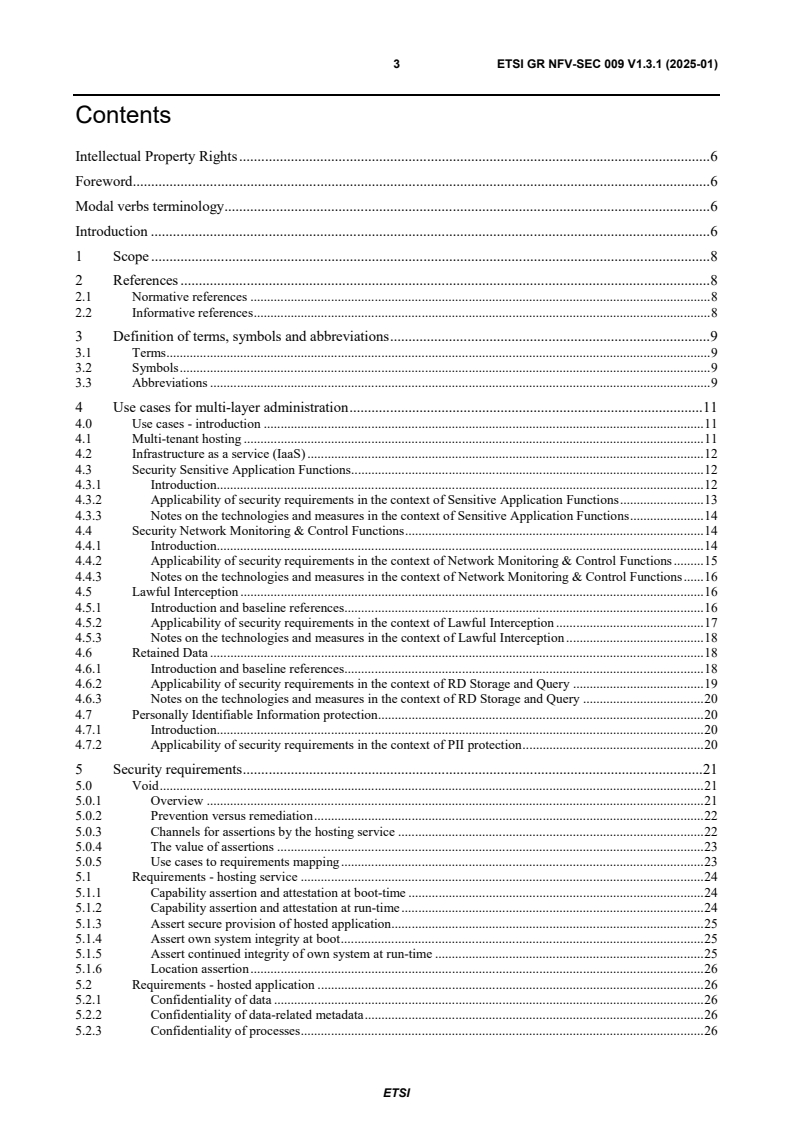
Contents
Intellectual Property Rights . 6
Foreword . 6
Modal verbs terminology . 6
Introduction . 6
1 Scope . 8
2 References . 8
2.1 Normative references . 8
2.2 Informative references . 8
3 Definition of terms, symbols and abbreviations . 9
3.1 Terms . 9
3.2 Symbols . 9
3.3 Abbreviations . 9
4 Use cases for multi-layer administration . 11
4.0 Use cases - introduction . 11
4.1 Multi-tenant hosting . 11
4.2 Infrastructure as a service (IaaS) . 12
4.3 Security Sensitive Application Functions . 12
4.3.1 Introduction. 12
4.3.2 Applicability of security requirements in the context of Sensitive Application Functions . 13
4.3.3 Notes on the technologies and measures in the context of Sensitive Application Functions . 14
4.4 Security Network Monitoring & Control Functions . 14
4.4.1 Introduction. 14
4.4.2 Applicability of security requirements in the context of Network Monitoring & Control Functions . 15
4.4.3 Notes on the technologies and measures in the context of Network Monitoring & Control Functions . 16
4.5 Lawful Interception . 16
4.5.1 Introduction and baseline references. 16
4.5.2 Applicability of security requirements in the context of Lawful Interception . 17
4.5.3 Notes on the technologies and measures in the context of Lawful Interception . 18
4.6 Retained Data . 18
4.6.1 Introduction and baseline references. 18
4.6.2 Applicability of security requirements in the context of RD Storage and Query . 19
4.6.3 Notes on the technologies and measures in the context of RD Storage and Query . 20
4.7 Personally Identifiable Information protection . 20
4.7.1 Introduction. 20
4.7.2 Applicability of security requirements in the context of PII protection . 20
5 Security requirements . 21
5.0 Void . 21
5.0.1 Overview . 21
5.0.2 Prevention versus remediation . 22
5.0.3 Channels for assertions by the hosting service . 22
5.0.4 The value of assertions . 23
5.0.5 Use cases to requirements mapping . 23
5.1 Requirements - hosting service . 24
5.1.1 Capability assertion and attestation at boot-time . 24
5.1.2 Capability assertion and attestation at run-time . 24
5.1.3 Assert secure provision of hosted application . 25
5.1.4 Assert own system integrity at boot . 25
5.1.5 Assert continued integrity of own system at run-time . 25
5.1.6 Location assertion . 26
5.2 Requirements - hosted application . 26
5.2.1 Confidentiality of data . 26
5.2.2 Confidentiality of data-related metadata . 26
5.2.3 Confidentiality of processes . 26
ETSI
4 ETSI GR NFV-SEC 009 V1.3.1 (2025-01)
5.2.4 Confidentiality of process-related metadata. 26
5.2.5 Concealment of resource usage . 26
5.2.6 Secure communications . 27
5.2.7 Secure storage . 27
5.2.8 Secure clean-up . 28
5.2.9 Secure routing/switching . 28
5.2.10 Assurance of compliance by hosting service . 28
5.2.11 Availability of entropy source . 28
5.3 Requirements - other components . 29
5.3.0 Introduction. 29
5.3.1 Secure routing/switching . 29
5.3.2 Workload placement policy and operation security . 29
5.3.3 Availability of an attestation authority. 30
6 Available technologies and measures . 30
6.0 Introduction . 30
6.1 Memory inspection . 30
6.1.0 Introduction. 30
6.1.1 Memory inspection as an attack vector . 31
6.1.2 Memory inspection as a security enabler . 31
6.2 Secure logging . 31
6.3 OS-level access control . 32
6.4 Post-incident analysis . 32
6.5 Physical controls and alarms . 32
6.6 Personnel controls and checks . 33
6.7 Logical authentication controls . 33
6.8 Read-only partitions . 34
6.9 Write-only partitions . 34
6.10 Policies for workload placement . 34
6.11 Communications Security . 35
6.12 Measured boot . 35
6.13 Secured boot . 35
6.14 Concealed resource usage. 36
6.15 Attestation . 36
6.16 Hardware-mediated execution enclaves . 36
6.17 Trusted Platform Module (TPM) . 37
6.17.0 Introduction. 37
6.17.1 Shared TPM . 37
6.17.2 Virtual TPM . 38
6.18 Self-encrypting drives/storage . 38
6.19 Direct Memory Access to hardware resources . 39
6.20 Hardware Security Modules . 39
6.20.1 Introduction. 39
6.20.2 Physical Hardware Security Modules . 39
6.20.3 Virtual Hardware Security Modules . 40
6.21 Software integrity protection and verification . 40
7 Technical approaches to multi-layer administration . 40
7.0 Introduction . 40
7.1 Approaches to address specific requirements . 41
7.2 Generic approaches . 41
7.2.0 Basic comparison . 41
7.2.1 Single, restricted hosts . 43
7.2.2 Pooled, restricted hosts . 45
7.2.2.0 General case . 45
7.2.2.1 Type 1 - no resource concealment . 46
7.2.2.2 Type 2 - resource concealment . 47
7.2.3 Pooled, unrestricted hosts . 50
8 Roadmap to secure-execution hosts . 52
8.0 Applicability of secure-execution hosts . 52
8.1 Moving to single, restricted hosts . 52
8.2 Moving to pooled, restricted hosts . 53
ETSI
5 ETSI GR NFV-SEC 009 V1.3.1 (2025-01)
8.3 Moving to pooled, unrestricted hosts . 53
Annex A: Change history . 54
History . 55
ETSI
6 ETSI GR NFV-SEC 009 V1.3.1 (2025-01)
Intellectual Property Rights
Essential patents
IPRs essential or potentially essential to normative deliverables may have been declared to ETSI. The declarations
pertaining to these essential IPRs, if any, are publicly available for ETSI members and non-members, and can be
found in ETSI SR 000 314: "Intellectual Property Rights (IPRs); Essential, or potentially Essential, IPRs notified to
ETSI in respect of ETSI standards", which is available from the ETSI Secretariat. Latest updates are available on the
ETSI IPR online database.
Pursuant to the ETSI Directives including the ETSI IPR Policy, no investigation regarding the essentiality of IPRs,
including IPR searches, has been carried out by ETSI. No guarantee can be given as to the existence of other IPRs not
referenced in ETSI SR 000 314 (or the updates on the ETSI Web server) which are, or may be, or may become,
essential to the present document.
Trademarks
The present document may include trademarks and/or tradenames which are asserted and/or registered by their owners.
ETSI claims no ownership of these except for any which are indicated as being the property of ETSI, and conveys no
right to use or reproduce any trademark and/or tradename. Mention of those trademarks in the present document does
not constitute an endorsement by ETSI of products, services or organizations associated with those trademarks.
DECT™, PLUGTESTS™, UMTS™ and the ETSI logo are trademarks of ETSI registered for the benefit of its
Members. 3GPP™, LTE™ and 5G™ logo are trademarks of ETSI registered for the benefit of its Members and of the
3GPP Organizational Partners. oneM2M™ logo is a trademark of ETSI registered for the benefit of its Members and of ®
the oneM2M Partners. GSM and the GSM logo are trademarks registered and owned by the GSM Association.
Foreword
This Group Report (GR) has been produced by ETSI Industry Specification Group (ISG) Network Functions
Virtualisation (NFV).
Modal verbs terminology
In the present document "should", "should not", "may", "need not", "will", "will not", "can" and "cannot" are to be
interpreted as described in clause 3.2 of the ETSI Drafting Rules (Verbal forms for the expression of provisions).
"must" and "must not" are NOT allowed in ETSI deliverables except when used in direct citation.
Introduction
The Security Problem Statement, ETSI GS NFV-SEC 001 [i.1] identifies an issue with multi-layer administration for
NFV. Multi-layer administration seeks to provide methods, capabilities, procedures and assurances that safeguard
Virtual Machines or Containers running on a virtualisation host from interference. The specific problem is that any user
or process with root access to the hosting service can normally view and change the memory and processes of any
hosted application. This is due to the fact that in the default administrative configuration for the majority of host-based
virtualisation systems - whether using hypervisors or Containers - any process or administrator operating at the "base"
level has access to the memory of all applications - including VMs and Containers - running on that host. The term
inspection is often used to refer to the ability for processes to directly interact with system memory. Further detail is
provided in clause 6.1.1.
Although this configuration is generally acceptable when the hosted applications and the hosting service operate in the
same trust domain, or when the hosted applications are in the same trust context and a subordinate trust domain to the
hosting service, there are a number of use cases where the trust relationship from the hosted application to the hosting
service does not conform to this model. In these cases, the hosted application may wish to protect a set of its resources
from the hosting service.
ETSI
7 ETSI GR NFV-SEC 009 V1.3.1 (2025-01)
Note that there are also attacks in the opposite direction: from the hosted application against the hosting service. While
serious, these are well understood issues and most hosting services already track vulnerabilities in this context and
provide defensive measures against these types of attacks. Another type of attack is from one hosted application against
another hosted application on the same hosting service. Neither of these "top-down" attacks are considered explicitly in
the present document, however, some of the methods and techniques presented here will reduce the incidence of such
attacks (e.g. hardware mediated secure enclaves). The focus of the present document, then, is on securing hosted
applications against attacks by the hosting service, as well as limiting undesired visibility.
Note that multi-layer administration in the context of NFV should not be confused with the similar term "Multi-Layer
Security" (MLS), though certain concepts relevant to MLS may be relevant or referenced in the present document.
ETSI
8 ETSI GR NFV-SEC 009 V1.3.1 (2025-01)
1 Scope
The present document addresses multi-layer administration use cases and technical approaches, an issue identified in
the Security Problem Statement, ETSI GS NFV-SEC 001 [i.1]. Multi-layer administration seeks to provide methods,
capabilities, procedures and assurances - of various strengths based on requirements and available technologies and
techniques - that safeguard Virtual Machines or Containers running on a virtualisation host ("hosted applications") -
from interference (of various types) by the host system or platform ("hosting service").
The scope of the present document is generally the system comprising the hosting service, associated hardware
(including TPM, GPU, etc.), software and configuration, and the hosted application. Some requirements and measures
outside this context are also considered, but not necessarily in equal depth.
2 References
2.1 Normative references
Normative references are not applicable in the present document.
2.2 Informative references
References are either specific (identified by date of publication and/or edition number or version number) or
non-specific. For specific references, only the cited version applies. For non-specific references, the latest version of the
referenced document (including any amendments) applies.
NOTE: While any hyperlinks included in this clause were valid at the time of publication, ETSI cannot guarantee
their long term validity.
The following referenced documents are not necessary for the application of the present document but they assist the
user with regard to a particular subject area.
[i.1] ETSI GS NFV-SEC 001: "Network Functions Virtualisation (NFV); NFV Security; Problem
Statement".
[i.2] ETSI GS NFV-SEC 003: "Network Functions Virtualisation (NFV); NFV Security; Security and
Trust Guidance".
[i.3] ETSI TR 103 331: "Cyber Security (CYBER); Structured threat information sharing".
[i.4] ETSI TS 102 232: "Lawful Interception (LI); Handover Interface for IP delivery".
[i.5] ETSI TS 101 331: "Lawful Interception (LI); Requirements of Law Enforcement Agencies".
[i.6] ETSI TS 102 656: "Lawful Interception (LI); Retained Data; Requirements of Law Enforcement
Agencies for handling Retained Data".
[i.7] ETSI TS 102 657: "Lawful Interception (LI); Retained data handling; Handover interface for the
request and delivery of retained data".
[i.8] ETSI GR NFV-SEC 007: "Network Functions Virtualisation (NFV); Trust; Report on Attestation
Technologies and Practices for Secure Deployments".
[i.9] NIST Special Publication 800-122: "Guide to Protecting the Confidentiality of Personally
Identifiable Information (PII)".
[i.10] Directive 95/46/EC of the European Parliament and of the Council of 24 October 1995 on the
protection of individuals with regard to the processing of personal data and on the free movement
of such data. .
[i.11] TCG PC: "Client Specific Implementation Specification for Conventional BIOS - Specification
Version 1.21 Errata".
ETSI
9 ETSI GR NFV-SEC 009 V1.3.1 (2025-01)
[i.12] ETSI GS NFV-SEC 004: "Network Functions Virtualisation (NFV); NFV Security; Privacy and
Regulation; Report on Lawful Interception Implications".
[i.13] Forensics Whitepapers.
[i.14] TCG TPM 2.0 Library: "Trusted Platform Module Library Specification, Family 2.0".
[i.15] TCG TSS 2.0 TAB and Resource Manager: "TSS TAB and Resource Manager Specification".
[i.16] NIST FIPS 140-2: "Security Requirements for Cryptographic Modules".
[i.17] TCG: "Virtualized Trusted Platform Architecture Specification".
[i.18] ETSI GS NFV-SEC 010: "Network Functions Virtualisation (NFV); NFV Security; Report on
Retained Data problem statement and requirements".
[i.19] ETSI GS NFV 001: "Network Functions Virtualisation (NFV); Use Cases".
3 Definition of terms, symbols and abbreviations
3.1 Terms
Void.
3.2 Symbols
Void.
3.3 Abbreviations
For the purposes of the present document, the following abbreviations apply:
AAA Authentication, Authorisation & Auditing
ADMF Administrative Function (for Lawful Interception)
API Application Programming Interface
AUC AUthentication Centre
BIOS Basic Input/Output System
BMSC Broadcast-Multicast Service Centre
BRAS Broadband Remote Access Server
CA Certificate Authority
CIA Confidentiality, Integrity and Availability
CoT Chain of Trust
CPU Central Processing Unit
CRTM Core Root of Trust for Measurement
CS Circuit Switched
CSCF Call Session Control Function
DMA Direct Memory Access
DSLAM Digital Subscriber Line Access Multiplexer
EMS Element Management System
ESXi Elastic Sky X integrated
FIPS Federal Information Processing Standards
GGSN Gateway GPRS support node
GMSC Gateway Mobile Switching Centre
GPU Graphics Processing Unit
HBRT Hardware-Based Root of Trust
HLR Home Location Register
HSM Hardware Security Module
HSS Home Subscriber Server
HW Hardware
ETSI
10 ETSI GR NFV-SEC 009 V1.3.1 (2025-01)
I/O Input/Output
IaaS Infrastructure as a Service
IBCF Interconnection Border Control Function
ID IDentifier
IMS IP Multimedia Subsystem
IMS-ALG IMS Application Level Gateway
KVM KVM hypervisor software
LBA Logical Block Array(s)
LEA Law Enforcement Agency
LI Lawful Interception
LTE Long Term Evolution
MAC Modify, Access, Create
MFRP Multimedia Resource Function Processor
MME Mobility Management Entity
MRFC Media Resource Function Controller
MSC Mobile Switching Centre
NFV Network Function Virtualisation
NFVI Network Function Virtualisation Infrastructure
NIC Network Interface Card
NIST National Institute of Standards and Technology
OS Operating System
OSS Operations Support Systems
PC Personal Computer
PCI Payment Card Industry
PCR Platform Configuration Register
P-CSCF Proxy - Call Session Control Function
PDN-Gateway Packet Data Network Gateway
PII Personal Identifiable Information
PKI Public Key Infrastructure
POI Point Of Interception
pTPM physical Trusted Platform Module
RAID Redundant Array of Inexpensive Disks OR Redundant Array of Independent Disks
RAM Random Access Memory
RD Retained Data
RoT Root of Trust
RSA RSA encryption algorithm
RTM Root-of Trust for Measurement
SBC Session Border Controller
S-CSCF Serving – Call Session Control Function
SDN Software-Defined Networking
SED Self-Encrypting Drive
SGSN Serving GPRS support node
S-GW Serving - GateWay
SLA Service Level Agreement
SMSC Short Message Service Centre
SW Software
TAB TPM Access Broker
TBB Trusted Building Block
TCG Trusted Computing Group
NOTE: See www.trustedcomputinggroup.org.
ToR Top of Rack
TPM Trusted Platform Module
UICC Universal Integrated Circuit Card
vCPE virtual Customer Premises Equipment
vHSM virtual HSM
VIM Virtual Infrastructure Manager
VLR Visitor Location Register
VM Virtual Machine
VMM Virtual Machine Manager
VNF Virtual Network Function
ETSI
11 ETSI GR NFV-SEC 009 V1.3.1 (2025-01)
VNFCI Virtual Network Function Component Instance
VNFI Virtual Network Function Instance
VNFM Virtual Network Function Manager
VoLTE Voice over LTE
vTPM virtual TPM.
4 Use cases for multi-layer administration
4.0 Use cases - introduction
These use case descriptions provide various levels of detail, some referencing items in clause 5.0.5 to note which
specific requirements are relevant to the use case. This is particularly the case where regulatory requirements allow for
detailed definition of requirements (in the case, for instance, of Lawful Interception clause 4.5 and Retained Data
clause 4.6. In other cases, the specific requirements will depend more on the business requirements of the operator, the
current business environment and local norms: here, a general description of the use case is provided, and some
suggestions made.
4.1 Multi-tenant hosting
This is the case where one operator hosts VNFs (or VNFCIs) from one or more operators on NFVI owned and/or
operated by the first operator. This is identified in ETSI GS NFV 001 [i.19] as Use Case #1 "Infrastructure as a
Service", but is differentiated in the present document from the use case in clause 4.2.
The relevance to the present document is that the first operator (the hosting operator) may need to be able to provide
assurances that sensitive processes, algorithms and data (e.g. subscriber details) owned by the other operators cannot be
viewed or changed by the NFVI operator, whether intentionally or unintentionally. The exact requirements for such an
agreement will be subject to contractual arrangements between different operators, and are not therefore considered in
detail in the present document. They may include, however, the requirements described in the following clauses of the
present document:
• 5.1.1 Capability assertion and attestation at boot-time.
• 5.1.3 Assert secure provision of hosted application.
• 5.1.6 Location assertion.
• 5.2.1 Confidentiality of data.
• 5.2.3 Confidentiality of processes.
• 5.2.6 Secure communications.
• 5.2.7 Secure storage.
• 5.2.8 Secure clean-up.
• 5.2.10 Assurance of compliance by hosting service.
• 5.2.11 Availability of entropy source.
• 5.3.2 Workload placement policy and operation security.
• 5.3.3 Availability of an attestation authority.
Another requirement that may arise is that of resource allocation: particularly the availability of sufficient CPU cycles
and network bandwidth for hosted VNFs/VNFCIs. This is outside the scope of the present document, and it is expected
that guarantees would be made by contractual agreements such as Service Level Agreements (SLAs). Monitoring for
such SLAs is also considered outside the scope of the present document.
ETSI
12 ETSI GR NFV-SEC 009 V1.3.1 (2025-01)
4.2 Infrastructure as a service (IaaS)
Infrastructure as a service ("IaaS") is the case where a service provider may wish to provide infrastructure services to
third party with the extra guarantee that the service provider cannot view or change data or algorithms in the hosted
applications. This is not considered a "pure" NFV use case, as it is more akin to data centre hosting than service
provision, but is briefly considered here as it shares similar requirements with multi-tenant and the measures available
are also applicable. Infrastructure as a service is also a service offered by other business units of operators, and it is
expected that best practice should be shared in both directions. A key point here is that customers may have
requirements to keep encryption keys safe (see example 1 or example 2), and it will therefore fall to the hosting service
provider to ensure that measures are in place to service this requirement.
The exact requirements for such a service will depend on the services offered by the hosting service provider, and are
not therefore considered in detail in the present document. They may include, however, the requirements described in
the following clauses of the present document:
• 5.1.1 Capability assertion and attestation at boot-time
• 5.1.3 Assert secure provision of hosted application
• 5.1.6 Location assertion
• 5.2.1 Confidentiality of data
• 5.2.3 Confidentiality of processes
• 5.2.6 Secure communications
• 5.2.7 Secure storage
• 5.2.8 Secure clean-up
• 5.2.10 Assurance of compliance by hosting service
• 5.2.11 Availability of entropy source
• 5.3.2 Workload placement policy and operation security
• 5.3.3 Availability of an attestation authority
As with Multi-tenant hosting clause 4.1, another requirement that may arise is that of fair resource allocation:
particularly the availability of sufficient CPU cycles and network bandwidth for hosted VNFs/VNFCIs. This is outside
the scope of the present document, and it is expected that guarantees would be made by contractual agreements such as
Service Level Agreements (SLAs). Monitoring for such SLAs is also considered outside the scope of the present
document.
4.3 Security Sensitive Application Functions
4.3.1 Introduction
This use case concerns the segregation of sensitive application functions from other network functions, where restricted
access and additional security domain separation requirements may be applied by operators.
Examples of such functions are the 3GPP AUC (master cryptographic key database responsible for holding UICC keys
and generating authentication vectors) and the HSS which contains the 3GPP user subscription information. Typically
operators allow a very restricted set of administrators access to such sensitive functions compared with other network
elements.
These functions are considered to be largely standalone islands within an operator's network although they will
interconnect with other VNFs in other administrative domains via specific restricted interfaces at the virtualised
application layer.
ETSI
13 ETSI GR NFV-SEC 009 V1.3.1 (2025-01)
4.3.2 Applicability of security requirements in the context of Sensitive
Application Functions
This clause gives specific interpretation of clause 5 in the context of Sensitive Application Functions.
Table 1
Clause of the present Notes for Security Sensitive Application Functions
document
5.0.1 Overview Depending on the Sensitive Function availability is likely to be important (e.g. HSS &
AUC), as network and/or user services will not be available without these functions.
5.0.2 Prevention versus Prevention is likely more important than remediation as the network may not function
remediation without these functions. However if a negative security event cannot be prevented,
remediation is very important.
5.1.1 Capability assertion Important for Sensitive Application Functions but no specific provisions are noted.
and attestation at boot-time
5.1.2 Capability assertion Important for Sensitive Application Functions but no specific provisions are noted.
and attestation at run-time
5.1.3 Assert secure Important for Sensitive Application Functions but no specific provisions are noted.
provision of hosted
application
5.1.4 Assert own system Important for Sensitive Application Functions. VNFI may be to verify integrity of
integrity at boot databases, static configuration data and application root key chain (e.g. AUC).
5.1.5 Assert continued Important for Sensitive Application Functions. Loss of integrity of Sensitive Functions
integrity of own system at may lead to loss of integrity of whole virtualised network and services.
run-time
5.1.6 Location assertion Depends on specific Sensitive Function.
5.2.1 Confidentiality of data Depends on specific Sensitive Function. Would be critical for functions containing
application cryptographic functions (e.g. AUC) but may not be critical in all functions.
5.2.2 Confidentiality of data- Depends on specific Sensitive Function. Would be critical for functions containing
related metadata application cryptographic functions (e.g. AUC) or subscriber databases (e.g. HSS) but
may not be critical in all functions.
5.2.3 Confidentiality of Important for Sensitive Application Functions but no specific provisions are noted.
processes
5.2.4 Confidentiality of Important for Sensitive Application Functions but no specific provisions are noted.
process-related metadata
5.2.5 Concealment of May be desirable for some functions to prevent attacks on cryptographic functions but
resource usage absolute concealment unlikely to be required.
5.2.6 Secure Important for Sensitive Application Functions but no specific provisions are noted.
communications
5.2.7 Secure storage Important for Sensitive Application Functions. Storage of cryptographic keys, algorithms
and other sensitive information will require secure storage.
5.2.8 Secure clean-up Important for Sensitive Application Functions. Cryptographic keys, algorithms and
customer data subject to Data Protection requirements will require secure clean-up.
5.2.9 Secure Important for Sensitive Application Functions but no specific provisions are noted.
routing/switching
5.2.10 Assurance of Important for Sensitive Application Functions but no specific provisions are noted.
compliance by hosting
service
5.2.11 Availability of entropy May be important for some functions (e.g. AUC) but not for other.
source
5.3.1 Important for Sensitive Application Functions but no specific provisions are noted.
Secure routing/switching
5.3.2 Workload placement Important for Sensitive Application Functions but no specific provisions are noted.
policy and operation
security
5.3.3 Availability of an May be important for some functions.
attestation authority
ETSI
14 ETSI GR NFV-SEC 009 V1.3.1 (2025-01)
4.3.3 Notes on the technologies and measures in the context of Sensitive
Application Functions
The following notes give specific interpretation of clause 6 in the context of Sensitive Application Functions.
Table 2
Clause of the present Notes for Sensitive Application Functions
document
6.1 Memory inspection Memory inspection by a hosting service would cause issues for some Sensitive
Functions (e.g. AUC). In general hosting services may not be trusted to introspect
Sensitive Function details
...
Questions, Comments and Discussion
Ask us and Technical Secretary will try to provide an answer. You can facilitate discussion about the standard in here.
Loading comments...