


ETSI GR PDL 021 V1.1.1 (2023-10)
Permissioned Distributed Ledgers (PDL); Overview of use cases in 3GPP network and impact analysis on architecture integration
Permissioned Distributed Ledgers (PDL); Overview of use cases in 3GPP network and impact analysis on architecture integration
DGR/PDL-0021_usecase_3GPP Net
General Information
Standards Content (Sample)
GROUP REPORT
Permissioned Distributed Ledgers (PDL);
Overview of use cases in 3GPP network and
impact analysis on architecture integration
Disclaimer
The present document has been produced and approved by the Permissioned Distributed Ledger (PDL) ETSI Industry
Specification Group (ISG) and represents the views of those members who participated in this ISG.
It does not necessarily represent the views of the entire ETSI membership.
2 ETSI GR PDL 021 V1.1.1 (2023-10)
Reference
DGR/PDL-0021_usecase_3GPP NET
Keywords
3GPP, core network, distributed ledger
ETSI
650 Route des Lucioles
F-06921 Sophia Antipolis Cedex - FRANCE
Tel.: +33 4 92 94 42 00 Fax: +33 4 93 65 47 16
Siret N° 348 623 562 00017 - APE 7112B
Association à but non lucratif enregistrée à la
Sous-Préfecture de Grasse (06) N° w061004871
Important notice
The present document can be downloaded from:
https://www.etsi.org/standards-search
The present document may be made available in electronic versions and/or in print. The content of any electronic and/or
print versions of the present document shall not be modified without the prior written authorization of ETSI. In case of any
existing or perceived difference in contents between such versions and/or in print, the prevailing version of an ETSI
deliverable is the one made publicly available in PDF format at www.etsi.org/deliver.
Users of the present document should be aware that the document may be subject to revision or change of status.
Information on the current status of this and other ETSI documents is available at
https://portal.etsi.org/TB/ETSIDeliverableStatus.aspx
If you find errors in the present document, please send your comment to one of the following services:
https://portal.etsi.org/People/CommiteeSupportStaff.aspx
If you find a security vulnerability in the present document, please report it through our
Coordinated Vulnerability Disclosure Program:
https://www.etsi.org/standards/coordinated-vulnerability-disclosure
Notice of disclaimer & limitation of liability
The information provided in the present deliverable is directed solely to professionals who have the appropriate degree of
experience to understand and interpret its content in accordance with generally accepted engineering or
other professional standard and applicable regulations.
No recommendation as to products and services or vendors is made or should be implied.
No representation or warranty is made that this deliverable is technically accurate or sufficient or conforms to any law
rule and/or regulation and further, no representation or warranty is made of merchantability or fitness
and/or governmental
for any particular purpose or against infringement of intellectual property rights.
In no event shall ETSI be held liable for loss of profits or any other incidental or consequential damages.
Any software contained in this deliverable is provided "AS IS" with no warranties, express or implied, including but not
limited to, the warranties of merchantability, fitness for a particular purpose and non-infringement of intellectual property
rights and ETSI shall not be held liable in any event for any damages whatsoever (including, without limitation, damages
for loss of profits, business interruption, loss of information, or any other pecuniary loss) arising out of or related to the use
of or inability to use the software.
Copyright Notification
No part may be reproduced or utilized in any form or by any means, electronic or mechanical, including photocopying and
microfilm except as authorized by written permission of ETSI.
The content of the PDF version shall not be modified without the written authorization of ETSI.
The copyright and the foregoing restriction extend to reproduction in all media.
© ETSI 2023.
All rights reserved.
ETSI
3 ETSI GR PDL 021 V1.1.1 (2023-10)
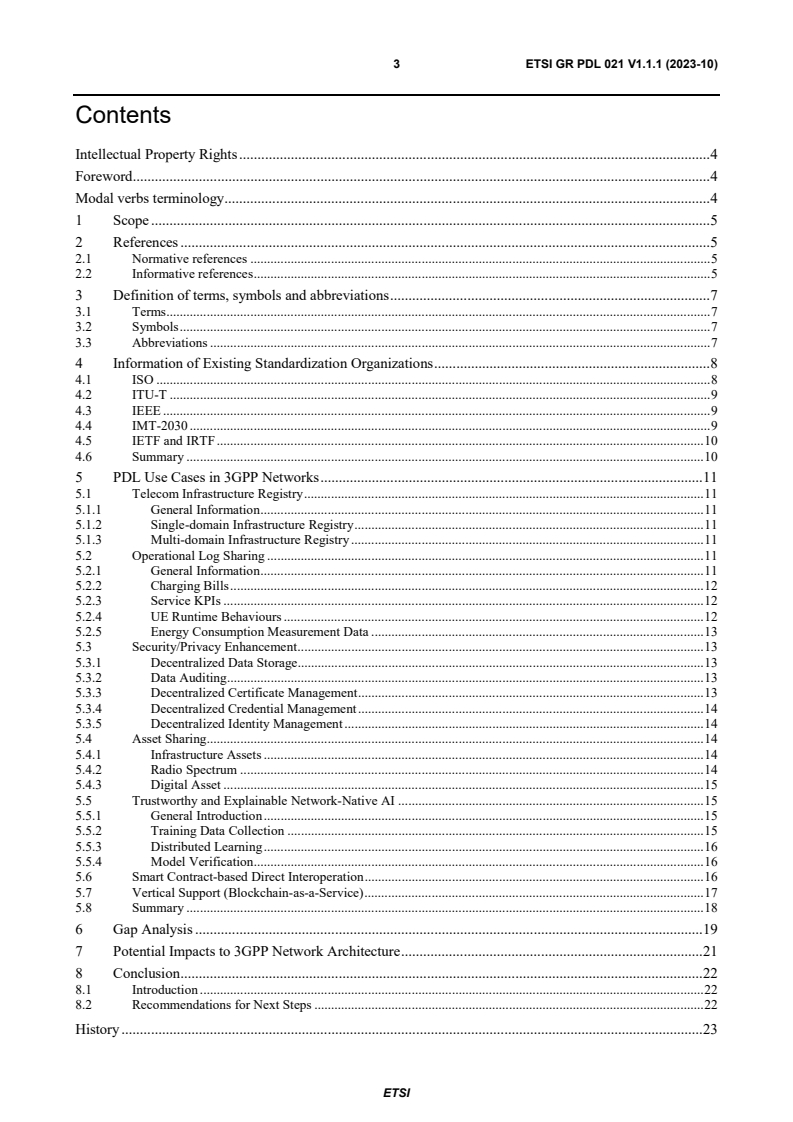
Contents
Intellectual Property Rights . 4
Foreword . 4
Modal verbs terminology . 4
1 Scope . 5
2 References . 5
2.1 Normative references . 5
2.2 Informative references . 5
3 Definition of terms, symbols and abbreviations . 7
3.1 Terms . 7
3.2 Symbols . 7
3.3 Abbreviations . 7
4 Information of Existing Standardization Organizations . 8
4.1 ISO . 8
4.2 ITU-T . 9
4.3 IEEE . 9
4.4 IMT-2030 . 9
4.5 IETF and IRTF . 10
4.6 Summary . 10
5 PDL Use Cases in 3GPP Networks . 11
5.1 Telecom Infrastructure Registry . 11
5.1.1 General Information . 11
5.1.2 Single-domain Infrastructure Registry . 11
5.1.3 Multi-domain Infrastructure Registry . 11
5.2 Operational Log Sharing . 11
5.2.1 General Information . 11
5.2.2 Charging Bills . 12
5.2.3 Service KPIs . 12
5.2.4 UE Runtime Behaviours . 12
5.2.5 Energy Consumption Measurement Data . 13
5.3 Security/Privacy Enhancement . 13
5.3.1 Decentralized Data Storage. 13
5.3.2 Data Auditing . 13
5.3.3 Decentralized Certificate Management . 13
5.3.4 Decentralized Credential Management . 14
5.3.5 Decentralized Identity Management . 14
5.4 Asset Sharing . 14
5.4.1 Infrastructure Assets . 14
5.4.2 Radio Spectrum . 14
5.4.3 Digital Asset . 15
5.5 Trustworthy and Explainable Network-Native AI . 15
5.5.1 General Introduction . 15
5.5.2 Training Data Collection . 15
5.5.3 Distributed Learning . 16
5.5.4 Model Verification . 16
5.6 Smart Contract-based Direct Interoperation . 16
5.7 Vertical Support (Blockchain-as-a-Service) . 17
5.8 Summary . 18
6 Gap Analysis . 19
7 Potential Impacts to 3GPP Network Architecture . 21
8 Conclusion . 22
8.1 Introduction . 22
8.2 Recommendations for Next Steps . 22
History . 23
ETSI
4 ETSI GR PDL 021 V1.1.1 (2023-10)
Intellectual Property Rights
Essential patents
IPRs essential or potentially essential to normative deliverables may have been declared to ETSI. The declarations
pertaining to these essential IPRs, if any, are publicly available for ETSI members and non-members, and can be
found in ETSI SR 000 314: "Intellectual Property Rights (IPRs); Essential, or potentially Essential, IPRs notified to
ETSI in respect of ETSI standards", which is available from the ETSI Secretariat. Latest updates are available on the
ETSI Web server (https://ipr.etsi.org/).
Pursuant to the ETSI Directives including the ETSI IPR Policy, no investigation regarding the essentiality of IPRs,
including IPR searches, has been carried out by ETSI. No guarantee can be given as to the existence of other IPRs not
referenced in ETSI SR 000 314 (or the updates on the ETSI Web server) which are, or may be, or may become,
essential to the present document.
Trademarks
The present document may include trademarks and/or tradenames which are asserted and/or registered by their owners.
ETSI claims no ownership of these except for any which are indicated as being the property of ETSI, and conveys no
right to use or reproduce any trademark and/or tradename. Mention of those trademarks in the present document does
not constitute an endorsement by ETSI of products, services or organizations associated with those trademarks.
DECT™, PLUGTESTS™, UMTS™ and the ETSI logo are trademarks of ETSI registered for the benefit of its
Members. 3GPP™ and LTE™ are trademarks of ETSI registered for the benefit of its Members and of the 3GPP
Organizational Partners. oneM2M™ logo is a trademark of ETSI registered for the benefit of its Members and of the ®
oneM2M Partners. GSM and the GSM logo are trademarks registered and owned by the GSM Association.
Foreword
This Group Report (GR) has been produced by ETSI Industry Specification Group (ISG) Permissioned Distributed
Ledger (PDL).
Modal verbs terminology
In the present document "should", "should not", "may", "need not", "will", "will not", "can" and "cannot" are to be
interpreted as described in clause 3.2 of the ETSI Drafting Rules (Verbal forms for the expression of provisions).
"must" and "must not" are NOT allowed in ETSI deliverables except when used in direct citation.
ETSI
5 ETSI GR PDL 021 V1.1.1 (2023-10)
1 Scope
The present document will first provide an overview of use cases/scenarios of PDL specific to mobile networks, based
on the deliverables published in major existing standardization bodies. It aims to form a common view to summarize the
key benefits of PDL technology to mobile network domain (including its operation controls and services).
Within one or multiple operators, utilizing PDL technology can be widely adopted in different domains (e.g. ranging
from end users, RAN/core network to service providers) of a mobile network system and different layers (e.g. data flow
layer, management layer and business layer), thus this WI will further identify several key
issues/challenges/deficiencies to specialize PDL solutions to a mobile network system and its essential impact to the
mobile network system architecture, which could refer 3GPP 5G architecture as a base.
Some WIs already show an initial try by introducing a new network entity in mobile networks to connect to PDL
services, this WI will comprehensively investigate if there will be any necessity to make modifications to the mobile
network system architecture (starting with 3GPP 5G reference architecture) to integrate PDL in a holistic way.
2 References
2.1 Normative references
Normative references are not applicable in the present document.
2.2 Informative references
References are either specific (identified by date of publication and/or edition number or version number) or
non-specific. For specific references, only the cited version applies. For non-specific references, the latest version of the
referenced document (including any amendments) applies.
NOTE: While any hyperlinks included in this clause were valid at the time of publication, ETSI cannot guarantee
their long term validity.
The following referenced documents are not necessary for the application of the present document but they assist the
user with regard to a particular subject area.
[i.1] ISO/TR 3242:2022: "Blockchain and distributed ledger technologies -- Use cases".
[i.2] ISO/PRF TR 6039: "Blockchain and distributed ledger technologies -- Identifiers of subjects and
objects for the design of blockchain systems".
[i.3] ISO/WD TR 6277.2: "Blockchain and distributed ledger technologies -- Data flow model for
blockchain and DLT use cases".
[i.4] ISO/WD 7603: "Decentralized Identity standard for the identification of subjects and objects".
[i.5] ISO/AWI 20435: "Representing Physical Assets using Non-Fungible Tokens".
[i.6] ISO 22739:2020: "Blockchain and distributed ledger technologies -- Vocabulary".
[i.7] ISO/TR 23244:2020: "Blockchain and distributed ledger technologies -- Privacy and personally
identifiable information protection considerations".
[i.8] ISO/TR 23249:2022: "Blockchain and distributed ledger technologies -- Overview of existing
DLT systems for identity management".
[i.9] ISO 23257:2022: "Blockchain and distributed ledger technologies -- Reference architecture".
[i.10] ISO/TS 23258:2021: "Blockchain and distributed ledger technologies -- Taxonomy and
Ontology".
ETSI
6 ETSI GR PDL 021 V1.1.1 (2023-10)
[i.11] ISO/TR 23455:2019: "Blockchain and distributed ledger technologies -- Overview of and
interactions between smart contracts in blockchain and distributed ledger technology systems".
[i.12] ISO/AWI TS 23516: "Blockchain and distributed ledger technology -- Interoperability
Framework".
[i.13] ISO/TR 23576:2020: "Blockchain and distributed ledger technologies -- Security management of
digital asset custodians".
[i.14] ISO/TS 23635:2022: "Blockchain and distributed ledger technologies -- Guidelines for
governance".
[i.15] ISO/WD TR 23642: "Blockchain and distributed ledger technologies -- Overview of smart
contract security good practice and issues".
[i.16] ISO/DTR 23644: "Blockchain and distributed ledger technologies -- Overview of trust anchors for
DLT-based identity management (TADIM)".
[i.17] ITU-T/FG DLT D1.1 TS: "DLT terms and definitions".
[i.18] ITU-T/FG DLT D1.2 TR: "DLT overview, concepts, ecosystem.
[i.19] ITU-T/FG DLT D1.3 TR: "DLT standardization landscape".
[i.20] ITU-T/FG DLT D2.1 TR: "DLT use cases".
[i.21] ITU-T/FG DLT D3.1 TS: "DLT reference architecture".
[i.22] ITU-T/FG DLT D3.3 TS: "Assessment criteria for DLT platforms".
[i.23] ITU-T/FG DLT D4.1 TR: "DLT regulatory framework".
[i.24] ITU-T/FG DLT D5.1 TR: "Outlook on distributed ledger technologies".
TM
[i.25] IEEE Std 3801 -2022: "Standard for Blockchain-based Electronic Contracts", vol., no., pp.1-26,
1 April 2022, doi: 10.1109/IEEESTD.2022.9745868.
TM
[i.26] IEEE Std 2418.10 -2022: "Standard for Blockchain based Digital Asset Management", vol., no.,
pp.1-19, 30 June 2022, doi: 10.1109/IEEESTD.2022.9810177.
TM
[i.27] IEEE Std 2146.1 -2022: "Standard for Entity-Based Risk Mutual Assistance Model through
Blockchain Technology", vol., no., pp.1-18, 11 August 2022, doi:
10.1109/IEEESTD.2022.9853246.
TM
[i.28] IEEE Std 2142.1 -2021: "Recommended Practice for E-Invoice Business Using Blockchain
Technology", vol., no., pp.1-18, 18 March 2021, doi: 10.1109/IEEESTD.2021.9381780.
TM
[i.29] IEEE Std 2140.2 -2021: "Standard for Security Management for Customer Cryptographic Assets
on Cryptocurrency Exchanges", vol., no., pp.1-20, 10 January 2022, doi:
10.1109/IEEESTD.2022.9676563.
TM
-2020: "Standard for General Requirements for Cryptocurrency Exchanges",
[i.30] IEEE Std 2140.1
vol., no., pp.1-18, 4 November 2020, doi: 10.1109/IEEESTD.2020.9248667.
TM
[i.31] IEEE Std 2140.5 -2020: "Standard for a Custodian Framework of Cryptocurrency", vol., no.,
pp.1-23, 17 July 2020, doi: 10.1109/IEEESTD.2020.9144688.
TM
[i.32] IEEE Std 2142.1 -2021: "Recommended Practice for E-Invoice Business Using Blockchain
Technology", vol., no., pp.1-18, 18 March 2021, doi: 10.1109/IEEESTD.2021.9381780.
TM
-2020: "Standard for General Process of Cryptocurrency Payment", vol., no.,
[i.33] IEEE Std 2143.1
pp.1-14, 12 June 2020, doi: 10.1109/IEEESTD.2020.9115946.
TM
[i.34] IEEE Std 2144.1 -2020: "Standard for Framework of Blockchain-based Internet of Things (IoT)
Data Management", vol., no., pp.1-20, 18 January 2021, doi: 10.1109/IEEESTD.2021.9329260.
ETSI
7 ETSI GR PDL 021 V1.1.1 (2023-10)
TM
[i.35] IEEE Std 2418.7 -2021: "Standard for the Use of Blockchain in Supply Chain Finance",
vol., no., pp.1-25, 28 October 2021, doi: 10.1109/IEEESTD.2021.9599622.
TM
-2020: "Standard for Data Format for Blockchain Systems", vol., no., pp.1-32,
[i.36] IEEE Std 2418.2
23 December 2020, doi: 10.1109/IEEESTD.2020.9303503.
TM
[i.37] IEEE P2145/D1: "Draft Standard for Framework and Definitions for Blockchain Governance",
vol., no., pp.1-35, 10 March 2023.
[i.38] IMT-2030 Network Group: "6G blockchain scenarios and requirements".
[i.39] IMT-2030 Network Group: "6G blockchain architecture and key technology".
[i.40] Birkholz, H., Delignat-Lavaud, A., Fournet, C., & Deshpande, Y. (2023): "An Architecture for
Trustworthy and Transparent Digital Supply Chains"(Internet-Draft draft-ietf-scitt-
architecture-01). Internet Engineering Task Force.
[i.41] Hardjono, T., Hargreaves, M., Smith, N., & Ramakrishna, V. (2023): "Secure Asset Transfer
(SAT) Interoperability Architecture" (Internet-Draft draft-hardjono-sat-architecture-03). Internet
Engineering Task Force.
[i.42] Urien, P. (2022): "Blockchain Transaction Protocol for Constraint Nodes" (Internet-Draft
draft-urien-core-blockchain-transaction-protocol-09). Internet Engineering Task Force.
[i.43] The Personal Information Protection Law (PIPL) of the People's Republic of China,
www.npc.gov.cn, Retrieved 2021-09-30.
[i.44] The Act on the Protection of Personal Information (APPI) of Japan, www.ppc.go.jp, Retrieved
2017-05-30.
[i.45] "AB-375, Chau. Privacy: personal information: businesses". California State Legislature.
Retrieved 2018-11-19.
[i.46] The General Data Protection Regulation (GDPR) in the EU and the European Economic Area
(EEA), Retrieved 2016-04-27.
[i.47] ETSI GR PDL 020 (V1.1.1): "Wireless Consensus Network".
3 Definition of terms, symbols and abbreviations
3.1 Terms
Void.
3.2 Symbols
Void.
3.3 Abbreviations
For the purposes of the present document, the following abbreviations apply:
rd
3GPP 3 Generation Partnership Project
AI Artificial Intelligence
AI4NET AI for NETwork
APPI Act on the Protection of Personal Information
AR Augmented Reality
BC BlockChain
BCaaS BlockChain as a Service
BS Base Station
ETSI
8 ETSI GR PDL 021 V1.1.1 (2023-10)
CA Certificate Authority
CCPA California Consumer Privacy Act
CLOUD Clarifying Lawful Overseas Use of Data act
DAPP Decentralized APPlication
DLT Distributed Ledger Technology
DRL Deep Reinforcement Learning
E2E End-to-End
ETSI European Telecommunications Standard Institute
FL Federated Learning
GDPR General Data Privacy Regulation
IEEE Institute of Electrical and Electronics Engineers
IETF Internet Engineering Task Force
IMT International Mobile Telecommunications
IoT Internet of Things
IRTF Internet Research Task Force
ISO International Standard Organization
ITU International Telecommunication Union
KPI Key Performance Indicator
LTE Long Term Evolution
M2M Machine-to-Machine
ML Machine Learning
NET4AI NETwork for AI
NF Network Function
NFT Non-Fungible Token
PKI Public Key Infrastructure
QoS Quality-of-Service
RAN Radio Access Network
RSU Road Side Unit
SAT Security Asset Transfer
SIM Subscriber Identity Module
SME Small and Medium-sized Enterprises
UE User Entity
UMTS Universal Mobile Telecommunications Service
V2X Vehicle-to-Everything
VC Verifiable Credential
VR Virtual Reality
XR eXtended Reality
4 Information of Existing Standardization Organizations
4.1 ISO
In 2016, ISO/TC 307 "blockchain and distributed ledger technologies" has been set up to meet the growing need for
standardization in this area by providing internationally agreed ways of working with it to improve security, privacy and
facilitate worldwide use of the technology through better interoperability. This is especially relevant due to the number
of SMEs, across various sectors, that are developing blockchain and distributed ledger technologies as a product.
The scope of ISO/TC 307 reads: "standardisation of blockchain technologies and distributed ledger technologies."
ISO/TC 307 has 7 Working Groups (WG). Specifically, WG1 places the foundation by defining the necessary
terminologies for ISO/TC 207 [i.6], [i.10]; WG2 Architecture [i.9]; WG3's interests are on smart contracts and their
applications [i.13],[i.15]; WG4 focuses on security, privacy and identity [i.2], [i.4], [i.7], [i.8], [i.11], [i.13], [i.16];
WG5 studies the mechanism of blockchain systems' governance [i.14]; WG6 aims to identify typical use cases [i.1],
[i.3], [i.5]; and WG7 investigates the interoperability issues of blockchain systems [i.11], [i.12].
In addition to the 7 WGs, ISO/TC 307 has 3 Advisory Groups (AGs), 4 Ad-Hoc Group (AHG) and 1 Joint Working
Group (JWG). Blockchain and distributed ledger technologies is a rapidly evolving and expanding area. The need for
collaboration and cooperation has been identified and ISO/TC 307 is liaising with the relevant ISO and IEC
committees, as well as external organizations, to minimize any overlap.
ETSI
9 ETSI GR PDL 021 V1.1.1 (2023-10)
4.2 ITU-T
The ITU-T Focus Group on Application of Distributed Ledger Technology (FG DLT) was established in May 2017 and
st
concluded on 1 August 2019.
A key element of achieving this mission was to identify and introduce the foundation of the DLT ecosystem (including
e.g. terms and definitions [i.17], taxonomies and concepts [i.18], and standardization activities [i.19]). In order to better
understand how the technology can be applied in different scenarios and industries, FG DLT conducted an in-depth
analysis of applications and services based on DLT, represented in its report [i.20] where 39 use cases were selected
from the vertical (e.g. financial, healthcare, information and communication technology, entertainment, industrial,
government and public sectors) and horizontal domains (e.g. identity, security and data management, governance and
decentralized autonomous organizations, and crypto-infrastructure).
FG DLT has studied many of the DLT platforms available and described their key components and features. The
common components and features are defined in the Focus Group's "DLT reference architecture" specification, which
also describes their hierarchical relationship [i.21]. In addition, FG DLT identified "Assessment criteria for DLT
platforms" described in a separate specification [i.22]. These 25 criteria aim to assist implementers to evaluate and
compare different platforms.
Apart from considering technical issues, many implementers are concerned with the applicability of DLT in their
respective legal and regulatory environments. Meanwhile, lawmakers and regulators are considering the need to adapt
their instruments to this emerging technology. FG DLT has considered the key properties of DLT and their relevance to
law and regulation in [i.23]. By analysing associated challenges and supplying practical recommendations addressing
users, regulators, and technologists, the "DLT regulatory framework" developed by this FG aims to create awareness
and mitigate risks. Developed by a multidisciplinary group of experts, the report in [i.23] describes DLT-property
specific problems and risks, and guides stakeholders on how to address them. The "DLT Outlook" in [i.24] report
explores the advancement of DLT beyond the current state of development, and addresses, inter alia, governance,
computation networks, identity and privacy, resilience, risk and audit. The report in [i.24] summarizes existing studies,
provides the reader with some future perspectives on these issues, and discusses related standardization aspects.
4.3 IEEE
The IEEE Future Directions Committee, represented by the societies of the IEEE, approved the formation of the IEEE
st
Blockchain Initiative effective 1 January, 2018. This initiative will be the hub for all IEEE Blockchain projects and
activities. The BLK encompasses a comprehensive set of projects and activities supported by the following core
subcommittees: Pre/Standards, Education, Conferences and Events, Community Development and Outreach,
Publications, and Special Projects. So far, it published 11 IEEE standards under this Standardization Association (SA).
The first area of the SA is about the general features and fundamental building blocks of DLT such as electronic
contracts [i.25], digital asset management [i.26], E-invoice [i.28], [i.32], data format [i.36], Internet of Things (IoT) data
management [i.34], supply chain finance [i.35] and its governance [i.37]. Another interest of the SA is about
cryptocurrency, the standards cover its security management [i.29], the requirements for exchanges [i.30], defining a
custodian framework [i.31] and the general payment process with cryptocurrency [i.33]; in addition, the SA also covers
how to build mutual assistance model in a trustless environment based on blockchain/DLT [i.27].
Moreover, there are more than 50 additional standards under development.
4.4 IMT-2030
IMT-2030 aims to explore the possibility and application scenarios of combining blockchain with 6G
networks/businesses in 6G scenarios. By analysing the development trend and security vision of 6G networks, it tries to
extract the combination points of 6G and blockchain, using the decentralized, tamper-proof and consensus-based
characteristics of blockchain to serve multiple scenarios of 6G networks/businesses [i.38].
Meanwhile, according to the characteristics of 6G networks/businesses, IMT-2030 reversely promotes the development
of blockchain technology. Based on scenarios and requirements, it studies the key technologies involved in the
integrated architecture of blockchain and communication networks [i.39].
ETSI
10 ETSI GR PDL 021 V1.1.1 (2023-10)
4.5 IETF and IRTF
From IETF, there is no dedicated working group for DLT. However, blockchain technology is mentioned in several use
cases in different drafts. For example, blockchain technology was used for building supply chain infrastructure,
designing a secure asset transfer protocol as well as enhancing the RESTful protocol to design a blockchain transaction
protocol for Constraint Nodes [i.40].
From IRTF, the Decentralized Internet Infrastructure Research Group (DINRG) investigates open research issues in
decentralizing infrastructure services such as trust management, identity management, name resolution, resource/asset
ownership management, and resource discovery. The focus of DINRG is on infrastructure services that can benefit from
decentralization or that are difficult to realize in local, potentially connectivity-constrained networks. The objective of
DINRG is to:
1) investigate (understand, document, survey) use cases and their specific requirements with respect to
implementing them in a distributed manner;
2) to discuss and assess solutions for specific use cases with a focus on Internet level deployment issues such as
scalability, performance, and security;
3) to develop and document technical solutions and best practices;
4) to develop tools and metrics to identify scaling issues and to determine whether components are missing; and
5) to identify future work items for the IETF.
Other topics of interest are the investigation of economic drivers and incentives and the development and operation of
experimental platforms. For example, a Security Asset Transfer (SAT) interoperability architecture was proposed in
[i.41]; and a transaction protocol for constraint nodes were proposed in [i.42].
4.6 Summary
The analysis in previous parts shows that most of the existing standardization organizations (such as ISO, ITU-T and
IEEE) involve the study the blockchain/DLT itself. In other words, studies on its internal mechanisms are widely
undertaken as a major research area. For example, ISO focuses on the standardization of the definition of
blockchain/DLT, the reference service architecture; ITU-T covers the definition, framework, management, smart
contract and even quantum-resistant blockchain, etc.
In addition, most of the existing standardization organizations involve studies on the applications of blockchain/DLT to
various vertical industries. For example, ISO studies how blockchain/DLT can be applied to vertical industries; ITU-T
has study items on deploying blockchain services within a telecommunication infrastructure such as blockchain-based
self-organized IoT network, blockchain-based charging mechanism, personal healthy record databases and so on. IEEE
has study items about Fintech, cryptocurrency, digital invoice and so on.
So far, among the existing standardization organizations, studies on applying blockchain/DLT in telecommunication
industry, especially in the scope of 3GPP domain, are rare. Specifically, on the one hand, it is lack of further studies on
the impact of blockchain/DLT to the architecture of a 3GPP network; on the other hand, how a 3GPP network can
facilitate the development of blockchain/DLT applications is also missing. These two aspects are the focus of this study,
which will fill the gap in the research community.
ETSI
11 ETSI GR PDL 021 V1.1.1 (2023-10)
5 PDL Use Cases in 3GPP Networks
5.1 Telecom Infrastructure Registry
5.1.1 General Information
The telecom infrastructure of an operator contains many components geographically distributed across nationwide. For
example, hardware components can be Base Stations (BS) in Radio Access Networks (RAN), (fibre) cables, network
switches and routers in transport networks, and server machines and networking devices in telecom cloud data centres.
In addition, with softwarization of the telecom infrastructure, many conventional hardware components are being
replaced with cloud-native virtual elements. More importantly, in future generations of telecom infrastructures, virtual
network entities do not have to tightly coupled with the underlying hardware resource owned by the operator. Instead,
rd
network entities can be flexibly virtualized with 3 -party resource providers (e.g. a cloud provider and/or other
operators' domains). This means that the telecom infrastructure can be federated. Given the factors above, registering
and tracking the (physical and virtual) components of the entire infrastructure will not be a static and single domain task
anymore. Instead, the number of components in the telecom infrastructure will not only become significantly larger,
much more dynamic, but also involve multiple domains. This poses new challenges to all parties involved in building a
federated infrastructure. However, PDL can be utilized to facilitate sharing the registry and tracking information of the
components from individual domains; meanwhile, PDL also improves the credibility and synchronization of the state of
the infrastructure. There are two main sub-cases, which are introduced next.
5.1.2 Single-domain Infrastructure Registry
For a single domain case, from hardware to software entities, the infrastructure is under the control of one operator. In
this case, PDL can be used to build a distributed registration repository layer, where network managers controlling
different segments can commit the activities of the network entities in the respective segments into the registration
repository. In this way, a hierarchical registry organization for tracking the network components within the
infrastructure can be avoided. Rather, a global and synchronized view of the whole infrastructure can be maintained.
Even a digital twin of the telecom network infrastructure can be built for other purposes.
5.1.3 Multi-domain Infrastructure Registry
For a multi-domain case, the infrastructure is under control of different participants, where each participant contributes
its own segment constitute the entire infrastructure. In this case, PDL can be used to build a decentralized registration
repository layer, where owners of different parties can directly access and provide information of the involved resource
elements. The registration repository based on PDL is owned by all participants and no one can dominate. Hence, with
PDL, the information shared via the decentralized registration layer is immutable and automatically synchronized. This
helps to avoid setting up a centralized registry where information from all the parties is aggregated. Such a
decentralized infrastructure registry becomes necessary in the future generation of constructing a federated telecom
network infrastructure.
5.2 Operational Log Sharing
5.2.1 General Information
When a telecom network is in operation, operational logs are generated. These operational logs provide important
information for service provisioning, optimization and coordination with application service providers. In the future the
telecom network service will deeply couple with other participants (e.g. cloud providers where Internet applications
locate and/or non-public networks widely used in industry sectors). However, directly sharing operational log is still
difficult among different parties because:
1) there is no standardized interface and procedure where different parties can directly use;
2) setting up a direct sharing channel involves complicated preparations for agreements on data privacy, law
issues and so on.
ETSI
12 ETSI GR PDL 021 V1.1.1 (2023-10)
As a result, a trusted third party is usually required. PDL can largely simplify and automate such operational log sharing
process. For solving this issue, specifically, a shared data layer can be created based on PDL. It facilitates different
rd
party and avoid complicated agreement negotiation
players to share operational log data without a commonly trusted 3
process. There are following use cases for sharing different kinds of operational data.
5.2.2 Charging Bills
Auditing invoice bills is a cumbersome operational task especially for roaming involving different operators. For
example, traditional use cases include roaming charging for mobile users traveling to different countries; in addition,
when a network service is transported with different networks, each network domain will issue billing invoices not only
for the end users, but also for other operators/service providers together forming the end-to-end infrastructure.
rd
For a long time, multi-party charging accounting relies on a 3 party to audit the billing data that are submitted from
different parties; after that, calculations and calibrations are made; at the end, the results are sent back for a final review
from different parties; once all these steps are done, the final invoices can be issued. The whole procedure takes time
and could be error prone.
With a shared data layer based on PDL, immutable charging bills related to specific service provisioning (e.g. data
volume consumptions) can be directly shared across different parties directly even in real time. With the mutually
synchronized data, the charging bills can be directly verified and accounted by relevant parties that are involved in a
rd
decentralized manner without a centralized 3 party. This largely improves the efficiency of the accounting process.
5.2.3 Service KPIs
The Quality-of-Service (QoS) is critical to user experience. With the service paradigm shifting to a fully dynamic and
flexible manner, monitoring KPIs of the services is not only the job of the operators, but also necessary to service
providers because in order to guarantee QoS (user experience), coordination in terms of the real time service KPIs is
inevitable.
Traditionally, there is only a few limited ways to expose and share service KPIs to other parties. For example, a service
provider can retrieve certain KPIs through interacting with a standardized NF and interface. This can only work with
two parties that can communicate with 3GPP specifications. However, in the future application scenarios, involved
players may cross different kinds of networks/systems. Hence, such a predefined method is neither common, flexible
nor efficient.
PDL can enable a novel network KPI data recording mechanism, where KPI data can be recorded in the first time, fast,
efficient, tamper-proof record on the ledger with a pre-defined consensus protocol.
5.2.4 UE Runtime Behaviours
UE behaviours data are operational data while a UE is active and uses a network service. UE behaviours are critical to
the decision-making process if the operator wants to adapt the network control to guarantee the user experience. This
may not only happen in a single domain of one telecom network, but also across different network operators and/or
application service providers. Therefore, sharing UE behaviour data is important when coordination among different
parties are required, which is not trivial without a trustworthy shared data layer. PDL can be a promising tool to build
this shared data layer, where UE runtime behaviours are committed into the ledger and safely shared beyond the
boundary of network domain. This improves the timeliness of the UE runtime behaviours shared among different
participants.
ETSI
13 ETSI GR PDL 021 V1.1.1 (2023-10)
5.2.5 Energy Consumption Measurement Data
In addition to all kinds of operational log data for system performance and use experience, the next generation of
telecom networks also aim to be sustainable and environment friendly. This asks for a stronger monitor on energy
consumption and based on that, corresponding energy saving solutions can be figured out. As mentioned, the future
telecom infrastructure will evolve to be virtualized, cloud-native and federated with many different infrastructure
players (contributing different types of resources and services). Sharing energy consumption measurement data among
those involved players become necessary. However, existing architecture and framework does not well support the
energy consumption of the whole service chain from data collection, measurement and sharing with similar reasons as
the previous use cases. Based on PDL, collected energy consumption measurement data (bound to corresponding
services) can be signed, certified by individual domains and directly shared over the distributed ledger. This can help all
relevant parties to yield much more precise energy consumption measurement data and coordinate each to figure a joint
energy saving solution where the aggregated effects can be maximized.
5.3 Security/Privacy Enhancement
5.3.1 Decentralized Data Storage
An operator keeps different types of data for operation. These data could be user-owned data, subscription data,
operational logs, system monitoring KPIs and so on. The data could be sensitive and confidential. Hence, any loss or
tamper of UE profile data may not only breach customer's privacy, but also violate law (e.g. GDPR).
With PDL, a decentralized storage system can be built where, firstly, the operator has options to choose the strategy of
how data should be stored, either on-chain or off-chain, depending on the characteristics (e.g. size and sensitivity) of the
data; in additi
...
Questions, Comments and Discussion
Ask us and Technical Secretary will try to provide an answer. You can facilitate discussion about the standard in here.
Loading comments...