


ETSI GS F5G-TEST 030 V1.1.1 (2026-04)
Fifth Generation Fixed Network (F5G); Test Specification for 50G-PON Functionality and Performance
Fifth Generation Fixed Network (F5G); Test Specification for 50G-PON Functionality and Performance
DGS/F5G-0030
General Information
- Status
- Not Published
- Technical Committee
- F5G TEST - TEST
- Current Stage
- 12 - Citation in the OJ (auto-insert)
- Due Date
- 05-Apr-2026
- Completion Date
- 21-Apr-2026

Frequently Asked Questions
ETSI GS F5G-TEST 030 V1.1.1 (2026-04) is a standard published by the European Telecommunications Standards Institute (ETSI). Its full title is "Fifth Generation Fixed Network (F5G); Test Specification for 50G-PON Functionality and Performance". This standard covers: DGS/F5G-0030
DGS/F5G-0030
ETSI GS F5G-TEST 030 V1.1.1 (2026-04) is available in PDF format for immediate download after purchase. The document can be added to your cart and obtained through the secure checkout process. Digital delivery ensures instant access to the complete standard document.
Standards Content (Sample)
GROUP SPECIFICATION
Fifth Generation Fixed Network (F5G);
Test Specification for 50G-PON Functionality and
Performance
Disclaimer
The present document has been produced and approved by the Fifth Generation Fixed Network (F5G) ETSI Industry
Specification Group (ISG) and represents the views of those members who participated in this ISG.
It does not necessarily represent the views of the entire ETSI membership.
2 ETSI GS F5G-TEST 030 V1.1.1 (2026-04)
Reference
DGS/F5G-0030
Keywords
F5G, F5G Advanced, performance, PON, test
ETSI
650 Route des Lucioles
F-06921 Sophia Antipolis Cedex - FRANCE
Tel.: +33 4 92 94 42 00 Fax: +33 4 93 65 47 16
Siret N° 348 623 562 00017 - APE 7112B
Association à but non lucratif enregistrée à la
Sous-Préfecture de Grasse (06) N° w061004871
Important notice
The present document can be downloaded from the
ETSI Search & Browse Standards application.
The present document may be made available in electronic versions and/or in print. The content of any electronic and/or
print versions of the present document shall not be modified without the prior written authorization of ETSI. In case of any
existing or perceived difference in contents between such versions and/or in print, the prevailing version of an ETSI
deliverable is the one made publicly available in PDF format on ETSI deliver repository.
Users should be aware that the present document may be revised or have its status changed,
this information is available in the Milestones listing.
If you find errors in the present document, please send your comments to
the relevant service listed under Committee Support Staff.
If you find a security vulnerability in the present document, please report it through our
Coordinated Vulnerability Disclosure (CVD) program.
Notice of disclaimer & limitation of liability
The information provided in the present deliverable is directed solely to professionals who have the appropriate degree of
experience to understand and interpret its content in accordance with generally accepted engineering or
other professional standard and applicable regulations.
No recommendation as to products and services or vendors is made or should be implied.
No representation or warranty is made that this deliverable is technically accurate or sufficient or conforms to any law
and/or governmental rule and/or regulation and further, no representation or warranty is made of merchantability or fitness
for any particular purpose or against infringement of intellectual property rights.
In no event shall ETSI be held liable for loss of profits or any other incidental or consequential damages.
Any software contained in this deliverable is provided "AS IS" with no warranties, express or implied, including but not
limited to, the warranties of merchantability, fitness for a particular purpose and non-infringement of intellectual property
rights and ETSI shall not be held liable in any event for any damages whatsoever (including, without limitation, damages
for loss of profits, business interruption, loss of information, or any other pecuniary loss) arising out of or related to the use
of or inability to use the software.
Copyright Notification
No part may be reproduced or utilized in any form or by any means, electronic or mechanical, including photocopying and
microfilm except as authorized by written permission of ETSI.
The content of the PDF version shall not be modified without the written authorization of ETSI.
The copyright and the foregoing restriction extend to reproduction in all media.
© ETSI 2026.
All rights reserved.
ETSI
3 ETSI GS F5G-TEST 030 V1.1.1 (2026-04)
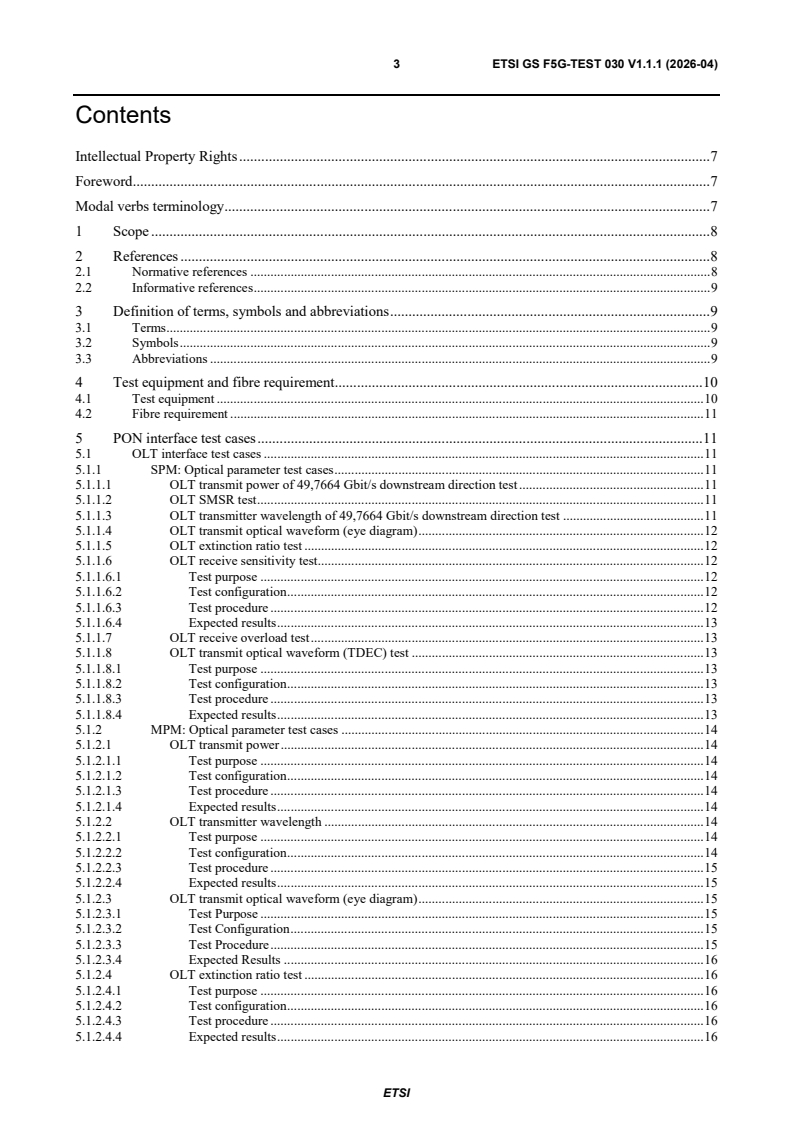
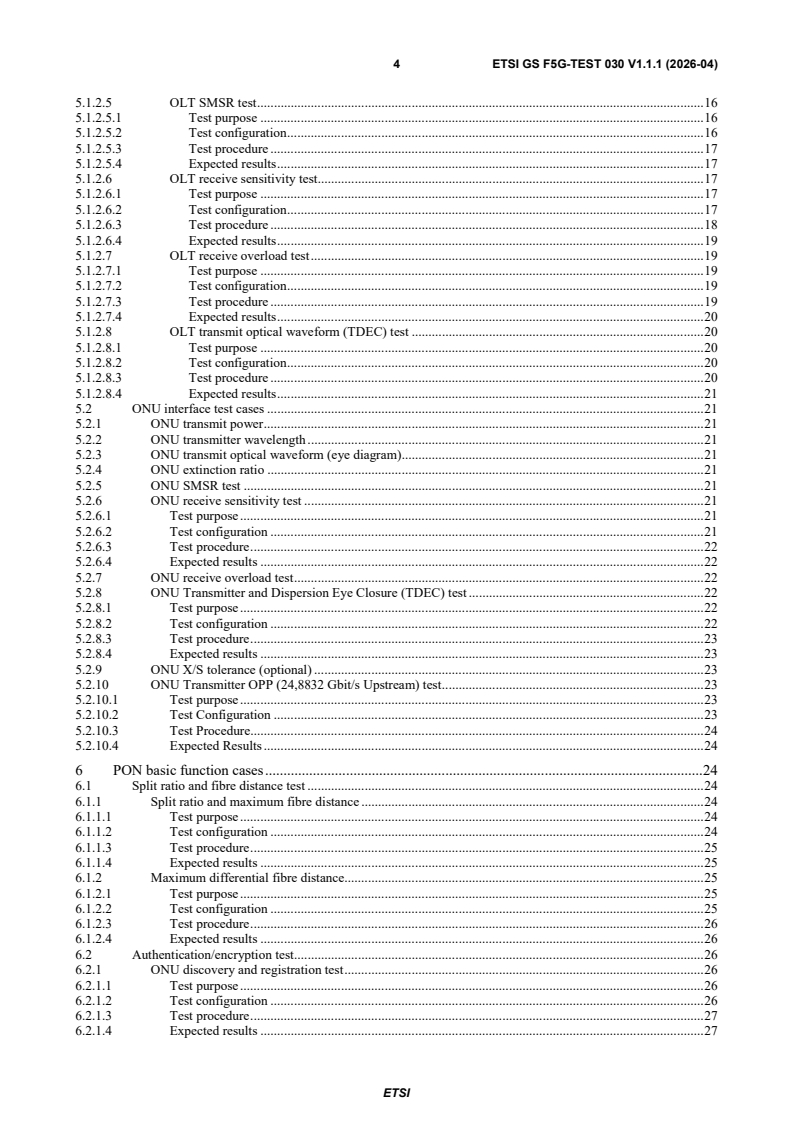
Contents
Intellectual Property Rights . 7
Foreword . 7
Modal verbs terminology . 7
1 Scope . 8
2 References . 8
2.1 Normative references . 8
2.2 Informative references . 9
3 Definition of terms, symbols and abbreviations . 9
3.1 Terms . 9
3.2 Symbols . 9
3.3 Abbreviations . 9
4 Test equipment and fibre requirement . 10
4.1 Test equipment . 10
4.2 Fibre requirement . 11
5 PON interface test cases . 11
5.1 OLT interface test cases . 11
5.1.1 SPM: Optical parameter test cases . 11
5.1.1.1 OLT transmit power of 49,7664 Gbit/s downstream direction test . 11
5.1.1.2 OLT SMSR test . 11
5.1.1.3 OLT transmitter wavelength of 49,7664 Gbit/s downstream direction test . 11
5.1.1.4 OLT transmit optical waveform (eye diagram) . 12
5.1.1.5 OLT extinction ratio test . 12
5.1.1.6 OLT receive sensitivity test. 12
5.1.1.6.1 Test purpose . 12
5.1.1.6.2 Test configuration . 12
5.1.1.6.3 Test procedure . 12
5.1.1.6.4 Expected results . 13
5.1.1.7 OLT receive overload test . 13
5.1.1.8 OLT transmit optical waveform (TDEC) test . 13
5.1.1.8.1 Test purpose . 13
5.1.1.8.2 Test configuration . 13
5.1.1.8.3 Test procedure . 13
5.1.1.8.4 Expected results . 13
5.1.2 MPM: Optical parameter test cases . 14
5.1.2.1 OLT transmit power . 14
5.1.2.1.1 Test purpose . 14
5.1.2.1.2 Test configuration . 14
5.1.2.1.3 Test procedure . 14
5.1.2.1.4 Expected results . 14
5.1.2.2 OLT transmitter wavelength . 14
5.1.2.2.1 Test purpose . 14
5.1.2.2.2 Test configuration . 14
5.1.2.2.3 Test procedure . 15
5.1.2.2.4 Expected results . 15
5.1.2.3 OLT transmit optical waveform (eye diagram) . 15
5.1.2.3.1 Test Purpose . 15
5.1.2.3.2 Test Configuration . 15
5.1.2.3.3 Test Procedure . 15
5.1.2.3.4 Expected Results . 16
5.1.2.4 OLT extinction ratio test . 16
5.1.2.4.1 Test purpose . 16
5.1.2.4.2 Test configuration . 16
5.1.2.4.3 Test procedure . 16
5.1.2.4.4 Expected results . 16
ETSI
4 ETSI GS F5G-TEST 030 V1.1.1 (2026-04)
5.1.2.5 OLT SMSR test . 16
5.1.2.5.1 Test purpose . 16
5.1.2.5.2 Test configuration . 16
5.1.2.5.3 Test procedure . 17
5.1.2.5.4 Expected results . 17
5.1.2.6 OLT receive sensitivity test. 17
5.1.2.6.1 Test purpose . 17
5.1.2.6.2 Test configuration . 17
5.1.2.6.3 Test procedure . 18
5.1.2.6.4 Expected results . 19
5.1.2.7 OLT receive overload test . 19
5.1.2.7.1 Test purpose . 19
5.1.2.7.2 Test configuration . 19
5.1.2.7.3 Test procedure . 19
5.1.2.7.4 Expected results . 20
5.1.2.8 OLT transmit optical waveform (TDEC) test . 20
5.1.2.8.1 Test purpose . 20
5.1.2.8.2 Test configuration . 20
5.1.2.8.3 Test procedure . 20
5.1.2.8.4 Expected results . 21
5.2 ONU interface test cases . 21
5.2.1 ONU transmit power . 21
5.2.2 ONU transmitter wavelength . 21
5.2.3 ONU transmit optical waveform (eye diagram). 21
5.2.4 ONU extinction ratio . 21
5.2.5 ONU SMSR test . 21
5.2.6 ONU receive sensitivity test . 21
5.2.6.1 Test purpose . 21
5.2.6.2 Test configuration . 21
5.2.6.3 Test procedure . 22
5.2.6.4 Expected results . 22
5.2.7 ONU receive overload test . 22
5.2.8 ONU Transmitter and Dispersion Eye Closure (TDEC) test . 22
5.2.8.1 Test purpose . 22
5.2.8.2 Test configuration . 22
5.2.8.3 Test procedure . 23
5.2.8.4 Expected results . 23
5.2.9 ONU X/S tolerance (optional) . 23
5.2.10 ONU Transmitter OPP (24,8832 Gbit/s Upstream) test . 23
5.2.10.1 Test purpose . 23
5.2.10.2 Test Configuration . 23
5.2.10.3 Test Procedure . 24
5.2.10.4 Expected Results . 24
6 PON basic function cases . 24
6.1 Split ratio and fibre distance test . 24
6.1.1 Split ratio and maximum fibre distance . 24
6.1.1.1 Test purpose . 24
6.1.1.2 Test configuration . 24
6.1.1.3 Test procedure . 25
6.1.1.4 Expected results . 25
6.1.2 Maximum differential fibre distance. 25
6.1.2.1 Test purpose . 25
6.1.2.2 Test configuration . 25
6.1.2.3 Test procedure . 26
6.1.2.4 Expected results . 26
6.2 Authentication/encryption test . 26
6.2.1 ONU discovery and registration test . 26
6.2.1.1 Test purpose . 26
6.2.1.2 Test configuration . 26
6.2.1.3 Test procedure . 27
6.2.1.4 Expected results . 27
ETSI
5 ETSI GS F5G-TEST 030 V1.1.1 (2026-04)
6.3 ODN resilience and protection test . 27
6.3.1 Backbone fibre protection switching test . 27
6.3.1.1 Test purpose . 27
6.3.1.2 Test configuration . 27
6.3.1.3 Test procedure . 27
6.3.1.4 Expected results . 28
6.3.2 Full fibre protection switching test (optional) . 28
6.3.2.1 Test purpose . 28
6.3.2.2 Test configuration . 28
6.3.2.3 Test procedure . 29
6.3.2.4 Expected results . 29
6.4 Optical parameters reporting . 29
7 Ethernet/IP function test cases . 29
7.1 VLAN and VLAN Stacking . 29
7.2 Multicast function. 29
7.3 OLT MAC address table depth. 29
7.3.1 Test purpose . 29
7.3.2 Test configuration . 29
7.3.3 Test procedure . 30
7.3.4 Expected results . 30
7.4 QoS function . 30
7.5 Security . 30
8 Performance test cases. 30
8.1 Throughput test . 30
8.1.1 Test purpose . 30
8.1.2 Test configuration . 30
8.1.3 Test procedure . 31
8.1.4 Expected results . 31
8.2 Latency and deterministic test . 32
8.2.1 Latency and deterministic test based on multiple bursts per frame . 32
8.2.1.1 Test purpose . 32
8.2.1.2 Test configuration . 32
8.2.1.3 Test procedure . 32
8.2.1.4 Expected results . 32
8.2.2 Latency and deterministic test based on disabling quiet window . 32
8.2.2.1 Test purpose . 32
8.2.2.2 Test configuration . 33
8.2.3.3 Test procedure . 33
8.2.3.4 Expected results . 33
8.2.3 Latency and deterministic test based on DAW (optional) . 34
8.2.3.1 Test purpose . 34
8.2.3.2 Test configuration . 34
8.2.3.3 Test procedure . 34
8.2.3.4 Expected results . 35
8.3 Synchronization test . 35
8.3.1 Timing source selection test. 35
8.3.1.1 Test purpose . 35
8.3.1.2 Test configuration . 35
8.3.1.3 Test procedure . 35
8.3.1.4 Expected results . 35
8.4 Stability test . 36
8.4.1 Test purpose . 36
8.4.2 Test configuration . 36
8.4.3 Test procedure . 36
8.4.4 Expected results . 36
9 Coexistence test cases . 37
9.1 Coexistence with CEx device . 37
9.1.1 Single-mode coexistence . 37
9.1.1.1 Coexistence of XG(S)-PON and 50G TDM PON . 37
9.1.1.1.1 Test purpose . 37
ETSI
6 ETSI GS F5G-TEST 030 V1.1.1 (2026-04)
9.1.1.1.2 Test configuration . 37
9.1.1.1.3 Test procedure . 37
9.1.1.1.4 Expected results . 38
9.1.1.2 Coexistence of 10G-EPON and 50G TDM PON . 38
9.1.1.2.1 Test purpose . 38
9.1.1.2.2 Test configuration . 38
9.1.1.2.3 Test procedure . 38
9.1.1.2.4 Expected results . 39
9.1.2 Multi-mode coexistence . 39
9.1.2.1 Coexistence of GPON, XG(S)-PON and 50G TDM PON . 39
9.2 Coexistence with MPM method . 39
9.2.1 Single-mode coexistence . 39
9.2.1.1 Coexistence with XG(S)-PON and 50G TDM PON . 39
9.2.1.1.1 Test Purpose . 39
9.2.1.1.2 Test Configuration . 39
9.2.1.1.3 Test Procedure . 39
9.2.1.1.4 Expected Results . 40
9.2.1.2 Coexistence of 10G-EPON and 50G TDM PON . 40
9.2.1.2.1 Test Purpose . 40
9.2.1.2.2 Test Configuration . 40
9.2.1.2.3 Test Procedure . 40
9.2.1.2.4 Expected Results . 41
9.2.2 Multi-mode coexistence . 41
9.2.2.1 Coexistence of GPON, XG(S)-PON and 50G TDM PON . 41
9.2.2.1.1 Test Purpose . 41
9.2.2.1.2 Test Configuration . 41
9.2.2.1.3 Test Procedure . 41
9.2.2.1.4 Expected Results . 42
9.2.2.2 Coexistence of EPON, 10G-EPON and 50G TDM PON . 42
9.2.2.2.1 Test Purpose . 42
9.2.2.2.2 Test Configuration . 42
9.2.2.2.3 Test Procedure . 42
9.2.2.2.4 Expected Results . 43
History . 44
ETSI
7 ETSI GS F5G-TEST 030 V1.1.1 (2026-04)
Intellectual Property Rights
Essential patents
IPRs essential or potentially essential to normative deliverables may have been declared to ETSI. The declarations
pertaining to these essential IPRs, if any, are publicly available for ETSI members and non-members, and can be
found in ETSI SR 000 314: "Intellectual Property Rights (IPRs); Essential, or potentially Essential, IPRs notified to
ETSI in respect of ETSI standards", which is available from the ETSI Secretariat. Latest updates are available on the
ETSI IPR online database.
Pursuant to the ETSI Directives including the ETSI IPR Policy, no investigation regarding the essentiality of IPRs,
including IPR searches, has been carried out by ETSI. No guarantee can be given as to the existence of other IPRs not
referenced in ETSI SR 000 314 (or the updates on the ETSI Web server) which are, or may be, or may become,
essential to the present document.
Trademarks
The present document may include trademarks and/or tradenames which are asserted and/or registered by their owners.
ETSI claims no ownership of these except for any which are indicated as being the property of ETSI, and conveys no
right to use or reproduce any trademark and/or tradename. Mention of those trademarks in the present document does
not constitute an endorsement by ETSI of products, services or organizations associated with those trademarks.
DECT™, PLUGTESTS™, UMTS™ and the ETSI logo are trademarks of ETSI registered for the benefit of its
Members. 3GPP™, LTE™ and 5G™ logo are trademarks of ETSI registered for the benefit of its Members and of the
3GPP Organizational Partners. oneM2M™ logo is a trademark of ETSI registered for the benefit of its Members and of ®
the oneM2M Partners. GSM and the GSM logo are trademarks registered and owned by the GSM Association.
Foreword
This Group Specification (GS) has been produced by ETSI Industry Specification Group (ISG) Fifth Generation Fixed
Network (F5G).
Modal verbs terminology
In the present document "shall", "shall not", "should", "should not", "may", "need not", "will", "will not", "can" and
"cannot" are to be interpreted as described in clause 3.2 of the ETSI Drafting Rules (Verbal forms for the expression of
provisions).
"must" and "must not" are NOT allowed in ETSI deliverables except when used in direct citation.
ETSI
8 ETSI GS F5G-TEST 030 V1.1.1 (2026-04)
1 Scope
The present document specifies the testing methodology and criteria of the functionality and performance of 50G TDM
PON as specified in Recommendation ITU-T G.9804.x series [3], [4] and [5]. Relevant standards of the Broadband
Forum (BBF) are referenced or extended.
2 References
2.1 Normative references
References are either specific (identified by date of publication and/or edition number or version number) or
non-specific. For specific references, only the cited version applies. For non-specific references, the latest version of the
referenced document (including any amendments) applies.
Referenced documents which are not found to be publicly available in the expected location might be found in the
ETSI docbox.
NOTE: While any hyperlinks included in this clause were valid at the time of publication, ETSI cannot guarantee
their long-term validity.
The following referenced documents are necessary for the application of the present document.
[1] Recommendation ITU-T G.984.2 (2019): "Gigabit-capable Passive Optical Networks (G-PON):
Physical Media Dependent (PMD) layer specification".
[2] Recommendation ITU-T G.987.2 (2023) Amd.2: "10-Gigabit-capable passive optical networks
(XG-PON): Physical media dependent (PMD) layer specification".
[3] Recommendation ITU-T G.9804.1 (2019) Amd.2: "Higher speed passive optical networks –
Requirements".
[4] Recommendation ITU-T G.9804.2 (2021) Amd.2: "Higher speed passive optical networks –
Common transmission convergence layer specification".
[5] Recommendation ITU-T G.9804.3 (2021) Amd.2: "50-Gigabit-capable passive optical networks
(50G-PON): Physical media dependent (PMD) layer specification".
[6] Recommendation ITU-T G.9807.1 (2023) Amd.1: "10-Gigabit-capable symmetric passive optical
network (XGS-PON)".
[7] Recommendation ITU-T G.652 (08/2024): "Characteristics of a single-mode optical fibre and
cable".
[8] Recommendation ITU-T G.657 (08/2024): "Characteristics of a bending-loss insensitive single-
mode optical fibre and cable".
TM
[9] IEEE 802.3ah-2004 : "IEEE Standard for Information technology-- Local and metropolitan area
networks-- Part 3: CSMA/CD Access Method and Physical Layer Specifications Amendment:
Media Access Control Parameters, Physical Layers, and Management Parameters for Subscriber
Access Networks".
TM
[10] IEEE 802.3av-2009 : "IEEE Standard for Information technology - Telecommunications and
information exchange between systems - Local and metropolitan area networks - Specific
requirements Part 3: Carrier Sense Multiple Access with Collision Detection (CSMA/CD) Access
Method and Physical Layer Specifications Amendment 1: Physical Layer Specifications and
Management Parameters for 10 Gb/s Passive Optical Networks".
[11] BBF TR-423 (August 2025 - Issue 3): "PON PMD Layer Conformance Test Plan".
[12] BBF TP-255 (Issue 2): "G-PON & XG-PON & XGS-PON Interoperability Test Plan".
ETSI
9 ETSI GS F5G-TEST 030 V1.1.1 (2026-04)
2.2 Informative references
References are either specific (identified by date of publication and/or edition number or version number) or
non-specific. For specific references, only the cited version applies. For non-specific references, the latest version of the
referenced document (including any amendments) applies.
NOTE: While any hyperlinks included in this clause were valid at the time of publication, ETSI cannot guarantee
their long-term validity.
The following referenced documents may be useful in implementing an ETSI deliverable or add to the reader's
understanding, but are not required for conformance to the present document.
Not applicable.
3 Definition of terms, symbols and abbreviations
3.1 Terms
For the purposes of the present document, the following terms apply:
Dynamic Bandwidth Assignment (DBA): process by which the Optical Line Terminal (OLT) distributes upstream
Passive Optical Network (PON) capacity between the traffic-bearing entities within Optical Network Units (ONUs),
based on the dynamic indication of their traffic activity and their configured traffic contracts
ODN Optical Path Loss class (ODN class): categorization of an Optical Distribution Network (ODN) based on the
predefined values of minimum and maximum optical path loss over all possible paths between the S/R [or S/Rm] and
any of the R/S reference points and over all possible operating wavelengths of a specific PON system
Optical Distribution Network (ODN): Optical Distribution Network including the fibres, splitters and connectors
Optical Modulation Amplitude (OMA): absolute difference between the optical power of a logic one level and the
optical power of a logic zero level
Optical Path Penalty (OPP): apparent degradation of receiver sensitivity due to impairments from fibre transmission
and apparent increase in ODN loss due to Raman depletion. The optical path penalty accounts for the effects of
reflections, inter-symbol interference, mode partition noise, fibre dispersion, and fibre non-linearities
Transmission Container (T-CONT): traffic-bearing object within an Optical Network
...
Questions, Comments and Discussion
Ask us and Technical Secretary will try to provide an answer. You can facilitate discussion about the standard in here.
Loading comments...