


ETSI GR ENI 035 V4.1.1 (2023-12)
Experiential Networked Intelligence (ENI); Definition of IP networks autonomicity level
Experiential Networked Intelligence (ENI); Definition of IP networks autonomicity level
DGR/ENI-0035v411_Def_IPNAL
General Information
Standards Content (Sample)
GROUP REPORT
Experiential Networked Intelligence (ENI);
Definition of IP networks autonomicity level
Disclaimer
The present document has been produced and approved by the Experiential Networked Intelligence (ENI) ETSI Industry
Specification Group (ISG) and represents the views of those members who participated in this ISG.
It does not necessarily represent the views of the entire ETSI membership.
2 ETSI GR ENI 035 V4.1.1 (2023-12)
Reference
DGR/ENI-0035v411_Def_IPNAL
Keywords
control, IP-Network, levels
ETSI
650 Route des Lucioles
F-06921 Sophia Antipolis Cedex - FRANCE
Tel.: +33 4 92 94 42 00 Fax: +33 4 93 65 47 16
Siret N° 348 623 562 00017 - APE 7112B
Association à but non lucratif enregistrée à la
Sous-Préfecture de Grasse (06) N° w061004871
Important notice
The present document can be downloaded from:
https://www.etsi.org/standards-search
The present document may be made available in electronic versions and/or in print. The content of any electronic and/or
print versions of the present document shall not be modified without the prior written authorization of ETSI. In case of any
existing or perceived difference in contents between such versions and/or in print, the prevailing version of an ETSI
deliverable is the one made publicly available in PDF format at www.etsi.org/deliver.
Users of the present document should be aware that the document may be subject to revision or change of status.
Information on the current status of this and other ETSI documents is available at
https://portal.etsi.org/TB/ETSIDeliverableStatus.aspx
If you find errors in the present document, please send your comment to one of the following services:
https://portal.etsi.org/People/CommiteeSupportStaff.aspx
If you find a security vulnerability in the present document, please report it through our
Coordinated Vulnerability Disclosure Program:
https://www.etsi.org/standards/coordinated-vulnerability-disclosure
Notice of disclaimer & limitation of liability
The information provided in the present deliverable is directed solely to professionals who have the appropriate degree of
experience to understand and interpret its content in accordance with generally accepted engineering or
other professional standard and applicable regulations.
No recommendation as to products and services or vendors is made or should be implied.
No representation or warranty is made that this deliverable is technically accurate or sufficient or conforms to any law
rule and/or regulation and further, no representation or warranty is made of merchantability or fitness
and/or governmental
for any particular purpose or against infringement of intellectual property rights.
In no event shall ETSI be held liable for loss of profits or any other incidental or consequential damages.
Any software contained in this deliverable is provided "AS IS" with no warranties, express or implied, including but not
limited to, the warranties of merchantability, fitness for a particular purpose and non-infringement of intellectual property
rights and ETSI shall not be held liable in any event for any damages whatsoever (including, without limitation, damages
for loss of profits, business interruption, loss of information, or any other pecuniary loss) arising out of or related to the use
of or inability to use the software.
Copyright Notification
No part may be reproduced or utilized in any form or by any means, electronic or mechanical, including photocopying and
microfilm except as authorized by written permission of ETSI.
The content of the PDF version shall not be modified without the written authorization of ETSI.
The copyright and the foregoing restriction extend to reproduction in all media.
© ETSI 2023.
All rights reserved.
ETSI
3 ETSI GR ENI 035 V4.1.1 (2023-12)
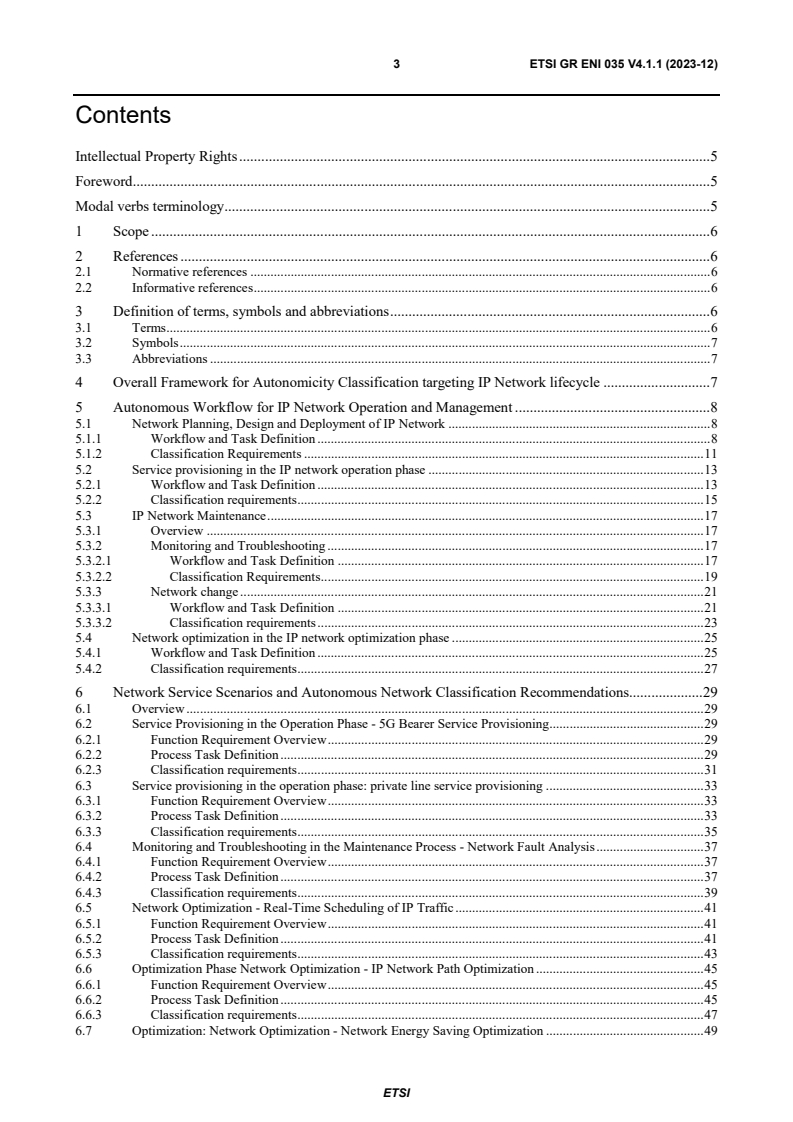
Contents
Intellectual Property Rights . 5
Foreword . 5
Modal verbs terminology . 5
1 Scope . 6
2 References . 6
2.1 Normative references . 6
2.2 Informative references . 6
3 Definition of terms, symbols and abbreviations . 6
3.1 Terms . 6
3.2 Symbols . 7
3.3 Abbreviations . 7
4 Overall Framework for Autonomicity Classification targeting IP Network lifecycle . 7
5 Autonomous Workflow for IP Network Operation and Management . 8
5.1 Network Planning, Design and Deployment of IP Network . 8
5.1.1 Workflow and Task Definition . 8
5.1.2 Classification Requirements . 11
5.2 Service provisioning in the IP network operation phase . 13
5.2.1 Workflow and Task Definition . 13
5.2.2 Classification requirements . 15
5.3 IP Network Maintenance . 17
5.3.1 Overview . 17
5.3.2 Monitoring and Troubleshooting . 17
5.3.2.1 Workflow and Task Definition . 17
5.3.2.2 Classification Requirements . 19
5.3.3 Network change . 21
5.3.3.1 Workflow and Task Definition . 21
5.3.3.2 Classification requirements . 23
5.4 Network optimization in the IP network optimization phase . 25
5.4.1 Workflow and Task Definition . 25
5.4.2 Classification requirements . 27
6 Network Service Scenarios and Autonomous Network Classification Recommendations . 29
6.1 Overview . 29
6.2 Service Provisioning in the Operation Phase - 5G Bearer Service Provisioning . 29
6.2.1 Function Requirement Overview . 29
6.2.2 Process Task Definition . 29
6.2.3 Classification requirements . 31
6.3 Service provisioning in the operation phase: private line service provisioning . 33
6.3.1 Function Requirement Overview . 33
6.3.2 Process Task Definition . 33
6.3.3 Classification requirements . 35
6.4 Monitoring and Troubleshooting in the Maintenance Process - Network Fault Analysis . 37
6.4.1 Function Requirement Overview . 37
6.4.2 Process Task Definition . 37
6.4.3 Classification requirements . 39
6.5 Network Optimization - Real-Time Scheduling of IP Traffic . 41
6.5.1 Function Requirement Overview . 41
6.5.2 Process Task Definition . 41
6.5.3 Classification requirements . 43
6.6 Optimization Phase Network Optimization - IP Network Path Optimization . 45
6.6.1 Function Requirement Overview . 45
6.6.2 Process Task Definition . 45
6.6.3 Classification requirements . 47
6.7 Optimization: Network Optimization - Network Energy Saving Optimization . 49
ETSI
4 ETSI GR ENI 035 V4.1.1 (2023-12)
6.7.1 Function Requirement Overview . 49
6.7.2 Process Task Definition . 49
6.7.3 Classification requirements . 51
7 Conclusions . 53
History . 54
ETSI
5 ETSI GR ENI 035 V4.1.1 (2023-12)
Intellectual Property Rights
Essential patents
IPRs essential or potentially essential to normative deliverables may have been declared to ETSI. The declarations
pertaining to these essential IPRs, if any, are publicly available for ETSI members and non-members, and can be
found in ETSI SR 000 314: "Intellectual Property Rights (IPRs); Essential, or potentially Essential, IPRs notified to
ETSI in respect of ETSI standards", which is available from the ETSI Secretariat. Latest updates are available on the
ETSI Web server (https://ipr.etsi.org/).
Pursuant to the ETSI Directives including the ETSI IPR Policy, no investigation regarding the essentiality of IPRs,
including IPR searches, has been carried out by ETSI. No guarantee can be given as to the existence of other IPRs not
referenced in ETSI SR 000 314 (or the updates on the ETSI Web server) which are, or may be, or may become,
essential to the present document.
Trademarks
The present document may include trademarks and/or tradenames which are asserted and/or registered by their owners.
ETSI claims no ownership of these except for any which are indicated as being the property of ETSI, and conveys no
right to use or reproduce any trademark and/or tradename. Mention of those trademarks in the present document does
not constitute an endorsement by ETSI of products, services or organizations associated with those trademarks.
DECT™, PLUGTESTS™, UMTS™ and the ETSI logo are trademarks of ETSI registered for the benefit of its
Members. 3GPP™ and LTE™ are trademarks of ETSI registered for the benefit of its Members and of the 3GPP
Organizational Partners. oneM2M™ logo is a trademark of ETSI registered for the benefit of its Members and of the ®
oneM2M Partners. GSM and the GSM logo are trademarks registered and owned by the GSM Association.
Foreword
This Group Report (GR) has been produced by ETSI Industry Specification Group (ISG) Experiential Networked
Intelligence (ENI).
Modal verbs terminology
In the present document "should", "should not", "may", "need not", "will", "will not", "can" and "cannot" are to be
interpreted as described in clause 3.2 of the ETSI Drafting Rules (Verbal forms for the expression of provisions).
"must" and "must not" are NOT allowed in ETSI deliverables except when used in direct citation.
ETSI
6 ETSI GR ENI 035 V4.1.1 (2023-12)
1 Scope
The present document define network autonomicity features and levels for IP networks, including the intelligent
characteristics at each layer (from Level 0 to Level 5) and closed-loop management process, including:
• The concept, scope, dimension and overall method of IP network operation and management autonomous level
classification, evolving from ETSI GR ENI 007 [i.2] and ETSI GR ENI 010 [i.3].
• IP network operation and management processes and classification method, including service and resource
management.
• Technical requirements for autonomous level classification, and its key technical processes.
2 References
2.1 Normative references
Normative references are not applicable in the present document.
2.2 Informative references
References are either specific (identified by date of publication and/or edition number or version number) or
non-specific. For specific references, only the cited version applies. For non-specific references, the latest version of the
referenced document (including any amendments) applies.
NOTE: While any hyperlinks included in this clause were valid at the time of publication, ETSI cannot guarantee
their long term validity.
The following referenced documents are not necessary for the application of the present document but they assist the
user with regard to a particular subject area.
[i.1] ETSI GR ENI 004 (V3.1.1): "Experiential Networked Intelligence (ENI); Terminology".
[i.2] ETSI GR ENI 007 (V1.1.1): "Experiential Networked Intelligence (ENI); ENI Definition of
Categories for AI Application to Networks".
[i.3] ETSI GR ENI 010 (V1.1.1): "Experiential Networked Intelligence (ENI); Evaluation of categories
for AI application to Networks".
3 Definition of terms, symbols and abbreviations
3.1 Terms
For the purposes of the present document, the terms defined in ETSI GR ENI 004 [i.1] and the following apply:
autonomous networks: set of self-governing programmable and explainable systems that seamlessly deliver secure,
context-aware, business-driven services that are created and maintained using model-driven engineering and
administered by using policies
evaluation dimension: one of the five dimensions defined as ManMachine Interface, Decision Making Participation,
Data Collection and Analysis, Degree of Intelligence and Environment Adaptability
NOTE: As defined in ETSI GR ENI 004 [i.1].
evaluation object: AI application or a part of Network Lifecycle, defined from two dimensions: the subsystems and the
network lifecycle
ETSI
7 ETSI GR ENI 035 V4.1.1 (2023-12)
network lifecycle: work-flow of activities including network planning, network deployment, network service
provisioning, network changes, network maintenance, network optimization in real-time
network element, management system, network platform
subsystem:
technical expert: person in charge of defining or supporting Operational Procedures within a CSP Network (e.g. in
charge of Capacity Planning, Engineering and Designing, Troubleshooting)
3.2 Symbols
Void.
3.3 Abbreviations
For the purposes of the present document, the abbreviations given in ETSI GR ENI 004 [i.1] and ETSI
GR ENI 007 [i.2] apply.
4 Overall Framework for Autonomicity Classification
targeting IP Network lifecycle
The IP network operation and management autonomous level classification framework describes the categorization
dimensions (Intent management, Perception, Analysis, Decision making, Execution) of evaluating the autonomous level
of specific network operation and management functional characteristics, and the categorization principle (human
participation in the whole process) and qualitative descriptions (operator, system, operator + system).
Referring to ETSI GR ENI 010 [i.3], the TMF autonomous network closed-loop framework in the reference, the
research on the intelligent hierarchical capability of network operation management mainly involves the service
operation layer and the resource operation layer. From the end-to-end network service operation perspective, the IP
network operation management process is mapped to the management and operation of one or more IP networks.
The main scope of IP network operation management in the present document involves the resource operation layer and
the business operation layer, which are decomposed into life cycle operation phases (network planning, network
deployment, network service provisioning, network changes, network maintenance, network optimization); each
operation phase can be further split into operation sub-phases. The specific content is shown in table 1.
ETSI
8 ETSI GR ENI 035 V4.1.1 (2023-12)
Table 1: Overall Framework of Network Operation Management
Operation management process Operation Management Task
01 Network Planning, Design and Deployment Requirements analysis and forecast
Resource survey
Resource analysis
Solution design and decision-making
Integrated configuration
Onsite acceptance
02 Service provisioning Service provisioning process
Resource survey
Solution design
Solution implementation and service verification
03 Monitoring and Troubleshooting Scenario-based monitoring
Fault awareness
Demarcation and location of faults
Evaluation and Decision-making
Solution implementation and service verification
04 Network Change Intent translation
Resource survey
Change analysis and design
Evaluation and Decision-making
Change implementation and service verification
05 Network Optimization Intent translation
Quality monitoring
Optimization identification
Optimization solution
Solution implementation and service verification
The present document will focus on the closed-loop workflows of each sub-phase in the entire life cycle of IP network
operation and management, and describe the operation management tasks that each process should have at different
levels. The present document will serve as the basis for the evaluation of intelligent and hierarchical categorization of IP
network operation and management.
In clause 5 a deep analysis of each of the operation management process and task identified in table 1 will be analysed
for each autonomous level (from 0 to 5), as defined in ETSI GR ENI 007 [i.2].
Clause 6 gives the general procedures and detailed capabilities of typical scenarios, respectively, and specifies each
typical scenario. Autonomic Classification for different autonomous levels of the more relevant scenarios involving IP
network.
5 Autonomous Workflow for IP Network Operation and
Management
5.1 Network Planning, Design and Deployment of IP Network
5.1.1 Workflow and Task Definition
Although the network planning and design and deployment of the IP network are two phases of intelligent network
operation and management, they together form a closed loop of operation and management activities.
Network planning refers to the process of surveying key information such as network coverage and high-value user
distribution based on network KPI requirements, providing network planning requirements, and evaluating whether the
planned solution meets network KPI requirements. The core objective of network planning is to improve the utilization
of network resources.
ETSI
9 ETSI GR ENI 035 V4.1.1 (2023-12)
Network deployment refers to the design of network topology, choosing appropriate hardware and software devices,
estimating network capacity, IP/MPLS network design, and routing selection based on network planning. Network
deployment also includes installing and deploying devices on site according to the network plan, configuration, and
network test. The core objective of network deployment is to accurately construct the network according to the planning
and to shorten the deployment duration as much as possible.
According to the closed-loop processing process, the IP network planning and deployment process can be divided into
seven sub-tasks: network planning requirements, resource collection, resource analysis, solution design, simulation
decision-making, integration configuration, and on-site acceptance. The seven subtasks can be mapped to the general
workflow of network management, control, and operation, and used to further analyse the intelligent Classification of
each task against the overall method of the intelligent classification framework.
Figure 1: Mapping between network planning and design deployment tasks and
operation management activities
Definition of the operation management tasks for IP network planning, design and deployment:
• Intent management tasks:
- Requirement analysis and forecast: Output the network planning requirements based on the customer's
business intention, service development objective, and network deployment plan (including Network
topologies, IGP/BGP routings, IP addresses/VLANs space allocation, network resource bandwidth
requirements, and service quality requirements).
• Awareness tasks:
- Resource survey: Based on the network planning objectives and requirements, survey the resource usage
(such as traffic performance, and resource usage) of the whole existing network or some areas, and
collect O&M data of the existing network. (Requirements related to monitoring and troubleshooting,
network optimization, service provisioning, and network complaints) Conduct a survey.
• Analysis tasks:
- Resource analysis: Based on the network planning requirements and resource survey results, analyse the
gap between the planning requirements and the current network resource status, obtain the resource
bottleneck, and output the High-Level Design (HLD), including the IP network topology architecture (for
example, multi-level AS and IP network topology). Network scale, service model (such as VPN network
design), network security solution, and deployment solution.
ETSI
10 ETSI GR ENI 035 V4.1.1 (2023-12)
• Decision-making tasks:
- Solution design and decision-making: Output the Low-Level Design (LLD) based on the HLD, existing
network survey results, device procurement, and networking technical requirements. (such as network
topology, board resources and interconnection relationships, IP addresses/VLANs space planning,
IGP/BGP route selection and policy configuration, QoS policy formulation, security policy design, and
network monitoring and optimization policies, etc.). Evaluate the correctness and rationality of network
planning requirements and perform simulation verification based on the solution planning or design
results.
• Execution tasks:
- Integrated configuration: Complete hardware installation and software deployment (NE initialization and
NE software installation) based on the network simulation decision, and open O&M channels to ensure
that NEs are managed. In addition, the NE data is delivered to the network to ensure correct software and
hardware configurations.
- Onsite acceptance: Verify the service connectivity, SLA, and reliability, generate a verification report,
and pass the acceptance criteria to meet the transfer-to-maintenance requirements.
ETSI
11 ETSI GR ENI 035 V4.1.1 (2023-12)
5.1.2 Classification Requirements
Table 2: Network Planning, Design and Deployment Capability Classification Requirements
Operation Task L0 L1 L2 L3 L4 L5
management
activities
Intent Requirement Manually analyse Manually analyse Collect network resource The system The system In all scenarios, the
management. analysis and planning planning data based on the automatically collects automatically predicts system automatically
forecast. requirements. requirements. system and manually and analyses the data. network and service identifies planning
analyse planning (e.g. network resource requirements based on requirements and
requirements. usage data, network collected data and AI completes the entire
traffic growth data, models. (e.g. network process of planning and
etc.), manually analyse traffic growth trend, design, including
and plan requirements. network connection requirement mapping,
scalability, and service resource survey,
quality level). planning, design,
simulation, data
Awareness. Resource Manual resource Manual resource Manually survey The system supports The system supports the
survey. survey. survey. resources in limited the automatic online automatic collection of production, data
delivery, commissioning
scenarios based on collection of online IP online IP resources,
and optimization, and
auxiliary tools. resources and their operation and SLA
status, including status, including network service verification.
When AI models need to
network device device resources, L2/L3
be iterated, Supports
resources, L2/L3 topologies, L2/L3
topology, and L2/L3 network connections, automatic optimization of
online learning.
network connections. traffic, and applications
status.
Analysis. Resource Manual resource Manual resource The system displays The system supports The system can predict
analysis. analysis. analysis. resource statistics based device resource the growth trend of
on fixed rules, facilitating bottleneck analysis, network traffic and IP
manual analysis. such as board, port connections based on AI
usage, and traffic models or digital twins
analysis, and and automatically
automatically identifies identify network
board resource bottlenecks, such as
bottlenecks. network devices,
boards, ports, link
bandwidth, and
connection reliability.
ETSI
12 ETSI GR ENI 035 V4.1.1 (2023-12)
Operation Task L0 L1 L2 L3 L4 L5
management
activities
Decision- Solution design Manually perform Manually perform Manually perform The system provides The system uses the
making. and Decision- network simulation network simulation network simulation and templates, and the intelligent model or
making. and and decision-making using planning design is digital twin to make
decision-making. decision-making tools. performed manually network simulation
with tools. based on the decisions.
templates (such as the The system
historical project automatically generates
cases). the network design
scheme (such as
network topology, device
types, IGP/BGP route
planning, and tunnel and
VPN services). Perform
network design, and the
system automatically
outputs the network
design result.
Execution. Integrated Prepare NE Use the tool to Use the system to The system The system
configuration. parameters and prepare NE prepare NE parameters automatically creates automatically creates
assurance policy parameters and and assurance policy NEs settings based on NEs configuration based
data by using the assurance policy data, and use the tool to the design scheme, on the design scheme.
tool and manually data, and use the remotely deliver When physical When physical network
deliver the tool to deliver configurations. network resources are resources go online, the
configuration. configurations ready, the system can system automatically
onsite. automatically deliver manages devices and
configurations. activates predefined
configurations.
Onsite Manually perform Manual on-site Use the system to verify Based on the manually The system supports the
acceptance. onsite acceptance. acceptance (such services remotely and entered acceptance flexible definition of the
as dialling test by generate reports data, the system service validation
meter, tool, and automatically. validates the software process. After the
service The system supports version, configuration, service goes online, the
verification). automatic validation of device status, and system automatically
device configurations network service validates the service and
and software versions quality. generates the validation
based on the manually report.
entered acceptance
data.
ETSI
13 ETSI GR ENI 035 V4.1.1 (2023-12)
5.2 Service provisioning in the IP network operation phase
5.2.1 Workflow and Task Definition
In the IP network operation management, carriers expect the service provisioning process to be e-commerce-based,
one-click, and visible. In addition, the service provisioning process can be continuously ensured for services with
differentiated SLAs, improving network serviceability. The present document divides the service provisioning
sub-phase in the IP network operation phase into four tasks: service provisioning process, resource survey, solution
design, solution implementation and service verification. The four tasks can be mapped to IP network operation
management activities.
Figure 2: Mapping between service provisioning tasks and operation management activities
The following tasks can be obtained by dividing the service provisioning process based on the IP network operation
management activities:
• Intent management activities:
- Service provisioning process: based on user service requirements (such as the number of sites, site
location, service volume, and security requirements), convert to specific network requirements (such as
bearer technologies, protection requirements, security policies, and SLA assurance policies).
• Awareness-like activities:
- Resource survey: Based on user service requirements and real-time network status, the resource
operational status is collected.
• Analysis and decision-making activities:
- Solution design: Assessment , design, and allocate network resources based on the network requirements.
(for example, the device types, fibre/cable connection, port/interface numbers, and IP/VLAN space. If
resources are insufficient, add new devices.) and comprehensively evaluate the design scheme
(e.g. whether the customer's requirements are met and whether the existing services are affected) and
provide the evaluation result.
ETSI
14 ETSI GR ENI 035 V4.1.1 (2023-12)
• Execution activities:
- Solution implementation and service verification: Deliver network configurations (including SLA
assurance policies) to network devices based on the final solution. After the solution is implemented,
verify and confirm the service implementation result, for example, whether the service is connected and
whether the service SLA meets the requirements.
ETSI
15 ETSI GR ENI 035 V4.1.1 (2023-12)
5.2.2 Classification requirements
Table 3: Requirements for service provisioning task levels
Operation Task L0 L1 L2 L3 L4 L5
management
activities
Intent Service Manually translate Manually completes Manually completes The system has built-in The system provides In all scenarios, the
management. provisioning the network the network the network service configuration customized defined system completes the
process. configuration configuration configuration templates. Service system model
intelligent closed-loop
parameters from parameters from the parameters from the requirements (including interface. The system management of the
the service intent to service intent to the service intent to the VPN Service type, automatically matches entire process,
the service. service. (such as
service. (such as Service topology,QoS and completes including requirement
bearer technology, bearer technology, profile, etc.) can be network configuration mapping, data
protection protection manually selected. The for services. (e.g. VPN sensing, analysis,
requirements, NE list, requirements, NE system automatically configuration, interface decision-making, and
tunnel policy, and SLA list, tunnel policy, maps the service configuration, execution, achieving
monitoring instance). and SLA monitoring parameters into network protection schemes, full intelligence in all
instance). configuration Tunnel policy, etc.). scenarios.
parameters. (such as
VPN configuration,
interface configuration,
etc.).
Awareness. Resource Manually view and Use tools to detect The system can The system The system
survey. collect network network status, provide the network automatically detects the automatically detects
status information, including resource status, including the network operation status network service status
including resource status, available ports, device resource in non-real-time (including operation
status, available link bandwidth, and
status, available (e.g. 15 minutes), status, SLA, etc.) in
ports, link service resource ports, link bandwidth, including the network real-time,
bandwidth, and usage. and service resource topology, available
e.g. seconds, and the
service resource usage. ports, link bandwidth,
network status in near
usage. VPN service resource
real time, e.g. minutes,
usage, etc.
including the network
topology, available
ports, link bandwidth,
and service resource
usage.
ETSI
16 ETSI GR ENI 035 V4.1.1 (2023-12)
Operation Task L0 L1 L2 L3 L4 L5
management
activities
Analysis & Solution design. Manually allocate Manually allocate Manually uses the The system provides the Based on the intention
Decision-making. network resource network resource system to allocate resource setting
interface, the system
parameters and parameters and network resource templates (such as the automatically allocates
manually formulate manually formulate parameters and IP addresses, VLAN IDs, network resource
service solutions. service solutions. manually formulates bandwidth resource, and parameters such as
a service plan. tunnel policy name). The the IP addresses,
system calculates VLAN IDs, bandwidth
network resources and resource, tunnels, etc.
automatically checks and calculates and
resource conflicts. recommends optimal
network paths and
network configuration.
Execution. Solution Manually deliver Use the tool to deliver Operators trigger The system The system
implementation service service configurations service configuration automatically delivers automatically delivers
and service configurations and and start service SLA delivery through the the service the service
verification. start service SLA monitoring. Manual system and manually configuration. If the configuration. If the
monitoring. verification is
start service SLA service configuration service configuration
Manually verify the performed using tools. monitoring and fails, the system fails, the system
configuration. service verification automatically rolls back automatically rolls
via the system. and retries the back.
configuration. The system support
automatically retry the
configuration and
starts SLA monitoring.
ETSI
17 ETSI GR ENI 035 V4.1.1 (2023-12)
5.3 IP Network Maintenance
5.3.1 Overview
Network maintenance starts after network deployment and service provisioning. The objective is to accurately detect
and rectify faults in a timely manner. The technical aspects focus on improving the complaint coverage rate, reducing
the fault duration, fault occurrence rate, personnel investment, and test automation, improving user experience, and
reducing O&M costs.
Network maintenance scenarios include monitoring, troubleshooting, and network change.
5.3.2 Monitoring and Troubleshooting
5.3.2.1 Workflow and Task Definition
According to the closed-loop processing process, the IP network monitoring and troubleshooting process consists of
seven subtasks: scenario-based monitoring, fault awareness (availability and monitoring status of network resources),
risk discovery, fault demarcation and locating, potential risk handling solution, solution implementation, and service
verification. The seven subtasks can be mapped to the general workflow of network management, control, and
operation, and are used to further analyse the intelligent Classification of each task based on the overall method of the
intelligent classification framework, as shown in figure 3.
Figure 3: Mapping between monitoring and troubleshooting tasks and
operation management activity
The IP network monitoring and troubleshooting process is broken down by IP network operation management
activities. The following tasks can be obtained:
• Intent management tasks:
- Scenario-based monitoring: Network monitoring assurance targets are defined as specific monitoring
requirements, such as monitoring areas, monitoring objects, reliability requirements, and service SLA
requirements. For example, SLA assurance policies for important festivals and service provisioning
processes are used.
• Awareness tasks:
- Fault awareness: Monitors and analyses network operation data and external spatiotemporal data to
detect unexpected service interruptions or service quality deterioration on the network promptly.
ETSI
18 ETSI GR ENI 035 V4.1.1 (2023-12)
• Analysis tasks:
- Demarcation and locating: Demarcate faults based on identified faults and potential risks. For the
cross-domain scenario, demarcate the fault to a specific technical domain. For the single-domain
scenario, demarcate the fault to a specific NE. Based on the fault demarcation result, locate the specific
software and hardware causes (such as configuration, board, and optical module) of the problem, and
generate a solution to rectify the service as soon as possible. Analyse the impact of the fault/potential risk
on services and notify the impact.
• Decision-making tasks:
- Evaluation and decision-making: Generate several alternative solutions (including recovery) based on the
problem demarcation and locating results (e.g. modifying configurations, restarting NEs, replacing
boards, and isolating NEs).
• Execution tasks:
- Solution implementation and service verification: Rectify faults and eliminate potential risks based on
the optimal solution. For faults or risks that can be remotely rectified, configurations are delivered to the
network through the CLI or NETCONF interface, or hardware faults are isolated from NEs or links. For
faults or potential risks that cannot be rectified remotely, replace boards or optical modules on site
manually, or remove and insert boards or optical modules manually. After the fault rectification and
potential risk elimination actions are performed, verify and confirm the execution results, for example,
whether the service interruption is recovered, whether the quality deterioration is recovered, and whether
alarms and KPI exceptions are cleared.
ETSI
19 ETSI GR ENI 035 V4.1.1 (2023-12)
5.3.2.2 Classification Requirements
Table 4: Monitoring and Troubleshooting Classification Requirements
Operation Task L0 L1 L2 L3 L4 L5
management
activities
Intent Scenario-based Manually monitor Manually define Manually developed Monitoring templates Based on
In all scenarios, the
management. monitoring. the system. monitoring rules and supervised control and assurance policies scenario-specific system automatically
(such as alarm are preconfigured in monitoring intentions, completes the whole
rule template. The
severity and the system. Users can the system process of intent
system converts the
category) based on select templates and automatically monitors mapping, fault
template into
alarm dimensions. assurance policies scenarios and areas detection, risk
monitoring rules (such
based on the scenario and generates prediction,
as service paths)
and confirm the monitoring rules and demarcation and
based on the
templates and automatically applies location, repair
templates.
assurance policies. rules. evaluation, and
implementation
Awareness. Fault awareness. Fault locating Use the tool to The system The system The system
verification, achieving
triggered manually periodically check automatically collect automatically performs automatically collects
by user complaints. the network to detect the status of network NE-level root cause and processes full-scenario and
full-process
faults. resources, such as analysis based on network operation
intelligence.
Manually identify alarms and events. configured rules and data, automatically
affected services and identifies affected identifies affected
determine the network services. services, automatically
service status. determines the service
status (interrupted,
degraded, or
interrupted outside the
network), and
automatically
aggregates alarms,
e.g. using the AI
algorithm.
Analysis. Demarcation and Manually use ping Use a tool to export The system provides The system provides The system performs
locating. and trace methods current or historical auxiliary functions. configured rules (such intelligent fault
to demarcate the alarms, performance (e.g. visible alarms as alarm correlation diagnosis based on
fault, and locate data, and logs for and logs associated rules), automatically the AI model and/or
the fault by correlation analysis, with trails). Manually perform correlation digital twin of the
querying logs, and manually demarcate and locate analysis and provide network a
...
Questions, Comments and Discussion
Ask us and Technical Secretary will try to provide an answer. You can facilitate discussion about the standard in here.
Loading comments...