


ETSI GS F5G 033 V1.1.1 (2026-04)
Fifth Generation Fixed Network (F5G); F5G Advanced Technology Requirements and Gap Analyses; Release 4
Fifth Generation Fixed Network (F5G); F5G Advanced Technology Requirements and Gap Analyses; Release 4
DGS/F5G-0033
General Information
- Status
- Not Published
- Technical Committee
- F5G - Fifth Generation Fixed Network
- Current Stage
- 12 - Citation in the OJ (auto-insert)
- Due Date
- 05-Apr-2026
- Completion Date
- 10-Apr-2026
Frequently Asked Questions
ETSI GS F5G 033 V1.1.1 (2026-04) is a standard published by the European Telecommunications Standards Institute (ETSI). Its full title is "Fifth Generation Fixed Network (F5G); F5G Advanced Technology Requirements and Gap Analyses; Release 4". This standard covers: DGS/F5G-0033
DGS/F5G-0033
ETSI GS F5G 033 V1.1.1 (2026-04) is available in PDF format for immediate download after purchase. The document can be added to your cart and obtained through the secure checkout process. Digital delivery ensures instant access to the complete standard document.
Standards Content (Sample)
GROUP SPECIFICATION
Fifth Generation Fixed Network (F5G);
F5G Advanced Technology Requirements and Gap Analyses;
Release 4
Disclaimer
The present document has been produced and approved by the Fifth Generation Fixed Network (F5G) ETSI Industry
Specification Group (ISG) and represents the views of those members who participated in this ISG.
It does not necessarily represent the views of the entire ETSI membership.
2 ETSI GS F5G 033 V1.1.1 (2026-04)
Reference
DGS/F5G-0033
Keywords
F5G, F5G Advanced, fibre, optical, PON,
requirements
ETSI
650 Route des Lucioles
F-06921 Sophia Antipolis Cedex - FRANCE
Tel.: +33 4 92 94 42 00 Fax: +33 4 93 65 47 16
Siret N° 348 623 562 00017 - APE 7112B
Association à but non lucratif enregistrée à la
Sous-Préfecture de Grasse (06) N° w061004871
Important notice
The present document can be downloaded from the
ETSI Search & Browse Standards application.
The present document may be made available in electronic versions and/or in print. The content of any electronic and/or
print versions of the present document shall not be modified without the prior written authorization of ETSI. In case of any
existing or perceived difference in contents between such versions and/or in print, the prevailing version of an ETSI
deliverable is the one made publicly available in PDF format on ETSI deliver repository.
Users should be aware that the present document may be revised or have its status changed,
this information is available in the Milestones listing.
If you find errors in the present document, please send your comments to
the relevant service listed under Committee Support Staff.
If you find a security vulnerability in the present document, please report it through our
Coordinated Vulnerability Disclosure (CVD) program.
Notice of disclaimer & limitation of liability
The information provided in the present deliverable is directed solely to professionals who have the appropriate degree of
experience to understand and interpret its content in accordance with generally accepted engineering or
other professional standard and applicable regulations.
No recommendation as to products and services or vendors is made or should be implied.
No representation or warranty is made that this deliverable is technically accurate or sufficient or conforms to any law
and/or governmental rule and/or regulation and further, no representation or warranty is made of merchantability or fitness
for any particular purpose or against infringement of intellectual property rights.
In no event shall ETSI be held liable for loss of profits or any other incidental or consequential damages.
Any software contained in this deliverable is provided "AS IS" with no warranties, express or implied, including but not
limited to, the warranties of merchantability, fitness for a particular purpose and non-infringement of intellectual property
rights and ETSI shall not be held liable in any event for any damages whatsoever (including, without limitation, damages
for loss of profits, business interruption, loss of information, or any other pecuniary loss) arising out of or related to the use
of or inability to use the software.
Copyright Notification
No part may be reproduced or utilized in any form or by any means, electronic or mechanical, including photocopying and
microfilm except as authorized by written permission of ETSI.
The content of the PDF version shall not be modified without the written authorization of ETSI.
The copyright and the foregoing restriction extend to reproduction in all media.
© ETSI 2026.
All rights reserved.
ETSI
3 ETSI GS F5G 033 V1.1.1 (2026-04)
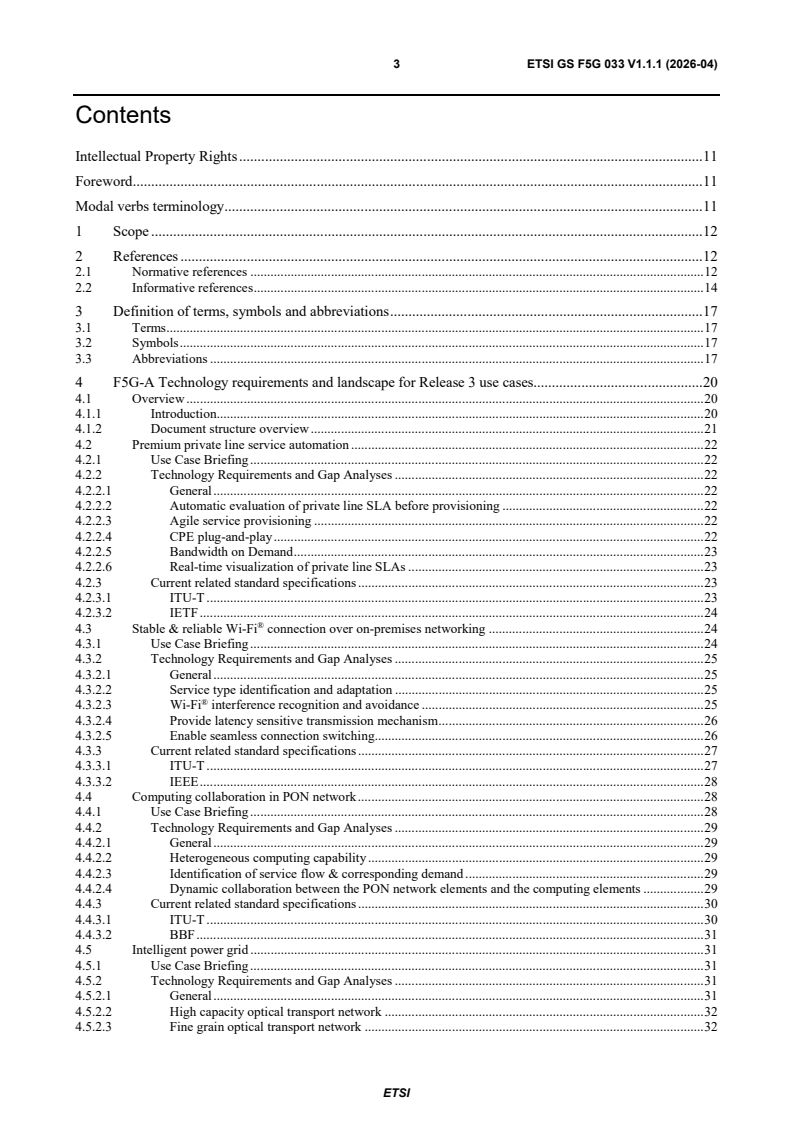
Contents
Intellectual Property Rights . 11
Foreword . 11
Modal verbs terminology . 11
1 Scope . 12
2 References . 12
2.1 Normative references . 12
2.2 Informative references . 14
3 Definition of terms, symbols and abbreviations . 17
3.1 Terms . 17
3.2 Symbols . 17
3.3 Abbreviations . 17
4 F5G-A Technology requirements and landscape for Release 3 use cases. 20
4.1 Overview . 20
4.1.1 Introduction. 20
4.1.2 Document structure overview . 21
4.2 Premium private line service automation . 22
4.2.1 Use Case Briefing . 22
4.2.2 Technology Requirements and Gap Analyses . 22
4.2.2.1 General . 22
4.2.2.2 Automatic evaluation of private line SLA before provisioning . 22
4.2.2.3 Agile service provisioning . 22
4.2.2.4 CPE plug-and-play . 22
4.2.2.5 Bandwidth on Demand . 23
4.2.2.6 Real-time visualization of private line SLAs . 23
4.2.3 Current related standard specifications . 23
4.2.3.1 ITU-T . 23
4.2.3.2 IETF . 24 ®
4.3 Stable & reliable Wi-Fi connection over on-premises networking . 24
4.3.1 Use Case Briefing . 24
4.3.2 Technology Requirements and Gap Analyses . 25
4.3.2.1 General . 25
4.3.2.2 Service type identification and adaptation . 25 ®
4.3.2.3 Wi-Fi interference recognition and avoidance . 25
4.3.2.4 Provide latency sensitive transmission mechanism . 26
4.3.2.5 Enable seamless connection switching. 26
4.3.3 Current related standard specifications . 27
4.3.3.1 ITU-T . 27
4.3.3.2 IEEE . 28
4.4 Computing collaboration in PON network . 28
4.4.1 Use Case Briefing . 28
4.4.2 Technology Requirements and Gap Analyses . 29
4.4.2.1 General . 29
4.4.2.2 Heterogeneous computing capability . 29
4.4.2.3 Identification of service flow & corresponding demand . 29
4.4.2.4 Dynamic collaboration between the PON network elements and the computing elements . 29
4.4.3 Current related standard specifications . 30
4.4.3.1 ITU-T . 30
4.4.3.2 BBF . 31
4.5 Intelligent power grid . 31
4.5.1 Use Case Briefing . 31
4.5.2 Technology Requirements and Gap Analyses . 31
4.5.2.1 General . 31
4.5.2.2 High capacity optical transport network . 32
4.5.2.3 Fine grain optical transport network . 32
ETSI
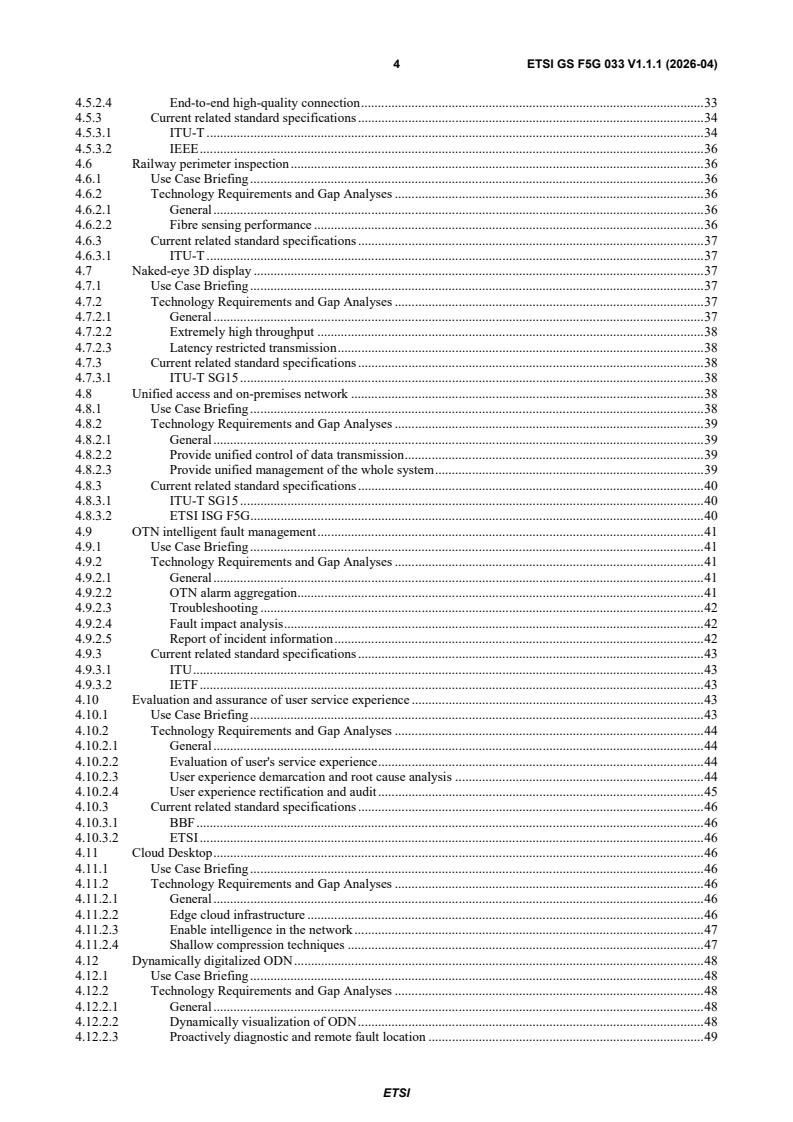
4 ETSI GS F5G 033 V1.1.1 (2026-04)
4.5.2.4 End-to-end high-quality connection . 33
4.5.3 Current related standard specifications . 34
4.5.3.1 ITU-T . 34
4.5.3.2 IEEE . 36
4.6 Railway perimeter inspection . 36
4.6.1 Use Case Briefing . 36
4.6.2 Technology Requirements and Gap Analyses . 36
4.6.2.1 General . 36
4.6.2.2 Fibre sensing performance . 36
4.6.3 Current related standard specifications . 37
4.6.3.1 ITU-T . 37
4.7 Naked-eye 3D display . 37
4.7.1 Use Case Briefing . 37
4.7.2 Technology Requirements and Gap Analyses . 37
4.7.2.1 General . 37
4.7.2.2 Extremely high throughput . 38
4.7.2.3 Latency restricted transmission . 38
4.7.3 Current related standard specifications . 38
4.7.3.1 ITU-T SG15 . 38
4.8 Unified access and on-premises network . 38
4.8.1 Use Case Briefing . 38
4.8.2 Technology Requirements and Gap Analyses . 39
4.8.2.1 General . 39
4.8.2.2 Provide unified control of data transmission . 39
4.8.2.3 Provide unified management of the whole system . 39
4.8.3 Current related standard specifications . 40
4.8.3.1 ITU-T SG15 . 40
4.8.3.2 ETSI ISG F5G . 40
4.9 OTN intelligent fault management . 41
4.9.1 Use Case Briefing . 41
4.9.2 Technology Requirements and Gap Analyses . 41
4.9.2.1 General . 41
4.9.2.2 OTN alarm aggregation . 41
4.9.2.3 Troubleshooting . 42
4.9.2.4 Fault impact analysis . 42
4.9.2.5 Report of incident information . 42
4.9.3 Current related standard specifications . 43
4.9.3.1 ITU . 43
4.9.3.2 IETF . 43
4.10 Evaluation and assurance of user service experience . 43
4.10.1 Use Case Briefing . 43
4.10.2 Technology Requirements and Gap Analyses . 44
4.10.2.1 General . 44
4.10.2.2 Evaluation of user's service experience . 44
4.10.2.3 User experience demarcation and root cause analysis . 44
4.10.2.4 User experience rectification and audit . 45
4.10.3 Current related standard specifications . 46
4.10.3.1 BBF . 46
4.10.3.2 ETSI . 46
4.11 Cloud Desktop . 46
4.11.1 Use Case Briefing . 46
4.11.2 Technology Requirements and Gap Analyses . 46
4.11.2.1 General . 46
4.11.2.2 Edge cloud infrastructure . 46
4.11.2.3 Enable intelligence in the network . 47
4.11.2.4 Shallow compression techniques . 47
4.12 Dynamically digitalized ODN . 48
4.12.1 Use Case Briefing . 48
4.12.2 Technology Requirements and Gap Analyses . 48
4.12.2.1 General . 48
4.12.2.2 Dynamically visualization of ODN . 48
4.12.2.3 Proactively diagnostic and remote fault location . 49
ETSI
5 ETSI GS F5G 033 V1.1.1 (2026-04)
4.12.2.4 ODN resource management . 49
4.12.3 Current related standard specifications . 49
4.12.3.1 Current ODN related standards . 49
4.13 On-premises Millimetre-Wave (mmWave) WLAN . 49
4.13.1 Use Case Briefing . 49
4.13.2 Technology Requirements and Gap Analyses . 50
4.13.2.1 General . 50
4.13.2.2 Provide necessary throughput to support F5G-A applications . 50 ®
4.13.2.3 Well controlled Wi-Fi signals to support interference free connection . 50 ®
4.13.2.4 Coordination with sub-6 G Wi-Fi . 51
4.13.3 Current related standard specifications . 51
4.13.3.1 ITU-T SG15 . 51
4.13.3.2 IEEE 802.11 . 52
4.14 Wavelength-shared WDM Aggregation Network (AGGN) . 52
4.14.1 Use Case Briefing . 52
4.14.2 Technology Requirements and Gap Analyses . 52
4.14.2.1 Network bandwidth . 52
4.14.2.2 Multiple-ring network and long-haul transmission distance . 53
4.14.2.3 Flexible grooming capability . 53
4.14.2.4 Automatic network O&M . 54
4.14.3 Current related standard specifications . 55
4.14.3.1 ITU-T . 55
4.14.3.2 ETSI . 55
4.14.3.3 IEEE . 55
4.14.3.4 OIF . 55
4.15 Robotics as a Service . 55
4.15.1 Use Case Briefing . 55
4.15.2 Technology Requirements and Gap Analyses . 55
4.15.2.1 General . 55
4.15.2.2 Latency . 55
4.15.2.3 Cable Requirements . 56
4.15.2.4 Ease of Installation . 57
4.15.2.5 Integration of F5G-A networks with ROS and DDS . 57
4.15.3 Current related standard specifications . 57
4.15.3.1 Cable Specifications . 57
4.15.3.2 Data Distribution Service (DDS) . 57
4.16 All-optical base for urban rail transit communication network . 58
4.16.1 Use Case Briefing . 58
4.16.2 Technology Requirements and Gap Analyses . 59
4.16.2.1 General . 59
4.16.2.2 All-optical network base communication network for urban rail transit network . 60
4.16.3 Current related standard specifications . 61
4.16.3.1 ITU-T . 61
4.16.3.2 IEEE . 61
4.17 Optical Fibre sensing for telecom operators . 62
4.17.1 Use Case Briefing . 62
4.17.2 Technology Requirements and Gap Analyses . 62
4.17.2.1 General . 62
4.17.3 Current related standard specifications . 63
4.17.3.1 ITU-T . 63
4.18 QoD App-Flow service provisioning . 64
4.18.1 Use Case Briefing . 64
4.18.2 Technology Requirements and Gap Analyses . 64
4.18.2.1 General . 64
4.18.3 Current related standard specifications . 66
4.18.3.1 CAMARA . 66
4.18.3.2 ITU-T QoS in PON and G.fin . 66
4.18.3.3 ETSI ISG F5G Telemetry . 66
5 F5G-A Technology requirements and landscape for Release 4 use cases. 66
5.1 Overview . 66
5.1.1 Introduction. 66
ETSI
6 ETSI GS F5G 033 V1.1.1 (2026-04)
5.1.2 Document structure overview . 67
5.2 Smart Hospital . 67
5.2.1 Use Case Briefing . 67
5.2.2 Technology Requirements and Gap Analyses . 67
5.2.2.1 General . 67
5.2.2.2 Optical network layer . 68
5.2.2.3 Network architecture and security . 68
5.2.2.4 Network management system (NMS) . 69
5.2.3 Current related standard specifications . 69
5.2.3.1 ITU-T (International Telecommunication Union) . 69
5.2.3.2 IEC (International Electrotechnical Commission) . 69
5.2.3.3 IEEE (Institute of Electrical and Electronics Engineers) . 69
5.2.3.4 IETF (Internet Engineering Task Force) . 69
5.3 Energy-efficiency by deactivating low-load ports . 70
5.3.1 Use Case Briefing . 70
5.3.2 Technology Requirements and Gap Analyses . 70
5.3.2.1 General . 70
5.3.2.2 Energy and Load Monitor . 70
5.3.2.3 Traffic Analyser . 71
5.3.2.4 Decision Engine . 71
5.3.2.5 Execution Engine . 71
5.3.2.6 Port Manager . 72
5.3.2.7 Path Availability . 72
5.3.2.8 Traffic Rerouting . 73
5.3.2.9 Device Capabilities . 73
5.3.3 Current related standard specifications . 73
5.3.3.1 IETF . 73
5.3.3.2 OpenConfig . 74
5.4 Cloud-based Object Wave Transmissions . 74
5.4.1 Use Case Briefing . 74
5.4.2 Technology Requirements and Gap Analyses . 74
5.4.2.1 General . 74
5.4.2.2 Computing and Storage Requirements . 74
5.4.2.3 Network Requirements . 75
5.4.2.4 Control and Management Requirements . 75
5.4.3 Current related standard specifications . 76
5.4.3.1 ITU-T SG21 . 76
5.5 P2MP fgOTN for premium private lines . 76
5.5.1 Use Case Briefing . 76
5.5.2 Technology Requirements and Gap Analyses . 76
5.5.2.1 General . 76
5.5.2.2 fgOTN over P2MP network . 76
5.5.3 Current related standard specifications . 77
5.5.3.1 ITU-T . 77
5.6 Smart Sensor Cloud for AI in Industrial Manufacturing . 78
5.6.1 Use Case Briefing . 78
5.6.2 Technology Requirements and Gap Analyses . 78
5.6.2.1 General . 78
5.6.2.2 Latency . 78
5.6.2.3 Bandwidth . 78
5.6.2.4 Security . 79
5.6.3 Current related standard specifications . 79
5.7 Integrated NAS over FTTR . 79
5.7.1 Use Case Briefing . 79
5.7.2 Technology Requirements and Gap Analyses . 79
5.7.2.1 General . 79
5.7.2.2 Reliability of user's data on NAS . 80
5.7.2.3 Security . 80
5.7.2.4 High performance for the network access . 80
5.7.3 Current related standard specifications . 81
5.7.3.1 ITU-T . 81
5.7.3.2 CCSA . 82
ETSI
7 ETSI GS F5G 033 V1.1.1 (2026-04)
5.7.3.3 ETSI . 82
5.8 Generating an Energy Map for sustainable F5G-Advanced networks infrastructure . 83
5.8.1 Use Case Briefing . 83
5.8.2 Technology Requirements and Gap Analyses . 83
5.8.2.1 General . 83
5.8.2.2 Energy Watcher . 83
5.8.2.3 Energy Cost Calculator . 84
5.8.3 Current related standard specifications . 85
5.8.3.1 IETF . 85
5.8.3.2 OpenConfig . 85
5.8.3.3 ITU-T . 86
5.9 Flat wheel detection using Distributed Acoustic Sensing (DAS) . 86
5.9.1 Use Case Briefing . 86
5.9.2 Technology Requirements and Gap Analyses . 86
5.9.2.1 General . 86
5.9.2.2 Detection Latency . 86
5.9.2.3 Localization accuracy . 87
5.9.2.4 Detection sensitivity . 87
5.9.2.5 Data Throughput . 87
5.9.2.6 Availability / uptime . 87
5.9.2.7 Environmental robustness . 87
5.9.2.8 Netwo
...
Questions, Comments and Discussion
Ask us and Technical Secretary will try to provide an answer. You can facilitate discussion about the standard in here.
Loading comments...