


ETSI TS 186 002-3 V1.1.1 (2008-06)
Telecommunications and Internet Converged Services and Protocols for Advanced Networking (TISPAN); Interworking between Session Initiation Protocol (SIP) and Bearer Independent Call Control Protocol (BICC) or ISDN User Part (ISUP); Part 3: Test Suite Structure and Test Purposes (TSS&TP) for Profile C
Telecommunications and Internet Converged Services and Protocols for Advanced Networking (TISPAN); Interworking between Session Initiation Protocol (SIP) and Bearer Independent Call Control Protocol (BICC) or ISDN User Part (ISUP); Part 3: Test Suite Structure and Test Purposes (TSS&TP) for Profile C
DTS/TISPAN-06014-2-NGN
General Information
Standards Content (Sample)
Technical Specification
Telecommunications and Internet Converged Services and
Protocols for Advanced Networking (TISPAN);
Interworking between Session Initiation Protocol (SIP) and
Bearer Independent Call Control
Protocol (BICC) or ISDN User Part (ISUP);
Part 3: Test Suite Structure and Test Purposes (TSS&TP)
for Profile C
2 ETSI TS 186 002-3 V1.1.1 (2008-06)
Reference
DTS/TISPAN-06014-2-NGN
Keywords
SIP, ISUP, BICC, TSS&TP, testing
ETSI
650 Route des Lucioles
F-06921 Sophia Antipolis Cedex - FRANCE
Tel.: +33 4 92 94 42 00 Fax: +33 4 93 65 47 16
Siret N° 348 623 562 00017 - NAF 742 C
Association à but non lucratif enregistrée à la
Sous-Préfecture de Grasse (06) N° 7803/88
Important notice
Individual copies of the present document can be downloaded from:
http://www.etsi.org
The present document may be made available in more than one electronic version or in print. In any case of existing or
perceived difference in contents between such versions, the reference version is the Portable Document Format (PDF).
In case of dispute, the reference shall be the printing on ETSI printers of the PDF version kept on a specific network drive
within ETSI Secretariat.
Users of the present document should be aware that the document may be subject to revision or change of status.
Information on the current status of this and other ETSI documents is available at
http://portal.etsi.org/tb/status/status.asp
If you find errors in the present document, please send your comment to one of the following services:
http://portal.etsi.org/chaircor/ETSI_support.asp
Copyright Notification
No part may be reproduced except as authorized by written permission.
The copyright and the foregoing restriction extend to reproduction in all media.
© European Telecommunications Standards Institute 2008.
All rights reserved.
TM TM TM TM
DECT , PLUGTESTS , UMTS , TIPHON , the TIPHON logo and the ETSI logo are Trade Marks of ETSI registered
for the benefit of its Members.
TM
3GPP is a Trade Mark of ETSI registered for the benefit of its Members and of the 3GPP Organizational Partners.
ETSI
3 ETSI TS 186 002-3 V1.1.1 (2008-06)
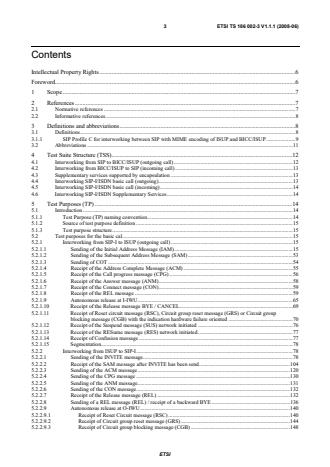
Contents
Intellectual Property Rights.6
Foreword.6
1 Scope.7
2 References.7
2.1 Normative references.7
2.2 Informative references.8
3 Definitions and abbreviations.8
3.1 Definitions.8
3.1.1 SIP Profile C for interworking between SIP with MIME encoding of ISUP and BICC/ISUP.9
3.2 Abbreviations.11
4 Test Suite Structure (TSS).12
4.1 Interworking from SIP to BICC/ISUP (outgoing call) .12
4.2 Interworking from BICC/ISUP to SIP (incoming call) .13
4.3 Supplementary services supported by encapsulation .13
4.4 Interworking SIP-I/ISDN basic call (outgoing).13
4.5 Interworking SIP-I/ISDN basic call (incoming).14
4.6 Interworking SIP-I/ISDN Supplementary Services.14
5 Test Purposes (TP).14
5.1 Introduction.14
5.1.1 Test Purpose (TP) naming convention.14
5.1.2 Source of test purpose definition .15
5.1.3 Test purpose structure.15
5.2 Test purposes for the basic cal.15
5.2.1 Interworking from SIP-I to ISUP (outgoing call) .15
5.2.1.1 Sending of the Initial Address Message (IAM).15
5.2.1.2 Sending of the Subsequent Address Message (SAM).53
5.2.1.3 Sending of COT.54
5.2.1.4 Receipt of the Address Complete Message (ACM) .55
5.2.1.5 Receipt of the Call progress message (CPG) .56
5.2.1.6 Receipt of the Answer message (ANM).58
5.2.1.7 Receipt of the Connect message (CON).59
5.2.1.8 Receipt of the REL message .59
5.2.1.9 Autonomous release at I-IWU.65
5.2.1.10 Receipt of the Release message BYE / CANCEL.69
5.2.1.11 Receipt of Reset circuit message (RSC), Circuit group reset message (GRS) or Circuit group
blocking message (CGB) with the indication hardware failure oriented .70
5.2.1.12 Receipt of the Suspend message (SUS) network initiated .76
5.2.1.13 Receipt of the RESume message (RES) network initiated.77
5.2.1.14 Receipt of Confusion message .77
5.2.1.15 Segmentation.78
5.2.2 Interworking from ISUP to SIP-I.78
5.2.2.1 Sending of the INVITE message.78
5.2.2.2 Receipt of the SAM message after INVITE has been send.104
5.2.2.3 Sending of the ACM message.120
5.2.2.4 Sending of the CPG message .130
5.2.2.5 Sending of the ANM message.131
5.2.2.6 Sending of the CON message.132
5.2.2.7 Receipt of the Release message (REL) .132
5.2.2.8 Sending of a REL message (REL) / receipt of a backward BYE .136
5.2.2.9 Autonomous release at O-IWU.140
5.2.2.9.1 Receipt of Reset Circuit message (RSC) .140
5.2.2.9.2 Receipt of Circuit group reset message (GRS).144
5.2.2.9.3 Receipt of Circuit group blocking message (CGB) .148
ETSI
4 ETSI TS 186 002-3 V1.1.1 (2008-06)
5.2.2.10 Receipt of Confusion message .152
5.2.2.11 Receipt of "Suspend" or "Resume" message.153
5.2.2.12 Receipt of a Blocking message .153
5.2.2.13 Receipt of a user part test message.155
5.2.2.14 Segmentation.156
5.3 Test purposes for the Supplementary Services.157
5.3.1 Calling Line Identification Presentation (CLIP).157
5.3.2 Calling Line Identification Restriction (CLIR).171
5.3.3 Connected line identification presentation (COLP).180
5.3.4 Connected Line Identification Restriction (COLR).192
5.3.5 Terminal Portability (TP).198
5.3.6 SUB-addressing (SUB).200
5.3.7 Malicious Call Identification (MCID) .202
5.3.8 Call hold (HOLD).207
5.3.9 Call Waiting (CW).213
5.3.10 Call Diversion (CFB, CFNR, CFU, CD) .217
5.3.11 CONF.229
5.3.12 ECT.237
5.3.13 3PTY.254
5.3.14 User-to-user service.265
5.3.14.1 User-to-user service 1 .265
5.3.14.2 User-to-user service 2 .270
5.3.14.3 User-to-user service 3 .272
Annex A (normative): Test purposes for SIP-I/ISDN interworking.278
A.1 Test purposes for ISDN-(ISUP)-SIP-I interworking.278
A.1.1 Test purposes for ISDN/SIP Basic call.278
A.1.1.1 Interworking from SIP-I to ISDN (Outgoing Call).278
A.1.1.1.1 Sending of the SETUP Message .278
A.1.1.1.1.2 Sending of the INFO .292
A.1.1.1.1.3 Receipt of the ALERTING - CALL PROCEEDING - PROGRESS message .293
A.1.1.1.1.4 Receipt of the CONNECT Message.300
A.1.1.1.1.5 Initiation of the release procedure from the ISDN side .302
A.1.1.1.1.6 Receipt of BYE / CANCEL messages.333
A.1.1.1.2 Test purposes for ISDN to SIP Basic call (Incoming) .341
A.1.1.1.2.1 Sending of the INVITE message .341
A.1.1.1.2.2 Overlap sending.349
A.1.1.1.2.3 Sending of the CALL PROCEEDING / ALERTING message.353
A.1.1.1.2.4 Sending of the CONNECT message.357
A.1.1.1.2.5 Receipt of the RELEASE or DISCONNECT.358
A.1.1.1.2.6 Receipt of a backward final response or BYE Message .378
A.1.1.1.2.7 Autonomous release at the MGC.393
A.1.1.2 Test purposes for ISDN/SIP Supplementary services.394
A.1.1.2.1 Calling Line Identification Presentation (CLIP) .394
A.1.1.2.2 Calling Line Identification Restriction (CLIR) .397
A.1.1.2.3 Connected Line Identification Presentation (COLP) .402
A.1.1.2.4 Connected Line Identification Restriction (COLR) .406
A.1.1.2.5 Terminal Portability (TP).411
A.1.1.2.6 User-to-User Signalling (UUS).414
A.1.1.2.6.1 User-to-User Signalling Service 1 (UUS1) .414
A.1.1.2.6.2 User-to-User Signalling Service 2 (UUS2) .422
A.1.1.2.6.3 User-to-User Signalling Service 3 (UUS3) .425
A.1.1.2.7 Closed User Group (CUG).429
A.1.1.2.8 SUB-addressing (SUB).435
A.1.1.2.9 Malicious Call Identification (MCID).436
A.1.1.2.10 Conference call (CONF) .441
A.1.1.2.11 Explicit Call Transfer (ECT).450
A.1.1.2.12 Call Diversion (CFB, CFNR, CFU, CD).462
A.1.1.2.13 Call HOLD (HOLD) .472
A.1.1.2.14 Call Waiting (CW) .476
A.1.1.2.15 Three Party Service (3PTY).478
ETSI
5 ETSI TS 186 002-3 V1.1.1 (2008-06)
History .484
ETSI
6 ETSI TS 186 002-3 V1.1.1 (2008-06)
Intellectual Property Rights
IPRs essential or potentially essential to the present document may have been declared to ETSI. The information
pertaining to these essential IPRs, if any, is publicly available for ETSI members and non-members, and can be found
in ETSI SR 000 314: "Intellectual Property Rights (IPRs); Essential, or potentially Essential, IPRs notified to ETSI in
respect of ETSI standards", which is available from the ETSI Secretariat. Latest updates are available on the ETSI Web
server (http://webapp.etsi.org/IPR/home.asp).
Pursuant to the ETSI IPR Policy, no investigation, including IPR searches, has been carried out by ETSI. No guarantee
can be given as to the existence of other IPRs not referenced in ETSI SR 000 314 (or the updates on the ETSI Web
server) which are, or may be, or may become, essential to the present document.
Foreword
This Technical Specification (TS) has been produced by ETSI Technical Committee Telecommunications and Internet
converged Services and Protocols for Advanced Networking (TISPAN).
The present document is part 3 of a multi-part deliverable covering the Interworking between Session Initiation
Protocol (SIP) and Bearer Independent Call Control Protocol (BICC) or ISDN User Part (ISUP), as identified below:
Part 1: "Protocol Implementation Conformance Statement (PICS)";
Part 2: "Test Suite Structure and Test Purposes (TSS&TP) for Profile A and B";.
Part 3: "Test Suite Structure and Test Purposes (TSS&TP) Profile C";
Part 4: "Abstract Test Suite (ATS) and partial Protocol Implementation eXtra Information for Testing (PIXIT)
for Profile A and B";
Part 5: "Abstract Test Suite (ATS) and partial Protocol Implementation eXtra Information for Testing (PIXIT)
for Profile C";
ETSI
7 ETSI TS 186 002-3 V1.1.1 (2008-06)
1 Scope
The present document specifies the network Test Suite Structure and Test Purposes (TSS and TP) Interworking between
Session Initiation Protocol (SIP) and Bearer Independent Call Control Protocol (BICCP)or ISDN User Part (ISUP) for
the Profile C (SIP-I) described in the ITU-T Recommendation Q.1912.5 [1] and EN 383 001 [2].
A further part of the present document specifies the Abstract Test Suite (ATS) and partial Protocol Implementation
eXtra Information for Testing (PIXIT) proforma based on the present document.
2 References
References are either specific (identified by date of publication and/or edition number or version number) or
non-specific.
• For a specific reference, subsequent revisions do not apply.
• Non-specific reference may be made only to a complete document or a part thereof and only in the following
cases:
- if it is accepted that it will be possible to use all future changes of the referenced document for the
purposes of the referring document;
- for informative references.
Referenced documents which are not found to be publicly available in the expected location might be found at
http://docbox.etsi.org/Reference.
For online referenced documents, information sufficient to identify and locate the source shall be provided. Preferably,
the primary source of the referenced document should be cited, in order to ensure traceability. Furthermore, the
reference should, as far as possible, remain valid for the expected life of the document. The reference shall include the
method of access to the referenced document and the full network address, with the same punctuation and use of upper
case and lower case letters.
NOTE: While any hyperlinks included in this clause were valid at the time of publication ETSI cannot guarantee
their long term validity.
2.1 Normative references
The following referenced documents are indispensable for the application of the present document. For dated
references, only the edition cited applies. For non-specific references, the latest edition of the referenced document
(including any amendments) applies.
[1] ITU-T Recommendation Q.1912.5: "Interworking between Session Initiation Protocol (SIP) and
Bearer Independent Call Control protocol or ISDN User Part".
[2] ETSI EN 383 001: "Telecommunications and Internet converged Services and Protocols for
Advanced Networking (TISPAN); Interworking between Session Initiation Protocol (SIP) and
Bearer Independent Call Control (BICC) Protocol or ISDN User Part (ISUP) [ITU-T
Recommendation Q.1912.5, modified]".
[3] ITU-T Recommendations Q.761 to Q.764 (2000): "Signalling System No.7 ISDN User Part
(ISUP)".
[4] ITU-T Recommendations Q.1902.1 to Q.1902.4 (2001): "Bearer Independent Call Control
Protocol (BICC)".
[5] ITU-T Recommendation Q.850 (1998): "Usage of cause and location in the Digital Subscriber
Signalling System No. 1 and the Signalling System No. 7 ISDN User Part".
[6] IETF RFC 3261 (2002): "SIP: Session Initiation Protocol".
ETSI
8 ETSI TS 186 002-3 V1.1.1 (2008-06)
[7] IETF RFC 3312 (2002): "Integration of Resource Management and Session Initiation Protocol
(SIP)".
[8] ISO/IEC 9646-1 (1994): "Conformance testing methodology and framework - Part 1: General
Concepts".
[9] ISO/IEC 9646-3 (1992): "Conformance testing methodology and framework - Part 3: The Tree
and Tabular Combined Notation".
[10] ISO/IEC 9646-7 (1994): "Conformance testing methodology and framework - Part 7:
Implementation Conformance Statements".
[11] ITU-T Recommendation E.164: "The international public telecommunication numbering plan".
[12] IETF RFC 3267: "Real-Time Transport Protocol (RTP) Payload Format and File Storage Format
for the Adaptive Multi-Rate (AMR) and Adaptive Multi-Rate Wideband (AMR-WB) Audio
Codecs".
[13] ITU-T Recommendation Q.939: "Typical DSS 1 service indicator codings for ISDN
telecommunications services".
2.2 Informative references
The following referenced documents are not essential to the use of the present document but they assist the user with
regard to a particular subject area. For non-specific references, the latest version of the referenced document (including
any amendments) applies.
Not applicable.
3 Definitions and abbreviations
3.1 Definitions
For the purposes of the present document, the following terms and definitions apply:
• terms defined in SIP / ISUP interworking reference specification;
• terms defined in ISDN layer 3 reference specification;
• terms defined in ISDN User Part (ISUP) reference specification terms defined in ISO/IEC 9646-1 [8],
ISO/IEC 9646-3 [9] and in ISO/IEC 9646-7 [10].
Abstract Test Case (ATC): complete and independent specification of the actions required to achieve a specific test
purpose, defined at the level of abstraction of a particular Abstract Test Method, starting in a stable testing state and
ending in a stable testing state
Abstract Test Method (ATM): description of how an SUT is to be tested, given at an appropriate level of abstraction
to make the description independent of any particular realization of a Means Of Testing, but with enough detail to
enable abstract test cases to be specified for this method
Abstract Test Suite (ATS): test suite composed of abstract test cases
Implementation Under Test (SUT): implementation of one or more OSI protocols in an adjacent user/provider
relationship, being part of a real open system which is to be studied by testing
SIP number: number conforming to the numbering and structure specified in ITU-T Recommendation E.164 [11]
Means of Testing (MOT): combination of equipment and procedures that can perform the derivation, selection,
parameterization and execution of test cases, in conformance with a reference standardized ATS, and can produce a
conformance log
ETSI
9 ETSI TS 186 002-3 V1.1.1 (2008-06)
PICS proforma: document, in the form of a questionnaire, which when completed for an implementation or system
becomes the PICS
PIXIT proforma: document, in the form of a questionnaire, which when completed for the SUT becomes the PIXIT
Point of Control and Observation (PCO): point within a testing environment where the occurrence of test events is to
be controlled and observed, as defined in an Abstract Test Method
pre-test condition: setting or state in the SUT which cannot be achieved by providing stimulus from the test
environment
Protocol Implementation Conformance Statement (PICS): statement made by the supplier of a protocol claimed to
conform to a given specification, stating which capabilities have been implemented
Protocol Implementation eXtra Information for Testing (PIXIT): statement made by a supplier or implementor of
an SUT (protocol) which contains or references all of the information related to the SUT and its testing environment,
which will enable the test laboratory to run an appropriate test suite against the SUT
System Under Test (SUT): real open system in which the SUT resides
user: access protocol entity at the user side of the user-network interface where a T reference point or coincident S and
T reference point applies
3.1.1 SIP Profile C for interworking between SIP with MIME encoding of
ISUP and BICC/ISUP
Profile
G/W Type 3 G/W Type 3
scope
BICC or SIP with MIME encoding of ISUP BICC or
ISUP ISUP
IP IP
IP, ATM or IP, ATM or
TDM TDM
Figure 1: Profile scope for SIP with MIME encoding of ISUP interworking
with BICC/ISUP with type 3 gateways
ETSI
10 ETSI TS 186 002-3 V1.1.1 (2008-06)
Profile
SN G/W Type 4 G/W Type 3
scope
BICC
BICC or SIP with MIME encoding BICC or
ISUP of ISUP ISUP
CSF-T
IP IP
IP, ATM or IP, ATM or
TDM TDM
Figure 2: Profile scope for SIP, with MIME encoding of ISUP interworking
with BICC/ISUP with type 3 and 4 gateways
Profile
G/W Type 3
scope
SIP BICC or
SIP with MIME encoding of ISUP
ISUP
Proxy*
IP
IP, ATM or
TDM
Figure 3: Profile scope for SIP with MIME encoding of ISUP interworking
with BICC/ISUP with type 3 gateways
ETSI
11 ETSI TS 186 002-3 V1.1.1 (2008-06)
Profile
SN
scope
G/W Type 4
SIP (with MIME encoding of
ISUP)
BICC
BICC or
SIP CSF-T
ISUP
Proxy
IP
IP, ATM or
TDM
Figure 4: Profile scope for SIP, with MIME encoding of ISUP interworking
with BICC/ISUP with type 4 gateway
NNI
Profile scope
G/W Type 3
SIP with MIME encoding of ISUP
BICC
SIP
Proxy*
IP
IP or ATM
Figure 5: Profile scope for SIP, with MIME encoding of ISUP interworking
with BICC/ISUP with type 3 gateway.
3.2 Abbreviations
For the purposes of the present document, the following abbreviations apply:
ASP Abstract Service Primitive
ATC Abstract Test Case
ATM Abstract Test Method
ATP Access Transport Parameter
ATS Abstract Test Suite
BC Bearer Capability
BCI Backward Call Indicators
ETSI
12 ETSI TS 186 002-3 V1.1.1 (2008-06)
BICCP Bearer Independent Call Control Protocol
CPS Calling Party's Category
DLE Destination Local Exchange
DSS1 Digital Subscriber System no. 1
FCI Forward Call Indicators
HLC High Layer Compatibility
ISDN Integrated Services Digital Network
ISUP ISDN User Part
MIME Multi-purpose Internet Mail Extension
MOT Means Of Testing
NCI Nature of Connection Indicators
OBCI Optional Backward Call Indicators
OLE Originating Local Exchange
OSI Open Systems Interconnection
PCO Point of Control and Observation
PICS Protocol Implementation Conformance Statement
PIXIT Protocol Implementation eXtra Information for Testing
PTC Parallel Test Component
SIP Session Initiation Protocol
SP Signalling Point
SUT System Under Test
TMR Transmission Medium Requirement
TP Test Purpose
TSS Test Suite Structure
UNI User-Network Interface
4 Test Suite Structure (TSS)
4.1 Interworking from SIP to BICC/ISUP (outgoing call)
SIP -ISUP basic call
Sending of the Initial Address Message (IAM) TP101xxx
Sending of the Subsequent Address Message (SAM) TP102xxx
Sending of COT TP103xxx
Receipt of the Address Complete Message (ACM) TP104xxx
Receipt of the Call Progress Message (CPG) TP105xxx
Receipt of the ANswer Mmessage (ANM) TP106xxx
Receipt of the CONnect message (CON) TP107xxx
Receipt of the RELease message (REL) TP108xxx
Autonomous release at I-IWU TP109xxx
Receipt of the BYE, CANCEL message / sending of a REL TP110xxx
message
Receipt of ReSet Circuit message (RSC), circuit Group ReSet TP111xxx
message (GRS) or Circuit Group Blocking message (CGB)
with the indication hardware failure oriented
Receipt of the SUSPEND Message (SUS) TP112xxx
Receipt of the RESUME Message (RES) TP113xxx
ETSI
13 ETSI TS 186 002-3 V1.1.1 (2008-06)
4.2 Interworking from BICC/ISUP to SIP (incoming call)
ISUP-SIP basic call
Sending of the INVITE message TP301xxx
Receipt of the Subsequent Address Message (SAM) TP302xxx
Sending of the Address Complete Message (ACM) TP303xxx
Sending of the Call Progress Message (CPG) TP304xxx
Sending of the ANswer Message (ANM) TP305xxx
Sending of the CONnect message (CON) TP306xxx
Receipt of the RELease message (REL) TP307xxx
Sending of the RELease Message (REL) TP308xxx
Receipt of ReSet Circuit message (RSC), circuit Group ReSet TP309xxx
message (GRS) or Circuit Group Blocking message (CGB)
with the indication hardware failure oriented
Receipt of Confusion message TP310xxx
Receipt of Suspend message TP311xxx
Receipt of a Blocking message TP312xxx
Receipt of a user part test message TP313xxx
Segmentation TP314xxx
4.3 Supplementary services supported by encapsulation
ISUP-SIP/SIP-ISUP
Calling Line Identification Presentation (CLIP) TP401xxx
Calling line Identification Restriction (CIR) TP402xxx
COnnected Line identification Presentation (COLP) TP403xxx
COnnected Line identification Restriction (COLR) TP404xxx
Terminal Portability (TP) TP405xxx
SUBaddressing (SUB) TP406xxx
Malicious Call IDentification (MCID) TP407xxx
Call HOLD (HOLD) TP408xxx
Call Waiting (CW) TP409xxx
Call DIVersion (CDIV) TP410xxx
CONFerence calling (CONF) TP411xxx
Explicit Call transfer (ECT) TP412xxx
Three-Party (3PTY) TP413xxx
User to User Signalling (UUS)
User-to-user service 1 TP4140xx
User-to-user service 2 TP4141xx
User-to-user service 3 TP4142xx
4.4 Interworking SIP-I/ISDN basic call (outgoing)
SIP-I_ISDN basic call outgoing
Sending of the SETUP Message TP501xxx
Sending of the INFO TP502xxx
Receipt of the ALERTING - CALL PROCEEDING - TP503xxx
PROGRESS Message
Receipt of the CONNECT Message TP504xxx
Initiation of the release procedure from the ISDN side TP505xxx
Receipt of BYE / CANCEL messages TP506xxx
ETSI
14 ETSI TS 186 002-3 V1.1.1 (2008-06)
4.5 Interworking SIP-I/ISDN basic call (incoming)
SIP-I_ISDN basic call incoming
Sending of the INVITE message TP601xxx
Overlap sending TP602xxx
Receipt of the ALERTING - CALL PROCEEDING - TP603xxx
PROGRESS Message
Sending of the CONNECT message TP604xxx
Receipt of the Release message (RELEASE) TP605xxx
Receipt of a backward BYE, CANCEL Message TP606xxx
Autonomous release at the MG TP607xxx
4.6 Interworking SIP-I/ISDN Supplementary Services
SIP-I_ISDN_Supplementary_Services
Calling Line Identification Presentation (CLIP) TP701xxx
Calling Line Identification Restriction (CLIR) TP702xxx
Connected Line Identification Presentation (COLP) TP703xxx
Connected Line Identification Restriction (COLR) TP704xxx
Terminal Portability (TP) TP705xxx
User-to-User Signalling (UUS)
User-to-User Signalling Service 1 (UUS1) TP7060xx
User-to-User Signalling Service 2 (UUS2) TP7061xx
User-to-User Signalling Service 3 (UUS3) TP7062xx
Closed User Group (CUG) TP707xxx
SUB-addressing (SUB) TP708xxx
Malicious Call Identification (MCID) TP709xxx
Conference call (CONF) TP710xxx
Explicit Call Transfer (ECT) TP711xxx
Call Diversion (CFB, CFNR, CFU, CD) TP712xxx
Call HOLD (HOLD) TP713xxx
Call Waiting (CW) TP714xxx
Three Party Service (3PTY) TP715xxx
5 Test Purposes (TP)
5.1 Introduction
For each test requirement a Test Purpose (TP) is defined.
5.1.1 Test Purpose (TP) naming convention
For each test requirement a Test Purpose (TP) is defined.
All test purposes belong to the main group ISUP_SIP_Interworking. Groups are organized according to the test suite
structure (TSS). Each test purpose is presented in a separate table. The first row of the table contains the following
items:
• TP Identifier of the test purpose.
• SIP reference the reference to the requirement in the DSS1 layer 3 Recommendation, which led to the TP.
• ISUP reference the reference to the requirement in the interworking specification and the requirement in the
SIP-UP Recommendation, which led to the TP.
ETSI
15 ETSI TS 186 002-3 V1.1.1 (2008-06)
5.1.2 Source of test purpose definition
The test purposes have been developed based on Recommendation Q.1912.5 [1].
5.1.3 Test purpose structure
The test purpose structure is according to the test suite structure (TSS).
5.2 Test purposes for the basic cal
5.2.1 Interworking from SIP-I to ISUP (outgoing call)
5.2.1.1 Sending of the Initial Address Message (IAM)
TP101001 SIP reference: RFC 3261 ISUP reference:
Q.1912.5 clause 6.1.2 (i,1)
TSS reference SIP-ISUP/Basic call/ Sending of the Initial Address Message (IAM)/
SIP selection NOT PICS 4/4 AND NOT PICS 4/5
criteria
ISUP selection PICS 1/6
criteria
Test purpose Ensure that if the SUT upon receipt of the first INVITE with sufficient digits, with a SDP
offer
• the SUT shall delete µ-law (PCMU), if present, from the media description that it will
send back in the SDP answer
• the SUT shall immediately send out the IAM
SIP parameter
SIP INVITE: Audio RTP/AVP 0 8
values 200 OK: Audio RTP/AVP 8
ISUP parameter IAM USI: A-law or absent
values
Comments SIP-I SUT ISUP
INVITE(IAM) IAM
180 Ringing(ACM) ACM
200 OK INVITE(ANM) ANM
ACK
Conversation
BYE(REL) REL
200 OK BYE(RLC) RLC
ETSI
16 ETSI TS 186 002-3 V1.1.1 (2008-06)
TP101002 SIP reference: RFC 3261 ISUP reference:
Q.1912.5 clause 6.1.2 (i,2ai)
TSS reference SIP-ISUP/Basic call/ Sending of the Initial Address Message (IAM)/
SIP selection PICS 4/4 AND PICS 4/5
criteria
ISUP selection PICS 1/4 AND NOT PICS 1/6 AND PICS 4/1
criteria
Test purpose Ensure that if the SUT upon receipt of the first INVITE with sufficient digits, with a SDP
offer 100rel extensions and preconditions extensions in the SIP Supported header:
• the SUT shall delete µ-law (PCMU), if present, from the media description that it will
send back in the SDP answer
• the IAM shall be sent out immediately on the BICC side with the coding of the Nature
of Connection Indicators parameter: "COT to be expected"
SIP parameter
SIP INVITE: Audio RTP/AVP 0 8
values 200 OK: Audio RTP/AVP 8
ISUP parameter IAM Continuity Indicator: COT to be expected, USI: A-law or absent
values COT; Continuity Indicator: continuity
Comments SIP-I SUT ISUP
INVITE(IAM) IAM
183 Session Progress
PRACK
200 OK PRACK
UPDATE COT
200 OK UPDATE
Preconditions met
180 Ringing(ACM) ACM
200 OK INVITE(ANM) ANM
ACK
Conversation
BYE(REL) REL
200 OK BYE(RLC) RLC
TP101003 SIP reference: RFC 3261 ISUP reference:
Q.1912.5 clause 6.1.2 (i,2ai)
TSS reference SIP-ISUP/Basic call/ Sending of the Initial Address Message (IAM)/
SIP selection PICS 4/4 AND PICS 4/5
criteria
ISUP selection PICS 1/4 AND NOT PICS 1/6 AND PICS 4/1
criteria
Test purpose Ensure that if the SUT upon receipt of the first INVITE with sufficient digits, with a SDP
offer 100rel extensions and preconditions extensions in the SIP Require header
• the SUT shall delete µ-law (PCMU), if present, from the media description that it will
send back in the SDP answer
• the IAM shall be sent out immediately on the BICC side with the coding of the Nature
of Connection Indicators parameter: "COT to be expected"
SIP parameter SIP INVITE: Audio RTP/AVP 0 8
values 200 OK: Audio RTP/AVP 8
ISUP parameter IAM Continuity Indicator: COT to be expected, USI: A-law or absent
values COT; Continuity Indicator: continuity
Comments SIP-I SUT ISUP
INVITE(IAM) IAM
183 Session Progress
PRACK
200 OK PRACK
UPDATE COT
200 OK UPDATE
Preconditions met
180 Ringing(ACM) ACM
200 OK INVITE(ANM) ANM
ACK
Conversation
BYE(REL) REL
200 OK BYE(RLC) RLC
ETSI
17 ETSI TS 186 002-3 V1.1.1 (2008-06)
TP101004 SIP reference: RFC 3261 ISUP reference:
Q.1912.5 clause 6.1.2 (i,2aii)
TSS reference SIP-ISUP/Basic call/ Sending of the Initial Address Message (IAM)/
SIP selection PICS 4/4 AND PICS 4/5
criteria
ISUP selection PICS 1/5 AND NOT PICS 1/6 AND PICS 4/1
criteria
Test purpose Ensure that if the SUT upon receipt of the first INVITE with sufficient digits, with a SDP
offer 100rel extensions and preconditions extensions in the SIP Supported header::
• the SUT shall delete µ-law (PCMU), if present, from the media description that it will
send back in the SDP answer
• the IAM shall be sent out immediately on the ISUP side with the Continuity check
indicator "continuity check required on this circuit"
SIP parameter
SIP INVITE: Audio RTP/AVP 0 8
values 200 OK: Audio RTP/AVP 8
ISUP parameter IAM Continuity Indicator: continuity check required on this circuit, USI: A-law or absent
values COT Continuity Indicator: continuity check successful
Comments SIP-I SUT ISUP
INVITE(IAM) IAM
183 Session Progress
PRACK
200 OK PRACK
UPDATE COT
200 OK UPDATE
Preconditions met
180 Ringing(ACM) ACM
200 OK INVITE(ANM) ANM
ACK
Conversation
BYE(REL) REL
200 OK BYE(RLC) RLC
TP101005 SIP reference: RFC 3261 ISUP reference:
Q.1912.5 clause 6.1.2 (i,2aii)
TSS reference SIP-ISUP/Basic call/ Sending of the Initial Address Message (IAM)/
SIP selection PICS 4/4 AND PICS 4/5
criteria
ISUP selection PICS 1/5 AND NOT PICS 1/6 AND PICS 4/1
criteria
Test purpose Ensure that if the SUT upon receipt of the first INVITE with sufficient digits, with a SDP
offer 100rel extensions and preconditions extensions in the SIP Require header
• the SUT shall delete µ-law (PCMU), if present, from the media description that it will
send back in the SDP answer
• the IAM shall be sent out immediately on the ISUP side with the Continuity check
indicator "continuity check required on this circuit"
SIP parameter SIP INVITE: Audio RTP/AVP 0 8
values 200 OK: Audio RTP/AVP 8
ISUP parameter IAM Continuity Indicator: continuity check required on this circuit, USI: A-law or absent
values COT Continuity Indicator: continuity check successful
Comments SIP-I SUT ISUP
INVITE(IAM) IAM
183 Session Progress
PRACK
200 OK PRACK
UPDATE COT
200 OK UPDATE
Preconditions met
180 Ringing(ACM) ACM
200 OK INVITE(ANM) ANM
ACK
Conversation
BYE(REL) REL
200 OK BYE(RLC) RLC
ETSI
18 ETSI TS 186 002-3 V1.1.1 (2008-06)
TP101006 SIP reference: RFC 3261 ISUP reference:
Q.1912.5 clause 6.1.2 (i,2aii)
TSS reference SIP-ISUP/Basic call/ Sending of the Initial Address Message (IAM)/
SIP selection PICS 4/4 AND PICS 4/5
criteria
ISUP selection PICS 1/5 AND NOT PICS 1/6 AND PICS 4/1
criteria
Test purpose Ensure that if the SUT upon receipt of the first INVITE with sufficient digits, with a SDP
offer 100rel extensions and preconditions extensions in the SIP Supported header::
• the SUT shall delete µ-law (PCMU), if present, from the media description that it will
send back in the SDP answer
• the IAM shall be sent out immediately on the ISUP side with the Continuity check
indicator "continuity check performed on previous circuit"
SIP parameter
SIP INVITE: Audio RTP/AVP 0 8
values 200 OK: Audio RTP/AVP 8
ISUP parameter IAM Continuity Indicator: continuity check performed on previous circuit, USI: A-law or
values absent
COT Continuity Indicator: continuity check successful
Comments SIP-I SUT ISUP
INVITE(IAM) IAM
183 Session Progress
PRACK
200 OK PRACK
UPDATE COT
200 OK UPDATE
Preconditions met
180 Ringing(ACM) ACM
200 OK INVITE(ANM) ANM
ACK
Conversation
BYE(REL) REL
200 OK BYE(RLC) RLC
ETSI
19 ETSI TS 186 002-3 V1.1.1 (2008-06)
TP101007 SIP reference: RFC 3261 ISUP reference:
Q.1912.5 clause 6.1.2 (i,2aii)
TSS reference SIP-ISUP/Basic call/ Sending of the Initial Address Message (IAM)/
SIP selection PICS 4/4 AND PICS 4/5
criteria
ISUP selection PICS 1/5 AND NOT PICS 1/6 AND PICS 4/1
criteria
Test purpose Ensure that if the SUT upon receipt of the first INVITE with sufficient digits, with a SDP
offer 100rel extensions and preconditions extensions in the SIP Require header
• the SUT shall delete µ-law (PCMU), if present, from the media description that it will
send back in the SDP answer
•
...
Questions, Comments and Discussion
Ask us and Technical Secretary will try to provide an answer. You can facilitate discussion about the standard in here.
Loading comments...