


ETSI GR PDL 009 V1.1.1 (2021-09)
Permissioned Distributed Ledger (PDL); Federated Data Management
Permissioned Distributed Ledger (PDL); Federated Data Management
DGR/PDL-009_Fed_Data_Mgmt
General Information
Standards Content (Sample)
GROUP REPORT
Permissioned Distributed Ledger (PDL);
Federated Data Management
Disclaimer
The present document has been produced and approved by the Permissioned Distributed Ledger ETSI Industry Specification
Group (ISG) and represents the views of those members who participated in this ISG.
It does not necessarily represent the views of the entire ETSI membership.
2 ETSI GR PDL 009 V1.1.1 (2021-09)
Reference
DGR/PDL-009_Fed_Data_Mgmt
Keywords
authentication, data preservation, data sharing,
privacy, security
ETSI
650 Route des Lucioles
F-06921 Sophia Antipolis Cedex - FRANCE
Tel.: +33 4 92 94 42 00 Fax: +33 4 93 65 47 16
Siret N° 348 623 562 00017 - APE 7112B
Association à but non lucratif enregistrée à la
Sous-Préfecture de Grasse (06) N° w061004871
Important notice
The present document can be downloaded from:
http://www.etsi.org/standards-search
The present document may be made available in electronic versions and/or in print. The content of any electronic and/or
print versions of the present document shall not be modified without the prior written authorization of ETSI. In case of any
existing or perceived difference in contents between such versions and/or in print, the prevailing version of an ETSI
deliverable is the one made publicly available in PDF format at www.etsi.org/deliver.
Users of the present document should be aware that the document may be subject to revision or change of status.
Information on the current status of this and other ETSI documents is available at
https://portal.etsi.org/TB/ETSIDeliverableStatus.aspx
If you find errors in the present document, please send your comment to one of the following services:
https://portal.etsi.org/People/CommiteeSupportStaff.aspx
Notice of disclaimer & limitation of liability
The information provided in the present deliverable is directed solely to professionals who have the appropriate degree of
experience to understand and interpret its content in accordance with generally accepted engineering or
other professional standard and applicable regulations.
No recommendation as to products and services or vendors is made or should be implied.
No representation or warranty is made that this deliverable is technically accurate or sufficient or conforms to any law
and/or governmental rule and/or regulation and further, no representation or warranty is made of merchantability or fitness
for any particular purpose or against infringement of intellectual property rights.
In no event shall ETSI be held liable for loss of profits or any other incidental or consequential damages.
Any software contained in this deliverable is provided "AS IS" with no warranties, express or implied, including but not
limited to, the warranties of merchantability, fitness for a particular purpose and non-infringement of intellectual property
rights and ETSI shall not be held liable in any event for any damages whatsoever (including, without limitation, damages
for loss of profits, business interruption, loss of information, or any other pecuniary loss) arising out of or related to the use
of or inability to use the software.
Copyright Notification
No part may be reproduced or utilized in any form or by any means, electronic or mechanical, including photocopying and
microfilm except as authorized by written permission of ETSI.
The content of the PDF version shall not be modified without the written authorization of ETSI.
The copyright and the foregoing restriction extend to reproduction in all media.
© ETSI 2021.
All rights reserved.
ETSI
3 ETSI GR PDL 009 V1.1.1 (2021-09)
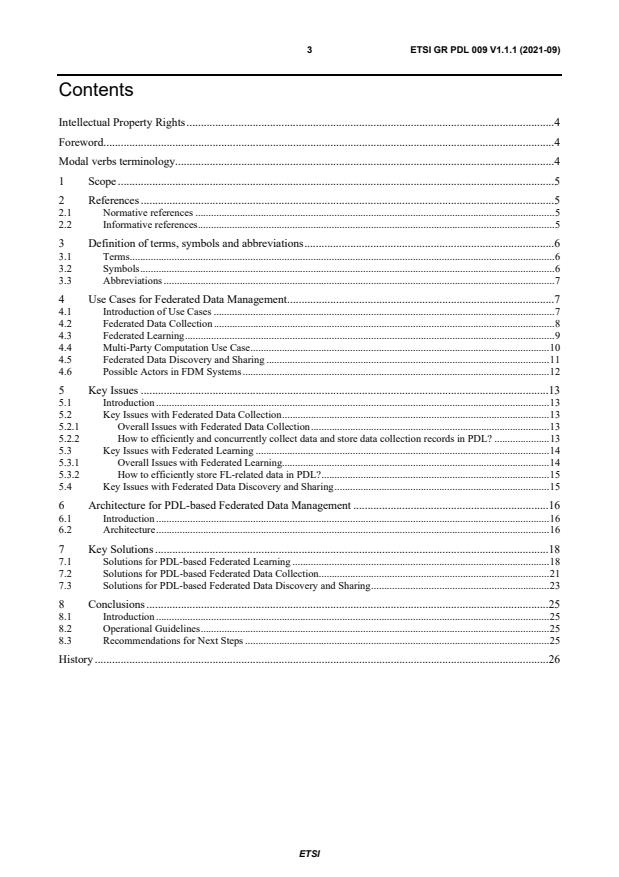
Contents
Intellectual Property Rights . 4
Foreword . 4
Modal verbs terminology . 4
1 Scope . 5
2 References . 5
2.1 Normative references . 5
2.2 Informative references . 5
3 Definition of terms, symbols and abbreviations . 6
3.1 Terms . 6
3.2 Symbols . 6
3.3 Abbreviations . 7
4 Use Cases for Federated Data Management . 7
4.1 Introduction of Use Cases . 7
4.2 Federated Data Collection . 8
4.3 Federated Learning . 9
4.4 Multi-Party Computation Use Case . 10
4.5 Federated Data Discovery and Sharing . 11
4.6 Possible Actors in FDM Systems . 12
5 Key Issues . 13
5.1 Introduction . 13
5.2 Key Issues with Federated Data Collection . 13
5.2.1 Overall Issues with Federated Data Collection . 13
5.2.2 How to efficiently and concurrently collect data and store data collection records in PDL? . 13
5.3 Key Issues with Federated Learning . 14
5.3.1 Overall Issues with Federated Learning. 14
5.3.2 How to efficiently store FL-related data in PDL? . 15
5.4 Key Issues with Federated Data Discovery and Sharing . 15
6 Architecture for PDL-based Federated Data Management . 16
6.1 Introduction . 16
6.2 Architecture . 16
7 Key Solutions . 18
7.1 Solutions for PDL-based Federated Learning . 18
7.2 Solutions for PDL-based Federated Data Collection . 21
7.3 Solutions for PDL-based Federated Data Discovery and Sharing . 23
8 Conclusions . 25
8.1 Introduction . 25
8.2 Operational Guidelines . 25
8.3 Recommendations for Next Steps . 25
History . 26
ETSI
4 ETSI GR PDL 009 V1.1.1 (2021-09)
Intellectual Property Rights
Essential patents
IPRs essential or potentially essential to normative deliverables may have been declared to ETSI. The declarations
pertaining to these essential IPRs, if any, are publicly available for ETSI members and non-members, and can be
found in ETSI SR 000 314: "Intellectual Property Rights (IPRs); Essential, or potentially Essential, IPRs notified to
ETSI in respect of ETSI standards", which is available from the ETSI Secretariat. Latest updates are available on the
ETSI Web server (https://ipr.etsi.org/).
Pursuant to the ETSI Directives including the ETSI IPR Policy, no investigation regarding the essentiality of IPRs,
including IPR searches, has been carried out by ETSI. No guarantee can be given as to the existence of other IPRs not
referenced in ETSI SR 000 314 (or the updates on the ETSI Web server) which are, or may be, or may become,
essential to the present document.
Trademarks
The present document may include trademarks and/or tradenames which are asserted and/or registered by their owners.
ETSI claims no ownership of these except for any which are indicated as being the property of ETSI, and conveys no
right to use or reproduce any trademark and/or tradename. Mention of those trademarks in the present document does
not constitute an endorsement by ETSI of products, services or organizations associated with those trademarks.
DECT™, PLUGTESTS™, UMTS™ and the ETSI logo are trademarks of ETSI registered for the benefit of its
Members. 3GPP™ and LTE™ are trademarks of ETSI registered for the benefit of its Members and of the 3GPP
Organizational Partners. oneM2M™ logo is a trademark of ETSI registered for the benefit of its Members and of the ®
oneM2M Partners. GSM and the GSM logo are trademarks registered and owned by the GSM Association.
Foreword
This Group Report (GR) has been produced by ETSI Industry Specification Group (ISG) Permissioned Distributed
Ledger (PDL).
Modal verbs terminology
In the present document "should", "should not", "may", "need not", "will", "will not", "can" and "cannot" are to be
interpreted as described in clause 3.2 of the ETSI Drafting Rules (Verbal forms for the expression of provisions).
"must" and "must not" are NOT allowed in ETSI deliverables except when used in direct citation.
ETSI
5 ETSI GR PDL 009 V1.1.1 (2021-09)
1 Scope
The present document will describe use case scenarios, functional architecture, key functional components mechanisms
of leveraging PDL for federated data management (e.g. PDL for federated learning, the integration of PDL and the
whole data pipeline).
2 References
2.1 Normative references
Normative references are not applicable in the present document.
2.2 Informative references
References are either specific (identified by date of publication and/or edition number or version number) or
non-specific. For specific references, only the cited version applies. For non-specific references, the latest version of the
referenced document (including any amendments) applies.
NOTE: While any hyperlinks included in this clause were valid at the time of publication, ETSI cannot guarantee
their long term validity.
The following referenced documents are not necessary for the application of the present document but they assist the
user with regard to a particular subject area.
[i.1] Industrial Internet Consortium: "The Industrial Internet of Things Volume G1: Reference
Architecture (Version 1.9)", June 19, 2019.
NOTE: Available at https://www.iiconsortium.org/pdf/IIRA-v1.9.pdf.
rd
[i.2] A. C. Yao: "Protocols for Secure Computations", 23 Annual Symposium on Foundations of
Computer Science (sfcs 1982), Chicago, IL, USA, 1982, Pages 160-164.
[i.3] D. W. Archer, D. Bogdanov, Y. Lindell, L. Kamm, K. Nielsen, J. I. Pagter, N. P. Smart and R. N.
Wright: "From Keys to Databases - Real-World Applications of Secure Multi-Party Computation",
The Computer Journal, Volume 61, Issue 12, December 2018, Pages 1749-1771.
[i.4] C. Zhao, S. Zhao, M. Zhao, Z. Chen, C.-Z. Gao, H. Li and Y. Tan: "Secure Multi-Party
Computation: Theory, practice and applications", Information Sciences, Volume 476, 2019,
Pages 357-372.
[i.5] World Economic Forum White Paper: "Federated Data Systems: Balancing Innovation and Trust
in the Use of Sensitive Data", July 2019.
NOTE: Available at http://www3.weforum.org/docs/WEF_Federated_Data_Systems_2019.pdf.
[i.6] World Economic Forum, Insight Report: "Sharing Sensitive Health Data in a Federated Data
Consortium Model - An Eight-Step Guide", July 2020.
NOTE: Available at http://www3.weforum.org/docs/WEF_Sharing_Sensitive_Health_Data_2020.pdf.
ETSI
6 ETSI GR PDL 009 V1.1.1 (2021-09)
3 Definition of terms, symbols and abbreviations
3.1 Terms
For the purposes of the present document, the following terms apply:
federated data collection: data collection scenario where multiple data types are involved and/or multiple
organizations jointly collect data of their interest, for instance, to improve data collection efficiency
federated data computing: data computing scenario where multiple organizations work together to solve a data
computation task
NOTE: Examples of federated data computing include, but not limited to, federated learning, multi-party
computation, and even decentralized Artificial Intelligence/Machine Learning (AI/ML).
federated data discovery and sharing: data discovery and sharing scenario where federated data is discovered by and
shared among multiple organizations
federated data management: data management scenario where multiple organizations and/or multiple data types could
get involved in each stage of the entire data pipeline or lifecycle and form data federation
NOTE: Examples of federated data management are federated data collection, federated data storing, federated
data computing such as federated learning and multi-party computation, federated data sharing, etc.
federated data storing: data storing scenario where multiple organizations participate in storing data, likely, in
distributed places
federated learning: distributed machine learning approach where multiple clients and a federated learning server
jointly learn an AI model and provide data privacy protection
NOTE: A federated learning process generally works with a few steps:
1) training data are distributed and kept at federated learning clients;
2) a federated learning server coordinates all federated learning clients for them to perform local
training and generate local and temporary model updates for each learning round;
3) the federated learning server receives model updates from federated learning clients and aggregate
them together to generate a global model;
4) the global model will be sent to federated learning clients for them to perform next round of local
training until the goal model converges to the one meeting the expected accuracy.
multi-party computation: secure computation protocol where multiple parties jointly compute a function and
guarantees their data privacy
NOTE: In a multi-party computation:
1) multiple parties jointly compute a function over their individual data inputs to get a computation
result;
2) each party knows the computation result; and
3) none of parties can learn other parties' data inputs but only knows the computation result.
3.2 Symbols
Void.
ETSI
7 ETSI GR PDL 009 V1.1.1 (2021-09)
3.3 Abbreviations
For the purposes of the present document, the following abbreviations apply:
AI Artificial Intelligence
ETSI European Telecommunications Standards Institute
FDDSS Federated Data Discovery and Sharing Service
FDM Federated Data Management
FDS Federated Discovery Service
FL Federated Learning
FPP FDM-PDL Proxy
GDPR General Data Protection Regulation
IIC Industrial Internet Consortium
IIoT Industrial Internet of Things
IoT Internet of Things
IT Information Technology
LMS Ledger Messaging Service
LSS Ledger Storage Service
ML Machine Learning
MPC Multi-Party Computation
MSG Message
PDL Permissioned Distributed Ledger
TXN Transaction
4 Use Cases for Federated Data Management
4.1 Introduction of Use Cases
This clause describes some selected federated data management use cases or scenarios, which could be benefited from
the use of Permissioned Distributed Ledger (PDL) technology and/or introduce new requirements to PDL technology.
As illustrated in Figure 4.1-1, a general data pipeline in federated data management could consist of a set of relatively
sequential stages such as data collection, data storing, data computing, data sharing, and data visualization. For each
stage, multiple organizations could participate and work together. Each organization could have their own data, for
example, generated from ubiquitous devices deployed for different applications such as connected vehicles. In general,
a data pipeline (e.g. data pipeline A and data pipeline B) starts with data collection from devices, but it could complete
in different places in the networking system. For example, data pipeline B in Figure 4.1-1 stops in edge networks
leveraging edge servers for data storing, data computing and data visualization, while data pipeline A ends in the cloud.
This clause will not cover the entire data pipeline but focus more on the stages and corresponding scenarios, which are
more relevant to PDL technology.
ETSI
8 ETSI GR PDL 009 V1.1.1 (2021-09)
Data Pipeline: Security, Privacy, Intelligence
Legend
Data Pipeline B
Data
Data Pipeline A
Collection
Data
Smart
Storing
Factory
Data
Computing
Smart
Data
City
Sharing
Data
Smart Visualization
eHealth
Federated
Data
Connected
Repository
Edge Server (Local Network Functions
Global Data Repositories and
Vehicles
Data Repositories & (Storage, Computing &
Global Intelligence (AI/ML)
Local Intelligence) Intelligence)
Computing
Various Organizations
Access Edge Core Cloud
Server
with Ubiquitous
Networks Networks Networks Infrastructure
Devices
Figure 4.1-1: General Data Pipeline in Federated Data Management
4.2 Federated Data Collection
Our daily lives are surrounded by a variety of sensors and devices. Internet of Things (IoT) technology enables us to
leverage these sensors/devices to monitor and measure the physical world in a real-time manner. In many data-driven
IoT applications, the first and most important stage is data collection. During data collection, the system can collect data
from different devices such as consumer equipment, personal devices, cameras, and wearable health devices; data can
also be collected from commercial equipment including security monitoring systems, traffic monitoring equipment,
production lines, logistics and supply chain systems, etc. These devices generate different types of data and could
belong to and be owned by multiple organizations; the resulted data collection that contains multiple data types and/or
relies on multiple organizations is referred to as federated data collection.
Figure 4.2-1 shows an Industrial Internet of Things (IIoT) use case, which includes a few processes such as smart
manufacturing, smart logistics, and customer experience monitoring. Multiple scenarios could be involved in each
process. For example, the smart manufacturing process could cover product quality control, storage management, onsite
energy management, equipment maintenance, etc. All those processes and scenarios need to be monitored in real-time
to ensure overall product delivery and product quality. As a result, a large amount of production, logistics and customer
experience data are generated at all times and need to be collected. However, in a real-world production environment,
manufacturing equipment and Information Technology (IT) systems usually involve multiple manufacturers; in the
meantime, a complete manufacturing process could involve different departments or even different
companies/organizations. Similarly, during the smart logistics process, products will be transported from factories to
customers through multiple intermediate transit places, where multiple organizations are involved as well. All of these
facts demonstrate that data collection in IIoT is a complex system and needs multi-party collaboration, which is referred
to as federated data collection. Please note that Industrial Internet Consortium (IIC) [i.1] defines more IIoT use cases,
which are not limited to Figure 4.2-1. In these use cases being considered, data security could be needed; as a result,
data at rest and/or data in transit could be encrypted when there is a risk of data leakage.
ETSI
9 ETSI GR PDL 009 V1.1.1 (2021-09)
Industrial Internet of Things (IIoT)
Manufacturing
Customer
Data Collection
Experience
Data Collection
Logistic
Data Collection
...
...
Smart Smart Customer
Smart
Experience
Logistics
Manufacturing
Monitoring
Process
Process
Figure 4.2-1: Federated Data Collection for Industrial Internet of Things (IIoT)
4.3 Federated Learning
Traditional Machine Learning (ML) technology is usually centralized, in the sense that:
1) training data is usually collected to be stored at a centralized location such as a centralized database; and
2) learning process is performed at a centralized location such as clouds as well. However, traditional ML could
cause data leakage issues, since training data is maintained at a location, different than its original place and
likely losing data privacy protection.
As a distributed ML technology and a type of federated data computing, Federated Learning (FL) was to implement a
distributed ML model training process by multiple FL participants while still ensuring data privacy, security and legal
compliance. Using FL-based mobile keyboard prediction as an example, FL usually consists the following steps:
• Step 1: Mobile phones as FL participants participating in an FL task first download initial training model
(i.e. the initial global model) from an FL Server.
• Step 2: Each mobile phone conducts the local training over its local data to train the model and generate its
local model (or model update).
• Step 3: After the local model is trained, the mobile phone uploads the encrypted local model update
(i.e. gradients) to the FL sever.
• Step 4: The FL server aggregates all local model updates collected from multiple mobile phones to obtain a
new/updated global model. The updated global model will be then further sent to each mobile phone for the
next round of training (Similar to Step 1).
• Overall, steps 1-4 will be executed for multiple rounds to improve the global model with expected quality
and/or other requirements.
From the above process, it can be seen that FL can make full use of the data and computing power of the FL
participants. Multiple parties (i.e. participants) can collaborate to build a more robust ML model without
sharing/moving their data. This is very important for ML tasks when a strict data law/supervision is enforced. For
example, the General Data Protection Regulation (GDPR) in Europe puts forward strict requirements on the storage,
use, and transfer of users' private data. Therefore, FL can be used to solve key issues such as data ownership, data
privacy, and data access rights in this environment.
ETSI
10 ETSI GR PDL 009 V1.1.1 (2021-09)
Consider a general use case of smart city and smart transportation as shown in Figure 4.3-1:
• In smart city applications, many cameras will be deployed on streets and generate continuous data or data
streams. These urban camera data can be used to train an ML model for urban environmental monitoring and
predicting. However, uploading all camera data to cloud could be cumbersome or unrealistic. Accordingly, FL
is a more feasible and efficient method.
• Similarly, in smart transportation applications, there will be a large number of vehicles driving on the road,
and each vehicle will generate massive real-time driving data. These data can be trained to generate many ML
models (e.g. to predict which road sections or during which time periods vehicles are most likely to have poor
driving behaviour/performance). However, these data are not only large in quantity, but also contain personal
privacy information; as a result, it is unwise or inefficient to upload these data to a cloud for centralized
processing/training as in traditional ML. FL can be applied in this use case such that a global ML model can be
jointly trained by vehicles without uploading driving data from vehicles to cloud.
Federated Learning
(FL) Server
Global Model
Aggregation
Global Model
Local Model Update
Local Model
Update
Update Local Model
Global Model
Update
Update
Local Model
Training
...
...
City Cameras
Mobile Phones Cars
Local Training/Learning at FL Participants
Figure 4.3-1: Federated Learning in Smart City and Smart Transportation
4.4 Multi-Party Computation Use Case
Secure Multi-Party Computation (MPC) was originally introduced in [i.2] in the form of "The Millionaire's Problem".
Since then, many advances have been made in both MPC theories and practical MPC deployments [i.3], [i.4].
In a general setting of MPC, there are n parties. Each party Pi hosts its own input data xi. They want to jointly compute
a function to get a result: result=f(x1, x2, …, xn) with the requirement that no party can know or deduce input data
hosted by other parties. In other words, all parties only know the function and the computed result. Figure 4.4-1 shows
such a general MPC structure as an example of MPC use cases, which consists of the following procedures:
• Step 1: Parties encrypt their input data.
• Step 2: Parties exchange their encrypted input data.
• Step 3: One (or multiple) party computes the function over received encrypted input data from other parties to
generate a temporary result.
• Step 4: The temporary result is sent to other parties.
• Step 5: One (or multiple) party computes the function over the temporary result to generate the final result.
• Step 6: The final result is sent to other parties.
ETSI
11 ETSI GR PDL 009 V1.1.1 (2021-09)
Input data (xi) at each party Pi
Party P1 Party P2
Send encrypted input
data to other parties
Receive encrypted input data
from other parties
Compute the function over the
MPC Protocol for
received encrypted input data to
Computing the Function
generate the temporary result
f(x1, …, xn)
Send the temporary result to
other parties
Receive the temporary result
to other parties
Generate the final result
Party P3 Party Pn
Figure 4.4-1: General Multi-Party Computation
4.5 Federated Data Discovery and Sharing
As a critical stage of federated data management pipeline, federated data discovery and sharing refers to the process,
where data discovery cannot be solely served by a single organization, but served by multiple organizations. In other
words, a federated data discovery request will trigger data lookup operations on data maintained locally by different
organizations, and discovery results from each organization will be combined or aggregated as the final result for the
federated data discovery request.
Figure 4.5-1 illustrates a federated data discovery scenario, where a user (e.g. a researcher) can discover data
(e.g. genomic data) from multiple organizations (e.g. hospitals). In other words, the user's data discovery request will
not be served by a single organization, but served by multiple, unnecessarily trusted, organizations [i.5], [i.6]. This
scenario consists of the following steps:
• Step 1: A user (e.g. a doctor or a researcher) issues an initial data discovery request to a Federated Data
Discovery and Sharing Service ("FDDSS"), which is a logical function and has access to data maintained
locally at different organizations. It is assumed that the user knows the address of FDDSS (e.g. through
pre-configuration or provisioning).
• Step 2: FDDSS could simply forward the initial data discovery request to organizations (e.g. Organization-1,
Organization-2 and Organization-3); alternatively, it could transform the initial data discovery request to
multiple transformed data discovery requests and forward each transformed data discovery request to a
different organization. Within this step, FDDSS could first authenticate and authorize if the user has the right
to leverage the discovery service. Then, FDDSS could enforce certain access control rules limiting data
discovery based on access criteria. As an example, access control rules could specify the list of data types or
items that are not discoverable.
• Step 3: Each organization receives a separate data discovery request from FDDSS. The organization will
authenticate and authorize the data discovery request, look up the data maintained locally against any
discovery criteria contained in the data discovery request, and generate discovery result. If any data cannot be
discovered (e.g. due to confidential or privacy considerations), the organization could reject the data discovery
request and/or exclude such data from the discovery result.
• Step 4: FDDSS receives data discovery results from multiple organizations, aggregates these results, generates
an aggregated result, and forwards the aggregated result to the user.
ETSI
12 ETSI GR PDL 009 V1.1.1 (2021-09)
Users (e.g., Researchers)
Local Data at
Different
Organizations
Data Discovery
Data Discovery
Result
Request (Initial)
(Aggregated)
Federated Data Discovery and Sharing Service
(Discover data from different organization and return aggregated/federated result to users)
Data Data Data
Data Discovery Data Discovery Data Discovery
Discovery Discovery Discovery
Request Request Request
Result
Result Result
(Transformed) (Transformed) (Transformed)
(Initial)
(Initial) (Initial)
Organization-2
Organization-1 Organization-3
(e.g., Healthcare
(e.g., Hospital) (e.g., Hospital)
Research Institute)
Figure 4.5-1: Federated Data Discovery
4.6 Possible Actors in FDM Systems
Dependent on the support applications (e.g. federated data collection, federated learning, federated data discovery and
sharing), FDM systems could have various types of data and different kinds of actors such as data source, data host,
data consumer, etc.:
• Data Source: The entity such as end devices that generates original data.
• Data Host: The entity that stores and hosts the data. A Data Source could send the original data to a Data Host;
if the Data Source maintains the original data locally, it acts as the Data Host as well.
• Data Consumer: The entity that requests to access the data. A Data Consumer requests data from a Data Host
and/or a Data Source.
Table 4.6-1: Possible Actors in FDM Systems
Actors Data Source Data Host Data Consumer
Federated Data Collection Entities (e.g. devices) that Entities (e.g. servers) that Entities (e.g. users)
generate data collect data that use data
Training Data FL participants (or other FL Participants FL Participants
entities that send training data
Federated to FL participants)
Learning Local Model FL Participants FL Server and FL Participants FL Server
Global Model FL Server FL Server and FL Participants FL Participants and
Users
Multi-Party Computation MPC Parties MPC Parties MPC Parties
(MPC)
Federated Data Discovery Domain entities of an Organizations that maintain Users issuing data
and Sharing organization that generates data locally discovery and
data sharing requests
ETSI
13 ETSI GR PDL 009 V1.1.1 (2021-09)
5 Key Issues
5.1 Introduction
This clause describes some key issues, which are related to federated data management use cases as discussed in the
clause 4 and can be potentially solved by leveraging PDL technologies.
5.2 Key Issues with Federated Data Collection
5.2.1 Overall Issues with Federated Data Collection
As illustrated in Figure 4.2-1, federated data collection is essentially a distributed system and involves multi-party
collaboration, which leads to the following issues:
• The first issue is related to trust. These multiple parties or multiple organizations involved in federated data
collection need to build a certain level of trust in order to jointly collect data in a trustworthy manner.
• The second issue is how to guarantee the integrity of the data collected by multiple organizations. For
example, in the IIoT use case, logistics data as collected from a shipping truck will probably not be tampered.
• The third issue is how to incentivize multiple organizations to participate federated data collection. For
example, customer experience data in the IIoT use case can be very useful for enhancing the manufacturing
process. A proper incentive mechanism is needed to encourage customers to contribute their experience data.
• The fourth issue is related to network security. For example, the IIoT use case relies on distributed IoT
networks to enable federated data collection. To secure distributed IoT network is crucial.
The above issues could be solved by leveraging PDL technologies. For example, PDL technologies can be used to form
a unified ledger infrastructure, which allows various companies, various equipment manufacturers and various logistic
companies to achieve more trustful collaboration relationships, which will ultimately ensure the credibility,
accountability and transparency of federated data collection in the IIoT use case, and in turn improve the efficiency and
reliability of next-generation smart manufacturing. More detailed solutions for PDL-enabled federated data collection
will be developed in clauses 6 and 7. In clause 5.2.2, a few specific key issues are elaborated.
5.2.2 How to efficiently and concurrently collect data and store data
collection records in PDL?
As described in federate data collection use cases, IIoT data will be transmitted and collected from various IIoT devices
(e.g. factory devices, shipping vehicles) to data collection service in the cloud. This is usually done without using or
interacting with PDL system. In other words, many applications currently use regular communications (i.e. off-chain
communications without leveraging PDL) for normal data transmission and collection, and only leverage distributed
ledgers for recording selected data collection histories (i.e. on-chain communications using PDL). This approach has
two problems:
• it involves two separate processes (i.e. off-chain and on-chain communications) and is inefficient in terms of
overall overhead. However, in some cases, it could be more desired to leverage PDL to support both on-chain
and off-chain communication; and
• applications need to directly deal with PDL, which might not be affordable especially when applications are
hosted on resource-constrained IIoT devices. As a result, new functionalities such as intermediary entities can
be designed to help applications to interact with the designated PDL on behalf of applications; such
intermediary entities are logical entities, which could be co-located with servers, gateways, and/or other type
of network nodes.
ETSI
14 ETSI GR PDL 009 V1.1.1 (2021-09)
When considering leveraging PDL systems to transmit/convey and record original application messages (or data)
simultaneously, a few issues need to be considered to improve the efficiency of such concurrent data transmission and
recording:
• For example, when a sender application sends an application message to a receiver application through a
selected PDL chain, the selected PDL chain needs to be able to route the application message through
appropriate PDL nodes and eventually arriving at the receiver application. Given the massive number of
applications (e.g. hosted by IIoT devices), it is inefficient and impractical to let PDL nodes to identify
application messages and their routing for these applications. In addition, an application could continuously
send many application messages through a PDL chain, while another application could only send sporadic
application messages through the PDL chain; different approaches will probably be designed for such
applications, which have different message generation and transmission needs.
• Another consideration is how to enable that these applications can flexibly and efficiently use various PDL
chains. An application could need to use different type of PDL chains but do not have adequate capability to
discover any available PDL chains and maintain their information. Plus, an application could even not directly
interact with any PDL nodes in order to reduce its complexity.
• In addition, how to efficiently transform and adapt application messages to the format of PDL transactions
needs to be considered for several reasons:
1) it could be required that the application message content cannot be seen by all other entities but entities
involved in the same application;
2) the message content also will probably be transparent to PDL nodes, but PDL nodes need to know some
metadata (e.g. which messages are from which applications so that messages from different applications
could be handled by PDL nodes differently based on their needs); and
3) the size of a single application message could be too small and to contain it in a PDL transaction could
cause high overhead.
5.3 Key Issues with Federated Learning
5.3.1 Overall Issues with Federated Learning
In smart city and smart transportation use case as illustrated in Figure 4.3-1, FL is used to learn AI models from
distributed camera data, mobile phone data and vehicle data. Although the use of FL does not need to move local data
away from FL participants (e.g. cameras, mobile phones, vehicles), traditional FL still introduces a few issues:
• First, many FL participants are not from the same organization and do not trust each other, which makes
effective collaboration and coordination between them difficult especially in a fully distributed scenario.
• Second, a FL participant could have useless and even malicious local data, which cannot help training a good
local model.
• Third, a FL participant could inject a bad local model, which will impact the aggregated global model. The
integrity of local model and global mode also needs to be guaranteed and accountable.
• Fourth, a sufficient number of FL participants are required to guarantee the quality of the global model. The
issue to how to incentivize FL participants with good local data to participate FL.
• Fifth, local models generated in each FL round could provide insights on the whole FL and enable explainable
AI. But it relies on how the integrity and accountability of local models can be guaranteed.
• Last but not the least, the FL aggregation server is still a single-point-of-failure. If the FL aggregation server
fails, the global model will never be appropriately generated.
PDL technologies help to solve and/or mitigate the above issues. For example, local models can be stored in the ledger
for future traceability and explanation purposes. Also, smart contracts can be leveraged to encourage FL participants to
actively cooperate and contribute their local data and learning capabilities. More detailed solutions for PDL-enabled
federated learning will be developed in clauses 6 and 7. In clause 5.3.2, a few specific key issues are elaborated.
ETSI
15 ETSI GR PDL 009 V1.1.1 (2021-09)
5.3.2 How to efficiently store FL-related data in PDL?
In reality, various FL tasks can be initiated and multiple FL participants in a given FL task could not be affiliated with
the same organization. In other words, those FL participants could not trust or know each other, and they could join a
specific FL task randomly. Those FL participants usually do not have formal business collaboration relationships with
the FL task initiator and therefore the FL participants do not have obligations for contributing themselves to an FL
training process. Given that, all the data related to FL training can be recorded using PDL since it can enable the
traceability and accountability of the FL training process among those untrusted FL participants. For instance, when
certain FL participants are malicious nodes and uploaded many bad local model updates, the FL records in the PDL can
be used to identify those malicious behaviours.
In the meantime, massive data such as training data and FL models can be generated by the FL participants and the FL
server during the whole FL training process:
• For example, during the FL training process, local model updates are produced by FL participants. Once the
FL training process is completed, the final global model is generated by the FL server.
• Other types of data could include training progress and performance-related data/statistics (e.g. how long did
an FL participant take for completing a local training during each training round? how much computing
resources were allocated for the local training?).
All types of these data can be recorded in PDL chains in order to support accountability and traceability (e.g. to support
rollback operations if an FL training process needs to be restarted from a certain point in order to eliminate a bad effect
made by a malicious FL participant). As such, how to effectively store them in PDL remains a major design challenge,
for example, based on the following design considerations:
• The type of FL-related data to be stored to PDL systems will probably be determined, for instance, based on
the availability and capability of PDL systems. For a specific FL training process, it might be determined that
only the final global model and/or the list of FL participants will be stored to a PDL chain to reduce overhead
to PDL system.
• FL participants will probably be appropriately instructed or notified of the type of FL-related data that they
need to store to PDL chains. Note that the entity that creates/initiates a specific FL training process could now
know or trust involved FL participants. Note that the size of FL models (either local models or the global
model) could be in tens of megabytes and even larger. An FL model could be stored with a full version or with
smaller tailored versions. As such, a critical issue is how to prepare the FL model in
...
Questions, Comments and Discussion
Ask us and Technical Secretary will try to provide an answer. You can facilitate discussion about the standard in here.
Loading comments...