


ETSI TR 184 012 V1.1.1 (2015-05)
Network Technologies (NTECH); Description of the DNS protocol usage in IP based operators networks
Network Technologies (NTECH); Description of the DNS protocol usage in IP based operators networks
DTR/NTECH-00003-NNAR-DNS
General Information
Standards Content (Sample)
TECHNICAL REPORT
Network Technologies (NTECH);
Description of the DNS protocol usage
in IP based operators networks
2 ETSI TR 184 012 V1.1.1 (2015-05)
Reference
DTR/NTECH-00003-NNAR-DNS
Keywords
addressing, DNS, enum
ETSI
650 Route des Lucioles
F-06921 Sophia Antipolis Cedex - FRANCE
Tel.: +33 4 92 94 42 00 Fax: +33 4 93 65 47 16
Siret N° 348 623 562 00017 - NAF 742 C
Association à but non lucratif enregistrée à la
Sous-Préfecture de Grasse (06) N° 7803/88
Important notice
The present document can be downloaded from:
http://www.etsi.org/standards-search
The present document may be made available in electronic versions and/or in print. The content of any electronic and/or
print versions of the present document shall not be modified without the prior written authorization of ETSI. In case of any
existing or perceived difference in contents between such versions and/or in print, the only prevailing document is the
print of the Portable Document Format (PDF) version kept on a specific network drive within ETSI Secretariat.
Users of the present document should be aware that the document may be subject to revision or change of status.
Information on the current status of this and other ETSI documents is available at
http://portal.etsi.org/tb/status/status.asp
If you find errors in the present document, please send your comment to one of the following services:
https://portal.etsi.org/People/CommiteeSupportStaff.aspx
Copyright Notification
No part may be reproduced or utilized in any form or by any means, electronic or mechanical, including photocopying
and microfilm except as authorized by written permission of ETSI.
The content of the PDF version shall not be modified without the written authorization of ETSI.
The copyright and the foregoing restriction extend to reproduction in all media.
© European Telecommunications Standards Institute 2015.
All rights reserved.
TM TM TM
DECT , PLUGTESTS , UMTS and the ETSI logo are Trade Marks of ETSI registered for the benefit of its Members.
TM
3GPP and LTE™ are Trade Marks of ETSI registered for the benefit of its Members and
of the 3GPP Organizational Partners.
GSM® and the GSM logo are Trade Marks registered and owned by the GSM Association.
ETSI
3 ETSI TR 184 012 V1.1.1 (2015-05)
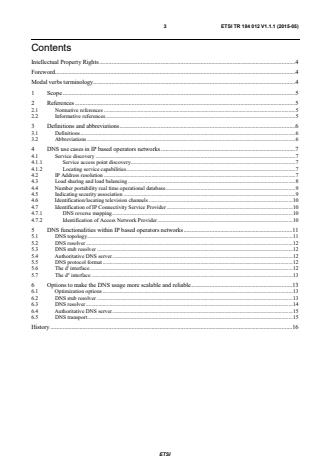
Contents
Intellectual Property Rights . 4
Foreword . 4
Modal verbs terminology . 4
1 Scope . 5
2 References . 5
2.1 Normative references . 5
2.2 Informative references . 5
3 Definitions and abbreviations . 6
3.1 Definitions . 6
3.2 Abbreviations . 6
4 DNS use cases in IP based operators networks . 7
4.1 Service discovery . 7
4.1.1 Service access point discovery. 7
4.1.2 Locating service capabilities . 7
4.2 IP Address resolution . 7
4.3 Load sharing and load balancing . 8
4.4 Number portability real time operational database . 9
4.5 Indicating security association . 9
4.6 Identification/locating television channels . 10
4.7 Identification of IP Connectivity Service Provider . 10
4.7.1 DNS reverse mapping . 10
4.7.2 Identification of Access Network Provider . 10
5 DNS functionalities within IP based operators networks . 11
5.1 DNS topology . 11
5.2 DNS resolver . 12
5.3 DNS stub resolver . 12
5.4 Authoritative DNS server . 12
5.5 DNS protocol format . 12
5.6 The d' interface . 12
5.7 The d'' interface . 13
6 Options to make the DNS usage more scalable and reliable . 13
6.1 Optimization options . 13
6.2 DNS stub resolver . 13
6.3 DNS resolver . 14
6.4 Authoritative DNS server . 15
6.5 DNS transport . 15
History . 16
ETSI
4 ETSI TR 184 012 V1.1.1 (2015-05)
Intellectual Property Rights
IPRs essential or potentially essential to the present document may have been declared to ETSI. The information
pertaining to these essential IPRs, if any, is publicly available for ETSI members and non-members, and can be found
in ETSI SR 000 314: "Intellectual Property Rights (IPRs); Essential, or potentially Essential, IPRs notified to ETSI in
respect of ETSI standards", which is available from the ETSI Secretariat. Latest updates are available on the ETSI Web
server (http://ipr.etsi.org).
Pursuant to the ETSI IPR Policy, no investigation, including IPR searches, has been carried out by ETSI. No guarantee
can be given as to the existence of other IPRs not referenced in ETSI SR 000 314 (or the updates on the ETSI Web
server) which are, or may be, or may become, essential to the present document.
Foreword
This Technical Report (TR) has been produced by ETSI Technical Committee Network Technologies (NTECH).
Modal verbs terminology
In the present document "shall", "shall not", "should", "should not", "may", "need not", "will", "will not", "can" and
"cannot" are to be interpreted as described in clause 3.2 of the ETSI Drafting Rules (Verbal forms for the expression of
provisions).
"must" and "must not" are NOT allowed in ETSI deliverables except when used in direct citation.
ETSI
5 ETSI TR 184 012 V1.1.1 (2015-05)
1 Scope
The present document describes different use cases for the usage of the DNS protocol (e.g. Service Location,
NP/ENUM, address resolution) in IP based operators networks. The DNS base protocol itself is defined in
RFC 1035 [i.16].
The present document describes the behaviour and details for DNS protocol usage in IP based operators networks,
transport options for DNS messages, DNS protocol behaviour and configuration as well as options to make the usage of
the DNS protocol more reliable (e.g. timer characteristics etc.).
The use cases described here and options to make the usage of the DNS protocol more reliable are principal ones for
network operators and not intended to be exhaustive.
2 References
2.1 Normative references
References are either specific (identified by date of publication and/or edition number or version number) or
non-specific. For specific references, only the cited version applies. For non-specific references, the latest version of the
reference document (including any amendments) applies.
Referenced documents which are not found to be publicly available in the expected location might be found at
http://docbox.etsi.org/Reference.
NOTE: While any hyperlinks included in this clause were valid at the time of publication, ETSI cannot guarantee
their long term validity.
The following referenced documents are necessary for the application of the present document.
Not applicable.
2.2 Informative references
References are either specific (identified by date of publication and/or edition number or version number) or
non-specific. For specific references, only the cited version applies. For non-specific references, the latest version of the
reference document (including any amendments) applies.
NOTE: While any hyperlinks included in this clause were valid at the time of publication, ETSI cannot guarantee
their long term validity.
The following referenced documents are not necessary for the application of the present document but they assist the
user with regard to a particular subject area.
[i.1] ICANN: "Internet Consensus Policy 2: Criteria for Establishment of New Regional Internet
Registries".
[i.2] ETSI TS 182 028: "Telecommunications and Internet converged Services and Protocols for
Advanced Networking (TISPAN); NGN integrated IPTV subsystem Architecture".
[i.3] IETF RFC 5966: "DNS Transport over TCP - Implementation Requirements".
[i.4] ETSI TS 124 229: "Digital cellular telecommunications system (Phase 2+); Universal Mobile
Telecommunications System (UMTS); LTE; IP multimedia call control protocol based on Session
Initiation Protocol (SIP) and Session Description Protocol (SDP); Stage 3 (3GPP TS 24.229)".
[i.5] IETF RFC 3263: "Session Initiation Protocol (SIP): Locating SIP Servers".
[i.6] ETSI TR 184 003: "Telecommunications and Internet converged Services and Protocols for
Advanced Networking (TISPAN); Portability of telephone numbers between operators for Next
Generation Networks (NGNs)".
ETSI
6 ETSI TR 184 012 V1.1.1 (2015-05)
[i.7] IETF RFC 3761: "The E.164 to Uniform Resource Identifiers (URI) Dynamic Delegation
Discovery System (DDDS) Application (ENUM)".
[i.8] ETSI TS 184 009: "Telecommunications and Internet converged Services and Protocols for
Advanced Networking (TISPAN); Rules covering the use of TV URIs for the Identification of
Television Channels".
[i.9] IETF RFC 2838: "Uniform Resource Identifiers for Television Broadcasts".
[i.10] IETF RFC 2396: "Uniform Resource Identifiers (URI): Generic Syntax".
[i.11] IETF RFC 2782: "A DNS RR for specifying the location of services (DNS SRV)".
[i.12] IETF RFC 3403: "Dynamic Delegation Discovery System (DDDS) Part Three: The Domain Name
System (DNS) Database".
[i.13] IETF RFC 1034: "Domain names - concepts and facilities".
[i.14] IETF RFC 2317: "Classless IN-ADDR.ARPA delegation".
[i.15] IETF RFC 3596: "DNS Extensions to Support IP Version 6".
[i.16] IETF RFC 1035: "Domain names - implementation and specification".
3 Definitions and abbreviations
3.1 Definitions
For the purposes of the present document, the following terms and definitions apply:
access network provider: service provider that provides physical and IP connectivity to a user equipment (UE) via a
fixed or mobile access
3.2 Abbreviations
For the purposes of the present document, the following abbreviations apply:
AfriNIC African Network Information Centre
APNIC Asia Pacific Network Information Centre
ARIN American Registry for Internet Numbers
IANA Internet Assigned Numbers Authority
DDDS Dynamic Delegation Discovery System
DNS Domain Name System
ENUM tElephone NUMber mapping
FQDN Fully Qualified Domain Name
ICANN Internet Corporation for Assigned Names and Numbers
IETF Internet Engineering Task Force
IP Internet Protocol
IPTV Internet Protocol TeleVision
LACNIC Latin America & Caribbean Network Information Centre
LIR Local Internet Registry
NAPTR Naming Authority Pointer
NGN Next Generation Network
NP Number Portability
OSI Open System Interconnection
P-CSCF Proxy-Call Session Control Function
PTR Pointer
RIPE NCC Réseaux IP Européens Network Coordination Centre
RIR Regional Internet Registry
RR Resource Record
S-CSCF Serving-Call Session Control Function
SDP Session Description Protocol
ETSI
7 ETSI TR 184 012 V1.1.1 (2015-05)
SIP Session Initiation Protocol
SRV Service
TCP Transport Control Protocol
TV Tele Vision
UDP User Datagram Protocol
UE User Equipment
URI Uniform Resource Identifier
4 DNS use cases in IP based operators networks
4.1 Service discovery
4.1.1 Service access point discovery
Service discovery can be defined as a mechanism which provides to a client, given a type of service that the client is
looking for, and a domain in which the service is located and the IP protocol version the client is using, one or several
IP addresses of systems which offer the requested services.
EXAMPLE: As described in clause 9 of ETSI TS 124 229 [i.4] the User Equipment (UE) can employ the DNS
to obtain the P-CSCF IP address(es). This can be done when the UE is using IPv6 or IPv4 as a
DNS or SIP/RTP message transport protocol and is valid for different IP-Connectivity Access
Network (IP-CAN) types. Usually the UE will use RFC 3263 [i.5] to locate the P-CSCF IP address
as a Session Initiation Protocol (SIP) server.
4.1.2 Locating service capabilities
The DNS protocol and infrastructure can be used to locate service capabilities in a DNS domain. In general there are 2
possibilities applicable:
• querying a FQDN which indicates service capabilities; or
• querying a distinct RR type and obtain the service capabilities from the answer.
In the first case the DNS client forms a FQDN which labels associate distinct service capabilities (e.g. SRV
RFC 2782 [i.11]). On a try and fail basis the DNS is queried with this FQDN in the query section. When there is a RR
delivered this service (DNS response code 0 - no error) is available in the DNS domain. When there is a negative
answer (DNS response code 3 - NX Domain) this service does not exist in that domain. The application which triggers
the DNS client can try to form a new FQDN which labels associate a similar service and sends a new DNS query with
another FQDN in the query section. When there is no positive answer the application can try another FQDN or can stop
using the DNS for service location for this current process.
In the second case the queried DNS Resource Records contain in their data section information regarding the available
services for the domain. Therefore the DNS delivers typically several DNS RRs. So the DNS client can analyse this
answer and select the best matching RR for the further processing of the communication service. A typical example for
such a kind of service location is ENUM. The services field within the NAPTR RR [i.12] contains a character-string
that specifies the service parameters applicable to the queried FQDN.
4.2 IP Address resolution
The impetus for the development of the domain system in the 1980's was the growth in the Internet. In the early days of
the Internet the mapping of hostnames to IP addresses was provided in a single file (HOSTS.TXT) which was
distributed via File Transfer Protocol by all hosts. This has now been replaced by the DNS. Whereas today the DNS
provides possibilities for managing more than 100 different Resource Record types
(http://www.iana.org/assignments/dns-parameters), the mapping of hostnames to IPv4 (DNS Resource Record Type 1)
and IPv6 addresses (DNS Resource Record Type 28) is still a key functionality of the DNS. It should be mentioned that
the queried resource record type is independent of DNS transport protocol.
...
Questions, Comments and Discussion
Ask us and Technical Secretary will try to provide an answer. You can facilitate discussion about the standard in here.
Loading comments...