


ETSI GR NIN 002 V1.1.1 (2021-03)
Non-IP Networking (NIN); Implementing Non-IP networking over 3GPP cellular access
Non-IP Networking (NIN); Implementing Non-IP networking over 3GPP cellular access
DGR/NIN-002
General Information
Standards Content (Sample)
GROUP REPORT
Non-IP Networking (NIN);
Implementing Non-IP networking over 3GPP cellular access
Disclaimer
The present document has been produced and approved by the Non-IP Networking ETSI Industry Specification Group (ISG)
and represents the views of those members who participated in this ISG.
It does not necessarily represent the views of the entire ETSI membership.
2 ETSI GR NIN 002 V1.1.1 (2021-03)
Reference
DGR/NIN-0002
Keywords
3GPP, access, internet, layer 3, network
performance, network scenarios, next generation
protocol
ETSI
650 Route des Lucioles
F-06921 Sophia Antipolis Cedex - FRANCE
Tel.: +33 4 92 94 42 00 Fax: +33 4 93 65 47 16
Siret N° 348 623 562 00017 - NAF 742 C
Association à but non lucratif enregistrée à la
Sous-Préfecture de Grasse (06) N° 7803/88
Important notice
The present document can be downloaded from:
http://www.etsi.org/standards-search
The present document may be made available in electronic versions and/or in print. The content of any electronic and/or
print versions of the present document shall not be modified without the prior written authorization of ETSI. In case of any
existing or perceived difference in contents between such versions and/or in print, the prevailing version of an ETSI
deliverable is the one made publicly available in PDF format at www.etsi.org/deliver.
Users of the present document should be aware that the document may be subject to revision or change of status.
Information on the current status of this and other ETSI documents is available at
https://portal.etsi.org/TB/ETSIDeliverableStatus.aspx
If you find errors in the present document, please send your comment to one of the following services:
https://portal.etsi.org/People/CommiteeSupportStaff.aspx
Copyright Notification
No part may be reproduced or utilized in any form or by any means, electronic or mechanical, including photocopying
and microfilm except as authorized by written permission of ETSI.
The content of the PDF version shall not be modified without the written authorization of ETSI.
The copyright and the foregoing restriction extend to reproduction in all media.
© ETSI 2021.
All rights reserved.
DECT™, PLUGTESTS™, UMTS™ and the ETSI logo are trademarks of ETSI registered for the benefit of its Members.
3GPP™ and LTE™ are trademarks of ETSI registered for the benefit of its Members and
of the 3GPP Organizational Partners.
oneM2M™ logo is a trademark of ETSI registered for the benefit of its Members and
of the oneM2M Partners. ®
GSM and the GSM logo are trademarks registered and owned by the GSM Association.
ETSI
3 ETSI GR NIN 002 V1.1.1 (2021-03)
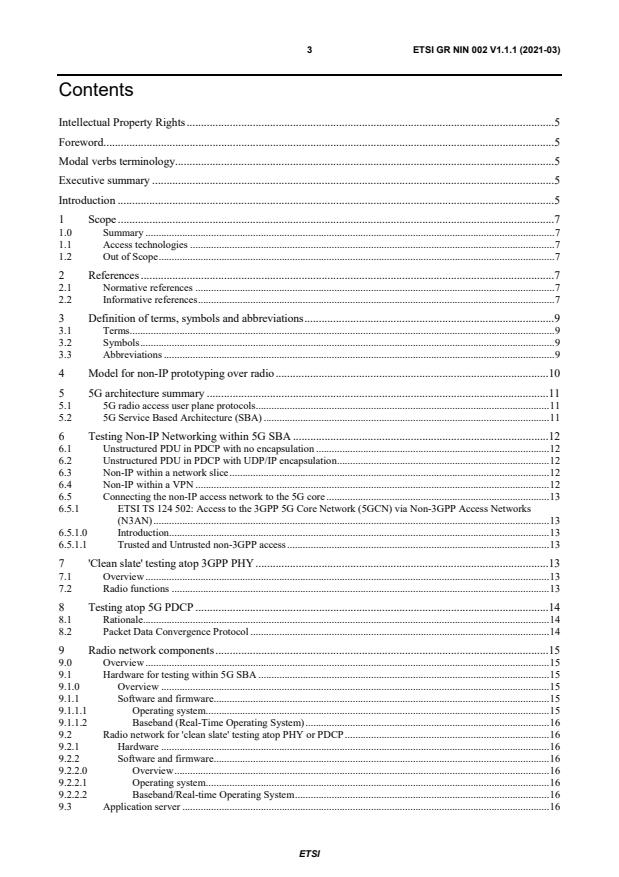
Contents
Intellectual Property Rights . 5
Foreword . 5
Modal verbs terminology . 5
Executive summary . 5
Introduction . 5
1 Scope . 7
1.0 Summary . 7
1.1 Access technologies . 7
1.2 Out of Scope . 7
2 References . 7
2.1 Normative references . 7
2.2 Informative references . 7
3 Definition of terms, symbols and abbreviations . 9
3.1 Terms . 9
3.2 Symbols . 9
3.3 Abbreviations . 9
4 Model for non-IP prototyping over radio . 10
5 5G architecture summary . 11
5.1 5G radio access user plane protocols . 11
5.2 5G Service Based Architecture (SBA) . 11
6 Testing Non-IP Networking within 5G SBA . 12
6.1 Unstructured PDU in PDCP with no encapsulation . 12
6.2 Unstructured PDU in PDCP with UDP/IP encapsulatio n . 12
6.3 Non-IP within a network slice . 12
6.4 Non-IP within a VPN . 12
6.5 Connecting the non-IP access network to the 5G core . 13
6.5.1 ETSI TS 124 502: Access to the 3GPP 5G Core Network (5GCN) via Non-3GPP Access Networks
(N3AN) . 13
6.5.1.0 Introduction. 13
6.5.1.1 Trusted and Untrusted non-3GPP access . 13
7 'Clean slate' testing atop 3GPP PHY . 13
7.1 Overview . 13
7.2 Radio functions . 13
8 Testing atop 5G PDCP . 14
8.1 Rationale. 14
8.2 Packet Data Convergence Protocol . 14
9 Radio network components . 15
9.0 Overview . 15
9.1 Hardware for testing within 5G SBA . 15
9.1.0 Overview . 15
9.1.1 Software and firmware . 15
9.1.1.1 Operating system . 15
9.1.1.2 Baseband (Real-Time Operating System) . 16
9.2 Radio network for 'clean slate' testing atop PHY or PDCP . 16
9.2.1 Hardware . 16
9.2.2 Software and firmware . 16
9.2.2.0 Overview . 16
9.2.2.1 Operating system . 16
9.2.2.2 Baseband/Real-time Operating System . 16
9.3 Application server . 16
ETSI
4 ETSI GR NIN 002 V1.1.1 (2021-03)
9.4 Application client . 17
10 Non-technical considerations . 17
10.1 Safety . 17
10.2 Test environment . 17
10.3 Licencing . 17
10.4 Regulatory compliance . 17
11 Comparison of the protyping approaches . 17
12 Scaling the prototype . 18
12.0 Overview . 18
12.1 Fronthaul . 18
12.1.1 Enhanced Common Public Radio Interface . 18
12.1.2 Implication for non-IP networking . 19
13 Test scenarios . 19
13.0 Overview . 19
13.1 Low-power IoT devices . 19
13.1.0 Rationale for scenario . 19
13.1.1 Comparative testing . 19
13.2 Video and audio services . 20
13.3 Tactile . 20
History . 21
ETSI
5 ETSI GR NIN 002 V1.1.1 (2021-03)
Intellectual Property Rights
Essential patents
IPRs essential or potentially essential to normative deliverables may have been declared to ETSI. The information
pertaining to these essential IPRs, if any, is publicly available for ETSI members and non-members, and can be found
in ETSI SR 000 314: "Intellectual Property Rights (IPRs); Essential, or potentially Essential, IPRs notified to ETSI in
respect of ETSI standards", which is available from the ETSI Secretariat. Latest updates are available on the ETSI Web
server (https://ipr.etsi.org/).
Pursuant to the ETSI IPR Policy, no investigation, including IPR searches, has been carried out by ETSI. No guarantee
can be given as to the existence of other IPRs not referenced in ETSI SR 000 314 (or the updates on the ETSI Web
server) which are, or may be, or may become, essential to the present document.
Trademarks
The present document may include trademarks and/or tradenames which are asserted and/or registered by their owners.
ETSI claims no ownership of these except for any which are indicated as being the property of ETSI, and conveys no
right to use or reproduce any trademark and/or tradename. Mention of those trademarks in the present document does
not constitute an endorsement by ETSI of products, services or organizations associated with those trademarks.
Foreword
This Group Report (GR) has been produced by ETSI Industry Specification Group (ISG) Non-IP Networking (NIN).
Modal verbs terminology
In the present document "should", "should not", "may", "need not", "will", "will not", "can" and "cannot" are to be
interpreted as described in clause 3.2 of the ETSI Drafting Rules (Verbal forms for the expression of provisions).
"must" and "must not" are NOT allowed in ETSI deliverables except when used in direct citation.
Executive summary
The present document describes and recommends approaches to test Non-IP Networking (NIN) over cellular radio
access. This includes existing mechanisms specified by 3GPP for both LTE and 5G Radio Access Networks, as well as
guidance on enabling a non-IP protocol stack directly atop the 3GPP PHY radio layer.
Introduction
The earliest digital cellular radio network ('2G') implemented circuit switching for voice and data services, providing a
dedicated circuit between sender and receiver. Whilst this can guarantee bandwidth for the circuit, it is not an efficient
use of network resources where communication flows are not constant and not at full capacity.
Hence cellular networks have implemented packet switching since the release of General Packet Radio Switching
(GPRS) in 2000, allowing packets to share available routing resources. There has been a steady move towards an
"all-IP" architecture with the releases of 3G, 4G (LTE) and 5G. The hypothesis was that this would drive down cost -
since switch and router vendors were already producing IP kit for wired networks - and that it would enable
interconnection with external IP networks and devices.
rd
The result has been that 3 Generation Partnership Project (3GPP) specifications for cellular networks necessitate the
use of IP. The phrase "all-IP" networks is a misnomer, since the TCP/IP stack is encapsulated ('tunnelled') in a bespoke
3GPP protocol stack to isolate a user's traffic from other users; secure, compress and transport data over the radio air
interface; and to support mobility.
ETSI
6 ETSI GR NIN 002 V1.1.1 (2021-03)
The 'Efficient use of Spectrum' clause of ETSI GR NIN 001 [i.6] explains the issues these can cause in cellular
networking. Non-IP networking aims to support native mobility and multihoming, security by design, shorter headers,
and in-network congestion control for improved performance to mitigate these issues. This motivates investigation into
what parts of the current 3GPP protocol stack can be considered redundant, and removed, in a Non-IP networking
implementation; how to test such an implementation; and how to compare performance against the TCP/IP protocol
suite.
The present document describes, compares and recommends approaches to test Non-IP Networking (NIN) over a 3GPP
cellular network (LTE and 5G). This includes existing mechanisms specified by 3GPP for both LTE and 5G Radio
Access Networks that account for non-IP protocol types. The present document also suggests the building blocks
required to test fully 'clean slate' non-IP networking atop the 3GPP PHY radio layer, and includes example scenarios
and non-technical considerations across all tests. Scalability of non-IP networking to live 5G networks is also discussed.
ETSI
7 ETSI GR NIN 002 V1.1.1 (2021-03)
1 Scope
1.0 Summary
The present document describes considerations for testing Non-IP Networking over 5G cellular Radio Access
Networks. Although the LTE protocol stack is not explicitly considered the approach will be similar: either to use a
clean-slate approach or one of the hooks provided by 3GPP to encapsulate non-IP PDUs. Fixed-line networks and ®
Wi-Fi are not in scope of the present document; although it may be that some of the material may be of relevance to
those contexts.
The initial scope of testing is a simple proof of concept: to demonstrate communication between two remote processes
over a radio air interface using Non-IP network protocols. This involves at minimum the UE, the air interface, the 3GPP
gNb or eNb, and a data plane that communicates using Non-IP Networking. Depending on the test approach chosen (as
described in clauses 6 and 7), certain elements of the 3GPP architecture may be utilized or adapted. If successful then
this proof of concept should be extended to comparative testing against IP networking per the KPIs published in ETSI
GS NGP 012 [i.7].
1.1 Access technologies
The present document covers testing over 3GPP 5G radio access networks, with LTE possible for the 'clean slate'
approaches document in clauses 7 and 8.
1.2 Out of Scope
The present document does not cover interoperability with IP-based networks, including roaming scenarios between
3GPP mobile network operators. These may be covered in future documents following a successful test of the simple
proof-of-concept.
2 References
2.1 Normative references
Normative references are not applicable in the present document.
2.2 Informative references
References are either specific (identified by date of publication and/or edition number or version number) or
non-specific. For specific references, only the cited version applies. For non-specific references, the latest version of the
referenced document (including any amendments) applies.
NOTE: While any hyperlinks included in this clause were valid at the time of publication, ETSI cannot guarantee
their long term validity.
The following referenced documents are not necessary for the application of the present document but they assist the
user with regard to a particular subject area.
[i.1] 3GPP System architecture milestone of 5G Phase 1 is achieved.
NOTE: Available at https://www.3gpp.org/NEWS-EVENTS/3GPP-NEWS/1930-SYS_ARCHITECTURE.
[i.2] eCPRI Specification V2.0: "Common Public Radio Interface: eCPRI Interface Specification".
NOTE: Available at http://www.cpri.info/downloads/eCPRI_v_2.0_2019_05_10c.pdf.
ETSI
8 ETSI GR NIN 002 V1.1.1 (2021-03)
[i.3] eCPRI: "Specification Overview".
NOTE: Available at http://www.cpri.info/spec.html.
[i.4] IEEE P802.CMTM™: "Time-Sensitive Networking for Fronthaul".
NOTE: Available at https://1.ieee802.org/tsn/802-1cm/.
[i.5] IETF draft-charter-ietf-6lowpan-06: "IPv6 over Low power WPAN (6lowpan)".
NOTE: Available at https://datatracker.ietf.org/wg/6lowpan/about/.
[i.6] ETSI GR NIN 001: "Non-IP Networking (NIN); Problem Statement: networking with TCP/IP in
the 2020s".
[i.7] ETSI GS NGP 012: "KPIs for Next Generation Protocols: Basis for measuring benefits of NGP".
[i.8] ETSI TS 138 425: "5G; NG-RAN NR user plane protocol (3GPP TS 38.425)".
[i.9] ETSI TS 123 502: "5G; Procedures for the 5G system (5GS) (3GPP TS 23.502)".
[i.10] ETSI TS 123 682: "Digital cellular telecommunications system (Phase 2+) (GSM); Universal
Mobile Telecommunications System (UMTS); LTE; Architecture enhancements to facilitate
communications with packet data networks and applications (3GPP TS 23.682)".
[i.11] ETSI TS 122 261: "5G; Service requirements for the 5G system (3GPP TS 22.261)".
[i.12] ETSI TS 124 502: "5G; Access to the 3GPP 5G Core Network (5GCN) via non-3GPP access
networks (3GPP TS 24.502)".
[i.13] "ICNIRP Guidelines for limiting exposure to electromagnetic fields (100 KHz to 300 GHz)",
International Commission on Non-Ionizing Radiation Protection, 2020.
NOTE: Available at https://www.icnirp.org/cms/upload/publications/ICNIRPrfgdl2020.pdf.
[i.14] GSMA, June 2019: "NB-IoT Deployment Guide to Basic Feature set Requirements".
NOTE: Available at https://www.gsma.com/iot/wp-content/uploads/2019/07/201906-GSMA-NB-IoT-
Deployment-Guide-v3.pdf.
[i.15] ETSI TS 123 401: "LTE; General Packet Radio Service (GPRS) enhancements for Evolved
Universal Terrestrial Radio Access Network (E-UTRAN) access (3GPP TS 23.401)".
[i.16] FreeRTOS: "Adding the TCP/IP Source Files to an RTOS Project".
NOTE: Available at https://freertos.org/FreeRTOS-
Plus/FreeRTOS_Plus_TCP/TCP_Networking_Tutorial_Adding_Source_Files.html.
[i.17] Office of Communication (Ofcom): Radiocommunications licence.
NOTE: Available at https://www.ofcom.org.uk/manage-your-licence/radiocommunication-licences.
[i.18] CPRI: "Common Public Radio Interface", diagram of eCPRI protocol stack over IP/Ethernet.
NOTE: Available at http://www.cpri.info/downloads/eCPRI_Presentation_for_CPRI_Server_2018_01_03.pdf.
[i.19] ETSI TS 123 501: "5G; System architecture for the 5G System (5GS) (3GPP TS 23.501)".
[i.20] ETSI TS 138 300: "5G; NR; NR and NG-RAN Overall description; Stage-2 (3GPP TS 38.300)".
ETSI
9 ETSI GR NIN 002 V1.1.1 (2021-03)
3 Definition of terms, symbols and abbreviations
3.1 Terms
Void.
3.2 Symbols
Void.
3.3 Abbreviations
For the purposes of the present document, the following abbreviations apply:
5GCN 5G Core Network
BLE Bluetooth Low Energy
CPRI Common Public Radio Interface
DN Data Network
EMF Electro Magnetic Field Limits (Human Exposure)
FPGA Field Programmable Gate Array
GPRS General Packet Radio Service
GTP GPRS Tunnel Protocol
ICNIRP International Commission for Non-Ionizing Radiation Protection
IoT Internet of Things
IP Internet Protocol
KS Kernel Space
L2CAP Logical Link Control and Adaptation Protocol
LAN Local Area Network
MAC Media Access Control
MTU Maximum Throughput Unit
NAS Non-Access Stratum
NGP Next Generation Protocols
NIDD Non-IP Data Delivery
NIN Non-IP Networking
NR 5G New Radio
OS Operating System
PCI-E Peripheral Component Interface Express
PDCP Packet Data Convergence Protocol
PDU Protocol Data Unit
PH Protocol Handler library
PHY PHYsical layer
PtP Point-to-Point
QoS Quality of Service
RAN Radio Access Network
RF Radio Frequency
RLC Radio Link Control
RRC Radio Resource Control
RTOS Real Time Operating System
SBA Service Based Architecture
SCEF Service Capabilities Exposure Function
SDAP Service Data Adaptation Protocol
SIM Subscriber Identity Module
TCP Transmission Control Protocol
TNGF Trusted Non-3GPP Gateway Function
TSN Time Sensitive Networking
UDP User Datagram Protocol
UE User Equipment
UPF User Plane Function
ETSI
10 ETSI GR NIN 002 V1.1.1 (2021-03)
US User Space
VLAN Virtual Local Area Network
VPN Virtual Private Network
4 Model for non-IP prototyping over radio
Legend:
KS = Kernel Space
US = User Space
PH = Protocol Handler library
Figure 4.1: Model for Non-IP prototyping over radio
The Protocol Handler may be implemented within kernel space or user space. The former requires kernel development,
but can offer more control over networking operations. The user space option is easier to develop but requests
networking resources from the kernel, and will hence reuse the existing TCP/IP network stack.
ETSI
11 ETSI GR NIN 002 V1.1.1 (2021-03)
5 5G architecture summary
5.1 5G radio access user plane protocols
Figure 5.1: 5G radio protocol stack
The 5G New Radio (NR) user plane protocol stack [i.8] is responsible for transferring user plane data between a Radio
Access Network (RAN) and User Equipment. Figure 5-1 shows the following protocols:
• the physical radio (PHY) where digital data is encoded as an analogue signal;
•
...
Questions, Comments and Discussion
Ask us and Technical Secretary will try to provide an answer. You can facilitate discussion about the standard in here.
Loading comments...