


ETSI GR PDL 002 V1.1.1 (2020-11)
Permissioned Distributed Ledger (PDL); Applicability and compliance to data processing requirements
Permissioned Distributed Ledger (PDL); Applicability and compliance to data processing requirements
DGR/PDL-002_CDPR
General Information
Standards Content (Sample)
GROUP REPORT
Permissioned Distributed Ledger (PDL);
Applicability and compliance to data processing requirements
Disclaimer
The present document has been produced and approved by the Permissioned Distributed Ledger ETSI Industry Specification
Group (ISG) and represents the views of those members who participated in this ISG.
It does not necessarily represent the views of the entire ETSI membership.
2 ETSI GR PDL 002 V1.1.1 (2020-11)
Reference
DGR/PDL-002_CDPR
Keywords
conformity, regulation, trust
ETSI
650 Route des Lucioles
F-06921 Sophia Antipolis Cedex - FRANCE
Tel.: +33 4 92 94 42 00 Fax: +33 4 93 65 47 16
Siret N° 348 623 562 00017 - NAF 742 C
Association à but non lucratif enregistrée à la
Sous-Préfecture de Grasse (06) N° 7803/88
Important notice
The present document can be downloaded from:
http://www.etsi.org/standards-search
The present document may be made available in electronic versions and/or in print. The content of any electronic and/or
print versions of the present document shall not be modified without the prior written authorization of ETSI. In case of any
existing or perceived difference in contents between such versions and/or in print, the prevailing version of an ETSI
deliverable is the one made publicly available in PDF format at www.etsi.org/deliver.
Users of the present document should be aware that the document may be subject to revision or change of status.
Information on the current status of this and other ETSI documents is available at
https://portal.etsi.org/TB/ETSIDeliverableStatus.aspx
If you find errors in the present document, please send your comment to one of the following services:
https://portal.etsi.org/People/CommiteeSupportStaff.aspx
Copyright Notification
No part may be reproduced or utilized in any form or by any means, electronic or mechanical, including photocopying
and microfilm except as authorized by written permission of ETSI.
The content of the PDF version shall not be modified without the written authorization of ETSI.
The copyright and the foregoing restriction extend to reproduction in all media.
© ETSI 2020.
All rights reserved.
DECT™, PLUGTESTS™, UMTS™ and the ETSI logo are trademarks of ETSI registered for the benefit of its Members.
3GPP™ and LTE™ are trademarks of ETSI registered for the benefit of its Members and
of the 3GPP Organizational Partners.
oneM2M™ logo is a trademark of ETSI registered for the benefit of its Members and
of the oneM2M Partners. ®
GSM and the GSM logo are trademarks registered and owned by the GSM Association.
ETSI
3 ETSI GR PDL 002 V1.1.1 (2020-11)
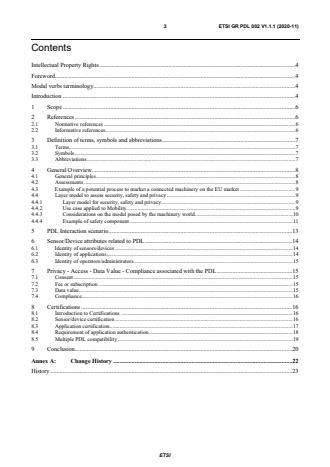
Contents
Intellectual Property Rights . 4
Foreword . 4
Modal verbs terminology . 4
Introduction . 4
1 Scope . 6
2 References . 6
2.1 Normative references . 6
2.2 Informative references . 6
3 Definition of terms, symbols and abbreviations . 7
3.1 Terms . 7
3.2 Symbols . 7
3.3 Abbreviations . 7
4 General Overview. 8
4.1 General principles. 8
4.2 Assessments . 8
4.3 Example of a potential process to market a connected machinery on the EU market . 9
4.4 Layer model to assess security, safety and privacy . 9
4.4.1 Layer model for security, safety and privacy . 9
4.4.2 Use case applied to Mobility. 9
4.4.3 Considerations on the model posed by the machinery world . 10
4.4.4 Example of safety component . 11
5 PDL Interaction scenario . 13
6 Sensor/Device attributes related to PDL . 14
6.1 Identity of sensors/devices . 14
6.2 Identity of applications . 14
6.3 Identity of operators/administrators. 15
7 Privacy - Access - Data Value - Compliance associated with the PDL . 15
7.1 Consent . 15
7.2 Fee or subscription . 15
7.3 Data value . 15
7.4 Compliance. 16
8 Certifications . 16
8.1 Introduction to Certifications . 16
8.2 Sensor/device certification . 16
8.3 Application certification . 17
8.4 Requirement of application authentication . 18
8.5 Multiple PDL compatibility . 19
9 Conclusion . 20
Annex A: Change History . 22
History . 23
ETSI
4 ETSI GR PDL 002 V1.1.1 (2020-11)
Intellectual Property Rights
Essential patents
IPRs essential or potentially essential to normative deliverables may have been declared to ETSI. The information
pertaining to these essential IPRs, if any, is publicly available for ETSI members and non-members, and can be found
in ETSI SR 000 314: "Intellectual Property Rights (IPRs); Essential, or potentially Essential, IPRs notified to ETSI in
respect of ETSI standards", which is available from the ETSI Secretariat. Latest updates are available on the ETSI Web
server (https://ipr.etsi.org/).
Pursuant to the ETSI IPR Policy, no investigation, including IPR searches, has been carried out by ETSI. No guarantee
can be given as to the existence of other IPRs not referenced in ETSI SR 000 314 (or the updates on the ETSI Web
server) which are, or may be, or may become, essential to the present document.
Trademarks
The present document may include trademarks and/or tradenames which are asserted and/or registered by their owners.
ETSI claims no ownership of these except for any which are indicated as being the property of ETSI, and conveys no
right to use or reproduce any trademark and/or tradename. Mention of those trademarks in the present document does
not constitute an endorsement by ETSI of products, services or organizations associated with those trademarks.
Foreword
This Group Report (GR) has been produced by ETSI Industry Specification Group (ISG) Permissioned Distributed
Ledger (PDL).
Modal verbs terminology
In the present document "should", "should not", "may", "need not", "will", "will not", "can" and "cannot" are to be
interpreted as described in clause 3.2 of the ETSI Drafting Rules (Verbal forms for the expression of provisions).
"must" and "must not" are NOT allowed in ETSI deliverables except when used in direct citation.
Introduction
Member States in Europe are responsible for ensuring the health and safety on their territory of workers, consumers,
animals and goods in relation to the risks arising out of the use of connected machinery.
The present document captures the impact that the use of connected machinery has upon health and safety compliance.
This will specify security requirements for electronic control units, telematics gateway, computational portion of smart
sensors, computational portion of smart actuators, and computational portion of other devices. The introduction of
connectivity will specify security for on-machine communications between electronic control units and sensors in order
to allow the remote reading of a machine's state: both static properties (e.g. manufacturer, equipment identifier, etc.)
fixed for the lifespan of the machine, and dynamic properties (e.g. operating temperature, last service date, firmware
version, etc.) of varying lifespans. Secure programming will request that a fault in the hardware or the software of the
control system does not lead to hazardous situations.
The example given in the present document took a tractor, but an autonomous robot in the field cannot be strictly a
tractor but rather an equipment capable to be any self-propelled autonomous machine. This could be any kind of
machinery falling under the Regulation No 167/2013 [i.5] and the Directive 2006/42/EC [i.1]. The use case to illustrate
the compliance case for the Mobile Machinery is any self-propelled machine (see note) covered by Machinery Directive
2006/42/EC [i.1] Article 1 Clause 1a and defined by Machinery Directive 2006/42/EC [i.1] Article 2 (a) Indent 1 to 4.
ETSI
5 ETSI GR PDL 002 V1.1.1 (2020-11)
NOTE: 'Self-propelled machine' means a mobile machine whose prime purpose is intended to perform work but
not to transport passengers or goods having at least two axles and wheels, or endless tracks, or a
combination of wheels and endless tracks, which, according to its design and the permanently mounted
devices, provides its own means of tractive movement.
The owner of a machine will be properly identified and verifiable, and data shared to and from the machine would
require verification to show it has not been corrupted or hacked in transit. Smart sensors and ECU will have
cryptographically strong evidence that the source of a message is a manufacturer approved node. Such verifications may
need to persist over time (for example, for an audit later), and to be shared across national boundaries in the case of
machine roaming. Hence, the present document also describes the use of PDL technologies to assert the health and
safety compliance of connected machines, and how to verify these assertions to meet applicable data-processing
requirements.
The process described in the present document has the purpose to manage the eco-system around a connected
machinery. This is one proposal for a revised content of the Directive 2006/42/EC [i.1], while the directive is under
assessment to evaluate if it fits for purposes. These technologies are available today, and manufacturers need to make
sure of the safety assessment proposed will provide new solutions complying to Essential Health Safety Requirements.
Performance levels for safety and security could be described into harmonised standards or Annexes of the Machinery
Directive. Finally, the General Product Safety Directive (GPSD) (2001/95/EC) [i.7] will complement sector specific
legislation
The example of a "single registry" is the way in which such requirements could be implemented for all interoperable
IoT devices being connected to any networked product on the market including tractors, self-propelled machinery and
earth moving equipment. A networked machinery can use the "single registry" based on a Permissioned Distributed
Ledger as a technology.
Ensuring the health and safety on their territory of workers, consumers, animals and goods in relation to the risks arising
out of the use of connected machinery deals with the horizontal legislation where several DGs are involved like
DG GROWTH and DG CNECT. In order to address all technology relevant sectors, the present document cross-cuts
several pieces of legislation, the GPSD [i.7], the LVD [i.9], the RED [i.10] and the EMC [i.11]. The pretention is not to
align all these legislations, but rather to establish some "bridges" between them.
ETSI
6 ETSI GR PDL 002 V1.1.1 (2020-11)
1 Scope
The present document will analyse the essential data processing prerequisites in terms of trust, security and effective
conformity assessment, and make recommendations on how PDL can be used by organizations, operations, deployment,
hardware, and software to be trusted.
The present document will reference use-cases work by other standards-developing organizations and material in the
public domain. The essential prerequisites for the PDL technology to ensure compliance to existing regulatory aspects
will also be analysed.
2 References
2.1 Normative references
Normative references are not applicable in the present document.
2.2 Informative references
References are either specific (identified by date of publication and/or edition number or version number) or
non-specific. For specific references, only the cited version applies. For non-specific references, the latest version of the
referenced document (including any amendments) applies.
NOTE: While any hyperlinks included in this clause were valid at the time of publication, ETSI cannot guarantee
their long term validity.
The following referenced documents are not necessary for the application of the present document but they assist the
user with regard to a particular subject area.
[i.1] Directive 2006/42/EC of the European Parliament and of the Council of 17 May 2006 on
machinery, and amending Directive 95/16/EC.
[i.2] IEC 62351-9: "Power systems management and associated information exchange - Data and
communications security - Part 9: Cyber security key management for power system equipment".
[i.3] Certificate Policy for Deployment and Operation of European Cooperative Intelligent Transport
Systems (C-ITS).
NOTE: Available at https://ec.europa.eu/transport/sites/transport/files/c-its_certificate_policy-v1.1.pdf.
[i.4] Regulation (EU) No 2016/679-GDPR of the European Parliament and of the Council of 27 April
2016 on the protection of natural persons with regard to the processing of personal data and on the
free movement of such data, and repealing Directive 95/46/EC (General Data Protection
Regulation).
[i.5] Regulation (EU) No 167/2013 of the European Parliament and of the Council of 5 February 2013
on the approval and market surveillance of agricultural and forestry vehicles.
[i.6] Council Directive 85/374/EEC of 25 July 1985 on the approximation of the laws, regulations and
administrative provisions of the Member States concerning liability for defective products
(Product Liability Directive).
[i.7] Directive 2001/95/EC of the European Parliament and of the Council of 3 December 2001 on
general product safety (General Product Safety Directive).
[i.8] Directive 2009/104/EC of the European Parliament and of the Council of 16 September 2009
concerning the minimum safety and health requirements for the use of work equipment by workers
at work (second individual Directive within the meaning of Article 16(1) of Directive
89/391/EEC).
ETSI
7 ETSI GR PDL 002 V1.1.1 (2020-11)
[i.9] Directive 2014/35/EU of the European Parliament and of the Council of 26 February 2014 on the
harmonisation of the laws of the Member States relating to the making available on the market of
electrical equipment designed for use within certain voltage limits (Low Voltage Directive).
[i.10] Directive 2014/53/EU of the European Parliament and of the Council of 16 April 2014 on the
harmonisation of the laws of the Member States relating to the making available on the market of
radio equipment and repealing Directive 1999/5/EC (Radio Equipment Directive).
[i.11] Directive 2014/30/EU of the European Parliament and of the Council of 26 February 2014 on the
harmonisation of the laws of the Member States relating to electromagnetic compatibility (EMC
Directive).
3 Definition of terms, symbols and abbreviations
3.1 Terms
Void.
3.2 Symbols
Void.
3.3 Abbreviations
For the purposes of the present document, the following abbreviations apply:
AEF Agricultural-industry Electronics Foundation
AI Artificial Intelligence
AN Access Network
CE Certified Equipment
CNECT Connect
DG Directorate General
EC European Commission
ECDH Elliptic Curve Diffie Hellman
ECU Electronic Control Unit
EMC Electro Magnetic Compatibility
GPSD General Product Safety Directive
ICT Information and Communication Technologies
IEC International Electrotechnical Commission
IoT Internet of Things
LAN Local Area Network
LVD Low Voltage Directive
OBD On Board Diagnostic
OEM Original Equipment Manufacturer
OMA Object Management Architecture
PC Personal Computer
PKI Public Key Infrastructure
RED Radio Equipment Directive
SCEP Service Creation Environment Point
SLA Service Level Agreement
TLS Transport Layer Security
VDMA Verband Deutscher Maschinen- und Anlagenbau
WAN Wide Area Network
ETSI
8 ETSI GR PDL 002 V1.1.1 (2020-11)
4 General Overview
4.1 General principles
The present document provides the data processing prerequisites relevant to trust, security, and safety set out in light of
the general principles listed as below.
By a way of certification and defined standard, manufacturers can make interoperable machineries, IoT devices between
each other.
The data processing will ensure that a risk assessment is carried out in order to determine the trust, security, and safety
prerequisites, which apply to the device equipped with sensors. The device will then be designed and calibrated taking
into account the results of the risk assessment.
By the iterative process of risk assessment and risk reduction referred to above, the device supplier would need to
consider:
1) determine the limits of the trusted environment, which include the intended use and any reasonably foreseeable
misuse thereof;
2) identify the risks that can be generated going through all the layers constituting the distributed ledger and the
associated unreliable situations;
3) estimate the lack of trust, considering the value that stakeholders can have in the data, that the end-user will
use through organizations, operations, hardware, and software;
4) evaluate the risks, with a view to determining whether risk reduction is required, in accordance with the
objective of the actuation of the device based on the data generated or received;
5) eliminate the risk of corruption or reduce the risks associated with a distributed database by application of
protective measures;
6) perform compliance testing, secure message categories, encrypted communication prerequisite principles, and
authentic conformance testing.
4.2 Assessments
The communication layer in PDL is supposed to give the unconditional trust in the safety, security. However, there is a
need to assess the safety and security to access sensor data in a way that is not dependent on a single third party. Access
to the communication is based on Internet Service Providers who act as a central hub for connected machineries. If
there is no communication possible, then the essential health and safety prerequisites have still to be insured.
In the case of lack of communication to the main ledger, a trusted communication between the two peers can be
established in such a way that it will be later possible to synchronize the full chain of events in the main ledger.
The local copy of the distributed ledger allows peer to peer connection allowing this decentralized communication in
the blockchain ecosystem as a backup in case of unconnected areas where the machinery is used. The PDL could be
used not only as a service but also as a decentralization of the services covering at the same time privacy, safety, and
security without central hub for the sensor management.
If the product meets the safety prerequisites and for example for the machinery directive, that affects the liability of the
manufacturers under the Product Liability Directive (85/374/EEC) [i.6], the General Product Safety Directive
(2001/95/EC) [i.7] and the Directive for the minimum safety and health requirements for the use of work equipment by
workers at work (2009/104/EC) [i.8], then the technical prerequisites described into the present document are important
to consider for the liability of the manufacturers. Indeed, improvements in the safety and health of workers at work are
important and the proper use of the equipment will be supported by the presumption of conformity, provided by the
unique registry. Additionally, transparent safety instructions should be provided to end users.
ETSI
9 ETSI GR PDL 002 V1.1.1 (2020-11)
The lack of safety will be due to the non-assessment of connected device to the connected machinery where essential
requirements are not met. The performances that this IoT device needs to fulfil will be described into the annex of the
standards listed for the safety of the machinery. ETSI standards would need however to be referenced under the
Machinery Regulation. An agreement between CEN (ISO TC23 under Vienna agreement) and ETSI will be required.
This has been the case recently for the subject linked to the wind turbines. This machinery involved CEN, CENELEC
and ETSI.
The Original Equipment Manufacturer runs the PDL in compliance with the harmonised standards applicable for the
certification of the IoT device or the connected Machinery.
4.3 Example of a potential process to market a connected
machinery on the EU market
Besides the existing European legislations as RED [i.10], LVD [i.9], EMC [i.11], etc. here are the steps toward placing
a connected machinery on the EU Market or putting a connected machinery into service in the EU would expect
implementing the following assessments (2006/42/EC [i.1]):
• STEP 1: Identify relevant Essential Health and Safety Requirements for the connected machinery.
• STEP 2: Apply technical standards to the connected machinery.
• STEP 3: Assemble the technical assessment/certification file.
• STEP 4: Certify conformance to the certification scheme.
• STEP 5: Create the EC Declaration of Conformity.
• STEP 6: Place the CE mark on the machinery.
Compliance to the standards means that the design meets or exceeds the requirements of all relevant and applicable
Essential Health and Safety Requirements.
4.4 Layer model to assess security, safety and privacy
4.4.1 Layer model for security, safety and privacy
The following model for the layers would allow the implementation of security, safety and privacy see Table 4.4.1-1.
Table 4.4.1-1: Layer model for security, safety and privacy
Application Layer
Machinery parameters
Management Layer
Data management
PDL Layer
Consensus management
Network Layer
LAN, WAN, Routers
IoT Layer
Security, safety at the sensor level
Physical Object
Analog data
This will provide immutably and securely data, which allows auditability, integrity, and transparency of the data and
parameters associated with the machinery.
4.4.2 Use case applied to Mobility
Machinery presenting hazards due to its connectivity should meet all the essential health and safety prerequisites.
ETSI
COMMUNICATIONLAYER
10 ETSI GR PDL 002 V1.1.1 (2020-11)
4.4.3 Considerations on the model posed by the machinery world
This clause is inspired from Ethical Guidelines for the Use of Automated Machinery in Agriculture/VDMA.
The purpose of these considerations is indicative and falls within the anticipated scope of the Machinery
Directive 2006/42/EC [i.1], which is under revision and is expected to be updated in the future and become a regulation.
It is without prejudice to the applicable laws by the EU, the Member States, and other countries.
a) 'Connected machinery presenting hazards due to its mobility' means:
- machinery which requires either remote control for the mobility while working, or continuous or semi-
continuous remote-control movement between
...
Questions, Comments and Discussion
Ask us and Technical Secretary will try to provide an answer. You can facilitate discussion about the standard in here.
Loading comments...