


ETSI GR ENI 051 V4.1.1 (2025-02)
Experiential Networked Intelligence (ENI); Study on AI Agents based Next-generation Network Slicing
Experiential Networked Intelligence (ENI); Study on AI Agents based Next-generation Network Slicing
DGR/ENI-0051v411_AI-Agent_NGCN
General Information
Standards Content (Sample)
GROUP REPORT
Experiential Networked Intelligence (ENI);
Study on AI Agents based Next-generation Network Slicing
Disclaimer
The present document has been produced and approved by the Experiential Networked Intelligence (ENI) ETSI Industry
Specification Group (ISG) and represents the views of those members who participated in this ISG.
It does not necessarily represent the views of the entire ETSI membership.
2 ETSI GR ENI 051 V4.1.1 (2025-02)
Reference
DGR/ENI-0051v411_AI-Agent_NGCN
Keywords
6G, GenAI, LLM, native AI
ETSI
650 Route des Lucioles
F-06921 Sophia Antipolis Cedex - FRANCE
Tel.: +33 4 92 94 42 00 Fax: +33 4 93 65 47 16
Siret N° 348 623 562 00017 - APE 7112B
Association à but non lucratif enregistrée à la
Sous-Préfecture de Grasse (06) N° w061004871
Important notice
The present document can be downloaded from the
ETSI Search & Browse Standards application.
The present document may be made available in electronic versions and/or in print. The content of any electronic and/or
print versions of the present document shall not be modified without the prior written authorization of ETSI. In case of any
existing or perceived difference in contents between such versions and/or in print, the prevailing version of an ETSI
deliverable is the one made publicly available in PDF format on ETSI deliver repository.
Users should be aware that the present document may be revised or have its status changed,
this information is available in the Milestones listing.
If you find errors in the present document, please send your comments to
the relevant service listed under Committee Support Staff.
If you find a security vulnerability in the present document, please report it through our
Coordinated Vulnerability Disclosure (CVD) program.
Notice of disclaimer & limitation of liability
The information provided in the present deliverable is directed solely to professionals who have the appropriate degree of
experience to understand and interpret its content in accordance with generally accepted engineering or
other professional standard and applicable regulations.
No recommendation as to products and services or vendors is made or should be implied.
No representation or warranty is made that this deliverable is technically accurate or sufficient or conforms to any law
and/or governmental rule and/or regulation and further, no representation or warranty is made of merchantability or fitness
for any particular purpose or against infringement of intellectual property rights.
In no event shall ETSI be held liable for loss of profits or any other incidental or consequential damages.
Any software contained in this deliverable is provided "AS IS" with no warranties, express or implied, including but not
limited to, the warranties of merchantability, fitness for a particular purpose and non-infringement of intellectual property
rights and ETSI shall not be held liable in any event for any damages whatsoever (including, without limitation, damages
for loss of profits, business interruption, loss of information, or any other pecuniary loss) arising out of or related to the use
of or inability to use the software.
Copyright Notification
No part may be reproduced or utilized in any form or by any means, electronic or mechanical, including photocopying and
microfilm except as authorized by written permission of ETSI.
The content of the PDF version shall not be modified without the written authorization of ETSI.
The copyright and the foregoing restriction extend to reproduction in all media.
© ETSI 2025.
All rights reserved.
ETSI
3 ETSI GR ENI 051 V4.1.1 (2025-02)
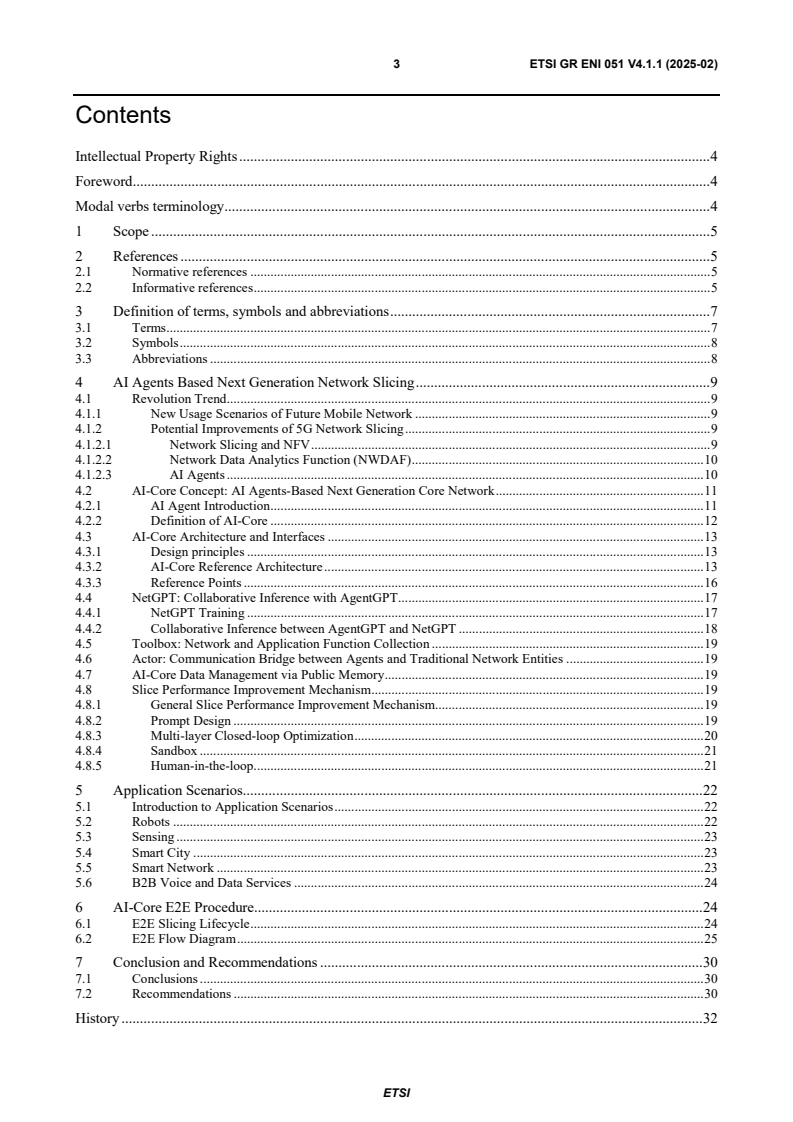
Contents
Intellectual Property Rights . 4
Foreword . 4
Modal verbs terminology . 4
1 Scope . 5
2 References . 5
2.1 Normative references . 5
2.2 Informative references . 5
3 Definition of terms, symbols and abbreviations . 7
3.1 Terms . 7
3.2 Symbols . 8
3.3 Abbreviations . 8
4 AI Agents Based Next Generation Network Slicing . 9
4.1 Revolution Trend . 9
4.1.1 New Usage Scenarios of Future Mobile Network . 9
4.1.2 Potential Improvements of 5G Network Slicing . 9
4.1.2.1 Network Slicing and NFV . 9
4.1.2.2 Network Data Analytics Function (NWDAF) . 10
4.1.2.3 AI Agents . 10
4.2 AI-Core Concept: AI Agents-Based Next Generation Core Network . 11
4.2.1 AI Agent Introduction . 11
4.2.2 Definition of AI-Core . 12
4.3 AI-Core Architecture and Interfaces . 13
4.3.1 Design principles . 13
4.3.2 AI-Core Reference Architecture . 13
4.3.3 Reference Points . 16
4.4 NetGPT: Collaborative Inference with AgentGPT . 17
4.4.1 NetGPT Training . 17
4.4.2 Collaborative Inference between AgentGPT and NetGPT . 18
4.5 Toolbox: Network and Application Function Collection . 19
4.6 Actor: Communication Bridge between Agents and Traditional Network Entities . 19
4.7 AI-Core Data Management via Public Memory . 19
4.8 Slice Performance Improvement Mechanism . 19
4.8.1 General Slice Performance Improvement Mechanism. 19
4.8.2 Prompt Design . 19
4.8.3 Multi-layer Closed-loop Optimization . 20
4.8.4 Sandbox . 21
4.8.5 Human-in-the-loop. 21
5 Application Scenarios. 22
5.1 Introduction to Application Scenarios . 22
5.2 Robots . 22
5.3 Sensing . 23
5.4 Smart City . 23
5.5 Smart Network . 23
5.6 B2B Voice and Data Services . 24
6 AI-Core E2E Procedure. 24
6.1 E2E Slicing Lifecycle . 24
6.2 E2E Flow Diagram . 25
7 Conclusion and Recommendations . 30
7.1 Conclusions . 30
7.2 Recommendations . 30
History . 32
ETSI
4 ETSI GR ENI 051 V4.1.1 (2025-02)
Intellectual Property Rights
Essential patents
IPRs essential or potentially essential to normative deliverables may have been declared to ETSI. The declarations
pertaining to these essential IPRs, if any, are publicly available for ETSI members and non-members, and can be
found in ETSI SR 000 314: "Intellectual Property Rights (IPRs); Essential, or potentially Essential, IPRs notified to
ETSI in respect of ETSI standards", which is available from the ETSI Secretariat. Latest updates are available on the
ETSI IPR online database.
Pursuant to the ETSI Directives including the ETSI IPR Policy, no investigation regarding the essentiality of IPRs,
including IPR searches, has been carried out by ETSI. No guarantee can be given as to the existence of other IPRs not
referenced in ETSI SR 000 314 (or the updates on the ETSI Web server) which are, or may be, or may become,
essential to the present document.
Trademarks
The present document may include trademarks and/or tradenames which are asserted and/or registered by their owners.
ETSI claims no ownership of these except for any which are indicated as being the property of ETSI, and conveys no
right to use or reproduce any trademark and/or tradename. Mention of those trademarks in the present document does
not constitute an endorsement by ETSI of products, services or organizations associated with those trademarks.
DECT™, PLUGTESTS™, UMTS™ and the ETSI logo are trademarks of ETSI registered for the benefit of its
Members. 3GPP™, LTE™ and 5G™ logo are trademarks of ETSI registered for the benefit of its Members and of the
3GPP Organizational Partners. oneM2M™ logo is a trademark of ETSI registered for the benefit of its Members and of ®
the oneM2M Partners. GSM and the GSM logo are trademarks registered and owned by the GSM Association.
Foreword
This Group Report (GR) has been produced by ETSI Industry Specification Group (ISG) Experiential Networked
Intelligence (ENI).
Modal verbs terminology
In the present document "should", "should not", "may", "need not", "will", "will not", "can" and "cannot" are to be
interpreted as described in clause 3.2 of the ETSI Drafting Rules (Verbal forms for the expression of provisions).
"must" and "must not" are NOT allowed in ETSI deliverables except when used in direct citation.
ETSI
5 ETSI GR ENI 051 V4.1.1 (2025-02)
1 Scope
The present document analyses and studies potential ENI activities on 6G native AI capabilities. ENI has a strong focus
on providing cognitive capabilities to improve the user experience of the operator. The present document covers the
areas and needs for new technical projects using 6G native AI capabilities. This covers: definition of the use cases and
requirements of Core Network (CN) Large Language Models (LLMs), definition of the CN-Agent to facilitate
interaction between the CN and the CN LLMs, identification of the key functional modules and interfaces of the
CN-Agent, and the key technologies required. Network slicing is used throughout the present document to explain the
operation of this system. However, this is not a limiting case, and the system described in the present document is
intended to serve a large variety of CN use cases.
2 References
2.1 Normative references
Normative references are not applicable in the present document.
2.2 Informative references
References are either specific (identified by date of publication and/or edition number or version number) or
non-specific. For specific references, only the cited version applies. For non-specific references, the latest version of the
referenced document (including any amendments) applies.
NOTE: While any hyperlinks included in this clause were valid at the time of publication, ETSI cannot guarantee
their long-term validity.
The following referenced documents are not necessary for the application of the present document but they assist the
user with regard to a particular subject area.
[i.1] 3GPP TS 23.288 (V16.0.0): "Architecture enhancements for 5G System (5GS) to support network
data analytics services (Release 16)".
[i.2] 3GPP TS 23.288 (V17.0.0): "Architecture enhancements for 5G System (5GS) to support network
data analytics services (Release 17)".
[i.3] 3GPP TS 23.501 (V19.0.0): "System architecture for the 5G System (5GS); Stage 2 (Release 19)".
[i.4] ETSI GR ENI 010 (V1.2.1): "Experiential Networked Intelligence (ENI); Evaluation of categories
for AI application to Networks".
[i.5] ETSI GS ENI 030 (V4.1.1): "Experiential Networked Intelligence (ENI); Transformer
Architecture for Policy Translation".
[i.6] J. Ruan, Y. Chen, B. Zhang, et al.: "Tptu: Task planning and tool usage of large language
model-based ai agents", NeurIPS 2023 Foundation Models for Decision Making Workshop, 2023.
[i.7] H. Pan, Z. Zhai, H. Yuan, Y. Lv, et al.: "KwaiAgents: Generalized Information-seeking Agent
System with Large Language Models", arXiv:2312.04889, 2024.
[i.8] C. Li, H. Chen, M. Yan, W. Shen, et al.: "ModelScope-Agent: Building Your Customizable Agent
System with Open-source Large Language Models", arXiv:2309.00986, 2023.
[i.9] Chen W, Su Y, Zuo J, et al.: "Agentverse: Facilitating multi-agent collaboration and exploring
emergent behaviors". The Twelfth International Conference on Learning Representations. 2023.
[i.10] Yilun Du, Shuang Li, Antonio Torralba, Joshua B. Tenenbaum, and Igor Mordatch: "Improving
factuality and reasoning in language models through multiagent debate", CoRR, abs/2305.14325,
2023. doi:10.48550/arXiv.2305.14325.
ETSI
6 ETSI GR ENI 051 V4.1.1 (2025-02)
[i.11] Zhenhailong Wang, Shaoguang Mao, Wenshan Wu, Tao Ge, Furu Wei, and Heng Ji: "Unleashing
cognitive synergy in large language models: A task-solving agent through multi-persona
selfcollaboration", CoRR, abs/2307.05300, 2023b. doi: 10.48550/arXiv.2307.05300.
[i.12] Hongxin Zhang, Weihua Du, Jiaming Shan, Qinhong Zhou, Yilun Du, Joshua B. Tenenbaum,
Tianmin Shu, and Chuang Gan: "Building cooperative embodied agents modularly with large
language models", CoRR, abs/2307.02485, 2023a. doi: 10.48550/arXiv.2307.02485.
[i.13] Chi-Min Chan, Weize Chen, Yusheng Su, Jianxuan Yu, Wei Xue, Shanghang Zhang, Jie Fu, and
Zhiyuan Liu: "Chateval: Towards better llm-based evaluators through multi-agent debate", 2023.
[i.14] J. Wei, X. Wang, D. Schuurmans et al.: "Chain-of-Thought Prompting Elicits Reasoning in Large
Language Models", Advances in Neural Information Processing Systems (NeurIPS), 2022.
[i.15] X. Wang, J. Wei, D. Schuurmans et al.: "Self-consistency improves chain of thought reasoning in
language models", arXiv: 22203.11171, 2022.
[i.16] J. Long: "Large Language Model Guided Tree-of-Thought", arXiv: 2305.08291, 2023.
[i.17] M. Besta, N. Blach, A. Kubicek, et al.: "Graph of Thoughts: Solving Elaborate Problems with
Large Language Models", Proceedings of the AAAI Conference on Artificial Intelligence, 2024.
[i.18] S. Yao, J. Zhao, D. Yu, et al.: "ReAct: Synergizing Reasoning and Acting in Language Models",
International Conference on Learning Representations (ICLR), 2023.
[i.19] Yan M., Agarwal S., Venkataraman S.: "Decoding speculative decoding". arXiv preprint
arXiv:2402.01528, 2024.
[i.20] Leviathan Y., Kalman M., Matias Y.: "Fast inference from transformers via speculative decoding".
International Conference on Machine Learning. PMLR, 2023: 19274-19286.
[i.21] Chen C., Borgeaud S., Irving G., et al.: "Accelerating large language model decoding with
speculative sampling". arXiv preprint arXiv:2302.01318, 2023.
[i.22] Liu X., Hu L., Bailis P., et al.: "Online speculative decoding". arXiv preprint arXiv:2310.07177,
2023.
[i.23] X. Liu, H. Yu, H. Zhang, et al.: "AgentBench: Evaluating LLMs as Agents", arXiv:2308.03688,
2023.
[i.24] J. Lin, H. Zhao, A. Zhang et al.: "AgentSims: An Open-Source Sandbox for Large Language
Model Evaluation", arXiv: 2308.04026, 2023.
[i.25] J. Lu, T. Holleis, Y. Zhang et al.: "ToolSandbox: A Stateful, Conversational, Interactive
Evaluation Benchmark for LLM Tool Use Capabilities", arXiv: arXiv:2408.04682, 2024.
[i.26] Y. Shavit, S. Agarwal, M. Brundage et al.: "Practices for governing agentic AI systems", Research
Paper, OpenAI, December, 2023.
[i.27] NGMN Alliance (V1.0): "6G Use Cases and Analysis".
[i.28] Recommendation ITU-R M.2160-0 (V1.0): "Framework and overall objectives of the future
development of IMT for 2030 and beyond".
[i.29] ETSI GS ENI 005 (V3.1.1): "Experiential Networked Intelligence (ENI); System Architecture".
[i.30] Q. Wu, G. Bansal, J. Zhang, et al.: "AutoGen: Enabling Next-Gen LLM Applications via
Multi-Agent Conversation", Conference on Language Modeling (COLM), August 2024.
[i.31] O. Ayan, S. Hirche, A. Ephremides, W. Kellerer: "Optimal Finite Horizon Scheduling of Wireless
Networked Control Systems", IEEE/ACM Transactions on Networking, April 2024.
[i.32] ETSI GR ENI 016 (V2.1.1): "Experiential Networked Intelligence (ENI); Functional Concepts for
Modular System Operation".
ETSI
7 ETSI GR ENI 051 V4.1.1 (2025-02)
[i.33] ETSI GR ENI 007 (V1.1.1): "Experiential Networked Intelligence (ENI); ENI Definition of
Categories for AI Application to Networks".
[i.34] D. López-Pérez, A. De Domenico, N. Piovesan and M. Debbah: "Data-Driven Energy Efficiency
Modeling in Large-Scale Networks: An Expert Knowledge and ML-Based Approach", in IEEE
Transactions on Machine Learning in Communications and Networking, 2024.
[i.35] ETSI TR 121 905: "Digital cellular telecommunications system (Phase 2+); Universal Mobile
Telecommunications System (UMTS); LTE; Vocabulary for 3GPP Specifications; (3GPP
TR 21.905)".
[i.36] ETSI GS ENI 019 (V3.1.1): "Experiential Networked Intelligence (ENI); Representing, Inferring,
and Proving Knowledge in ENI", 2023.
[i.37] EI AI Act Regulation (EU) 2024/1689 of the European Parliament and of the European Council.
3 Definition of terms, symbols and abbreviations
3.1 Terms
For the purposes of the present document, the following terms apply:
AgentGPT: domain-specific model trained with domain-specific knowledge that matches the responsibilities of the AI
Agent that it resides in
AI Agent: autonomous system that can interact with its environment to collect data, learn from the past experiences and
subsequently use these to improve its decision-making capability in order to perform specific tasks
NOTE: As defined in clause 4.2.1 also [i.6], [i.7] and [i.8].
E2E Slice: logical network that provides a combination of specific network and network capabilities and network
characteristics, supporting various service properties for network slice customers
E2E Slice Instance: set of Network Function, and Application Function instances and the required computing and
communication resources that form a deployed E2E Slice
functional block: abstraction that defines a black box structural representation of the capabilities and functionality of a
component or module, and its relationships with other functional blocks
intent policy: type of policy that uses statements from a restricted natural language (e.g. an external DSL) to express
the goals of the policy, but does not specify how to accomplish those goals
NOTE: As defined in [i.29].
Large Language Model Meta AI (LLaMA): family of autoregressive large language models released by Meta AI
starting in February 2023
NOTE: As defined in https://github.com/meta-llama/llama.
NetGPT: domain-specific model trained with data from core network domain
policy: set of rules that is used to manage and control the changing and/or maintaining of the state of one or more
managed objects
NOTE: As defined in [i.29].
Quality of Experience (QoE): performance of users when using what is presented by a communication service or
application user interface
Quality of Service (QoS): collective effect of service performances which determine the degree of satisfaction of a user
of a service
NOTE: As defined in ETSI TR 121 905 [i.35].
ETSI
8 ETSI GR ENI 051 V4.1.1 (2025-02)
Service Level Agreement (SLA): contract between a service provider and a customer that defines the service(s) to be
provided and the level of performance to be expected
3.2 Symbols
Void.
3.3 Abbreviations
For the purposes of the present document, the following abbreviations apply:
2B To Business
2C To Consumer
2H To Home
ABI Agent Based Interface
ADRF Analytics Data Repository Function
AF Application Function
AgentGPT Agent Generative Pre-trained Transformer
AI Artificial Intelligence
AI4N AI for Network
AMF Access and Mobility Management Function
API Application Programming Interface
AR Augmented Reality
BS Base Station
CN Core Network
CoT Chain of Thought
CoT-SC Self Consistency with Chain of Thought
DB Data Base
E2E End-to-End
eMBB enhanced Mobile BroadBand
FB Functional Block
GoT Graph of Thought
GPT Generative Pre-trained Transformer
HTTP HyperText Transfer Protocol
ICT Information and Communication Technology
IMU Inertial Measurement Unit
IP Internet Protocol
ISAC Integrated Sensing And Communication
IT Information Technology
KNN K-Nearest Neighbour
KPI Key Performance Indicator
KQI Key Quality Indicator
LLM Large Language Model
ML Machine Learning
mMTC massive Machine Type Communications
MSISDN Mobile Subscriber Integrated Services Digital Network Number
N4AI Network for AI
NetGPT Network Generative Pre-trained Transformer
NF Network Function
NFV Network Function Virtualisation
NGMN Next Generation Mobile Networks
NLP Natural Language Processing
NRF Network Repository Function
NWDAF NetWork Data Analytics Function
O&M Operation and Maintenance
OAM Operations, Administration and Maintenance
PCF Policy Control Function
QoE Quality of Experience
QoS Quality of Service
RAG Retrieval Augmented Generation
ETSI
9 ETSI GR ENI 051 V4.1.1 (2025-02)
RAN Radio Access Network
RCS Rich Communication Service
ReAct Response and Action
RPC Remote Procedure Call
SBA Service Based Architecture
SLA Service Level Agreement
SMF Session Management Function
SMS Short Message Service
TCP Transmission Control Protocol
ToT Tree of Thought
UE User Equipment
URLLC Ultra-Reliable Low-Latency Communication
XR Extended Reality
4 AI Agents Based Next Generation Network Slicing
4.1 Revolution Trend
4.1.1 New Usage Scenarios of Future Mobile Network
The NGMN white paper [i.27] describes new use cases and services that need to be supported by 6G networks. These
new use cases and services require 6G networks to provide ultra-high performance while connecting humans, machines
and various other entities. This calls for a variety of new capabilities and requires 6G networks to have enhanced
on-demand customization capabilities to adapt to the wide range of applications autonomously. These include
immersive multimedia and multi-sensory interactions, highly intelligent industrial applications, integration of physical
and virtual worlds through digital twins, and ubiquitous intelligence and computing.
As described by Recommendation ITU-R M.2160-0 [i.28], it is expected to integrate sensing and intelligence
capabilities, empowered with AI and machine learning, into networks to keep up with the steady progress and fast
spread of such. As stated in the same document, [i.28] could serve as an AI-enabling infrastructure that can provide
services for intelligent applications listed above. Therefore, 6G networks are expected to face great challenges in the
future as intelligent applications will take numerous forms and may be triggered based on user intents.
4.1.2 Potential Improvements of 5G Network Slicing
4.1.2.1 Network Slicing and NFV
5G systems are known for their heterogeneity in service categories, such as enhanced Mobile Broadband (eMBB),
Ultra-Reliable Low-Latency Communication (URLLC), and massive Machine Type Communications (mMTC). Such a
broad diversity in service requirements calls for customized solutions by 5G network operators for their customers,
which has primarily been addressed via the network slicing concept. Together with Network Function
Virtualisation (NFV), network slicing allows the 5G mobile network operators to build dedicated, virtualized and
logical networks on a common physical infrastructure to meet the diverse communication requirements of their
customers.
In contrast to 5G networks, which are designed for providing only communication service to their users, 6G networks
are envisioned to extend their services beyond connectivity. More specifically, 6G networks are expected to add AI,
compute, and sensing to their services on top of connectivity, introducing new types of resources, new functionalities,
and design considerations. This calls for a more flexible, autonomous, and generalizable network slicing framework for
the configuration, deployment and management of such slices of new type. Since this comes with increased complexity
rendering the conventional methods insufficient, the deep integration of AI/ML technology into the operation of 6G
networks offers a promising solution.
ETSI
10 ETSI GR ENI 051 V4.1.1 (2025-02)
4.1.2.2 Network Data Analytics Function (NWDAF)
3GPP has introduced a new logical function entity in 5G, known as the Network Data Analytics Function (NWDAF),
into the 5G network architecture [i.1]. The NWDAF can interact with other core network functions such as the
Application Function (AF), Policy Control Function (PCF), Access and Mobility Management Function (AMF), and
Session Management Function (SMF) to provide network data analytics services, network intelligence, and automation
capabilities for 5G networks.
These services include receiving network data analytics requests from other core Network Functions (NFs), collecting
and analysing data using AI algorithms to generate network analytics results, and delivering these results to the
requesting (i.e. consumer) NF.
Each NF leverages the network analytics provided by the NWDAF to monitor the operational status of the 5G network
and the User Equipment (UE), enabling closed-loop network control and optimization of communication services. For
example, the NWDAF supports analytics and event exposure services related to network service experience, network
performance, slice load, NF load, UE mobility, communication events, abnormal events, Quality of Service (QoS)
sustainability, user data congestion, and more.
3GPP has enhanced the 5G network data analytics framework over multiple releases by introducing the logical
functional division of the NWDAF and defining their interactions. It also facilitates cooperation between multiple
NWDAF instances for model training and sharing, while incorporating new functional entities to improve data
collection efficiency and enhance real-time performance [i.2]. Several enhancements have been proposed for the
NWDAF, particularly to support flexible deployments (centralized, distributed, etc.), enable collaboration between
different NWDAF instances, decompose NWDAF functionality, and achieve tighter integration with the UE
(e.g. analysis of session load and signal quality). Additionally, the NWDAF has been further integrated with edge
devices to optimize network operations.
Despite all of the aforementioned features, the existing capabilities of NWDAF primarily focus on analytics centred
around better connectivity. As it has been explained in clause 4.1.2.1 on 6G network slicing, the considerations beyond
connectivity service (e.g. compute, sensing, AI) are not fully incorporated into the NWDAF's services. For instance,
idle resources within the network infrastructure will be important and needed to embrace the native integration of AI
and deployment of foundation models towards an autonomous and optimized network operation. Therefore, 6G systems
are to make better use of under-utilized resources in the network, contributing to sustainability targets and further
expand the profitability of mobile networks for mobile network operators.
4.1.2.3 AI Agents
The current 5G core network deeply integrates telecommunications networks and IT technologies by cloud deployment,
making the network architecture more agile and open. Therefore, network operations have become more efficient and
automated. Looking towards the 6G era, in which the diversity of network services, resources and capabilities are
envisioned to increase, standardized pre-defined processes based on scenario-specific expert knowledge are no longer
sufficient for the efficient operation of the network. This is due to the significant increase in service and resource
diversity required along with increased flexibility that is needed in service requirements and network functionalities.
Together, these bring unprecedented challenges to the network architecture design, especially for the core networks.
Agentic AI is a new class of artificial intelligence systems designed to act with autonomy, making decisions and taking
actions without having been specified in advance or without direct human intervention. These systems are capable of
processing vast amounts of data, reasoning (the process of reaching understanding), and adapting to real-time changes
in their environment. Hence, AI agents-based systems are a promising solution towards a more generalized and
extensible design of 6G systems. Key features of Agentic AI systems include autonomy in decision-making,
goal-oriented behaviour, continuous learning and adaptation, proactive planning and execution, as well as advanced
reasoning capabilities According to [i.26], systems integrating AI agents "are characterized by the ability to take actions
which consistently contribute towards achieving goals over an extended period of time, without their behaviour having
been entirely specified in advance". This will render the mobile network a fully autonomous networks, as specified in
[i.33], where any scenario (although unknown from before) can be supported due to excellent adaptability and
knowledge reasoning capabilities of Agentic AI.
Developing and deploying an AI Agent is not a straightforward process, as such systems are complex by design
requiring various functional modules and mechanisms to realize its value to the full extent. These typically include
different decision-making models, vector databases, tool libraries, self-reflection and self-evolving mechanisms. As of
today, AI agents have not been considered and deployed in 3GPP systems.
ETSI
11 ETSI GR ENI 051 V4.1.1 (2025-02)
An example use case to be studied for the adoption of AI agents in 6G core is the optimal and flexible design of
End-to-End (E2E) network slices. In such a setting, AI agents that are empowered with Large Language
Models (LLMs) can be employed as an interface to support human operators in defining high-level intents and setting
up optimization tasks as external input.
4.2 AI-Core Concept: AI Agents-Based Next Generation Core
Network
4.2.1 AI Agent Introduction
AI Agent is defined as an autonomous system that can interact with its environment to collect data, learn from the past
experiences and subsequently use these to improve its decision making capability in order to perform specific tasks
[i.6], [i.7] and [i.8].
Figure 4.2.1-1: General Framework of an AI Agent
Figure 4.2.1-1 depicts a general framework of an AI Agent that is made up of the following logical components:
• Communication: The interface of an AI Agent to communicate with external components, supporting various
networking standards and protocols, such as TCP/IP and HTTP. The communication block handles the
input/output operations.
• Memory: Collects and stores data for the AI Agent for task continuity and self-improvement, including
short-term memory (external input, historical inference result, temporary information, etc.) and long-term
memory (knowledge, profile, etc.). The memory sub-component plays a crucial role in accelerating and agent's
learning and adaptation capabilities, thereby, contributing to reducing computational complexity and energy
efficiency. Such mechanisms have been used in the existing literature, not necessarily to design and implement
AI agents, for storing/caching reoccurring problems that have already been solved in the past, also referred as
dynamic programming [i.31], [i.34].
• AgentGPT: a domain-specific model with less parameters compared to the 'NetGPT' (see clause 4.4). The
AgentGPT is trained with domain-specific knowledge (e.g. on a certain problem class) that matches the
responsibilities of the AI Agent that it resides in.
NOTE 1: The name "AgentGPT" does not reflect any publicly available library or service and has solely been
selected to emphasize the fact that it resides inside an AI Agent, also to easily distinguish from NetGPT.
NOTE 2: The name "AgentGPT" is also chosen because an AI Agent system does not mandate either the use of an
LLM or an Agent to be embodied in an LLM. Since AgentGPT does both, the name has increased
significance.
• Tools: Functions and APIs that are used to obtain additional information or abilities that are not present in the
AgentGPT. These can include search engines, databases, calculators, calendars, maps, APIs for specific
services, and other task-specific utilities.
• Control: The executive function of the agent that orchestrates the interaction between all components. It
manages the flow of information, decides when to use AgentGPT or specific tools, coordinates memory access
and updates, and implements the agent's overall strategy and decision-making.
ETSI
12 ETSI GR ENI 051 V4.1.1 (2025-02)
Some open source frameworks (such as LangChain, LangGraph, CrewAI, Semantic Kernel, AutoGen) can be referred
for the implementation of agent and multi-agent-based architectures [i.3], [i.8] and [i.24]. They can:
• Accelerate development by providing in built components;
• Provide consistent approaches to common challenges;
• Support scalability by moving from simple agent to complex multi agent environments;
• Access to a broad range of developers and researchers;
• Foster innovation by handling the foundational aspect of AI agent development frameworks.
All the frameworks above do have particular advantages and disadvantages. Significantly, none of them yet support
specific use cases of telecommunication networks. Nevertheless, these frameworks can be seen as a baseline for
agent-based core network developments.
4.2.2 Definition of AI-Core
The proposed AI-Core for the next generation core network consists of multiple agents. As shown in Figure 4.2.2-2, it
utilizes multiple AI Agents to manage and control the network and to flexibly process the data for new services based
on the dynamic requirements of various applications. Here, the multi-agent core assembles the network functions,
application functions and resources autonomously to create the E2E slice. Moreover, it monitors its status in real time,
dynamically updates the functions or resources of the slice when the network environment or demand changes, and
deletes the slice instance when the service is terminated.
Figure 4.2.2-2: High-level conceptual illustration of the AI-Core
Different than the current 5G network slicing, the proposed network slicing using the AI-Core concept expands the
scope of a network slice. Flexibly customizes network functions and application functions, as well as computing- and
communication resources in an E2E fashion. This can provide abundant and diverse services for the slice tenant. In
addition, the E2E customization greatly decreases the cost and complexity of slice customization for tenants. Moreover,
AI-Core does not require customers (e.g. tenant/application/UE) to provide a large set of technical parameters that are
used for the slice configuration. Instead, a high-level intent that is to be interpreted by the intelligent multi-agent
component in the architecture above can be provided in natural language. This way, it is expected to have significant
added value for the to consumer (2C)/to business (2B)/to home (2H) scenarios. The management and control by the
multi-agent core for slice design and execution is highly intelligent and autonomous, which in return facilitates the
cross-domain slice collaboration. Thus, the proposed AI-Core can also contribute to improving the network
autonomicity, characterized by different levels as presented in [i.4].
It is important to mention that although the present document focuses on redefining the concept of E2E network slicing,
the multi-agent-based AI core can be extended to various other use cases and decision-making problems in the network
including but not limited to improved coverage, network capacity and energy efficiency, targeting the sustainability and
ubiquitous connectivity considerations recommended in [i.28].
ETSI
13 ETSI GR ENI 051 V4.1.1 (2025-02)
4.3 AI-Core Architecture and Interfaces
4.3.1 Design principles
The following design principles are used for the agent-based core architecture:
• Multiple AI Agents constitute the foundation of the core network architecture and are not employed as a
simple "integration" or an "add-on" feature.
• The agent-based architecture serves as a reference for different network services (e.g. connectivity, compute
for industrial applications or AI applications) with very limited to no modifications needed to tailor it for each
individual service. Thus, it is inherently general and extensible.
• Agent reference architecture will support multiple technical and business domains.
• AI-Core complies with all relevant compliance, security and privacy obligations, including explainability as
required by the AI Act [i.37].
• The resulting next generation core network offers significant benefits towards AI for Network (AI4N) and
rd
Network for AI (N4AI) services (internal and 3 party).
4.3.2 AI-Core Reference Architecture
Figure 4.3.2-1: Reference Architecture of AI-Core
Figure 4.3.2-1 shows the AI-Core reference architecture. It consists of multiple agents that are optimised for different
tasks, multiple common components that are shared by these Agents and an Agent Based Interface (ABI). The
functionalities of Agents, common components and the ABI are explained in the following, while other reference
interfaces are further described in clause 4.3.3.
• Planning Agent receives an input policy, information, and knowledge (e.g. a customized slice request from an
application, which can be an imperative, declarative, or intent-based policy [i.29], [i.36]). It is the
responsibility of the planning agent to convert or decompose the input (if necessary) into multiple executable
policies or requests. Specifically, the planning agent outputs the decomposed task list, where each item
includes a task description, task dependency indicators, QoS requirement, and more. This can be mapped to a
combination of multiple functional blocks of an ENI system (e.g. a combination of the data ingestion and data
normalization FBs, as specified in [i.29]).
ETSI
14 ETSI GR ENI 051 V4.1.1 (2025-02)
• Assemble Agent is responsible for receiving the output (i.e. a decomposed task list) from the planning agent,
identifying the appropriate network- and/or application functions for each sub-task, and subsequently
determining the function topology based on the task dependency relationship. The assemble agent outputs two
parts of function list, where the first part is a function list for configuring UE(s) and/or RAN(s), and the second
part is intended for the deployment of other services beyond connectivity (e.g. computing services) that are
necessary for the requested E2E slice. Each entry in the list includes a function ID, function input(s), a type
(configure or deploy), and a function dependency indicator.
NOTE 1: The output of the assemble agent does not specify the exact configuration of the access and core
network configuration of the E2E slice components, which is the task of the connection and
execution agents.
• Connection Agent is responsible for receiving the output part 1 (i.e. the function list) from Assemble Agent,
determining which UE(s) and/or RAN(s) to be utilized in the requested E2E slice and determining their
configuration parameters and resources, managing and c
...
Questions, Comments and Discussion
Ask us and Technical Secretary will try to provide an answer. You can facilitate discussion about the standard in here.
Loading comments...